

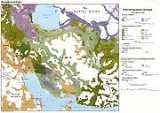
Demographics of Iran

Encyclopedia
.jpg)
Iran
Iran , officially the Islamic Republic of Iran , is a country in Southern and Western Asia. The name "Iran" has been in use natively since the Sassanian era and came into use internationally in 1935, before which the country was known to the Western world as Persia...
's population increased dramatically during the later half of the 20th century, reaching about 75 million by 2011. In recent years, however, Iran
Iran
Iran , officially the Islamic Republic of Iran , is a country in Southern and Western Asia. The name "Iran" has been in use natively since the Sassanian era and came into use internationally in 1935, before which the country was known to the Western world as Persia...
's birth rate
Birth rate
Crude birth rate is the nativity or childbirths per 1,000 people per year . Another word used interchangeably with "birth rate" is "natality". When the crude birth rate is subtracted from the crude death rate, it reveals the rate of natural increase...
has dropped significantly. Studies project that Iran's rate of population growth will continue to slow until it stabilizes above 100 million by 2050. In 2008, the number of households stood at 15.3 million (4.8 person/household).
According to the OECD/World Bank statistics population growth
Population growth
Population growth is the change in a population over time, and can be quantified as the change in the number of individuals of any species in a population using "per unit time" for measurement....
in Iran from 1990 to 2008 was 17.6 million and 32 %.
| Population in Iran | |
|---|---|
| Year | Million |
| 1971 | 29.35 |
| 1980 | 39.12 |
| 1990 | 54.40 |
| 2000 | 63.94 |
| 2004 | 68.07 |
| 2008 | 71.96 |
| Source: OECD/World Bank | |
The literacy rate was 80% in 2007.
Languages and ethnic groups
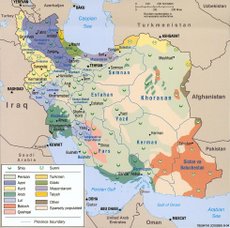
Iran
Iran , officially the Islamic Republic of Iran , is a country in Southern and Western Asia. The name "Iran" has been in use natively since the Sassanian era and came into use internationally in 1935, before which the country was known to the Western world as Persia...
's population is fluent in modern Persian
Persian language
Persian is an Iranian language within the Indo-Iranian branch of the Indo-European languages. It is primarily spoken in Iran, Afghanistan, Tajikistan and countries which historically came under Persian influence...
, approximately 75-80% of Iran's peoples exclusively speak Iranian languages
Iranian languages
The Iranian languages form a subfamily of the Indo-Iranian languages which in turn is a subgroup of Indo-European language family. They have been and are spoken by Iranian peoples....
(the most common language known as Persian
Persian language
Persian is an Iranian language within the Indo-Iranian branch of the Indo-European languages. It is primarily spoken in Iran, Afghanistan, Tajikistan and countries which historically came under Persian influence...
- or "Farsi" as it is known in the Persian language). The major groups in this category include Persians
Persian people
The Persian people are part of the Iranian peoples who speak the modern Persian language and closely akin Iranian dialects and languages. The origin of the ethnic Iranian/Persian peoples are traced to the Ancient Iranian peoples, who were part of the ancient Indo-Iranians and themselves part of...
, Kurd
Kürd
Kürd or Kyurd or Kyurt may refer to:*Kürd Eldarbəyli, Azerbaijan*Kürd Mahrızlı, Azerbaijan*Kürd, Goychay, Azerbaijan*Kürd, Jalilabad, Azerbaijan*Kürd, Qabala, Azerbaijan*Qurdbayram, Azerbaijan...
s, Gilakis, Mazandarani
Mazandarani
Mazandarani may refer to :* Mazandarani people, Mazandaranis, Tabarian people* Mazandarani language, A language spoken mainly in South Caspian region* Morteza Sadouqi Mazandarani, Iranian grand ayatollah...
s, Lurs
Lurs
Lurs are an Iranic people living mainly in south-western Iran. Their population is estimated at above two million. They occupy Lorestan, Bakhtiari, and Kuh-Gilu-Boir Ahmed. "....
, and Baluchi
Baloch people
The Baloch or Baluch are an ethnic group that belong to the larger Iranian peoples. Baluch people mainly inhabit the Balochistan region and Sistan and Baluchestan Province in the southeast corner of the Iranian plateau in Western Asia....
s. Turkic
Turkic languages
The Turkic languages constitute a language family of at least thirty five languages, spoken by Turkic peoples across a vast area from Eastern Europe and the Mediterranean to Siberia and Western China, and are considered to be part of the proposed Altaic language family.Turkic languages are spoken...
speakers, such as the Azeri
Azerbaijani people
The Azerbaijanis are a Turkic-speaking people living mainly in northwestern Iran and the Republic of Azerbaijan, as well as in the neighbourhood states, Georgia, Russia and formerly Armenia. Commonly referred to as Azeris or Azerbaijani Turks , they also live in a wider area from the Caucasus to...
, Turkmen
Turkmen people
The Turkmen are a Turkic people located primarily in the Central Asian states of Turkmenistan, Afghanistan, and northeastern Iran. They speak the Turkmen language, which is classified as a part of the Western Oghuz branch of the Turkic languages family together with Turkish, Azerbaijani, Qashqai,...
, and the Qashqai
Qashqai
Qashqai are the largest group of nomadic pastoralists people of Azeri descent who mainly live in the provinces of Fars, Khuzestan and southern Isfahan on the territory of modern Iran, especially around the city of Shiraz in Fars. They speak the Qashqai language which is a member of the Turkic...
peoples, comprise a substantial minority. The remainder are primarily Semitic
Semitic
In linguistics and ethnology, Semitic was first used to refer to a language family of largely Middle Eastern origin, now called the Semitic languages...
s such as Arabs and Assyrians
Assyrian people
The Assyrian people are a distinct ethnic group whose origins lie in ancient Mesopotamia...
or other Indo-Europeans such as Armenians. There are also small communities of Brahui
Brahui people
The Brahui or Brohi are ethnic Baloch group of about 2.2 million people with the majority found in Kalat, Baluchistan, Pakistan, but they are also found in smaller numbers in neighboring Afghanistan and Iran. The Brahuis are almost entirely Sunni Muslims.-Origins:The ethnonym "Brahui" is a very...
in southeastern Iran. The Georgian language
Georgian language
Georgian is the native language of the Georgians and the official language of Georgia, a country in the Caucasus.Georgian is the primary language of about 4 million people in Georgia itself, and of another 500,000 abroad...
is spoken only by those Iranian Georgians that live in Fereydan
Fereydan
- Georgians in Fereydan :The Fereydan Georgians are an ethnographic group of the Georgian people who mostly live in the city of Fereydoon Shahr and in the Fereydan region of Iran.- Origins :...
and Fereydunshahr. All other communities of Iranian Georgians in Iran have already lost their language.
CIA World Factbook, which is based on (2008) statics gives us the following numbers: Persian
Persian language
Persian is an Iranian language within the Indo-Iranian branch of the Indo-European languages. It is primarily spoken in Iran, Afghanistan, Tajikistan and countries which historically came under Persian influence...
, Luri, Gilaki and Mazandarani
Mazandarani
Mazandarani may refer to :* Mazandarani people, Mazandaranis, Tabarian people* Mazandarani language, A language spoken mainly in South Caspian region* Morteza Sadouqi Mazandarani, Iranian grand ayatollah...
66%, Azeri and other Turkic languages
Turkic languages
The Turkic languages constitute a language family of at least thirty five languages, spoken by Turkic peoples across a vast area from Eastern Europe and the Mediterranean to Siberia and Western China, and are considered to be part of the proposed Altaic language family.Turkic languages are spoken...
18%, Kurdish
Kurdish
Kurdish may refer to:*The Kurdish people*The Kurdish language*The Kurdish alphabet*Kurdistan, the land of the Kurdish people which includes:*Iranian Kurdistan*Iraqi Kurdistan*Turkish Kurdistan*Syrian Kurdistan*History of the Kurdish people...
10%, Arabs 2%, Baloch
Baloch people
The Baloch or Baluch are an ethnic group that belong to the larger Iranian peoples. Baluch people mainly inhabit the Balochistan region and Sistan and Baluchestan Province in the southeast corner of the Iranian plateau in Western Asia....
2%, other 2%.
Another source, Library of Congress
Library of Congress
The Library of Congress is the research library of the United States Congress, de facto national library of the United States, and the oldest federal cultural institution in the United States. Located in three buildings in Washington, D.C., it is the largest library in the world by shelf space and...
like the Encyclopedia of Islam (Leiden) states Iran's ethnic group as following: Persians
Persian people
The Persian people are part of the Iranian peoples who speak the modern Persian language and closely akin Iranian dialects and languages. The origin of the ethnic Iranian/Persian peoples are traced to the Ancient Iranian peoples, who were part of the ancient Indo-Iranians and themselves part of...
65%, Azeris 16%, Kurds 7%, Lurs
Lurs
Lurs are an Iranic people living mainly in south-western Iran. Their population is estimated at above two million. They occupy Lorestan, Bakhtiari, and Kuh-Gilu-Boir Ahmed. "....
6%, Arabs 2%, Baloch
Baloch people
The Baloch or Baluch are an ethnic group that belong to the larger Iranian peoples. Baluch people mainly inhabit the Balochistan region and Sistan and Baluchestan Province in the southeast corner of the Iranian plateau in Western Asia....
2%, Turkmens 1%, Turkic tribal groups (e.g. Qashqai
Qashqai
Qashqai are the largest group of nomadic pastoralists people of Azeri descent who mainly live in the provinces of Fars, Khuzestan and southern Isfahan on the territory of modern Iran, especially around the city of Shiraz in Fars. They speak the Qashqai language which is a member of the Turkic...
) 1%, and non-Persian, non-Turkic groups (e.g. Armenians
Armenians
Armenian people or Armenians are a nation and ethnic group native to the Armenian Highland.The largest concentration is in Armenia having a nearly-homogeneous population with 97.9% or 3,145,354 being ethnic Armenian....
, Assyrians
Assyrian people
The Assyrian people are a distinct ethnic group whose origins lie in ancient Mesopotamia...
, and Georgians
Georgians
The Georgians are an ethnic group that have originated in Georgia, where they constitute a majority of the population. Large Georgian communities are also present throughout Russia, European Union, United States, and South America....
) less than 1%. For sources prior to 2000, see Languages and ethnicities in Iran.
Urban Population
In addition to its international migration pattern, Iran also exhibits one of the steepest urban growth rates in the world according to the UN humanitarian information unit. According to 2005 population estimates, approximately 67 percent of Iran's population lives in urban areas, up from 27 percent in 1950. The following is a list of the six most populous cities in the country.| Rank | City (Province) | 2007 population |
|---|---|---|
| 1. | Tehran Tehran Tehran , sometimes spelled Teheran, is the capital of Iran and Tehran Province. With an estimated population of 8,429,807; it is also Iran's largest urban area and city, one of the largest cities in Western Asia, and is the world's 19th largest city.In the 20th century, Tehran was subject to... (Tehran Province Tehran Province Tehran Province is one of the 31 provinces of Iran. It covers on area of 18,909 square kilometers and is located to the north of the central plateau of Iran.... ) |
12,765,238 (conurbation and commuter towns included) (8,088,287 in the city itself) |
| 2. | Mashad (Razavi Khorasan) | 2,868,350 (this does include suburban population) (2,410,800 in the city itself) |
| 3. | Isfahan Isfahan (city) Isfahan , historically also rendered in English as Ispahan, Sepahan or Hispahan, is the capital of Isfahan Province in Iran, located about 340 km south of Tehran. It has a population of 1,583,609, Iran's third largest city after Tehran and Mashhad... (Isfahan Province) |
3,430,353 (including its metropolitan area and the population living within the Isfahan conurbation) (1,602,110 in the city itself) |
| 4. | Tabriz Tabriz Tabriz is the fourth largest city and one of the historical capitals of Iran and the capital of East Azerbaijan Province. Situated at an altitude of 1,350 meters at the junction of the Quri River and Aji River, it was the second largest city in Iran until the late 1960s, one of its former... (East Azarbaijan) |
1,597,319 (city proper and main suburbs) (1,378,935 in the city itself) |
| 5. | Karaj Karaj Karaj is a city in and the capital of Karaj County, Alborz Province, Iran. At the 2006 census, its population was 1,377,450, in 385,955 families, , making it the fifth-largest city in Iran after Tehran, Mashhad, Isfahan and Tabriz.) It is situated west of Tehran, at the foothills of the Alborz... (Tehran Province Tehran Province Tehran Province is one of the 31 provinces of Iran. It covers on area of 18,909 square kilometers and is located to the north of the central plateau of Iran.... ) |
1,377,450 |
| 6. | Shiraz Shiraz, Iran Shiraz is the sixth most populous city in Iran and is the capital of Fars Province, the city's 2009 population was 1,455,073. Shiraz is located in the southwest of Iran on the Roodkhaneye Khoshk seasonal river... (Fars Province) |
1,204,882 |
Religious affiliations
Zoroastrians in Iran
Zoroastrians in Iran are the oldest religious community of the nation, with a long history continuing up to the present day.Prior to the Islamization of Iran, Zoroastrianism was the primary religion of the Iranian peoples...
, Jews
Persian Jews
Persian Jews , are Jews historically associated with Iran, traditionally known as Persia in Western sources.Judaism is one of the oldest religions practiced in Iran. The Book of Esther contains some references to the experiences of Jews in Persia...
, Bahá'ís
Bahá'í Faith
The Bahá'í Faith is a monotheistic religion founded by Bahá'u'lláh in 19th-century Persia, emphasizing the spiritual unity of all humankind. There are an estimated five to six million Bahá'ís around the world in more than 200 countries and territories....
, Mandeans, Christian
Christian
A Christian is a person who adheres to Christianity, an Abrahamic, monotheistic religion based on the life and teachings of Jesus of Nazareth as recorded in the Canonical gospels and the letters of the New Testament...
s and Yarsan. The Bahá'í Faith
Bahá'í Faith
The Bahá'í Faith is a monotheistic religion founded by Bahá'u'lláh in 19th-century Persia, emphasizing the spiritual unity of all humankind. There are an estimated five to six million Bahá'ís around the world in more than 200 countries and territories....
, Iran's largest religious minority with a population around 300 000, is not officially recognized, and has been persecuted during its existence in Iran. Since the 1979 revolution the persecution of Bahá'ís
Persecution of Bahá'ís
The persecution of Bahá'ís is the religious persecution of Bahá'ís in various countries, especially in Iran, where the Bahá'í Faith originated and the location of one of the largest Bahá'í populations in the world...
has increased with executions, the denial of civil rights and liberties, and the denial of access to higher education and employment.
Non-Muslim minorities have been shrinking in the past few decades as they have been emigrating and leaving Iran. About 11,000 to 40,000 Jews
Jews
The Jews , also known as the Jewish people, are a nation and ethnoreligious group originating in the Israelites or Hebrews of the Ancient Near East. The Jewish ethnicity, nationality, and religion are strongly interrelated, as Judaism is the traditional faith of the Jewish nation...
remain in Iran today, still being the largest Jewish community in the Middle East outside Israel, but it stood at about 100,000 before the Islamic Revolution. Zoroastrian, and Christian communities are seeing similar contraction. Today, there are about 8,000 Assyria
Assyria
Assyria was a Semitic Akkadian kingdom, extant as a nation state from the mid–23rd century BC to 608 BC centred on the Upper Tigris river, in northern Mesopotamia , that came to rule regional empires a number of times through history. It was named for its original capital, the ancient city of Assur...
n Christians in Iran, who belong to the Chaldean Catholic Church
Chaldean Catholic Church
The Chaldean Catholic Church , is an Eastern Syriac particular church of the Catholic Church, maintaining full communion with the Bishop of Rome and the rest of the Catholic Church...
.
Women
Iranian women have played an important role throughout history. ScheherazadeScheherazade
Scheherazade , sometimes Scheherazadea, Persian transliteration Shahrazad or Shahrzād is a legendary Persian queen and the storyteller of One Thousand and One Nights.-Narration :...
, though fictional, is an important figure of female wit and intelligence, while the beauty of Mumtaz Mahal
Mumtaz Mahal
Mumtaz Mahal born as Arjumand Banu Begum was a Mughal Empress and chief consort of emperor Shah Jahan...
inspired the building of the Taj Mahal
Taj Mahal
The Taj Mahal is a white Marble mausoleum located in Agra, India. It was built by Mughal emperor Shah Jahan in memory of his third wife, Mumtaz Mahal...
itself.
Former Vice President Masoumeh Ebtekar
Masoumeh Ebtekar
Masoumeh Ebtekar is an Iranian scientist, journalist and politician. She is currently the director of Peace and Environment Center in Tehran.Ebtekar first achieved fame as the spokeswoman of the students who had occupied the US Embassy in 1979...
, noted for her eloquence in dealing with western media, set a new standard for aspiring Iranian female politicians while serving under President Khatami. Outstanding Iranian female academics, such as Laleh Bakhtiar have forever left a mark in the fields they contribute to.
Iranian citizens abroad
The term "Iranian citizens abroad" or "Iranian/Persian diasporaDiaspora
A diaspora is "the movement, migration, or scattering of people away from an established or ancestral homeland" or "people dispersed by whatever cause to more than one location", or "people settled far from their ancestral homelands".The word has come to refer to historical mass-dispersions of...
" refers to the Iranian people born in Iran
Iran
Iran , officially the Islamic Republic of Iran , is a country in Southern and Western Asia. The name "Iran" has been in use natively since the Sassanian era and came into use internationally in 1935, before which the country was known to the Western world as Persia...
and their children but living outside of Iran. Migrant Iranian workers abroad remitted less than two billion dollars home in 2006.
As of 2010, there are about five million Iranians living abroad, mostly in the United States
United States
The United States of America is a federal constitutional republic comprising fifty states and a federal district...
, Canada
Canada
Canada is a North American country consisting of ten provinces and three territories. Located in the northern part of the continent, it extends from the Atlantic Ocean in the east to the Pacific Ocean in the west, and northward into the Arctic Ocean...
, Europe
Europe
Europe is, by convention, one of the world's seven continents. Comprising the westernmost peninsula of Eurasia, Europe is generally 'divided' from Asia to its east by the watershed divides of the Ural and Caucasus Mountains, the Ural River, the Caspian and Black Seas, and the waterways connecting...
, Persian Gulf States
Persian Gulf States
Persian Gulf States can refer to:* Countries in the Middle East bordering the Persian Gulf and sometimes known as the Gulf States: Bahrain, Iran, Iraq, Kuwait, Oman, Qatar, Saudi Arabia, and the United Arab Emirates....
, Turkey
Turkey
Turkey , known officially as the Republic of Turkey , is a Eurasian country located in Western Asia and in East Thrace in Southeastern Europe...
, Australia
Australia
Australia , officially the Commonwealth of Australia, is a country in the Southern Hemisphere comprising the mainland of the Australian continent, the island of Tasmania, and numerous smaller islands in the Indian and Pacific Oceans. It is the world's sixth-largest country by total area...
and the broader Middle East
Middle East
The Middle East is a region that encompasses Western Asia and Northern Africa. It is often used as a synonym for Near East, in opposition to Far East...
. In particular, the Los Angeles
Los Ángeles
Los Ángeles is the capital of the province of Biobío, in the commune of the same name, in Region VIII , in the center-south of Chile. It is located between the Laja and Biobío rivers. The population is 123,445 inhabitants...
area is estimated to be host to approximately 720,000 Iranians, earning the Westwood
Westwood, Los Angeles, California
Westwood is a neighborhood on the Westside of Los Angeles, California, United States. It is the home of the University of California, Los Angeles .-History:...
area of LA the nickname Tehrangeles
Tehrangeles
Tehrangeles is a portmanteau deriving from the combination of Tehran, the capital of Iran, and Los Angeles. It is used when referring to the large number of former Iranian nationals and their descendants residing in the Los Angeles metropolitan area; it is the largest such population outside of...
. Other metropolises that have large Iranian populations include Dubai
Dubai
Dubai is a city and emirate in the United Arab Emirates . The emirate is located south of the Persian Gulf on the Arabian Peninsula and has the largest population with the second-largest land territory by area of all the emirates, after Abu Dhabi...
with 300,000 Iranians, Vancouver
Vancouver
Vancouver is a coastal seaport city on the mainland of British Columbia, Canada. It is the hub of Greater Vancouver, which, with over 2.3 million residents, is the third most populous metropolitan area in the country,...
, London
London
London is the capital city of :England and the :United Kingdom, the largest metropolitan area in the United Kingdom, and the largest urban zone in the European Union by most measures. Located on the River Thames, London has been a major settlement for two millennia, its history going back to its...
, Toronto
Toronto
Toronto is the provincial capital of Ontario and the largest city in Canada. It is located in Southern Ontario on the northwestern shore of Lake Ontario. A relatively modern city, Toronto's history dates back to the late-18th century, when its land was first purchased by the British monarchy from...
, San Francisco Bay Area
San Francisco Bay Area
The San Francisco Bay Area, commonly known as the Bay Area, is a populated region that surrounds the San Francisco and San Pablo estuaries in Northern California. The region encompasses metropolitan areas of San Francisco, Oakland, and San Jose, along with smaller urban and rural areas...
, Washington D.C., Stockholm
Stockholm
Stockholm is the capital and the largest city of Sweden and constitutes the most populated urban area in Scandinavia. Stockholm is the most populous city in Sweden, with a population of 851,155 in the municipality , 1.37 million in the urban area , and around 2.1 million in the metropolitan area...
, Berlin
Berlin
Berlin is the capital city of Germany and is one of the 16 states of Germany. With a population of 3.45 million people, Berlin is Germany's largest city. It is the second most populous city proper and the seventh most populous urban area in the European Union...
, Hamburg
Hamburg
-History:The first historic name for the city was, according to Claudius Ptolemy's reports, Treva.But the city takes its modern name, Hamburg, from the first permanent building on the site, a castle whose construction was ordered by the Emperor Charlemagne in AD 808...
and Frankfurt
Frankfurt
Frankfurt am Main , commonly known simply as Frankfurt, is the largest city in the German state of Hesse and the fifth-largest city in Germany, with a 2010 population of 688,249. The urban area had an estimated population of 2,300,000 in 2010...
. Their combined net worth
Net worth
In business, net worth is the total assets minus total outside liabilities of an individual or a company. For a company, this is called shareholders' preference and may be referred to as book value. Net worth is stated as at a particular year in time...
is estimated to be $1.3 trillion.
Note that this differs from the other Iranian peoples
Iranian peoples
The Iranian peoples are an Indo-European ethnic-linguistic group, consisting of the speakers of Iranian languages, a major branch of the Indo-European language family, as such forming a branch of Indo-European-speaking peoples...
living in other areas of Greater Iran
Greater Iran
Greater Iran refers to the regions that have significant Iranian cultural influence. It roughly corresponds to the territory on the Iranian plateau and its bordering plains, stretching from Iraq, the Caucasus, and Turkey in the west to the Indus River in the east...
, who are of related ethnolinguistical family, speaking languages belonging to the Iranian languages
Iranian languages
The Iranian languages form a subfamily of the Indo-Iranian languages which in turn is a subgroup of Indo-European language family. They have been and are spoken by Iranian peoples....
which is a branch of Indo-European languages
Indo-European languages
The Indo-European languages are a family of several hundred related languages and dialects, including most major current languages of Europe, the Iranian plateau, and South Asia and also historically predominant in Anatolia...
.
CIA World Factbook demographic statistics
The following demographic statistics are from the CIA World Factbook, unless otherwise indicated.Religions
- Shi'a Muslim 89%, Sunni Muslim 9%, Zoroastrian, JewishJudaismJudaism ) is the "religion, philosophy, and way of life" of the Jewish people...
, ChristianChristianA Christian is a person who adheres to Christianity, an Abrahamic, monotheistic religion based on the life and teachings of Jesus of Nazareth as recorded in the Canonical gospels and the letters of the New Testament...
, and Bahá'íBahá'í FaithThe Bahá'í Faith is a monotheistic religion founded by Bahá'u'lláh in 19th-century Persia, emphasizing the spiritual unity of all humankind. There are an estimated five to six million Bahá'ís around the world in more than 200 countries and territories....
(largest non-Muslim minority) 2%.
Literacy
- definition: age 15 and over can read and write
- total population: above 80%
- male: 86%
- female: 75.0% (2003 est.)
Age structure
- 0-14 years: 21.7% (male 7,394,841/female 7,022,076)
- 15-64 years: 72.9% (male 24,501,544/female 23,914,172)
- 65 years and over: 5.4% (male 1,725,828/female 1,870,823) (2010 est.)
Sex ratio
- at birth: 1.05 male(s)/female
- under 15 years: 1.05 male(s)/female
- 15-64 years: 1.02 male(s)/female
- 65 years and over: 0.93 male(s)/female
- total population: 1.03 male(s)/female (2008 est.)
Life expectancy at birth
- total population: 70.86 years
- male: 69.65 years
- female: 72.72 years (2008 est.)
Refugee population
- Iran hosts one of the largest refugeeRefugeeA refugee is a person who outside her country of origin or habitual residence because she has suffered persecution on account of race, religion, nationality, political opinion, or because she is a member of a persecuted 'social group'. Such a person may be referred to as an 'asylum seeker' until...
population in the world, with more than one million refugees, mostly from Afghanistan (80%) and IraqIraqIraq ; officially the Republic of Iraq is a country in Western Asia spanning most of the northwestern end of the Zagros mountain range, the eastern part of the Syrian Desert and the northern part of the Arabian Desert....
(10%). Since 2006, Iranian officials have been working with the UNHCR and Afghan officials for their repatriationRepatriationRepatriation is the process of returning a person back to one's place of origin or citizenship. This includes the process of returning refugees or soldiers to their place of origin following a war...
.
- Between 1979 and 1997, UNHCR spent more than US$1 billion on Afghan refugees in Pakistan but only $150 million on those in Iran. In 1999, the Iranian government estimated the cost of maintaining its refugee population at US$10 million per day, compared with the US$18 million UNHCR allocated for all of its operations in Iran in 1999.
People of Iranian Ancestry
It is estimated that some 200 million people around the world have PersianPersian people
The Persian people are part of the Iranian peoples who speak the modern Persian language and closely akin Iranian dialects and languages. The origin of the ethnic Iranian/Persian peoples are traced to the Ancient Iranian peoples, who were part of the ancient Indo-Iranians and themselves part of...
ancestry.
Parsis
The Parsis are the close-knit ZoroastrianZoroastrianism
Zoroastrianism is a religion and philosophy based on the teachings of prophet Zoroaster and was formerly among the world's largest religions. It was probably founded some time before the 6th century BCE in Greater Iran.In Zoroastrianism, the Creator Ahura Mazda is all good, and no evil...
community based primarily in India
India
India , officially the Republic of India , is a country in South Asia. It is the seventh-largest country by geographical area, the second-most populous country with over 1.2 billion people, and the most populous democracy in the world...
but also found in Pakistan
Pakistan
Pakistan , officially the Islamic Republic of Pakistan is a sovereign state in South Asia. It has a coastline along the Arabian Sea and the Gulf of Oman in the south and is bordered by Afghanistan and Iran in the west, India in the east and China in the far northeast. In the north, Tajikistan...
. Parsis are descended from Persian Zoroastrians who emigrated to the Indian subcontinent over 1,000 years ago.
Indian census data (2001) records 69,601 Parsis in India, with a concentration in and around the city of Mumbai
Mumbai
Mumbai , formerly known as Bombay in English, is the capital of the Indian state of Maharashtra. It is the most populous city in India, and the fourth most populous city in the world, with a total metropolitan area population of approximately 20.5 million...
(previously known as Bombay). There are approximately 8,000 Parsis elsewhere on the subcontinent, with an estimated 2,500 Parsis in the city of Karachi
Karachi
Karachi is the largest city, main seaport and the main financial centre of Pakistan, as well as the capital of the province of Sindh. The city has an estimated population of 13 to 15 million, while the total metropolitan area has a population of over 18 million...
and approximately 50 Parsi families in Sri Lanka. The number of Parsis worldwide is estimated to be fewer than 100,000 (Eliade, 1991:254).
Iranis
In Pakistan and India, the term "Irani" has come to denote IranianIranian peoples
The Iranian peoples are an Indo-European ethnic-linguistic group, consisting of the speakers of Iranian languages, a major branch of the Indo-European language family, as such forming a branch of Indo-European-speaking peoples...
Zoroastrian
Zoroastrianism
Zoroastrianism is a religion and philosophy based on the teachings of prophet Zoroaster and was formerly among the world's largest religions. It was probably founded some time before the 6th century BCE in Greater Iran.In Zoroastrianism, the Creator Ahura Mazda is all good, and no evil...
s who have immigrated to Pakistan and India within the last two centuries, as opposed to most Parsis who arrived in India over 1000 years ago. Many of them immigrated during the Qajar era, when persecution of Iranian Zoroastrians was rampant. They are culturally and linguistically closer to the Zoroastrians of Iran
Zoroastrians in Iran
Zoroastrians in Iran are the oldest religious community of the nation, with a long history continuing up to the present day.Prior to the Islamization of Iran, Zoroastrianism was the primary religion of the Iranian peoples...
. Unlike the Parsis, they speak a Dari
Dari (Zoroastrian)
Dari is a Northwestern Iranian ethnolect spoken as a first language by an estimated 8,000 to 15,000 Zoroastrians in and around the cities of Yazd and Kerman in central Iran...
dialect, the language spoken by the Iranian Zoroastrians in Yazd
Yazd
Yazd is the capital of Yazd Province in Iran, and a centre of Zoroastrian culture. The city is located some 175 miles southeast of Isfahan. At the 2006 census, the population was 423,006, in 114,716 families....
and Kerman
Kerman
- Geological characteristics :For the Iranian paleontologists, Kerman has always been considered a fossil paradise. Finding new dinosaur footprints in 2005 has now revealed new hopes for paleontologists to better understand the history of this area.- Economy :...
. Their last names often resemble modern Iranian names, however Irani is a common surname among them. In India they are mostly located in modern-day Mumbai
Mumbai
Mumbai , formerly known as Bombay in English, is the capital of the Indian state of Maharashtra. It is the most populous city in India, and the fourth most populous city in the world, with a total metropolitan area population of approximately 20.5 million...
while in Pakistan they are mostly located in modern-day Karachi
Karachi
Karachi is the largest city, main seaport and the main financial centre of Pakistan, as well as the capital of the province of Sindh. The city has an estimated population of 13 to 15 million, while the total metropolitan area has a population of over 18 million...
. In both Pakistan and India, they are famous for their restaurants and tea-houses. http://www.iranian.ws/cgi-bin/iran_news/exec/view.cgi/5/12134 Some, such as Ardeshir Irani
Ardeshir Irani
Khan Bahadur Ardeshir Irani ; popularly known as Ardeshir Irani, was a writer, director, producer, actor, film distributor, film showman and cinematographer in the silent and sound eras of early Indian cinema. He was renowned for making films in Hindi, Telugu, English, German, Indonesian, Persian,...
, have also become very famous in cinema.
Ajam (Bahrain)
The "Ajam" are an ethnic community of Bahrain, of Iranian origin. They have traditionally been merchants living in specific quarters of ManamaManama
Manama is the capital and largest city of Bahrain, with an approximate population of 155,000 people.Long an important trading center in the Persian Gulf, Manama is home to a very diverse population...
and Muharraq
Muharraq
Muharraq , is Bahrain's third largest city, and served as its capital until 1923. The city is located on Muharraq Island and has long been a centre of religiosity...
. The Iranians who adhere to both the Sunni or Shiite sect of Islam are Ajam
Ajam
Ajam is a word used in Persian and Arabic literature but with different concepts. Ajam in Arabic has two primary meanings: "non-Arab" and "Persian".literally it has other meaning "one who is illiterate in language", "silent", or "mute", and refers to non-Arabs in general, or people of Southern...
, and they are different from the Huwala
Huwala
The Huwala meaning "Those that have changed or moved". Originally the "Huwala" word is Arabic, but since Persian does not contain the pharyngeal fricative "ح" present in Arabic, it pronounced it Huwala...
, who have Arab origins.
In addition to this, many names of ancient villages in Bahrain are of Persian origin. It is believed that these names were given during the Safavid rule of Bahrain (1501–1722). i.e. Karbabad, Salmabad, Karzakan, Duraz, Barbar, which indicates that the history of Ajams is much older.
Huwala
Huwala are the descendants of Sunni Arabs, and the word is also mistakenly used to call Sunni Persians, who migrated from IranIran
Iran , officially the Islamic Republic of Iran , is a country in Southern and Western Asia. The name "Iran" has been in use natively since the Sassanian era and came into use internationally in 1935, before which the country was known to the Western world as Persia...
to the Arabian peninsula. The Huwala are much different from the Sunni Persians who also have migrated from their original homeland "Iran" to Arabia, except that the two ethnicities share the same Islamic Sunni faith.
Y-chromosome DNA
Y-Chromosome DNA Y-DNA represents the male lineage, The Iranian Y-chromosome pool may be summarized as follows where haplogroups R1Haplogroup R1 (Y-DNA)
In human genetics, Haplogroup R1 is a Y-chromosome DNA haplogroup, a subgroup of haplogroup R, associated with the M173 mutation. It is dominated in practice by two very common Eurasian clades, R1a and R1b, which together are found all over Eurasia except in Southeast Asia and East Asia...
, J2
Haplogroup J2 (Y-DNA)
In human genetics, Haplogroup J2 is a Y-chromosome haplogroup which is a subdivision of haplogroup J. It is further divided into two complementary clades, J2a-M410 and J2b-M12.-Origins:...
, G
Haplogroup G (Y-DNA)
In human genetics, Haplogroup G is a Y-chromosome haplogroup. It is a branch of Haplogroup F . Haplogroup G has an overall low frequency in most populations but is widely distributed within many ethnic groups of the Old World in Europe, northern and western Asia, northern Africa, the Middle East,...
, I
Haplogroup I (Y-DNA)
In human genetics, Haplogroup I is a Y-chromosome DNA haplogroup, a subgroup of haplogroup IJ, itself a derivative of Haplogroup IJK....
, and NOP*
Haplogroup NOP (Y-DNA)
In more detail, the following phylogenetic tree of haplogroup subclades is based on the YCC 2008 tree and subsequent published research.*K **M ***M****M1 ****M1*****M1a *****M1a*...
comprise generally more than 90% of the total chromosomes.
- R1Haplogroup R1 (Y-DNA)In human genetics, Haplogroup R1 is a Y-chromosome DNA haplogroup, a subgroup of haplogroup R, associated with the M173 mutation. It is dominated in practice by two very common Eurasian clades, R1a and R1b, which together are found all over Eurasia except in Southeast Asia and East Asia...
~ 30% - J2Haplogroup J2 (Y-DNA)In human genetics, Haplogroup J2 is a Y-chromosome haplogroup which is a subdivision of haplogroup J. It is further divided into two complementary clades, J2a-M410 and J2b-M12.-Origins:...
~ 30% - IHaplogroup I (Y-DNA)In human genetics, Haplogroup I is a Y-chromosome DNA haplogroup, a subgroup of haplogroup IJ, itself a derivative of Haplogroup IJK....
~ 10% - GHaplogroup G (Y-DNA)In human genetics, Haplogroup G is a Y-chromosome haplogroup. It is a branch of Haplogroup F . Haplogroup G has an overall low frequency in most populations but is widely distributed within many ethnic groups of the Old World in Europe, northern and western Asia, northern Africa, the Middle East,...
~ 10% - NOP*Haplogroup NOP (Y-DNA)In more detail, the following phylogenetic tree of haplogroup subclades is based on the YCC 2008 tree and subsequent published research.*K **M ***M****M1 ****M1*****M1a *****M1a*...
~ 10% - Other Haplogroups 10%
Mitochondrial DNA
Mitochondrial DNA mtDNA represents the female lineage The Iranian mitochondrial DNA shows more European lineages than the Y-DNA lineages.- Haplogroup UKHaplogroup UK (mtDNA)In human genetics, Haplogroup UK was a human mitochondrial DNA haplogroup. It is now known that K is a subclade of U8.-See also:*Genealogical DNA test*Genetic Genealogy*Human mitochondrial genetics*Population Genetics-External links:...
~ 30% - Haplogroup JTHaplogroup JT (mtDNA)In human mitochondrial genetics, Haplogroup JT is a human mitochondrial DNA haplogroup.-Origin:A descendant of the macro-haplogroup R, Haplogroup JT is the ancestral haplogroup to mitochondrial haplogroups J and T.-Tree:...
~ 25% - Other Haplogroups ~20%
See also
- Social class in IranSocial class in IranClasses in Iran have been divided up into upper class, propertied middle class, salaried middle class, working class, independent farmers, rural wage earners...
- List of Iranians
- Demography of Central AsiaDemography of Central AsiaCentral Asia is a diverse land with many ethnic groups, languages, religions and tribes. This article discusses all of the above, and includes the demographics of the nations of the five former Soviet republics: Kazakhstan, Kyrgyzstan, Turkmenistan, Tajikistan, and Uzbekistan, a group which has a...
- Iranian names
- Education in IranEducation in IranEducation in Iran is highly centralized and is divided to K-12 education and higher education. K-12 education is supervised by the Ministry of Education and higher education is under supervision of Ministry of Science and Technology....
- Health care in IranHealth care in IranHealth care in Iran and medical sector's market value was almost US $24 billion in 2002 and was forecast to rise to US $31 billion by 2007. With a population of almost 70 million, Iran is one of the most populous countries in the Middle East...
- Family planning in IranFamily planning in IranThe Republic of Iran has a comprehensive and effective program of family planning. While Iran's population grew at a rate of more than 3%/year between 1956 and 1986, the growth rate began to decline in the late 1980s and early 1990s after the government initiated a major population control program...
- Family planning in Iran
- Iran's brain drainIran's brain drainAccording to the International Monetary Fund, the Islamic Republic of Iran ranks first in "brain drain" among 61 "developing" and "less developed" countries it measured....
- Culture of IranCulture of IranTo best understand Iran, Afghanistan, their related societies and their people, one must first attempt to acquire an understanding of their culture. It is in the study of this area where the Persian identity optimally expresses itself...
- Economy of IranEconomy of IranThe economy of Iran is the eighteenth largest in the world by purchasing power parity and according to Iranian officials' claims is going to become the 12th largest by 2015. The economy of Iran is a mixed and transition economy with a large public sector and some 50% of the economy centrally planned...
- Human rights in the Islamic Republic of IranHuman rights in the Islamic Republic of IranThe state of human rights in Iran has been criticized both by Iranians and international human right activists, writers, and NGOs. The United Nations General Assembly and the Human Rights Commission have condemned prior and ongoing abuses in Iran in published critiques and several resolutions.The...
External links
- Human geography of Iran, Encyclopædia Iranica (mostly about the historical human geography of Iran)
- Statistical Center of Iran
- BBC - Iran in Maps - Map of Iranian ethnic groups & population density
- Iran: A Vast Diaspora Abroad and Millions of Refugees at Home - Migration Information Institute (2006)
- Iran's Challenges from Within: An Overview of Ethno-Sectarian Unrest by Chris Zambelis
- Human Development Report - 2009 (UNDP Iran's entry)