

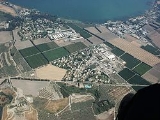
Degania

Encyclopedia
Degania Alef is a kibbutz
in northern Israel
. It falls under the jurisdiction of the Emek HaYarden Regional Council
.
established by Jewish Zionist pioneers in Palestine
, then under Ottoman
rule. It was founded in 1909 by the World Zionist Organization
. In 1910 the land was handed over to a commune of workers which established itself on it in 1911. Degania Bet
was established to the south in 1920. On May 20, 1948 during the Battles of the Kinarot Valley
, Degania Alef and Degania Bet
repelled a Syrian attack.
Degania Alef has been home to many prominent Israelis and members of the Yishuv
. The poet Rachel
, the "prophet of labor" A.D. Gordon
, and Joseph Trumpeldor
all worked at Degania Alef, whilst many early members of Degania Alef left to found other kibbutzim. Gideon Baratz was the first child ever to be born in a kibbutz and Moshe Dayan
was the second, both in Degania Alef. Dayan was named after kibbutz member Moshe Barsky, the first kibbutz member to be killed in an Arab attack. Barsky was killed in November, 1913. He was alone in the kibbutz fields when he was shot in the back and left for dead by Arab marauders.
Both Deganias lie along the southern shores of the Sea of Galilee
. Technically, Degania Alef is a kvutza
and not a kibbutz
- the distinction comes from its small size. Degania Alef is also distinctive in that children there never slept communally - children always slept in their parents' quarters.
In 1981, Kvutza Degania Alef was awarded the Israel Prize
, for its special contribution to society and the State in social-human pioneering.
In 2007, Degania Alef announced that it was to undergo privatization." Instead of assigned jobs and equal pay under the rule of the elders, the reorganization will allow people to seek their jobs, earn their salaries, and own their homes, but still offer a social "safety net" for the weaker members of society.
In 1947 Degania Alef had a population of 380. During the 1948 Arab-Israeli war
, the settlement was completely destroyed by the Syrian
army. According to a 1949 book by the Jewish National Fund
, the village was destroyed following attacks on the neighboring Jewish villages of Shaar Hagolan
and Massada. The settlers resisted, however, and launched a counter-attack which help to recover the neighboring settlements. Reconstruction started almost immediately. The name is derived from "dagan," meaning "corn."
Kibbutz
A kibbutz is a collective community in Israel that was traditionally based on agriculture. Today, farming has been partly supplanted by other economic branches, including industrial plants and high-tech enterprises. Kibbutzim began as utopian communities, a combination of socialism and Zionism...
in northern Israel
Israel
The State of Israel is a parliamentary republic located in the Middle East, along the eastern shore of the Mediterranean Sea...
. It falls under the jurisdiction of the Emek HaYarden Regional Council
Emek Hayarden Regional Council
The Emek HaYarden Regional Council , is a regional council in the Jordan River Valley between the Sea of Galilee in the north and Beit She'an in the south. It was the first regional council in Israel, formed in 1949....
.
History
Degania Alef was the first kibbutzKibbutz
A kibbutz is a collective community in Israel that was traditionally based on agriculture. Today, farming has been partly supplanted by other economic branches, including industrial plants and high-tech enterprises. Kibbutzim began as utopian communities, a combination of socialism and Zionism...
established by Jewish Zionist pioneers in Palestine
Palestine
Palestine is a conventional name, among others, used to describe the geographic region between the Mediterranean Sea and the Jordan River, and various adjoining lands....
, then under Ottoman
Ottoman Empire
The Ottoman EmpireIt was usually referred to as the "Ottoman Empire", the "Turkish Empire", the "Ottoman Caliphate" or more commonly "Turkey" by its contemporaries...
rule. It was founded in 1909 by the World Zionist Organization
World Zionist Organization
The World Zionist Organization , or WZO, was founded as the Zionist Organization , or ZO, in 1897 at the First Zionist Congress, held from August 29 to August 31 in Basel, Switzerland...
. In 1910 the land was handed over to a commune of workers which established itself on it in 1911. Degania Bet
Degania Bet
-External links:*...
was established to the south in 1920. On May 20, 1948 during the Battles of the Kinarot Valley
Battles of the Kinarot Valley
The Battles of the Kinarot Valley , is a collective name for a series of military engagements between the Haganah and the Syrian army during the 1948 Arab–Israeli War, fought between May 15–22, 1948 in the Kinarot Valley. It includes two main sites: the Battle of Degania–Tzemah, and battles near...
, Degania Alef and Degania Bet
Degania Bet
-External links:*...
repelled a Syrian attack.
Degania Alef has been home to many prominent Israelis and members of the Yishuv
Yishuv
The Yishuv or Ha-Yishuv is the term referring to the body of Jewish residents in Palestine before the establishment of the State of Israel...
. The poet Rachel
Rachel Bluwstein
Sela was a Hebrew poet who immigrated to Palestine in 1909. She is known by her first name, Rachel, or as Rachel the poetess .-Biography:...
, the "prophet of labor" A.D. Gordon
A. D. Gordon
Aaron David Gordon , more commonly known as A. D. Gordon, was a Zionist ideologue and the spiritual force behind practical Zionism and Labor Zionism. He founded Hapoel Hatzair, a movement that set the tone for the Zionist movement for many years to come. Influenced by Leo Tolstoy and others, it is...
, and Joseph Trumpeldor
Joseph Trumpeldor
Joseph Trumpeldor , was an early Zionist activist. He helped organize the Zion Mule Corps and bring Jewish immigrants to the Land of Israel. Trumpeldor died defending the settlement of Tel Hai in 1920 and subsequently became a Zionist national hero...
all worked at Degania Alef, whilst many early members of Degania Alef left to found other kibbutzim. Gideon Baratz was the first child ever to be born in a kibbutz and Moshe Dayan
Moshe Dayan
Moshe Dayan was an Israeli military leader and politician. The fourth Chief of Staff of the Israel Defense Forces , he became a fighting symbol to the world of the new State of Israel...
was the second, both in Degania Alef. Dayan was named after kibbutz member Moshe Barsky, the first kibbutz member to be killed in an Arab attack. Barsky was killed in November, 1913. He was alone in the kibbutz fields when he was shot in the back and left for dead by Arab marauders.
Both Deganias lie along the southern shores of the Sea of Galilee
Sea of Galilee
The Sea of Galilee, also Kinneret, Lake of Gennesaret, or Lake Tiberias , is the largest freshwater lake in Israel, and it is approximately in circumference, about long, and wide. The lake has a total area of , and a maximum depth of approximately 43 m...
. Technically, Degania Alef is a kvutza
Kvutza
Kvutza or kevutza can be used as:*A definition of an organized group of children consisting of boys and girls graded by age, as used in modern Israel.*It can also refer to any other type of group of individuals...
and not a kibbutz
Kibbutz
A kibbutz is a collective community in Israel that was traditionally based on agriculture. Today, farming has been partly supplanted by other economic branches, including industrial plants and high-tech enterprises. Kibbutzim began as utopian communities, a combination of socialism and Zionism...
- the distinction comes from its small size. Degania Alef is also distinctive in that children there never slept communally - children always slept in their parents' quarters.
In 1981, Kvutza Degania Alef was awarded the Israel Prize
Israel Prize
The Israel Prize is an award handed out by the State of Israel and is largely regarded as the state's highest honor. It is presented annually, on Israeli Independence Day, in a state ceremony in Jerusalem, in the presence of the President, the Prime Minister, the Knesset chairperson, and the...
, for its special contribution to society and the State in social-human pioneering.
In 2007, Degania Alef announced that it was to undergo privatization." Instead of assigned jobs and equal pay under the rule of the elders, the reorganization will allow people to seek their jobs, earn their salaries, and own their homes, but still offer a social "safety net" for the weaker members of society.
In 1947 Degania Alef had a population of 380. During the 1948 Arab-Israeli war
1948 Arab-Israeli War
The 1948 Arab–Israeli War, known to Israelis as the War of Independence or War of Liberation The war commenced after the termination of the British Mandate for Palestine and the creation of an independent Israel at midnight on 14 May 1948 when, following a period of civil war, Arab armies invaded...
, the settlement was completely destroyed by the Syrian
Syria
Syria , officially the Syrian Arab Republic , is a country in Western Asia, bordering Lebanon and the Mediterranean Sea to the West, Turkey to the north, Iraq to the east, Jordan to the south, and Israel to the southwest....
army. According to a 1949 book by the Jewish National Fund
Jewish National Fund
The Jewish National Fund was founded in 1901 to buy and develop land in Ottoman Palestine for Jewish settlement. The JNF is a quasi-governmental, non-profit organisation...
, the village was destroyed following attacks on the neighboring Jewish villages of Shaar Hagolan
Shaar Hagolan
Sha'ar HaGolan is a kibbutz situated at the foot of the Golan Heights in the Jordan Valley area of north-eastern Israel. Located less than 1 km from the border with Jordan, it falls under the jurisdiction of Emek HaYarden Regional Council...
and Massada. The settlers resisted, however, and launched a counter-attack which help to recover the neighboring settlements. Reconstruction started almost immediately. The name is derived from "dagan," meaning "corn."
Further reading
- Gavron, Daniel. The Kibbutz: Awakening from Utopia. Lanham, MD: Rowman & Littlefield, 2000.
External links
- Official website
- A Day in Degania, from the Steven Spielberg Jewish Film ArchiveSteven Spielberg Jewish Film ArchiveThe Steven Spielberg Jewish Film Archive is dedicated to the preservation and research of Jewish documentary films. The Archive is jointly administered by the Abraham Harman Institute of Contemporary Jewry at the Hebrew University of Jerusalem and the Central Zionist Archives of the World Zionist...
internet site