
All Topics  
Definition of planet

 
Definition of Planet

   Email Print
   Bookmark   Link


Definition of planet


From its beginnings denoting the "wandering stars" of the classical world, the definition of "planet
Planet

A planet , as 2006 definition of planet by the International Astronomical Union , is a celestial body orbiting a star or Stellar evolution#Stellar remnants that is massive enough to be rounded by its own gravity, is not massive enough to cause thermonuclear fusion, and has cleared the neighbourhood of planetesimals....
"
has been fraught with ambiguity. In its long life, the word has meant many different things, often simultaneously. Over the millennia, use of the term was never strict and its meaning has twisted and blurred to include or exclude a variety of different objects, from the Sun and the Moon to satellites and asteroids.


Discussion
Ask a question about 'Definition of planet'
Start a new discussion about 'Definition of planet'
Answer questions from other users
Full Discussion Forum


Encyclopedia


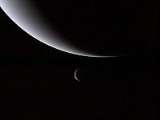
Voyager 2 Neptune and Triton
From its beginnings denoting the "wandering stars" of the classical world, the definition of "planet
Planet

A planet , as 2006 definition of planet by the International Astronomical Union , is a celestial body orbiting a star or Stellar evolution#Stellar remnants that is massive enough to be rounded by its own gravity, is not massive enough to cause thermonuclear fusion, and has cleared the neighbourhood of planetesimals....
"
has been fraught with ambiguity. In its long life, the word has meant many different things, often simultaneously. Over the millennia, use of the term was never strict and its meaning has twisted and blurred to include or exclude a variety of different objects, from the Sun and the Moon to satellites and asteroids. As knowledge of the universe grew, the word "planet" grew and changed with it, casting off old meanings and adopting new ones, though never arriving at a single, concrete definition.

By the end of the 19th century, the word "planet" had, without being defined, settled into a comfortable working term. It only applied to objects in the Solar System
Solar System

The Solar System consists of the Sun and those Astronomical object bound to it by gravity: the eight planets and five dwarf planets, their 173 known Natural satellite, and billions of Small Solar System body....
; a number small enough that any differences could be dealt with on an individual basis. After 1992 however, astronomers began to discover many additional objects beyond the orbit of Neptune
NEPTUNE

=Overview=The project, along with sister project, VENUS, offers a unique approach to ocean science. Traditionally, ocean scientists have relied on infrequent ship cruises or space-based satellites to carry out their research....
, as well as hundreds of objects orbiting other stars
Extrasolar planet

An extrasolar planet, or exoplanet, is a planet beyond the Solar System, orbiting a star other than the Sun. As of February 2009, 342 exoplanets are listed in the Extrasolar Planets Encyclopaedia....
. These discoveries not only increased the number of potential planets, but also expanded their variety and peculiarity. Some were nearly large enough to be star
Star

A star is a massive, luminous ball of Plasma that is held together by its own gravity. The nearest star to Earth is the Sun, which is the source of most of the energy on Earth....
s, while others were smaller than Earth's moon
Moon

The Moon is Earth's only natural satellite and the List of natural satellites by diameter satellite in the Solar System. The average centre-to-centre distance from the Earth to the Moon is km, about thirty times the diameter of the Earth....
. These discoveries challenged long-perceived notions of what a planet could be.

The issue of a clear definition for "planet" came to a head in 2005 with the discovery of the trans-Neptunian object
Trans-Neptunian object

A trans-Neptunian object is any object in the solar system that orbits the sun at a greater distance on average than Neptune . The Kuiper belt, scattered disk, and Oort cloud are three divisions of this volume of space....
 Eris
Eris (dwarf planet)

'Eris' , Minor planet names '136199 Eris', is the largest known dwarf planet in the Solar System and the ninth-largest body known to orbit the Sun directly....
, a body larger than the smallest then-accepted planet, Pluto
Pluto

Pluto , Minor planet names Pluto, is the second-largest known dwarf planet in the Solar System and the tenth-largest body observed directly orbiting the Sun....
. In its 2006 response, the International Astronomical Union
International Astronomical Union

The International Astronomical Union is a collection of professional astronomers, at the Ph.D. level and beyond, active in professional research and education in astronomy....
 (IAU), recognised by astronomers as the world body responsible for resolving issues of nomenclature
Nomenclature

Nomenclature can refer to a system of names or terms, or the rules used for forming the names, as used by an individual or community, especially those used in a particular science or art....
, released its decision on the matter. This definition, which applies only to the Solar System, states that a planet is a body that orbits the Sun
Sun

The Sun , a G V star, is the star at the center of the Solar System. The Earth and other matter orbit the Sun, which by itself accounts for about 98.6% of the Solar System's mass....
, is large enough for its own gravity to make it round, and has "cleared its neighbourhood" of smaller objects. Under this new definition, Pluto, along with the other trans-Neptunian objects, does not qualify as a planet. The IAU's decision has not resolved all controversies, and while many scientists have accepted the definition, some in the astronomical community have rejected it outright.

History


Planets in antiquity

While knowledge of the planets predates history and is common to most civilisations, the word "planet" dates back to ancient Greece
Ancient Greece

The term Ancient Greece refers to the period of History of Greece lasting from the Greek Dark Ages ca. 1100 BC and the Dorian invasion, to 146 BC and the Roman Republic conquest of Greece after the Battle of Corinth ....
. The Greeks believed the Earth to be stationary and at the centre of the universe in accordance with the geocentric model
Geocentric model

In astronomy, the geocentric model or The Ptolemaic worldview of the universe is the Superseded scientific theories#Superseded astronomical and cosmological theories that the Earth is the center of the universe and other objects go around it....
, and that the objects in the sky, and indeed the sky itself, revolved around it. Greek astronomers employed the term asteres planetai, "wandering stars", to describe those starlike lights in the heavens that moved over the course of the year, in contrast to the asteres aplanis, the "fixed stars", which stayed motionless relative to one another. The five bodies currently called "planets" that were known to the Greeks were those visible to the naked eye: Mercury
Mercury (planet)

Mercury is the innermost and smallest planet in the Solar System, orbiting the Sun once every 88 days. The orbit of Mercury has the highest Orbital eccentricity of all the Solar System planets, and it has the smallest axial tilt....
, Venus
Venus

Venus is the second-closest planet to the Sun, orbiting it every 224.7 Earth days. The planet is named after Venus , the Roman mythology goddess of love....
, Mars
MARS

In cryptography, MARS is a block cipher that was IBM's submission to the Advanced Encryption Standard process. MARS was selected as an AES finalist in August 1999, after the AES2 conference in March 1999, where it was voted as the fifth and last finalist algorithm....
, Jupiter
Jupiter

Jupiter is the fifth planet from the Sun and the Solar system by size planet within the Solar System. It is two and a half times as massive as all of the other planets in our Solar System combined....
, and Saturn
Saturn

Saturn is the sixth planet from the Sun and the second largest planet in the Solar System, after Jupiter. Saturn, along with Jupiter, Uranus and Neptune, is classified as a gas giant....
.

Graeco-Roman cosmology commonly considered seven planets, with the Sun and the Moon counted among them (as is the case in modern astrology
Planets in astrology

Planets in astrology have a meaning different from the modern Astronomy understanding of Definition of planet. Astrology utilises the ancient geocentric model of the universe in its calculations and thus employs the term in its original geocentric sense....
); however, there is some ambiguity on that point, as many ancient astronomers distinguished the five starlike planets from the Sun and Moon. As the 19th century German naturalist Alexander von Humboldt
Alexander von Humboldt

was a German people natural scientist and List of explorers, and the younger brother of the Prussian minister, philosopher, and linguistics, Wilhelm von Humboldt ....
 noted in his work Cosmos,

Of the seven cosmical bodies which, by their continually varying relative positions and distances apart, have ever since the remotest antiquity been distinguished from the "unwandering orbs" of the heaven of the "fixed stars", which to all sensible appearance preserve their relative positions and distances unchanged, five only -Mercury, Venus, Mars, Jupiter and Saturn- wear the appearance of stars- "cinque stellas errantes"- while the Sun and Moon, from the size of their disks, their importance to man, and the place assigned to them in mythological systems, were classed apart.
Cellarius Ptolemaic System C2
In his Timaeus
Timaeus (dialogue)

Timaeus is a theoretical treatise of Plato in the form of a Socratic dialogue, written circa 360 Before Christ. The work puts forward speculation on the nature of the physical world....
, written in roughly 360 BC, Plato
Plato

Plato , was a Classical Greece Greeks philosopher, mathematician, writer of philosophical dialogues, and founder of the Platonic Academy in Ancient Athens, the first institution of higher learning in the western world....
 mentions, "the Sun and Moon and five other stars, which are called the planets". His student Aristotle
Aristotle

Aristotle was a Greeks philosopher, a student of Plato and teacher of Alexander the Great. He wrote on many subjects, including physics, metaphysics, Poetics , theater, music, logic, rhetoric, politics, government, ethics, biology and zoology....
 makes a similar distinction in his On the Heavens
On the Heavens

On the Heavens is Aristotle's chief cosmological treatise: it contains his astronomical theory.According to him, the heavenly bodies are the most perfect realities, , whose motions are ruled by principles other than those of bodies in the sublunary sphere....
: "The movements of the sun and moon are fewer than those of some of the planets". In his Phaenomena, which set to verse an astronomical treatise written by the philosopher Eudoxus
Eudoxus of Cnidus

Eudoxus of Cnidus was a Ancient Greece astronomer, mathematician, scholar and student of Plato. Since all his own works are lost, our knowledge of him is obtained from secondary sources, such as Aratus's poem on astronomy....
 in roughly 350 BC, the poet Aratus
Aratus

Aratus was a Greeks didactic poet, known for his technical poetry....
 describes "those five other orbs, that intermingle with [the constellations] and wheel wandering on every side of the twelve figures of the Zodiac."

In his Almagest
Almagest

Almagest is the Latin form of the Arabic language name of a mathematical and astronomical treatise proposing the complex motions of the stars and planetary paths, originally written in Greek language as by Ptolemy of Alexandria, Egypt, written in the 2nd century....
 written in the 2nd century, Ptolemy refers to "the Sun, Moon and five planets." Hyginus
Gaius Julius Hyginus

Gaius Julius Hyginus was a Latin author, though whether a native of Spain or of Alexandria it is not clear, a pupil of the famous Alexander Cornelius, and a freedman of Caesar Augustus, by whom he was made superintendent of the Palatine library, according to Suetonius' minor works, De Grammaticis, 20....
 explicitly mentions "the five stars which many have called wandering, and which the Greeks call Planeta." Marcus Manilius
Marcus Manilius

Marcus Manilius was a Roman poet, astrologer, and author of a poem in five books called Astronomica....
, a Latin writer who lived during the time of Caesar Augustus and whose poem Astronomica is considered one of the principal texts for modern astrology
Astrology

Astrology is a group of systems, traditions, and beliefs which hold that the relative positions of astronomical object and related details can provide useful information about personality, human affairs, and other terrestrial matters....
, says, "Now the dodecatemory is divided into five parts, for so many are the stars called wanderers which with passing brightness shine in heaven."

The single view of the seven planets is found in Cicero
Cicero

Marcus Tullius Cicero was a Ancient Rome philosopher, statesman, lawyer, political theorist, and Constitution of the Roman Republic. Cicero is widely considered one of Rome's greatest rhetoric and prose stylists....
's Dream of Scipio
Dream of Scipio

The Dream of Scipio , written by Cicero, describes a fictional dream vision of the Roman republic general Publius Cornelius Scipio Aemilianus, set two years before he commanded at the destruction of Carthage in 146 BC....
, written sometime around 53 BC, where the spirit of Scipio Africanus
Scipio Africanus

Publius Cornelius Scipio Africanus also known as Scipio Africanus, Scipio the Elder, and Africanus the Elder was a general in the Second Punic War and statesman of the Roman Republic....
 proclaims, "Seven of these spheres contain the planets, one planet in each sphere, which all move contrary to the movement of heaven." In his Natural History, written in 77 AD, Pliny the Elder
Pliny the Elder

Gaius Plinius Secundus , better known as Pliny the Elder, was an ancient author, naturalist or natural philosopher and naval and military commander of some importance who wrote Natural History ....
 refers to "the seven stars, which owing to their motion we call planets, though no stars wander less than they do." Nonnus
Nonnus

Nonnus , was a Greek language epic poet. He was a native of Panopolis in the Egyptian Thebaid, and probably lived at the end of the 4th or early 5th century....
, the 5th century Greek poet, says in his Dionysiaca, "I have oracles of history on seven tablets, and the tablets bear the names of the seven planets."

Planets in the Middle Ages

John Gower World Vox Clamantis
Medieval and Renaissance writers generally accepted the idea of seven planets. The standard medieval introduction to astronomy, Sacrobosco's De Sphaera
De sphaera mundi

De sphaera mundi is a medieval introduction to the basic elements of astronomy written by Johannes de Sacrobosco c. 1230. Based heavily on Ptolemy?s Almagest, and drawing additional ideas from Islamic astronomy, it was one of the most influential works of pre-Nicolaus Copernicus astronomy in Europe....
, includes the Sun and Moon among the planets, the more advanced Theorica planetarum presents the "theory of the seven planets," while the instructions to the Alfonsine Tables
Alfonsine tables

The Alfonsine tables were ephemeris drawn up at Toledo, Spain by order of Alfonso X around 1252 to 1270 to correct anomalies in the Tables of Toledo....
 show how "to find by means of tables the mean motuses of the sun, moon, and the rest of the planets." In his Confessio Amantis
Confessio Amantis

Confessio Amantis is a 33,000-line Middle English poem by John Gower, which uses the confession made by an ageing lover to the chaplain of Venus as a frame story for a collection of shorter narrative poems....
, 14th century poet John Gower
John Gower

John Gower was an English poet, a contemporary of William Langland and a personal friend of Geoffrey Chaucer. He is remembered primarily for three major works, the Mirroir de l'Omme, Vox Clamantis, and Confessio Amantis, three long poems written in French, Latin, and English respectively, which are united by common moral and po...
, referring to the planets' connection with the craft of alchemy
Classical planets in western alchemy

Alchemy in the Western World and other locations where it was widely practiced was allied and intertwined with traditional Babylonian-Greek style astrology; in numerous ways they were built to complement each other in the search for occult ....
, writes, "Of the planetes ben begonne/The gold is tilted to the Sonne/The Mone of Selver hath his part...", indicating that the Sun and the Moon were planets. Even Nicolaus Copernicus
Nicolaus Copernicus

Nicolaus Copernicus was the first astronomer to formulate a scientifically-based heliocentrism cosmology that displaced the Earth from the center of the universe....
, who rejected the geocentric model, was ambivalent concerning whether the Sun and Moon were planets. In his De Revolutionibus, Copernicus clearly separates "the sun, moon, planets and stars"; however, in his Dedication of the work to Pope Paul III, Copernicus refers to, "the motion of the sun and the moon... and of the five other planets."

Earth

Nikolaus Kopernikus
Eventually, when Copernicus's heliocentric model was accepted over the geocentric, Earth
Earth

Earth is the third planet from the Sun. Earth is the largest of the terrestrial planets in the Solar System in diameter, mass and density. It is also referred to as the World and Wiktionary:Terra.Note that by International Astronomical Union convention, the term "Terra" is used for naming extensive land masses, rather...
 was placed among the planets and the Sun and Moon were demoted, necessitating a conceptual revolution in the understanding of planets. As the historian of science Thomas Kuhn noted in his book, The Structure of Scientific Revolutions
The Structure of Scientific Revolutions

The Structure of Scientific Revolutions , by Thomas Samuel Kuhn, is an analysis of the history of science. Its publication was a landmark event in the sociology of knowledge, and popularized the terms paradigm and paradigm shift....
:

The Copernicans who denied its traditional title 'planet' to the sun ... were changing the meaning of 'planet' so that it would continue to make useful distinctions in a world where all celestial bodies ... were seen differently from the way they had been seen before... Looking at the moon, the convert to Copernicanism ... says, 'I once took the moon to be (or saw the moon as) a planet, but I was mistaken.'


Copernicus obliquely refers to Earth as a planet in De Revolutionibus when he says, "Having thus assumed the motions which I ascribe to the Earth later on in the volume, by long and intense study I finally found that if the motions of the other planets are correlated with the orbiting of the earth..." Galileo also indirectly asserts that Earth is a planet in the Dialogue Concerning the Two Chief World Systems
Dialogue Concerning the Two Chief World Systems

The Dialogue Concerning the Two Chief World Systems was a 1632 book by Galileo Galilei, comparing the Nicolaus Copernicus system with the traditional Ptolemy system....
; "[T]he Earth, no less than the moon or any other planet, is to be numbered among the natural bodies that move circularly."

Modern planets

William Herschel01
In 1781, the astronomer William Herschel
William Herschel

Sir Frederick William Herschel, Fellow of the Royal Society Royal Guelphic Order was a German-born British astronomer and composer who became famous for discovering Uranus....
 was searching the sky for elusive stellar parallaxes, when he observed what he termed a comet
Comet

A comet is a Small Solar System body that orbits the Sun and, when close enough to the Sun, exhibits a visible coma or a tail?both primarily from the effects of solar radiation upon the Comet nucleus....
 in the constellation of Taurus
Taurus (constellation)

Taurus is one of the constellations of the zodiac. Its name is Latin for cattle, and its symbol is , a stylized bull's head. Taurus is a large and prominent constellation in the northern hemisphere's winter sky, between Aries to the west and Gemini to the east; to the north lie Perseus and Auriga , to the southeast Orion , to the south E...
. Unlike stars, which remained mere points of light even under high magnification, this object's size increased in proportion to the power used. That this strange object might have been a planet simply did not occur to Herschel; the five planets beyond Earth had been part of humanity's conception of the universe since antiquity. As the asteroids had yet to be discovered, comets were the only moving objects one expected to find in a telescope. However, unlike a comet, this object's orbit was nearly circular and within the ecliptic plane. Before Herschel announced his discovery of his "comet", his colleague, British Astronomer Royal
Astronomer Royal

Astronomer Royal is a senior post in the Royal Household of the Monarch of the United Kingdom. There are two officers, the senior being the Astronomer Royal dating from 22 June 1675; the second is the Astronomer Royal for Scotland dating from 1834....
 Nevil Maskelyne
Nevil Maskelyne

The Reverend Dr Nevil Maskelyne Fellow of the Royal Society was the fifth England Astronomer Royal. He held the office from 1765 to 1811....
, wrote to him, saying, "I don't know what to call it. It is as likely to be a regular planet moving in an orbit nearly circular to the sun as a Comet moving in a very eccentric ellipsis. I have not yet seen any coma
Coma (cometary)

In astronomy, a coma is the nebulous envelope around the Comet nucleus of a comet. It is formed when the comet passes close to the Sun on its highly ellipse orbit; as the comet warms, parts of it Sublimation_%28chemistry%29....
 or tail to it." The "comet" was also very far away, too far away for a mere comet to resolve itself. Eventually it was recognised as the seventh planet and named Uranus
Uranus

Uranus is the seventh planet from the Sun and the third-largest and fourth most massive planet in the Solar System. It is named after the ancient Greek deity of the sky Uranus the father of Kronos and grandfather of Zeus ....
 after the father of Saturn.

Gravitationally induced irregularities in Uranus's observed orbit led eventually to the discovery of Neptune
NEPTUNE

=Overview=The project, along with sister project, VENUS, offers a unique approach to ocean science. Traditionally, ocean scientists have relied on infrequent ship cruises or space-based satellites to carry out their research....
 in 1846, and presumed irregularities in Neptune's orbit subsequently led to the search which ultimately located Pluto
Pluto

Pluto , Minor planet names Pluto, is the second-largest known dwarf planet in the Solar System and the tenth-largest body observed directly orbiting the Sun....
 in 1930. Initially believed to be roughly the mass of the Earth, observation gradually shrank Pluto's estimated mass until it was revealed to be a mere five hundredth as large; far too small to have influenced Neptune's orbit at all. In 1989, Voyager 2
Voyager 2

The spacecraft is an Unmanned space mission interplanetary space probe launched on August 20, 1977. Identical in form to its sister Voyager program craft Voyager 1, Voyager 2 followed a slower trajectory that allowed it to be kept in the ecliptic so that it could be sent to Uranus and Neptune by means of gravity assist during...
 determined the irregularities to be due to an overestimation of Neptune's mass.

Satellites

Galileo
When Copernicus placed the Earth among the planets, he also placed the Moon in orbit around the Earth, making the Moon the first natural satellite
Natural satellite

A natural satellite or moon is a celestial body that orbits a planet or smaller body, which is called the primary. Technically, the term natural satellite could refer to a planet orbiting a star, or a dwarf galaxy orbiting a major galaxy, but it is normally synonymous with moon and used to identify non-artificial satellites...
 to be discovered. When Galileo
Galileo Galilei

Galileo Galilei was a Grand Duchy of Tuscany physicist, mathematician, astronomer, and philosopher who played a major role in the Scientific Revolution....
 discovered his four satellites
Galilean moons

The Galilean moons are the four moons of Jupiter discovered by Galileo Galilei on January 7, 1610. They are the largest of the many moons of Jupiter and derive their names from the lovers of Zeus : Io , Europa , Ganymede and Callisto ....
 of Jupiter in 1610, they lent weight to Copernicus's argument, since if other planets could have satellites, then the Earth could too. However, there remained some confusion as to whether these objects were "planets"; Galileo initially intended to name them the "Medicean stars", in honour of his patrons, the Medicis, but also referred to them as "four planets flying around the star of Jupiter at unequal intervals and periods with wonderful swiftness." Similarly, Christiaan Huygens
Christiaan Huygens

Christiaan Huygens was a prominent Netherlands mathematics, astronomer, physics, and horology. His work included early telescopic studies, investigations and inventions related to time keeping, and studies of both optics and centrifugal force....
, upon discovering Saturn's largest moon Titan
Titan (moon)

Titan or Saturn VI is the largest natural satellite of Saturn, the only moon known to have a dense celestial body atmosphere, and the only object other than Earth for which clear evidence of stable bodies of surface liquid has been found....
 in 1655, employed many terms to describe it, including "planeta", (planet) "stella" (star) "Luna" (moon), and the more modern "satellite". Giovanni Cassini, in announcing his discovery of Saturn's moons Iapetus
Iapetus (moon)

'Iapetus' , occasionally 'Japetus' , is the third-largest natural satellite of Saturn, and List of moons, discovered by Giovanni Domenico Cassini in 1671....
 and Rhea
Rhea (moon)

'Rhea' is the second-largest natural satellite of Saturn and the List of natural satellites by diameter in the Solar System. It was discovered in 1672 by Giovanni Domenico Cassini....
 in 1671 and 1672, described them as Nouvelles Planetes autour de Saturne ("New planets around Saturn"). However, when the "Journal de Scavans" reported Cassini's discovery of two new Saturnian moons in 1686, it referred to them strictly as "satellites". When William Herschel announced his discovery of two objects in orbit around Uranus in 1787, he referred to them as "satellites" and "secondary planets". All subsequent reports of natural satellite discoveries used the term "satellite" exclusively, though the 1868 book, "Smith's Illustrated Astronomy" referred to satellites as "secondary planets".

Minor planets

Giuseppe Piazzi
One of the unexpected results of William Herschel's
William Herschel

Sir Frederick William Herschel, Fellow of the Royal Society Royal Guelphic Order was a German-born British astronomer and composer who became famous for discovering Uranus....
 discovery of Uranus was that it appeared to validate Bode's law, a mathematical function which generates the size of the semimajor axis of planetary orbit
ORBit

ORBit is a Common Object Request Broker Architecture 2.4 compliant Object Request Broker . It features mature C , C++ and Python bindings, and less developed bindings for Perl, Lisp , Pascal , Ruby , and Tcl....
s. Astronomers had considered the "law" a meaningless coincidence, but Uranus fell at very nearly the exact distance it predicted. Since Bode's law also predicted a body between Mars and Jupiter that at that point had not been observed, astronomers turned their attention to that region in the hope that it might be vindicated again. Finally, in 1801, astronomer Giuseppe Piazzi
Giuseppe Piazzi

'Giuseppe Piazzi' was an Italy Theatines monk, mathematician, and astronomer. He was born in Ponte in Valtellina, and died in Naples. He established an observatory at Palermo, now the Osservatorio Astronomico di Palermo ? Giuseppe S....
 found a miniature new world, Ceres
1 Ceres

Ceres , Minor planet names 1 Ceres, is the smallest identified dwarf planet in the Solar System and the only one in the asteroid belt. It was discovered on January 1, 1801, by Giuseppe Piazzi, and is named after the Roman mythology Ceres — the goddess of growing plants, the harvest, and motherly love....
, lying at just the correct point in space. The object was hailed as a new planet.

Then in 1802, Heinrich Olbers
Heinrich Wilhelm Matthäus Olbers

Heinrich Wilhelm Matth?us Olbers was a Germany physician and astronomer....
 discovered Pallas
2 Pallas

'2 Pallas' is one of the largest asteroids and is located in the main asteroid belt. It was the second asteroid to be discovered, by astronomy Heinrich Wilhelm Matth?us Olbers on March 28, 1802....
, a second "planet" at roughly the same distance from the Sun as Ceres. That two planets could occupy the same orbit was an affront to centuries of thinking; even Shakespeare had ridiculed the idea ("Two stars keep not their motion in one sphere"). Even so, in 1804, another world, Juno
3 Juno

Juno , formal designation 3 Juno in the Minor Planet Center catalogue system, was the third asteroid to be discovered and is one of the larger main belt asteroids, being one of the two largest stony asteroids, along with 15 Eunomia....
, was discovered in a similar orbit. In 1807, Olbers discovered a fourth object, Vesta
4 Vesta

4 Vesta is the second most massive object in the asteroid belt, with a mean diameter of about 530 km and an estimated mass of 9% of the mass of the entire asteroid belt....
, at a similar orbital distance.

Herschel suggested that these four worlds be given their own separate classification, asteroid
Asteroid

Asteroids, sometimes called minor planets or planetoids, are small Solar System bodies in orbit around the Sun, smaller than planets but larger than meteoroids....
s (meaning "starlike" since they were too small for their disks to resolve and thus resembled star
Star

A star is a massive, luminous ball of Plasma that is held together by its own gravity. The nearest star to Earth is the Sun, which is the source of most of the energy on Earth....
s), though most astronomers preferred to refer to them as planets. This conception was entrenched by the fact that, due to the difficulty of distinguishing asteroids from yet-uncharted stars, those four remained the only asteroids known until 1845. Science textbooks in 1828, after Herschel's death, still numbered the asteroids among the planets. With the arrival of more refined star charts, the search for asteroids resumed, and a fifth and sixth were discovered by Karl Ludwig Hencke
Karl Ludwig Hencke

Karl Ludwig Hencke was a Germany astronomer. He is sometimes confused with Johann Franz Encke, another German astronomer.Hencke was born in Driesen, Brandenburg ....
 in 1845 and 1847. By 1851 the number of asteroids had increased to 15, and a new method of classifying them, by affixing a number before their names in order of discovery, was adopted, inadvertently placing them in their own distinct category. Ceres became "(1) Ceres", Pallas became "(2) Pallas", and so on. By the 1860s, the number of known asteroids had increased to over a hundred, and observatories in Europe and the United States began referring to them collectively as "minor planet
Minor planet

An asteroid group or minor planet group is a population of minor planets that have a share broadly similar orbits. Members are generally unrelated to each other, unlike in an asteroid family, which often results from the break-up of a single asteroid....
s", or "small planets", though it took the first four asteroids longer to be grouped as such. To this day, "minor planet" remains the official designation for all small bodies in orbit around the Sun, and each new discovery is numbered accordingly in the IAU's Minor Planet Catalogue.

Pluto

Clyde Tombaugh Image
The long road from planethood to reconsideration undergone by Ceres is mirrored in the story of Pluto
Pluto

Pluto , Minor planet names Pluto, is the second-largest known dwarf planet in the Solar System and the tenth-largest body observed directly orbiting the Sun....
, which was named a planet soon after its discovery by Clyde Tombaugh
Clyde Tombaugh

Clyde William Tombaugh was an United States astronomer.Tombaugh is best known for discovering the dwarf planet Pluto in 1930, but also discovered many asteroids, and called for serious scientific research of unidentified flying objects....
 in 1930. Uranus and Neptune had been declared planets based on their circular orbits, large masses and proximity to the ecliptic plane. None of these applied to Pluto; a tiny, icy world in a region of gas giant
Gas giant

A gas giant is a large planet that is not primarily composed of Rock or other solid matter. There are four gas giants in our Solar System: Jupiter, Saturn, Uranus, and Neptune....
s with an orbit that carried it high above the ecliptic
Ecliptic

The ecliptic is the apparent path that the Sun traces out in the sky during the year. As it appears to move in the sky in relation to the stars, the apparent path aligns with the planets throughout the course of the year....
 and even inside that of Neptune. In 1978, astronomers discovered Pluto's largest moon, Charon
Charon (moon)

'Charon' , discovered in 1978, is the largest moon of the dwarf planet Pluto. Following the 2005 discovery of two other natural satellites of Pluto , Charon may also referred to as 'Pluto I'....
, which allowed them to determine its mass. Pluto was found to be much tinier than anyone had expected; only one sixth the mass of Earth's Moon. However, it was, as far as anyone could tell, unique. Then, beginning in 1992, astronomers began to detect large numbers of icy bodies beyond the orbit of Neptune that were similar to Pluto in composition, size, and orbital characteristics. They concluded that they had discovered the long-hypothesised Kuiper belt
Kuiper belt

The Kuiper belt , sometimes called the Edgeworth-Kuiper belt, is a region of the Solar System beyond the planets extending from the orbit of Neptune to approximately 55 Astronomical unit from the Sun....
 (sometimes called the Edgeworth-Kuiper belt), a band of icy debris that is the source for "short-period" comets—those with orbital periods of up to 200 years.

Pluto's orbit lay within this band and thus its planetary status was thrown into question; many scientists concluded that tiny Pluto should be reclassified as a minor planet, just as Ceres had been a century earlier. Mike Brown
Michael E. Brown

Michael E. Brown has been a professor of planetary astronomy at the California Institute of Technology since 2003. He was previously an associate professor at Caltech from 2002-2003 and an assistant professor at Caltech from 1997?2002....
 of the California Institute of Technology
California Institute of Technology

The California Institute of Technology is a private university research university located in Pasadena, California, United States. Caltech maintains a strong emphasis on the natural sciences and engineering....
 suggested that a "planet" should be redefined as "any body in the Solar System that is more massive than the total mass of all of the other bodies in a similar orbit." Those objects under that mass limit would become minor planets. In 1999, Brian Marsden of Harvard University
Harvard University

Harvard University is a private university in Cambridge, Massachusetts, Massachusetts, United States, and a member of the Ivy League. Founded in 1636 by the colonial Massachusetts legislature, Harvard is the Colonial Colleges institution of higher learning in the United States....
's Minor Planet Center
Minor Planet Center

The Minor Planet Center operates at the Smithsonian Astrophysical Observatory , which is part of the Center for Astrophysics along with the Harvard College Observatory ....
 suggested that Pluto be given the minor planet number 10000 while still retaining its official position as a planet. The prospect of Pluto's "demotion" created a public outcry, and in response the International Astronomical Union
International Astronomical Union

The International Astronomical Union is a collection of professional astronomers, at the Ph.D. level and beyond, active in professional research and education in astronomy....
 clarified that it was not at that time proposing to remove Pluto from the planet list. The discovery of several other trans-Neptunian object
Trans-Neptunian object

A trans-Neptunian object is any object in the solar system that orbits the sun at a greater distance on average than Neptune . The Kuiper belt, scattered disk, and Oort cloud are three divisions of this volume of space....
s approaching the size of Pluto, such as Quaoar
50000 Quaoar

50000 Quaoar is a Trans-Neptunian object and potential dwarf planet orbiting the Sun in the Kuiper belt. It was discovered on June 4, 2002 by astronomers Chad Trujillo and Michael E....
 and Sedna
90377 Sedna

90377 Sedna is a trans-Neptunian object and a likely dwarf planet, discovered by Michael E. Brown , Chad Trujillo and David L. Rabinowitz on November 14, 2003....
, continued to erode arguments that Pluto was exceptional from the rest of the trans-Neptunian population. On July 29, 2005, Mike Brown and his team announced the discovery of a trans-Neptunian object confirmed to be larger than Pluto, named Eris.

In the immediate aftermath of the object's discovery, there was much discussion as to whether it could be termed a "tenth planet
Tenth planet

;In media*The Tenth Planet, the Doctor Who serial*Tenth Planet Productions, production company for awards shows*Tenth Planet Math, a educational software program...
". NASA even put out a press release describing it as such. However, acceptance of Eris as the tenth planet implicitly demanded a definition of planet that set Pluto as an arbitrary minimum size. Many astronomers, claiming that the definition of planet was of little scientific importance, preferred to recognise Pluto's historical identity as a planet by "grandfathering" it into the planet list.

IAU definition

Image:EightTNOs.png|thumb|300 px|The relative sizes of the largest trans-Neptunian objects as compared to Earth.
  1. Earth
rect 646 1714 2142 1994 The Earth
Earth

Earth is the third planet from the Sun. Earth is the largest of the terrestrial planets in the Solar System in diameter, mass and density. It is also referred to as the World and Wiktionary:Terra.Note that by International Astronomical Union convention, the term "Terra" is used for naming extensive land masses, rather...
  1. Eris and Dysnomia
circle 226 412 16 Dysnomia
Dysnomia (moon)

'Dysnomia' , officially ' Eris I Dysnomia', is the only known natural satellite of the dwarf planet Eris . It was discovered in 2005 by Michael E....
circle 350 626 197 (136199) Eris
Eris (dwarf planet)

'Eris' , Minor planet names '136199 Eris', is the largest known dwarf planet in the Solar System and the ninth-largest body known to orbit the Sun directly....
  1. Pluto and Charon
circle 1252 684 86 Charon
Charon (moon)

'Charon' , discovered in 1978, is the largest moon of the dwarf planet Pluto. Following the 2005 discovery of two other natural satellites of Pluto , Charon may also referred to as 'Pluto I'....
circle 1038 632 188 (134340) Pluto
Pluto

Pluto , Minor planet names Pluto, is the second-largest known dwarf planet in the Solar System and the tenth-largest body observed directly orbiting the Sun....
  1. Makemake
circle 1786 614 142 (136472) Makemake
  1. Haumea
circle 2438 616 155 (136108) Haumea
  1. Sedna
circle 342 1305 137 (90377) Sedna
90377 Sedna

90377 Sedna is a trans-Neptunian object and a likely dwarf planet, discovered by Michael E. Brown , Chad Trujillo and David L. Rabinowitz on November 14, 2003....
  1. Orcus
circle 1088 1305 114 (90482) Orcus
90482 Orcus

90482 Orcus is a Kuiper Belt object and a likely dwarf planet that was discovered by Michael E. Brown of California Institute of Technology, Chad Trujillo of the Gemini Observatory, and David L....
  1. Quaoar
circle 1784 1305 97 (50000) Quaoar
50000 Quaoar

50000 Quaoar is a Trans-Neptunian object and potential dwarf planet orbiting the Sun in the Kuiper belt. It was discovered on June 4, 2002 by astronomers Chad Trujillo and Michael E....
  1. Varuna
circle 2420 1305 58 (20000) Varuna
20000 Varuna

'20000 Varuna' is a large Classical Kuiper belt object Kuiper Belt object and a Plutoid candidate. It previously had the provisional designation and has been precovery in plates dating back to 1953....


desc none
  1. - setting this to "bottom-right" will display a (rather large) icon linking to the graphic, if desired


  1. Notes:
  2. Details on the new coding for clickable images is here: mw:Extension:ImageMap
  3. While it may look strange, it is important to keep the codes for a particular system in order. The clickable coding treats the first object created in an area as the one on top.
  4. Moons should be placed on "top" so that their smaller circles won't disappear "under" their respective primaries.


The discovery of Eris
Eris (dwarf planet)

'Eris' , Minor planet names '136199 Eris', is the largest known dwarf planet in the Solar System and the ninth-largest body known to orbit the Sun directly....
 forced the IAU
International Astronomical Union

The International Astronomical Union is a collection of professional astronomers, at the Ph.D. level and beyond, active in professional research and education in astronomy....
 to act on a definition. In October 2005, a group of 19 IAU members, which had already been working on a definition since the discovery of Sedna
90377 Sedna

90377 Sedna is a trans-Neptunian object and a likely dwarf planet, discovered by Michael E. Brown , Chad Trujillo and David L. Rabinowitz on November 14, 2003....
 in 2003, narrowed their choices to a shortlist of three, using approval voting
Approval voting

Approval voting is a Voting_system#Single-winner methods used for elections. Each voter may vote for as many of the candidates as they wish....
. The definitions were:

  • A planet is any object in orbit
    ORBit

    ORBit is a Common Object Request Broker Architecture 2.4 compliant Object Request Broker . It features mature C , C++ and Python bindings, and less developed bindings for Perl, Lisp , Pascal , Ruby , and Tcl....
     around the Sun with a diameter greater than 2000 km. (eleven votes in favour)
  • A planet is any object in orbit around the Sun whose shape is stable due to its own gravity. (eight votes in favour)
  • A planet is any object in orbit around the Sun that is dominant in its immediate neighbourhood. (six votes in favour)
Since no overall consensus could be reached, the committee decided to put these three definitions to a wider vote at the IAU General Assembly meeting in Prague
Prague

Prague is the Capital and World's largest cities of the Czech Republic. Its official name is Hlavn? mesto Praha, meaning Prague, the Capital City....
 in August 2006, and on August 24, the IAU put a final draft to a vote, which combined elements from two of the three proposals. It essentially created a medial classification between "planet" and "rock" (or, in the new parlance, "small Solar System body
Small solar system body

Small Solar System Body is a term IAU definition of planet by the International Astronomical Union to describe objects in the Solar System that are neither planets or dwarf planets:...
"), called "dwarf planet
Dwarf planet

A dwarf planet, as defined by the International Astronomical Union , is a celestial body orbiting the Sun that is massive enough to be rounded by its own gravity but has not Clearing the neighbourhood of planetesimals and is not a natural satellite....
" and placed Pluto
Pluto

Pluto , Minor planet names Pluto, is the second-largest known dwarf planet in the Solar System and the tenth-largest body observed directly orbiting the Sun....
 in it, along with Ceres and Eris. The vote was passed, with 424 astronomers taking part in the ballot.

The IAU also resolved that "planets and dwarf planets are two distinct classes of objects", meaning that dwarf planets, despite their name, would not be considered planets.

On September 13, 2006, the IAU placed Eris, its moon Dysnomia, and Pluto into their Minor Planet Catalogue, giving them the official minor planet designations (134340) Pluto, (136199) Eris, and (136199) Eris I Dysnomia. Other dwarf planet candidates, such as 2003 EL61, 2005 FY9, Sedna
90377 Sedna

90377 Sedna is a trans-Neptunian object and a likely dwarf planet, discovered by Michael E. Brown , Chad Trujillo and David L. Rabinowitz on November 14, 2003....
 and Quaoar
50000 Quaoar

50000 Quaoar is a Trans-Neptunian object and potential dwarf planet orbiting the Sun in the Kuiper belt. It was discovered on June 4, 2002 by astronomers Chad Trujillo and Michael E....
, were left in temporary limbo until a formal decision could be reached regarding their status.

On June 11, 2008, the IAU executive committee announced the establishment of a subclass of dwarf planets comprising the aforementioned "new category of trans-Neptunian objects" to which Pluto is a prototype. This new class of objects, termed plutoids, would include Pluto, Eris and any other future trans-Neptunian dwarf planets, but excluded Ceres. The IAU also determined that, for naming purposes, only those TNOs with an absolute magnitude
Absolute magnitude

In astronomy, absolute magnitude measures a celestial object's intrinsic brightness. To derive the absolute magnitude from the observed apparent magnitude of a celestial object its value is corrected for distance to the observer....
 brighter than H = +1 would be allowed into the category. To date, only two other TNOs, 2003 EL61 and 2005 FY9, meet the absolute magnitude requirement, while other potential dwarf planets, such as Sedna, Orcus and Quaoar, do not. On July 11, 2008, the Working Group on Planetary Nomenclature included FY9 in the Plutoid class, naming it Makemake. On September 17, 2008, 2003 EL61 joined the category with the name Haumea.

Acceptance of the definition

Among the most vocal proponents of the IAU's decided definition are Mike Brown
Michael E. Brown

Michael E. Brown has been a professor of planetary astronomy at the California Institute of Technology since 2003. He was previously an associate professor at Caltech from 2002-2003 and an assistant professor at Caltech from 1997?2002....
, the discoverer of Eris, and Steven Soter
Steven Soter

Dr. Steven Soter, PhD, is an astrophysicist currently holding the positions of scientist-in-residence for New York University's Environmental Studies Program and of Research Associate for the Department of Astrophysics at the American Museum of Natural History....
, professor of astrophysics at the American Museum of Natural History
American Museum of Natural History

The American Museum of Natural History , located on the Upper West Side, Manhattan, New York, USA, is one of the largest and most celebrated museums in the world....
.

In an article in the January 2007 issue of
Scientific American
Scientific American

Scientific American is a popular science science magazine, published since August 28, 1845, making it one of the oldest continuously published magazines in the United States....
, Soter cited the definition's incorporation of current theories of the formation and evolution of the Solar System
Formation and evolution of the Solar System

The formation and wikt:evolution of the Solar System is estimated to have begun 4.6 1000000000 years ago with the gravitational collapse of a small part of a giant molecular cloud....
; that as the earliest protoplanet
Protoplanet

Protoplanets are moon-sized planets, or larger embryos within protoplanetary discs. They are believed to form out of kilometer-sized planetesimals that attract each other gravitationally and collide....
s emerged from the swirling dust of the protoplanetary disc, some bodies "won" the initial competition for limited material and, as they grew, their increased gravity meant that they accumulated more material, and thus grew larger, eventually outstripping the other bodies in the Solar System by a very wide margin. The asteroid belt, disturbed by the gravitational tug of nearby Jupiter, and the Kuiper belt, too widely spaced for its constituent objects to collect together before the end of the initial formation period, both failed to win the accretion competition.

When the numbers for the winning objects are compared to those of the losers, the contrast is quite striking; if we accept Soter's concept that each planet occupies an "orbital zone," then the least orbitally dominant planet, Mars, is larger than all other collected material in its orbital zone by a factor of 5100. Ceres, the largest asteroid, is only larger by a factor of 0.33; Pluto's ratio is even lower, at 0.07. Mike Brown asserts that this massive difference in orbital dominance leaves "absolutely no room for doubt about which objects do and do not belong."

Ongoing controversies

Despite the IAU's declaration, a number of critics remain unconvinced. The definition is seen by many as arbitrary and confusing, and a number of Pluto
Pluto

Pluto , Minor planet names Pluto, is the second-largest known dwarf planet in the Solar System and the tenth-largest body observed directly orbiting the Sun....
-as-planet proponents, in particular Alan Stern
Alan Stern

S. Alan Stern is an United States Planetary science, born 22 November 1957, New Orleans, Louisiana, married . He is the principal investigator of the New Horizons mission to Pluto....
, head of NASA's
NASA

The National Aeronautics and Space Administration is an agency of the Federal government of the United States, responsible for the nation's public list of space agencies....
 New Horizons
New Horizons

New Horizons is a NASA robotic spacecraft mission currently en route to the dwarf planet Pluto. It is expected to be the first spacecraft to fly by and study Pluto and its moons, Charon , Nix , and Hydra ....
 mission to Pluto, have circulated a petition among astronomers to alter the definition. His claim is that, since less than 5 percent of astronomers voted for it, the decision was not representative of the entire astronomical community. The issue of what constitutes a planet will likely remain contentious at least until 2009, when the IAU holds its next Congress in Rio de Janeiro
Rio de Janeiro

Rio de Janeiro , is the second largest city of Brazil and South America, behind S?o Paulo, and the third largest metropolitan area in South America, behind S?o Paulo and Buenos Aires....
. Even with this controversy excluded however, there remain several ambiguities in the definition.

Clearing the neighbourhood

One of the main points at issue is the precise meaning of "cleared the neighbourhood around its orbit
ORBit

ORBit is a Common Object Request Broker Architecture 2.4 compliant Object Request Broker . It features mature C , C++ and Python bindings, and less developed bindings for Perl, Lisp , Pascal , Ruby , and Tcl....
". Alan Stern
Alan Stern

S. Alan Stern is an United States Planetary science, born 22 November 1957, New Orleans, Louisiana, married . He is the principal investigator of the New Horizons mission to Pluto....
 objects that "it is impossible and contrived to put a dividing line between dwarf planets and planets," and that since neither Earth, Mars, Jupiter, nor Neptune have entirely cleared their regions of debris, none could properly be considered planets under the IAU
International Astronomical Union

The International Astronomical Union is a collection of professional astronomers, at the Ph.D. level and beyond, active in professional research and education in astronomy....
 definition.
Innersolarsystem En
Mike Brown counters these claims by saying that, far from not having cleared their orbits, the major planets completely control the orbits of the other bodies within their orbital zone. Jupiter may coexist with a large number of small bodies in its orbit (the Trojan asteroid
Trojan asteroid

The Jupiter Trojans, commonly called Trojans or Trojan asteroids, are a large group of objects that share the orbit of the planet Jupiter around the Sun....
s), but these bodies only exist in Jupiter's orbit because they are in the sway of the planet's huge gravity. Similarly, Pluto may cross the orbit of Neptune, but Neptune long ago locked Pluto and its attendant Kuiper belt objects, called plutino
Plutino

In astronomy, a plutino is a trans-Neptunian object in 2:3 orbital resonance with Neptune . For every 2 orbits that a Plutino makes, Neptune orbits 3 times....
s, into a 3:2 resonance, i.e., they orbit the Sun twice for every three Neptune orbits. The orbits of these objects are entirely dictated by Neptune's gravity, and thus, Neptune is gravitationally dominant.

Whatever definition of "clearing the neighbourhood" is ultimately accepted by the IAU, it is still an ambiguous concept. Mark Sykes, director of the Planetary Science Institute in Tucson, Arizona and organiser of the petition, explained the ambiguity to National Public Radio
National Public Radio

National Public Radio is a privately and publicly funded non-profit membership media organization that serves as a national Radio syndication to 797 public radio List of NPR stations in the United States....
. Since the definition does not categorise a planet by composition or formation, but, effectively, by its location, a Mars-sized or larger object beyond the orbit of Pluto would be considered a dwarf planet, since it would not have time to clear its orbit and would therefore be surrounded by objects of similar mass, whereas an object smaller than Pluto orbiting in isolation would be considered a planet.

Brown notes, however, that were the "clearing the neighbourhood" criterion to be abandoned, the number of planets in the Solar System could rise from eight to more than 50
List of plutoid candidates

At present, the International Astronomical Union classifies four objects as plutoids: , , , and ; dozens of others are thought likely to be plutoids. The qualifying feature is that plutoids must "have sufficient mass for their self-gravity to overcome rigid body forces so that they assume a hydrostatic equilibrium ." Except for Pluto, observations...
, with hundreds more potentially to be discovered.

Proteus (voyager 2)

Hydrostatic equilibrium

The IAU's
International Astronomical Union

The International Astronomical Union is a collection of professional astronomers, at the Ph.D. level and beyond, active in professional research and education in astronomy....
 definition mandates that planets be large enough for their own gravity to form them into a state of hydrostatic equilibrium
Hydrostatic equilibrium

Hydrostatic equilibrium occurs when compression due to gravity is balanced by a pressure gradient which creates a pressure gradient force in the opposite direction....
; this means that they will reach a shape that is, if not spherical, then spheroid
Spheroid

A spheroid is a quadric surface obtained by rotating an ellipse about one of its principal axes; in other words, an ellipsoid with two equal semi-diameters....
al. Up to a certain mass, an object can be irregular in shape, but beyond that point gravity begins to pull an object towards its own centre of mass until the object collapses into a sphere. Relaxing the demand for strict sphericity was mandated by the fact that many large objects in the Solar System
Solar System

The Solar System consists of the Sun and those Astronomical object bound to it by gravity: the eight planets and five dwarf planets, their 173 known Natural satellite, and billions of Small Solar System body....
, such as the planets Jupiter and Saturn, the moons Mimas
Mimas (moon)

'Mimas' is a natural satellite of Saturn which was discovered in 1789 by William Herschel. It is named after Mimas , a son of Gaia in Greek mythology, and is also designated 'Saturn I'....
, Enceladus
Enceladus (moon)

'Enceladus' , is the sixth-largest Moons of Saturn of Saturn . It was discovered in 1789 by William Herschel. Until the two Voyager program spacecraft passed near it in the early 1980s, very little was known about this small moon besides the identification of water ice on its surface....
 and Miranda
Miranda (moon)

Miranda is the smallest and innermost of Uranus ' five major natural satellites.It was discovered by Gerard Kuiper on 1948-02-16 at McDonald Observatory....
, and the dwarf planet
Dwarf planet

A dwarf planet, as defined by the International Astronomical Union , is a celestial body orbiting the Sun that is massive enough to be rounded by its own gravity but has not Clearing the neighbourhood of planetesimals and is not a natural satellite....
 , have been distorted into oblate or prolate spheroids by rapid rotation or tidal force
Tidal force

The tidal force is a secondary effect of the force of gravity and is responsible for the tides. It arises because the gravitational force exerted on one body by a second body is not constant across its diameter....
s.

However, there is no one point at which an object can be said to have reached hydrostatic equilibrium. As Soter noted in his article,"How are we to quantify the degree of roundness that distinguishes a planet? Does gravity dominate such a body if its shape deviates from a spheroid by 10 percent or by 1 percent? Nature provides no unoccupied gap between round and nonround shapes, so any boundary would be an arbitrary choice." Furthermore, the point at which an object's mass compresses it into a sphere varies depending on the chemical makeup of the object. Objects made of ices, such as Enceladus and Miranda, assume that state more easily than those made of rock, such as Vesta and Pallas. Heat energy, from gravitational collapse
Gravitational collapse

Gravitational collapse in astronomy is the inward fall of a massive body under the influence of the force of gravity. It occurs when all other forces fail to supply a sufficiently high pressure to counterbalance gravity and keep the massive body in hydrostatic equilibrium....
, impacts
Impact event

An impact event is the collision of a large meteoroid, asteroid or comet with the Earth. Impact events have been a plot and background element in science fiction since knowledge of real impacts became established in the scientific mainstream....
, tidal forces, or radioactive decay
Radioactive decay

Radioactive decay is the process in which an unstable atomic nucleus loses energy by emitting ionizing particles and radiation. This decay, or loss of energy, results in an atom of one type, called the parent nuclide transforming to an atom of a different type, called the daughter nuclide....
 also factors into whether an object will be spherical or not; Saturn's icy moon Mimas is spheroidal, but Neptune's larger moon Proteus, which is similarly composed but colder because of its greater distance from the Sun, is irregular.

Double planets and moons

Pluto and Charon
The definition specifically excludes satellites
Natural satellite

A natural satellite or moon is a celestial body that orbits a planet or smaller body, which is called the primary. Technically, the term natural satellite could refer to a planet orbiting a star, or a dwarf galaxy orbiting a major galaxy, but it is normally synonymous with moon and used to identify non-artificial satellites...
 from the category of dwarf planet, though it does not directly define the term "satellite". In the original draft proposal, an exception was made for Pluto
Pluto

Pluto , Minor planet names Pluto, is the second-largest known dwarf planet in the Solar System and the tenth-largest body observed directly orbiting the Sun....
 and its largest satellite, Charon
Charon (moon)

'Charon' , discovered in 1978, is the largest moon of the dwarf planet Pluto. Following the 2005 discovery of two other natural satellites of Pluto , Charon may also referred to as 'Pluto I'....
, which possess a barycenter outside the volume of either body. The initial proposal classified Pluto/Charon as a double planet, with the two objects orbiting the Sun in tandem. However, the final draft made clear that, even though they are similar in relative size, only Pluto would currently be classified as a dwarf planet. Under the same definition, the Earth-Moon
Moon

The Moon is Earth's only natural satellite and the List of natural satellites by diameter satellite in the Solar System. The average centre-to-centre distance from the Earth to the Moon is km, about thirty times the diameter of the Earth....
 system is not formally recognised as a double planet, despite the Moon's large relative size, since the barycenter lies within the Earth. As the Moon is slowly receding from the Earth, the Earth-Moon system may eventually become a double planet system on the basis of this barycentric definition.
Moon Trajectory1
However, some have suggested that our Moon nonetheless deserves to be called a planet. In 1975, Isaac Asimov
Isaac Asimov

Isaac Asimov , was a Russian-born United States author and professor of biochemistry, best known for his works of science fiction and for his popular science books....
 noted that the timing of the Moon's orbit is in tandem with the Earth's own orbit around the Sun — looking down on the ecliptic
Ecliptic

The ecliptic is the apparent path that the Sun traces out in the sky during the year. As it appears to move in the sky in relation to the stars, the apparent path aligns with the planets throughout the course of the year....
, the Moon never actually loops back on itself, and in essence it orbits the Sun in its own right.

Also many moons, even those that do not orbit the Sun directly, often exhibit features in common with true planets. There are 19 moons in our Solar System that have achieved hydrostatic equilibrium and would be considered planets if only the physical parameters are considered. Even in the late 1800s astronomers had calculated that the Galilean moons
Galilean moons

The Galilean moons are the four moons of Jupiter discovered by Galileo Galilei on January 7, 1610. They are the largest of the many moons of Jupiter and derive their names from the lovers of Zeus : Io , Europa , Ganymede and Callisto ....
 were larger than our own, with one being larger than Mercury
Mercury (planet)

Mercury is the innermost and smallest planet in the Solar System, orbiting the Sun once every 88 days. The orbit of Mercury has the highest Orbital eccentricity of all the Solar System planets, and it has the smallest axial tilt....
. Saturn's moon Titan
Titan (moon)

Titan or Saturn VI is the largest natural satellite of Saturn, the only moon known to have a dense celestial body atmosphere, and the only object other than Earth for which clear evidence of stable bodies of surface liquid has been found....
 is also larger than Mercury, and even has a substantial atmosphere, thicker than the Earth's. Moons such as Io
Io (moon)

'Io' is the innermost of the four Galilean moons natural satellite of Jupiter and, with a diameter of 3,642 Kilometre, the List of moons by diameter in the Solar System....
 and Triton
Triton (moon)

'Triton' is the largest natural satellite of the planet Neptune, discovered on October 10, 1846 by William Lassell. It is the only large moon in the Solar System with a Retrograde and direct motion, which is an orbit in the opposite direction to its planet's rotation....
 demonstrate obvious and ongoing geological activity, and Ganymede has a magnetic field
Magnetic field

A magnetism field is a vector field which can exert a magnetic force on moving electric charges and on magnetic dipoles . When placed in a magnetic field, magnetic dipoles tend to align their axes parallel to the magnetic field....
. Just as star
Star

A star is a massive, luminous ball of Plasma that is held together by its own gravity. The nearest star to Earth is the Sun, which is the source of most of the energy on Earth....
s in orbit around other stars are still referred to as stars, so some astronomers argue that objects in orbit around planets that share all their characteristics could also be called planets. Indeed Mike Brown makes just such a claim in his dissection of the issue, saying:

It is hard to make a consistent argument that a 400 km iceball should count as a planet because it might have interesting geology, while a 5000 km satellite with a massive atmosphere, methane lakes, and dramatic storms (Titan) shouldn't be put into the same category, whatever you call it.


However, he goes on to say that, "For most people, considering round satellites (including our Moon) "planets" violates the idea of what a planet is."

Extrasolar planets and brown dwarfs

The discovery since 1992 of more than 300 extrasolar planet
Extrasolar planet

An extrasolar planet, or exoplanet, is a planet beyond the Solar System, orbiting a star other than the Sun. As of February 2009, 342 exoplanets are listed in the Extrasolar Planets Encyclopaedia....
s, planet-sized objects around other stars, has widened the debate on the nature of planethood in unexpected ways. Many of these planets are of considerable size, approaching the mass of small stars, while many newly-discovered brown dwarfs are conversely small enough to be considered planets.

Brown Dwarf Gliese 229b
Traditionally, the defining characteristic for starhood has been an object's ability to fuse
Nuclear fusion

In nuclear physics and nuclear chemistry, nuclear fusion is the process by which multiple like-charged atomic nuclei join together to form a heavier nucleus....
 hydrogen
Hydrogen

Hydrogen is the chemical element with atomic number 1. It is represented by the chemical symbol H. At standard temperature and pressure, hydrogen is a colorless, odorless, nonmetallic, tasteless, highly combustion and explosive Diatomic molecule gas with the molecular formula H2....
 in its core. However, stars such as brown dwarfs have always challenged that distinction. Too small to commence sustained hydrogen fusion, they have been granted star status on their ability to fuse deuterium
Deuterium

Deuterium, also called heavy hydrogen, is a stable isotope of hydrogen with a natural abundance in the oceans of Earth of approximately one atom in 6500 of hydrogen ....
. However, due to the relative rarity of that isotope
Isotope

Isotopes are any of the different types of atoms of the same chemical element, each having a different atomic mass . Isotopes of an element have atomic nucleus with the same number of protons but different numbers of neutron....
, this process lasts only a tiny fraction of the star's lifetime, and hence most brown dwarfs would have ceased fusion long before their discovery. Binary star
Binary star

A binary star is a star system consisting of two stars orbiting around their common center of mass. The brighter star is called the primary and the other is its companion star or secondary....
s and other multiple-star formations are common, and many brown dwarfs orbit other stars. Therefore, since they do not produce energy through fusion, they could be described as planets. Indeed, astronomer Adam Burrows of the University of Arizona
University of Arizona

The University of Arizona is a land-grant and Space grant colleges Public university institution of higher education and research located in Tucson, Arizona, United States....
 claims that "from the theoretical perspective, however different their modes of formation, extrasolar giant planets and brown dwarfs are essentially the same." Burrows also claims that such stellar remnants as white dwarfs should not be considered stars, a stance which would mean that an orbiting white dwarf
White dwarf

A white dwarf, also called a degenerate dwarf, is a small star composed mostly of electron-degenerate matter. Because a white dwarf's mass is comparable to that of the Sun and its volume is comparable to that of the Earth, it is very density....
, such as Sirius B could be considered a planet. However, the current convention among astronomers is that any object massive enough to have possessed the capability to fuse during its lifetime should be considered a star.

The confusion does not end with brown dwarfs. Maria Rosa Zapatario-Osorio et al. have discovered many objects in young star cluster
Star cluster

Star clusters or star clouds are groups of stars which are gravity bound. Two types of star clusters can be distinguished: globular clusters are tight groups of hundreds of thousands of very old stars, while open clusters generally contain less than a few hundred members, and are often very young....
s of masses below that required to sustain fusion of any sort (currently calculated to be roughly 13 Jupiter masses). These have been described as "free floating planets
Rogue Planet

Rogue Planet may refer to:In literature:* Rogue Planet , a Dan Dare story that ran in the original Eagle comic from Volume 6, Issue 48 to Volume 8, Issue 7...
" because current theories of Solar System formation suggest that planets may be ejected from Solar Systems altogether if their orbits become unstable.

However, it is also possible that these "free floating planets" could have formed in the same manner as stars. The material difference between a low-mass star and a large gas giant
Gas giant

A gas giant is a large planet that is not primarily composed of Rock or other solid matter. There are four gas giants in our Solar System: Jupiter, Saturn, Uranus, and Neptune....
 is not clearcut; apart from size and relative temperature, there is little to separate a gas giant like Jupiter from its host star. Both have similar overall compositions: hydrogen and helium
Helium

Helium is a colorless, odorless, tasteless, non-toxic, inert monatomic chemical element that heads the noble gas group in the periodic table and whose atomic number is 2....
, with trace levels of heavier elements
Chemical element

A chemical element is a type of atom that is distinguished by its atomic number; that is, by the number of protons in its atomic nucleus. The term is also used to refer to a pure chemical Chemical substance composed of atoms with the same number of protons....
 in their atmosphere
Atmosphere

An atmosphere is a layer of gases that may surround a material body of sufficient mass, by the gravity of the body, and are retained for a longer duration if gravity is high and the atmosphere's temperature is low....
s. The generally accepted difference is one of formation; stars are said to have formed from the "top down"; out of the gases in a nebula as they underwent gravitational collapse, and thus would be composed almost entirely of hydrogen and helium, while planets are said to have formed from the "bottom up"; from the accretion of dust and gas in orbit around the young star, and thus should have cores of silicate
Silicate

A silicate is a compound containing an anion in which one or more central silicon atoms are surrounded by electronegative ligands. This definition is broad enough to include species such as hexafluorosilicate , [SiF6]2-, but the silicate species that are encountered most often consist of silicon with oxygen as the ligand...
s or ices. As yet it is uncertain whether gas giants possess such cores. If it is indeed possible that a gas giant could form as a star does, then it raises the question of whether such an object, even one as familiar as Jupiter or Saturn, should be considered an orbiting low-mass star rather than a planet.

In 2003, the IAU officially released a statement to define what constitutes an extrasolar planet and what constitutes an orbiting star. To date, it remains the only official decision reached by the IAU on this issue. The 2006 committee did not attempt to challenge it, or to incorporate it into their definition, claiming that the issue of defining a planet was already difficult to resolve without also considering extrasolar planets.

Like defining a planet by having cleared its neighbourhood
Clearing the neighbourhood

In the end stages of Nebular hypothesis, a planet will have cleared the neighbourhood of its own Planet#Orbit, meaning it has become gravitationally dominant, and there are no other bodies of comparable size other than its own natural satellite or those otherwise under its gravitational influence....
, this definition creates ambiguity by making location, rather than formation or composition, the determining characteristic for planethood. A free-floating object with a mass below 13 Jupiter masses is a "sub-brown dwarf," whereas such an object in orbit round a fusing star is a planet, even if, in all other respects, the two objects may be identical.

This ambiguity was highlighted in December 2005, when the Spitzer Space Telescope
Spitzer Space Telescope

The Spitzer Space Telescope is an infrared space observatory. It is the fourth and final of NASA's Great Observatories program.The planned nominal mission period was to be 2.5 years with a pre-launch expectation that the mission could extend to five or slightly more years until the onboard liquid helium supply was exhausted....
 observed Cha 110913-773444
Cha 110913-773444

Cha 110913-773444 is an astronomical object surrounded by what appears to be a protoplanetary disk. There is no consensus yet among astronomers whether to classify the object as a sub-brown dwarf or a Interstellar planetary mass object ....
 (above), the least massive brown dwarf yet found, only eight times Jupiter's mass with what appears to be the beginnings of its own planetary system
Planetary system

A planetary system consists of the various non-stellar objects orbiting a star such as planets, natural satellites, asteroids, meteoroids, comets, and cosmic dust....
. Were this object found in orbit round another star, it would have been termed a planet.

It was highlighted again in September 2006, when the Hubble Space Telescope
Hubble Space Telescope

The Hubble Space Telescope is a Space observatory that was carried into Low Earth orbit STS-31 in April 1990. It is named after the American astronomer Edwin Hubble....
 imaged CHXR 73 b (left), an object orbiting a young companion star at a distance of roughly 200 AU. At 12 Jovian masses, CHXR 73 b is just under the threshold for deuterium fusion, and thus technically a planet; however, its vast distance from its parent star suggests it could not have formed inside the small star's protoplanetary disc, and therefore must have formed, as stars do, from gravitational collapse.

Criteria for determining "plutoids"

The current criterion established by the IAU for classifying an object as a "plutoid" demands that its absolute magnitude be higher than H= +1. What that effectively means is that any new plutoids will be determined not by size, but by their brightness. As Mike Brown noted in his blog, brightness is not an absolute indicator that an object has achieved hydrostatic equilibrium:

If you take Pluto and cover it with dirt it would no longer be a Plutoid. Or take something much smaller and cover it was snow instead of rocks and it might be a Plutoid. Or, my favorite example, if you take Eris, which is currently the intrinsically brightest object, bring it closer to the sun (where it will be in 290 years), melt some of the ice on the surface, and exposure some of the darker substrate, it might just get dark enough to no longer be a Plutoid. Now you see it; now you don’t.


Semantics

Finally, from a purely linguistic point of view, there is the dichotomy that the IAU created between 'planet' and 'dwarf planet'. The term 'dwarf planet' arguably contains two words, a noun (planet) and an adjective (dwarf). Thus, the term could suggest that a dwarf planet is a type of planet, even though the IAU explicitly defines a dwarf planet as
not so being. By this formulation therefore, 'dwarf planet' and 'minor planet' are best considered compound nouns. Benjamin Zimmer
Benjamin Zimmer

Benjamin Zimmer is an American linguist and lexicographer. He is executive producer of the Visual Thesaurus and a research associate at the University of Pennsylvania's Institute for Research in Cognitive Science....
 of Language Log
Language Log

Language Log is a collaborative language blog maintained by University of Pennsylvania phonetics Mark Liberman.The site is updated daily at the whims of the contributors, and most of the posts are on language use in the media and popular culture....
 summarised the confusion: "The fact that the IAU would like us to think of dwarf planets as distinct from 'real' planets lumps the lexical item 'dwarf planet' in with such oddities as 'Welsh rabbit
Welsh rabbit

Welsh rarebit, Welsh rabbit, or more infrequently, rarebit is traditionally a savoury sauce made from a mixture of melted cheese and various other ingredients and served hot over toasted bread....
' (not really a rabbit) and 'Rocky Mountain oysters
Rocky Mountain oysters

Rocky Mountain oysters is a North American culinary name for edible offal, specifically American Bison, boar, or cattle testicles. They are usually peeled, coated in flour, pepper and salt, sometimes pounded flat, then deep-fried....
' (not really oysters)." As Dava Sobel
Dava Sobel

Dava Sobel is a writer of popular expositions of scientific topics. She graduated from the Bronx High School of Science and Binghamton University....
, the historian and popular science writer who participated in the IAU's initial decision in October 2006, noted in an interview with National Public Radio
National Public Radio

National Public Radio is a privately and publicly funded non-profit membership media organization that serves as a national Radio syndication to 797 public radio List of NPR stations in the United States....
, "A dwarf planet is not a planet, and in astronomy, there are dwarf stars, which are stars, and dwarf galaxies, which are galaxies, so it's a term no one can love, dwarf planet." Mike Brown noted in an interview with the Smithsonian that, "Most of the people in the dynamical camp really did not want the word "dwarf planet," but that was forced through by the pro-Pluto camp. So you’re left with this ridiculous baggage of dwarf planets not being planets."

Conversely, astronomer Robert Cumming of the Stockholm Observatory notes that, "The name 'minor planet' been more or less synonymous with 'asteroid' for a very long time. So it seems to me pretty insane to complain about any ambiguity or risk for confusion with the introduction of 'dwarf planet'."

See also

  • Timeline of discovery of Solar System planets and their moons
  • List of Solar System objects in hydrostatic equilibrium
  • Mesoplanet
    Mesoplanet

    Mesoplanet is a term coined by Isaac Asimov to refer to Planet with sizes smaller than Mercury but larger than Ceres . Assuming "size" is defined List of solar system objects by radius , mesoplanets should be approximately 1000 km to 5000 km in diameter....
  • Natural kind
    Natural kind

    In philosophy a natural kind is a grouping of things which is a natural grouping, not an artificial one. Or, it is something a set of things has in common which distinguishes it from other things as a real set rather than as a group of things arbitrarily lumped together by a person or group of people....
  • Planemo
    Planemo

    A planemo is a celestial object with mass greater than that of a small solar system body, yet smaller than that of a nuclear reactive brown dwarf or star....
  • Planetar
    Planetar (astronomy)

    Planetar is a term used in astronomy that refers to one of two things:* Brown dwarfs - objects intermediate in size between planets and stars....
  • Planetesimal
    Planetesimal

    Planetesimals are solid objects thought to exist in protoplanetary disks and in debris disks.A widely accepted theory of planet formation, the so-called planetesimal hypothesis of Viktor Safronov, states that planets form out of dust grains that collide and stick to form larger and larger bodies....
  • Planets in astrology
    Planets in astrology

    Planets in astrology have a meaning different from the modern Astronomy understanding of Definition of planet. Astrology utilises the ancient geocentric model of the universe in its calculations and thus employs the term in its original geocentric sense....
  • Rogue planet
    Rogue Planet

    Rogue Planet may refer to:In literature:* Rogue Planet , a Dan Dare story that ran in the original Eagle comic from Volume 6, Issue 48 to Volume 8, Issue 7...


Bibliography and external links