

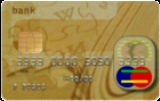
Debit card

Encyclopedia
A debit card is a plastic card that provides the cardholder electronic access to his or her bank account
/s at a financial institution. Some cards have a stored value with which a payment is made, while most relay a message to the cardholder's bank to withdraw funds from a designated account in favor of the payee's designated bank account. The card can be used as an alternative payment method to cash
when making purchases. In some cases, the cards are designed exclusively for use on the Internet, and so there is no physical card.
In many countries the use of debit cards has become so widespread that their volume of use has overtaken or entirely replaced the check
and, in some instances, cash transactions. Like credit card
s, debit cards are used widely for telephone and Internet purchases.
However, unlike credit cards, the funds paid using a debit card are transferred immediately from the bearer's bank account, instead of having the bearer pay back the money at a later date.
Debit cards usually also allow for instant withdrawal of cash, acting as the ATM card
for withdrawing cash and as a check guarantee card. Merchants may also offer cashback
facilities to customers, where a customer can withdraw cash along with their purchase.
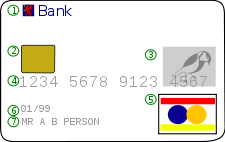
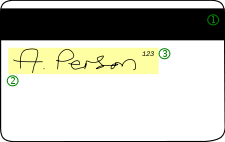 There are currently three ways that debit card transactions are processed: online debit (also known as PIN debit), offline debit (also known as signature debit) and the Electronic Purse Card System. One physical card can include the functions of an online debit card, an offline debit card and an electronic purse card.
Although many debit cards are of the Visa
or MasterCard
brand, there are many other types of debit card, each accepted only within a particular country or region, for example Switch
(now: Maestro) and Solo
in the United Kingdom
, Interac
in Canada
, Carte Bleue
in France
, Laser
in Ireland
, "EC electronic cash" (formerly Eurocheque
) in Germany
, UnionPay in China
and EFTPOS
cards in Australia and New Zealand. The need for cross-border compatibility and the advent of the euro
recently led to many of these card networks (such as Switzerland
's "EC direkt", Austria
's "Bankomatkasse" and Switch
in the United Kingdom
) being re-branded with the internationally recognised Maestro
logo, which is part of the MasterCard
brand. Some debit cards are dual branded with the logo of the (former) national card as well as Maestro
(for example, EC cards in Germany, Laser cards in Ireland, Switch and Solo in the UK, Pinpas cards in the Netherlands, Bancontact cards in Belgium, etc.). The use of a debit card system allows operators to package their product more effectively while monitoring customer spending. An example of one of these systems is ECS by Embed International
.
(PIN) authentication
system and some online cards require such authentication for every transaction, essentially becoming enhanced automatic teller machine (ATM) cards
. One difficulty in using online debit cards is the necessity of an electronic authorization device at the point of sale
(POS) and sometimes also a separate PINpad
to enter the PIN, although this is becoming commonplace for all card transactions in many countries. Overall, the online debit card is generally viewed as superior to the offline debit card because of its more secure authentication system and live status, which alleviates problems with processing lag
on transactions that may only issue online debit cards. Some on-line debit systems are using the normal authentication processes of Internet banking to provide real-time on-line debit transactions. The most notable of these are Ideal and POLl.
s of major credit cards (for example, Visa
or MasterCard
) or major debit cards (for example, Maestro
in the United Kingdom
and other countries, but not the United States
) and are used at the point of sale
like a credit card (with payer's signature). This type of debit card may be subject to a daily limit, and/or a maximum limit equal to the current/checking account balance from which it draws funds. Transactions conducted with offline debit cards require 2–3 days to be reflected on users’ account balances.
In some countries and with some banks and merchant service organizations, a "credit" or offline debit transaction is without cost to the purchaser beyond the face value of the transaction, while a fee may be charged for a "debit" or online debit transaction (although it is often absorbed by the retailer). Other differences are that online debit purchasers may opt to withdraw cash in addition to the amount of the debit purchase (if the merchant supports that functionality); also, from the merchant's standpoint, the merchant pays lower fees on online debit transaction as compared to "credit" (offline) debit transaction.
), Austria (Quick Wertkarte
), the Netherlands (Chipknip), Belgium (Proton
), Switzerland (CASH) and France (Mon€o
, which is usually carried by a debit card). In Austria and Germany, all current bank cards now include electronic purses.
people, an umbrella term used to describe diverse groups of individuals who do not use banks or credit unions for their financial transactions.
The advantages of prepaid debit cards include being safer than carry cash, worldwide functionality due to Visa and MasterCard
merchant acceptance, not having to worry about paying a credit card bill or going into debt, the ability for anyone over the age of 18 to apply and be accepted without regard to credit quality and the ability to direct deposit paychecks and government benefits onto the card for free.
Some of the first companies to enter this market were MiCash, RushCard and Netspend who gained high market share as a result of being first to market. However, in the past few years there have been several new providers that carry a number of other benefits, such as money remittance service, card-to-card transfers and the ability to apply without a social security number. An example of two of these providers are Goyow, a company based in New York who has grown substantially in the past 2 years as a result of their unique features and low fees. The other one is TransCash, a company based in California that came up with the only dual Visa
prepaid debit card product with the 2 cards inside the pack. The unique feature of the product is the fact that it comes with 2 separate accounts and not a shared balance.
Advantages of debit cards
Disadvantages of debit cards
In some countries, like India and Sweden, the consumer protection is the same regardless of the network used. Some banks set minimum and maximum purchase sizes, mostly for online-only cards. However, this has nothing to do with the card networks, but rather with the bank's judgement of the person's age and credit records. Any fees that the customers have to pay to the bank are the same regardless of whether the transaction is conducted as a credit or as a debit transaction, so there is no advantage for the customers to choose one transaction mode over another. Shops may add surcharges to the price of the goods or services in accordance with laws allowing them to do so. Banks consider the purchases as having been made at the moment when the card was swiped, regardless of when the purchase settlement was made. Regardless of which transaction type was used, the purchase may result in an overdraft because the money is considered to have left the account at the moment of the card swiping.
d workers to send money home to their families holding an affiliated debit card.
on the customer's account; funds are not actually withdrawn until the transaction is reconciled and hard-posted to the customer's account, usually a few days later. However, the previous sentence applies to all kinds of transaction types, at least when using a card issued by a European bank. This is in contrast to a typical credit card transaction; though it can also have a lag time of a few days before the transaction is posted to the account, it can be many days to a month or more before the consumer makes repayment with actual money.
Because of this, in the case of a benign or malicious error by the merchant or bank, a debit transaction may cause more serious problems (for example, money not accessible; overdrawn account) than in the case of a credit card transaction (for example, credit not accessible; over credit limit
). This is especially true in the United States
, where check fraud is a crime in every state, but exceeding your credit limit is not.
offers the customer to use an online-only Maestro card if the customer enters a Dutch address of residence, but not if the same customer enters a Swedish address of residence.
Internet purchases use neither a PIN code nor a signature for identification. Transactions may be conducted in either credit or debit mode (which is sometimes, but not always, indicated on the receipt), and this has nothing to do with whether the transaction was conducted on online or offline mode, since both credit and debit transactions may be conducted in both modes.
, banking industry spokesperson and lobbyist, contended that "current technology makes real-time notification of overdrafts cost-prohibitive." The article contended that "financial institutions don't want to change the status quo because they make good and easy money off their own customers' mistakes and irresponsibility."
On the other hand, prevention to keep consumers from debt has been a great relief to many consumers who are irresponsible and lack the necessary budgeting skills. Instead of taking away from others blindfolded, prepaid debit cards will disallow consumers from not spending what they do not have and encourage better habits with money management. To a great extent, prevention from such fees is helpful, trustworthy, and provides great relief to many that do not have to worry about any financial loss.
on the sale, making the transaction uneconomic for the retailer.
are called different names depending on the issuing bank: Commonwealth Bank of Australia: Keycard; Westpac Banking Corporation
: Handycard; National Australia Bank
: FlexiCard; ANZ Bank
: Access card; Bendigo Bank
: Cashcard.
EFTPOS is very popular in Australia and has been operating there since the 1980s. EFTPOS-enabled cards are accepted at almost all swipe terminals able to accept credit card
s, regardless of the bank that issued the card, including Maestro
cards issued by foreign banks, with most businesses accepting them, with 450,000 point of sale terminals.
EFTPOS cards can also be used to deposit and withdraw cash over the counter at Australia Post
outlets participating in giroPost, just as if the transaction was conducted at a bank branch, even if the bank branch is closed. Electronic transactions in Australia are generally processed via the Telstra Argent and Optus Transact Plus network - which has recently superseded the old Transcend network in the last few years. Most early keycards were only usable for EFTPOS and at ATM or bank branches, whilst the new debit card system works in the same ways a credit card, except it will only use funds in the specified bank account. This means that, among other advantages, the new system is suitable for electronic purchases without a delay of 2 to 4 days for bank-to-bank money transfers.
Australia operates both electronic credit card transaction authorization and traditional EFTPOS debit card authorization systems, the difference between the two being that EFTPOS transactions are authorized by a personal identification number (PIN) while credit card transactions are usually authorized by the printing and signing of a receipt, however in recent years card holders have been encouraged to enter their pin for added security on credit card purchases, negating the need to sign the receipt. If the user fails to enter the correct pin 3 times, the consequences range from the card being locked out for a minimum 24 hour period, a phone call or trip to the branch to reactivate with a new PIN, the card being cut up by the merchant, or in the case of an ATM, being kept inside the machine, both of which require a new card to be ordered.
Generally credit card transaction costs are borne by the merchant with no fee applied to the end user while EFTPOS transactions cost the consumer an applicable withdrawal fee charged by their bank.
The introduction of Visa and MasterCard
debit cards along with regulation in the settlement fees charged by the operators of both EFTPOS and credit cards by the Reserve Bank has seen a continuation in the increasing ubiquity of credit card use among Australians and a general decline in the profile of EFTPOS. However, the regulation of settlement fees also removed the ability of banks, who typically provide merchant services to retailers on behalf of Visa, MasterCard or Bankcard, from stopping those retailers charging extra fees to take payment by credit card instead of cash or EFTPOS. Though only a few operators with strong market power have done so, the passing on of fees charged for credit card transactions may result in an increased use of EFTPOS.
has a nation-wide EFTPOS system, called Interac Direct Payment
. Since being introduced in 1994, IDP has become the most popular payment method in the country. Previously, debit cards have been in use for ABM usage since the late 1970s, with Credit Unions in Saskatchewan and Alberta, Canada introducing the first card-based, networked ATMs beginning in June, 1977. Debit Cards, which could be used anywhere a credit card was accepted, were first introduced in Canada by Saskatchewan Credit Unions in 1982. In the early 1990s, pilot projects were conducted among Canada's six largest banks to gauge security, accuracy and feasibility of the Interac system. Slowly in the later half of the 1990s, it was estimated that approximately 50% of retailers offered Interac as a source of payment. Retailers, many small transaction retailers like coffee shops, resisted offering IDP to promote faster service. In 2009, 99% of retailers offer IDP as an alternative payment form.
In Canada, the debit card is sometimes referred to as a "bank card". It is a client card issued by a bank that provides access to funds and other bank account transactions, such as transferring funds, checking balances, paying bills, etc., as well as point of purchase transactions connected on the Interac
network. Since its national launch in 1994, Interac Direct Payment has become so widespread that, as of 2001, more transactions in Canada were completed using debit cards than cash. This popularity may be partially attributable to two main factors: the convenience of not having to carry cash, and the availability of automated bank machines (ABMs) and Direct Payment merchants on the network.
Debit cards may be considered similar to stored-value card
s in that they represent a finite amount of money owed by the card issuer to the holder. They are different in that stored-value cards are generally anonymous and are only usable at the issuer, while debit cards are generally associated with an individual's bank account and can be used anywhere on the Interac
network.
In Canada, the bank cards can be used at POS and ABMs. Interac Online has also been introduced in recent years allowing clients of most major Canadian banks to use their debit cards for online payment with certain merchants as well. Certain financial institutions also allow their clients to use their debit cards in the United States on the NYCE network.
(FCAC), which investigates consumer complaints.
According to the FCAC website, revisions to the Code that came into effect in 2005 put the onus on the financial institution to prove that a consumer was responsible for a disputed transaction, and also place a limit on the number of days that an account can be frozen during the financial institution's investigation of a transaction.
has an EFTPOS system called Redcompra (Purchase Network) which is currently used in at least 23,000 establishments throughout the country. Goods may be purchased using this system at most supermarkets, retail stores, pubs and restaurants in major urban centers.
has a system called Redeban-Multicolor and Credibanco Visa which are currently used in at least 23,000 establishments throughout the country. Goods may be purchased using this system at most supermarkets, retail stores, pubs and restaurants in major urban centers. Colombian debit cards are Maestro (pin), Visa Electron (pin), Visa Debit (as Credit) and MasterCard-Debit (as Credit).
was introduced on 1 September 1983, and despite the initial transactions being paper-based, the Dankort quickly won widespread acceptance in Denmark
. By 1985 the first EFTPOS
terminals were introduced, and 1985 was also the year when the number of Dankort transactions first exceeded 1 million.
It is not uncommon that Dankort is the only card accepted at smaller stores, thus making it harder for tourists to travel without cash.
Miscellaneous facts & numbers
Banks in France charge annual fees for debit cards (despite card payments being very cost efficient for the banks), yet they do not charge personal customers for checkbooks or processing checks (despite checks being very costly for the banks). This imbalance most probably dates from the unilateral introduction in France of Chip and PIN
debit cards in the early 1990s, when the cost of this technology was much higher than it is now. Credit cards of the type found in the United Kingdom and United States
are unusual in France and the closest equivalent is the deferred debit card, which operates like a normal debit card, except that all purchase transactions are postponed until the end of the month, thereby giving the customer between 1 and 31 days of interest-free credit. The annual fee for a deferred debit card is around €10 more than for one with immediate debit. Most France debit cards are branded with the Carte Bleue
logo, which assures acceptance throughout France. Most card holders choose to pay around €5 more in their annual fee to additionally have a Visa
or a MasterCard logo on their Carte Bleue
, so that the card is accepted internationally. A Carte Bleue
without a Visa
or a MasterCard logo is often known as a "Carte Bleue
Nationale" and a Carte Bleue
with a Visa
or a MasterCard logo is known as a "Carte Bleue
Internationale", or more frequently, simply called a "Visa" or "MasterCard". Many smaller merchants in France refuse to accept debit cards for transactions under a certain amount because of the minimum fee charged by merchants' banks per transaction (this minimum amount varies from €5 to €15.25, or in some rare cases even more). But more and more merchants accept debit cards for small amounts, due to the massive daily use of debit card nowadays. Merchants in France do not differentiate between debit and credit cards, and so both have equal acceptance. It is legal in France to set a minimum amount to transactions but the merchants must display it clearly.
for years. Facilities already existed before EFTPOS became popular with the Eurocheque
card, an authorization system initially developed for paper checks
where, in addition to signing the actual check, customers also needed to show the card alongside the check as a security measure. Those cards could also be used at ATMs and for card-based electronic funds transfer
(called Girocard
) with PIN entry. These are now the only functions of such cards: the Eurocheque system (along with the brand) was abandoned in 2002 during the transition from the Deutsche Mark to the euro
. As of 2005, most stores and petrol outlets have EFTPOS facilities. Processing fees are paid by the businesses, which leads to some business owners refusing debit card payments for sales totalling less than a certain amount, usually 5 or 10 euro.
To avoid the processing fees, many businesses resorted to using direct debit
, which is then called electronic direct debit . The point-of-sale terminal reads the bank sort code and account number from the card but instead of handling the transaction through the Girocard network it simply prints a form, which the customer signs to authorise the debit note. However, this method also avoids any verification or payment guarantee provided by the network. Further, customers can return debit notes by notifying their bank without giving a reason. This means that the beneficiary bears the risk of fraud and illiquidity. Some business mitigate the risk by consulting a proprietary blacklist
or by switching to Girocard for higher transaction amounts.
Around 2000, an Electronic Purse Card was introduced, dubbed Geldkarte
("money card"). It makes use of the smart card
chip on the front of the standard issue debit card. This chip can be charged with up to 200 euro, and is advertised as a means of making medium to very small payments, even down to several euros or cent payments. The key factor here is that no processing fees are deducted by banks. It did not gain the popularity its inventors had hoped for. However, this could change as this chip is now used as means of age verification at cigarette vending machines, which has been mandatory since January 2007. Furthermore, some payment discounts are being offered (e.g. a 10% reduction for public transport fares) when paying with "Geldkarte". The "Geldkarte" payment lacks all security measures, since it does not require the user to enter a PIN or sign a sales slip: the loss of a "Geldkarte" is similar to the loss of a wallet or purse - anyone who finds it can then use their find to pay for their own purchases.
is EPS
. Bank customers can use their ATM card to make an instant EPS payment, much like a debit card. Most banks in Hong Kong provide ATM cards with EPS capability.
Only one bank at this time offers a Visa card as a debit card in Hong Kong. Hang Seng's Bank's Enjoy card is the only one. It is linked to a person's or company's savings or checking account and funds can be moved upon request or on a regularly scheduled basis to cover the charges that are incurred, whether in person or on-line. Overdraft privileges are not permitted at this time. The reason for the limited use is the virtual monopoly of the EPS Corporation which us co-owned by 21 major banks. Unfortunately, EPS is not useable on-line or overseas as a debit card (with limited exceptions, i.e. PLUS network POS transactions).
debit cards are far more common and popular than credit cards. Many Hungarians even refer to their debit card ("betéti kártya") mistakenly using the word for credit card ("hitelkártya").
as the merchant is charged for each transaction. The debit card therefore is mostly used for ATM
transactions. Most of the banks issue VISA debit cards, while some banks (like SBI
and Citibank India
) issue Maestro
cards. The debit card transactions are routed through the VISA or MasterCard
networks rather than directly via the issuing bank.
The National Payments Corporation of India
(NPCI) is introducing a payment network and debit card dubbed 'India card'. The Reserve Bank of India
is expecting this system will gradually replace the overseas run networks from Visa and MaterCard for Indian ATM, debit and credit card services.
The National Payments Corporation of India
(NPCI) has formally decided the name and logo of this new international payment gateway. The new name is being called RuPay
.
and Rasheed Bank
, together with the Iraqi Electronic Payment System (IEPS) have established a company called International Smart Card, which have developed a national credit card called 'Qi Card
'. The card is issued since 2008. According to the company's website: 'after less than two years of the initial launch of the Qi card solution, we have hit 1.6 million cardholder with the potential to issue 2 million cards by the end of 2010, issuing about 100,000 card monthly is a testament to the huge success of the Qi card solution. Parallel to this will be the expansion into retail stores through a network of points of sales of about 30,000 units by 2015'
people usually use their , originally intended only for use with cash machines, as debit cards. The debit functionality of these cards is usually referred to as , and only cash cards from certain banks can be used. A cash card has the same size as a VISA/MasterCard. As identification, the user will have to enter his or her four-digit PIN when paying. J-Debit was started in Japan on March 6, 2000.
Suruga Bank began service of Japan's first Visa Debit
in 2006. Ebank will start service of Visa Debit by the end of 2007.
using EFTPOS
is known as pinnen (pinning), a term derived from the use of a Personal Identification Number
. PINs are also used for ATM
transactions, and the term is used interchangeably by many people, although it was introduced as a marketing brand for EFTPOS. The system was launched in 1987, and in 2010 there were 258,585 terminals throughout the country, including mobile terminals used by delivery services and on markets. All banks offer a debit card suitable for EFTPOS with current accounts.
PIN transactions are usually free to the customer, but the retailer is charged per-transaction and monthly fees. Equens, an association with all major banks as its members, runs the system, and until August 2005 also charged for it. Responding to allegations of monopoly abuse, it has handed over contractual responsibilities to its member banks, who now offer competing contracts. Interpay, a legal predecessor of Equens, was fined €47 million in 2004, but the fine was later dropped, and a related fine for banks was lowered from €17 million to €14 million. Per-transaction fees are between 5-10 eurocents, depending on volume.
Credit cards use in the Netherlands is very low, and most credit cards cannot be used with EFTPOS, or charge very high fees to the customer. Debit cards can often, though not always, be used in the entire EU for EFTPOS. Most debit cards are Maestro
cards.
Electronic Purse Cards (called Chipknip) were introduced in 1996, but have never become very popular.
(electronic fund transfer at point of sale
) in New Zealand is highly popular. In 2006, 70 percent of all retail transactions were made by eftpos, with an average of 306 EFTPOS transaction being made per person. At the same time, there were 125,000 EFTPOS terminals in operation (one for every 30 people), and 5.1 million EFTPOS cards in circulation (1.27 per capita).
The system involves the merchant swiping (or inserting) the customer's card and entering the purchase amount. Point of sale systems with integrated EFTPOS often sent the purchase total to the terminal and the customer swipes their own card. The customer then selects the account they wish to use: Current/Cheque (CHQ), Savings (SAV), or Credit Card (CRD), before entering in their PIN. After a short processing time in which the terminal contacts the EFTPOS network and the bank, the transaction is accepted (or declined) and a receipt is printed. The EFTPOS system is used for credit cards as well, with a customer selecting Credit Card and entering their PIN, or for older credit cards without loaded PIN, pressing OK and signing their receipt with identification through matching signatures. Larger businesses connect to the EFTPOS network by dedicated phone lines or more recently internet protocol
connections. Most smaller businesses however have their EFTPOS terminals communicate through their regular voice line, often resulting in shouts for people to get off the phone or "Declined Transmission Error" transactions when the merchant forgets someone is on the phone.
Virtually all retail outlets have EFTPOS facilities, so much that retailers without EFTPOS have to advertise so. In addition, an increasing number of mobile operator, such as taxis, stall holders and pizza deliverers have mobile EFTPOS systems. The system is made up of two primary networks: EFTPOS NZ, which is owned by ANZ National Bank and Paymark Limited (formerly Electronic Transaction Services Limited), which is owned by ANZ National Bank, ASB Bank
, Westpac
and the Bank of New Zealand
. The two networks are intertwined and highly sophisticated and secure, able to handle huge volumes of transactions during busy periods such as the lead-up to Christmas. Network failures are rare, but when they occur they cause massive disruption, resulting in major delays and loss of income for businesses. Most businesses have to resort to manual "zip-zap" swipe machines in such case. Newer POS-based terminals have the ability to "capture" transactions in the event of a communications break-down - instead of entering a PIN, the customer signs their receipt and the transaction is accepted on a matching signature, and the transaction is stored until the network is restored. A notable example of this occurs on the Cook Strait
ferries, where in the middle of Cook Strait there is no mobile phone reception to connect to the EFTPOS network.
EFTPOS is used for transactions large and small, from 10c up to thousands of dollars (or the daily limit of the EFTPOS card). Depending on the user's bank, a fee may be charged for use of EFTPOS. Most youth accounts do not attract fees for electronic transactions, meaning the use of EFTPOS by the younger generations has become ubiquitous (and subsequently cash use becoming rare). Typically merchants don't pay fees for transactions, most only having to pay for the equipment rental.
ATM cards and EFTPOS cards were once separate, but today EFTPOS and ATM cards are combined into a single EFTPOS-ATM card. The cards are issued by banks to customers, and often come in multiple designs, with some banks allowing customers to place a picture of their choice on their EFTPOS card. One of the disadvantages of New Zealand's well-established EFTPOS system is that it is incompatible with overseas systems and non-face-to-face purchases. In response to this, many banks have adopted international debit card systems such as Maestro
and Visa Debit
in addition to the New Zealand EFTPOS system.
, all three national ATM network consortia offer proprietary PIN debit. This was first offered by Express Payment System
in 1987, followed by Megalink
with Paylink in 1993 then BancNet
with the Point-of-Sale in 1994.
Express Payment System
or EPS was the pioneer provider, having launched the service in 1987 on behalf of the Bank of the Philippine Islands
. The EPS service has subsequently been extended in late 2005 to include the other Expressnet members: Banco de Oro and Land Bank of the Philippines
. They currently operate 10,000 terminals for their cardholders.
Megalink
launched Paylink EFTPOS system in 1993. Terminal services are provided by Equitable Card Network on behalf of the consortium. Service is available in 2,000 terminals, mostly in Metro Manila
.
BancNet
introduced their Point of sale
System in 1994 as the first consortium-operated EFTPOS service in the country. The service is available in over 1,400 locations throughout the Philippines, including second and third-class municipalities. In 2005, BancNet signed a Memorandum of Agreement to serve as the local gateway for China UnionPay
, the sole ATM switch in the People's Republic of China
. This will allow the estimated 1.0 billion Chinese ATM cardholders to use the BancNet ATMs and the EFTPOS in all participating merchants.
Visa debit cards are issued by Union Bank of the Philippines
(e-Wallet & eon), Chinatrust, Equicom Savings Bank
(Key Card & Cash Card), Banco De Oro, HSBC
, HSBC Savings Bank & Sterling Bank of Asia (VISA ShopNPay prepaid and debit cards). Union Bank of the Philippines cards, Equicom Savings Bank & Sterling Bank of Asia EMV cards which can also be used for internet purchases. Sterling Bank of Asia has released its first line of prepaid and debit Visa cards with EMV
chip.
MasterCard
debit cards are issued by Banco de Oro, Security Bank
(Cashlink & Cash Card) & Smart Communications
(Smart Money) tied up with Banco De Oro. MasterCard Electronic cards are issued by BPI (Express Cash) and Security Bank
(CashLink Plus). All VISA and MasterCard based debit cards in the Philippines are non-embossed and are marked either for "Electronic Use Only" (VISA/MasterCard) or "Valid only where MasterCard Electronic is Accepted" (MasterCard Electronic).
, local debit cards, such as PolCard, have become largely substituted with international ones, such as Visa, MasterCard, or the unembossed Visa Electron or Maestro. Most banks in Poland block Internet and MOTO transactions with unembossed cards, requiring the customer to buy an embossed card or a card for Internet/MOTO transactions only. The number of banks which do not block MOTO transactions on unembossed cards has recently started to increase.
, debit cards are accepted almost everywhere: ATMs, stores, and so on. The most commonly accepted are Visa and MasterCard, or the unembossed Visa Electron or Maestro. Regarding Internet payments debit cards can't be used for transfers, due to its unsafeness, so banks recommend the use of 'MBnet', a pre-registered safe system that creates a virtual card with a pre-selected credit limit. All the card system is regulated by SIBS, the institution created by Portuguese banks to manage all the regulations and communication processes proply. SIBS' shareholders are all the 27 banks operating in Portugal.
technology.
Nearly every transaction, regardless of brand or system, is processed as an immediate debit transaction. Non-debit transactions within these systems have spending limits that are strictly limited when compared with typical Visa or MasterCard accounts.
, all debit card transactions are routed trough Saudi Payments Network (SPAN), the only electronic payment system in the Kingdom and all banks are required by the Saudi Arabian Monetary Agency
(SAMA) to issue cards fully compatible with the network. It connects all point of sale (POS) terminals throughout the country to a central payment switch which in turn re-routes the financial transactions to the card issuer, local bank, VISA, AMEX or MasterCard.
As well as its use for debit cards, the network is also used for ATM and credit card transactions.
(NETS), founded by Singapore’s leading banks and shareholders namely DBS, Keppel Bank, OCBC and its associates, OUB, IBS, POSB, Tat Lee Bank and UOB in 1985 as a result of a need for a centralised e-Payment operator.
However,due to the banking restructuring and mergers, the local banks became UOB, OCBC, DBS-POSB as the shareholders of NETS with Standard Chartered Bank to offer NETS to their customers. However, DBS and POSB customers can use their network atms on their own and not be shared with UOB, OCBC or SCB (StanChart). The mega failure of 5 July 2010 of POSB-DBS ATM Networks (about 97,000 machines) made the government to rethink the shared ATM system again as it affected the NETS system too.
In 2010, in line with the mandatory EMV system, Local Singapore Banks starts to reissue their Debit Visa/Mastercard branded debit cards with the EMV Chip compliant ones compared to the magnetic stripe system in place. Banks involved includes the NETS Members of POSB-DBS, UOB-OCBC-SCB along with the SharedATM alliance (NON-NETS) of HSBC, Citibank, State Bank of India, and Maybank. Standard Chartered Bank (SCB) is also a SharedATM alliance member. Non branded cards of POSB and Maybank local ATM Cards are kept without a chip but has a Plus or Maestro sign so that they can use it only to draw cash locally or overseas.
Maybank Debit Mastercard are also available to use in Malaysia just as a normal ATM or Dedit MEPS card.
Singapore also uses the e-purse systems of NETS CASHCARD and the CEPAS wave system by EZ-Link
and NETS.
debit cards (an integrated EFTPOS
system) are an established part of the retail market and are widely accepted both by bricks and mortar stores and by internet stores. The term EFTPOS
is not widely used by the public; debit card is the generic term used. Cards commonly in circulation include Maestro
(previously Switch
), Debit MasterCard
, Visa Debit
(previously Visa Delta) and Visa Electron
. Banks do not charge customers for EFTPOS
transactions in the UK, but some retailers make small charges, particularly where the transaction amount in question is small. The UK has converted all debit cards in circulation to Chip and PIN
(except for Chip and Signature cards issued to people with certain disabilities), based on the EMV
standard, to increase transaction security; however, PINs are not required for internet transactions.
In the United Kingdom, banks started to issue debit cards in the mid 1980s in a bid to reduce the number of cheques being used at the point of sale, which are costly for the banks to process; the first bank to do so was Barclays with the Barclays Connect card. As in most countries, fees paid by merchants in the United Kingdom
to accept credit cards are a percentage of the transaction amount, which funds card holders' interest-free credit periods as well as incentive schemes such as points, airmiles or cashback. Debit cards do not usually have these characteristics, and so the fee for merchants to accept debit cards is a low fixed amount, regardless of transaction amount. For very small amounts, this means it is cheaper for a merchant to accept a credit card than a debit card. Although merchants won the right through The Credit Cards (Price Discrimination) Order 1990 to charge customers different prices according to the payment method, few merchants in the UK charge less for payment by debit card than by credit card, the most notable exceptions being budget airlines, travel agents and IKEA
. Debit cards in the UK lack the advantages offered to holders of UK-issued credit cards, such as free incentives (points, airmiles, cashback etc.), interest-free credit and protection against defaulting merchants under Section 75 of the Consumer Credit Act 1974. Almost all establishments in the United Kingdom that accept credit cards also accept debit cards (although not always Solo
and Visa Electron
), but a minority of merchants, for cost reasons, accept debit cards and not credit cards.
, EFTPOS is universally referred to simply as debit. The same interbank network
s that operate the ATM
network also operate the POS network. Most interbank network
s, such as Pulse
, NYCE
, MAC, Tyme
, SHAZAM
, STAR
, and so on, are regional and do not overlap, however, most ATM/POS networks have agreements to accept each other's cards. This means that cards issued by one network will typically work anywhere they accept ATM/POS cards for payment. For example, a NYCE card will work at a Pulse POS terminal or ATM, and vice versa. Many debit cards in the United States are issued with a Visa, MasterCard or American Express
logo allowing use of their signature-based networks.
The liability of a U.S. debit card user in case of loss or theft is up to $50 USD if the loss or theft is reported to the issuing bank in two business days after the customer notices the loss.
The fees charged to merchants on offline debit purchases—and the lack of fees charged merchants for processing online debit purchases and paper checks—have prompted some major merchants in the U.S. to file lawsuit
s against debit-card transaction processors such as Visa and MasterCard. In 2003, Visa and MasterCard agreed to settle the largest of these lawsuits and agreed to settlement
s of billions of dollars.
Some consumers prefer "credit" transactions because of the lack of a fee charged to the consumer/purchaser; also, a few debit cards in the U.S. offer rewards for using "credit" (for example, S&T Bank's "Preferred Debit Rewards Card" ). However, since "credit" costs more for merchants, many terminals at PIN-accepting merchant locations now make the "credit" function more difficult to access. For example, if you swipe a debit card at Wal-Mart
in the U.S., you are immediately presented with the PIN screen for online debit; to use offline debit you must press "cancel" to exit the PIN screen, then press "credit" on the next screen.
2009-07-08: Minimum and Maximum Charges for Visa in USA
The Merchants Agreement for Visa states (page 9, or 14/141 in PDF):
Always honor valid Visa cards in your acceptance category, regardless of the dollar amount of the purchase. Imposing minimum or maximum purchase amounts in order to accept a Visa card transaction is a violation of the Visa rules.
As a result of the Dodd-Frank Act, U.S. merchants can now set a minimum purchase amount on credit cards (but not debit cards), not to exceed $10.
only allows medical expenses. It is used by some banks for withdrawals from their FSAs
, MSA
s, and HSA
s as well. They have Visa or MasterCard
logos, but cannot be used as "debit cards", only as "credit cards"", and they are not accepted by all merchants that accept debit and credit cards, but only by those that accept FSA debit card
s. Merchant codes and product codes are used at the point of sale (required by law by certain merchants by certain dates in the USA) to restrict sales if they do not qualify. Because of the extra checking and documenting that goes on, later, the statement can be used to substantiate
these purchases for tax deductions. In the occasional instance that a qualifying purchase is rejected, another form of payment must be used (a check or payment from another account and a claim for reimbursement later). In the more likely case that non-qualifying items are accepted, the consumer is technically still responsible, and the discrepancy could be revealed during an audit.
A small but growing segment of the debit card business in the U.S. involves access to tax-favored spending accounts such as flexible spending account
s (FSA), health reimbursement accounts
(HRA), and health savings account
s (HSA). Most of these debit cards are for medical expenses, though a few are also issued for dependent care and transportation expenses.
Traditionally, FSAs (the oldest of these accounts) were accessed only through claims for reimbursement after incurring, and often paying, an out-of-pocket expense; this often happens after the funds have already been deducted from the employee's paycheck. (FSAs are usually funded by payroll deduction.) The only method permitted by the Internal Revenue Service
(IRS) to avoid this "double-dipping" for medical FSAs and HRAs is through accurate and auditable reporting on the tax return. Statements on the debit card that say "for medical uses only" are invalid for several reasons: (1) The merchant and issuing banks have no way of quickly determining whether the entire purchase qualifies for the customer's type of tax benefit; (2) the customer also has no quick way of knowing; often has mixed purchases by necessity or convenience; and can easily make mistakes; (3) extra contractual clauses between the customer and issuing bank would cross-over into the payment processing standards, creating additional confusion (for example if a customer was penalized for accidentally purchasing a non-qualifying item, it would undercut the potential savings advantages of the account). Therefore, using the card exclusively for qualifying purchases may be convenient for the customer, but it has nothing to do with how the card can actually be used. If the bank rejects a transaction, for instance, because it is not at a recognized drug store, then it would be causing harm and confusion to the cardholder. In the United States, not all medical service or supply stores are capable of providing the correct information so an FSA debit card issuer can honor every transaction-if rejected or documentation is not deemed enough to satisfy regulations, cardholders may have to send in forms manually.
Bank account
A Bank account is a financial account recording the financial transactions between the customer and the bank and the resulting financial position of the customer with the bank .-Account types:...
/s at a financial institution. Some cards have a stored value with which a payment is made, while most relay a message to the cardholder's bank to withdraw funds from a designated account in favor of the payee's designated bank account. The card can be used as an alternative payment method to cash
Cash
In common language cash refers to money in the physical form of currency, such as banknotes and coins.In bookkeeping and finance, cash refers to current assets comprising currency or currency equivalents that can be accessed immediately or near-immediately...
when making purchases. In some cases, the cards are designed exclusively for use on the Internet, and so there is no physical card.
In many countries the use of debit cards has become so widespread that their volume of use has overtaken or entirely replaced the check
Cheque
A cheque is a document/instrument See the negotiable cow—itself a fictional story—for discussions of cheques written on unusual surfaces. that orders a payment of money from a bank account...
and, in some instances, cash transactions. Like credit card
Credit card
A credit card is a small plastic card issued to users as a system of payment. It allows its holder to buy goods and services based on the holder's promise to pay for these goods and services...
s, debit cards are used widely for telephone and Internet purchases.
However, unlike credit cards, the funds paid using a debit card are transferred immediately from the bearer's bank account, instead of having the bearer pay back the money at a later date.
Debit cards usually also allow for instant withdrawal of cash, acting as the ATM card
ATM card
An ATM card is a card issued by a bank, credit union or building society that can be used at an ATM for deposits, withdrawals, account information, and other types of transactions, often through interbank networks.Some ATM cards can also be used:* at a branch, as identification for in-person...
for withdrawing cash and as a check guarantee card. Merchants may also offer cashback
Debit card cashback
Debit card cashback is a service offered to retail customers whereby an amount is added to the total purchase price of a transaction paid by debit card and the customer receives that amount in cash along with the purchase. For example, a customer purchasing $18.99 worth of goods might ask for...
facilities to customers, where a customer can withdraw cash along with their purchase.
Types of debit card systems
Although many debit cards are of the Visa
VISA (credit card)
Visa Inc. is an American multinational financial services corporation headquartered on 595 Market Street, Financial District in San Francisco, California, United States, although much of the company's staff is based in Foster City, California. It facilitates electronic funds transfers throughout...
or MasterCard
MasterCard
Mastercard Incorporated or MasterCard Worldwide is an American multinational financial services corporation with its headquarters in the MasterCard International Global Headquarters, Purchase, Harrison, New York, United States...
brand, there are many other types of debit card, each accepted only within a particular country or region, for example Switch
Switch (debit card)
Switch is a debit card in the United Kingdom. It is a sister to the Solo debit card.Switch was launched in 1988 by Midland Bank, National Westminster Bank and the Royal Bank of Scotland as a multifunction cheque guarantee and cash card. The brand was merged with Maestro, an international debit card...
(now: Maestro) and Solo
Solo (debit card)
Solo is a debit card in the United Kingdom. It is a sister to the UK Maestro debit card. Solo was launched on 1 July 1997 by the Switch Card Scheme for use on deposit accounts, as well as by customers who did not qualify for a Maestro card on current accounts.Solo was formerly issued as a...
in the United Kingdom
United Kingdom
The United Kingdom of Great Britain and Northern IrelandIn the United Kingdom and Dependencies, other languages have been officially recognised as legitimate autochthonous languages under the European Charter for Regional or Minority Languages...
, Interac
Interac
Interac Association is a Canadian organization linking enterprises that have proprietary networks so that they may communicate with each other for the purpose of exchanging electronic financial transactions. The Association was founded in 1984 as a cooperative venture between five financial...
in Canada
Canada
Canada is a North American country consisting of ten provinces and three territories. Located in the northern part of the continent, it extends from the Atlantic Ocean in the east to the Pacific Ocean in the west, and northward into the Arctic Ocean...
, Carte Bleue
Carte Bleue
Carte Bleue is a major debit card payment system operating in France. Unlike Visa Electron or Maestro debit cards, Carte Bleue allows transactions without requiring authorization from the cardholder's bank. In many situations, the card works like a credit card but without fees for the cardholder...
in France
France
The French Republic , The French Republic , The French Republic , (commonly known as France , is a unitary semi-presidential republic in Western Europe with several overseas territories and islands located on other continents and in the Indian, Pacific, and Atlantic oceans. Metropolitan France...
, Laser
Laser (debit card)
Laser Card is a debit card scheme in Ireland. The Laser Scheme is maintained and operated by , a not-for-profit body owned by four leading financial institutions in Ireland and overseen since 2008 by the Oversight Unit of the Central Bank. The scheme was launched in 1996 and in 2010 there were...
in Ireland
Republic of Ireland
Ireland , described as the Republic of Ireland , is a sovereign state in Europe occupying approximately five-sixths of the island of the same name. Its capital is Dublin. Ireland, which had a population of 4.58 million in 2011, is a constitutional republic governed as a parliamentary democracy,...
, "EC electronic cash" (formerly Eurocheque
Eurocheque
The Eurocheque was a type of cheque used in Europe that was accepted across national borders and which could be written in a variety of currencies....
) in Germany
Germany
Germany , officially the Federal Republic of Germany , is a federal parliamentary republic in Europe. The country consists of 16 states while the capital and largest city is Berlin. Germany covers an area of 357,021 km2 and has a largely temperate seasonal climate...
, UnionPay in China
China
Chinese civilization may refer to:* China for more general discussion of the country.* Chinese culture* Greater China, the transnational community of ethnic Chinese.* History of China* Sinosphere, the area historically affected by Chinese culture...
and EFTPOS
EFTPOS
EFTPOS is the general term used for debit card based systems used for processing transactions through terminals at points of sale. In Australia and New Zealand it is also the brand name of the specific system used for such payments...
cards in Australia and New Zealand. The need for cross-border compatibility and the advent of the euro
Euro
The euro is the official currency of the eurozone: 17 of the 27 member states of the European Union. It is also the currency used by the Institutions of the European Union. The eurozone consists of Austria, Belgium, Cyprus, Estonia, Finland, France, Germany, Greece, Ireland, Italy, Luxembourg,...
recently led to many of these card networks (such as Switzerland
Switzerland
Switzerland name of one of the Swiss cantons. ; ; ; or ), in its full name the Swiss Confederation , is a federal republic consisting of 26 cantons, with Bern as the seat of the federal authorities. The country is situated in Western Europe,Or Central Europe depending on the definition....
's "EC direkt", Austria
Austria
Austria , officially the Republic of Austria , is a landlocked country of roughly 8.4 million people in Central Europe. It is bordered by the Czech Republic and Germany to the north, Slovakia and Hungary to the east, Slovenia and Italy to the south, and Switzerland and Liechtenstein to the...
's "Bankomatkasse" and Switch
Switch (debit card)
Switch is a debit card in the United Kingdom. It is a sister to the Solo debit card.Switch was launched in 1988 by Midland Bank, National Westminster Bank and the Royal Bank of Scotland as a multifunction cheque guarantee and cash card. The brand was merged with Maestro, an international debit card...
in the United Kingdom
United Kingdom
The United Kingdom of Great Britain and Northern IrelandIn the United Kingdom and Dependencies, other languages have been officially recognised as legitimate autochthonous languages under the European Charter for Regional or Minority Languages...
) being re-branded with the internationally recognised Maestro
Maestro (debit card)
Maestro is a multi-national debit card service owned by MasterCard, and was founded in 1990. Maestro cards are obtained from associate banks and can be linked to the card holder's current account, or they can be prepaid cards...
logo, which is part of the MasterCard
MasterCard
Mastercard Incorporated or MasterCard Worldwide is an American multinational financial services corporation with its headquarters in the MasterCard International Global Headquarters, Purchase, Harrison, New York, United States...
brand. Some debit cards are dual branded with the logo of the (former) national card as well as Maestro
Maestro (debit card)
Maestro is a multi-national debit card service owned by MasterCard, and was founded in 1990. Maestro cards are obtained from associate banks and can be linked to the card holder's current account, or they can be prepaid cards...
(for example, EC cards in Germany, Laser cards in Ireland, Switch and Solo in the UK, Pinpas cards in the Netherlands, Bancontact cards in Belgium, etc.). The use of a debit card system allows operators to package their product more effectively while monitoring customer spending. An example of one of these systems is ECS by Embed International
Embed International
Embed International is a supplier and manufacturer of debit card systems and managementapplications for the amusement, leisure and entertainment industries.Embed systems are now used throughout the world at over 1000 operating locations...
.
Online Debit System
Online debit cards require electronic authorization of every transaction and the debits are reflected in the user’s account immediately. The transaction may be additionally secured with the personal identification numberPersonal identification number
A personal identification number is a secret numeric password shared between a user and a system that can be used to authenticate the user to the system. Typically, the user is required to provide a non-confidential user identifier or token and a confidential PIN to gain access to the system...
(PIN) authentication
Authentication
Authentication is the act of confirming the truth of an attribute of a datum or entity...
system and some online cards require such authentication for every transaction, essentially becoming enhanced automatic teller machine (ATM) cards
ATM card
An ATM card is a card issued by a bank, credit union or building society that can be used at an ATM for deposits, withdrawals, account information, and other types of transactions, often through interbank networks.Some ATM cards can also be used:* at a branch, as identification for in-person...
. One difficulty in using online debit cards is the necessity of an electronic authorization device at the point of sale
Point of sale
Point of sale or checkout is the location where a transaction occurs...
(POS) and sometimes also a separate PINpad
PINpad
A PIN pad is an electronic device used in a debit or smart card-based transaction to input and encrypt the cardholder's PIN. PIN pads are normally used with integrated point of sale devices in which an electronic cash register is responsible for taking the sale amount and initiating/handling the...
to enter the PIN, although this is becoming commonplace for all card transactions in many countries. Overall, the online debit card is generally viewed as superior to the offline debit card because of its more secure authentication system and live status, which alleviates problems with processing lag
Lag
Lag is a common word meaning to fail to keep up or to fall behind. In real-time applications, the term is used when the application fails to respond in a timely fashion to inputs...
on transactions that may only issue online debit cards. Some on-line debit systems are using the normal authentication processes of Internet banking to provide real-time on-line debit transactions. The most notable of these are Ideal and POLl.
Offline Debit System
Offline debit cards have the logoLogo
A logo is a graphic mark or emblem commonly used by commercial enterprises, organizations and even individuals to aid and promote instant public recognition...
s of major credit cards (for example, Visa
VISA (credit card)
Visa Inc. is an American multinational financial services corporation headquartered on 595 Market Street, Financial District in San Francisco, California, United States, although much of the company's staff is based in Foster City, California. It facilitates electronic funds transfers throughout...
or MasterCard
MasterCard
Mastercard Incorporated or MasterCard Worldwide is an American multinational financial services corporation with its headquarters in the MasterCard International Global Headquarters, Purchase, Harrison, New York, United States...
) or major debit cards (for example, Maestro
Maestro (debit card)
Maestro is a multi-national debit card service owned by MasterCard, and was founded in 1990. Maestro cards are obtained from associate banks and can be linked to the card holder's current account, or they can be prepaid cards...
in the United Kingdom
United Kingdom
The United Kingdom of Great Britain and Northern IrelandIn the United Kingdom and Dependencies, other languages have been officially recognised as legitimate autochthonous languages under the European Charter for Regional or Minority Languages...
and other countries, but not the United States
United States
The United States of America is a federal constitutional republic comprising fifty states and a federal district...
) and are used at the point of sale
Point of sale
Point of sale or checkout is the location where a transaction occurs...
like a credit card (with payer's signature). This type of debit card may be subject to a daily limit, and/or a maximum limit equal to the current/checking account balance from which it draws funds. Transactions conducted with offline debit cards require 2–3 days to be reflected on users’ account balances.
In some countries and with some banks and merchant service organizations, a "credit" or offline debit transaction is without cost to the purchaser beyond the face value of the transaction, while a fee may be charged for a "debit" or online debit transaction (although it is often absorbed by the retailer). Other differences are that online debit purchasers may opt to withdraw cash in addition to the amount of the debit purchase (if the merchant supports that functionality); also, from the merchant's standpoint, the merchant pays lower fees on online debit transaction as compared to "credit" (offline) debit transaction.
Electronic Purse Card System
Smart-card-based electronic purse systems (in which value is stored on the card chip, not in an externally recorded account, so that machines accepting the card need no network connectivity) are in use throughout Europe since the mid-1990s, most notably in Germany (GeldkarteGeldkarte
Geldkarte is a Stored-value card or electronic cash system used in Germany. It operates as an offline smart card for small payment at things like vending machines and to pay for public transport or parking tickets. The card is pre-paid and funds are loaded onto the card using ATMs or dedicated...
), Austria (Quick Wertkarte
Quick Wertkarte
Quick is an electronic purse system available on Austrian bank cards to allow small purchases to be made without cash. The history of the Quick system goes back to 1994....
), the Netherlands (Chipknip), Belgium (Proton
Proton (bank card)
Proton is an electronic purse application for debit cards in Belgium. The system was introduced in February 1995 with the goal to replace cash primarily for small transactions around the 15 EUR...
), Switzerland (CASH) and France (Mon€o
Mon€o
Moneo, sometimes branded as mon€o, is an electronic purse system available on French bank cards to allow small purchases to be made without cash....
, which is usually carried by a debit card). In Austria and Germany, all current bank cards now include electronic purses.
Prepaid debit cards
Prepaid debit cards, also called reloadable debit cards, appeal to a variety of users. The primary market for prepaid cards are unbankedUnbanked
The unbanked are citizens of a country who do not have their own bank account. Along with the underbanked, they may rely on alternative financial services for their financial needs, where these are available.-The unbanked in the United States:...
people, an umbrella term used to describe diverse groups of individuals who do not use banks or credit unions for their financial transactions.
The advantages of prepaid debit cards include being safer than carry cash, worldwide functionality due to Visa and MasterCard
MasterCard
Mastercard Incorporated or MasterCard Worldwide is an American multinational financial services corporation with its headquarters in the MasterCard International Global Headquarters, Purchase, Harrison, New York, United States...
merchant acceptance, not having to worry about paying a credit card bill or going into debt, the ability for anyone over the age of 18 to apply and be accepted without regard to credit quality and the ability to direct deposit paychecks and government benefits onto the card for free.
Some of the first companies to enter this market were MiCash, RushCard and Netspend who gained high market share as a result of being first to market. However, in the past few years there have been several new providers that carry a number of other benefits, such as money remittance service, card-to-card transfers and the ability to apply without a social security number. An example of two of these providers are Goyow, a company based in New York who has grown substantially in the past 2 years as a result of their unique features and low fees. The other one is TransCash, a company based in California that came up with the only dual Visa
Visa
Visa or VISA may refer to:* Visa , a document issued by a country's government allowing the holder to enter or to leave that country...
prepaid debit card product with the 2 cards inside the pack. The unique feature of the product is the fact that it comes with 2 separate accounts and not a shared balance.
Advantages and disadvantages
The widespread use of debit and check cards have revealed numerous advantages and disadvantages to the consumer and retailer alike.Advantages of debit cards
- A consumer who is not credit worthy and may find it difficult or impossible to obtain a credit card can more easily obtain a debit card, allowing him/her to make plastic transactions. For example, legislation often prevents minors from taking out debt, which includes the use of a credit card, but not online debit card transactions.
- For most transactions, a check card can be used to avoid check writing altogether. Check cards debit funds from the user's account on the spot, thereby finalizing the transaction at the time of purchase, and bypassing the requirement to pay a credit card bill at a later date, or to write an insecure check containing the account holder's personal information.
- Like credit cards, debit cards are accepted by merchants with less identification and scrutiny than personal checks, thereby making transactions quicker and less intrusive. Unlike personal checks, merchants generally do not believe that a payment via a debit card may be later dishonored.
- Unlike a credit card, which charges higher fees and interest rates when a cash advance is obtained, a debit card may be used to obtain cash from an ATM or a PIN-based transaction at no extra charge, other than a foreign ATM fee.
Disadvantages of debit cards
- Use of a debit card is not usually limited to the existing funds in the account to which it is linked, most banks allow a certain threshold over the available bank balance which can cause overdraftOverdraftAn overdraft occurs when money is withdrawn from a bank account and the available balance goes below zero. In this situation the account is said to be "overdrawn". If there is a prior agreement with the account provider for an overdraft, and the amount overdrawn is within the authorized overdraft...
fees if the user's transaction does not reflect available balance. This disadvantage has lessened in the United States with the requirement that an issuer obtain opt-in permission in advance to allow an overdraft on a debit card. Lacking this opt-in, overdrafts are not permitted for electronic transactions. - Many banks are now charging over-limit fees or non-sufficient funds fees based upon pre-authorizations, and even attempted but refused transactions by the merchant (some of which may be unknown until later discovery by account holder).
- Many merchants mistakenly believe that amounts owed can be "taken" from a customer's account after a debit card (or number) has been presented, without agreement as to date, payee name, amount and currency, thus causing penalty fees for overdrafts, over-the-limit, amounts not available causing further rejections or overdrafts, and rejected transactions by some banks.
- In some countries debit cards offer lower levels of security protection than credit cards. Theft of the users PIN using skimming devices can be accomplished much easier with a PIN input than with a signature-based credit transaction. However, theft of users' PIN codes using skimming devices can be equally easily accomplished with a debit transaction PIN input, as with a credit transaction PIN input, and theft using a signature-based credit transaction is equally easy as theft using a signature-based debit transaction.
- In many places, laws protect the consumer from fraud much less than with a credit card. While the holder of a credit card is legally responsible for only a minimal amount of a fraudulent transaction made with a credit card, which is often waived by the bank, the consumer may be held liable for hundreds of dollars, or even the entire value of fraudulent debit transactions. The consumer also has a shorter time (usually just two days) to report such fraud to the bank in order to be eligible for such a waiver with a debit card, whereas with a credit card, this time may be up to 60 days. A thief who obtains or clones a debit card along with its PIN may be able to clean out the consumer's bank account, and the consumer will have no recourse.
Federally Imposed Maximum Liability for Unauthorized Card Use (United States) Reported Maximum Card Holder Liability Credit Card Debit Card Before Use $0 $0 Within 2 business days $50 $50 After 2 but before 60 business days $50 $500 After 60 business days Unlimited Unlimited
- In the UKUnited KingdomThe United Kingdom of Great Britain and Northern IrelandIn the United Kingdom and Dependencies, other languages have been officially recognised as legitimate autochthonous languages under the European Charter for Regional or Minority Languages...
and IrelandRepublic of IrelandIreland , described as the Republic of Ireland , is a sovereign state in Europe occupying approximately five-sixths of the island of the same name. Its capital is Dublin. Ireland, which had a population of 4.58 million in 2011, is a constitutional republic governed as a parliamentary democracy,...
, among other countries, a consumer who purchases goods or services with a credit card can pursue the credit card issuer if the goods or services are not delivered or are unmerchantable. While they must generally exhaust the process provided by the retailer first, this is not necessary if the retailer has gone out of business. This protection is not provided by legislation when using a debit card but may be offered to a limited extent as a benefit provided by the card network, for example, Visa debit cards. - When a transaction is made using a credit card, the bank's money is being spent, and therefore, the bank has a vested interest in claiming its money where there is fraud or a dispute. The bank may fight to void the charges of a consumer who is dissatisfied with a purchase, or who has otherwise been treated unfairly by the merchant. But when a debit purchase is made, the consumer has spent his/her own money, and the bank has little if any motivation to collect the funds.
- In some countries, and for certain types of purchases, such as gasolineGasolineGasoline , or petrol , is a toxic, translucent, petroleum-derived liquid that is primarily used as a fuel in internal combustion engines. It consists mostly of organic compounds obtained by the fractional distillation of petroleum, enhanced with a variety of additives. Some gasolines also contain...
(via a pay at the pumpPay at the pumpPay at the pump is a system used at some filling stations where customers can pay for their fuel by inserting a credit or debit card into a slot on the pump, bypassing the requirement to make the transaction with the station attendant or to walk away from one's vehicle.The system was introduced in...
system), lodgingLodgingLodging is a type of residential accommodation. People who travel and stay away from home for more than a day need lodging for sleep, rest, safety, shelter from cold temperatures or rain, storage of luggage and access to common household functions.Lodgings may be self catering in which case no...
, or car rentalCar rentalA car rental or car hire agency is a company that rents automobiles for short periods of time for a fee...
, the bank may place a hold on funds much greater than the actual purchase for a fixed period of time. However, this isn't the case in other countries, such as Sweden. Until the hold is released, any other transactions presented to the account, including checks, may be dishonoured, or may be paid at the expense of an overdraftOverdraftAn overdraft occurs when money is withdrawn from a bank account and the available balance goes below zero. In this situation the account is said to be "overdrawn". If there is a prior agreement with the account provider for an overdraft, and the amount overdrawn is within the authorized overdraft...
fee if the account lacks any additional funds to pay those items. - While debit cards bearing the logo of a major credit card are accepted for virtually all transactions where an equivalent credit card is taken, a major exception in some countries is at car rental facilities. In some countries, such as Canada & Australia, car rental agencies require an actual credit card to be used, or at the very least, will verify the creditworthiness of the renter using a debit card. In Canada and additional unspecified countries, car rental companies will deny a rental to anyone who does not fit the requirements, and such a credit check may actually hurt one's credit scoreCredit scoreA credit score is a numerical expression based on a statistical analysis of a person's credit files, to represent the creditworthiness of that person...
, as long as there is such a thing as a credit score in the country of purchase and/or the country of residence of the customer.
Consumer protection
Consumer protections vary, depending on the network used. Visa and MasterCard, for instance, prohibit minimum and maximum purchase sizes, surcharges, and arbitrary security procedures on the part of merchants. Merchants are usually charged higher transaction fees for credit transactions, since debit network transactions are less likely to be fraudulent. This may lead them to "steer" customers to debit transactions. Consumers disputing charges may find it easier to do so with a credit card, since the money will not immediately leave their control. Fraudulent charges on a debit card can also cause problems with a checking account because the money is withdrawn immediately and may thus result in an overdraft or bounced checks. In some cases debit card-issuing banks will promptly refund any disputed charges until the matter can be settled, and in some jurisdictions the consumer liability for unauthorized charges is the same for both debit and credit cards.In some countries, like India and Sweden, the consumer protection is the same regardless of the network used. Some banks set minimum and maximum purchase sizes, mostly for online-only cards. However, this has nothing to do with the card networks, but rather with the bank's judgement of the person's age and credit records. Any fees that the customers have to pay to the bank are the same regardless of whether the transaction is conducted as a credit or as a debit transaction, so there is no advantage for the customers to choose one transaction mode over another. Shops may add surcharges to the price of the goods or services in accordance with laws allowing them to do so. Banks consider the purchases as having been made at the moment when the card was swiped, regardless of when the purchase settlement was made. Regardless of which transaction type was used, the purchase may result in an overdraft because the money is considered to have left the account at the moment of the card swiping.
Financial access
Debit cards and secured credit cards are popular among college students who have not yet established a credit history. Debit cards may also be used by expatriateExpatriate
An expatriate is a person temporarily or permanently residing in a country and culture other than that of the person's upbringing...
d workers to send money home to their families holding an affiliated debit card.
Issues with deferred posting of offline debit
To the consumer, a debit transaction is perceived as occurring in real-time; i.e. the money is withdrawn from their account immediately following the authorization request from the merchant, which in many countries, is the case when making an online debit purchase. However, when a purchase is made using the "credit" (offline debit) option, the transaction merely places an authorization holdAuthorization hold
Authorization hold is the practice within the banking industry of authorizing electronic transactions done with a debit card or credit card and holding this balance as unavailable either until the merchant clears the transaction , or the hold "falls off." In the case of debit cards,...
on the customer's account; funds are not actually withdrawn until the transaction is reconciled and hard-posted to the customer's account, usually a few days later. However, the previous sentence applies to all kinds of transaction types, at least when using a card issued by a European bank. This is in contrast to a typical credit card transaction; though it can also have a lag time of a few days before the transaction is posted to the account, it can be many days to a month or more before the consumer makes repayment with actual money.
Because of this, in the case of a benign or malicious error by the merchant or bank, a debit transaction may cause more serious problems (for example, money not accessible; overdrawn account) than in the case of a credit card transaction (for example, credit not accessible; over credit limit
Credit limit
A credit limit is the maximum amount of credit that a financial institution or other lender will extend to a debtor for a particular line of credit...
). This is especially true in the United States
United States
The United States of America is a federal constitutional republic comprising fifty states and a federal district...
, where check fraud is a crime in every state, but exceeding your credit limit is not.
Internet purchases
Debit cards may also be used on the Internet. Internet transactions may be conducted in either online or offline mode, although shops accepting online-only cards are rare in some countries (such as Sweden), while they are common in other countries (such as the Netherlands). For a comparison, PayPalPayPal
PayPal is an American-based global e-commerce business allowing payments and money transfers to be made through the Internet. Online money transfers serve as electronic alternatives to paying with traditional paper methods, such as checks and money orders....
offers the customer to use an online-only Maestro card if the customer enters a Dutch address of residence, but not if the same customer enters a Swedish address of residence.
Internet purchases use neither a PIN code nor a signature for identification. Transactions may be conducted in either credit or debit mode (which is sometimes, but not always, indicated on the receipt), and this has nothing to do with whether the transaction was conducted on online or offline mode, since both credit and debit transactions may be conducted in both modes.
Overdraft fees
A 2007 Washington Post article — on banks' lucrative debit card overdraft fees — pointed out that debit card issuers could notify customers electronically, allowing them to avoid overdraft fees. Nessa FeddisNessa Feddis
Nessa Feddis is an American attorney and banking industry spokesperson.As vice president and senior counsel to the American Bankers Association's Financial Institutions Policy and Regulatory Affairs Group , she focuses on consumer protection laws and payment system issues...
, banking industry spokesperson and lobbyist, contended that "current technology makes real-time notification of overdrafts cost-prohibitive." The article contended that "financial institutions don't want to change the status quo because they make good and easy money off their own customers' mistakes and irresponsibility."
On the other hand, prevention to keep consumers from debt has been a great relief to many consumers who are irresponsible and lack the necessary budgeting skills. Instead of taking away from others blindfolded, prepaid debit cards will disallow consumers from not spending what they do not have and encourage better habits with money management. To a great extent, prevention from such fees is helpful, trustworthy, and provides great relief to many that do not have to worry about any financial loss.
Debit cards around the world
In some countries, banks tend to levy a small fee for each debit card transaction. In some countries (for example, the UK) the merchants bear all the costs and customers are not charged. There are many people who routinely use debit cards for all transactions, no matter how small. Some (small) retailers refuse to accept debit cards for small transactions, where paying the transaction fee would absorb the profit marginProfit margin
Profit margin, net margin, net profit margin or net profit ratio all refer to a measure of profitability. It is calculated by finding the net profit as a percentage of the revenue.Net profit Margin = x100...
on the sale, making the transaction uneconomic for the retailer.
Australia
Debit cards in AustraliaAustralia
Australia , officially the Commonwealth of Australia, is a country in the Southern Hemisphere comprising the mainland of the Australian continent, the island of Tasmania, and numerous smaller islands in the Indian and Pacific Oceans. It is the world's sixth-largest country by total area...
are called different names depending on the issuing bank: Commonwealth Bank of Australia: Keycard; Westpac Banking Corporation
Westpac
Westpac , is a multinational financial services, one of the Australian "big four" banks and the second-largest bank in New Zealand....
: Handycard; National Australia Bank
National Australia Bank
National Australia Bank is one of the four largest financial institutions in Australia in terms of market capitalisation and customers. NAB is ranked 17th largest bank in the world measured by market capitalisation...
: FlexiCard; ANZ Bank
ANZ Bank
The Australia and New Zealand Banking Group Limited , commonly called ANZ, is the fourth largest bank in Australia, after the Commonwealth Bank, Westpac Banking Corporation and the National Australia Bank. Australian operations make up the largest part of ANZ's business, with commercial and retail...
: Access card; Bendigo Bank
Bendigo Bank
Bendigo Bank is an Australian financial institution, operating primarily in retail banking. The company merged with Adelaide Bank in November 2007, with shareholders voting in March 2008 to change the merged company’s name to Bendigo and Adelaide Bank Limited.Before the merger, Bendigo Bank...
: Cashcard.
EFTPOS is very popular in Australia and has been operating there since the 1980s. EFTPOS-enabled cards are accepted at almost all swipe terminals able to accept credit card
Credit card
A credit card is a small plastic card issued to users as a system of payment. It allows its holder to buy goods and services based on the holder's promise to pay for these goods and services...
s, regardless of the bank that issued the card, including Maestro
Maestro (debit card)
Maestro is a multi-national debit card service owned by MasterCard, and was founded in 1990. Maestro cards are obtained from associate banks and can be linked to the card holder's current account, or they can be prepaid cards...
cards issued by foreign banks, with most businesses accepting them, with 450,000 point of sale terminals.
EFTPOS cards can also be used to deposit and withdraw cash over the counter at Australia Post
Australia Post
Australia Post is the trading name of the Australian Government-owned Australian Postal Corporation .-History:...
outlets participating in giroPost, just as if the transaction was conducted at a bank branch, even if the bank branch is closed. Electronic transactions in Australia are generally processed via the Telstra Argent and Optus Transact Plus network - which has recently superseded the old Transcend network in the last few years. Most early keycards were only usable for EFTPOS and at ATM or bank branches, whilst the new debit card system works in the same ways a credit card, except it will only use funds in the specified bank account. This means that, among other advantages, the new system is suitable for electronic purchases without a delay of 2 to 4 days for bank-to-bank money transfers.
Australia operates both electronic credit card transaction authorization and traditional EFTPOS debit card authorization systems, the difference between the two being that EFTPOS transactions are authorized by a personal identification number (PIN) while credit card transactions are usually authorized by the printing and signing of a receipt, however in recent years card holders have been encouraged to enter their pin for added security on credit card purchases, negating the need to sign the receipt. If the user fails to enter the correct pin 3 times, the consequences range from the card being locked out for a minimum 24 hour period, a phone call or trip to the branch to reactivate with a new PIN, the card being cut up by the merchant, or in the case of an ATM, being kept inside the machine, both of which require a new card to be ordered.
Generally credit card transaction costs are borne by the merchant with no fee applied to the end user while EFTPOS transactions cost the consumer an applicable withdrawal fee charged by their bank.
The introduction of Visa and MasterCard
MasterCard
Mastercard Incorporated or MasterCard Worldwide is an American multinational financial services corporation with its headquarters in the MasterCard International Global Headquarters, Purchase, Harrison, New York, United States...
debit cards along with regulation in the settlement fees charged by the operators of both EFTPOS and credit cards by the Reserve Bank has seen a continuation in the increasing ubiquity of credit card use among Australians and a general decline in the profile of EFTPOS. However, the regulation of settlement fees also removed the ability of banks, who typically provide merchant services to retailers on behalf of Visa, MasterCard or Bankcard, from stopping those retailers charging extra fees to take payment by credit card instead of cash or EFTPOS. Though only a few operators with strong market power have done so, the passing on of fees charged for credit card transactions may result in an increased use of EFTPOS.
Brazil
In Brazil debit cards are called cartão de débito (singular) and are getting increasingly popular as a replacement for checks, which are still uncommonly popular in the country.Canada
CanadaCanada
Canada is a North American country consisting of ten provinces and three territories. Located in the northern part of the continent, it extends from the Atlantic Ocean in the east to the Pacific Ocean in the west, and northward into the Arctic Ocean...
has a nation-wide EFTPOS system, called Interac Direct Payment
Interac
Interac Association is a Canadian organization linking enterprises that have proprietary networks so that they may communicate with each other for the purpose of exchanging electronic financial transactions. The Association was founded in 1984 as a cooperative venture between five financial...
. Since being introduced in 1994, IDP has become the most popular payment method in the country. Previously, debit cards have been in use for ABM usage since the late 1970s, with Credit Unions in Saskatchewan and Alberta, Canada introducing the first card-based, networked ATMs beginning in June, 1977. Debit Cards, which could be used anywhere a credit card was accepted, were first introduced in Canada by Saskatchewan Credit Unions in 1982. In the early 1990s, pilot projects were conducted among Canada's six largest banks to gauge security, accuracy and feasibility of the Interac system. Slowly in the later half of the 1990s, it was estimated that approximately 50% of retailers offered Interac as a source of payment. Retailers, many small transaction retailers like coffee shops, resisted offering IDP to promote faster service. In 2009, 99% of retailers offer IDP as an alternative payment form.
In Canada, the debit card is sometimes referred to as a "bank card". It is a client card issued by a bank that provides access to funds and other bank account transactions, such as transferring funds, checking balances, paying bills, etc., as well as point of purchase transactions connected on the Interac
Interac
Interac Association is a Canadian organization linking enterprises that have proprietary networks so that they may communicate with each other for the purpose of exchanging electronic financial transactions. The Association was founded in 1984 as a cooperative venture between five financial...
network. Since its national launch in 1994, Interac Direct Payment has become so widespread that, as of 2001, more transactions in Canada were completed using debit cards than cash. This popularity may be partially attributable to two main factors: the convenience of not having to carry cash, and the availability of automated bank machines (ABMs) and Direct Payment merchants on the network.
Debit cards may be considered similar to stored-value card
Stored-value card
A stored-value card refers to monetary value on a card not in an externally recorded account and differs from prepaid cards where money is on deposit with the issuer similar to a debit card...
s in that they represent a finite amount of money owed by the card issuer to the holder. They are different in that stored-value cards are generally anonymous and are only usable at the issuer, while debit cards are generally associated with an individual's bank account and can be used anywhere on the Interac
Interac
Interac Association is a Canadian organization linking enterprises that have proprietary networks so that they may communicate with each other for the purpose of exchanging electronic financial transactions. The Association was founded in 1984 as a cooperative venture between five financial...
network.
In Canada, the bank cards can be used at POS and ABMs. Interac Online has also been introduced in recent years allowing clients of most major Canadian banks to use their debit cards for online payment with certain merchants as well. Certain financial institutions also allow their clients to use their debit cards in the United States on the NYCE network.
Consumer protection in Canada
Consumers in Canada are protected under a voluntary code* entered into by all providers of debit card services, The Canadian Code of Practice for Consumer Debit Card Services (sometimes called the "Debit Card Code"). Adherence to the Code is overseen by the Financial Consumer Agency of CanadaFinancial Consumer Agency of Canada
The Financial Consumer Agency of Canada is an independent government agency of the Government of Canada. FCAC provides consumer information and oversees financial institutions to ensure that they comply with federal consumer protection measures. Created in 2001, the Agency investigates cases of...
(FCAC), which investigates consumer complaints.
According to the FCAC website, revisions to the Code that came into effect in 2005 put the onus on the financial institution to prove that a consumer was responsible for a disputed transaction, and also place a limit on the number of days that an account can be frozen during the financial institution's investigation of a transaction.
Chile
ChileChile
Chile ,officially the Republic of Chile , is a country in South America occupying a long, narrow coastal strip between the Andes mountains to the east and the Pacific Ocean to the west. It borders Peru to the north, Bolivia to the northeast, Argentina to the east, and the Drake Passage in the far...
has an EFTPOS system called Redcompra (Purchase Network) which is currently used in at least 23,000 establishments throughout the country. Goods may be purchased using this system at most supermarkets, retail stores, pubs and restaurants in major urban centers.
Colombia
ColombiaColombia
Colombia, officially the Republic of Colombia , is a unitary constitutional republic comprising thirty-two departments. The country is located in northwestern South America, bordered to the east by Venezuela and Brazil; to the south by Ecuador and Peru; to the north by the Caribbean Sea; to the...
has a system called Redeban-Multicolor and Credibanco Visa which are currently used in at least 23,000 establishments throughout the country. Goods may be purchased using this system at most supermarkets, retail stores, pubs and restaurants in major urban centers. Colombian debit cards are Maestro (pin), Visa Electron (pin), Visa Debit (as Credit) and MasterCard-Debit (as Credit).
Denmark
The Danish debit card DankortDankort
right|thumb|200px|The Dankort logoThe Dankort is a Danish debit card and is the national credit card of Denmark. Today it is usually combined with a VISA card so it can be used abroad.- History :...
was introduced on 1 September 1983, and despite the initial transactions being paper-based, the Dankort quickly won widespread acceptance in Denmark
Denmark
Denmark is a Scandinavian country in Northern Europe. The countries of Denmark and Greenland, as well as the Faroe Islands, constitute the Kingdom of Denmark . It is the southernmost of the Nordic countries, southwest of Sweden and south of Norway, and bordered to the south by Germany. Denmark...
. By 1985 the first EFTPOS
EFTPOS
EFTPOS is the general term used for debit card based systems used for processing transactions through terminals at points of sale. In Australia and New Zealand it is also the brand name of the specific system used for such payments...
terminals were introduced, and 1985 was also the year when the number of Dankort transactions first exceeded 1 million.
It is not uncommon that Dankort is the only card accepted at smaller stores, thus making it harder for tourists to travel without cash.
Miscellaneous facts & numbers
- In 2007 PBS, the Danish operator of the Dankort system, processed a total of 737 million Dankort transactions. Of these, 4.5 million just on a single day, 21 December. This remains the current record.
- At the end of 2007, there were 3.9 million Dankort in existence.
- More than 80,000 Danish shops have a Dankort terminal. Another 11,000 internet shops also accept the Dankort.
France
Carte Bancaire (CB), the national payment scheme, in 2008, had 57,5 milion cards carrying its logo and 7,76 billion transactions (POS and ATM) were processed through the e-rsb network (135 transactions per card mostly debit or deferred debit). Most CB cards are debit cards, either debit or deferred debit. Less than 10% of CB cards were credit cards.Banks in France charge annual fees for debit cards (despite card payments being very cost efficient for the banks), yet they do not charge personal customers for checkbooks or processing checks (despite checks being very costly for the banks). This imbalance most probably dates from the unilateral introduction in France of Chip and PIN
Chip and PIN
Chip and PIN is the brandname adopted by the banking industries in the United Kingdom and Ireland for the rollout of the EMV smartcard payment system for credit, debit and ATM cards.- History :...
debit cards in the early 1990s, when the cost of this technology was much higher than it is now. Credit cards of the type found in the United Kingdom and United States
United States
The United States of America is a federal constitutional republic comprising fifty states and a federal district...
are unusual in France and the closest equivalent is the deferred debit card, which operates like a normal debit card, except that all purchase transactions are postponed until the end of the month, thereby giving the customer between 1 and 31 days of interest-free credit. The annual fee for a deferred debit card is around €10 more than for one with immediate debit. Most France debit cards are branded with the Carte Bleue
Carte Bleue
Carte Bleue is a major debit card payment system operating in France. Unlike Visa Electron or Maestro debit cards, Carte Bleue allows transactions without requiring authorization from the cardholder's bank. In many situations, the card works like a credit card but without fees for the cardholder...
logo, which assures acceptance throughout France. Most card holders choose to pay around €5 more in their annual fee to additionally have a Visa
VISA (credit card)
Visa Inc. is an American multinational financial services corporation headquartered on 595 Market Street, Financial District in San Francisco, California, United States, although much of the company's staff is based in Foster City, California. It facilitates electronic funds transfers throughout...
or a MasterCard logo on their Carte Bleue
Carte Bleue
Carte Bleue is a major debit card payment system operating in France. Unlike Visa Electron or Maestro debit cards, Carte Bleue allows transactions without requiring authorization from the cardholder's bank. In many situations, the card works like a credit card but without fees for the cardholder...
, so that the card is accepted internationally. A Carte Bleue
Carte Bleue
Carte Bleue is a major debit card payment system operating in France. Unlike Visa Electron or Maestro debit cards, Carte Bleue allows transactions without requiring authorization from the cardholder's bank. In many situations, the card works like a credit card but without fees for the cardholder...
without a Visa
VISA (credit card)
Visa Inc. is an American multinational financial services corporation headquartered on 595 Market Street, Financial District in San Francisco, California, United States, although much of the company's staff is based in Foster City, California. It facilitates electronic funds transfers throughout...
or a MasterCard logo is often known as a "Carte Bleue
Carte Bleue
Carte Bleue is a major debit card payment system operating in France. Unlike Visa Electron or Maestro debit cards, Carte Bleue allows transactions without requiring authorization from the cardholder's bank. In many situations, the card works like a credit card but without fees for the cardholder...
Nationale" and a Carte Bleue
Carte Bleue
Carte Bleue is a major debit card payment system operating in France. Unlike Visa Electron or Maestro debit cards, Carte Bleue allows transactions without requiring authorization from the cardholder's bank. In many situations, the card works like a credit card but without fees for the cardholder...
with a Visa
VISA (credit card)
Visa Inc. is an American multinational financial services corporation headquartered on 595 Market Street, Financial District in San Francisco, California, United States, although much of the company's staff is based in Foster City, California. It facilitates electronic funds transfers throughout...
or a MasterCard logo is known as a "Carte Bleue
Carte Bleue
Carte Bleue is a major debit card payment system operating in France. Unlike Visa Electron or Maestro debit cards, Carte Bleue allows transactions without requiring authorization from the cardholder's bank. In many situations, the card works like a credit card but without fees for the cardholder...
Internationale", or more frequently, simply called a "Visa" or "MasterCard". Many smaller merchants in France refuse to accept debit cards for transactions under a certain amount because of the minimum fee charged by merchants' banks per transaction (this minimum amount varies from €5 to €15.25, or in some rare cases even more). But more and more merchants accept debit cards for small amounts, due to the massive daily use of debit card nowadays. Merchants in France do not differentiate between debit and credit cards, and so both have equal acceptance. It is legal in France to set a minimum amount to transactions but the merchants must display it clearly.
Germany
Debit cards have enjoyed wide acceptance in GermanyGermany
Germany , officially the Federal Republic of Germany , is a federal parliamentary republic in Europe. The country consists of 16 states while the capital and largest city is Berlin. Germany covers an area of 357,021 km2 and has a largely temperate seasonal climate...
for years. Facilities already existed before EFTPOS became popular with the Eurocheque
Eurocheque
The Eurocheque was a type of cheque used in Europe that was accepted across national borders and which could be written in a variety of currencies....
card, an authorization system initially developed for paper checks
Cheque
A cheque is a document/instrument See the negotiable cow—itself a fictional story—for discussions of cheques written on unusual surfaces. that orders a payment of money from a bank account...
where, in addition to signing the actual check, customers also needed to show the card alongside the check as a security measure. Those cards could also be used at ATMs and for card-based electronic funds transfer
Electronic funds transfer
Electronic funds transfer is the electronic exchange or transfer of money from one account to another, either within a single financial institution or across multiple institutions, through computer-based systems....
(called Girocard
Girocard
Girocard is an interbank network and debit card service connecting virtually all German ATMs and banks. It is based on standards and agreements developed by Central Credit Committee....
) with PIN entry. These are now the only functions of such cards: the Eurocheque system (along with the brand) was abandoned in 2002 during the transition from the Deutsche Mark to the euro
Euro
The euro is the official currency of the eurozone: 17 of the 27 member states of the European Union. It is also the currency used by the Institutions of the European Union. The eurozone consists of Austria, Belgium, Cyprus, Estonia, Finland, France, Germany, Greece, Ireland, Italy, Luxembourg,...
. As of 2005, most stores and petrol outlets have EFTPOS facilities. Processing fees are paid by the businesses, which leads to some business owners refusing debit card payments for sales totalling less than a certain amount, usually 5 or 10 euro.
To avoid the processing fees, many businesses resorted to using direct debit
Direct debit
A direct debit or direct withdrawal is an instruction that a bank account holder gives to his or her bank to collect an amount directly from another account. It is similar to a direct deposit but initiated by the beneficiary...
, which is then called electronic direct debit . The point-of-sale terminal reads the bank sort code and account number from the card but instead of handling the transaction through the Girocard network it simply prints a form, which the customer signs to authorise the debit note. However, this method also avoids any verification or payment guarantee provided by the network. Further, customers can return debit notes by notifying their bank without giving a reason. This means that the beneficiary bears the risk of fraud and illiquidity. Some business mitigate the risk by consulting a proprietary blacklist
Blacklist
A blacklist is a list or register of entities who, for one reason or another, are being denied a particular privilege, service, mobility, access or recognition. As a verb, to blacklist can mean to deny someone work in a particular field, or to ostracize a person from a certain social circle...
or by switching to Girocard for higher transaction amounts.
Around 2000, an Electronic Purse Card was introduced, dubbed Geldkarte
Geldkarte
Geldkarte is a Stored-value card or electronic cash system used in Germany. It operates as an offline smart card for small payment at things like vending machines and to pay for public transport or parking tickets. The card is pre-paid and funds are loaded onto the card using ATMs or dedicated...
("money card"). It makes use of the smart card
Smart card
A smart card, chip card, or integrated circuit card , is any pocket-sized card with embedded integrated circuits. A smart card or microprocessor cards contain volatile memory and microprocessor components. The card is made of plastic, generally polyvinyl chloride, but sometimes acrylonitrile...
chip on the front of the standard issue debit card. This chip can be charged with up to 200 euro, and is advertised as a means of making medium to very small payments, even down to several euros or cent payments. The key factor here is that no processing fees are deducted by banks. It did not gain the popularity its inventors had hoped for. However, this could change as this chip is now used as means of age verification at cigarette vending machines, which has been mandatory since January 2007. Furthermore, some payment discounts are being offered (e.g. a 10% reduction for public transport fares) when paying with "Geldkarte". The "Geldkarte" payment lacks all security measures, since it does not require the user to enter a PIN or sign a sales slip: the loss of a "Geldkarte" is similar to the loss of a wallet or purse - anyone who finds it can then use their find to pay for their own purchases.
Hong Kong
A popular payment instant method widely used in Hong KongHong Kong
Hong Kong is one of two Special Administrative Regions of the People's Republic of China , the other being Macau. A city-state situated on China's south coast and enclosed by the Pearl River Delta and South China Sea, it is renowned for its expansive skyline and deep natural harbour...
is EPS
Electronic Payment Services
Electronic Payment Services , commonly known as EPS, is the largest electronic payment system in Hong Kong, Macau and Shenzhen starting from 1985. The service is provided by EPS Company Limited...
. Bank customers can use their ATM card to make an instant EPS payment, much like a debit card. Most banks in Hong Kong provide ATM cards with EPS capability.
Only one bank at this time offers a Visa card as a debit card in Hong Kong. Hang Seng's Bank's Enjoy card is the only one. It is linked to a person's or company's savings or checking account and funds can be moved upon request or on a regularly scheduled basis to cover the charges that are incurred, whether in person or on-line. Overdraft privileges are not permitted at this time. The reason for the limited use is the virtual monopoly of the EPS Corporation which us co-owned by 21 major banks. Unfortunately, EPS is not useable on-line or overseas as a debit card (with limited exceptions, i.e. PLUS network POS transactions).
Hungary
In HungaryHungary
Hungary , officially the Republic of Hungary , is a landlocked country in Central Europe. It is situated in the Carpathian Basin and is bordered by Slovakia to the north, Ukraine and Romania to the east, Serbia and Croatia to the south, Slovenia to the southwest and Austria to the west. The...
debit cards are far more common and popular than credit cards. Many Hungarians even refer to their debit card ("betéti kártya") mistakenly using the word for credit card ("hitelkártya").
India
The debit card has limited popularity in IndiaIndia
India , officially the Republic of India , is a country in South Asia. It is the seventh-largest country by geographical area, the second-most populous country with over 1.2 billion people, and the most populous democracy in the world...
as the merchant is charged for each transaction. The debit card therefore is mostly used for ATM
Automated teller machine
An automated teller machine or automatic teller machine, also known as a Cashpoint , cash machine or sometimes a hole in the wall in British English, is a computerised telecommunications device that provides the clients of a financial institution with access to financial transactions in a public...
transactions. Most of the banks issue VISA debit cards, while some banks (like SBI
SBI
The initialism SBI could mean:*Sound Business, Inc. a non-profit organization. College and Career Preparation for A. Philip Randolph Campus High School* SBI Group, a financial services company of Japan...
and Citibank India
Citibank India
-History:Established 109 years ago in Kolkata, Citibank has a long history in India. Currently it is the largest foreign direct investor in financial services in India with a total capital commitment of approximately US$ 4 Billion in its onshore banking and financial services business and its...
) issue Maestro
Maestro (debit card)
Maestro is a multi-national debit card service owned by MasterCard, and was founded in 1990. Maestro cards are obtained from associate banks and can be linked to the card holder's current account, or they can be prepaid cards...
cards. The debit card transactions are routed through the VISA or MasterCard
MasterCard
Mastercard Incorporated or MasterCard Worldwide is an American multinational financial services corporation with its headquarters in the MasterCard International Global Headquarters, Purchase, Harrison, New York, United States...
networks rather than directly via the issuing bank.
The National Payments Corporation of India
National Payments Corporation of India
Reserve Bank of India, after setting up of the Board for Payment and Settlement Systems in 2005, released a vision document incorporating a proposal to set up an umbrella institution for all the RETAIL PAYMENT SYSTEMS in the country...
(NPCI) is introducing a payment network and debit card dubbed 'India card'. The Reserve Bank of India
Reserve Bank of India
The Reserve Bank of India is the central banking institution of India and controls the monetary policy of the rupee as well as US$300.21 billion of currency reserves. The institution was established on 1 April 1935 during the British Raj in accordance with the provisions of the Reserve Bank of...
is expecting this system will gradually replace the overseas run networks from Visa and MaterCard for Indian ATM, debit and credit card services.
The National Payments Corporation of India
National Payments Corporation of India
Reserve Bank of India, after setting up of the Board for Payment and Settlement Systems in 2005, released a vision document incorporating a proposal to set up an umbrella institution for all the RETAIL PAYMENT SYSTEMS in the country...
(NPCI) has formally decided the name and logo of this new international payment gateway. The new name is being called RuPay
RuPay
RuPay is the Indian domestic card payment network being set up by National Payments Corporation of India at the behest of banks in India. This project had been conceived by Indian Banks Association and had the approval of Reserve Bank of India...
.
Iraq
Iraq's two biggest state-owned banks, Rafidain BankRafidain Bank
Rafidain Bank is the largest bank in Iraq, with 165 branches inside Iraq and with branches in Cairo, Beirut, Abu Dhabi, Bahrain, Sana'a, Amman and Jabal Amman. Its HQ is in central Baghdad. The bank was established in 1941 and in the 1960s in a wave of Ba'ath nationalisation became a state bank...
and Rasheed Bank
Rasheed Bank
Rasheed Bank is the second largest Iraqi bank, with 162 inside Iraq. The bank was established in 1988....
, together with the Iraqi Electronic Payment System (IEPS) have established a company called International Smart Card, which have developed a national credit card called 'Qi Card
Qi Card
The Qi Card is an Iraqi debit card and is the national credit card of Iraq. It is pronounced as 'key', and it is the reversed form of iq, the code for Iraq.- History :...
'. The card is issued since 2008. According to the company's website: 'after less than two years of the initial launch of the Qi card solution, we have hit 1.6 million cardholder with the potential to issue 2 million cards by the end of 2010, issuing about 100,000 card monthly is a testament to the huge success of the Qi card solution. Parallel to this will be the expansion into retail stores through a network of points of sales of about 30,000 units by 2015'
Italy
Debit cards are quite popular in Italy. There are both classic and prepaid cards. The main classic debit card in Italy is PagoBancomat: this kind of card is issued by Italian banks, often with a credit card (so you get a dual mode card). It allows access to the owner's bank account funds and it is widely accepted in most shops, although on the Internet it is allowed only the credit card mode. The major debit prepaid card is issued by Poste Italiane S.p.A., is called Postepay and runs on the Visa Electron circuit. It can be used on Poste Italiane's ATMs (Postamat) and on Visa Electron-compatible bank ATMs all over the world. It has no fees when used on the Internet and in POS-based transactions. Other cards are issued by other companies, such as Vodafone CashCard, Banca di Milano's Carta Jeans and Carta Moneta Online.Japan
In JapanJapan
Japan is an island nation in East Asia. Located in the Pacific Ocean, it lies to the east of the Sea of Japan, China, North Korea, South Korea and Russia, stretching from the Sea of Okhotsk in the north to the East China Sea and Taiwan in the south...
people usually use their , originally intended only for use with cash machines, as debit cards. The debit functionality of these cards is usually referred to as , and only cash cards from certain banks can be used. A cash card has the same size as a VISA/MasterCard. As identification, the user will have to enter his or her four-digit PIN when paying. J-Debit was started in Japan on March 6, 2000.
Suruga Bank began service of Japan's first Visa Debit
Visa Debit
Visa Debit is a major debit card issued by Visa in the United Kingdom, the Republic of Ireland and other nations of the European Union. Prior to October 2004, the debit card was known as Visa Delta. Since June 2009, the major banks in the UK have begun issuing Visa Debit. Barclays, Bank of...
in 2006. Ebank will start service of Visa Debit by the end of 2007.
Kuwait
In Kuwait, all banks provide a debit card to their account holders. This card is branded as KNET, which is the central switch in Kuwait. KNET card transactions are free for both customer and the merchant and therefore KNET debit cards are used for low valued transactions as well. KNET cards are mostly co-branded as Maestro or Visa Electron which makes it possible to use the same card outside Kuwait on any terminal supporting these payment schemes.The Netherlands
In the NetherlandsNetherlands
The Netherlands is a constituent country of the Kingdom of the Netherlands, located mainly in North-West Europe and with several islands in the Caribbean. Mainland Netherlands borders the North Sea to the north and west, Belgium to the south, and Germany to the east, and shares maritime borders...
using EFTPOS
EFTPOS
EFTPOS is the general term used for debit card based systems used for processing transactions through terminals at points of sale. In Australia and New Zealand it is also the brand name of the specific system used for such payments...
is known as pinnen (pinning), a term derived from the use of a Personal Identification Number
Personal identification number
A personal identification number is a secret numeric password shared between a user and a system that can be used to authenticate the user to the system. Typically, the user is required to provide a non-confidential user identifier or token and a confidential PIN to gain access to the system...
. PINs are also used for ATM
Automated teller machine
An automated teller machine or automatic teller machine, also known as a Cashpoint , cash machine or sometimes a hole in the wall in British English, is a computerised telecommunications device that provides the clients of a financial institution with access to financial transactions in a public...
transactions, and the term is used interchangeably by many people, although it was introduced as a marketing brand for EFTPOS. The system was launched in 1987, and in 2010 there were 258,585 terminals throughout the country, including mobile terminals used by delivery services and on markets. All banks offer a debit card suitable for EFTPOS with current accounts.
PIN transactions are usually free to the customer, but the retailer is charged per-transaction and monthly fees. Equens, an association with all major banks as its members, runs the system, and until August 2005 also charged for it. Responding to allegations of monopoly abuse, it has handed over contractual responsibilities to its member banks, who now offer competing contracts. Interpay, a legal predecessor of Equens, was fined €47 million in 2004, but the fine was later dropped, and a related fine for banks was lowered from €17 million to €14 million. Per-transaction fees are between 5-10 eurocents, depending on volume.
Credit cards use in the Netherlands is very low, and most credit cards cannot be used with EFTPOS, or charge very high fees to the customer. Debit cards can often, though not always, be used in the entire EU for EFTPOS. Most debit cards are Maestro
Maestro (debit card)
Maestro is a multi-national debit card service owned by MasterCard, and was founded in 1990. Maestro cards are obtained from associate banks and can be linked to the card holder's current account, or they can be prepaid cards...
cards.
Electronic Purse Cards (called Chipknip) were introduced in 1996, but have never become very popular.
New Zealand
The EFTPOSEFTPOS
EFTPOS is the general term used for debit card based systems used for processing transactions through terminals at points of sale. In Australia and New Zealand it is also the brand name of the specific system used for such payments...
(electronic fund transfer at point of sale
Point of sale
Point of sale or checkout is the location where a transaction occurs...
) in New Zealand is highly popular. In 2006, 70 percent of all retail transactions were made by eftpos, with an average of 306 EFTPOS transaction being made per person. At the same time, there were 125,000 EFTPOS terminals in operation (one for every 30 people), and 5.1 million EFTPOS cards in circulation (1.27 per capita).
The system involves the merchant swiping (or inserting) the customer's card and entering the purchase amount. Point of sale systems with integrated EFTPOS often sent the purchase total to the terminal and the customer swipes their own card. The customer then selects the account they wish to use: Current/Cheque (CHQ), Savings (SAV), or Credit Card (CRD), before entering in their PIN. After a short processing time in which the terminal contacts the EFTPOS network and the bank, the transaction is accepted (or declined) and a receipt is printed. The EFTPOS system is used for credit cards as well, with a customer selecting Credit Card and entering their PIN, or for older credit cards without loaded PIN, pressing OK and signing their receipt with identification through matching signatures. Larger businesses connect to the EFTPOS network by dedicated phone lines or more recently internet protocol
Internet Protocol
The Internet Protocol is the principal communications protocol used for relaying datagrams across an internetwork using the Internet Protocol Suite...
connections. Most smaller businesses however have their EFTPOS terminals communicate through their regular voice line, often resulting in shouts for people to get off the phone or "Declined Transmission Error" transactions when the merchant forgets someone is on the phone.
Virtually all retail outlets have EFTPOS facilities, so much that retailers without EFTPOS have to advertise so. In addition, an increasing number of mobile operator, such as taxis, stall holders and pizza deliverers have mobile EFTPOS systems. The system is made up of two primary networks: EFTPOS NZ, which is owned by ANZ National Bank and Paymark Limited (formerly Electronic Transaction Services Limited), which is owned by ANZ National Bank, ASB Bank
ASB Bank
ASB is a New Zealand bank owned by the Commonwealth Bank of Australia, which is listed on the Australian Stock Exchange. It is one of the largest New Zealand banks, with branches throughout the country. It operates BankDirect, a branchless banking service that provides service via phone, Internet,...
, Westpac
Westpac
Westpac , is a multinational financial services, one of the Australian "big four" banks and the second-largest bank in New Zealand....
and the Bank of New Zealand
Bank of New Zealand
Bank of New Zealand is one of New Zealand’s largest banks and has been operating continuously in the country since the first office was opened in Auckland in October 1861 followed shortly after by the first branch in Dunedin in December 1861...
. The two networks are intertwined and highly sophisticated and secure, able to handle huge volumes of transactions during busy periods such as the lead-up to Christmas. Network failures are rare, but when they occur they cause massive disruption, resulting in major delays and loss of income for businesses. Most businesses have to resort to manual "zip-zap" swipe machines in such case. Newer POS-based terminals have the ability to "capture" transactions in the event of a communications break-down - instead of entering a PIN, the customer signs their receipt and the transaction is accepted on a matching signature, and the transaction is stored until the network is restored. A notable example of this occurs on the Cook Strait
Cook Strait
Cook Strait is the strait between the North and South Islands of New Zealand. It connects the Tasman Sea on the west with the South Pacific Ocean on the east....
ferries, where in the middle of Cook Strait there is no mobile phone reception to connect to the EFTPOS network.
EFTPOS is used for transactions large and small, from 10c up to thousands of dollars (or the daily limit of the EFTPOS card). Depending on the user's bank, a fee may be charged for use of EFTPOS. Most youth accounts do not attract fees for electronic transactions, meaning the use of EFTPOS by the younger generations has become ubiquitous (and subsequently cash use becoming rare). Typically merchants don't pay fees for transactions, most only having to pay for the equipment rental.
ATM cards and EFTPOS cards were once separate, but today EFTPOS and ATM cards are combined into a single EFTPOS-ATM card. The cards are issued by banks to customers, and often come in multiple designs, with some banks allowing customers to place a picture of their choice on their EFTPOS card. One of the disadvantages of New Zealand's well-established EFTPOS system is that it is incompatible with overseas systems and non-face-to-face purchases. In response to this, many banks have adopted international debit card systems such as Maestro
Maestro (debit card)
Maestro is a multi-national debit card service owned by MasterCard, and was founded in 1990. Maestro cards are obtained from associate banks and can be linked to the card holder's current account, or they can be prepaid cards...
and Visa Debit
Visa Debit
Visa Debit is a major debit card issued by Visa in the United Kingdom, the Republic of Ireland and other nations of the European Union. Prior to October 2004, the debit card was known as Visa Delta. Since June 2009, the major banks in the UK have begun issuing Visa Debit. Barclays, Bank of...
in addition to the New Zealand EFTPOS system.
Philippines
In the PhilippinesPhilippines
The Philippines , officially known as the Republic of the Philippines , is a country in Southeast Asia in the western Pacific Ocean. To its north across the Luzon Strait lies Taiwan. West across the South China Sea sits Vietnam...
, all three national ATM network consortia offer proprietary PIN debit. This was first offered by Express Payment System
Express Payment System
The Express Payment System, more commonly known as the EPS, was the EFTPOS system originally of the ATM cards of Bank of the Philippine Islands and its subsidiaries, BPI Family Savings Bank and BPI Direct Savings Bank. Today, it is the EFTPOS system of the Expressnet interbank network in the...
in 1987, followed by Megalink
MegaLink
MegaLink is an interbank network connecting the ATM networks of nineteen* members in the Philippines with a total of more than 2,921* ATMs nationwide and handling more than 795,000* transactions a day...
with Paylink in 1993 then BancNet
BancNet
Bancnet, Inc. is a Philippine-based interbank network connecting the ATM networks of more than forty local banks. It is considered the largest interbank network in the Philippines in terms of the number of member banks and annual transactions...
with the Point-of-Sale in 1994.
Express Payment System
Express Payment System
The Express Payment System, more commonly known as the EPS, was the EFTPOS system originally of the ATM cards of Bank of the Philippine Islands and its subsidiaries, BPI Family Savings Bank and BPI Direct Savings Bank. Today, it is the EFTPOS system of the Expressnet interbank network in the...
or EPS was the pioneer provider, having launched the service in 1987 on behalf of the Bank of the Philippine Islands
Bank of the Philippine Islands
Bank of the Philippine Islands is the oldest bank in the Philippines still in operation and is the country's third largest bank in terms of assets, the country's largest bank in terms of market capitalization, and the country's most profitable bank...
. The EPS service has subsequently been extended in late 2005 to include the other Expressnet members: Banco de Oro and Land Bank of the Philippines
Land Bank of the Philippines
Land Bank of the Philippines , also known as LANDBANK or by its initials, LBP, is a bank in the Philippines owned by the Philippine government with a special focus on serving the needs of farmers and fishermen...
. They currently operate 10,000 terminals for their cardholders.
Megalink
MegaLink
MegaLink is an interbank network connecting the ATM networks of nineteen* members in the Philippines with a total of more than 2,921* ATMs nationwide and handling more than 795,000* transactions a day...
launched Paylink EFTPOS system in 1993. Terminal services are provided by Equitable Card Network on behalf of the consortium. Service is available in 2,000 terminals, mostly in Metro Manila
Metro Manila
Metropolitan Manila , the National Capital Region , or simply Metro Manila, is the metropolitan region encompassing the City of Manila and its surrounding areas in the Philippines...
.
BancNet
BancNet
Bancnet, Inc. is a Philippine-based interbank network connecting the ATM networks of more than forty local banks. It is considered the largest interbank network in the Philippines in terms of the number of member banks and annual transactions...
introduced their Point of sale
Point of sale
Point of sale or checkout is the location where a transaction occurs...
System in 1994 as the first consortium-operated EFTPOS service in the country. The service is available in over 1,400 locations throughout the Philippines, including second and third-class municipalities. In 2005, BancNet signed a Memorandum of Agreement to serve as the local gateway for China UnionPay
China UnionPay
China UnionPay , also known as UnionPay or by its abbreviation, CUP, is the only domestic bank card organization in the People's Republic of China . Founded in March 2002, China UnionPay is an association for China's banking card industry, operating under the approval of the People's Bank of China...
, the sole ATM switch in the People's Republic of China
People's Republic of China
China , officially the People's Republic of China , is the most populous country in the world, with over 1.3 billion citizens. Located in East Asia, the country covers approximately 9.6 million square kilometres...
. This will allow the estimated 1.0 billion Chinese ATM cardholders to use the BancNet ATMs and the EFTPOS in all participating merchants.
Visa debit cards are issued by Union Bank of the Philippines
Union Bank of the Philippines
Union Bank of the Philippines more commonly known as UnionBank, is one of the largest banks in the Philippines, ranking seventh in terms of assets after its successful merger with smaller competitor International Exchange Bank...
(e-Wallet & eon), Chinatrust, Equicom Savings Bank
Equicom Savings Bank
Equicom Savings Bank, Inc. is a duly licensed thrift bank majority owned by the Equicom Group and Mr. Antonio L. Go. Mr. Go was the former Chairman of Equitable PCI Bank and was also Founder and President of Equitable Card Network established in 1989...
(Key Card & Cash Card), Banco De Oro, HSBC
HSBC
HSBC Holdings plc is a global banking and financial services company headquartered in Canary Wharf, London, United Kingdom. it is the world's second-largest banking and financial services group and second-largest public company according to a composite measure by Forbes magazine...
, HSBC Savings Bank & Sterling Bank of Asia (VISA ShopNPay prepaid and debit cards). Union Bank of the Philippines cards, Equicom Savings Bank & Sterling Bank of Asia EMV cards which can also be used for internet purchases. Sterling Bank of Asia has released its first line of prepaid and debit Visa cards with EMV
EMV
EMV stands for Europay, MasterCard and VISA, a global standard for inter-operation of integrated circuit cards and IC card capable point of sale terminals and automated teller machines , for authenticating credit and debit card transactions.It is a joint effort between Europay, MasterCard and...
chip.
MasterCard
MasterCard
Mastercard Incorporated or MasterCard Worldwide is an American multinational financial services corporation with its headquarters in the MasterCard International Global Headquarters, Purchase, Harrison, New York, United States...
debit cards are issued by Banco de Oro, Security Bank
Security Bank
Security Bank , more formally known as Security Bank Corporation and abbreviated as SBC, is one of the largest commercial banks in the Philippines. It is one of the twenty largest banks in the Philippines in terms of assets.-History:...
(Cashlink & Cash Card) & Smart Communications
Smart Communications
Smart Communications is a wholly owned mobile phone and Internet service subsidiary of the Philippine Long Distance Telephone Company .On June 30, 2010 the company reported that it had over 45 million cellular subscribers.-Brands:...
(Smart Money) tied up with Banco De Oro. MasterCard Electronic cards are issued by BPI (Express Cash) and Security Bank
Security Bank
Security Bank , more formally known as Security Bank Corporation and abbreviated as SBC, is one of the largest commercial banks in the Philippines. It is one of the twenty largest banks in the Philippines in terms of assets.-History:...
(CashLink Plus). All VISA and MasterCard based debit cards in the Philippines are non-embossed and are marked either for "Electronic Use Only" (VISA/MasterCard) or "Valid only where MasterCard Electronic is Accepted" (MasterCard Electronic).
Poland
In PolandPoland
Poland , officially the Republic of Poland , is a country in Central Europe bordered by Germany to the west; the Czech Republic and Slovakia to the south; Ukraine, Belarus and Lithuania to the east; and the Baltic Sea and Kaliningrad Oblast, a Russian exclave, to the north...
, local debit cards, such as PolCard, have become largely substituted with international ones, such as Visa, MasterCard, or the unembossed Visa Electron or Maestro. Most banks in Poland block Internet and MOTO transactions with unembossed cards, requiring the customer to buy an embossed card or a card for Internet/MOTO transactions only. The number of banks which do not block MOTO transactions on unembossed cards has recently started to increase.
Portugal
In PortugalPortugal
Portugal , officially the Portuguese Republic is a country situated in southwestern Europe on the Iberian Peninsula. Portugal is the westernmost country of Europe, and is bordered by the Atlantic Ocean to the West and South and by Spain to the North and East. The Atlantic archipelagos of the...
, debit cards are accepted almost everywhere: ATMs, stores, and so on. The most commonly accepted are Visa and MasterCard, or the unembossed Visa Electron or Maestro. Regarding Internet payments debit cards can't be used for transfers, due to its unsafeness, so banks recommend the use of 'MBnet', a pre-registered safe system that creates a virtual card with a pre-selected credit limit. All the card system is regulated by SIBS, the institution created by Portuguese banks to manage all the regulations and communication processes proply. SIBS' shareholders are all the 27 banks operating in Portugal.
Russia
In addition to VISA, Master Card and American Express, there are some local payment system based in general on Smart CardSmart card
A smart card, chip card, or integrated circuit card , is any pocket-sized card with embedded integrated circuits. A smart card or microprocessor cards contain volatile memory and microprocessor components. The card is made of plastic, generally polyvinyl chloride, but sometimes acrylonitrile...
technology.
- SbercardSbercardSbercard , is the interbank network in Russia.The Payment System was created by Sberbank at 1995-1996 and used smart cards technology.-External links:...
. This payment system was created by SberbankSberbankSberbank Rossii is the largest bank in Russia and Eastern Europe. The company's headquarters are in Moscow and its history goes back to Cancrin's financial reform of 1841...
around 1995–1996. It uses BGS Smartcard Systems AG smart card technology that is, DUET. Sberbank was a single retail bank in USSR before 1990. De facto this is a payment system of the SberBank. - Zolotaya KoronaZolotaya KoronaZolotaya Korona , is a Russian payment system that provides cash and cashless payment services.Participants of system are 220 banks from 75 regions of Russia, CIS and other countries....
. This card brand was created in 1994. Zolotaya Korona is based on CFT technology. - STB Card. This card uses the classic magnetic stripe technology. It almost fully collapsed after 1998 (GKO crisis) with STB bank failure.
- Union Card. The card also uses the classic magnetic stripe technology. This card brand is on the decline. These accounts are being reissued as Visa or MasterCard accounts.
Nearly every transaction, regardless of brand or system, is processed as an immediate debit transaction. Non-debit transactions within these systems have spending limits that are strictly limited when compared with typical Visa or MasterCard accounts.
Saudi Arabia
In Saudi ArabiaSaudi Arabia
The Kingdom of Saudi Arabia , commonly known in British English as Saudi Arabia and in Arabic as as-Sa‘ūdiyyah , is the largest state in Western Asia by land area, constituting the bulk of the Arabian Peninsula, and the second-largest in the Arab World...
, all debit card transactions are routed trough Saudi Payments Network (SPAN), the only electronic payment system in the Kingdom and all banks are required by the Saudi Arabian Monetary Agency
Saudi Arabian Monetary Agency
The Saudi Arabian Monetary Agency , established in 1952, is the central bank of the Kingdom of Saudi Arabia.- History :Prior to the establishment of the Saudi Monetary Agency, the Saudi Hollandi Bank, a branch of the Netherlands Trading Society acted as a de-facto central bank, keeping the...
(SAMA) to issue cards fully compatible with the network. It connects all point of sale (POS) terminals throughout the country to a central payment switch which in turn re-routes the financial transactions to the card issuer, local bank, VISA, AMEX or MasterCard.
As well as its use for debit cards, the network is also used for ATM and credit card transactions.
Singapore
Singapore's debit service is managed by the Network for Electronic TransfersNetwork for Electronic Transfers
The Network for Electronic Transfers Pte Ltd was founded in 1985 to operate and manage an online debit payment system pioneering Singapore's shift to a cashless society. It has since grown to a multi-service organisation, providing a comprehensive range of electronic payment services...
(NETS), founded by Singapore’s leading banks and shareholders namely DBS, Keppel Bank, OCBC and its associates, OUB, IBS, POSB, Tat Lee Bank and UOB in 1985 as a result of a need for a centralised e-Payment operator.
However,due to the banking restructuring and mergers, the local banks became UOB, OCBC, DBS-POSB as the shareholders of NETS with Standard Chartered Bank to offer NETS to their customers. However, DBS and POSB customers can use their network atms on their own and not be shared with UOB, OCBC or SCB (StanChart). The mega failure of 5 July 2010 of POSB-DBS ATM Networks (about 97,000 machines) made the government to rethink the shared ATM system again as it affected the NETS system too.
In 2010, in line with the mandatory EMV system, Local Singapore Banks starts to reissue their Debit Visa/Mastercard branded debit cards with the EMV Chip compliant ones compared to the magnetic stripe system in place. Banks involved includes the NETS Members of POSB-DBS, UOB-OCBC-SCB along with the SharedATM alliance (NON-NETS) of HSBC, Citibank, State Bank of India, and Maybank. Standard Chartered Bank (SCB) is also a SharedATM alliance member. Non branded cards of POSB and Maybank local ATM Cards are kept without a chip but has a Plus or Maestro sign so that they can use it only to draw cash locally or overseas.
Maybank Debit Mastercard are also available to use in Malaysia just as a normal ATM or Dedit MEPS card.
Singapore also uses the e-purse systems of NETS CASHCARD and the CEPAS wave system by EZ-Link
EZ-Link
The EZ-Link card is a contactless smart card based on the Sony FeliCa smartcard technology and used for the payment of public transportation fares in Singapore, with limited use in the small payments retail sector...
and NETS.
United Kingdom
In the UKUnited Kingdom
The United Kingdom of Great Britain and Northern IrelandIn the United Kingdom and Dependencies, other languages have been officially recognised as legitimate autochthonous languages under the European Charter for Regional or Minority Languages...
debit cards (an integrated EFTPOS
EFTPOS
EFTPOS is the general term used for debit card based systems used for processing transactions through terminals at points of sale. In Australia and New Zealand it is also the brand name of the specific system used for such payments...
system) are an established part of the retail market and are widely accepted both by bricks and mortar stores and by internet stores. The term EFTPOS
EFTPOS
EFTPOS is the general term used for debit card based systems used for processing transactions through terminals at points of sale. In Australia and New Zealand it is also the brand name of the specific system used for such payments...
is not widely used by the public; debit card is the generic term used. Cards commonly in circulation include Maestro
Maestro (debit card)
Maestro is a multi-national debit card service owned by MasterCard, and was founded in 1990. Maestro cards are obtained from associate banks and can be linked to the card holder's current account, or they can be prepaid cards...
(previously Switch
Switch (debit card)
Switch is a debit card in the United Kingdom. It is a sister to the Solo debit card.Switch was launched in 1988 by Midland Bank, National Westminster Bank and the Royal Bank of Scotland as a multifunction cheque guarantee and cash card. The brand was merged with Maestro, an international debit card...
), Debit MasterCard
Debit MasterCard
The Debit MasterCard is a type of debit card in the United Kingdom, Australia, the United States and other countries. It uses the same systems as the standard MasterCard credit card, but does not use a line of credit to the customer as it is a debit card...
, Visa Debit
Visa Debit
Visa Debit is a major debit card issued by Visa in the United Kingdom, the Republic of Ireland and other nations of the European Union. Prior to October 2004, the debit card was known as Visa Delta. Since June 2009, the major banks in the UK have begun issuing Visa Debit. Barclays, Bank of...
(previously Visa Delta) and Visa Electron
Visa Electron
Visa Electron is a debit card available across most of the world, with the exception of Canada, Australia, Ireland and the United States. The card was introduced by VISA in the 1980s and is a sister card to the Visa Debit card...
. Banks do not charge customers for EFTPOS
EFTPOS
EFTPOS is the general term used for debit card based systems used for processing transactions through terminals at points of sale. In Australia and New Zealand it is also the brand name of the specific system used for such payments...
transactions in the UK, but some retailers make small charges, particularly where the transaction amount in question is small. The UK has converted all debit cards in circulation to Chip and PIN
Chip and PIN
Chip and PIN is the brandname adopted by the banking industries in the United Kingdom and Ireland for the rollout of the EMV smartcard payment system for credit, debit and ATM cards.- History :...
(except for Chip and Signature cards issued to people with certain disabilities), based on the EMV
EMV
EMV stands for Europay, MasterCard and VISA, a global standard for inter-operation of integrated circuit cards and IC card capable point of sale terminals and automated teller machines , for authenticating credit and debit card transactions.It is a joint effort between Europay, MasterCard and...
standard, to increase transaction security; however, PINs are not required for internet transactions.
In the United Kingdom, banks started to issue debit cards in the mid 1980s in a bid to reduce the number of cheques being used at the point of sale, which are costly for the banks to process; the first bank to do so was Barclays with the Barclays Connect card. As in most countries, fees paid by merchants in the United Kingdom
United Kingdom
The United Kingdom of Great Britain and Northern IrelandIn the United Kingdom and Dependencies, other languages have been officially recognised as legitimate autochthonous languages under the European Charter for Regional or Minority Languages...
to accept credit cards are a percentage of the transaction amount, which funds card holders' interest-free credit periods as well as incentive schemes such as points, airmiles or cashback. Debit cards do not usually have these characteristics, and so the fee for merchants to accept debit cards is a low fixed amount, regardless of transaction amount. For very small amounts, this means it is cheaper for a merchant to accept a credit card than a debit card. Although merchants won the right through The Credit Cards (Price Discrimination) Order 1990 to charge customers different prices according to the payment method, few merchants in the UK charge less for payment by debit card than by credit card, the most notable exceptions being budget airlines, travel agents and IKEA
IKEA
IKEA is a privately held, international home products company that designs and sells ready-to-assemble furniture such as beds and desks, appliances and home accessories. The company is the world's largest furniture retailer...
. Debit cards in the UK lack the advantages offered to holders of UK-issued credit cards, such as free incentives (points, airmiles, cashback etc.), interest-free credit and protection against defaulting merchants under Section 75 of the Consumer Credit Act 1974. Almost all establishments in the United Kingdom that accept credit cards also accept debit cards (although not always Solo
Solo (debit card)
Solo is a debit card in the United Kingdom. It is a sister to the UK Maestro debit card. Solo was launched on 1 July 1997 by the Switch Card Scheme for use on deposit accounts, as well as by customers who did not qualify for a Maestro card on current accounts.Solo was formerly issued as a...
and Visa Electron
Visa Electron
Visa Electron is a debit card available across most of the world, with the exception of Canada, Australia, Ireland and the United States. The card was introduced by VISA in the 1980s and is a sister card to the Visa Debit card...
), but a minority of merchants, for cost reasons, accept debit cards and not credit cards.
United States
In the U.S.United States
The United States of America is a federal constitutional republic comprising fifty states and a federal district...
, EFTPOS is universally referred to simply as debit. The same interbank network
Interbank network
An interbank network, also known as an ATM consortium or ATM network, is a computer network that connects the ATMs of different banks and permits these ATMs to interact with the ATM cards of non-native banks....
s that operate the ATM
Automated teller machine
An automated teller machine or automatic teller machine, also known as a Cashpoint , cash machine or sometimes a hole in the wall in British English, is a computerised telecommunications device that provides the clients of a financial institution with access to financial transactions in a public...
network also operate the POS network. Most interbank network
Interbank network
An interbank network, also known as an ATM consortium or ATM network, is a computer network that connects the ATMs of different banks and permits these ATMs to interact with the ATM cards of non-native banks....
s, such as Pulse
Pulse (interbank network)
PULSE is an interbank electronic funds transfer network in the United States. It serves more than 4,400 U.S. financial institutions and includes more than 380,000 ATMs, as well as POS terminals nationwide...
, NYCE
NYCE
The New York Currency Exchange is an interbank network connecting the ATMs of various financial institutions in the United States and Canada. NYCE also serves as an EFTPOS network for NYCE-linked ATM cards....
, MAC, Tyme
Tyme
TYME is an ATM/interbank network in Wisconsin and the Upper Peninsula of Michigan. It was organized in 1975 and was the first shared EFT network in the country...
, SHAZAM
SHAZAM (interbank network)
The SHAZAM network was founded in 1976 and is one of the last remaining member-owned and -controlled Electronic Funds Transfer networks and processors in the industry. SHAZAM provides EFT services to more than 1,500 community financial institutions in America...
, STAR
STAR (interbank network)
STAR is an interbank network and EFTPOS network in the United States. It is the largest American interbank network, with 250,000 ATMs, 134 million cardholders and over 5,700 participating financial institutions. The network is owned and operated by STAR Networks, a subsidiary company of First Data...
, and so on, are regional and do not overlap, however, most ATM/POS networks have agreements to accept each other's cards. This means that cards issued by one network will typically work anywhere they accept ATM/POS cards for payment. For example, a NYCE card will work at a Pulse POS terminal or ATM, and vice versa. Many debit cards in the United States are issued with a Visa, MasterCard or American Express
American Express
American Express Company or AmEx, is an American multinational financial services corporation headquartered in Three World Financial Center, Manhattan, New York City, New York, United States. Founded in 1850, it is one of the 30 components of the Dow Jones Industrial Average. The company is best...
logo allowing use of their signature-based networks.
The liability of a U.S. debit card user in case of loss or theft is up to $50 USD if the loss or theft is reported to the issuing bank in two business days after the customer notices the loss.
The fees charged to merchants on offline debit purchases—and the lack of fees charged merchants for processing online debit purchases and paper checks—have prompted some major merchants in the U.S. to file lawsuit
Lawsuit
A lawsuit or "suit in law" is a civil action brought in a court of law in which a plaintiff, a party who claims to have incurred loss as a result of a defendant's actions, demands a legal or equitable remedy. The defendant is required to respond to the plaintiff's complaint...
s against debit-card transaction processors such as Visa and MasterCard. In 2003, Visa and MasterCard agreed to settle the largest of these lawsuits and agreed to settlement
Settlement (law)
In law, a settlement is a resolution between disputing parties about a legal case, reached either before or after court action begins. The term "settlement" also has other meanings in the context of law.-Basis:...
s of billions of dollars.
Some consumers prefer "credit" transactions because of the lack of a fee charged to the consumer/purchaser; also, a few debit cards in the U.S. offer rewards for using "credit" (for example, S&T Bank's "Preferred Debit Rewards Card" ). However, since "credit" costs more for merchants, many terminals at PIN-accepting merchant locations now make the "credit" function more difficult to access. For example, if you swipe a debit card at Wal-Mart
Wal-Mart
Wal-Mart Stores, Inc. , branded as Walmart since 2008 and Wal-Mart before then, is an American public multinational corporation that runs chains of large discount department stores and warehouse stores. The company is the world's 18th largest public corporation, according to the Forbes Global 2000...
in the U.S., you are immediately presented with the PIN screen for online debit; to use offline debit you must press "cancel" to exit the PIN screen, then press "credit" on the next screen.
2009-07-08: Minimum and Maximum Charges for Visa in USA
The Merchants Agreement for Visa states (page 9, or 14/141 in PDF):
Always honor valid Visa cards in your acceptance category, regardless of the dollar amount of the purchase. Imposing minimum or maximum purchase amounts in order to accept a Visa card transaction is a violation of the Visa rules.
As a result of the Dodd-Frank Act, U.S. merchants can now set a minimum purchase amount on credit cards (but not debit cards), not to exceed $10.
FSA, HRA, and HSA debit cards
In the U.S.A, a FSA debit cardFSA debit card
An FSA Debit Card is a special type of debit card issued in the United States to access tax-favored spending accounts such as flexible spending accounts and health reimbursement accounts , and sometimes health savings accounts as well. All such cards to date bear the Visa, MasterCard, or...
only allows medical expenses. It is used by some banks for withdrawals from their FSAs
FSA debit card
An FSA Debit Card is a special type of debit card issued in the United States to access tax-favored spending accounts such as flexible spending accounts and health reimbursement accounts , and sometimes health savings accounts as well. All such cards to date bear the Visa, MasterCard, or...
, MSA
Medical savings account
Medical savings account refers to an account in which tax-deferred deposits can be made for medical expenses.-In Singapore:Medisave was introduced in April 1984 as a national medical savings system for Singaporeans...
s, and HSA
Health savings account
A health savings account is a tax-advantaged medical savings account available to taxpayers in the United States who are enrolled in a high-deductible health plan . The funds contributed to an account are not subject to federal income tax at the time of deposit. Unlike a flexible spending account...
s as well. They have Visa or MasterCard
MasterCard
Mastercard Incorporated or MasterCard Worldwide is an American multinational financial services corporation with its headquarters in the MasterCard International Global Headquarters, Purchase, Harrison, New York, United States...
logos, but cannot be used as "debit cards", only as "credit cards"", and they are not accepted by all merchants that accept debit and credit cards, but only by those that accept FSA debit card
FSA debit card
An FSA Debit Card is a special type of debit card issued in the United States to access tax-favored spending accounts such as flexible spending accounts and health reimbursement accounts , and sometimes health savings accounts as well. All such cards to date bear the Visa, MasterCard, or...
s. Merchant codes and product codes are used at the point of sale (required by law by certain merchants by certain dates in the USA) to restrict sales if they do not qualify. Because of the extra checking and documenting that goes on, later, the statement can be used to substantiate
Balance sheet substantiation
Balance Sheet Substantiation is the accounting process conducted by businesses on a regular basis to confirm that the balances held in the primary accounting system of record Balance Sheet Substantiation is the accounting process conducted by businesses on a regular basis to confirm that the...
these purchases for tax deductions. In the occasional instance that a qualifying purchase is rejected, another form of payment must be used (a check or payment from another account and a claim for reimbursement later). In the more likely case that non-qualifying items are accepted, the consumer is technically still responsible, and the discrepancy could be revealed during an audit.
A small but growing segment of the debit card business in the U.S. involves access to tax-favored spending accounts such as flexible spending account
Flexible spending account
A flexible spending account , also known as a flexible spending arrangement, is one of a number of tax-advantaged financial accounts that can be set up through a cafeteria plan of an employer in the United States...
s (FSA), health reimbursement accounts
Health Reimbursement Account
Health Reimbursement Accounts or Health Reimbursement Arrangements are Internal Revenue Service -sanctioned programs that allow an employer to set aside funds to reimburse medical expenses paid by participating employees...
(HRA), and health savings account
Health savings account
A health savings account is a tax-advantaged medical savings account available to taxpayers in the United States who are enrolled in a high-deductible health plan . The funds contributed to an account are not subject to federal income tax at the time of deposit. Unlike a flexible spending account...
s (HSA). Most of these debit cards are for medical expenses, though a few are also issued for dependent care and transportation expenses.
Traditionally, FSAs (the oldest of these accounts) were accessed only through claims for reimbursement after incurring, and often paying, an out-of-pocket expense; this often happens after the funds have already been deducted from the employee's paycheck. (FSAs are usually funded by payroll deduction.) The only method permitted by the Internal Revenue Service
Internal Revenue Service
The Internal Revenue Service is the revenue service of the United States federal government. The agency is a bureau of the Department of the Treasury, and is under the immediate direction of the Commissioner of Internal Revenue...
(IRS) to avoid this "double-dipping" for medical FSAs and HRAs is through accurate and auditable reporting on the tax return. Statements on the debit card that say "for medical uses only" are invalid for several reasons: (1) The merchant and issuing banks have no way of quickly determining whether the entire purchase qualifies for the customer's type of tax benefit; (2) the customer also has no quick way of knowing; often has mixed purchases by necessity or convenience; and can easily make mistakes; (3) extra contractual clauses between the customer and issuing bank would cross-over into the payment processing standards, creating additional confusion (for example if a customer was penalized for accidentally purchasing a non-qualifying item, it would undercut the potential savings advantages of the account). Therefore, using the card exclusively for qualifying purchases may be convenient for the customer, but it has nothing to do with how the card can actually be used. If the bank rejects a transaction, for instance, because it is not at a recognized drug store, then it would be causing harm and confusion to the cardholder. In the United States, not all medical service or supply stores are capable of providing the correct information so an FSA debit card issuer can honor every transaction-if rejected or documentation is not deemed enough to satisfy regulations, cardholders may have to send in forms manually.
See also
- American ExpressAmerican ExpressAmerican Express Company or AmEx, is an American multinational financial services corporation headquartered in Three World Financial Center, Manhattan, New York City, New York, United States. Founded in 1850, it is one of the 30 components of the Dow Jones Industrial Average. The company is best...
- APACSAPACSThe UK Payments Administration Ltd is a United Kingdom trade organisation that brings together all payment systems organisations and gives banks, building societies and card issuers a forum where they can work together on non-competitive issues...
- Automated teller machineAutomated teller machineAn automated teller machine or automatic teller machine, also known as a Cashpoint , cash machine or sometimes a hole in the wall in British English, is a computerised telecommunications device that provides the clients of a financial institution with access to financial transactions in a public...
(ATM) - Bank card numberBank card numberA bank card number is the primary account number found on credit cards and bank cards. It has a certain amount of internal structure and shares a common numbering scheme. Credit card numbers are a special case of ISO/IEC 7812 bank card numbers....
- Debit card cashbackDebit card cashbackDebit card cashback is a service offered to retail customers whereby an amount is added to the total purchase price of a transaction paid by debit card and the customer receives that amount in cash along with the purchase. For example, a customer purchasing $18.99 worth of goods might ask for...
- Point-of-sale (POS)
- Credit cardCredit cardA credit card is a small plastic card issued to users as a system of payment. It allows its holder to buy goods and services based on the holder's promise to pay for these goods and services...
- pagoPagoPago may refer to:* Chalan Pago-Ordot, Guam, a municipality** Pago Bay, on the coast of Guam* pago, the Chamorro word for Hibiscus tiliaceus* Pago Pago, American Samoa* the Italian name for Pag , off the coast of Croatia...
- Electronic funds transferElectronic funds transferElectronic funds transfer is the electronic exchange or transfer of money from one account to another, either within a single financial institution or across multiple institutions, through computer-based systems....
- EPASEPASEPAS is a non-commercial cooperation initiative launched in Europe which aims at developing a series of data protocols to be applied in a point of interaction environment....
- Electronic Payment ServicesElectronic Payment ServicesElectronic Payment Services , commonly known as EPS, is the largest electronic payment system in Hong Kong, Macau and Shenzhen starting from 1985. The service is provided by EPS Company Limited...
- interbank networkInterbank networkAn interbank network, also known as an ATM consortium or ATM network, is a computer network that connects the ATMs of different banks and permits these ATMs to interact with the ATM cards of non-native banks....
- InteracInteracInterac Association is a Canadian organization linking enterprises that have proprietary networks so that they may communicate with each other for the purpose of exchanging electronic financial transactions. The Association was founded in 1984 as a cooperative venture between five financial...
- Inventory information approval systemInventory information approval systemThe Inventory Information Approval System, or IIAS, is a point-of-sale technology used by retailers that accept FSA debit cards, which are issued for use with medical flexible spending accounts , health reimbursement accounts , and some health savings accounts in the United States.By the end of...
, a point-of-sale technology used with FSA debit cardFSA debit cardAn FSA Debit Card is a special type of debit card issued in the United States to access tax-favored spending accounts such as flexible spending accounts and health reimbursement accounts , and sometimes health savings accounts as well. All such cards to date bear the Visa, MasterCard, or...
s - Laser (debit card)Laser (debit card)Laser Card is a debit card scheme in Ireland. The Laser Scheme is maintained and operated by , a not-for-profit body owned by four leading financial institutions in Ireland and overseen since 2008 by the Oversight Unit of the Central Bank. The scheme was launched in 1996 and in 2010 there were...
- Maestro (debit card)Maestro (debit card)Maestro is a multi-national debit card service owned by MasterCard, and was founded in 1990. Maestro cards are obtained from associate banks and can be linked to the card holder's current account, or they can be prepaid cards...
- Solo (debit card)Solo (debit card)Solo is a debit card in the United Kingdom. It is a sister to the UK Maestro debit card. Solo was launched on 1 July 1997 by the Switch Card Scheme for use on deposit accounts, as well as by customers who did not qualify for a Maestro card on current accounts.Solo was formerly issued as a...
- Switch (debit card)Switch (debit card)Switch is a debit card in the United Kingdom. It is a sister to the Solo debit card.Switch was launched in 1988 by Midland Bank, National Westminster Bank and the Royal Bank of Scotland as a multifunction cheque guarantee and cash card. The brand was merged with Maestro, an international debit card...
- Visa DebitVisa DebitVisa Debit is a major debit card issued by Visa in the United Kingdom, the Republic of Ireland and other nations of the European Union. Prior to October 2004, the debit card was known as Visa Delta. Since June 2009, the major banks in the UK have begun issuing Visa Debit. Barclays, Bank of...
- Visa ElectronVisa ElectronVisa Electron is a debit card available across most of the world, with the exception of Canada, Australia, Ireland and the United States. The card was introduced by VISA in the 1980s and is a sister card to the Visa Debit card...
- MasterCardMasterCardMastercard Incorporated or MasterCard Worldwide is an American multinational financial services corporation with its headquarters in the MasterCard International Global Headquarters, Purchase, Harrison, New York, United States...
- PayoneerPayoneerPayoneer is an Internet-based financial services business that allows users to transfer money and receive payments through re-loadable prepaid MasterCard debit cards...
- Stored-value cardStored-value cardA stored-value card refers to monetary value on a card not in an externally recorded account and differs from prepaid cards where money is on deposit with the issuer similar to a debit card...
- Debit card collection