

Debar

Encyclopedia
Debar is a city in the western part of the Republic of Macedonia
, near the border with Albania
, on the road from Struga
to Gostivar
. It is the seat of Debar Municipality
.
, Jablanica
and Bistra
mountains. It is located 625 meters above sea level, next to Lake Debar, the Black Drin
River and its smaller break-off river, Radika
.
, 3,911 (20.11%) Macedonians
, 2,684 (13.80%) Turks
, 1,080 (5.55%) Roma, and 519 (2.67%) others.
is Debar (Дебар), in Albanian
Dibër or Dibra, in Serbian
Debar (Дебар), in Bulgarian
Debar (Дебър), in Turkish
Debre or Debre-i Bala and in Greek
, Divrē (Δίβρη) or Divra (Δίβρα).
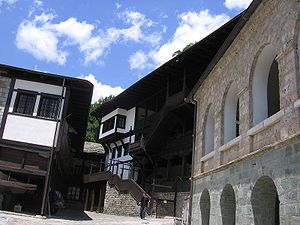 The first recorded document mentioning Debar is the map of Ptolemy
, dating around the middle of the 2nd century, in which it is called Deborus. The Byzantine emperor Basil II
knew of its existence, and Felix Petancic referred to it as Dibri in 1502.
The city was subsequently conquered by the First Bulgarian Empire
, but lost to the Byzantines under Tsar Samuil
by the early 11th century, as Bulgaria was subjugated.
Bohemond
and his Norman
army took the city in 1107. In the 13th and 14th century, the city changed hands between the Despotate of Epirus
, the Second Bulgarian Empire
, the Byzantine Empire
and Serbia
.
The city was under the rule of the short-lived Principality of Prilep
of Prince Marko
(r. 1371 – 1395), a successor state of the Serbian Empire
(1346–1371) where the father of , Župan Vukašin Mrnjavčević
(co-ruler of King Stefan Uroš V) held the region. The principality and region came under Ottoman Turkish
rule in 1395.
It was conquered by the Ottomans in 1395 and subsequently became the seat of the Sanjak of Dibra. In 1440 Skanderbeg
was appointed as its sanjakbey.
During the Ottoman-Albanian wars between 1443-1479 the Debar region was the borderline between the Ottomans and the League of Lezhë
led by Skanderbeg
and became an area of continuous conflict. There were two major battles near Debar April 29, 1444 and September 27, 1446, both ending with the defeat of the Ottoman armies.
In the early 19th century, when Debar rebelled against the Turkish Sultan, the French traveller, publicist, and scientist Ami Bue observed that Debar had 64 shops and 4,200 residents. It was first a sanjak centre in Scutari Province before 1877, and afterwards in Monastır
between 1877-1912 as Debre or Debre-i Bala ("Upper Debre" in Ottoman Turkish, as contrasted with Debre-i Zir, which was Peshkopi
's Turkish name). Debar was significantly involved in the national Albanian movement and on November 1, 1878 the Albanian leaders of the city participated in founding the League of Prizren
. By the end of the century, the town had 15,500 residents, but after World War I
, this number started to decline.
During the First Balkan War
of 1912-1913, the city was annexed by the Kingdom of Serbia. In September 1913 there was an uprising by the Macedonians of Debar with the aim of separating from the Kingdom of Yugoslavia. In September 1913 local Albanian and Internal Macedonian Revolutionary Organization leaders rebelled against the Kingdom of Serbia
.
Debar was annexed, along with most of Western Macedonia, into the Kingdom of Italy on June 29, 1939. Greater Albania
was officially a protectorate of Italy and therefore public administration duties were passed to Albanian authorities. Albanian-language schools, radio stations and newspapers were established in Debar. When Italy capitulated in September 1943, Debar passed into German hands. After a two month struggle for the city between Albanian National Liberation Front
and German forces including the SS Skanderbeg division
, the Communist forces led by Haxhi Lleshi
finally secured Debar on August 30, 1944. After the cessation of hostilities and the establishment of Communism
in both states, Debar passed back into Yugoslav
hands.
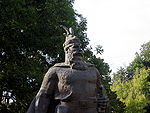 Some of the best craftsman, woodcarving
masters and builders came from the Debar region and were recognized for their skills in creating detailed and impressive woodcarvings, painting beautiful icons and building unique architecture. In fact Debar was one of the then famous three woodcarving schools in the region, the other two being Samokov and Bansko. Their work can be seen in many churches and cultural buildings throughout the Balkan Peninsula. The Debar School of Macedonian woodcarving became noted for its artistic excellence, and an amazing example that can be seen today by tourists is the iconostasis
in the nearby Monastery of Saint Jovan Bigorski, near the town of Debar. The monastery was rebuilt in th 19th century and is situated on the slopes of Mount Bistra
, above the banks of the River Radika. The monastery was built on the remains of an older church dating from 1021.
Another important religious monument is the monastery of Saint Gjorgi in the village of Rajcica in the immediate vicinity of Debar. The monastery was recently built.
Grigor Prlichev was given the title Second Homer in 1860 in Athens for his poem The Serdar . Based on a folk poem, it deals with the exploits and heroic death of Kuzman Kapidan, a famous hero and protector of Christian people in the Debar region in their struggle with bandits.
Some of the oldest and richest Albanian epics still exist in the Debar regions and are part of the Albanian mythological heritage.
Republic of Macedonia
Macedonia , officially the Republic of Macedonia , is a country located in the central Balkan peninsula in Southeast Europe. It is one of the successor states of the former Yugoslavia, from which it declared independence in 1991...
, near the border with Albania
Albania
Albania , officially known as the Republic of Albania , is a country in Southeastern Europe, in the Balkans region. It is bordered by Montenegro to the northwest, Kosovo to the northeast, the Republic of Macedonia to the east and Greece to the south and southeast. It has a coast on the Adriatic Sea...
, on the road from Struga
Struga
Struga is a town and popular tourist destination situated in the south-western region of the Republic of Macedonia, lying on the shore of Lake Ohrid. The town of Struga is the seat of Struga Municipality.-Etymology:...
to Gostivar
Gostivar
Gostivar , is a city in the Republic of Macedonia, located in the upper Polog valley region. It is one of the largest municipalities in the country with a population of 81,042, and the town also covers . Gostivar has good road and railway connections with the other cities in the region, such as...
. It is the seat of Debar Municipality
Debar municipality
Debar is a municipality in western Republic of Macedonia. Debar is also the name of the town where the municipal seat is found. Debar Municipality is part of the Southwestern Statistical Region.-Geography:...
.
Geography
Debar is surrounded by the Dešat, StogovoStogovo
Stogovo is a mountain in the western part of the Republic of Macedonia. It has impressive peaks: Golem Rid , Babin Srt , Kanesh and many more higher that 2000 meters above the sea level....
, Jablanica
Jablanica, Republic of Macedonia
Jablanica is a mountain in Albania and the Republic of Macedonia, located along the border between both countries. The long mountain ridge is higher than for approximately , while the highest part, located in its very center, is Black Stone at high. Both countries have 50% of the mountain,...
and Bistra
Mount Bistra
Bistra is one of the most interesting mountains in the Republic of Macedonia . The mountain has many peaks higher than 2,000 meters and the highest one is Medenica Peak, 2,163 meters above sea level.Limestone erosion on the mountain created limestone fields...
mountains. It is located 625 meters above sea level, next to Lake Debar, the Black Drin
Black Drin
The Black Drin is a river in Albania and the Republic of Macedonia. It flows out of Lake Ohrid in Struga, Macedonia. After approximately it crosses the border to Albania, west of Debar. It merges with the White Drin in Kukës to form the Drin, which flows into the Adriatic Sea...
River and its smaller break-off river, Radika
Radika
The Radika is a river in southern Kosovo and western Macedonia, a -long right tributary to the Black Drin river....
.
Population
According to the last census data from 2002, Debar has a population of 19,542,made up of 11,348 (58.52%) AlbaniansAlbanians
Albanians are a nation and ethnic group native to Albania and neighbouring countries. They speak the Albanian language. More than half of all Albanians live in Albania and Kosovo...
, 3,911 (20.11%) Macedonians
Macedonians (ethnic group)
The Macedonians also referred to as Macedonian Slavs: "... the term Slavomacedonian was introduced and was accepted by the community itself, which at the time had a much more widespread non-Greek Macedonian ethnic consciousness...
, 2,684 (13.80%) Turks
Turkish people
Turkish people, also known as the "Turks" , are an ethnic group primarily living in Turkey and in the former lands of the Ottoman Empire where Turkish minorities had been established in Bulgaria, Cyprus, Bosnia and Herzegovina, Georgia, Greece, Kosovo, Macedonia, and Romania...
, 1,080 (5.55%) Roma, and 519 (2.67%) others.
Name
The name of the city in MacedonianMacedonian language
Macedonian is a South Slavic language spoken as a first language by approximately 2–3 million people principally in the region of Macedonia but also in the Macedonian diaspora...
is Debar (Дебар), in Albanian
Albanian language
Albanian is an Indo-European language spoken by approximately 7.6 million people, primarily in Albania and Kosovo but also in other areas of the Balkans in which there is an Albanian population, including western Macedonia, southern Montenegro, southern Serbia and northwestern Greece...
Dibër or Dibra, in Serbian
Serbian language
Serbian is a form of Serbo-Croatian, a South Slavic language, spoken by Serbs in Serbia, Bosnia and Herzegovina, Montenegro, Croatia and neighbouring countries....
Debar (Дебар), in Bulgarian
Bulgarian language
Bulgarian is an Indo-European language, a member of the Slavic linguistic group.Bulgarian, along with the closely related Macedonian language, demonstrates several linguistic characteristics that set it apart from all other Slavic languages such as the elimination of case declension, the...
Debar (Дебър), in Turkish
Turkish language
Turkish is a language spoken as a native language by over 83 million people worldwide, making it the most commonly spoken of the Turkic languages. Its speakers are located predominantly in Turkey and Northern Cyprus with smaller groups in Iraq, Greece, Bulgaria, the Republic of Macedonia, Kosovo,...
Debre or Debre-i Bala and in Greek
Greek language
Greek is an independent branch of the Indo-European family of languages. Native to the southern Balkans, it has the longest documented history of any Indo-European language, spanning 34 centuries of written records. Its writing system has been the Greek alphabet for the majority of its history;...
, Divrē (Δίβρη) or Divra (Δίβρα).
History
Ptolemy
Claudius Ptolemy , was a Roman citizen of Egypt who wrote in Greek. He was a mathematician, astronomer, geographer, astrologer, and poet of a single epigram in the Greek Anthology. He lived in Egypt under Roman rule, and is believed to have been born in the town of Ptolemais Hermiou in the...
, dating around the middle of the 2nd century, in which it is called Deborus. The Byzantine emperor Basil II
Basil II
Basil II , known in his time as Basil the Porphyrogenitus and Basil the Young to distinguish him from his ancestor Basil I the Macedonian, was a Byzantine emperor from the Macedonian dynasty who reigned from 10 January 976 to 15 December 1025.The first part of his long reign was dominated...
knew of its existence, and Felix Petancic referred to it as Dibri in 1502.
The city was subsequently conquered by the First Bulgarian Empire
First Bulgarian Empire
The First Bulgarian Empire was a medieval Bulgarian state founded in the north-eastern Balkans in c. 680 by the Bulgars, uniting with seven South Slavic tribes...
, but lost to the Byzantines under Tsar Samuil
Samuil of Bulgaria
Samuel was the Emperor of the First Bulgarian Empire from 997 to 6 October 1014. From 980 to 997, he was a general under Roman I of Bulgaria, the second surviving son of Emperor Peter I of Bulgaria, and co-ruled with him, as Roman bestowed upon him the command of the army and the effective royal...
by the early 11th century, as Bulgaria was subjugated.
Bohemond
Bohemund I of Antioch
Bohemond I , Prince of Taranto and Prince of Antioch, was one of the leaders of the First Crusade. The Crusade had no outright military leader, but instead was ruled by a committee of nobles...
and his Norman
Normans
The Normans were the people who gave their name to Normandy, a region in northern France. They were descended from Norse Viking conquerors of the territory and the native population of Frankish and Gallo-Roman stock...
army took the city in 1107. In the 13th and 14th century, the city changed hands between the Despotate of Epirus
Despotate of Epirus
The Despotate or Principality of Epirus was one of the Byzantine Greek successor states of the Byzantine Empire that emerged in the aftermath of the Fourth Crusade in 1204. It claimed to be the legitimate successor of the Byzantine Empire, along with the Empire of Nicaea, and the Empire of Trebizond...
, the Second Bulgarian Empire
Second Bulgarian Empire
The Second Bulgarian Empire was a medieval Bulgarian state which existed between 1185 and 1396 . A successor of the First Bulgarian Empire, it reached the peak of its power under Kaloyan and Ivan Asen II before gradually being conquered by the Ottomans in the late 14th-early 15th century...
, the Byzantine Empire
Byzantine Empire
The Byzantine Empire was the Eastern Roman Empire during the periods of Late Antiquity and the Middle Ages, centred on the capital of Constantinople. Known simply as the Roman Empire or Romania to its inhabitants and neighbours, the Empire was the direct continuation of the Ancient Roman State...
and Serbia
History of Medieval Serbia
Тhe medieval history of Serbia begins in the 5th century AD with the Slavic invasion of the Balkans, and lasts until the Ottoman occupation of 1540.- Slavic invasion :...
.
The city was under the rule of the short-lived Principality of Prilep
Kingdom of Prilep
The Lordship of Prilep was one of the provinces of the Serbian Empire, held by Vukašin Mrnjavčević, the co-ruler of Serbia alongside child-less Uroš the Weak . Emperor Uroš and Lord Vukašin died at the Battle of Maritsa, and Prilep was obtained by Marko Mrnjavčević, the son of Lord Vukašin...
of Prince Marko
Prince Marko
Marko Mrnjavčević was de jure the Serbian king from 1371 to 1395, while de facto he ruled only over a territory in western Macedonia centered on the town of Prilep...
(r. 1371 – 1395), a successor state of the Serbian Empire
Serbian Empire
The Serbian Empire was a short-lived medieval empire in the Balkans that emerged from the Serbian Kingdom. Stephen Uroš IV Dušan was crowned Emperor of Serbs and Greeks on 16 April, 1346, a title signifying a successorship to the Eastern Roman Empire...
(1346–1371) where the father of , Župan Vukašin Mrnjavčević
Vukašin Mrnjavcevic
Vukašin Mrnjavčević was a Serbian ruler in modern-day central and northwestern Macedonia, who ruled from 1365 to 1371. According to 17th-century Ragusan historian Mavro Orbin, his father was a minor noble named Mrnjava from Zachlumia, whose sons Vukašin and Uglješa were born in Livno in western...
(co-ruler of King Stefan Uroš V) held the region. The principality and region came under Ottoman Turkish
Ottoman Empire
The Ottoman EmpireIt was usually referred to as the "Ottoman Empire", the "Turkish Empire", the "Ottoman Caliphate" or more commonly "Turkey" by its contemporaries...
rule in 1395.
It was conquered by the Ottomans in 1395 and subsequently became the seat of the Sanjak of Dibra. In 1440 Skanderbeg
Skanderbeg
George Kastrioti Skanderbeg or Gjergj Kastrioti Skënderbeu , widely known as Skanderbeg , was a 15th-century Albanian lord. He was appointed as the governor of the Sanjak of Dibra by the Ottomans in 1440...
was appointed as its sanjakbey.
During the Ottoman-Albanian wars between 1443-1479 the Debar region was the borderline between the Ottomans and the League of Lezhë
League of Lezhë
The League of Lezhë was an alliance of Albanian Principalities forged in Lezhë on the 2nd of March 1444. It was initiated and organised by Skanderbeg with the aim of uniting the Albanian principalities that had been founded in the 12th - 14th centuries, to fight the Ottoman Armies...
led by Skanderbeg
Skanderbeg
George Kastrioti Skanderbeg or Gjergj Kastrioti Skënderbeu , widely known as Skanderbeg , was a 15th-century Albanian lord. He was appointed as the governor of the Sanjak of Dibra by the Ottomans in 1440...
and became an area of continuous conflict. There were two major battles near Debar April 29, 1444 and September 27, 1446, both ending with the defeat of the Ottoman armies.
In the early 19th century, when Debar rebelled against the Turkish Sultan, the French traveller, publicist, and scientist Ami Bue observed that Debar had 64 shops and 4,200 residents. It was first a sanjak centre in Scutari Province before 1877, and afterwards in Monastır
Bitola
Bitola is a city in the southwestern part of the Republic of Macedonia. The city is an administrative, cultural, industrial, commercial, and educational centre. It is located in the southern part of the Pelagonia valley, surrounded by the Baba and Nidže mountains, 14 km north of the...
between 1877-1912 as Debre or Debre-i Bala ("Upper Debre" in Ottoman Turkish, as contrasted with Debre-i Zir, which was Peshkopi
Peshkopi
Peshkopi is a city in Dibër District, Dibër County, northeastern Albania.It is located away from Tirana, the capital of Albania, and from the Macedonian border. It is situated at 41°40'N and 20°25'. It sits above sea level. In the 2004 census, there were approximately 14,100 residents. It is...
's Turkish name). Debar was significantly involved in the national Albanian movement and on November 1, 1878 the Albanian leaders of the city participated in founding the League of Prizren
League of Prizren
The League for the Defense of the Rights of the Albanian Nation commonly known as the League of Prizren was an Albanian political organization founded on 10 June 1878 in Prizren, in the Kosovo province of the Ottoman Empire....
. By the end of the century, the town had 15,500 residents, but after World War I
World War I
World War I , which was predominantly called the World War or the Great War from its occurrence until 1939, and the First World War or World War I thereafter, was a major war centred in Europe that began on 28 July 1914 and lasted until 11 November 1918...
, this number started to decline.
During the First Balkan War
First Balkan War
The First Balkan War, which lasted from October 1912 to May 1913, pitted the Balkan League against the Ottoman Empire. The combined armies of the Balkan states overcame the numerically inferior and strategically disadvantaged Ottoman armies and achieved rapid success...
of 1912-1913, the city was annexed by the Kingdom of Serbia. In September 1913 there was an uprising by the Macedonians of Debar with the aim of separating from the Kingdom of Yugoslavia. In September 1913 local Albanian and Internal Macedonian Revolutionary Organization leaders rebelled against the Kingdom of Serbia
Kingdom of Serbia
The Kingdom of Serbia was created when Prince Milan Obrenović, ruler of the Principality of Serbia, was crowned King in 1882. The Principality of Serbia was ruled by the Karađorđevic dynasty from 1817 onwards . The Principality, suzerain to the Porte, had expelled all Ottoman troops by 1867, de...
.
Debar was annexed, along with most of Western Macedonia, into the Kingdom of Italy on June 29, 1939. Greater Albania
Greater Albania
Greater Albania or Ethnic Albania is an irredentist concept of lands outside the borders of the Republic of Albania that are considered part of a greater national homeland by most Albanians, based on the present-day or historical presence of Albanian populations in those areas...
was officially a protectorate of Italy and therefore public administration duties were passed to Albanian authorities. Albanian-language schools, radio stations and newspapers were established in Debar. When Italy capitulated in September 1943, Debar passed into German hands. After a two month struggle for the city between Albanian National Liberation Front
Albanian National Liberation Front
The National Liberation Movement , also translated as National Liberation Front, was an Albanian resistance organization that fought in World War II. It was created in 16 September 1942, in a conference held in Pezë, a village near Tirana...
and German forces including the SS Skanderbeg division
21st Waffen Mountain Division of the SS Skanderbeg (1st Albanian)
The 21st Division of the SS Skanderbeg was a Mountain division of the SS set up by Heinrich Himmler in March 1944, officially under the title of the 21. Waffen-Gebirgs Division der SS Skanderbeg...
, the Communist forces led by Haxhi Lleshi
Haxhi Lleshi
Haxhi Lleshi was an Albanian military leader and communist politician.Lleshi was one of the top commanders in Albania's fight against the Italians and Germans during World War II and is still considered by some to be a hero in Albania for his actions during the war...
finally secured Debar on August 30, 1944. After the cessation of hostilities and the establishment of Communism
Communism
Communism is a social, political and economic ideology that aims at the establishment of a classless, moneyless, revolutionary and stateless socialist society structured upon common ownership of the means of production...
in both states, Debar passed back into Yugoslav
Yugoslavia
Yugoslavia refers to three political entities that existed successively on the western part of the Balkans during most of the 20th century....
hands.
Culture
Wood carving
Wood carving is a form of working wood by means of a cutting tool in one hand or a chisel by two hands or with one hand on a chisel and one hand on a mallet, resulting in a wooden figure or figurine, or in the sculptural ornamentation of a wooden object...
masters and builders came from the Debar region and were recognized for their skills in creating detailed and impressive woodcarvings, painting beautiful icons and building unique architecture. In fact Debar was one of the then famous three woodcarving schools in the region, the other two being Samokov and Bansko. Their work can be seen in many churches and cultural buildings throughout the Balkan Peninsula. The Debar School of Macedonian woodcarving became noted for its artistic excellence, and an amazing example that can be seen today by tourists is the iconostasis
Iconostasis
In Eastern Christianity an iconostasis is a wall of icons and religious paintings, separating the nave from the sanctuary in a church. Iconostasis also refers to a portable icon stand that can be placed anywhere within a church...
in the nearby Monastery of Saint Jovan Bigorski, near the town of Debar. The monastery was rebuilt in th 19th century and is situated on the slopes of Mount Bistra
Mount Bistra
Bistra is one of the most interesting mountains in the Republic of Macedonia . The mountain has many peaks higher than 2,000 meters and the highest one is Medenica Peak, 2,163 meters above sea level.Limestone erosion on the mountain created limestone fields...
, above the banks of the River Radika. The monastery was built on the remains of an older church dating from 1021.
Another important religious monument is the monastery of Saint Gjorgi in the village of Rajcica in the immediate vicinity of Debar. The monastery was recently built.
Grigor Prlichev was given the title Second Homer in 1860 in Athens for his poem The Serdar . Based on a folk poem, it deals with the exploits and heroic death of Kuzman Kapidan, a famous hero and protector of Christian people in the Debar region in their struggle with bandits.
Some of the oldest and richest Albanian epics still exist in the Debar regions and are part of the Albanian mythological heritage.
Notable people from Debar
- Ivan Agovski, revolutionary
- Eqrem BashaEqrem BashaEqrem Basha is among the most respected contemporary writers of Kosovo in recent years. He was born in Debar in the western region of the Republic of Macedonia, but his life and literary production are intimately linked to Kosovo and its capital Pristina, where he has lived and worked for the past...
, writer - Jordan Danilovski, poet, novelist
- Abdurraman DibraAbdurraman DibraAbdurraman Dibra was an Albanian politician. He was born in Debar in modern day Macedonia. He served under various ministries of the Albanian government including Minister of Finance....
, politician, Minister in Ahmet Zogu's rule - Fiqri DineFiqri DineColonel Fiqri Dine was Prime Minister of Albania's Quisling government under Nazi Germany. He was the chieftain of the Dine clan from Debar.-Prime minister:...
, former Prime Minister of AlbaniaAlbaniaAlbania , officially known as the Republic of Albania , is a country in Southeastern Europe, in the Balkans region. It is bordered by Montenegro to the northwest, Kosovo to the northeast, the Republic of Macedonia to the east and Greece to the south and southeast. It has a coast on the Adriatic Sea... - Moisi Golemi, General in Skenderbeg's army
- Ivan Ivanovski, poet, writer
- Sherif LenguSherif LenguSherif Lengu was a 19th century Albanian politician. He was one of the signatories of the Albanian Declaration of Independence.-References:...
, modern Albania founding father - Živko Ošavkov, sociologist
- Ibe Palikukja, revolutionary
- Haki StërmilliHaki StërmilliHaki Stërmilli was an Albanian writer and journalist. His works dealt mostly with issues related to the rights of the Albanian communities outside Albania, republicanism, emancipation of women and feminism. His best known work was the novel Sikur të isha djalë .- Life :Born in Debar, Ottoman...
, writer - Myfti Vehbi DibraMyfti Vehbi DibraVehbi Dibra was a 19th century Albanian politician. He was one of the signatories of the Albanian Declaration of Independence.-References:...
, modern Albania founding father - Naum Boyadzhiev, revolutionary
- Sehat Karpuzi, revolutionary, traveler, moderator, The Navigator
General references
- The History of Byzantine State by G. Ostrogorsky
- The Serdar by G. Prlicev