

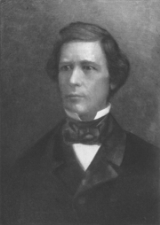
David Wilmot

Encyclopedia
David Wilmot was a U.S. political figure. He was a sponsor and eponym of the Wilmot Proviso
which aimed to ban slavery in land gained from Mexico
in the Mexican-American War of 1846–1848. Wilmot was a Democrat, a Free Soiler
, and a Republican during his political career. His opposition to slavery did not include the abolitionist position of ending slavery in the entire country, and his views on race, by today’s standards, could be classified as racist
.
to Randall (1792–1896) and Mary Grant Wilmot (1792–1820). His father was a well to do merchant, and David’s early life was a comfortable one. He was educated at the local Beech Woods Academy and later at the Cayuga Lake Academy in Aurora, New York
. Moving to Wilkes-Barre
in 1832, he read law under George W. Woodward and was admitted to the bar in Bradford County, Pennsylvania
in August 1834. In 1836 he married Anna Morgan and the couple had three children, none of whom survived childhood.
Wilmot practiced law for some time in Towanda, Pennsylvania
and was involved in local politics as a strong supporter of Andrew Jackson
. Wilmot was elected Representative from the 12th District of Pennsylvania as a Democrat
in 1844. He served from 1845 until 1851, in the 29th, 30th and 31st Congresses. He initially supported the policies of President James Polk. Also, as a Representative of a largely agrarian district, he voted for the Walker Tariff
of 1846 which made a moderate reduction in tariff rates. Only gradually did Wilmot come to believe that the South was dominating the national government to the detriment of the rest of the nation.
was introduced in the House of Representatives
. Wilmot immediately offered the following amendment:
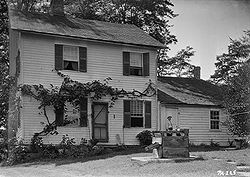 Wilmot modeled the language for what would usually be referred to as the Wilmot Proviso after the Northwest Ordinance
of 1787. Although known as the Wilmot Proviso it really originated with Jacob Brinkerhoff
of Ohio, Wilmot being selected to present it only because his party standing was more regular. The House, after first voting down a counter-proposal simply to extend the Missouri Compromise
line across the Mexican Cession
, passed the proviso by a vote of 83-64. This led to an attempt to table the entire appropriations bill rather than pass it with “the obnoxious proviso attached”, but this effort was defeated “in an ominously sectional vote, 78-94". The Senate
adjourned rather than approve the bill with the proviso.
A similar measure was brought forward at the next session with the appropriation amount increased to $3 million, and the scope of the amendment expanded to include all future territory which might be acquired by the United States. This was passed in the House by a vote of 115 to 105, but the Senate refused to concur and passed a bill of its own without the amendment. The House acquiesced, owing largely to the influence of General Lewis Cass
. As the 1848 presidential election took shape, the Democrats rejected the Wilmot Proviso in their platform and selected Cass as their candidate to run on a popular sovereignty
platform. The new Free Soil Party
rallied around the Wilmot Proviso, and nominated Martin Van Buren
on a platform calling for “No more slave states and no more slave territory.”
By 1848 Wilmot was thoroughly identified as a Free Soiler, but, like many other Free Soilers, Wilmot did not oppose the expansion of slavery based on a moral rejection of the institution itself. In a speech in the House, Wilmot said, “I plead the cause and the rights of white freemen [and] I would preserve to free white labor a fair country, a rich inheritance, where the sons of toil, of my own race and own color, can live without the disgrace which association with negro slavery brings upon free labor.” Around the same time, however, Wilmot, in a New York speech, spoke of the ultimate demise of slavery when he argued, “Keep it within given limits …and in time it will wear itself out. Its existence can only be perpetuated by constant expansion. … Slavery has within itself the seeds of its own destruction.”
Wilmot was presented as the Free Soil candidate for Speaker of the House
in 1849 and was soon at odds with the mainstream Pennsylvania Democratic Party led by James Buchanan
. Wilmot was forced to withdraw from the 1850 Congressional elections in favor of the more moderate Galusha A. Grow
. Wilmot was elected as a presiding judge of the 13th Judicial District of Pennsylvania in 1851, serving till 1861, and he was instrumental in founding the Republican Party in Pennsylvania. He chaired the Republican Party platform committee, was a delegate to the 1856 national convention
, and worked vigorously for the first Republican presidential candidate, John C. Fremont
, in 1856.
. He was a delegate to the Republican National Convention
in 1860 and was a key figure in obtaining the nomination for Abraham Lincoln
. Wilmot was considered for a cabinet post by Lincoln, but he declined, and in 1861 he was elected to the Senate
to fill the seat of Simon Cameron
. He served in that body from 1861 until 1863.
He was also a member of the peace convention of 1861
, held in Washington, D.C.
, in an effort to devise means to prevent the impending American Civil War
. Wilmot was appointed by President
Abraham Lincoln as judge of the Court of Claims in 1863 and served until his death in Towanda in 1868. He is interred in Riverside Cemetery,a Pennsylvania State historical marker is placed at Williams St, at Riverside Cemetery, Towanda identifying the cemetery as his resting place.
Wilmot Proviso
The Wilmot Proviso, one of the major events leading to the Civil War, would have banned slavery in any territory to be acquired from Mexico in the Mexican War or in the future, including the area later known as the Mexican Cession, but which some proponents construed to also include the disputed...
which aimed to ban slavery in land gained from Mexico
Mexico
The United Mexican States , commonly known as Mexico , is a federal constitutional republic in North America. It is bordered on the north by the United States; on the south and west by the Pacific Ocean; on the southeast by Guatemala, Belize, and the Caribbean Sea; and on the east by the Gulf of...
in the Mexican-American War of 1846–1848. Wilmot was a Democrat, a Free Soiler
Free Soil Party
The Free Soil Party was a short-lived political party in the United States active in the 1848 and 1852 presidential elections, and in some state elections. It was a third party and a single-issue party that largely appealed to and drew its greatest strength from New York State. The party leadership...
, and a Republican during his political career. His opposition to slavery did not include the abolitionist position of ending slavery in the entire country, and his views on race, by today’s standards, could be classified as racist
Racism
Racism is the belief that inherent different traits in human racial groups justify discrimination. In the modern English language, the term "racism" is used predominantly as a pejorative epithet. It is applied especially to the practice or advocacy of racial discrimination of a pernicious nature...
.
Early life
David Wilmot was born in Bethany, PennsylvaniaBethany, Pennsylvania
Bethany is a borough in Wayne County, Pennsylvania, United States. The population was 246 at the 2010 census.-Geography:Bethany is located at ....
to Randall (1792–1896) and Mary Grant Wilmot (1792–1820). His father was a well to do merchant, and David’s early life was a comfortable one. He was educated at the local Beech Woods Academy and later at the Cayuga Lake Academy in Aurora, New York
Aurora, Cayuga County, New York
Aurora is a village and college town in Cayuga County, in the Town of Ledyard, north of Ithaca, New York, United States. The village had a population of 720 at the 2000 census, of which more than 400 were college students....
. Moving to Wilkes-Barre
Wilkes-Barre, Pennsylvania
Wilkes-Barre is a city in the U.S. state of Pennsylvania, the county seat of Luzerne County. It is at the center of the Wyoming Valley area and is one of the principal cities in the Scranton/Wilkes-Barre metropolitan area, which had a population of 563,631 as of the 2010 Census...
in 1832, he read law under George W. Woodward and was admitted to the bar in Bradford County, Pennsylvania
Bradford County, Pennsylvania
-Demographics:As of the census of 2000, there were 62,761 people, 24,453 households, and 17,312 families residing in the county. The population density was 54 people per square mile . There were 28,664 housing units at an average density of 25 per square mile...
in August 1834. In 1836 he married Anna Morgan and the couple had three children, none of whom survived childhood.
Wilmot practiced law for some time in Towanda, Pennsylvania
Towanda, Pennsylvania
Towanda is a borough in and the county seat of Bradford County, Pennsylvania, United States, northwest of Wilkes Barre, on the Susquehanna River. The name means "burial ground" in the Algonquian language...
and was involved in local politics as a strong supporter of Andrew Jackson
Andrew Jackson
Andrew Jackson was the seventh President of the United States . Based in frontier Tennessee, Jackson was a politician and army general who defeated the Creek Indians at the Battle of Horseshoe Bend , and the British at the Battle of New Orleans...
. Wilmot was elected Representative from the 12th District of Pennsylvania as a Democrat
Democratic Party (United States)
The Democratic Party is one of two major contemporary political parties in the United States, along with the Republican Party. The party's socially liberal and progressive platform is largely considered center-left in the U.S. political spectrum. The party has the lengthiest record of continuous...
in 1844. He served from 1845 until 1851, in the 29th, 30th and 31st Congresses. He initially supported the policies of President James Polk. Also, as a Representative of a largely agrarian district, he voted for the Walker Tariff
Walker tariff
The Walker Tariff was a set of tariff rates adopted by the United States in 1846. The Walker Tariff was enacted by the Democrats, and made substantial cuts in the high rates of the "Black Tariff" of 1842, enacted by the Whigs. It was based on a report by Secretary of the Treasury Robert J. Walker...
of 1846 which made a moderate reduction in tariff rates. Only gradually did Wilmot come to believe that the South was dominating the national government to the detriment of the rest of the nation.
Free Soil and the Wilmot Proviso
Although he opposed the extension of slavery into the territories, Wilmot supported Polk in the initiation of the Mexican War, and was still considered a Democratic Party loyalist. But on August 8, 1846, an appropriations bill for $2 million to be used by the president in negotiating a treaty of peace with MexicoMexico
The United Mexican States , commonly known as Mexico , is a federal constitutional republic in North America. It is bordered on the north by the United States; on the south and west by the Pacific Ocean; on the southeast by Guatemala, Belize, and the Caribbean Sea; and on the east by the Gulf of...
was introduced in the House of Representatives
United States House of Representatives
The United States House of Representatives is one of the two Houses of the United States Congress, the bicameral legislature which also includes the Senate.The composition and powers of the House are established in Article One of the Constitution...
. Wilmot immediately offered the following amendment:
- "Provided, That, as an express and fundamental condition to the acquisition of any territory from the Republic of Mexico by the United States, by virtue of any treaty which may be negotiated between them, and to the use by the Executive of the moneys herein appropriated, neither slavery nor involuntary servitude shall ever exist in any part of said territory, except for crime, whereof the party shall first be duly convicted."
Northwest Ordinance
The Northwest Ordinance was an act of the Congress of the Confederation of the United States, passed July 13, 1787...
of 1787. Although known as the Wilmot Proviso it really originated with Jacob Brinkerhoff
Jacob Brinkerhoff
Jacob Brinkerhoff was an American jurist, Congressman, and author of the Wilmot Proviso.Brinkerhoff was born in Niles, Cayuga County, New York. He was schooled at the academy at Prattsburgh, New York, and studied law in the office of Howell and Bro...
of Ohio, Wilmot being selected to present it only because his party standing was more regular. The House, after first voting down a counter-proposal simply to extend the Missouri Compromise
Missouri Compromise
The Missouri Compromise was an agreement passed in 1820 between the pro-slavery and anti-slavery factions in the United States Congress, involving primarily the regulation of slavery in the western territories. It prohibited slavery in the former Louisiana Territory north of the parallel 36°30'...
line across the Mexican Cession
Mexican Cession
The Mexican Cession of 1848 is a historical name in the United States for the region of the present day southwestern United States that Mexico ceded to the U.S...
, passed the proviso by a vote of 83-64. This led to an attempt to table the entire appropriations bill rather than pass it with “the obnoxious proviso attached”, but this effort was defeated “in an ominously sectional vote, 78-94". The Senate
United States Senate
The United States Senate is the upper house of the bicameral legislature of the United States, and together with the United States House of Representatives comprises the United States Congress. The composition and powers of the Senate are established in Article One of the U.S. Constitution. Each...
adjourned rather than approve the bill with the proviso.
A similar measure was brought forward at the next session with the appropriation amount increased to $3 million, and the scope of the amendment expanded to include all future territory which might be acquired by the United States. This was passed in the House by a vote of 115 to 105, but the Senate refused to concur and passed a bill of its own without the amendment. The House acquiesced, owing largely to the influence of General Lewis Cass
Lewis Cass
Lewis Cass was an American military officer and politician. During his long political career, Cass served as a governor of the Michigan Territory, an American ambassador, a U.S. Senator representing Michigan, and co-founder as well as first Masonic Grand Master of the Grand Lodge of Michigan...
. As the 1848 presidential election took shape, the Democrats rejected the Wilmot Proviso in their platform and selected Cass as their candidate to run on a popular sovereignty
Popular sovereignty
Popular sovereignty or the sovereignty of the people is the political principle that the legitimacy of the state is created and sustained by the will or consent of its people, who are the source of all political power. It is closely associated with Republicanism and the social contract...
platform. The new Free Soil Party
Free Soil Party
The Free Soil Party was a short-lived political party in the United States active in the 1848 and 1852 presidential elections, and in some state elections. It was a third party and a single-issue party that largely appealed to and drew its greatest strength from New York State. The party leadership...
rallied around the Wilmot Proviso, and nominated Martin Van Buren
Martin Van Buren
Martin Van Buren was the eighth President of the United States . Before his presidency, he was the eighth Vice President and the tenth Secretary of State, under Andrew Jackson ....
on a platform calling for “No more slave states and no more slave territory.”
By 1848 Wilmot was thoroughly identified as a Free Soiler, but, like many other Free Soilers, Wilmot did not oppose the expansion of slavery based on a moral rejection of the institution itself. In a speech in the House, Wilmot said, “I plead the cause and the rights of white freemen [and] I would preserve to free white labor a fair country, a rich inheritance, where the sons of toil, of my own race and own color, can live without the disgrace which association with negro slavery brings upon free labor.” Around the same time, however, Wilmot, in a New York speech, spoke of the ultimate demise of slavery when he argued, “Keep it within given limits …and in time it will wear itself out. Its existence can only be perpetuated by constant expansion. … Slavery has within itself the seeds of its own destruction.”
Wilmot was presented as the Free Soil candidate for Speaker of the House
Speaker of the United States House of Representatives
The Speaker of the United States House of Representatives, or Speaker of the House, is the presiding officer of the United States House of Representatives...
in 1849 and was soon at odds with the mainstream Pennsylvania Democratic Party led by James Buchanan
James Buchanan
James Buchanan, Jr. was the 15th President of the United States . He is the only president from Pennsylvania, the only president who remained a lifelong bachelor and the last to be born in the 18th century....
. Wilmot was forced to withdraw from the 1850 Congressional elections in favor of the more moderate Galusha A. Grow
Galusha A. Grow
Galusha Aaron Grow was a prominent U.S. politician, lawyer, writer and businessman, and was Speaker of the House of Representatives from 1861 to 1863. He was defeated for reelection in 1862...
. Wilmot was elected as a presiding judge of the 13th Judicial District of Pennsylvania in 1851, serving till 1861, and he was instrumental in founding the Republican Party in Pennsylvania. He chaired the Republican Party platform committee, was a delegate to the 1856 national convention
Republican National Convention
The Republican National Convention is the presidential nominating convention of the Republican Party of the United States. Convened by the Republican National Committee, the stated purpose of the convocation is to nominate an official candidate in an upcoming U.S...
, and worked vigorously for the first Republican presidential candidate, John C. Fremont
John C. Frémont
John Charles Frémont , was an American military officer, explorer, and the first candidate of the anti-slavery Republican Party for the office of President of the United States. During the 1840s, that era's penny press accorded Frémont the sobriquet The Pathfinder...
, in 1856.
Later career
In 1857 Wilmot was the first Republican candidate for Governor of Pennsylvania, although he lost to William F. PackerWilliam F. Packer
William Fisher Packer was the 14th Governor of Pennsylvania from 1858 to 1861. His father was James Packer from Chester County, Pennsylvania and his mother was Charity Packer. His ancestry was primarily Quakers from Philadelphia...
. He was a delegate to the Republican National Convention
Republican National Convention
The Republican National Convention is the presidential nominating convention of the Republican Party of the United States. Convened by the Republican National Committee, the stated purpose of the convocation is to nominate an official candidate in an upcoming U.S...
in 1860 and was a key figure in obtaining the nomination for Abraham Lincoln
Abraham Lincoln
Abraham Lincoln was the 16th President of the United States, serving from March 1861 until his assassination in April 1865. He successfully led his country through a great constitutional, military and moral crisis – the American Civil War – preserving the Union, while ending slavery, and...
. Wilmot was considered for a cabinet post by Lincoln, but he declined, and in 1861 he was elected to the Senate
United States Senate
The United States Senate is the upper house of the bicameral legislature of the United States, and together with the United States House of Representatives comprises the United States Congress. The composition and powers of the Senate are established in Article One of the U.S. Constitution. Each...
to fill the seat of Simon Cameron
Simon Cameron
Simon Cameron was an American politician who served as United States Secretary of War for Abraham Lincoln at the start of the American Civil War. After making his fortune in railways and banking, he turned to a life of politics. He became a U.S. senator in 1845 for the state of Pennsylvania,...
. He served in that body from 1861 until 1863.
He was also a member of the peace convention of 1861
Peace conference of 1861
The Peace Conference of 1861 was a meeting of more than 100 of the leading politicians of the antebellum United States held in Washington, D.C., in February 1861 that was meant to prevent what ultimately became the Civil War. The success of President Abraham Lincoln and the Republican Party in the...
, held in Washington, D.C.
Washington, D.C.
Washington, D.C., formally the District of Columbia and commonly referred to as Washington, "the District", or simply D.C., is the capital of the United States. On July 16, 1790, the United States Congress approved the creation of a permanent national capital as permitted by the U.S. Constitution....
, in an effort to devise means to prevent the impending American Civil War
American Civil War
The American Civil War was a civil war fought in the United States of America. In response to the election of Abraham Lincoln as President of the United States, 11 southern slave states declared their secession from the United States and formed the Confederate States of America ; the other 25...
. Wilmot was appointed by President
President of the United States
The President of the United States of America is the head of state and head of government of the United States. The president leads the executive branch of the federal government and is the commander-in-chief of the United States Armed Forces....
Abraham Lincoln as judge of the Court of Claims in 1863 and served until his death in Towanda in 1868. He is interred in Riverside Cemetery,a Pennsylvania State historical marker is placed at Williams St, at Riverside Cemetery, Towanda identifying the cemetery as his resting place.
External links
- David Wilmot at Find A GraveFind A GraveFind a Grave is a commercial website providing free access and input to an online database of cemetery records. It was founded in 1998 as a DBA and incorporated in 2000.-History:...
- More David Wilmot info at Wyalusing, PA Chamber