

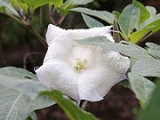
Datura metel

Encyclopedia
Datura metel is a shrub-like perennial herb
, commonly known as angel's trumpet, devil's trumpet, and metel.
Datura metel grows in the wild in all the warmer parts of the world, and is cultivated worldwide for its chemical and ornamental properties. It was first described by Linnaeus in 1753, but no botanically correct illustrations or descriptions were made until after the New World
was settled. It is not possible to be sure about its original home.
The plant is an annual herb growing up to 3 ft. high. It is slightly furry, with dark violet shoots and oval to broad oval leaves that are often dark violet as well. The pleasantly-scented 6-8 in. flowers are immensely varied, and can be single or double. Colors range from white to cream, yellow, red, and violet. The seed capsule is covered with numerous conical humps and a few spines. It is similar to D. inoxia
, but D. metel has almost glabrous leaves and fruits that are knobby, not spiny. D. inoxia is pilose all over and has a spiny fruit.
, where it is called yáng jīn huā (洋金花). However, the ingestion of D. metel in any form is dangerous and should be treated with extreme caution.
s (highly poisonous) and may be fatal if ingested by humans or other animals, including livestock and pets. In some places, it is prohibited to buy, sell or cultivate Datura plants.
Datura metel may be toxic if ingested in a tiny quantity, symptomatically expressed as flushed skin, headaches, hallucinations, and possibly convulsions or even a coma
. The principal toxic elements are tropane alkaloids. Accidentally (or intentionally) ingesting even a single leaf could lead to severe side effects.
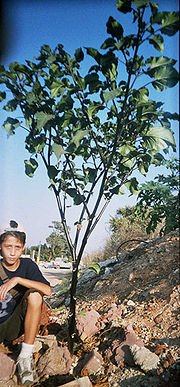
in Israel (see illustration). The black cultivar might become a common roadside dweller, like its white-flowered ancestor.
It is known under several cultivar names such as 'Black', 'Blackcurrant Swirl', 'Cornucopaea', 'Double Blackcurrant Swirl', 'Double Purple', and 'Purple Hindu'. It has also received many scientific names which should not be used for a cultivar:
Herb
Except in botanical usage, an herb is "any plant with leaves, seeds, or flowers used for flavoring, food, medicine, or perfume" or "a part of such a plant as used in cooking"...
, commonly known as angel's trumpet, devil's trumpet, and metel.
Datura metel grows in the wild in all the warmer parts of the world, and is cultivated worldwide for its chemical and ornamental properties. It was first described by Linnaeus in 1753, but no botanically correct illustrations or descriptions were made until after the New World
New World
The New World is one of the names used for the Western Hemisphere, specifically America and sometimes Oceania . The term originated in the late 15th century, when America had been recently discovered by European explorers, expanding the geographical horizon of the people of the European middle...
was settled. It is not possible to be sure about its original home.
The plant is an annual herb growing up to 3 ft. high. It is slightly furry, with dark violet shoots and oval to broad oval leaves that are often dark violet as well. The pleasantly-scented 6-8 in. flowers are immensely varied, and can be single or double. Colors range from white to cream, yellow, red, and violet. The seed capsule is covered with numerous conical humps and a few spines. It is similar to D. inoxia
Datura inoxia
Datura inoxia is a species in the family Solanaceae. It is native to Central and South America, and introduced in Africa, Asia, Australia and Europe. The scientific name is often cited as D. innoxia...
, but D. metel has almost glabrous leaves and fruits that are knobby, not spiny. D. inoxia is pilose all over and has a spiny fruit.
Medicinal use
D. metel is one of the 50 fundamental herbs used in traditional Chinese medicineTraditional Chinese medicine
Traditional Chinese Medicine refers to a broad range of medicine practices sharing common theoretical concepts which have been developed in China and are based on a tradition of more than 2,000 years, including various forms of herbal medicine, acupuncture, massage , exercise , and dietary therapy...
, where it is called yáng jīn huā (洋金花). However, the ingestion of D. metel in any form is dangerous and should be treated with extreme caution.
Toxicity
All parts of Datura plants contain dangerous levels of tropane alkaloidTropane alkaloid
Tropane alkaloids are a class of alkaloids and secondary metabolites that contain a tropane ring in their chemical structure...
s (highly poisonous) and may be fatal if ingested by humans or other animals, including livestock and pets. In some places, it is prohibited to buy, sell or cultivate Datura plants.
Datura metel may be toxic if ingested in a tiny quantity, symptomatically expressed as flushed skin, headaches, hallucinations, and possibly convulsions or even a coma
Coma
In medicine, a coma is a state of unconsciousness, lasting more than 6 hours in which a person cannot be awakened, fails to respond normally to painful stimuli, light or sound, lacks a normal sleep-wake cycle and does not initiate voluntary actions. A person in a state of coma is described as...
. The principal toxic elements are tropane alkaloids. Accidentally (or intentionally) ingesting even a single leaf could lead to severe side effects.
Black daturas (Datura metel 'Fastuosa')
A cultivar of D. metel with a polished-looking ebony-black stem exists as a garden plant. Its flowers normally have a double or triple corolla, each corolla having a deep purple exterior and white or off-white interior. The plant is already reported to have become naturalisedNaturalisation (biology)
In biology, naturalisation is any process by which a non-native organism spreads into the wild and its reproduction is sufficient to maintain its population. Such populations are said to be naturalised....
in Israel (see illustration). The black cultivar might become a common roadside dweller, like its white-flowered ancestor.
It is known under several cultivar names such as 'Black', 'Blackcurrant Swirl', 'Cornucopaea', 'Double Blackcurrant Swirl', 'Double Purple', and 'Purple Hindu'. It has also received many scientific names which should not be used for a cultivar:
- Datura hummatu var. fastuosa (L.) Bernh.
- Datura fastuosa L.
- Datura metel f. fastuosa (L.) Danert
- Datura metel var. fastuosa (L.) Saff.
- Stramonium fastuosum (L.) Moench
See also
- Chinese herbology 50 fundamental herbs
- DaturaDaturaDatura is a genus of nine species of vespertine flowering plants belonging to the family Solanaceae. Its precise and natural distribution is uncertain, owing to its extensive cultivation and naturalization throughout the temperate and tropical regions of the globe...
External links
- USDA Germplasm Resources Information Network (GRIN): Datura metel L.
- American Brugmansia and Datura Society
- Poisonous Plants of North Carolina: Datura Metel