
Encyclopedia
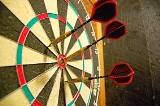
Darts is a game, or rather a variety of related games, in which darts are thrown at a circular target hung on a wall. Though various different boards and games have been used in the past, the term 'darts' usually now refers to a standardized game involving a specific board design and set of rules.
As well as being a professional competitive game, darts is a traditional
pub game, commonly played in the
United Kingdom , the
Netherlands,
Israel, the
Scandinavian countries, the
United States and elsewhere, not forgetting
Poland.
Dart boards
Dart boards are usually made of sisal fibers and each section is lined with thin metal wire. The numbers indicating the various scoring sections of the board are normally made of wire, especially on tournament-quality boards, but may be printed directly on the board instead.
Height and distance
In the standard game, the dart board is hung so that the bullseye is 5 ft 8 in from the floor, eye-level for a six foot man. The oche , or throwing line behind which the player must stand, is 7 ft 9¼ in from the face of the board, though a few British pubs set it at 8 ft or 8 ft 6 in . For casual play, it is not uncommon to find the oche somewhat further or closer than the tournament standard, either due to rounding of the specified distance , or just due to measurement error .
History
Various designs of dartboard have been used, and regional variations remain in parts of
Staffordshire,
Lancashire and
Yorkshire. In particular, the Yorkshire and Lancashire boards differs from the standard board in that it has no treble ring and has a single, inner bull. The dartboard itself may have its origins in the cross section of a
tree, although some historical records suggest that the first standard dartboards were the bottoms of wine casks, hence the game's original name of "butts".
There is speculation that the game originated among soldiers throwing short arrows at the bottom of the cast or at the bottom of trunks of trees. As the wood dried, cracks would develop, creating "sections". Soon, regional standards emerged and many woodworkers supplemented bar tabs by fabricating dart boards for the local pubs.
The numbering plan known by many today has a 20 on top; however, a great many other configurations have been used throughout the years and in different geographical locations. By most accounts, the numbering layout was devised by Brian Gamlin in 1896 to penalize inaccuracy.
Although this applies to most of the board, the left-hand side is preferred by beginners, for its concentration of larger numbers.
Mathematically, removing the rotational symmetry by placing the "20" at the top, there are
19!, or 121,645,100,408,832,000 possible dartboards. There are many different layouts that would penalize a player more than the current setup; however, the current setup actually does the job rather efficiently .
Scoring
The standard dartboard is divided into twenty numbered sections, scoring from one to 20 points, by wires running from the small central circle to the outer circular wire. Circular wires within the outer wire divide each section into single, double and triple areas.
Various quite different games can be played using the standard dartboard. However, in the official game, any dart landing inside the outer wire scores as follows:
- Hitting one of the large portions of each of the numbered sections, traditionally coloured black and yellow, scores precisely the points value of that section.
- Hitting the thin outer portions of these sections, coloured red and green, scores double the points value of that section.
- Hitting the thin inner portions of these sections, roughly halfway between the outer wire and the central circle and again coloured red or green, scores triple the points value of that section.
- The central circle is divided into a green outer ring worth 25 points and a red inner circle , worth 50 points. The term "bullseye" can mean either the whole central part of the board or just the inner red section.
- Hitting outside the outer wire scores nothing.
- Any dart that does not remain in the board after throwing also scores nothing. Variations on this rule exist - some judge that a dart which obviously hits a scoring section but then subsequently drops out will count if caught before it hits the floor or if it rebounds behind the throwing line before touching the ground it may be thrown again. In professional rules, a dart's tip must be touching a scoring section for the dart to count.
The highest score possible with 3 darts is 180, obtained when all three darts land in the triple 20. In the
televised game, the
referee frequently announces a score of 180 in exuberant style. The commentator will often refer to this as "ton-eighty".
Soft tip boards and darts
A relatively new type of board is the soft tip board, which is made of plastic and cast with small holes in the face. The soft tip darts are, in general, lighter than the steel tipped darts, and have a lower maximum allowable weight. The soft tip darts have semi-rigid tapered plastic tips that will penetrate the holes cast in the board to a depth of about .25 inches before lodging securely in place. The darts may be removed from the board by a gentle twist and pull. While still dangerous, soft tip darts are less likely to cause serious injury if they hit a person, and are far less likely to damage items they hit if they bounce out of the board. Since the plastic tips are prone to chip, bend and break with use, even inexpensive soft tip darts are made with replaceable tips, and replacement tips are sold in quantity.
Other than the difference in maximum allowable weights of darts, soft tip dart rules are the same as those for steel tip darts. One big advantage of the soft tip dart for the recreational player is the availability of electronic boards that will detect and score each dart hit, and track the score of each player. Many of these electronic dart boards have dozens of different dart games and variations programmed in, and will even coach a player as to where to aim his next throw.
Playing darts
A game, or "leg", of darts is usually contested between two players who take turns in throwing up to three darts. Starting from a set score, usually 501 or 301, a player wins by reducing his score to zero. The last dart in the leg must hit either a double or the inner portion of the bullseye, which is the double of the outer bull, and must reduce the score to exactly zero. Successfully doing so is known as "doubling out" or "checking out" . A throw that would reduce a player's score to one or below zero does not count, his turn ends, and his score is reset to what it was before that turn. . Since the double areas are small, doubling out is usually the most difficult and tense part of a leg. Longer matches are often divided into sets, each comprising some number of legs.
Although playing straight down from 501 is standard in darts, other variations exist, notably "doubling in", where players must hit a double to begin scoring, with all darts thrown before said double contributing nothing to his score.
Other games that are commonly played differ in their scoring methods. These include "Round The Clock", "Killer" and the more complicated
Cricket.
In "Round the Clock", players must hit each numbered section in turn, finishing with a bull to win. Far from being a beginner's game, Round The Clock is a good training game since it practices targeting all areas of the board, a skill which is essential when finishing a classic leg. This can be taken further by only counting the double or the treble rings. It can also be played where hitting the double advances you two numbers and the treble advances three. For example, if your first target is number 1 and you hit the treble ring, then your next target is number 4. In addition, some play that if you successfully hit three numbers with your three darts in a turn, you get to throw again. Often in some leagues, hitting a double advances you to the number which is twice the value of that thrown, plus one. For example, hitting a double 9 will take you to 19. These games often end with the first person to hit two double 20s.
An additional rule which can add some spice to playing Round The Clock with two or more players is that any dart that falls in a bed other than the one aimed for is forteited to any player awaiting that number.
In Killer, a number of players "own" a number on the dartboard and compete to build up "lives" until a threshold is reached before attempting to "kill" other players by removing the lives they have built up until a single player is left.
Professional organizations
Of the two professional organisations, the British Darts Organisation , founded 1973, is the older. Its tournaments are often shown on the BBC in the UK, and on
SBS6 in the
Netherlands. The BDO is a member of the World Darts Federation , along with organisations in some 60 other countries worldwide. The BDO organises all British darts players, with the exception of a small group of professionals.
In 1994 a breakaway organisation was formed, initially known as the World Darts Council but shortly after known as the Professional Darts Corporation . Over the years many top players from the BDO have left to join the PDC with very few going in the other direction. An influx of sponsors and rapid expansion of television coverage continues.
The PDC tournaments often have higher prize money and without doubt the best player in the world: 13-time World Champion
Phil Taylor. Cementing the PDC's dominance at the very top of the game in early 2006, four-time BDO world champion
Raymond van Barneveld moved to the PDC.
Both the PDC and the BDO received a massive boost in 2005, when
Sport England announced that Darts was to be officially classed as a sport, and according to the book written by
Wayne Mardle, the sport is being seriously considered as a demonstration sport at the
2008 Olympics, although there has been no official confirmation of this.
Professional competitions
The BDO and PDC both organise a
World Professional Championship. They are held at the start of the year, with the PDC championship finishing slighly earlier than the BDO tournament. The BDO World Championship has been running since 1978, the
PDC World Championship started in 1994.
Both organisations hold other professional tournaments. The BDO organise the International Darts League, World Darts Trophy, World Masters, Leendesk Masters, Europe Cup, and many Open tournaments. They also organise county darts for their 64 county members in the UK including individual and team events.
The PDC's major tournaments, known as Premier Events are the Premier League, UK Open, Las Vegas Desert Classic,
World Matchplay and the World Grand Prix. They also hold PDC Pro Tour events and smaller category events around the UK.
The WDF World Cup for national teams and a singles tournament has been played bi-annually since 1977.
Amateur competition
- The American Darters Association offers league organization for casual singles players throughout the United States
- The American Darts Organization is the world's largest national dart league, facilitating the organization of members' regional divisions, and promoting the sport via pub-based teams and individuals across the country
Televised darts
Darts first appeared on British television in 1962 when
Westward Television broadcast the Westward TV Invitational to the
south-west of England. In 1970,
ITV broadcast the News of the World Championship and from 1972 the Indoor League, which featured a darts tournament.
From there darts coverage first expanded with many major tournaments appearing on both ITV and BBC through the 1970s and early 1980s, but by 1988 only one major event was still broadcast - the World Championship. Darts has since grown again and now there are more major tournaments broadcast in the UK, Europe and the rest of the world.
In Europe, Eurosport broadcast the Lakeside World Championships having signed a three-year contract in 2006 and have also broadcast the Finland Open, BDO British Internationals, the BDO England Open and the BDO British Open this year.
In the UK, The Lakeside and the Winmau World Masters are currently broadcast by BBC. However it wasn't until 2005 that viewers were able to see every dart thrown live at the World Championship. This was the year that BBC introduced interactive coverage on its
BBCi service.
In the Netherlands,
SBS6 broadcasts the Lakeside , International Darts League, World Darts Trophy and the Dutch Open.
RTL 5 broadcasts the Leendesk Masters. Most of these tournaments can also be watched on the internet for free using a live stream .
The PDC's Premier League, UK Open, Las Vegas Desert Classic,
World Matchplay and World Grand Prix are all televised live and in their entirity in the UK by satellite and cable broadcaster
Sky Television. Dutch station, Sport One and several other tv stations across the globe also broadcast the PDC events.
The launched the World Series of Darts for the first time in the
United States in 2006. Its $1 million prize showcased professional darts in the
United States. Unfortunately the programme was not a ratings success and was taken from its peak time broadcast slot on ESPN after just a few weeks. It is unclear whether there will be another World Series of Darts tournament.
Betting
On premises where
alcohol is consumed, English law has long permitted
betting only on games of skill, as opposed to games of chance, and then only for small stakes. An apocryphal tale relates that in 1908, Jim Garside, the landlord of the Adelphi Inn,
Leeds, England was called before the local magistrates to answer the charge that he had allowed betting on a game of chance, darts, on his premises. Garside asked for the assistance of local champion William "Bigfoot" Anakin who attended as a witness and demonstrated that he could hit any number on the board nominated by the court. Garside was discharged as the magistrates found darts, indeed, to be a game of skill.
More recently, in keeping with Darts' strong association with pubs and drinking, matches between friends or pub teams are often played for pints.
In the professional game, betting is prominent with many of the big betting companies sponsoring events, such as Stan James and
Ladbrokes. Stan James sponsor the World Matchplay, Ladbrokes sponsor the world championship.
On FSN broadcasts in the United States, the logos for Ladbrokes are pixelized out and digitally obscured, along with any audible references to Ladbrokes, due to American laws and policies against online gambling.
Famous players
World Champions- Bob Anderson The Limestone Cowboy 1 time BDO World Champion
- Steve Beaton The Adonis 1 time BDO World Champion
- Richie Burnett The Prince of Wales 1 time BDO World Champion
- Eric Bristow Crafty Cockney 5 times BDO World Champion
- Tony David The Deadly Boomerang 1 time BDO World Champion
- Keith Deller The Fella 1 time BDO World Champion
- Andy Fordham The Viking 1 time BDO World Champion
- Trina Gulliver 6 times Women's BDO World Champion
- Ted Hankey The Count 1 time BDO World Champion
- Jelle Klaasen - The Matador 1 time BDO World Champion , youngest ever World Champion.
- John Lowe Old Stoneface 3 times BDO World Champion
- John Part Darth Maple 1 time BDO World Champion, 1 time PDC World Champion
- Dennis Priestley The Menace 1 time BDO World Champion, 1 time PDC World Champion
- Leighton Rees 1 time BDO World Champion
- Phil Taylor The Power 2 times BDO Champion, 11 times PDC World Champion
- Raymond van Barneveld Barney 4 times BDO World Champion
- Les Wallace 1 time BDO World Champion
- John Walton John Boy 1 time BDO World Champion
- Jocky Wilson 2 times BDO World Champion
Other Famous BDO Players:- Martin Adams Wolfie 2 time WDF World Cup Singles Champion
- Martin Atkins The Assassin
- Gary Anderson Dreamboy - Current WDF World Number One
- Tony Eccles The Viper
- Darryl Fitton The Dazzler
- Bobby George Mister Glitter
- Shaun Greatbatch 9 Dart
- Mervyn King The King
- Jarkko Komula Smiley
- Jonny Nijs 1 time WDF Youth World Champion
- Gary Robson Robbo
- Vincent van der Voort
- Mike Veitch The Cat
- Tony West The Tornado
- Simon Whitlock The Wizard
- Dick van Dijk The Undertaker 1 time WDF World Cup Singles Champion
- Michael van Gerwen Mighty Mike -Youngest Professional Dart Player
Other Famous PDC Players:- Ronnie Baxter The Rocket
- Adrian Lewis Jackpot
- Colin Lloyd Jaws Current PDC World Number One
- Wayne Mardle Hawaii 501
- Peter Manley One Dart
- Kevin Painter The Artist
- Roland Scholten The Tripod
- James Wade The Gladiator
See also
- Cricket - An alternative game using the standard dart board.
- Glossary of Darts
- Pub Sports
- Nine dart finish
- Bullseye - A British game show based around darts.
- Pub games
- World Series of Darts
- American Darts
External links
- brings players and fans together with loads of nice features
- contains a popular forum frequented by many top players, officials and organisers
- is a great source of articles, reviews and a great forum.
- Various online free to use dart calculators. Including graphical overview each leg played and more statistics.
- is a great source of articles, WSOD Player profiles and more
- The only BDO-centric forum on the Internet. A thriving community for BDO darts players and followers.
Organizations
History
Rules
Analysis