
All Topics  
Darter

 
Darter

   Email Print
   Bookmark   Link


Darter


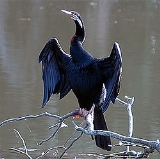
The darters or snake-birds are birds in the family Anhingidae. There are four living species, one of which is near-threatened. The darters are frequently referred to as snake-birds because of their long thin neck, which gives a snake-like appearance when they swim with their bodies submerged.

The darters are large birds with sexually dimorphic
Sexual dimorphism

Sexual dimorphism is the systematic difference in form between individuals of different sex in the same species. Examples include color , size, and the presence or absence of parts of the body used in courtship displays or fights, such as ornamental feathers, horns, antlers or tusks....
 plumage. The males have black and dark brown plumage, an erectile crest on the nape and a larger bill than the female.


Discussion
Ask a question about 'Darter'
Start a new discussion about 'Darter'
Answer questions from other users
Full Discussion Forum


Recent Posts


Encyclopedia


The darters or snake-birds are birds in the family Anhingidae. There are four living species, one of which is near-threatened. The darters are frequently referred to as snake-birds because of their long thin neck, which gives a snake-like appearance when they swim with their bodies submerged.

The darters are large birds with sexually dimorphic
Sexual dimorphism

Sexual dimorphism is the systematic difference in form between individuals of different sex in the same species. Examples include color , size, and the presence or absence of parts of the body used in courtship displays or fights, such as ornamental feathers, horns, antlers or tusks....
 plumage. The males have black and dark brown plumage, an erectile crest on the nape and a larger bill than the female. The females have a much paler plumage especially on the neck and underparts. Both have grey stippling on long scapulars and upper wing coverts. The sharply pointed bill has serrated edges. The darters have completely webbed feet, and their legs are short and set far back on the body. Their plumage is somewhat permeable, like that of cormorant
Cormorant

The bird family Phalacrocoracidae is represented by some 40 species of cormorants and shags. Several different classifications of the family have been proposed recently, and the number of Genus is disputed....
s, and they spread their wings to dry after diving. Vocalizations include a clicking or rattling when flying or perching. During breeding adults sometimes have caw or hissing calls.

Range

Darters are circum-equatorial, tropical or subtropical. They inhabit either fresh or brackish water and can be found in lakes, rivers, marshes, swamps, estuaries, bays, lagoons and mangrove
Mangrove

Mangroves are trees and shrubs that grow in saline water coastal habitats in the tropics and subtropics. The word is used in at least three senses: most broadly to refer to the habitat and entire plant assemblage or mangal, for which the terms mangrove swamp and mangrove forest are also used, to refer to all trees and...
 swamps. They tend to gather in flocks sometimes up to about 100 birds but are highly territorial when breeding. Most are sedentary and do not migrate
Bird migration

Bird migration refers to the regular seasonal journeys undertaken by many species of birds. Bird movements include those made in response to changes in food availability, habitat or weather....
, however the populations at extreme distributions may migrate. The Oriental Darter is near-threatened species. Habitat destruction along with other human interferences is among the main reasons for a declining population.

Food and feeding

Darters feed mainly on fish. They use their sharply pointed bill to spear their prey when they dive; this is how they get the name darter. Their ventral keel is present on the 5-7 vertebrae which allows for muscles to attach so that they are able to project their bill forward like a spear. They also eat amphibians such as frogs and newts, reptiles such as snakes and turtles and invertebrates such as insects, shrimp and mollusks. These birds use their feet to move underwater and quietly stalk and ambush their prey. They then stab the prey, such as a fish, and bring them to the surface where they toss it into the air and catch and swallow it.

Breeding

Snake Bird Nesting
The darters are monogamous and pair bond during the breeding season. There are many different types of displays used for mating including male displays to attract the female, greeting displays between the male and female and pair bonding displays between the pairs. Also during breeding, their small gular sac changes from pink or yellow to black and the bare facial skin turns to turquoise from a yellow or yellow-green color. They usually breed in colonies.

Breeding can be seasonal or year round and varies by geographic range. The nests are made of twigs and are built in trees or reeds, often near water. The clutch size is two to six eggs (usually about 4) of a pale green color and the eggs are incubated for 25 to 30 days. The eggs hatch asynchronously. Bi-parental care
Bi-parental care

Bi-parental care is when both parents care for an offspring. A Geococcyx is an example of bi-parental care.also known as parental care...
 is given and the young are considered altricial
Altricial

Altricial, meaning "requiring nourishment", refers to a pattern of growth and development in organisms which are incapable of moving around on their own soon after hatching or being born....
. They reach sexual maturity by about 2 years. These birds generally live to around 9 years.


Systematics and evolution

Darterfemale
This family is very closely related to the other families in the Pelecaniformes
Pelecaniformes

The Pelecaniformes are an order of medium-sized and large waterbirds found worldwide. They are distinguished from other birds by the possession of feet with all four toes webbed ....
 suborder Sulae, i.e. the cormorants and shags and the gannets and boobies
Sulidae

The bird family Sulidae comprises the gannets and booby. Both groups are medium-large coastal seabirds that plunge-dive for fish. The species in this family are often considered congeneric, placing all in the genus Sula....
. Cormorants and anhingas are extremely similar as regards their body and leg skeletons, showing that they are closely related. In fact, several anhinga fossil
Fossil

Fossils are the preserved remains or trace fossil of animals, plants, and other organisms from the remote past. The totality of fossils, both discovered and undiscovered, and their placement in fossiliferous Rock formations and sedimentary rock layers is known as the fossil record....
s were initially believed to be cormorants or shags (see below for examples).

There are four living species of darters recognized, all in the genus
Genus

A genus is a low-level taxonomic rank used in the classification of living and fossil organisms. The taxonomic ranks are domain , kingdom , phylum, class , order , family , genus, and species....
 Anhinga, although the Old World ones are often lumped together as subspecies of A. melanogaster:
  • Anhinga
    Anhinga

    The Anhinga , sometimes called Snakebird, Darter, American Darter, or Water Turkey, is a water bird of the warmer parts of North America and South America....
    , Anhinga anhinga
  • Oriental Darter
    Oriental Darter

    The Oriental Darter or Indian Darter , sometimes called Snakebird, is a water bird of tropical South Asia and Southeast Asia. It is a cormorant species that has a very long neck....
    , Anhinga melanogaster
  • African Darter
    African Darter

    The African Darter , sometimes called the Snakebird, is a water bird of tropical sub-Saharan Africa.This species builds a stick nest in a tree and lays 3-6 eggs....
    , Anhinga rufa
  • Australian Darter
    Australian Darter

    The Australian Darter or Australasian Darter is a species of bird in the darter family, Anhingidae . It is found in Australia, Indonesia, New Zealand, and Papua New Guinea....
    , Anhinga novaehollandiae


Extinct "species" from Mauritius
Mauritius

Mauritius , officially the Republic of Mauritius, , is an island nation off the coast of the African continent in the southwest Indian Ocean, about 900 kilometres east of Madagascar....
  and Australia
Australia

Australia, officially the Commonwealth of Australia, is a country in the southern hemisphere comprising the Australia of the world's smallest continent, the major island of Tasmania, and numerous list of islands of Australia in the Indian Ocean and Pacific Oceans....
 known only from bones were described as Anhinga nana ("Mauritian Darter") and Anhinga parva, but they were misidentifications of bones of the Long-tailed Cormorant
Long-tailed Cormorant

The Long-tailed Cormorant or Reed Cormorant, is a member of the cormorant family. It breeds in much of Africa south of the Sahara, and Madagascar....
 and the Little Pied Cormorant
Little Pied Cormorant

The Little Pied Cormorant, Little Shag or Kawaupaka is a common Australasian waterbird, found around the coasts, islands, Estuary, and inland waters of Australia, New Guinea, New Zealand, Malaysia, and Indonesia, and around the islands of the south-western Pacific and the sub-Antarctic....
, respectively. In the former case, however, they might belong to an extinct subspecies which would have to be called Phalacrocorax africanus nanus (Mauritian Cormorant) - quite ironically, as nanus means "dwarf" and the remains are larger than those of the geographically closest population of the Long-tailed Cormorant.

The darters are known since the Early Miocene
Miocene

The Miocene is a Geologic time scale of the Neogene period and extends from about 23.03 to 5.33 million years before the present. As with other older geologic periods, the rock beds that define the start and end are well identified but the exact dates of the start and end of the period are uncertain....
. The diversity was highest in the Americas; a number of prehistoric species and genera known only from fossil
Fossil

Fossils are the preserved remains or trace fossil of animals, plants, and other organisms from the remote past. The totality of fossils, both discovered and undiscovered, and their placement in fossiliferous Rock formations and sedimentary rock layers is known as the fossil record....
s have been described. The aptly named Macranhinga, Meganhinga and Giganhinga represent very large and at least partly flightless forms:
  • Meganhinga (Early Miocene of Chile)
  • Macranhinga (Middle/Late Miocene -? Early Pliocene of SC South America)
  • Giganhinga (Late Pliocene/Early Pleistocene of Uruguay)
  • Anhingidae gen. et sp. indet. (Middle/Late Miocene of Paraná, Argentina)


Prehistoric members of Anhinga are:
  • Anhinga subvolans (Early Miocene of Thomas Farm, USA) - formerly in Phalacrocorax
  • Anhinga cf. grandis (Middle Miocene of Colombia -? Late Pliocene of SC South America)
  • Anhinga sp. (Sajóvölgyi Middle Miocene of Mátraszőlős, Hungary)
  • Anhinga fraileyi (Late Miocene -? Early Pliocene of S South America)
  • Anhinga minuta (Solimőes Late Miocene/Early Pliocene of SC South America)
  • Anhinga pannonica (Late Miocene/Early Pliocene of Tatarus-Brusturi, Hungary ?and Tunisia, East Africa, Pakistan and Thailand - ?Sahabi Early Pliocene of Libya)
  • Anhinga grandis (Late Miocene - Kimball Late Pliocene of USA)
  • Anhinga malagurala (Allingham Early Pliocene of Charters Towers, Australia)
  • Anhinga sp. (Early Pliocene of Bone Valley, USA)
  • Anhinga hadarensis (Late Pliocene/Early Pleistocene of E Africa)
  • Anhinga sp. (Early Pleistocene of Coleman, USA) - may be same as Anhinga sp. "Bone Valley"


The Pleistocene
Pleistocene

The Pleistocene is the epoch from 1.8 million to 10,000 years Before Present covering the world's recent period of repeated glaciations. The name pleistocene is derived from the Greek and ....
 Anhinga laticeps is a misidentified Australian Darter
Australian Darter

The Australian Darter or Australasian Darter is a species of bird in the darter family, Anhingidae . It is found in Australia, Indonesia, New Zealand, and Papua New Guinea....
; it might have been a paleosubspecies of the last ice age.

Footnotes


External links

  • on the Internet Bird Collection