All Topics  
Daniel Boone

 
Daniel Boone

   Email Print
   Bookmark   Link


Daniel Boone


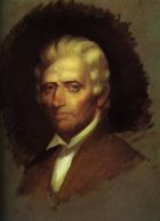
Daniel Boone [October 22 (November 2 new style), 1734 – September 26, 1820] was an American pioneer
American pioneer

American pioneers are any of the people in American history who migrated west to join in Settler and developing new areas. This especially refers to those who were going to settle any territory which had previously not been settled or developed by European or American society....
 and hunter
Hunting

Hunting is the practice of pursuing living animals for food, recreation, or trade. In present-day use, the term refers to lawful hunting, as distinguished from poaching, which is the killing, trapping or capture of the hunted species contrary to law....
 whose frontier exploits made him one of the first folk heroes
Folklore of the United States

The folklore of the United States, or American folklore, is one of the folk traditions which has evolved on the North American continent since Europeans arrived in the 16th century....
 of the United States
United States

The United States of America is a Federal government constitutional republic comprising U.S. state and a federal district. The country is situated mostly in central North America, where its Contiguous United States and Washington, D.C., the Capital districts and territories, lie between the Pacific Ocean and Atlantic Oceans, Borders of the U...
. Boone is most famous for his exploration and settlement of what is now the U.S. state of Kentucky
Kentucky

The Commonwealth of Kentucky is a U.S. state located in the East Central United States of America. Kentucky is normally included in the group of Southern United States , but it is uncommonly included, geographically and culturally, in the Midwestern United States....
, which was then beyond the western borders of the Thirteen Colonies
Thirteen Colonies

The Thirteen Colonies were part of what became known as British America, a name that was used by Great Britain until the Treaty of Paris recognized the independence of the original thirteen United States of America in 1783....
. Despite resistance from American Indians
Native Americans in the United States

Native Americans in the United States are the Indigenous peoples of the Americas from the regions of North America now encompassed by the continental United States United States, including parts of Alaska and the island state of Hawaii....
, for whom Kentucky was a traditional hunting ground, in 1775 Boone blazed the Wilderness Road
Wilderness Road

The Wilderness Road was the principal route used by settlers to reach Kentucky for more than fifty years. In 1775, Daniel Boone blazed a trail for the Transylvania Company from Fort Chiswell in Virginia through the Cumberland Gap into central Kentucky....
 through the Cumberland Gap
Cumberland Gap

Cumberland Gap is a pass through the Cumberland Mountains region of the Appalachian Mountains, also known as the Cumberland water gap. Famous in American history for its role as the chief passageway through the central Appalachians, it was an important part of the Wilderness Road....
 and into Kentucky.


Discussion
Ask a question about 'Daniel Boone'
Start a new discussion about 'Daniel Boone'
Answer questions from other users
Full Discussion Forum


Recent Posts


Quotations


I can't say as ever I was lost, but I was bewildered once for three days.

As quoted in Daniel Boone: The Life and Legend of an American Pioneer (1993) by John Mack Faragher p. 65

I've opened the way for others to make fortunes, but a fortune for myself was not what I was after.

As quoted in Daniel Boone: The Life and Legend of an American Pioneer (1993) by John Mack Faragher p. 301


Encyclopedia


Daniel Boone [October 22 (November 2 new style), 1734 – September 26, 1820] was an American pioneer
American pioneer

American pioneers are any of the people in American history who migrated west to join in Settler and developing new areas. This especially refers to those who were going to settle any territory which had previously not been settled or developed by European or American society....
 and hunter
Hunting

Hunting is the practice of pursuing living animals for food, recreation, or trade. In present-day use, the term refers to lawful hunting, as distinguished from poaching, which is the killing, trapping or capture of the hunted species contrary to law....
 whose frontier exploits made him one of the first folk heroes
Folklore of the United States

The folklore of the United States, or American folklore, is one of the folk traditions which has evolved on the North American continent since Europeans arrived in the 16th century....
 of the United States
United States

The United States of America is a Federal government constitutional republic comprising U.S. state and a federal district. The country is situated mostly in central North America, where its Contiguous United States and Washington, D.C., the Capital districts and territories, lie between the Pacific Ocean and Atlantic Oceans, Borders of the U...
. Boone is most famous for his exploration and settlement of what is now the U.S. state of Kentucky
Kentucky

The Commonwealth of Kentucky is a U.S. state located in the East Central United States of America. Kentucky is normally included in the group of Southern United States , but it is uncommonly included, geographically and culturally, in the Midwestern United States....
, which was then beyond the western borders of the Thirteen Colonies
Thirteen Colonies

The Thirteen Colonies were part of what became known as British America, a name that was used by Great Britain until the Treaty of Paris recognized the independence of the original thirteen United States of America in 1783....
. Despite resistance from American Indians
Native Americans in the United States

Native Americans in the United States are the Indigenous peoples of the Americas from the regions of North America now encompassed by the continental United States United States, including parts of Alaska and the island state of Hawaii....
, for whom Kentucky was a traditional hunting ground, in 1775 Boone blazed the Wilderness Road
Wilderness Road

The Wilderness Road was the principal route used by settlers to reach Kentucky for more than fifty years. In 1775, Daniel Boone blazed a trail for the Transylvania Company from Fort Chiswell in Virginia through the Cumberland Gap into central Kentucky....
 through the Cumberland Gap
Cumberland Gap

Cumberland Gap is a pass through the Cumberland Mountains region of the Appalachian Mountains, also known as the Cumberland water gap. Famous in American history for its role as the chief passageway through the central Appalachians, it was an important part of the Wilderness Road....
 and into Kentucky. There he founded Boonesborough
Boonesborough, Kentucky

Boonesborough is an unincorporated area in Madison County, Kentucky, Kentucky, United States. It lies in the central part of the state along the Kentucky River....
, one of the first English-speaking settlements beyond the Appalachian Mountains
Appalachian Mountains

The Appalachian Mountains or , often called the Appalachians, are a vast mountain range in eastern North America. Definitions vary on the precise boundaries of the Appalachians....
. Before the end of the 18th century, more than 200,000 people entered Kentucky by following the route marked by Boone.

Boone was a Militia
Militia (United States)

The role of militia, also known as military service and duty, in the United States of America is complex and has transformed over time. The term militia can be used to describe any number of groups within the United States....
 officer during the American Revolutionary War
American Revolutionary War

The American Revolutionary War , also known as the American War of Independence, began as a war between the Kingdom of Great Britain and Thirteen Colonies on the North America, and ended in a global war between several European great powers....
 (1775–1783), which in Kentucky was fought primarily between settlers and British
Kingdom of Great Britain

The Kingdom of Great Britain, also known as the United Kingdom of Great Britain, was a country in North-West Europe, in existence from 1707 to 1801....
-allied American Indians. Boone was captured by Shawnee
Shawnee

The Shawnee, Shaawanwaki, Shaawanooki and Shaawanowi lenaweeki, are a people native to North America. They originally inhabited the areas of Ohio, Virginia, West Virginia, Western Maryland, Kentucky, and Pennsylvania....
s in 1778 and adopted into the tribe, but he escaped and continued to help defend the Kentucky settlements. He was elected to the first of his three terms in the Virginia General Assembly
Virginia General Assembly

The Virginia General Assembly is the State legislature of the Commonwealth of Virginia. The General Assembly is a bicameralism body consisting of a lower house, the Virginia House of Delegates, with 100 members, and an upper house, the Senate of Virginia, with 40 members....
 during the war, and fought in the Battle of Blue Licks
Battle of Blue Licks

}|-||}The Battle of Blue Licks, fought in Kentucky on August 19, 1782, was one of the last battles of the American Revolutionary War. The battle occurred ten months after Charles Cornwallis, 1st Marquess Cornwallis famous surrender at siege of Yorktown, which had effectively ended the war in the east....
 in 1782, one of the last battles of the American Revolution. Boone worked as a surveyor and merchant after the war, but he went deep into debt as a Kentucky land speculator. Frustrated with legal problems resulting from his land claims, in 1799 Boone resettled in Missouri
Missouri

Missouri is a U.S. state in the Midwestern United States of the United States bordered by Iowa, Illinois, Kentucky, Tennessee, Arkansas, Oklahoma, Kansas and Nebraska....
, where he spent his final years.

Boone remains an iconic, if imperfectly remembered, figure in American history. He was a legend in his own lifetime, especially after an account of his adventures was published in 1784, making him famous in America and Europe. After his death, he was frequently the subject of tall tales and works of fiction. His adventures—real and legendary—were influential in creating the archetypal Western hero of American folklore. In American popular culture, he is remembered as one of the foremost early frontiersmen, even though the mythology often overshadows the historical details of his life.

Youth

Daniel Boone Bicentennial Half Dollar Commemorative Reverse
Daniel Boone was born on October 22, 1734. Because the Gregorian calendar
Gregorian calendar

The Gregorian calendar is the internationally accepted civil calendar. It was first proposed by the Calabrian doctor Aloysius Lilius, and decreed by Pope Gregory XIII, after whom it was named, on 24 February 1582 by the papal bull Inter gravissimas....
 was adopted during Boone's lifetime, his birth date is sometimes given as November 2, 1734 (the "New Style" date
Old Style and New Style dates

Old Style and New Style are used in English language historical studies either to indicate that the start of the Julian year has been adjusted to start on :January 1 even though contemporary documents use a different start of year ; or to indicate that a date conforms to the Julian calendar , formerly in use in many countries, rathe...
), although Boone used the October date. He was the sixth of eleven children in a family of Quakers
Religious Society of Friends

The Religious Society of Friends, commonly known as the Quakers, was founded in England in the 17th century as a Christian denomination by people who were dissatisfied with the existing denominations and sects of Christianity....
. His father, Squire Boone, Sr. (1696–1765), had immigrated to Pennsylvania from the small town of Bradninch
Bradninch

Bradninch is a small town in Devon, England, lying about three miles south of Cullompton. Bradninch dates back to before the 7th century and at this time there was a Saxon fortress on Castle hill....
, Devon
Devon

Devon is a large Counties of England in South West England. The county is also referred to as Devonshire, but that is an entirely unofficial name, rarely used inside of the county but often indicating a shire....
, England
England

native_name =|conventional_long_name = England|common_name = England|image_flag = Flag of England.svg|image_coat = England COA.svg|symbol_type = Royal Coat of Arms...
 in 1713. Squire Boone's parents George
George Boone

George Boone was the grandfather of the famous Settler Daniel Boone and his brother Squire Boone, Jr., and the father of Squire Boone, Sr. He and the rest of his family sailed to British North America from Bradninch, England on August 17, 1717....
 and Mary Boone followed their son to Pennsylvania in 1717. In 1720, Squire, who worked primarily as a weaver and a blacksmith, married Sarah Morgan (1700–1777), whose family members were Quakers from Wales
Wales

native_name = Cymru|conventional_long_name = Wales|common_name = Wales|image_flag = Flag of Wales 2.svg|national_motto = ...
, and settled in Towamencin Township
Towamencin Township, Pennsylvania

Towamencin Township is a township in Montgomery County, Pennsylvania, Pennsylvania, United States. The population was 17,597 at the 2000 census....
, Pennsylvania
Pennsylvania

The Commonwealth of Pennsylvania , often colloquially referred to as PA by natives and Northeasterners, is a U.S. state located in the Northeastern United States and Mid-Atlantic States regions of the United States....
 in 1708. In 1731, the Boones built a log cabin
Log cabin

A log cabin is a small house built from loggings. It is a simple type of log house. A distinction should be drawn between the traditional meanings of "log cabin" and "log house." "Log cabin" generally denotes a simple one, or one-and-one-half story structure, somewhat impermanent, and less finished or less architecturally sophisticated....
 in the Oley Valley
Oley Valley

The Oley Valley is a valley northeast of Reading, Pennsylvania, Pennsylvania, United States of America. It covers all of Oley, Pike Township, Berks County, Pennsylvania, Ruscombmanor, Alsace and part of Exeter Township....
, now the Daniel Boone Homestead
Daniel Boone Homestead

The Daniel Boone Homestead, the birthplace of American frontiersman Daniel Boone, is a museum that is administered by the Pennsylvania Historical and Museum Commission near Birdsboro, Pennsylvania, Berks County, Pennsylvania, Pennsylvania in the United States....
 in Berks County, Pennsylvania
Berks County, Pennsylvania

Berks County is a county located in the U.S. state of Pennsylvania. As of the United States Census 2000, the population was 373,638. The population in 2006 was estimated at 401,149 by the US Census Bureau....
, where Daniel was born.

Daniel Boone spent his early years on what was then the western edge of the Pennsylvania
Pennsylvania

The Commonwealth of Pennsylvania , often colloquially referred to as PA by natives and Northeasterners, is a U.S. state located in the Northeastern United States and Mid-Atlantic States regions of the United States....
 frontier. There were a number of American Indian
Native Americans in the United States

Native Americans in the United States are the Indigenous peoples of the Americas from the regions of North America now encompassed by the continental United States United States, including parts of Alaska and the island state of Hawaii....
 villages nearby. The pacifist Pennsylvania Quakers generally had good relations with the Indians, but the steady growth of the white population compelled many Indians to relocate further west. Boone received his first rifle
Rifle

A rifle is a firearm designed to be fired from the shoulder, with a barrel that has a helical groove or pattern of grooves cut into the barrel walls....
 at age 12 and picked up hunting skills from local whites and Indians, beginning his lifelong love of hunting. Folk tales
Folklore of the United States

The folklore of the United States, or American folklore, is one of the folk traditions which has evolved on the North American continent since Europeans arrived in the 16th century....
 often emphasized Boone's skills as a hunter. In one story, the young Boone was hunting in the woods with some other boys. The scream of a panther scattered the boys, except for Boone, who calmly cocked his squirrel
Squirrel

File:Eichh?rnchen D?sseldorf Hofgarten edit.jpgA squirrel is one of many small or medium-sized rodents in the family Sciuridae. In the English language-speaking world, squirrel commonly refers to members of this family's genus Sciurus and Tamiasciurus, which are tree squirrels with large bushy tails, indigenous to Asia, the America...
 gun and shot the animal through the heart just as it leaped at him. As with so many tales about Boone, the story may or may not be true, but it was told so often that it became part of the popular image of the man.

In Boone's youth, his family became a source of controversy in the local Quaker community. In 1742, Boone's parents were compelled to publicly apologize after their eldest child Sarah married John Wilcoxson, a "worldling" (non-Quaker), while she was visibly pregnant. When Boone's oldest brother Israel also married a "worldling" in 1747, Squire Boone stood by his son and was therefore expelled from the Quakers, although his wife continued to attend monthly meetings with her children. Perhaps as a result of this controversy, in 1750 Squire sold his land and moved the family to North Carolina
North Carolina

North Carolina is a U.S. state located on the Atlantic Seaboard in the southeastern United States. The state borders South Carolina and Georgia to the south, Tennessee to the west and Virginia to the north....
. Daniel Boone did not attend church again, although he considered himself a Christian and had all of his children baptized
Baptism

In Christianity, baptism is the ritual act, with the use of water, by which one is admitted as a full member of the Christian Church and, in the view of some, as a member of the particular Church in which the baptism is administered....
. The Boones eventually settled on the Yadkin River
Yadkin River

The Yadkin River is one of the longest rivers in North Carolina. It rises in the northwestern portion of the state near the Blue Ridge Parkway Thunder Hill Overlook....
, in what is now Davie County, North Carolina
Davie County, North Carolina

Davie County is a county located in the U.S. state of North Carolina. As of 2000, the population was 34,835. Its county seat is Mocksville, North Carolina....
, about two miles (3 km) west of Mocksville
Mocksville, North Carolina

Mocksville is a town in Davie County, North Carolina, North Carolina, USA. The population was 4,178 at the 2000 census. It is the county seat of Davie County, North Carolina....
.

Because he spent so much time hunting in his youth, Boone received little formal education. According to one family tradition, a schoolteacher once expressed concern over Boone's education, but Boone's father was unconcerned, saying "let the girls do the spelling and Dan will do the shooting…." Boone received some tutoring from family members, though his spelling remained unorthodox. Historian John Mack Faragher cautions that the folk image of Boone as semiliterate is misleading, however, arguing that Boone "acquired a level of literacy that was the equal of most men of his times." Boone regularly took reading material with him on his hunting expeditions—the Bible
Bible

The Bible is the central religious text of Judaism and Christianity. The exact Books of the Bible is dependent on the religious traditions of specific denominations....
 and Gulliver's Travels
Gulliver's Travels

Gulliver's Travels , officially Travels into Several Remote Nations of the World, in Four Parts. By Lemuel Gulliver, First a Surgeon, and then a Captain of several Ships, is a novel by Jonathan Swift that is both a satire on human nature and a parody of the "travellers' tales" literary sub-genre....
 were favorites—and he was often the only literate person in groups of frontiersmen. Boone would sometimes entertain his hunting companions by reading to them around the evening campfire.

Hunter, husband, and soldier

As a young man, Boone served with the British military during the French and Indian War
French and Indian War

The French and Indian War was the North American chapter of the Seven Years' War, known in Canada as the War of the Conquest. The name refers to the two main enemies of the British: the royal French forces and the various Indigenous peoples of the Americas forces allied with them....
 (1754–1763), a struggle for control of the land beyond the Appalachian Mountains
Appalachian Mountains

The Appalachian Mountains or , often called the Appalachians, are a vast mountain range in eastern North America. Definitions vary on the precise boundaries of the Appalachians....
. In 1755, he was a wagon driver in General Edward Braddock
Edward Braddock

General Edward Braddock was a British soldier and commander-in-chief for North America during the actions at the start of the French and Indian War ....
's attempt to drive the French out of the Ohio Country
Ohio Country

The Ohio Country was the name used in the 18th century for the regions of North America west of the Appalachian Mountains and in the region of the upper Ohio River south of Lake Erie....
, which ended in disaster at the Battle of the Monongahela
Braddock expedition

The Braddock expedition, also called Braddock's campaign or, more commonly, Braddock's Defeat, was a failed Great Britain attempt to capture the France Fort Duquesne in the summer of 1755 during the French and Indian War that ended with the #Battle of the Monongahela....
. Boone returned home after the defeat, and on August 14, 1756, he married Rebecca Bryan
Rebecca Boone

Rebecca Boone was an American settler and the wife of famed frontiersman Daniel Boone.She was born near Winchester, Virginia. Her parents were Joseph and Alee Bryan....
, a neighbor in the Yadkin Valley. The couple initially lived in a cabin on his father's farm. They would eventually have ten children.

In 1759, a conflict erupted between British colonists and Cherokee
Cherokee

The Cherokee are a Native Americans in the United States people orginally from the Southeastern United States . They are linguistically connected to speakers of the Iroquoian language....
 Indians, their former allies in the French and Indian War. After the Yadkin Valley was raided by Cherokees, many families, including the Boones, fled to Culpeper County, Virginia
Culpeper County, Virginia

Culpeper County is a county located in the U.S. state — officially, "Commonwealth " — of Virginia. As of the United States Census, 2000, the population was 34,262....
. Boone served in the North Carolina militia during this "Cherokee Uprising"
Anglo-Cherokee War

The Anglo-Cherokee War , also known as the Cherokee War, the Cherokee Uprising, the Cherokee Rebellion, was a conflict between Kingdom of Great Britain forces in North America and Cherokee Indians during the French and Indian War....
, and his hunting expeditions deep into Cherokee territory beyond the Blue Ridge Mountains
Blue Ridge Mountains

The Blue Ridge, or Blue Ridge Mountains, is a Physiographic regions of the world of the larger Appalachian Mountains division. The province consists of the Northern and Southern physiographic sections, which divide near the Roanoke River gap....
 separated him from his wife for about two years. According to one story, Boone was gone for so long that Rebecca assumed he was dead, and began a relationship with his brother Edward ("Ned"), giving birth to daughter Jemima in 1762. Upon his return, the story goes, his wife reproved him saying, "You'd had better have stayed home and got it yourself." Boone was understanding and did not blame Rebecca. Whatever the truth of the tale, Boone raised Jemima as his own and favorite child. Boone's early biographers knew this story, but did not publish it.

I can't say as ever I was lost,
but I was bewildered once for three days.

—Daniel Boone
Boone's chosen profession also made for long absences from home. He supported his growing family in these years as a market hunter
Hunting

Hunting is the practice of pursuing living animals for food, recreation, or trade. In present-day use, the term refers to lawful hunting, as distinguished from poaching, which is the killing, trapping or capture of the hunted species contrary to law....
. Almost every autumn, Boone would go on "long hunts"
Longhunter

A Longhunter was an eighteenth century explorer and hunter who made expeditions into the United States frontier wilderness for as much as six months at a time....
, which were extended expeditions into the wilderness lasting weeks or months. Boone would go on long hunts alone or with a small group of men, accumulating hundreds of deer skins in the autumn, and then trapping beaver and otter over the winter. The long hunters would return in the spring and sell their take to commercial fur trade
Fur trade

The fur trade is a worldwide industry dealing in the acquisition and sale of animal fur....
rs. In this business, buckskins came to be known as "bucks", which is the origin of the American slang term for "dollar
Dollar

The dollar is the name of the official currency in several countries, including the US, Australia, and Canada, dependencies and other world regions....
."

Frontiersmen often carved messages on trees or wrote their names on cave walls, and Boone's name or initials have been found in many places. One of the best-known inscriptions was carved into a tree in present Washington County, Tennessee
Washington County, Tennessee

Washington County is a county located in the U.S. state of Tennessee. As of 2000, the population was 107,198. Its county seat is Jonesborough, Tennessee....
 which reads "D. Boon Cilled a. Bar [killed a bear] on [this] tree in the year 1760". A similar carving is preserved in the museum of the Filson Historical Society in Louisville, Kentucky
Louisville, Kentucky

Louisville is Kentucky's largest city and county seat of Jefferson County, Kentucky. The city's estimated population as of 2006 is listed as 557,789, with a population of 1,233,733 in the Louisville-Jefferson County, KY-IN Metropolitan Statistical Area....
, which reads "D. Boon Kilt a Bar, 1803." However, because Boone spelled his name with the final "e", and the inconsistency of an 1803 date east of the Mississippi after Boone moved to Missouri in 1799, these particular inscriptions may be forgeries, part of a long tradition of phony Boone relics.

In 1762 Boone and his wife and four children moved back to the Yadkin Valley from Culpeper. By mid-1760s, with peace made with the Cherokees, immigration into the area increased, and Boone began to look for a new place to settle, as competition decreased the amount of game available for hunting. This meant that Boone had difficulty making ends meet; he was often taken to court for nonpayment of debts, and he sold what land he owned to pay off creditors. After his father's death in 1765, Boone traveled with his brother Squire and a group of men to Florida
Florida

Florida is a U.S. state located in the Southeastern United States of the United States, bordering Alabama to the northwest and Georgia to the northeast....
, which had become British territory after the end of the war, to look into the possibility of settling there. According to a family story, Boone purchased land in Pensacola
Pensacola, Florida

Pensacola is the westernmost city in the Florida Panhandle and the county seat of Escambia County, Florida. As of the United States 2000 Census, the city had a total population of 56,255 and as of 2006, the estimated population was 53,248....
, but Rebecca refused to move so far away from friends and family. The Boones instead moved to a more remote area of the Yadkin Valley, and Boone began to hunt westward into the Blue Ridge Mountains
Blue Ridge Mountains

The Blue Ridge, or Blue Ridge Mountains, is a Physiographic regions of the world of the larger Appalachian Mountains division. The province consists of the Northern and Southern physiographic sections, which divide near the Roanoke River gap....
.

Kentucky


Boone first reached Kentucky in the fall of 1767 when on a long hunt with his brother Squire Boone, Jr.
Squire Boone

Squire Boone Jr. was an American Settler and brother of Daniel Boone. In 1780, he founded the first settlement in Shelby County, Kentucky. The tenth of twelve children, Squire Boone was born to Squire Boone Sr....
 While on the Braddock expedition years earlier, Boone had heard about the fertile land and abundant game of Kentucky from fellow wagoner John Findley, who had visited Kentucky to trade with American Indians. Boone and Findley happened to meet again, and Findley encouraged Boone with more tales of Kentucky. At the same time, news had arrived about the Treaty of Fort Stanwix
Treaty of Fort Stanwix

The Treaty of Fort Stanwix was an important treaty between North American Indians and the British Empire. It was signed at in 1768 at Fort Stanwix, located in present-day Rome, New York....
, in which the Iroquois
Iroquois

The Iroquois Confederacy is a group of First Nations/Native Americans in the United States that originally consisted of five nations: the Mohawk nation, the Oneida tribe, the Onondaga , the Cayuga nation, and the Seneca nation....
 had ceded their claim to Kentucky to the British. This, as well as the unrest in North Carolina due to the Regulator movement
War of the Regulation

The War of the Regulation was a North Carolina uprising, lasting from approximately 1764 to 1771, where citizens took up arms against corrupt colonial officials....
, likely prompted Boone to extend his exploration.

On May 1, 1769, Boone began a two-year hunting expedition in Kentucky. On December 22, 1769, he and a fellow hunter were captured by a party of Shawnee
Shawnee

The Shawnee, Shaawanwaki, Shaawanooki and Shaawanowi lenaweeki, are a people native to North America. They originally inhabited the areas of Ohio, Virginia, West Virginia, Western Maryland, Kentucky, and Pennsylvania....
s, who confiscated all of their skins and told them to leave and never return. The Shawnees had not signed the Stanwix treaty, and since they regarded Kentucky as their hunting ground, they considered white hunters there to be poachers
Poaching

Poaching is the illegal hunting, fishing or eating of wild plants or animals contrary to local and international Conservation and wildlife management laws....
. Boone, however, continued hunting and exploring Kentucky until his return to North Carolina in 1771, and returned to hunt there again in the autumn of 1772.

On September 25, 1773, Boone packed up his family and, with a group of about 50 emigrants, began the first attempt by British colonists to establish a settlement in Kentucky. Boone was still an obscure hunter and trapper at the time; the most prominent member of the expedition was William Russell
William Russell (Virginia)

General William Russell was an American Revolutionary War officer and a prominent early settler of southwestern Virginia. Russell County, Virginia, and Russellville, Kentucky, are named for him, while Russell County, Kentucky, is named for his son William Russell ....
, a well-known Virginian and future brother-in-law of Patrick Henry
Patrick Henry

Patrick Henry was a prominent figure in the American Revolution, known and remembered for his "Give me Liberty, or give me Death!" speech. Along with Samuel Adams and Thomas Paine, he is remembered as one of the most influential advocates of the American Revolution and Republicanism in the United States, especially in his denunciations of c...
. On October 9, Boone's eldest son James and a small group of men and boys who had left the main party to retrieve supplies were attacked by a band of Delawares
Lenape

The Lenape are organized bands of Native Americans in the United States peoples with shared cultural and linguistic characteristics.These are the people who are living in what is now New Jersey and along the Delaware River in Pennsylvania, the northern shore of Delaware, and the lower Hudson Valley and New York Harbor in New York, at the t...
, Shawnees, and Cherokees. Following the Treaty of Fort Stanwix, American Indians in the region had been debating what to do about the influx of settlers. This group had decided, in the words of historian John Mack Faragher, "to send a message of their opposition to settlement…." James Boone and William Russell's son Henry were captured and gruesomely tortured to death. The brutality of the killings sent shock waves along the frontier, and Boone's party abandoned its expedition.

Boone Cumberland
The massacre was one of the first events in what became known as Dunmore's War
Dunmore's War

Dunmore's War was a war from 1774 to 1775 between the Colony of Virginia and the Indian nations of the Shawnee and Mingo.The House of Burgesses was asked by John Murray, 4th Earl of Dunmore, the Governor of Colony and Dominion of Virginia, to declare a state of war with the hostile Indian nations and order up an elite volunteer militia for...
, a struggle between Virginia and primarily Shawnees of the Ohio Country for control of what is now West Virginia and Kentucky. In the summer of 1774, Boone volunteered to travel with a companion to Kentucky to notify surveyors there about the outbreak of war. The two men journeyed more than in two months in order to warn those who had not already fled the region. Upon his return to Virginia, Boone helped defend colonial settlements along the Clinch River
Clinch River

The Clinch River rises in Southwest Virginia near Tazewell, VA and flows southwest through the Great Appalachian Valley, gathering various tributary including the Powell River before joining the Tennessee River in East Tennessee....
, earning a promotion to captain in the militia as well as acclaim from fellow citizens. After the brief war, which ended soon after Virginia's victory in the Battle of Point Pleasant
Battle of Point Pleasant

The Battle of Point Pleasant, known as the Battle of Kanawha in some older accounts, was the only major battle of Dunmore's War. It was fought on October 10, 1774, primarily between Virginia militia and Native Americans in the United States from the Shawnee and Mingo tribes....
 in October 1774, Shawnees relinquished their claims to Kentucky.

Following Dunmore's War, Richard Henderson
Richard Henderson (American pioneer)

Richard Henderson was an United States American pioneer and merchant who attempted to create a colony called Transylvania just as the American Revolutionary War was starting....
, a prominent judge from North Carolina, hired Boone to travel to the Cherokee towns in present North Carolina and Tennessee
Tennessee

Tennessee is a U.S. state located in the Southern United States United States. In 1796, it became the sixteenth state to join the United States....
 and inform them of an upcoming meeting. In the 1775 treaty, Henderson purchased the Cherokee claim to Kentucky in order to establish a colony called Transylvania
Transylvania (colony)

Transylvania was a short-lived colony primarily in what is now the United States state of Kentucky. The colony was founded in 1775 by Richard Henderson of North Carolina, who purchased the land from the Cherokees....
. Afterwards, Henderson hired Boone to blaze what became known as the Wilderness Road
Wilderness Road

The Wilderness Road was the principal route used by settlers to reach Kentucky for more than fifty years. In 1775, Daniel Boone blazed a trail for the Transylvania Company from Fort Chiswell in Virginia through the Cumberland Gap into central Kentucky....
, which went through the Cumberland Gap
Cumberland Gap

Cumberland Gap is a pass through the Cumberland Mountains region of the Appalachian Mountains, also known as the Cumberland water gap. Famous in American history for its role as the chief passageway through the central Appalachians, it was an important part of the Wilderness Road....
 and into central Kentucky. Along with a party of about thirty workers, Boone marked a path to the Kentucky River
Kentucky River

The Kentucky River is a tributary of the Ohio River, 259 mi long, in the U.S. state of Kentucky. The river and its tributaries drain much of the central region of the state, with its upper course passing through the coal-mining regions of the Cumberland Mountains, and its lower course passing through the Bluegrass region in the north central...
, where he established Boonesborough
Boonesborough, Kentucky

Boonesborough is an unincorporated area in Madison County, Kentucky, Kentucky, United States. It lies in the central part of the state along the Kentucky River....
. Other settlements, notably Harrodsburg
Harrodsburg, Kentucky

Harrodsburg is a city in and the county seat of Mercer County, Kentucky, Kentucky, United States. The population was 8,014 at the United States Census, 2000....
, were also established at this time. Despite occasional Indian attacks, Boone returned to the Clinch Valley and brought his family and other settlers to Boonesborough on September 8, 1775.

American Revolution

Violence in Kentucky increased with the outbreak of the American Revolutionary War
American Revolutionary War

The American Revolutionary War , also known as the American War of Independence, began as a war between the Kingdom of Great Britain and Thirteen Colonies on the North America, and ended in a global war between several European great powers....
 (1775–1783). Native Americans who were unhappy about the loss of Kentucky in treaties saw the war as a chance to drive out the colonists. Isolated settlers and hunters became the frequent target of attacks, convincing many to abandon Kentucky. By late spring of 1776, fewer than 200 colonists remained in Kentucky, primarily at the fortified settlements of Boonesborough, Harrodsburg, and Logan's Station.

On July 14, 1776, Boone's daughter Jemima and two other teenage girls were captured outside Boonesborough
Capture and rescue of Jemima Boone

The capture and rescue of Jemima Boone and the Callaway girls is a famous incident in the early history of Kentucky and the most celebrated event of Daniel Boone's life....
 by an Indian war party, who carried the girls north towards the Shawnee towns in the Ohio country. Boone and a group of men from Boonesborough followed in pursuit, finally catching up with them two days later. Boone and his men ambushed the Indians while they were stopped for a meal, rescuing the girls and driving off their captors. The incident became the most celebrated event of Boone's life. James Fenimore Cooper
James Fenimore Cooper

James Fenimore Cooper was a prolific and popular United States writer of the early 19th century. He is best remembered as a novel who wrote numerous sea-stories and the historical novels known as the Leatherstocking Tales, featuring frontiersman Natty Bumppo....
 created a fictionalized version of the episode in his classic book The Last of the Mohicans
The Last of the Mohicans

The Last of the Mohicans is a historical novel by James Fenimore Cooper, first published in January 1826.It was one of the most popular English-language novels of its time....
 (1826).

In 1777, Henry Hamilton
Henry Hamilton

Henry Hamilton was an Irish-born official of the British Empire. He was captured during the American Revolutionary War while serving as the lieutenant governor at the British post of Fort Detroit....
, a British Lieutenant Governor of Canada, began to recruit American Indian war parties to raid the Kentucky settlements. On April 24, Shawnees led by Chief Blackfish
Chief Blackfish

Blackfish , known in his native tongue as Cot-ta-wa-ma-go or Mkah-day-way-may-qua, was a Native Americans in the United States leader, war chief of the Chalahgawtha division of the Shawnee tribe....
 attacked Boonesborough. A bullet struck Boone's ankle, smashing the bone, but he was carried back inside the fort amid a flurry of bullets by Simon Kenton
Simon Kenton

Simon Kenton was a famous United States frontiersman and friend of the renowned Daniel Boone, the infamous Simon Girty, and the valiant Spencer Records....
, a recent arrival at Boonesborough. Kenton became Boone's close friend as well as a legendary frontiersman in his own right.

While Boone recovered, Shawnees kept up their attacks outside Boonesborough, destroying the surrounding cattle and crops. With the food supply running low, the settlers needed salt to preserve what meat they had, and so in January 1778 Boone led a party of thirty men to the salt springs on the Licking River
Licking River (Kentucky)

The Licking River is a tributary of the Ohio River, approximately 320 mi long in northeastern Kentucky in the United States. The river and its tributaries drain much of the region of northeastern Kentucky between the watersheds of the Kentucky River to the west and the Big Sandy River to the east....
. On February 7, 1778, when Boone was hunting meat for the expedition, he was surprised and captured by warriors led by Blackfish. Because Boone's party was greatly outnumbered, he convinced his men to surrender rather than put up a fight.

Blackfish wanted to continue to Boonesborough and capture it, since it was now poorly defended, but Boone convinced him that the women and children were not hardy enough to survive a winter trek. Instead, Boone promised that Boonesborough would surrender willingly to the Shawnees the following spring. Boone did not have an opportunity to tell his men that he was bluffing in order to prevent an immediate attack on Boonesborough, however. Boone pursued this strategy so convincingly that many of his men concluded that he had switched his loyalty to the British.

Boone Adoption
Boone and his men were taken to Blackfish's town of Chillicothe
Chalahgawtha

Chalahgawtha was the name of one of the five divisions of the Shawnee, a Native Americans in the United States people, during the 18th century, as well as the name of the principal village of the division....
 where they were made to run the gauntlet
Running the gauntlet

Running the gauntlet is a form of physical punishment wherein a man is compelled to run between two rows ? a gauntlet ? of soldiers who strike him as he passes....
. As was their custom, the Shawnees adopted some of the prisoners into the tribe to replace fallen warriors; the remainder were taken to Hamilton in Detroit. Boone was adopted into a Shawnee family at Chillicothe, perhaps into the family of Chief Blackfish himself, and given the name Sheltowee ("Big Turtle"). On June 16, 1778, when he learned that Blackfish was about to return to Boonesborough with a large force, Boone eluded his captors and raced home, covering the to Boonesborough in five days on horseback and, after his horse gave out, on foot.

During Boone's absence, his wife and children (except for Jemima) had returned to North Carolina, fearing that he was dead. Upon his return to Boonesborough, some of the men expressed doubts about Boone's loyalty, since after surrendering the salt making party he had apparently lived quite happily among the Shawnees for months. Boone responded by leading a preemptive raid against the Shawnees across the Ohio River, and then by helping to successfully defend Boonesborough against a 10-day siege
Siege of Boonesborough

The Siege of Boonesborough took place in September 1778 during the American Revolutionary War. The attack on the Kentucky settlement of Boonesborough, Kentucky was led by Chief Blackfish, a Shawnee leader allied to the Kingdom of Great Britain....
 led by Blackfish, which began on September 7, 1778.

After the siege, Captain Benjamin Logan
Benjamin Logan

Benjamin Logan was an United States pioneer, soldier, and politician from Shelby County, Kentucky. As colonel of the Kentucky County, Virginia militia of Virginia during the American Revolutionary War, he was second-in-command of militia in Kentucky....
 and Colonel Richard Callaway
Richard Callaway

Richard Callaway was an early settler of Kentucky, now a state in the United States. With Daniel Boone, in 1775 he helped mark the Wilderness Road into central Kentucky, becoming one of the founders of Boonesborough, Kentucky....
—both of whom had nephews who were still captives surrendered by Boone—brought charges against Boone for his recent activities. In the court-martial
Court-martial

A court-martial is a military court. These military courts can determine punishments for members of the military subject to military law who are found guilty or may dismiss the charges based on the evidence and the case presented....
 that followed, Boone was found "not guilty" and was even promoted after the court heard his testimony. Despite this vindication, Boone was humiliated by the court-martial, and he rarely spoke of it.

After the trial, Boone returned to North Carolina in order to bring his family back to Kentucky. In the autumn of 1779, a large party of emigrants came with him, including (according to tradition) the family of Abraham Lincoln
Abraham Lincoln

Abraham Lincoln was the List of Presidents of the United States President of the United States. He successfully led the country through its greatest internal crisis, the American Civil War, preserving the Union and ending slavery....
's grandfather. Rather than remain in Boonesborough, Boone founded the nearby settlement of Boone's Station
Boone's Station

Boone Station was a settlement in Kentucky and the home of Daniel Boone from 1779 to 1782. It was located on Boone's Creek in Fayette County, Kentucky, near present Athens, Kentucky....
. Boone began earning money at this time by locating good land for other settlers. Transylvania land claims had been invalidated after Virginia created Kentucky County
Kentucky County, Virginia

Kentucky County was formed in Virginia in 1776. Four years later it was divided into the Fayette County, Kentucky, Jefferson County, Kentucky, and Lincoln County, Kentucky counties of Virginia....
, and so settlers needed to file new land claims with Virginia. In 1780, Boone collected about $20,000 in cash from various settlers and traveled to Williamsburg
Williamsburg, Virginia

Williamsburg is a city located on the Virginia Peninsula in the Hampton Roads region in southeastern Virginia. As of the United States Census 2000, the city had a total population of 11,998....
 to purchase their land warrants. While he was sleeping in a tavern during the trip, the cash was stolen from his room. Some of the settlers forgave Boone the loss; others insisted that he repay the stolen money, which took him several years to do.

A popular image of Boone which emerged in later years is that of the backwoodsman who had little affinity for "civilized" society, moving away from places like Boonesborough when they became "too crowded". In reality, however, Boone was a leading citizen of Kentucky at this time. When Kentucky was divided into three Virginia counties in November 1780, Boone was promoted to lieutenant colonel in the Fayette County
Fayette County, Kentucky

Fayette County is a county located in the U.S. state of Kentucky. As of 2007, the estimated population was 279,044. Its territory, population and Lexington-Fayette, Kentucky are coextensive with the city of Lexington, Kentucky, which also serves as county seat....
 militia. In April 1781, Boone was elected as a representative to the Virginia General Assembly
Virginia General Assembly

The Virginia General Assembly is the State legislature of the Commonwealth of Virginia. The General Assembly is a bicameralism body consisting of a lower house, the Virginia House of Delegates, with 100 members, and an upper house, the Senate of Virginia, with 40 members....
, which was held in Richmond. In 1782, he was elected sheriff of Fayette County.

Meanwhile, the American Revolutionary War continued. Boone joined General George Rogers Clark
George Rogers Clark

George Rogers Clark was a soldier from Virginia and the highest ranking American military officer on the northwestern frontier during the American Revolutionary War....
's invasion of the Ohio country in 1780, fighting in the Battle of Piqua
Battle of Piqua

The Battle of Piqua, also known as the Battle of Pekowee or Pekowi, was part of the Western theater of the American Revolutionary War during the American Revolutionary War....
 on August 7. In October, when Boone was hunting with his brother Ned, Shawnees shot and killed Ned. Apparently thinking that they had killed Daniel Boone, the Shawnees beheaded Ned and took the head home as a trophy. In 1781, Boone traveled to Richmond to take his seat in the legislature, but British dragoons under Banastre Tarleton
Banastre Tarleton

General Sir Banastre Tarleton, 1st Baronet, Order of the Bath was a United Kingdom soldier and politician.He is today probably best remembered for his military service during the American War of Independence....
 captured Boone and several other legislators near Charlottesville
Charlottesville, Virginia

Charlottesville is an independent city located within the confines of Albemarle County, Virginia in the Commonwealth of Virginia, United States, and named after Charlotte of Mecklenburg-Strelitz, the queen consort of George III of the United Kingdom of the United Kingdom....
. The British released Boone on parole several days later. During Boone's term, Cornwallis
Charles Cornwallis, 1st Marquess Cornwallis

Charles Cornwallis, 1st Marquess Cornwallis, Knight of the Garter was a Kingdom of Great Britain army officer and colonial administrator. In the United States and Britain, he is best remembered as one of the leading generals in the American War of Independence....
 surrendered at Yorktown
Siege of Yorktown

The Siege of Yorktown or Battle of Yorktown in 1781 was a decisive victory by combined assault of American Continental Army led by General George Washington and France in the American Revolutionary War led by General Jean-Baptiste Donatien de Vimeur, comte de Rochambeau over a British Army commanded by General Charles Cornwallis, 1st Ma...
 in October 1781, but the fighting continued in Kentucky unabated. Boone returned to Kentucky and in August 1782 fought in the Battle of Blue Licks
Battle of Blue Licks

}|-||}The Battle of Blue Licks, fought in Kentucky on August 19, 1782, was one of the last battles of the American Revolutionary War. The battle occurred ten months after Charles Cornwallis, 1st Marquess Cornwallis famous surrender at siege of Yorktown, which had effectively ended the war in the east....
, in which his son Israel was killed. In November 1782, Boone took part in another Clark expedition into Ohio, the last major campaign of the war.

Businessman on the Ohio

After the Revolution, Boone resettled in Limestone (renamed Maysville, Kentucky in 1786), then a booming Ohio River port. In 1787, he was elected to the Virginia state assembly as a representative from Bourbon County
Bourbon County, Kentucky

Bourbon County is a county located in the U.S. state of Kentucky. It was formed as a county within Virginia in 1786. In 1792, it Lost_counties,_cities,_and_towns_of_Virginia#Kentucky:_ten_lost_counties to the newly formed State of Kentucky....
. In Maysville, he kept a tavern and worked as a surveyor, horse trader, and land speculator. He was initially prosperous, owning seven slaves
History of slavery in the United States

Slavery in the United States began soon after British colonization of the Americas first settled Colony of Virginia in 1607 and lasted as a legal institution until the passage of the Thirteenth Amendment to the United States Constitution in 1865....
 by 1787, a relatively large number for Kentucky at the time, which was dominated by small farms rather than large plantations. Boone became something of a celebrity while living in Maysville: in 1784, on Boone's 50th birthday, historian John Filson
John Filson

John Filson was an United States author, historian of Kentucky, pioneer, surveyor and one of the founders of Cincinnati, Ohio....
 published The Discovery, Settlement And present State of Kentucke, a book which included a chronicle of Boone's adventures.

Although the Revolutionary War had ended, the border war with American Indians north of the Ohio River soon resumed. In September 1786, Boone took part in a military expedition into the Ohio Country led by Benjamin Logan. Back in Limestone, Boone housed and fed Shawnees who were captured during the raid and helped to negotiate a truce and prisoner exchange. Although the Northwest Indian War
Northwest Indian War

The Northwest Indian War , also known as Little Turtle's War and by various other names, was a war fought between the United States and a large confederation of Native Americans in the United States for control of the Northwest Territory, which ended with a decisive U.S....
 escalated and would not end until the American victory at the Battle of Fallen Timbers
Battle of Fallen Timbers

The Battle of Fallen Timbers was the final battle of the Northwest Indian War, a struggle between American Indians in the United Statess and the United States for control of the Northwest Territory ....
 in 1794, the 1786 expedition was the last time Boone saw military action.

Boone began to have financial troubles while living in Maysville. According to the later folk image, Boone the trailblazer was too unsophisticated for the civilization which followed him and which eventually defrauded him of his land. Boone was not the simple frontiersman of legend, however: he engaged in land speculation on a large scale, buying and selling claims to tens of thousands of acres. The land market in frontier Kentucky was chaotic, and Boone's ventures ultimately failed because his investment strategy was faulty and because his sense of honor made him reluctant to profit at someone else's expense. According to Faragher, "Boone lacked the ruthless instincts that speculation demanded."

Frustrated with the legal hassles that went with land speculation, in 1788 Boone moved upriver to Point Pleasant
Point Pleasant, West Virginia

Point Pleasant is a city in Mason County, West Virginia, West Virginia, United States, at the Confluence of the Ohio River and Kanawha River Rivers....
, Virginia (now West Virginia
West Virginia

West Virginia is a U.S. state in the Appalachian, Upland South, and Mid-Atlantic States regions of the United States, bordered by Virginia on the southeast, Kentucky on the southwest, Ohio on the northwest, and Pennsylvania and Maryland on the northeast....
). There he operated a trading post and occasionally worked as a surveyor's assistant. When Virginia created Kanawha County
Kanawha County, West Virginia

Kanawha County is a county located in the U.S. state of West Virginia taking its name from the Native term, Kanawha: "place of white stone". As of 2000, the population was 200,073....
 in 1789, Boone was appointed lieutenant colonel of the county militia. In 1791, he was elected to the Virginia legislature for the third time. He contracted to provide supplies for the Kanawha militia, but his debts prevented him from buying goods on credit, and so he closed his store and returned to hunting and trapping.

In 1795, he and Rebecca moved back to Kentucky, living in present Nicholas County
Nicholas County, Kentucky

Nicholas County is a county located in the U.S. state of Kentucky. As of 2000, the population was 6,813. Its county seat is Carlisle, Kentucky....
 on land owned by their son Daniel Morgan Boone. The next year, Boone applied to Isaac Shelby
Isaac Shelby

Isaac Shelby was the first and fifth Governor of Kentucky of the U.S. state of Kentucky and served in the state legislatures of Virginia and North Carolina....
, the first governor of the new state of Kentucky, for a contract to widen the Wilderness Road into a wagon route, but the governor did not respond and the contract was awarded to someone else. Meanwhile, lawsuits over conflicting land claims continued to make their way through the Kentucky courts. Boone's remaining land claims were sold off to pay legal fees and taxes, but he no longer paid attention to the process. In 1798, a warrant was issued for Boone's arrest after he ignored a summons to testify in a court case, although the sheriff never found him. That same year Kentucky named Boone County
Boone County, Kentucky

Boone County is a county located in the U.S. state of Kentucky. It was formed in 1798. The population estimate as of 2007 was 112,459. Its county seat is Burlington, Kentucky....
 in his honor.

Missouri

In 1799, Boone moved out of the United States to Missouri
Missouri

Missouri is a U.S. state in the Midwestern United States of the United States bordered by Iowa, Illinois, Kentucky, Tennessee, Arkansas, Oklahoma, Kansas and Nebraska....
, which was then part of Spanish Louisiana
Louisiana (New Spain)

Louisiana was the name of an administrative district of New Spain from 1764 to 1803 that represented territory west of the Mississippi River basin, plus New Orleans, Louisiana....
. The Spanish, eager to promote settlement in the sparsely populated region, did not enforce the legal requirement that all immigrants had to be Catholics. Boone, looking to make a fresh start, emigrated with much of his extended family to what is now St. Charles County. The Spanish governor appointed Boone "syndic" (judge and jury) and commandant (military leader) of the Femme Osage district. The many anecdotes of Boone's tenure as syndic suggest that he sought to render fair judgments rather than to strictly observe the letter of the law.

Boone served as syndic and commandant until 1804, when Missouri became part of the United States following the Louisiana Purchase
Louisiana Purchase

The Louisiana Purchase was the acquisition by the United States of America of of the French territory Louisiana in 1803. The U.S. paid 60 million French franc plus cancellation of debts worth 18 million francs , a total cost of $15,000,000 for the Louisiana territory....
. Because Boone's land grants from the Spanish government had been largely based on verbal agreements, he once again lost his land claims. In 1809, he petitioned Congress
United States Congress

The United States Congress is the Bicameralism legislature of the Federal government of the United States of the United States of America, consisting of two houses, the United States Senate and the United States House of Representatives....
 to restore his Spanish land claims, which was finally done in 1814. Boone sold most of this land to repay old Kentucky debts. When the War of 1812
War of 1812

The War of 1812, between the United States of America and the British Empire , was fought from 1812 to 1815.There were several immediate stated causes for the U.S....
 came to Missouri, Boone's sons Daniel Morgan Boone and Nathan Boone took part, but by that time Boone was too old for militia duty.

Boone spent his final years in Missouri, often in the company of children and grandchildren. He hunted and trapped as often as his failing health allowed. According to one story, in 1810 or later Boone went with a group on a long hunt as far west as the Yellowstone River
Yellowstone River

The Yellowstone River is a tributary of the Missouri River, approximately , in the western United States. Considered the principal tributary of the upper Missouri, the river and its tributaries drain a wide area stretching from the Rocky Mountains in the vicinity of the Yellowstone National Park across the mountains and Great Plains of southe...
, a remarkable journey at his age, if true. Other stories of Boone around this time have him making one last visit to Kentucky in order to pay off his creditors, although some or all of these tales may be folklore. American painter John James Audubon
John James Audubon

John James Audubon was a French people-United States ornithology, natural history, Hunting#United States, and Painting. He painted, catalogued, and described the birds of North America in a form far superior to what had gone before....
 claimed to have gone hunting with Boone in the woods of Kentucky around 1810. Years later, Audubon painted a portrait of Boone, supposedly from memory, although skeptics have noted the similarity of this painting to the well-known portraits by Chester Harding
Chester Harding (painter)

Chester Harding , United States portrait Painting, was born at Conway, Massachusetts.Brought up in the wilderness of New York state, Harding, as a lad of splendid physique, standing over 6 feet 3 inches, marched as a drummer with the militia to the St....
. Boone's family insisted that he never returned to Kentucky after 1799, although some historians believe that Boone visited his brother Squire near Kentucky in 1810 and have therefore reported Audubon's story as factual.

Boone died on September 26, 1820, at Nathan Boone's home on Femme Osage Creek. His last words were, "I'm going now. My time has come." He was buried next to Rebecca, who had died on March 18, 1813. The graves, which were unmarked until the mid-1830s, were near Jemima (Boone) Callaway's home on Tuque Creek, about two miles (3 km) from present day Marthasville, Missouri
Marthasville, Missouri

Marthasville is a city in Warren County, Missouri, Missouri, United States. The population was 837 at the 2000 census. The Katy Trail State Park, a 225 mile long bike path, passes through Marthasville, and the original grave of Daniel Boone is located there....
. In 1845, the Boones' remains were disinterred and reburied in a new cemetery in Frankfort, Kentucky
Frankfort, Kentucky

Frankfort is a city in the Commonwealth of Kentucky that serves as the state Capital and the county seat of Franklin County, Kentucky. The population was 27,741 at the United States Census, 2000; by population, it is the 5th smallest state capital in the United States....
. Resentment in Missouri about the disinterment grew over the years, and a legend arose that Boone's remains never left Missouri. According to this story, Boone's tombstone in Missouri had been inadvertently placed over the wrong grave, but no one had corrected the error. Boone's Missouri relatives, displeased with the Kentuckians who came to exhume Boone, kept quiet about the mistake and allowed the Kentuckians to dig up the wrong remains. There is no contemporary evidence that this actually happened, but in 1983, a forensic anthropologist
Forensic anthropology

'Forensic anthropology' is the application of the science of physical anthropology and human osteology in a legal setting, most often in criminal cases where the victim's remains are more or less skeletonized....
 examined a crude plaster cast of Boone's skull made before the Kentucky reburial and announced that it might be the skull of an African American. Black slaves were also buried at Tuque Creek, so it is possible that the wrong remains were mistakenly removed from the crowded graveyard. Both the Frankfort Cemetery in Kentucky and the Old Bryan Farm graveyard in Missouri claim to have Boone's remains.

Cultural legacy

Many heroic actions and chivalrous adventures are related of me which exist only in the regions of fancy. With me the world has taken great liberties, and yet I have been but a common man.
—Daniel Boone


Daniel Boone remains an iconic figure in American history, although his status as an early American folk hero and later as a subject of fiction has tended to obscure the actual details of his life. The general public remembers him as a hunter, pioneer, and "Indian-fighter", even if they are uncertain when he lived or exactly what he did. Many places
Boone

Boone may refer to:...
 in the United States are named for him, including the Daniel Boone National Forest
Daniel Boone National Forest

Daniel Boone National Forest is the only national forest completely within the boundary of Kentucky. Established in 1937, it was originally named the Cumberland National Forest, after the core region called the Cumberland Purchase Unit....
, the Sheltowee Trace Trail
Sheltowee Trace Trail

The Sheltowee Trace Trail is a 260-270 mile National Recreation Trail that was created in 1976 and stretches from Pickett State Park in Tennessee to northern Rowan County, Kentucky....
, and six counties: Boone County, Illinois
Boone County, Illinois

Boone County is a county located in the U.S. state of Illinois. As of the United States Census 2000, the population was 41,786. Its county seat is Belvidere, Illinois, Illinois....
, Boone County, Indiana
Boone County, Indiana

Boone County is a county located in the U.S. state of Indiana. As of 2000, the population was 46,107. Its estimated 2005 population was 52,061....
, Boone County, Nebraska
Boone County, Nebraska

Boone County is a county located in the U.S. state of Nebraska. As of 2000, the population is 6,259. Its county seat is Albion, Nebraska.In the Nebraska license plate system, Boone County is represented by the prefix 23 ....
, Boone County, West Virginia
Boone County, West Virginia

Boone County is a county located in the U.S. state of West Virginia. As of 2000, the population was 25,535. Its county seat is Madison, West Virginia....
, Boone County, Missouri
Boone County, Missouri

Boone County is a County centrally located in the U.S. state of Missouri. In 2007 the population was 152,435. Its county seat, Columbia, Missouri, is the fifth largest city in Missouri and the anchor city of the Columbia, Missouri Metropolitan Area....
 and Boone County, Kentucky
Boone County, Kentucky

Boone County is a county located in the U.S. state of Kentucky. It was formed in 1798. The population estimate as of 2007 was 112,459. Its county seat is Burlington, Kentucky....
. His name has long been synonymous with the American outdoors. For example, the Boone and Crockett Club
Boone and Crockett Club

The Boone and Crockett Club is a conservationist organization, founded in the United States in 1887 by Theodore Roosevelt. The original name was intended to honor Daniel Boone and Davy Crockett, who were seen as ethical hunters and honest men who loved the outdoors and earthly pursuits....
 was a conservationist organization founded by Theodore Roosevelt
Theodore Roosevelt

Theodore Roosevelt , also known as T.R., and to the public as Teddy, was the List of Presidents of the United States President of the United States....
 in 1887, and the Sons of Daniel Boone
Sons of Daniel Boone

The Sons of Daniel Boone was a youth program developed by Daniel Carter Beard in 1905 based on the American Frontiersman. When Dan Beard joined the Boy Scouts of America in 1910 as one of their National Scout Commissioners, he merged his group into the fledging BSA....
 was the precursor of the Boy Scouts of America
Boy Scouts of America

The Boy Scouts of America is the largest List of youth organizations in the United States, with over five million members in its age-related divisions....
.

Emergence as a legend

Boone emerged as a legend in large part because of John Filson
John Filson

John Filson was an United States author, historian of Kentucky, pioneer, surveyor and one of the founders of Cincinnati, Ohio....
's "The Adventures of Colonel Daniel Boon", part of his book The Discovery, Settlement And present State of Kentucke. First published in 1784, Filson's book was soon translated into French and German, and made Boone famous in America and Europe. Based on interviews with Boone, Filson's book contained a mostly factual account of Boone's adventures from the exploration of Kentucky through the American Revolution. However, because the real Boone was a man of few words, Filson invented florid, philosophical dialogue for this "autobiography". Subsequent editors cut some of these passages and replaced them with more plausible—but still spurious—ones. Often reprinted, Filson's book established Boone as one of the first popular heroes of the United States.Today there are schools named after Daniel Boone in Birdsboro Pennsylvania, Douglassville Pennsylvania, and Chicago Illinois.

Like John Filson, Timothy Flint also interviewed Boone, and his Biographical Memoir of Daniel Boone, the First Settler of Kentucky (1833) became one of the bestselling biographies of the 19th century. Flint greatly embellished Boone's adventures, doing for Boone what Parson Weems
Parson Weems

Mason Locke Weems , generally known as Parson Weems, was an United States printer and author. He is best known as the source of some of the apocryphal stories about George Washington, including the famous tale of the cherry tree ....
 did for George Washington
George Washington

George Washington was the leader of the Continental Army in the American Revolutionary War and served as the List of Presidents of the United States President of the United States of the United States of Americas ....
. In Flint's book, Boone fought hand-to-hand with a bear, escaped from Indians by swinging on vines (as Tarzan
Tarzán

Tarz?n was a half-hour syndicated series that aired 1991 in television?1994 in television. In this version of the show, Tarzan was portrayed as a blond environmentalist, with Jane turned into a French ecologist....
 would later do), and so on. Although Boone's family thought the book was absurd, Flint greatly influenced the popular conception of Boone, since these tall tales were recycled in countless dime novel
Dime novel

Dime novel, though it has a specific meaning, has also become a catch-all term for several different forms of late 19th century and early 20th century U.S....
s and books aimed at young boys.

Much of Daniel Boone's life was covered by William Henry Bogart
William Henry Bogart

William Henry Bogart was born in 1810 in New York state and died in 1888. He was a historian of Dutch Colonial, and American History. He is most well noted for writing Daniel Boone and the hunters of Kentucky in 1854 and Who goes there? or, Men and Events in 1866....
 in his book Daniel Boone and the hunters of Kentucky.

Three American actor
Actor

An actor or actress is a person who acting in a dramatic production and who works in film, television, theatre, or radio programming in that capacity....
s claim ancestry to Boone: singer Pat Boone
Pat Boone

Charles Eugene "Pat" Boone is an United States singer, actor and writer who was a successful pop singer in the United States during the 1950s and early 1960s....
, Richard Boone
Richard Boone

Richard Allen Boone was an American actor who starred in over 50 films and was notable for his roles in Westerns. He was best known as the star of the TV series Have Gun ? Will Travel....
 (1917-1981) of the CBS Have Gun, Will Travel television series, and Randy Boone
Randy Boone

Clyde Randall Boone, known as Randy Boone , is a former actor who co-starred in two of the three 90-minute Western telecast during the 1960s on the national television networks, National Broadcasting Company's The Virginian and Columbia Broadcasting System's Cimarron Strip....
, one of the regulars on NBC's western
Western (genre)

The Western is a fiction genre seen in film, television, radio, literature, painting and other visual arts. Westerns are devoted to telling stories set primarily in the later half of the 19th century in what became the Western United States , but also in Western Canada, Mexico , Alaska and even Australia ....
 series, The Virginian
The Virginian (TV series)

The Virginian is a Western -themed television series which aired on NBC from 1962 in television to 1971 in television for a total of 249 episodes....
.

In Chuck Jones
Chuck Jones

Charles Martin "Chuck" Jones was an American animator, cartoon artist, screenwriter, film producer, and film director of animation films, most memorably of Looney Tunes and Merrie Melodies shorts for the Warner Bros....
's 1953
1953 in film

The year 1953 in film involved some significant events....
 cartoon
Cartoon

The word cartoon has various meanings, based on several very different forms of visual art and illustration. The term has evolved over time.The original meaning was in fine art, and there cartoon meant a preparatory drawing for a piece of art such as a painting or tapestry....
 Duck! Rabbit! Duck!
Duck! Rabbit! Duck!

Duck! Rabbit, Duck! is a 1953 Merrie Melodies cartoon, directed by Chuck Jones, and starring Bugs Bunny. It is the sequel to Rabbit Seasoning, and the third and final entry in Jones' "hunting trilogy" ....
, Daffy Duck
Daffy Duck

Daffy Duck is an animated cartoon fictional character in the Warner Bros. Looney Tunes and Merrie Melodies series of cartoons. Daffy was the first of the new breed of "screwball comedy film" characters that emerged in the late 1930s to supplant traditional everyman characters, such as Mickey Mouse and Popeye, who were more popular ear...
 hears from Elmer Fudd
Elmer Fudd

Elmer J. Fudd is a fictional cartoon character and one of the most famous Looney Tunes characters. He has one of the more disputed origins in the Warner Brothers cartoon pantheon ....
 that the latter lacks a license
License

The verb license or grant license means to give permission. The noun license refers to that permission as well as to the document memorializing that permission....
 to shoot "fricasseeing rabbits" (a term that Bugs Bunny
Bugs Bunny

Bugs Bunny is a fictional rabbit who appears in the Looney Tunes and Merrie Melodies series of animation films produced by Leon Schlesinger Productions, which became Warner Bros....
 has made up). So, Daffy tells Elmer "Don't go away, Daniel Boone. I'll be back in a jiffy." Daffy returns with a piece of paper
Paper

Paper is thin material mainly used for writing upon, printing upon or packaging. It is produced by pressing together moist fibers, typically cellulose pulp derived from wood, rags or grasses, and drying them into flexible sheets....
 to create a license (although Bugs tricks Daffy into writing a license to shoot "fricasseeing ducks").

Symbol and stereotype


Thanks to Filson's book, in Europe Boone became a symbol of the "natural man" who lives a virtuous, uncomplicated existence in the wilderness. This was most famously expressed in Lord Byron's
George Gordon Byron, 6th Baron Byron

George Gordon Byron, later Noel, 6th Baron Byron Royal Society was a United Kingdom poet and a leading figure in Romanticism. Amongst Byron's best-known works are the brief poems She Walks in Beauty, When We Two Parted, and So, we'll go no more a roving, in addition to the narrative poems Childe Harold's Pilgrimage and...
 epic poem Don Juan
Don Juan (Byron)

Don Juan is a long, digressive satiric poem by George Gordon Byron, 6th Baron Byron, based on the Don Juan, which Byron reverses, portraying Juan not as a womaniser but someone easily seduced by women....
 (1822), which devoted a number of stanzas to Boone, including this one:
Of the great names which in our faces stare,
The General Boon, back-woodsman of Kentucky,
Was happiest amongst mortals any where;
For killing nothing but a bear or buck, he
Enjoyed the lonely vigorous, harmless days
Of his old age in wilds of deepest maze.


Byron's poem celebrated Boone as someone who found happiness by turning his back on civilization. In a similar vein, many folk tales depicted Boone as a man who migrated to more remote areas whenever civilization crowded in on him. In a typical anecdote, when asked why he was moving to Missouri, Boone supposedly replied, "I want more elbow room!" Boone rejected such an interpretation of his life, however. "Nothing embitters my old age," he said late in life, like "the circulation of absurd stories that I retire as civilization advances…."

Existing simultaneously with the image of Boone as a refugee from society was, paradoxically, the popular portrayal of him as civilization's trailblazer. Boone was celebrated as an agent of Manifest Destiny
Manifest Destiny

Manifest Destiny is the historical belief that the United States was destined and divinely ordained by God in Christianityto expand across the North American continent, from the Atlantic seaboard to the Pacific Ocean....
, a pathfinder who tamed the wilderness, paving the way for the extension of American civilization. In 1852, critic Henry Tuckerman dubbed Boone "the Columbus of the woods", comparing Boone's passage through the Cumberland Gap to Christopher Columbus
Christopher Columbus

Christopher Columbus was a Republic of Genoa navigator, colonialist and explorer whose voyages across the Atlantic Ocean?funded by Queen Isabella of Spain?led to general European awareness of the America in the Western Hemisphere....
's voyage to the New World. In popular mythology, Boone became the first to explore and settle Kentucky, opening the way for countless others to follow. In fact, other Americans had explored and settled Kentucky before Boone, as debunkers in the 20th century often pointed out, but Boone came to symbolize them all, making him what historian Michael Lofaro called "the founding father
Founding Fathers of the United States

The Founding Fathers of the United States were the political leaders who signed the United States Declaration of Independence or otherwise participated in the American Revolution as leaders of the Patriot s, or who participated in drafting the United States Constitution eleven years later....
 of westward expansion".

In the 19th century, when Native Americans were being displaced from their lands
Indian Removal

Indian Removal was a nineteenth century policy of the government of the United States to Ethnic cleansing Native Americans in the United States tribes living east of the Mississippi River to lands west of the river....
 and confined on reservations
Indian reservation

An Indian reservation is an area of land managed by a Native Americans of the United States tribe under the United States Department of the Interior Bureau of Indian Affairs....
, Boone's image was often reshaped into the stereotype of the belligerent, Indian-hating frontiersman which was then popular. In John A. McClung's Sketches of Western Adventure (1832), for example, Boone was portrayed as longing for the "thrilling excitement of savage warfare." Boone was transformed in the popular imagination into someone who regarded Indians with contempt and had killed scores of the "savages". The real Boone disliked bloodshed, however. According to historian John Bakeless, there is no record that Boone ever scalped Indians, unlike other frontiersmen of the era. Boone once told his son Nathan that he was certain of having killed only one Indian, during the battle at Blue Licks, although he believed that others may have died from his bullets in other battles. Even though Boone had lost two sons in wars with Indians, he respected Indians and was respected by them. In Missouri, Boone often went hunting with the very Shawnees who had captured and adopted him decades earlier. Some 19th century writers regarded Boone's sympathy for Indians as a character flaw and therefore altered his words to conform to contemporary attitudes.

Fiction

Boone's adventures, real and mythical, formed the basis of the archetypal hero of the American West, popular in 19th century novels and 20th century films. The main character of James Fenimore Cooper
James Fenimore Cooper

James Fenimore Cooper was a prolific and popular United States writer of the early 19th century. He is best remembered as a novel who wrote numerous sea-stories and the historical novels known as the Leatherstocking Tales, featuring frontiersman Natty Bumppo....
's Leatherstocking Tales
Leatherstocking Tales

The Leatherstocking Tales is a series of novels by United States writer James Fenimore Cooper, each featuring the main hero Nathaniel Bumppo, known by European settlers as "Leatherstocking," 'The Pathfinder", and "the trapper" and by the Native Americans as "Deerslayer," "La Longue Carabine" and "Hawkeye"....
, the first of which was published in 1823, bore striking similarities to Boone; even his name, Nathaniel Bumppo, echoed Daniel Boone's name. As mentioned above, The Last of the Mohicans
The Last of the Mohicans

The Last of the Mohicans is a historical novel by James Fenimore Cooper, first published in January 1826.It was one of the most popular English-language novels of its time....
 (1826), Cooper's second Leatherstocking novel, featured a fictionalized version of Boone's rescue of his daughter. After Cooper, other writers developed the Western hero, an iconic figure which began as a variation of Daniel Boone.

In the 20th century, Boone was featured in numerous comic strips, radio programs, and films, where the emphasis was usually on action and melodrama rather than historical accuracy. These are little remembered today; probably the most noteworthy is the 1936 film Daniel Boone, with George O'Brien playing the title role. Audiences of the "baby boomer
Baby boomer

Baby boomer is a term used to describe a person who was born during the demographic Post-World War II baby boom. Many analysts now believe that two distinct cultural generations were born during this baby boom; the older generation is often called the Baby Boom Generation and the younger generation is often called Generation Jones....
" generation are more familiar with the Daniel Boone
Daniel Boone (TV series)

Daniel Boone is an United States Action /Adventure television series that aired from September 24, 1964 to September 10, 1970 on NBC for 165 episodes, and was made by 20th Century Fox Television....
 television series, which ran from 1964 to 1970. In the popular theme song for the series, Boone was described as a "big man" in a "coonskin cap", and the "rippin'est, roarin'est, fightin'est man the frontier ever knew!" This did not describe the real Daniel Boone, who was not a big man and did not wear a coonskin cap
Coonskin cap

A coonskin cap is a hat fashioned from the skin and fur of a raccoon. The original coonskin cap consisted of the entire skin of the raccoon including its head and tail....
. Boone was portrayed this way because Fess Parker
Fess Parker

Fess Elisha Parker, Jr. is an American film and television actor best known for his 1950s portrayals of Davy Crockett for Walt Disney and of Daniel Boone in the late 1960s....
, the tall actor who played Boone, was essentially reprising his role as Davy Crockett
Davy Crockett

David Stern Crockett was a celebrated 19th-century United States folk hero, Frontier#American frontier, soldier and politician; referred to in popular culture as Davy Crockett and often by the popular title ?King of the Wild Frontier.? He represented Tennessee in the U.S....
 from an earlier TV series. That Boone could be portrayed as a Crockett, another American frontiersman with a very different persona, was another example of how Boone's image could be reshaped to suit popular tastes.

Further reading

  • Aron, Stephen. How the West was Lost: The Transformation of Kentucky from Daniel Boone to Henry Clay. Baltimore: Johns Hopkins University Press, 1996. ISBN 0-8018-5296-X.
  • Hammon, Neal O., ed. My Father, Daniel Boone: The Draper Interviews with Nathan Boone. Lexington: University Press of Kentucky, 1999; ISBN 0-8131-2103-5. Draper's interviews with Nathan Boone.
  • Morgan, Robert. Boone: A Biography. Chapel Hill, N.C.: Algonquin Books of Chapel Hill, 2007; ISBN 978-1-56512-455-4.
  • Slotkin, Richard. Regeneration through Violence: The Mythology of the American Frontier, 1600–1860. Middletown, Conn.: Wesleyan University Press, 1973. ISBN 0-8195-4055-2.
  • Smith, Henry Nash. Virgin Land: The American West as Symbol and Myth. Cambridge: Harvard University Press, 1950.
  • Sweeney, J. Gray. The Columbus of the Woods: Daniel Boone and the Typology of Manifest Destiny. St. Louis, Mo.: Washington University Gallery of Art, 1992. ISBN 0-936316-14-4.
  • Thwaites, Reuben Gold
    Reuben Gold Thwaites

    Reuben Gold Thwaites was an United States historical writer....
    . . The first modern biography, originally published in 1902 and often reprinted.
  • Brown, Meredith Mason. Frontiersman: Daniel Boone and the Making of America. Baton Rouge, LA.:Louisiana State University Press
    Louisiana State University Press

    The Louisiana State University Press, founded in 1935, is a nonprofit book publisher dedicated to the publication of scholarly, general interest, and regional books....
    ,2008 ISBN 978-0-8071-3356-9


External links

Primary material
  • Filson's "autobiographical" memoir
  • The entire work by John Filson, including the "Appendix" life of Boone
  • searchable 32-volume collection of Boone manuscripts and correspondence, part of the Lyman Draper collection
  • at Internet Archive
    Internet Archive

    The Internet Archive is a nonprofit organization dedicated to building and maintaining a free and openly accessible online digital library, including an archive site of the World Wide Web....
     (scanned books original editions color illustrated)


Other material
  • , additional photographs
  • , Berks County website
  • , genealogical information, photographs of Missouri gravesite, various other material