


Danel

Encyclopedia
Culture hero
A culture hero is a mythological hero specific to some group who changes the world through invention or discovery...
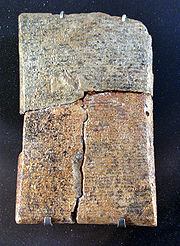
who appears in an incomplete Ugarit
Ugarit
Ugarit was an ancient port city in the eastern Mediterranean at the Ras Shamra headland near Latakia, Syria. It is located near Minet el-Beida in northern Syria. It is some seven miles north of Laodicea ad Mare and approximately fifty miles east of Cyprus...
ic text of the fourteenth century BCE at Ugarit
Ugarit
Ugarit was an ancient port city in the eastern Mediterranean at the Ras Shamra headland near Latakia, Syria. It is located near Minet el-Beida in northern Syria. It is some seven miles north of Laodicea ad Mare and approximately fifty miles east of Cyprus...
(modern Ras Shamra), Syria
Syria
Syria , officially the Syrian Arab Republic , is a country in Western Asia, bordering Lebanon and the Mediterranean Sea to the West, Turkey to the north, Iraq to the east, Jordan to the south, and Israel to the southwest....
, where the name is rendered DN'IL, "El
El (god)
is a Northwest Semitic word meaning "deity", cognate to Akkadian and then to Hebrew : Eli and Arabic )....
is judge".
Danel
The text in Corpus Tablettes Alphabetiques [CTA] 17–19 is often referred to as the Epic of Aqhat. Danel was depicted as "judging the cause of the widow, adjudicating the case of the fatherless" in the city gate. He passed through trials: his son Aqhat was destroyed but apparently in the missing conclusion was revived or replaced by Danel's patron god, Rp'u, who sits and judges with HadadHadad
Haddad was a northwest Semitic storm and rain god, cognate in name and origin with the Akkadian god Adad. Hadad was often called simply Ba‘al , but this title was also used for other gods. The bull was the symbolic animal of Hadad. He appeared as a bearded deity, often shown as holding a club and...
and Astarte
Astarte
Astarte is the Greek name of a goddess known throughout the Eastern Mediterranean from the Bronze Age to Classical times...
and is clearly identical to El
El (god)
is a Northwest Semitic word meaning "deity", cognate to Akkadian and then to Hebrew : Eli and Arabic )....
. "This is significant," John Day remarked "since the Old Testament identifies El with Yahweh and did not have the scruples about so doing which it had with Baal
Baal
Baʿal is a Northwest Semitic title and honorific meaning "master" or "lord" that is used for various gods who were patrons of cities in the Levant and Asia Minor, cognate to Akkadian Bēlu...
."
The three tablets bearing the story of Danel in about 400 lines break off before the story is completed. Danel, a leader, has no son and engages in an incubation
Incubation (ritual)
Incubation is the religious practice of sleeping in a sacred area with the intention of experiencing a divinely inspired dream or cure. Incubation was practised by many ancient cultures...
rite; on the seventh day Baal
Baal
Baʿal is a Northwest Semitic title and honorific meaning "master" or "lord" that is used for various gods who were patrons of cities in the Levant and Asia Minor, cognate to Akkadian Bēlu...
induces the other deities to intercede with El, who takes pity, blesses Danel and grants him a son, Aqhat. Aqhat is presented with a bow by the craftsman deity Kothar-wa-Khasis
Kothar-wa-Khasis
Kothar-wa-Khasis is a Canaanite god whose name means "Skillful-and-Wise" or "Adroit-and-Perceptive" or "Deft-and-Clever". Another of his names means "Deft-with-both-hands". Kothar is smith, craftsman, engineer, architect, and inventor...
. The goddess Anat
Anat
Anat, also ‘Anat is a major northwest Semitic goddess.-‘Anat in Ugarit:In the Ugaritic Ba‘al/Hadad cycle ‘Anat is a violent war-goddess, a virgin in Ugarit though the sister and lover of the great Ba‘al known as Hadad elsewhere. Ba‘al is usually called the son of Dagon and sometimes the son of El....
desires the bow and makes several tries unsuccessfully to obtain it, offering even immortality; Aqhat calls her offer spurious, since old age and death are man's common lot. Anat with the consent of El, launches her attendant in the form of a hawk to steal back the bow; however, in the event, the bow is broken and lost in the sea, and Aqhat dies. The bloodshed brings drought to the land and mourning. Aqhat's sister Pagat seeks vengeance, but discovers that the killer she has contracted is the very murderer of her brother. Here the narrative is interrupted. It is generally surmised that in the missing ending, with the help of Danel's patron god Aqhat's remains are recovered from the eagle that has devoured them.
The text was published and translated in 1936 by Charles Virolleaud
Charles Virolleaud
Jean Charles Gabriel Virolleaud was a French archaeologist, one of the excavators of Ugarit.-References:* Bibliography and overviews of his publications by several writers appeared in Syria: Revue d’art oriental et d’archéologie, 33 .* Dupont-Sommer, André, “Notice sur la vie et les travaux de M...
and has been extensively analysed since then.
Danel and the Book of Ezekiel
The Book of EzekielBook of Ezekiel
The Book of Ezekiel is the third of the Latter Prophets in the Hebrew Bible, following the books of Isaiah and Jeremiah and preceding the Book of the Twelve....
in three verses (14:14. 14:20, and 28:3) writes "Danel", which according to the Masoretic Text
Masoretic Text
The Masoretic Text is the authoritative Hebrew text of the Jewish Bible and is regarded as Judaism's official version of the Tanakh. While the Masoretic Text defines the books of the Jewish canon, it also defines the precise letter-text of these biblical books, with their vocalization and...
should be read as "Daniel". This notwithstanding, parallels and contrasts with the righteous and wise Danel (without i) of the Book of Ezekiel, placed between Noah
Noah
Noah was, according to the Hebrew Bible, the tenth and last of the antediluvian Patriarchs. The biblical story of Noah is contained in chapters 6–9 of the book of Genesis, where he saves his family and representatives of all animals from the flood by constructing an ark...
and Job
Job (Biblical figure)
Job is the central character of the Book of Job in the Hebrew Bible. Job is listed as a prophet of God in the Qur'an.- Book of Job :The Book of Job begins with an introduction to Job's character — he is described as a blessed man who lives righteously...
and invoked as the very example of righteous judgement, first pointed out by René Dussaud
René Dussaud
René Dussaud was a French Orientalist, archaeologist, and epigrapher. Among his major works are studies on the religion of the Hittites, the Hurrians, the Phoenicians and the Syriacs...
in 1931, have led readers commonly to accept or occasionally to reject a degree of identification with Ugaritic Danel of the "Aqhat text", amounting virtually to the same figure. The three figures referred to in — "Even if Noah
Noah
Noah was, according to the Hebrew Bible, the tenth and last of the antediluvian Patriarchs. The biblical story of Noah is contained in chapters 6–9 of the book of Genesis, where he saves his family and representatives of all animals from the flood by constructing an ark...
, Danel and Job were in it..." — links the name with two non-Israelites of great antiquity. In , Danel is one noted for his wisdom in the prophecy addressed to the king of Tyre: "you are indeed wiser than Danel, no secret is hidden from you". The name, "Danel", had a long tradition in Hebrew culture: he is supplied as the father-in-law of Enoch
Enoch (ancestor of Noah)
Enoch is a figure in the Generations of Adam. Enoch is described as Adam's greatx4 grandson , the son of Jared, the father of Methuselah, and the great-grandfather of Noah...
in Jubilees
Jubilees
The Book of Jubilees , sometimes called Lesser Genesis , is an ancient Jewish religious work, considered one of the pseudepigrapha by Protestant, Roman Catholic, and Eastern Orthodox Churches...
.
Texts in the Ugaritic language
Ugaritic language
The following table shows Proto-Semitic phonemes and their correspondences among Ugaritic, Arabic and Tiberian Hebrew:-Grammar:Ugaritic is an inflected language, and as a Semitic language its grammatical features are highly similar to those found in Classical Arabic and Akkadian...
may provide an important clue. The Canaanite tongue was discovered by French
France
The French Republic , The French Republic , The French Republic , (commonly known as France , is a unitary semi-presidential republic in Western Europe with several overseas territories and islands located on other continents and in the Indian, Pacific, and Atlantic oceans. Metropolitan France...
archaeologists
Archaeology
Archaeology, or archeology , is the study of human society, primarily through the recovery and analysis of the material culture and environmental data that they have left behind, which includes artifacts, architecture, biofacts and cultural landscapes...
in 1928, and known only from texts found in the lost city of Ugarit
Ugarit
Ugarit was an ancient port city in the eastern Mediterranean at the Ras Shamra headland near Latakia, Syria. It is located near Minet el-Beida in northern Syria. It is some seven miles north of Laodicea ad Mare and approximately fifty miles east of Cyprus...
(modern Ras Shamra), Syria
Syria
Syria , officially the Syrian Arab Republic , is a country in Western Asia, bordering Lebanon and the Mediterranean Sea to the West, Turkey to the north, Iraq to the east, Jordan to the south, and Israel to the southwest....
. Ugaritic has been used by scholars of the Old Testament
Old Testament
The Old Testament, of which Christians hold different views, is a Christian term for the religious writings of ancient Israel held sacred and inspired by Christians which overlaps with the 24-book canon of the Masoretic Text of Judaism...
to clarify Biblical Hebrew texts and has revealed ways in which ancient Israelite culture finds parallels in the neighboring cultures. Ugaritic was "the greatest literary discovery from antiquity since the deciphering of the Egyptian hieroglyphs and Mesopotamian cuneiform." Literary texts discovered at Ugarit include the Aqhat Epic (or Legend of Danel) — all revealing a Canaan
Canaan
Canaan is a historical region roughly corresponding to modern-day Israel, Palestine, Lebanon, and the western parts of Jordan...
ite religion. According to Edward L. Greenstein, a distinguished professor at Bar-Ilan University
Bar-Ilan University
Bar-Ilan University is a university in Ramat Gan of the Tel Aviv District, Israel.Established in 1955, Bar Ilan is now Israel's second-largest academic institution. It has nearly 26,800 students and 1,350 faculty members...
, Ugaritic texts solved the biblical
Bible
The Bible refers to any one of the collections of the primary religious texts of Judaism and Christianity. There is no common version of the Bible, as the individual books , their contents and their order vary among denominations...
puzzle of the anachronism
Anachronism
An anachronism—from the Greek ανά and χρόνος — is an inconsistency in some chronological arrangement, especially a chronological misplacing of persons, events, objects, or customs in regard to each other...
of Ezekiel
Ezekiel
Ezekiel , "God will strengthen" , is the central protagonist of the Book of Ezekiel in the Hebrew Bible. In Judaism, Christianity and Islam, Ezekiel is acknowledged as a Hebrew prophet...
mentioning Daniel
Daniel
Daniel is the protagonist in the Book of Daniel of the Hebrew Bible. In the narrative, when Daniel was a young man, he was taken into Babylonian captivity where he was educated in Chaldean thought. However, he never converted to Neo-Babylonian ways...
at ; it is because in both Ugaritic and the Ancient Hebrew texts, it is correctly Danel -- the yod
Yodh
Yodh is the tenth letter of many Semitic alphabets, including Phoenician, Aramaic, Hebrew Yud , Syriac and Arabic...
is missing in the originals.
T.E. Gaston argues that there are reasons to doubt the identification of Danel with the Danel of Ezekiel. Firstly, Danel is never described as wise or righteous. Secondly, given he was a Baal-worshiper it is unlikely that a strict Yahwist like Ezekiel would have considered Danel to be righteous. Thirdly, over eight hundred years separate the Aqhat text and the book of Ezekiel, and Danel is not mentioned in any Jewish source in the intervening period.
On the other hand, it is argued that Danel would fit the pattern of being an ancient non-Israelite like Job and Noah. Ezekiel's literary arrangement may also support this position. Yahweh has compared Judah with foreign nations before and the context appears to contain similar comparison in . The hypothetical rebellious country, while a cipher for Israel is not specifically named and could represent any ancient Near Eastern country. Ezekiel's audience is clearly enamored with non-Israelite myths (cf. Tammuz in ), and so they could easily be aware of King Danel's legendary virtues. Thus, Ezekiel's triad, if they were three ancient, righteous, non-Israelite men, would fit the pattern of Yahweh judging Israel to some degree by the nations around them. The connection is more plausible when one considers that Ezekiel alludes to Danel in an oracle against Tyre (Eze. 28), for the cultures of Ugarit
Ugarit
Ugarit was an ancient port city in the eastern Mediterranean at the Ras Shamra headland near Latakia, Syria. It is located near Minet el-Beida in northern Syria. It is some seven miles north of Laodicea ad Mare and approximately fifty miles east of Cyprus...
and Tyre were both Canaanite. Danel also had son and like Job, was unable to deliver him from divine harm (cf. ).