

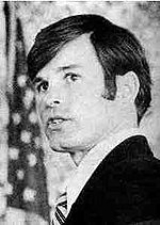
Dan White

Encyclopedia
Daniel James "Dan" White (September 2, 1946 – October 21, 1985) was a San Francisco supervisor
who assassinated San Francisco Mayor George Moscone
and Supervisor Harvey Milk
, on Monday, November 27, 1978, at City Hall
. In a controversial verdict that led to the coining of the legal slang "Twinkie defense
," White was convicted of manslaughter
rather than murder
in the deaths of Milk and Moscone. Less than two years after serving a sentence of five years, White returned to San Francisco and committed suicide. San Francisco Weekly has referred to White as "perhaps the most hated man in San Francisco's history."
parents in a Roman Catholic household in the Visitacion Valley neighborhood of San Francisco. He attended Riordan High School
and was expelled for violence during his junior year. He went on to attend Woodrow Wilson
High School where he was valedictorian
of his class. He enlisted in the Army in 1965 and served in the Vietnam War
before being honorably discharged in 1972. He worked as a security professional at A. J. Dimond High School
in Anchorage, Alaska
during early 1972. He returned to San Francisco to work as a police officer
. According to a San Francisco Weekly
newspaper account, citing no sources but based largely on interviews with two former political allies of White, he quit the force after reporting another officer for beating a handcuffed suspect.
White then joined the San Francisco Fire Department
. While on duty, according to the San Francisco Weekly story, White's rescue of a woman and her baby from a seventh-floor apartment in the Geneva Towers was covered by The San Francisco Chronicle. The city's newspapers referred to him as "an all-American boy."
to the San Francisco Board of Supervisors
from District 8, which included several neighborhoods near the southeastern limits of San Francisco. At that time, supervisors were elected by district and not "at-large
", as they had been before and then were again in the 1980s and 1990s. He had strong support from the police and firefighters' unions. His district was described by The New York Times
as "a largely white, middle-class section that is hostile to the growing homosexual community of San Francisco." As a supervisor, White openly saw himself as the board's "defender of the home, the family and religious life against homosexuals, pot smokers and cynics."
initially had several areas of political agreement and they initially worked well together, according to the San Francisco Weekly account. That story said that Milk was one of three supervisors invited to the baptism
of White's newborn child shortly after the election. White also persuaded Dianne Feinstein
, then president of the board of supervisors, to appoint Milk chairman of the Streets and Transportation Committee, according to that story.
The Catholic Church in April 1978 proposed a facility, to be operated by the Sisters of the Good Shepherd, in White's district for juvenile offenders who had committed murder, arson
, rape
, and other crimes, according to the same story. The account said White was strongly opposed, while Milk supported the facility, and this difference led to a conflict between the two. White held a mixed record on gay rights issues, both opposing the Briggs Initiative and voting against an ordinance prohibiting anti-gay
housing and employment discrimination.
, which failed to become profitable. He reversed his resignation on November 14, 1978 after his supporters lobbied him to seek appointment from George Moscone
.
Moscone initially agreed to White's request, but later refused the appointment at the urging of Milk and others. On November 27, 1978, White visited San Francisco City Hall
with the later-declared intention of killing Moscone, Milk, and two other San Francisco politicians whom he also blamed for lobbying Moscone not to re-appointment him. He arrived that day by climbing through a first-floor window on the side of City Hall carrying a loaded gun and 10 rounds of ammunition. By entering the building through the window, White was able to circumvent the recently installed metal detector
s. After entering Moscone's office, White pleaded to be re-instated as supervisor, but Moscone said no. White then killed Moscone by shooting him in the shoulder, chest, and twice in the head. He then walked to the other side of City Hall to Milk's office, reloaded his gun, and fatally shot Milk five times, the final two shots fired with the gun's barrel touching Milk's skull, according to the medical examiner. White then fled City Hall, turning himself in at the San Francisco's Northern Police Station where he had been a police officer. While being interviewed by investigators, White recorded a tearful confession, stating, "I just shot him."
due to depression. They argued, therefore, he was not capable of premeditating the killings, and thus was not legally guilty of first-degree murder. Forensic psychiatrist
Martin Blinder
testified that White was suffering from depression and pointed to several behavioral symptoms of that depression, including the fact that White had gone from being highly health-conscious to consuming sugary foods and drinks. When the prosecution played a recording of White's confession, several jurors wept as they listened to what was described as "a man pushed beyond his endurance." Many people familiar with City Hall claimed that it was common to enter through the window to save time. A police officer friend of White claimed to reporters that several officials carried weapons at this time and speculated that White carried the extra ammunition as a habit that police officers had. The jury found White guilty of voluntary manslaughter
rather than first-degree murder. Outrage within San Francisco's gay community
over the resulting seven-year sentence sparked the city's White Night Riots
; general disdain for the outcome of the court case led to the elimination of California's "diminished capacity
" law.
 White served five years of his seven-year sentence at Soledad State Prison
and was parole
d on January 7, 1984. Fearing White might be murdered in retaliation for his crimes, California State Corrections Officials secretly transported him to Los Angeles
, where he served a year's parole
. At the expiration of that year, White sought to return to San Francisco; Mayor Dianne Feinstein
issued a public announcement of his plans, and a statement formally asking White not to return. White did move back to San Francisco and attempted to rebuild his life with his wife and children. His marriage soon ended.
On October 21, 1985, less than two years after his release from prison, White committed suicide
by carbon monoxide poisoning
in his garage by running a garden hose from the exhaust pipe to the inside of his car. White's body was discovered by his brother, Thomas, shortly before 2 p.m. the same day.
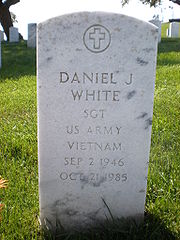
White was buried at Golden Gate National Cemetery
in San Bruno, California
, with a traditional government-furnished headstone issued for war veterans. He was survived by his two sons (seven and four years old at the time of his death), an infant daughter, and his ex-wife.
, and then-member of the California State Assembly
(and future San Francisco Mayor) Willie Brown
. Falzon quoted White as having said, "I was on a mission. I wanted four of them. Carol Ruth Silver, she was the biggest snake ... and Willie Brown, he was masterminding the whole thing." In 1975, Brown had authored the bill that legalized homosexuality in California. Falzon indicated that he believed White, stating, "I felt like I had been hit by a sledge-hammer ... I found out it was a premeditated murder."
San Francisco Board of Supervisors
The San Francisco Board of Supervisors is the legislative body within the government of the City and County of San Francisco, California, United States.-Government and politics:...
who assassinated San Francisco Mayor George Moscone
George Moscone
George Richard Moscone was an American attorney and Democratic politician. He was the 37th mayor of San Francisco, California, US from January 1976 until his assassination in November 1978. Moscone served in the California State Senate from 1967 until becoming Mayor. In the Senate, he served as...
and Supervisor Harvey Milk
Harvey Milk
Harvey Bernard Milk was an American politician who became the first openly gay man to be elected to public office in California when he won a seat on the San Francisco Board of Supervisors...
, on Monday, November 27, 1978, at City Hall
San Francisco City Hall
San Francisco City Hall, re-opened in 1915, in its open space area in the city's Civic Center, is a Beaux-Arts monument to the City Beautiful movement that epitomized the high-minded American Renaissance of the 1880s to 1917. The structure's dome is the fifth largest in the world...
. In a controversial verdict that led to the coining of the legal slang "Twinkie defense
Twinkie defense
"Twinkie defense" is a derisive label for an improbable legal defense. It is not a recognized legal defense in jurisprudence, but a catchall term coined by reporters during their coverage of the trial of defendant Dan White for the murders of San Francisco city supervisor Harvey Milk and mayor...
," White was convicted of manslaughter
Manslaughter
Manslaughter is a legal term for the killing of a human being, in a manner considered by law as less culpable than murder. The distinction between murder and manslaughter is said to have first been made by the Ancient Athenian lawmaker Dracon in the 7th century BC.The law generally differentiates...
rather than murder
Murder
Murder is the unlawful killing, with malice aforethought, of another human being, and generally this state of mind distinguishes murder from other forms of unlawful homicide...
in the deaths of Milk and Moscone. Less than two years after serving a sentence of five years, White returned to San Francisco and committed suicide. San Francisco Weekly has referred to White as "perhaps the most hated man in San Francisco's history."
Early life
Daniel James White was born in Los Angeles County, the second of nine children. He was raised by working classWorking class
Working class is a term used in the social sciences and in ordinary conversation to describe those employed in lower tier jobs , often extending to those in unemployment or otherwise possessing below-average incomes...
parents in a Roman Catholic household in the Visitacion Valley neighborhood of San Francisco. He attended Riordan High School
Archbishop Riordan High School
Archbishop Riordan High School is an Archdiocesan, all-boys Catholic high school run by members of the Society of Mary in San Francisco, California. It is located in the Roman Catholic Archdiocese of San Francisco. Originally called Riordan High School, the school was named after Archbishop...
and was expelled for violence during his junior year. He went on to attend Woodrow Wilson
Woodrow Wilson
Thomas Woodrow Wilson was the 28th President of the United States, from 1913 to 1921. A leader of the Progressive Movement, he served as President of Princeton University from 1902 to 1910, and then as the Governor of New Jersey from 1911 to 1913...
High School where he was valedictorian
Valedictorian
Valedictorian is an academic title conferred upon the student who delivers the closing or farewell statement at a graduation ceremony. Usually, the valedictorian is the highest ranked student among those graduating from an educational institution...
of his class. He enlisted in the Army in 1965 and served in the Vietnam War
Vietnam War
The Vietnam War was a Cold War-era military conflict that occurred in Vietnam, Laos, and Cambodia from 1 November 1955 to the fall of Saigon on 30 April 1975. This war followed the First Indochina War and was fought between North Vietnam, supported by its communist allies, and the government of...
before being honorably discharged in 1972. He worked as a security professional at A. J. Dimond High School
Dimond High School
A. J. Dimond High School is a public four-year high school in Anchorage in Alaska, and is a part of the Anchorage School District. It has been accredited by the Northwest Commission on Colleges and Universities. Dimond High operates on a traditional six period schedule, with a nine-month school...
in Anchorage, Alaska
Alaska
Alaska is the largest state in the United States by area. It is situated in the northwest extremity of the North American continent, with Canada to the east, the Arctic Ocean to the north, and the Pacific Ocean to the west and south, with Russia further west across the Bering Strait...
during early 1972. He returned to San Francisco to work as a police officer
San Francisco Police Department
The San Francisco Police Department, also known as the SFPD and San Francisco Department Of Police, is the police department of the City and County of San Francisco, California...
. According to a San Francisco Weekly
SF Weekly
SF Weekly is a free alternative weekly newspaper in San Francisco, California. The newspaper, distributed throughout the San Francisco Bay Area every Wednesday, is published by Village Voice Media, a 16-paper alt weekly newspaper chain that also includes the New York City Village Voice and the Los...
newspaper account, citing no sources but based largely on interviews with two former political allies of White, he quit the force after reporting another officer for beating a handcuffed suspect.
White then joined the San Francisco Fire Department
San Francisco Fire Department
The San Francisco Fire Department provides fire and emergency services to the City and County of San Francisco, California.The San Francisco Fire Department, along with the San Francisco Police Department and San Francisco Sheriff's Department, serves an estimated population of 1.4 million people...
. While on duty, according to the San Francisco Weekly story, White's rescue of a woman and her baby from a seventh-floor apartment in the Geneva Towers was covered by The San Francisco Chronicle. The city's newspapers referred to him as "an all-American boy."
Election as supervisor
In 1977, White was elected as a DemocratDemocratic Party (United States)
The Democratic Party is one of two major contemporary political parties in the United States, along with the Republican Party. The party's socially liberal and progressive platform is largely considered center-left in the U.S. political spectrum. The party has the lengthiest record of continuous...
to the San Francisco Board of Supervisors
San Francisco Board of Supervisors
The San Francisco Board of Supervisors is the legislative body within the government of the City and County of San Francisco, California, United States.-Government and politics:...
from District 8, which included several neighborhoods near the southeastern limits of San Francisco. At that time, supervisors were elected by district and not "at-large
At-Large
At-large is a designation for representative members of a governing body who are elected or appointed to represent the whole membership of the body , rather than a subset of that membership...
", as they had been before and then were again in the 1980s and 1990s. He had strong support from the police and firefighters' unions. His district was described by The New York Times
The New York Times
The New York Times is an American daily newspaper founded and continuously published in New York City since 1851. The New York Times has won 106 Pulitzer Prizes, the most of any news organization...
as "a largely white, middle-class section that is hostile to the growing homosexual community of San Francisco." As a supervisor, White openly saw himself as the board's "defender of the home, the family and religious life against homosexuals, pot smokers and cynics."
Tenure as supervisor
Despite their personal differences, White and Supervisor Harvey MilkHarvey Milk
Harvey Bernard Milk was an American politician who became the first openly gay man to be elected to public office in California when he won a seat on the San Francisco Board of Supervisors...
initially had several areas of political agreement and they initially worked well together, according to the San Francisco Weekly account. That story said that Milk was one of three supervisors invited to the baptism
Baptism
In Christianity, baptism is for the majority the rite of admission , almost invariably with the use of water, into the Christian Church generally and also membership of a particular church tradition...
of White's newborn child shortly after the election. White also persuaded Dianne Feinstein
Dianne Feinstein
Dianne Goldman Berman Feinstein is the senior U.S. Senator from California. A member of the Democratic Party, she has served in the Senate since 1992. She also served as 38th Mayor of San Francisco from 1978 to 1988....
, then president of the board of supervisors, to appoint Milk chairman of the Streets and Transportation Committee, according to that story.
The Catholic Church in April 1978 proposed a facility, to be operated by the Sisters of the Good Shepherd, in White's district for juvenile offenders who had committed murder, arson
Arson
Arson is the crime of intentionally or maliciously setting fire to structures or wildland areas. It may be distinguished from other causes such as spontaneous combustion and natural wildfires...
, rape
Rape
Rape is a type of sexual assault usually involving sexual intercourse, which is initiated by one or more persons against another person without that person's consent. The act may be carried out by physical force, coercion, abuse of authority or with a person who is incapable of valid consent. The...
, and other crimes, according to the same story. The account said White was strongly opposed, while Milk supported the facility, and this difference led to a conflict between the two. White held a mixed record on gay rights issues, both opposing the Briggs Initiative and voting against an ordinance prohibiting anti-gay
LGBT rights opposition
LGBT rights opposition refers to active opposition to lesbian, gay, bisexual, and transgender civil rights. Organizations influential in LGBT rights opposition frequently challenge judicial rulings, and legislative initiatives, and dispute findings that sexual orientation is an immutable...
housing and employment discrimination.
Assassinations
After his disagreement with Milk over the proposed rehab center, White frequently clashed with Milk as well as other members of the board. On November 10, 1978, White resigned his seat as supervisor. The reasons he cited were his dissatisfaction with what he saw as the corrupt inner-workings of San Francisco city politics, as well as the difficulty in making a living without a police officer's or firefighter's salary, jobs he could not hold legally while serving as supervisor. White had opened a baked-potato stand at Pier 39Pier 39
Pier 39 is a shopping center and popular tourist attraction built on a pier in San Francisco, California. At Pier 39, there are shops, restaurants, a video arcade, street performances, an interpretive center for the Marine Mammal Center, the Aquarium of the Bay, virtual 3D rides, and views of...
, which failed to become profitable. He reversed his resignation on November 14, 1978 after his supporters lobbied him to seek appointment from George Moscone
George Moscone
George Richard Moscone was an American attorney and Democratic politician. He was the 37th mayor of San Francisco, California, US from January 1976 until his assassination in November 1978. Moscone served in the California State Senate from 1967 until becoming Mayor. In the Senate, he served as...
.
Moscone initially agreed to White's request, but later refused the appointment at the urging of Milk and others. On November 27, 1978, White visited San Francisco City Hall
San Francisco City Hall
San Francisco City Hall, re-opened in 1915, in its open space area in the city's Civic Center, is a Beaux-Arts monument to the City Beautiful movement that epitomized the high-minded American Renaissance of the 1880s to 1917. The structure's dome is the fifth largest in the world...
with the later-declared intention of killing Moscone, Milk, and two other San Francisco politicians whom he also blamed for lobbying Moscone not to re-appointment him. He arrived that day by climbing through a first-floor window on the side of City Hall carrying a loaded gun and 10 rounds of ammunition. By entering the building through the window, White was able to circumvent the recently installed metal detector
Metal detector
A metal detector is a device which responds to metal that may not be readily apparent.The simplest form of a metal detector consists of an oscillator producing an alternating current that passes through a coil producing an alternating magnetic field...
s. After entering Moscone's office, White pleaded to be re-instated as supervisor, but Moscone said no. White then killed Moscone by shooting him in the shoulder, chest, and twice in the head. He then walked to the other side of City Hall to Milk's office, reloaded his gun, and fatally shot Milk five times, the final two shots fired with the gun's barrel touching Milk's skull, according to the medical examiner. White then fled City Hall, turning himself in at the San Francisco's Northern Police Station where he had been a police officer. While being interviewed by investigators, White recorded a tearful confession, stating, "I just shot him."
Trial
At the trial, White's defense team argued that his mental state at the time of the killings was one of diminished capacityDiminished Capacity
Diminished Capacity is a comedy film directed by Terry Kinney and starring Matthew Broderick, Virginia Madsen, and Alan Alda. It was released at the 2008 Sundance Film Festival and opened in theaters in July 2008...
due to depression. They argued, therefore, he was not capable of premeditating the killings, and thus was not legally guilty of first-degree murder. Forensic psychiatrist
Forensic psychiatry
Forensic psychiatry is a sub-speciality of psychiatry and an auxiliar science of criminology. It encompasses the interface between law and psychiatry...
Martin Blinder
Martin Blinder
Martin Blinder, M.D. is a physician and forensic psychiatrist licensed to practice in Hawaii, California, Kentucky and Georgia. He is Editor-in-Chief of the academic journal, Family Therapy, past Assistant Clinical Professor of Psychiatry at the University of California, San Francisco, and Past...
testified that White was suffering from depression and pointed to several behavioral symptoms of that depression, including the fact that White had gone from being highly health-conscious to consuming sugary foods and drinks. When the prosecution played a recording of White's confession, several jurors wept as they listened to what was described as "a man pushed beyond his endurance." Many people familiar with City Hall claimed that it was common to enter through the window to save time. A police officer friend of White claimed to reporters that several officials carried weapons at this time and speculated that White carried the extra ammunition as a habit that police officers had. The jury found White guilty of voluntary manslaughter
Manslaughter
Manslaughter is a legal term for the killing of a human being, in a manner considered by law as less culpable than murder. The distinction between murder and manslaughter is said to have first been made by the Ancient Athenian lawmaker Dracon in the 7th century BC.The law generally differentiates...
rather than first-degree murder. Outrage within San Francisco's gay community
Gay community
The gay community, or LGBT community, is a loosely defined grouping of LGBT and LGBT-supportive people, organizations and subcultures, united by a common culture and civil rights movements. These communities generally celebrate pride, diversity, individuality, and sexuality...
over the resulting seven-year sentence sparked the city's White Night Riots
White Night Riots
The White Night riots were a series of violent events sparked by an announcement of the lenient sentencing of Dan White, for the assassinations of San Francisco Mayor George Moscone and San Francisco Supervisor Harvey Milk. The events took place on the night of May 21, 1979 in San Francisco...
; general disdain for the outcome of the court case led to the elimination of California's "diminished capacity
Diminished Capacity
Diminished Capacity is a comedy film directed by Terry Kinney and starring Matthew Broderick, Virginia Madsen, and Alan Alda. It was released at the 2008 Sundance Film Festival and opened in theaters in July 2008...
" law.
Imprisonment and suicide
Correctional Training Facility
Correctional Training Facility is a state prison located on U.S. Highway 101, north of Soledad, California. Randy Grounds is the current Warden of the prison.-Facilities:...
and was parole
Parole
Parole may have different meanings depending on the field and judiciary system. All of the meanings originated from the French parole . Following its use in late-resurrected Anglo-French chivalric practice, the term became associated with the release of prisoners based on prisoners giving their...
d on January 7, 1984. Fearing White might be murdered in retaliation for his crimes, California State Corrections Officials secretly transported him to Los Angeles
Los Angeles, California
Los Angeles , with a population at the 2010 United States Census of 3,792,621, is the most populous city in California, USA and the second most populous in the United States, after New York City. It has an area of , and is located in Southern California...
, where he served a year's parole
Parole
Parole may have different meanings depending on the field and judiciary system. All of the meanings originated from the French parole . Following its use in late-resurrected Anglo-French chivalric practice, the term became associated with the release of prisoners based on prisoners giving their...
. At the expiration of that year, White sought to return to San Francisco; Mayor Dianne Feinstein
Dianne Feinstein
Dianne Goldman Berman Feinstein is the senior U.S. Senator from California. A member of the Democratic Party, she has served in the Senate since 1992. She also served as 38th Mayor of San Francisco from 1978 to 1988....
issued a public announcement of his plans, and a statement formally asking White not to return. White did move back to San Francisco and attempted to rebuild his life with his wife and children. His marriage soon ended.
On October 21, 1985, less than two years after his release from prison, White committed suicide
Suicide
Suicide is the act of intentionally causing one's own death. Suicide is often committed out of despair or attributed to some underlying mental disorder, such as depression, bipolar disorder, schizophrenia, alcoholism, or drug abuse...
by carbon monoxide poisoning
Carbon monoxide poisoning
Carbon monoxide poisoning occurs after enough inhalation of carbon monoxide . Carbon monoxide is a toxic gas, but, being colorless, odorless, tasteless, and initially non-irritating, it is very difficult for people to detect...
in his garage by running a garden hose from the exhaust pipe to the inside of his car. White's body was discovered by his brother, Thomas, shortly before 2 p.m. the same day.
White was buried at Golden Gate National Cemetery
Golden Gate National Cemetery
Golden Gate National Cemetery is a U.S. National Cemetery, located in the city of San Bruno, San Mateo County, 12 miles south of San Francisco. Because of the name and location, it is frequently confused with San Francisco National Cemetery, which dates to the 19th century and is in the Presidio...
in San Bruno, California
San Bruno, California
San Bruno is a city in San Mateo County, California, United States. The population was 41,114 at the 2010 census.The city is adjacent to San Francisco International Airport and Golden Gate National Cemetery.-Geography:San Bruno is located at...
, with a traditional government-furnished headstone issued for war veterans. He was survived by his two sons (seven and four years old at the time of his death), an infant daughter, and his ex-wife.
Confession
In 1998, Frank Falzon, the homicide inspector with the San Francisco police to whom White had turned himself in after the killings, said that he met White in 1984, and that at this meeting White had confessed that he had the intention to kill not only Moscone and Milk, but another supervisor, Carol Ruth SilverCarol Ruth Silver
Carol Ruth Silver is an American lawyer and former politician. She was a Freedom Rider arrested and incarcerated for 40 days in Jackson, Mississippi,...
, and then-member of the California State Assembly
California State Assembly
The California State Assembly is the lower house of the California State Legislature. There are 80 members in the Assembly, representing an approximately equal number of constituents, with each district having a population of at least 420,000...
(and future San Francisco Mayor) Willie Brown
Willie Brown (politician)
Willie Lewis Brown, Jr. is an American politician of the Democratic Party. He served over 30 years in the California State Assembly, spending 15 years as its Speaker, and afterward served as the 41st mayor of San Francisco, the first African American to do so...
. Falzon quoted White as having said, "I was on a mission. I wanted four of them. Carol Ruth Silver, she was the biggest snake ... and Willie Brown, he was masterminding the whole thing." In 1975, Brown had authored the bill that legalized homosexuality in California. Falzon indicated that he believed White, stating, "I felt like I had been hit by a sledge-hammer ... I found out it was a premeditated murder."
In popular culture
- The story of the assassinations is told in the Academy Award-winning documentary filmDocumentary filmDocumentary films constitute a broad category of nonfictional motion pictures intended to document some aspect of reality, primarily for the purposes of instruction or maintaining a historical record...
The Times of Harvey MilkThe Times of Harvey MilkThe Times of Harvey Milk is an American documentary film that premiered at The Telluride Film Festival, the New York Film Festival, and then on November 1, 1984 at the Castro Theatre in San Francisco...
(1984), which came out a year before White committed suicide. - White's life, the assassinations, and his trial are covered in the 1984 book Double PlayDouble playIn baseball, a double play for a team or a fielder is the act of making two outs during the same continuous playing action. In baseball slang, making a double play is referred to as "turning two"....
: The San Francisco City Hall Killings by Mike Weiss, which won the Edgar AwardEdgar AwardThe Edgar Allan Poe Awards , named after Edgar Allan Poe, are presented every year by the Mystery Writers of America...
as Best True Crime Book of the Year. An expanded second edition, Double Play: The Double Assassination of George Moscone and Harvey Milk, was issued in 2010 and updated White's story to include his life after prison and his suicide. The second edition also includes a DVD with a half-hour video interview of White. - Execution of JusticeExecution of JusticeExecution of Justice is an award-winning ensemble play by Emily Mann chronicling the case of the People vs. Dan White. White assassinated San Francisco mayor George Moscone and openly gay city supervisor Harvey Milk in November 1978...
, a play by Emily MannEmily Mann (director)Emily Mann, born April 12, 1952, is the multi-award–winning Artistic Director and Resident Playwright of McCarter Theatre in Princeton, New Jersey, where she has overseen over 85 productions....
, chronicles the events leading to the assassinations. In 1999, the play was adapted to film for cable network Showtime, with Tim Daly portraying White. - The assassinations were the basis for a scene in the 1987 science fictionScience fictionScience fiction is a genre of fiction dealing with imaginary but more or less plausible content such as future settings, futuristic science and technology, space travel, aliens, and paranormal abilities...
movie RoboCopRoboCopRoboCop is a 1987 American science fiction-action film directed by Paul Verhoeven. Set in a crime-ridden Detroit, Michigan in the near future, RoboCop centers on a police officer who is brutally murdered and subsequently re-created as a super-human cyborg known as "RoboCop"...
in which a deranged former municipal official holds the Mayor and others hostage and demands his job back. - Actor Josh BrolinJosh BrolinJosh James Brolin is an American actor. He has acted in theater, film and television roles since 1985, and won acting awards for his roles in the films W., No Country for Old Men, Milk and True Grit.-Early life:...
was nominated for an Academy Award for playing Dan White in Gus Van SantGus Van SantGus Green Van Sant, Jr. is an American director, screenwriter, painter, photographer, musician, and author. He is a two time nominee of the Academy Award for Best Director for his 1997 film Good Will Hunting and his 2008 film Milk, both of which were also nominated for Best Picture, and won the...
's 2008 biopic MilkMilk (film)Milk is a 2008 American biographical film on the life of gay rights activist and politician Harvey Milk, who was the first openly gay person to be elected to public office in California, as a member of the San Francisco Board of Supervisors...
, which opened with wide release from Focus FeaturesFocus FeaturesFocus Features is the art house films division of NBC Universal's Universal Pictures, and acts as both a producer and distributor for its own films and a distributor for foreign films....
. The film suggests that Milk believed White may have been a closetedClosetedCloseted and in the closet are metaphors used to describe lesbian, gay, bisexual, transgender, queer/questioning and intersex people who have not disclosed their sexual orientation or gender identity and aspects thereof, including sexual identity and sexual behavior.-Background:In late 20th...
gay man. However, there is no evidence to suggest that Dan White was homosexual. Sean PennSean PennSean Justin Penn is an American actor, screenwriter and film director, also known for his political and social activism...
plays Milk in the film.