
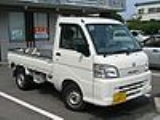
The
Daihatsu Hijet is a
microvanA microvan is a van that fits into Japanese kei car classification or similar. In certain regions, these models are inexpensive and widely used for small business because of tax and insurance benefits; for example, in Japan they are exempted from a certification that there is adequate parking...
and
pickup truckA pickup truck is a light motor vehicle with an open-top rear cargo area .-Definition:...
produced by the Japanese automaker Daihatsu. Despite the similarities between the Hijet name and Toyota's naming scheme for its trucks and vans (
HiaceThe Toyota HiAce is a motor vehicle produced by the Japanese manufacturer Toyota. First launched in 1967, the HiAce has since been available in a wide range of configurations, including minivan and minibus, van, pick-up, taxi, and ambulance....
and
HiluxThe Toyota Hilux is a series of compact pickup trucks produced and marketed by the Toyota Motor Corporation. Most countries used the Hilux name for the entire life of the series but in North America, the Hilux name was retired in 1976 in favor of Truck, Pickup Truck, or Compact Truck...
), the name "Hijet" has been in use for Daihatsu's Kei trucks and vans since 1960, over two decades before Toyota took control. "Hijet", when transliterated into Japanese, is very similar to "
MidgetThe Daihatsu Midget is a single-seat mini-truck made by Japanese automaker Daihatsu. Several distinct vehicles have borne the Midget name over the years, but all have had in common a single-seat utilitarian design, with an enclosed or semi-enclosed cab....
", one of Daihatsu's other mini-trucks. The Hijet competes in Japan with the
Honda Acty- External links :*****...
,
Subaru SambarThe Subaru Sambar is an automobile built by automaker Subaru for the Japanese market. It is Japan's first Keitora , shorthand for "kei class truck" and is still in production. The Sambar is available in both microvan and Kei truck to fulfill the Kei car guidelines...
,
Mitsubishi MinicabThe Mitsubishi Minicab is a kei truck and microvan built and sold in Japan by Mitsubishi Motors since 1966.-First generation:The Minicab cab-over pickup truck was launched in 1966 to replace the 360, which by this time had adopted the same model name as the Minica sedan...
, and the
Suzuki CarryThe Suzuki Carry is a kei truck produced by the Japanese automaker Suzuki. The microvan version was originally called the Carry van until 1982 when the van was renamed as the '...
.
History
The first Hijet received a 360 cc two-stroke engine, as was dictated by the
kei carKei cars, K-cars, or , are a Japanese category of small vehicles, including passenger cars, vans, and pickup trucks. They are designed to comply with Japanese government tax and insurance regulations, and in most rural areas are exempted from the requirement to certify that adequate parking is...
laws of the time. The Hijet's development has long followed the evolution of Japan's kei regulations, with an increase to 550 cc in 1976 and then 660 cc for 1990. Exterior dimensions have also increased somewhat, from 3 x 1.3 m originally to 3.4 x 1,475 m today. Export versions have usually been somewhat larger as bigger bumpers and sometimes wider bodies are fitted.
The band Diehatzu Hijets, of similar spelling, pay homage to the vehicle.
Fourth generation (S60)
In March 1977, production of the truck version of the fourth generation began. Called the
Hijet Wide 55, to draw attention to its wider body and bigger 550 cc engine, this was the first Hijet to reach export markets in any serious numbers. The 547 cc AB20 was a four-stroke, water-cooled two-cylinder unit. Power output is 28 PS at 5,500 rpm, while max torque is 4 kgm at 3,500 rpm. The only transmission installed is a four-speed manual with a floor-mounted shifter.
The engine is mid-mounted just behind the front axle, and access is gained by simply lifting the front seats. Chassis code is
S60, with the succeeding letter "P" signifying a simple pickup bed with one opening flap; "T" for the three-way dropside pickup; and "V" for the vans.
Three months after the introduction of the pickups (in June 1977), a glassed van with sliding doors and also a "panel van" version were released. The panel van was simply a truck with a box mounted on the rear; this version was not exported. For export, a van version without windows or rear seats was preferred. A low floor dropside bed was added in December 1977, and a minor facelift took place in September 1978. The changes were limited to different colored bumpers and headlight surrounds, and a changed metal grille insert featuring a larger "D" logo. All versions were available in either Standard or Super DeLuxe trims, but in March 1979 a comparatively luxurious "Custom EX" version of the light van was added.
In September of 1979, the Hijet Wide 55 underwent a more thorough facelift: A new front clip with a single-piece grille was the most obvious change, while inside there was a new more sculpted dash as well as more comfortable seats which were now adjustable. Production continued until replaced by the fifth generation Hijet in 1981.
Ninth generation (S200)
When the ninth generation Hijet was introduced in 1999, a divergence between the truck and van versions (Cargo) occurred, with the vans now being of a front-engined "semicab" design rather than the mid-engined cabover design retained for the truck. A tenth generation of the Hijet Cargo has since appeared, but the ninth generation of the truck remains in production. A similar divergence took place in the
Suzuki CarryThe Suzuki Carry is a kei truck produced by the Japanese automaker Suzuki. The microvan version was originally called the Carry van until 1982 when the van was renamed as the '...
lineup, necessitated by new crash protection legislations enacted for passenger cars. Since the Hijet Cargo also forms the basis for the passenger use Atrai, it too now has a front-mounted engine.
Tenth generation (S320)
The tenth generation is only available in van form, with the trucks remaining the ninth generation cabover model. In Japan, the passenger car version of the Hijet is known as the
Daihatsu Atrai, which is also powered by a 660 cc Turbo engine producing 64 bhp. Available engines for 2006 include the
DVVTIn internal combustion engines, variable valve timing , also known as Variable valve actuation , is a generalized term used to describe any mechanism or method that can alter the shape or timing of a valve lift event within an internal combustion engine...
equipped 660 cc EF-VE, making 39 kW at 7,000 rpm and 63 newton metre of
torqueTorque, moment or moment of force , is the tendency of a force to rotate an object about an axis, fulcrum, or pivot. Just as a force is a push or a pull, a torque can be thought of as a twist....
at 4,000 rpm, and the 660 cc EF-SE, making 33 kW at 5,900 rpm and 57 newton metre of torque at 3,600 rpm. The base model is mid-engined with rear-wheel drive, but
four-wheel driveFour-wheel drive, 4WD, or 4×4 is a four-wheeled vehicle with a drivetrain that allows all four wheels to receive torque from the engine simultaneously...
versions are also available.
Variants
There are also versions of the Hijet sold outside
JapanJapan is an island nation in East Asia. Located in the Pacific Ocean, it lies to the east of the Sea of Japan, China, North Korea, South Korea and Russia, stretching from the Sea of Okhotsk in the north to the East China Sea and Taiwan in the south...
, available with 1.0 and 1.3-litre engines. These are no longer considered
kei carKei cars, K-cars, or , are a Japanese category of small vehicles, including passenger cars, vans, and pickup trucks. They are designed to comply with Japanese government tax and insurance regulations, and in most rural areas are exempted from the requirement to certify that adequate parking is...
s, as they are wider and longer than allowed by these narrowly defined regulations. The
Hijet Maxx/Hijet Jumbo is a pick-up truck or chasis cab which can be set up for other uses such as a moving stall. The
Daihatsu Zebra (also known as the
Daihatsu Citivan,
Daihatsu Devan, and
Daihatsu Zebra Espass) is a van version of the Hijet Maxx. The
Perodua RusaThe Perodua Rusa is a microvan manufactured by Malaysian automaker Perodua, and based on the Daihatsu Zebra and Daihatsu Hijet Maxx. Launched on March 6, 1996, with a 1.3 litre engine, followed by the 1.6 litre range on May 14, 1997, the Rusa is the first van to be produced by a Malaysian...
is a rebadged Zebra sold by Daihatsu's Malaysian partner,
PeroduaThe ' , usually abbreviated to Perodua , is Malaysia's second largest automobile manufacturer after Proton. It was established in 1992 and launched their first car, the Perodua Kancil in August 1994. 'M2’ was refers to the codename which was used when the project to establish Perodua was still Top...
. In the Japanese market, there was also a larger version of the ninth generation Hijet, sold as the
Hijet Gran Cargo. This car has been exported as the
Extol as well.
The
Piaggio Porter is a licenced version manufactured in Italy since 1992 (originally as the "Innocenti Porter"), available also with diesel, LPG or electric motors. Originally equipped with a 1.0 petrol or a 1.2 litre diesel, more recent cars receive a 1,269 cc petrol/LPG engine or a 1,371 cc diesel. The 1.3 offers 48 kW in either configuration while the 1.4 diesel only manages 28 kW. All of these Porter variants are based on the facelifted sixth generation of the Hijet (S82) which has its front wheel located below the front door and a mid-mounted engine. The S82 Hijet also provided the basis for Kia's Towner.
In 2007, Daihatsu Indonesia launched the new
Daihatsu Gran Max which is based on the newest Hijet ("semicab", front wheels located forward of the door). It is powered by 1,300 and 1,500 cc engines and is both wider and longer than the
kei carKei cars, K-cars, or , are a Japanese category of small vehicles, including passenger cars, vans, and pickup trucks. They are designed to comply with Japanese government tax and insurance regulations, and in most rural areas are exempted from the requirement to certify that adequate parking is...
based Hijet. It replaces the previous Daihatsu Zebra of similar size. The Gran Max is available in
minivanMinivan is a type of van designed for personal use. Minivans are typically either two-box or one box designs for maximum interior volume – and are taller than a sedan, hatchback, or a station wagon....
and
pick-upA pickup truck is a light motor vehicle with an open-top rear cargo area .-Definition:...
bodystyles and since February 2008 it is imported to Japan where it is sold as the
Toyota LiteAceThe Toyota Liteace is a line of motor vehicles produced by the Japanese manufacturer Toyota. Launched in 1970, the Liteace is a medium-sized van which was most commonly exported to Asia, Australia and Africa....
(S402).
Hybrid Hijet
In 2002, Daihatsu debuted the
Hijet Cargo Hybrid conceptA concept vehicle or show vehicle is a car made to showcase new styling and or new technology. They are often shown at motor shows to gauge customer reaction to new and radical designs which may or may not have a chance of being produced....
, a
hybrid van, in
JapanJapan is an island nation in East Asia. Located in the Pacific Ocean, it lies to the east of the Sea of Japan, China, North Korea, South Korea and Russia, stretching from the Sea of Okhotsk in the north to the East China Sea and Taiwan in the south...
using a 660 cc engine. The car is based on the existing non-hybrid Hijet Cargo. Daihatsu calls it a mild hybrid design. Its design (called Daihatsu Mild Hybrid System or DMHS based on Toyota hybrid technology) is quite different from many existing hybrid design where as the gas and electric powered components assembled as one unit. The electric motor sits between the gasoline powered engine and the transmission unit. The car is 30% more fuel efficient than its gas-powered counterpart.
The
hybrid minicarMinicar or mini car may refer to:*City car, a European car classification*Kei car, a Japanese car classification*Obvio!, is a Brazilian car*The Mini, a popular British small car made from 1959 to 2000...
s (called FEV - Ultra Fuel Economy - and Atrai Hybrid-IV) made its debut in 2002 as a concept
minicarMinicar or mini car may refer to:*City car, a European car classification*Kei car, a Japanese car classification*Obvio!, is a Brazilian car*The Mini, a popular British small car made from 1959 to 2000...
. Its production was announced in October 2004 but as of May 2006 had not been released.
External links