
In
Greek mythologyGreek mythology is the body of myths and legends belonging to the ancient Greeks concerning their gods and heroes, the nature of the world, and the origins and significance of their own cult and ritual practices. They were a part of religion in ancient Greece...
,
Daedalus (Latin, also Hellenized Latin
Daedalos, Greek
Daidalos (
Δαίδαλος) meaning "cunning worker", and Etruscan
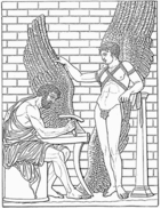
Taitle) was a most skillful architect, or artificer, or craftsman, so skillful that he was said to have invented images that seemed to move about. Daedalus had two sons:
IcarusIcarus is a character in Greek mythology. He is the son of Daedalus and is commonly known for his attempt to escape Crete by flight, which ended in a fall to his death.-Escape from Crete:...
and
IapyxIn Roman mythology, Iapyx or Iapux was Aeneas's healer during the Trojan War and then escaped to Italy after the war and founded Apulia.-Descent:He was either:...
, along with a nephew, whose name varies. He is first mentioned by
HomerHomer is a legendary ancient Greek epic poet, traditionally said to be the author of the epic poems the Iliad and the Odyssey...
as the creator of a wide dancing-ground for
AriadneAriadne , in Greek mythology , was daughter of King Minos of Crete and his queen, Pasiphaë, daughter of Helios, the Sun-titan...
. The Labyrinth on
CreteCrete is the largest of the Greek islands and the fifth largest island in the Mediterranean Sea at 8,336 km²...
in which the
MinotaurIn Greek mythology, the Minotaur , as the Greeks imagined him, was a creature with the head of a bull on the body of a man or, as described by Ovid, "part man and part bull." He dwelt at the center of the Cretan Labyrinth, which was an elaborate maze-like construction built for King Minos of Crete...
(part man, part bull) was kept, was also created by the artificer Daedalus. The story of the labyrinth is told where
TheseusFor other uses, see Theseus Theseus was the legendary founder-king of Athens, son of Aethra, and fathered by Aegeus and Poseidon, with both of whom Aethra lay in one night. Theseus was a founder-hero, like Perseus, Cadmus or Heracles, all of whom battled and overcame foes that were identified with...
is challenged to kill the Minotaur, finding his way with the help of Ariadne's thread.
Ignoring Homer, later writers envisaged the
labyrinthIn Greek mythology, the Labyrinth was an elaborate structure designed and built by the legendary artificer Daedalus for King Minos of Crete at Knossos. Its function was to hold the Minotaur, a creature that was half man and half bull and was eventually killed by the Athenian hero Theseus...
as an edifice rather than a single path to the center and out again, and gave it numberless winding passages and turns that opened into one another, seeming to have neither beginning nor end (see
labyrinthIn Greek mythology, the Labyrinth was an elaborate structure designed and built by the legendary artificer Daedalus for King Minos of Crete at Knossos. Its function was to hold the Minotaur, a creature that was half man and half bull and was eventually killed by the Athenian hero Theseus...
as opposed to
mazeA maze is a complex tour puzzle in the form of a complex branching passage through which the solver must find a route. In everyday speech, both maze and labyrinth denote a complex and confusing series of pathways, but technically the maze is distinguished from the labyrinth...
).
OvidPublius Ovidius Naso , known as Ovid in the English-speaking world, was a Roman poet who wrote about love, seduction, and mythological transformation....
, in his
MetamorphosesThe Metamorphoses by the Roman poet Ovid is a narrative poem in fifteen books that describes the creation and history of the world. Completed in 8 AD, it has remained one of the most popular works of mythology, being the Classical work best known to medieval writers and thus having a great deal of...
, suggests that Daedalus constructed the
LabyrinthIn Greek mythology, the Labyrinth was an elaborate structure designed and built by the legendary artificer Daedalus for King Minos of Crete at Knossos. Its function was to hold the Minotaur, a creature that was half man and half bull and was eventually killed by the Athenian hero Theseus...
so cunningly that he himself could barely escape it after he built it. Daedalus built the labyrinth for King
MinosIn Greek mythology, Minos was a mythical king of Crete, son of Zeus and Europa. After his death, Minos became a judge of the dead in Hades. The Minoan civilization of pre-Hellene Crete has been named after him...
, who needed it to imprison his wife's son the
MinotaurIn Greek mythology, the Minotaur , as the Greeks imagined him, was a creature with the head of a bull on the body of a man or, as described by Ovid, "part man and part bull." He dwelt at the center of the Cretan Labyrinth, which was an elaborate maze-like construction built for King Minos of Crete...
. The story is told that
PoseidonIn Greek mythology, Poseidon was the god of the sea and, as "Earth-Shaker," of earthquakes. The name of the sea-god Nethuns in Etruscan was adopted in Latin for Neptune in Roman mythology: both were sea gods analogous to Poseidon...
had given a white bull to
MinosIn Greek mythology, Minos was a mythical king of Crete, son of Zeus and Europa. After his death, Minos became a judge of the dead in Hades. The Minoan civilization of pre-Hellene Crete has been named after him...
so that he might use it as a sacrifice. Instead, Minos kept it for himself; and in revenge, Poseidon made his wife
PasiphaëIn Greek mythology, Pasiphaë , "wide-shining" was the daughter of Helios, the Sun, by the eldest of the Oceanids, Perse; Like her doublet Europa, her origins were in the East, in her case at Colchis, the palace of the Sun; she was given in marriage to King Minos of Crete. With Minos, she was the...
lust for the bull. For Pasiphaë, as Greek mythologers interpreted it, Daedalus also built a wooden cow so she could mate with the bull, for the Greeks imagined the Minoan
bull of the sunAppearances of the Bull in mythology and worship are widespread in the ancient world. It is the subject of various cultural and religious incarnations, as well as modern mentions in new age cultures.- Paleolithic findings :...
to be an actual, earthly bull.
Athenians transferred Cretan Daedalus to make him Athenian-born, the grandson of the ancient king
ErechtheusErechtheus in Greek mythology was the name of an archaic king of Athens, the re-founder of the polis and a double at Athens for Poseidon, as "Poseidon Erechtheus"...
, who fled to Crete, having killed his nephew. Over time, other stories were told of Daedalus. In the nineteenth century,
Thomas BulfinchThomas Bulfinch was an American writer, born in Newton, Massachusetts. Bulfinch belonged to a well educated Bostonian merchant family of modest means. His father was Charles Bulfinch, the architect of the Massachusetts State House in Boston and parts of the U.S. Capitol in Washington, D.C....
combined these into a single synoptic view of material which Andrew Stewart calls a "historically-intractable farrago of 'evidence', heavily tinged with Athenian cultural chauvinism" (Stewart).
Daedalus and his nephew
Daedalus was so proud of his achievements that he could not bear the idea of a rival. His sister had placed her son, named multiply as
PerdixPerdix - nephew and student of Daedalus in Greek mythology Daedalus was so proud of his achievements that he could not bear the idea of a rival...
, Talos, or Calos, under his charge to be taught the mechanical arts. He was an apt scholar and showed striking evidence of ingenuity. Walking on the seashore, he picked up the spine of a fish. Imitating it, he took a piece of iron and notched it on the edge, and thus invented the saw. He put two pieces of iron together, connecting them at one end with a rivet, and sharpening the other ends, and made a pair of compasses. It is also said that he invented a way to transfer the soul of a human being into a machine, therefore creating a machine with a soul and rendering the soul immortal. Daedalus was so envious of his nephew's accomplishments that he took an opportunity, when they were together one day on the top of a high tower, to push him off. But
AthenaIn Greek mythology, Athena is the goddess of wisdom, peace, warfare, strategy, handicrafts and reason, shrewd companion of heroes and the goddess of heroic endeavour...
, who favors ingenuity, saw him falling and arrested his fate by changing him into a bird called after his name, the
partridgePartridges are birds in the pheasant family, Phasianidae. They are a non-migratory Old World group.These are medium-sized birds, intermediate between the larger pheasants and the smaller quails. Partridges are native to Europe, Asia, Africa, and the Middle East...
. This bird does not build his nest in the trees, nor take lofty flights, but nestles in the hedges, and mindful of his fall, avoids high places. For this crime, Daedalus was tried and banished.
Daedalus and Icarus
Among these anecdotes, one is told in Ovid's
Metamorphoses (VIII:183-235) that Daedalus was shut up in a tower to prevent his knowledge of the labyrinth from spreading to the public. He could not leave Crete by sea, as the king kept strict watch on all vessels, permitting none to sail without being carefully searched. Since Minos controlled the land and sea routes, Daedalus set to work to fabricate wings for himself and his young son
IcarusIcarus is a character in Greek mythology. He is the son of Daedalus and is commonly known for his attempt to escape Crete by flight, which ended in a fall to his death.-Escape from Crete:...
. He tied feathers together, from smallest to largest so as to form an increasing surface. The larger ones he secured with thread and the smaller with wax, and gave the whole a gentle curvature like the wings of a bird. When the work was finally done, the artist, waving his wings, found himself buoyed upward and hung suspended, poising himself on the beaten air. He next equipped his son in the same manner, and taught him how to fly. When both were prepared for flight, Daedalus warned Icarus not to fly too high, because the heat of the sun would melt the wax, nor too low because the sea foam would make the wings wet and they would no longer fly. Thus the father and son flew away.
They had passed
SamosSamos is a Greek island in the North Aegean sea, south of Chios, north of Patmos and the Dodecanese, and off the coast of Asia Minor.-Geography:...
,
DelosThe island of Delos , isolated in the centre of the roughly circular ring of islands called the Cyclades, near Mykonos, is one of the most important mythological, historical and archaeological sites in Greece...
and
LebynthosLebynthos is a small island located in the east of the Aegean Sea, between Kos and Paros, which is part of the Dodecanese islands. The island is mentioned in two of Ovid's works Ars Amatoria and the Metamorphoses in connection with the saga of Daedalus and Icarus. While escaping from Crete,...
when the boy began to soar upward as if to reach heaven. The blazing sun softened the wax which held the feathers together and they came off. Icarus fell into the sea. His father cried, bitterly lamenting his own arts, and called the land near the place where Icarus fell into the ocean
IcariaIcaria, also spelled Ikaria , locally Nikaria or Nicaria , ancient name: Doliche , is a Greek island 10 nautical miles southwest of Samos. It derived its name from Icarus, the son of Daedalus in Greek mythology, who fell into the sea nearby.-History:Icaria has been inhabited since at least 7000 B.C...
in memory of his child.
Eventually Daedalus arrived safely in
SicilySicily is the largest island in the Mediterranean Sea. It is an autonomous region of Italy. Several much smaller islands surrounding it are considered to be part of Sicily....
, in the care of King
CocalusIn Greek mythology, Cocalus was a king of Kamikos in Sicily, according to Diodorus Siculus . After the escape of Daedalus and Icarus from King Minos's imprisonment, and the subsequent death of Icarus, Daedalus arrived in Sicily, where he was welcomed by King Cocalus...
, where he built a temple to Apollo, and hung up his wings, an offering to the god. In an alternative version given by
VirgilPublius Vergilius Maro was a classical Roman poet, best known for three major works—the Eclogues , the Georgics, and the Aeneid—although several minor poems are also attributed to him.The son of a farmer, Virgil came to be...
in Book 6 of the
AeneidThe Aeneid is a Latin epic poem written by Virgil in the late 1st century BC that tells the legendary story of Aeneas, a Trojan who traveled to Italy, where he became the ancestor of the Romans. It is written in dactylic hexameter...
, Daedalus flies to
CumaeCumae is an ancient Greek settlement lying to the northwest of Naples in the Italian region of Campania...
, and founds his temple there, rather than in Sicily.
MinosIn Greek mythology, Minos was a mythical king of Crete, son of Zeus and Europa. After his death, Minos became a judge of the dead in Hades. The Minoan civilization of pre-Hellene Crete has been named after him...
, meanwhile, searched for Daedalus by travelling from city to city asking a riddle. He presented a spiral seashell and asked for a string to be run through it. When he reached Camicus, King Cocalus, knowing Daedalus would be able to solve the riddle, privately fetched the old man to him. He tied the string to an ant which, lured by a drop of honey at one end, walked through the seashell stringing it all the way through. Minos then knew Daedalus was in the court of King Cocalus and demanded he be handed over. Cocalus managed to convince Minos to take a bath first, where Cocalus' daughters killed Minos. In some versions, Daedalus himself poured boiling water on Minos and killed him.
The Innovator
Such anecdotal details as these were embroideries upon the reputation of Daedalus as an innovator in many arts. In Pliny's Natural History (7.198) he is credited with inventing carpentry "and with it the saw, axe, plumb-line, drill, glue, and
isinglassIsinglass is a substance obtained from the swimbladders of fish . It is a form of collagen used mainly for the clarification of wine and beer.-Use in foods and drinks:...
".
PausaniasPausanias was a Greek traveller and geographer of the 2nd century AD, who lived in the times of Hadrian, Antoninus Pius and Marcus Aurelius. He is famous for his Description of Greece , a lengthy work that describes ancient Greece from firsthand observations, and is a crucial link between...
, in travelling around Greece, attributed to Daedalus numerous archaic wooden cult figures (see
xoanaA xoanon was an Archaic wooden cult image of Ancient Greece. Classical Greeks associated such cult objects, whether aniconic or effigy, with the legendary Daedalus...
) that impressed him: "All the works of this artist, though somewhat uncouth to look at, nevertheless have a touch of the divine in them."
Daedalus gave his name,
eponymAn eponym is the name of a person, whether real or fictitious, after which a particular place, tribe, era, discovery, or other item is named or thought to be named. One who is referred to as eponymous is someone who gives his or her name to something, e.g...
ously, to any Greek artificer and to many Greek contraptions that represented dextrous skill. At
PlataeaPlataea or Plataeae was an ancient city, located in Greece in southeastern Boeotia, south of Thebes. It was the location of the Battle of Plataea in 479 BC, in which an alliance of Greek city-states defeated the Persians...
there was a festival, the
DaedalaIn ancient Greece, the Daedala was a festival celebrating the goddess Hera celebrated among the Boeotians, particularly the Plataeans. The festival is described by Pausanias and also by Plutarch....
, in which a temporary wooden altar was fashioned, and an effigy was made from an oak-tree and dressed in bridal attire. It was carried in a cart with a woman who acted as bridesmaid. The image was called
Daedale and the archaic ritual given an explanation through a myth to the purpose.
In the period of
RomanticismRomanticism is a complex artistic, literary, and intellectual movement that originated in the second half of the 18th century in Western Europe, and gained strength during the Industrial Revolution...
, Daedalus came to denote the classic artist, a skilled mature craftsman, while
IcarusIcarus is a character in Greek mythology.Icarus may also refer to:-Outer space:* Icarus * Icarus , a planetary science journal* 1566 Icarus, an asteroid-Fictional:* Icarus...
symbolized the romantic artist, an undisputed prototype of the classic artist, whose impetuous, passionate and rebellious nature, as well as his defiance of formal aesthetic and social conventions, may ultimately prove to be self-destructive.
Stephen DedalusStephen Dedalus is James Joyce's literary alter ego, as well as the protagonist and antihero of his first, semi-autobiographical novel of artistic existence A Portrait of the Artist as a Young Man and an important character in Joyce's monumental Ulysses...
, in Joyce's
Portrait of the Artist as a Young Man envisages his future artist-self "a hawklike man flying above the waves”.
Sources
- Thomas Bulfinch's
Thomas Bulfinch was an American writer, born in Newton, Massachusetts. Bulfinch belonged to a well educated Bostonian merchant family of modest means. His father was Charles Bulfinch, the architect of the Massachusetts State House in Boston and parts of the U.S. Capitol in Washington, D.C....
MythologyBulfinch's Mythology is a collection of the works of Thomas Bulfinch, renamed after him and published after his death. It is a classic work of mythology and is still being printed, even 150 years after the first work, Age of Fable, was published in 1855....
- Encyclopaedia Britannica Daedalus
- Andrew Stewart, One Hundred Greek Sculptors: Their Careers and Extant Works. Begins with Daedalus.
- Peter Hunt, "Ekphrasis or Not? Ovid (Met. 8.183-235 ) in Pieter Bruegel the Elder’s Landscape with the Fall of Icarus" Essay on Brueghel's visualisation of Ovid.