
In
molecular biologyMolecular biology is the branch of biology that deals with the molecular basis of biological activity. This field overlaps with other areas of biology and chemistry, particularly genetics and biochemistry...
,
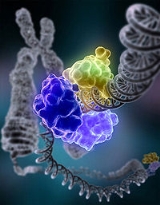
DNA ligase is a specific type of enzyme, a
ligaseIn biochemistry, ligase is an enzyme that can catalyse the joining of two large molecules by forming a new chemical bond, usually with accompanying hydrolysis of a small chemical group dependent to one of the larger molecules...
, that repairs single-stranded discontinuities in double stranded
DNADeoxyribonucleic acid is a nucleic acid that contains the genetic instructions used in the development and functioning of all known living organisms . The DNA segments that carry this genetic information are called genes, but other DNA sequences have structural purposes, or are involved in...
molecules, in simple words strands that have double-strand break (a break in both complementary strands of DNA). Purified DNA ligase is used in gene cloning to join DNA molecules together. The alternative, a single-strand break, is fixed by a different type of DNA ligase using the
complementary strandIn genetics, complementary DNA is DNA synthesized from a messenger RNA template in a reaction catalyzed by the enzyme reverse transcriptase and the enzyme DNA polymerase. cDNA is often used to clone eukaryotic genes in prokaryotes...
as a template, but still requires DNA ligase to create the final
phosphodiester bondA phosphodiester bond is a group of strong covalent bonds between a phosphate group and two 5-carbon ring carbohydrates over two ester bonds. Phosphodiester bonds are central to all known life, as they make up the backbone of each helical strand of DNA...
to fully repair the DNA.
DNA ligase has applications in both
DNA repairDNA repair refers to a collection of processes by which a cell identifies and corrects damage to the DNA molecules that encode its genome. In human cells, both normal metabolic activities and environmental factors such as UV light and radiation can cause DNA damage, resulting in as many as 1...
and
DNA replicationDNA replication is a biological process that occurs in all living organisms and copies their DNA; it is the basis for biological inheritance. The process starts with one double-stranded DNA molecule and produces two identical copies of the molecule...
(see
Mammalian ligases). In addition, DNA ligase has extensive use in molecular biology laboratories for
Genetic recombinationGenetic recombination is a process by which a molecule of nucleic acid is broken and then joined to a different one. Recombination can occur between similar molecules of DNA, as in homologous recombination, or dissimilar molecules, as in non-homologous end joining. Recombination is a common method...
experiments (see
Applications in molecular biology research).
Ligase mechanism
The mechanism of DNA ligase is to form two covalent phosphodiester bonds between 3' hydroxyl ends of one
nucleotideNucleotides are molecules that, when joined together, make up the structural units of RNA and DNA. In addition, nucleotides participate in cellular signaling , and are incorporated into important cofactors of enzymatic reactions...
, ("acceptor") with the 5' phosphate end of another ("donor"). ATP is required for the ligase reaction, which proceeds in three steps: (1) adenylation (addition of AMP) of a residue in the active center of the enzyme,
pyrophosphateIn chemistry, the anion, the salts, and the esters of pyrophosphoric acid are called pyrophosphates. Any salt or ester containing two phosphate groups is called a diphosphate. As a food additive, diphosphates are known as E450.- Chemistry :...
is released; (2) transfer of the AMP to the 5' phosphate of the so-called donor, formation of a pyrophosphate bond; (3) formation of a phosphodiester bond between the 5' phosphate of the donor and the 3' hydroxyl of the acceptor.
Ligase will also work with
blunt endDNA end or sticky end refers to the properties of the end of a molecule of DNA or a recombinant DNA molecule. The concept is important in molecular biology, especially in cloning or when subcloning inserts DNA into vector DNA. All the terms can also be used in reference to RNA. The sticky ends or...
s, although higher enzyme concentrations and different reaction conditions are required.
Mammalian ligases
In mammals, there are four specific types of ligase.
- DNA ligase I
DNA ligase 1 is an enzyme that in humans is encoded by the LIG1 gene.-Further reading:...
: ligates the nascent DNA of the lagging strand after the Ribonuclease H has removed the RNA primer from the Okazaki fragmentOkazaki fragments are short molecules of single-stranded DNA that are formed on the lagging strand during DNA replication. They are between 1,000 to 2,000 nucleotides long in Escherichia coli and are between 100 to 200 nucleotides long in eukaryotes....
s.
- DNA ligase II: alternatively splice
In molecular biology and genetics, splicing is a modification of an RNA after transcription, in which introns are removed and exons are joined. This is needed for the typical eukaryotic messenger RNA before it can be used to produce a correct protein through translation...
d form of DNA ligase III found in non-dividing cells.
- DNA ligase III: complexes
A multiprotein complex is a group of two or more associated polypeptide chains. If the different polypeptide chains contain different protein domain, the resulting multiprotein complex can have multiple catalytic functions...
with DNA repairDNA repair refers to a collection of processes by which a cell identifies and corrects damage to the DNA molecules that encode its genome. In human cells, both normal metabolic activities and environmental factors such as UV light and radiation can cause DNA damage, resulting in as many as 1...
proteinProteins are biochemical compounds consisting of one or more polypeptides typically folded into a globular or fibrous form, facilitating a biological function. A polypeptide is a single linear polymer chain of amino acids bonded together by peptide bonds between the carboxyl and amino groups of...
XRCC1XRCC1 is a DNA repair protein.It complexes with DNA ligase III.-Interactions:XRCC1 has been shown to interact with PARP2, DNA polymerase beta, Aprataxin, Oxoguanine glycosylase, PCNA, APEX1, PNKP and PARP1.-Further reading:-External links:...
to aid in sealing DNA during the process of nucleotide excision repairDNA repair refers to a collection of processes by which a cell identifies and corrects damage to the DNA molecules that encode its genome. In human cells, both normal metabolic activities and environmental factors such as UV light and radiation can cause DNA damage, resulting in as many as 1...
and recombinant fragments.
- DNA ligase IV
LIG4 is a human gene that encodes the protein DNA Ligase IV.-Further reading:...
: complexes with XRCC4DNA repair protein XRCC4 is a protein that in humans is encoded by the XRCC4 gene.-Function:-Pathology:Mutations in XRCC4 are associated with embryonic lethality in mice specimens. This can be mitigated by crossing the XRCC4 knockouts with p53 mutants, suggesting that lethality is a result of p53...
. It catalyzes the final step in the non-homologous end joiningNon-homologous end joining is a pathway that repairs double-strand breaks in DNA. NHEJ is referred to as "non-homologous" because the break ends are directly ligated without the need for a homologous template, in contrast to homologous recombination, which requires a homologous sequence to guide...
DNA double-strand break repair pathway. It is also required for V(D)J recombinationVJ recombination, also known as somatic recombination, is a mechanism of genetic recombination in the early stages of immunoglobulin and T cell receptors production of the immune system...
, the process that generates diversity in immunoglobulin and T-cell receptor loci during immune systemAn immune system is a system of biological structures and processes within an organism that protects against disease by identifying and killing pathogens and tumor cells. It detects a wide variety of agents, from viruses to parasitic worms, and needs to distinguish them from the organism's own...
development.
Some forms of DNA ligase present in bacteria (usually larger) may require NAD to act as a co-factor, whereas other forms of DNA ligases (usually present in
E.coli, and usually smaller) may require ATP to react. Also, a number of other structures present in the DNA ligase are the AMP and lysine, both of which are important in the ligation process since they create an intermediate enzyme.
Applications in molecular biology research
DNA ligases have become an indispensable tool in modern molecular biology research for generating
recombinantRecombinant DNA molecules are DNA sequences that result from the use of laboratory methods to bring together genetic material from multiple sources, creating sequences that would not otherwise be found in biological organisms...
DNA sequences. For example, DNA ligases are used with
restriction enzymeA Restriction Enzyme is an enzyme that cuts double-stranded DNA at specific recognition nucleotide sequences known as restriction sites. Such enzymes, found in bacteria and archaea, are thought to have evolved to provide a defense mechanism against invading viruses...
s to insert DNA fragments, often
genesGênes is the name of a département of the First French Empire in present Italy, named after the city of Genoa. It was formed in 1805, when Napoleon Bonaparte occupied the Republic of Genoa. Its capital was Genoa, and it was divided in the arrondissements of Genoa, Bobbio, Novi Ligure, Tortona and...
, into
plasmidIn microbiology and genetics, a plasmid is a DNA molecule that is separate from, and can replicate independently of, the chromosomal DNA. They are double-stranded and, in many cases, circular...
s.
One vital aspect to performing efficient recombination experiments involving the ligation of cohesive-ended fragments is controlling the optimal temperature. Most experiments use T4 DNA Ligase (isolated from
bacteriophage T4Enterobacteria phage T4 is a bacteriophage that infects E. coli bacteria. Its DNA is 169–170 kbp long, and is held in an icosahedral head. T4 is a relatively large phage, at approximately 90 nm wide and 200 nm long...
), which is most active at 25°C. However, for optimal ligation efficiency with cohesive-ended fragments ("sticky ends"), the optimal enzyme temperature needs to be balanced with the
melting temperatureMelting temperature may refer to:* Melting point, the temperature at which a substance changes from solid to liquid state.* DNA melting temperature, the temperature at which a DNA double helix dissociates into single strands....
T
m (also the
annealing temperatureAnnealing temperature may refer to:*Annealing *Annealing *Polymerase chain reaction...
) of the sticky ends being ligated. If the ambient temperature exceeds T
m, the
homologous pairingHomologous chromosomes are chromosome pairs of approximately the same length, centromere position, and staining pattern, with genes for the same characteristics at corresponding loci. One homologous chromosome is inherited from the organism's mother; the other from the organism's father...
of the sticky ends would not be stable because the high temperature disrupts hydrogen bonding. Ligation reaction is most efficient when the sticky ends are already stably annealed, disruption of the annealing ends would therefore results in low ligation efficiency. The shorter the overhang, the lower the T
m, typically a 4-base overhang has a T
m of 12-16°C.
Since blunt-ended DNA fragments have no cohesive ends to anneal, the melting temperature is not a factor to consider within the normal temperature range of the ligation reaction. However, the higher the temperature, the less chance that the ends to be joined will be aligned to allow ligation (molecules move around the solution more at higher temperatures). The limiting factor in blunt end ligation is not the activity of the ligase but rather the number of alignments between DNA fragment ends that occur. The most efficient ligation temperature for blunt-ended DNA would therefore be the temperature at which the greatest number of alignments can occur. Therefore, the majority of blunt-ended ligations are carried out at 14-16°C overnight. The absence of a stably annealed ends also means that the ligation efficiency is lowered, requiring a higher ligase concentration to be used.(T4 DNA ligase is the only commercially-available DNA ligase to anneal blunt ends).
History
The first DNA ligase was purified and characterized in 1967. The common commercially available DNA ligases were originally discovered in
bacteriophage T4Enterobacteria phage T4 is a bacteriophage that infects E. coli bacteria. Its DNA is 169–170 kbp long, and is held in an icosahedral head. T4 is a relatively large phage, at approximately 90 nm wide and 200 nm long...
,
E. coli and other
bacteriaBacteria are a large domain of prokaryotic microorganisms. Typically a few micrometres in length, bacteria have a wide range of shapes, ranging from spheres to rods and spirals...
.
See also
- DNA end
DNA end or sticky end refers to the properties of the end of a molecule of DNA or a recombinant DNA molecule. The concept is important in molecular biology, especially in cloning or when subcloning inserts DNA into vector DNA. All the terms can also be used in reference to RNA. The sticky ends or...
- Lagging strand
- DNA replication
DNA replication is a biological process that occurs in all living organisms and copies their DNA; it is the basis for biological inheritance. The process starts with one double-stranded DNA molecule and produces two identical copies of the molecule...
- Okazaki fragment
Okazaki fragments are short molecules of single-stranded DNA that are formed on the lagging strand during DNA replication. They are between 1,000 to 2,000 nucleotides long in Escherichia coli and are between 100 to 200 nucleotides long in eukaryotes....
- DNA Polymerase
A DNA polymerase is an enzyme that helps catalyze in the polymerization of deoxyribonucleotides into a DNA strand. DNA polymerases are best known for their feedback role in DNA replication, in which the polymerase "reads" an intact DNA strand as a template and uses it to synthesize the new strand....
External links