
All Topics  
DKW

 
DKW

   Email Print
   Bookmark   Link


DKW


Dampf Kraft Wagen or DKW is a historic car
Automobile

An automobile or motor car is a wheeled motor vehicle for transportation passengers, which also carries its own car engine or motor. Most definitions of the term specify that automobiles are designed to run primarily on roads, to have seating for one to eight people, to typically have four wheels, and to be constructed principally f...
 and motorcycle
Motorcycle

A motorcycle is a Single track, two-wheeled motor vehicle powered by an Motorcycle engine. Motorcycles vary considerably depending on the task for which they are designed, such as Touring motorcycle travel, navigating Naked bike, Cruiser , Motorcycle sport and Motorbike racing, or off-road conditions....
 marque
Marque

A marque is a brand name, especially in the automobile industry. For example, Chevrolet and Pontiac are marques of their maker, General Motors Corporation ....
. In 1916, the Danish
Denmark

Denmark is a Scandinavian country in northern Europe and the senior member of the Kingdom of Denmark. It is the southernmost of the Nordic countries....
 engineer
Engineer

An engineer is a person professionally engaged in a field of engineering. Engineers are concerned with developing economical and safe solutions to practical problems, by applying mathematics and scientific knowledge while considering technical constraints....
 Jørgen Skafte Rasmussen
Jørgen Skafte Rasmussen

J?rgen Skafte Rasmussen was an engineer and industrialist of Denmark origin. He moved to Germany and established several automobile and motorcycle manufacturing companies, including DKW and Framo....
 founded a factory in Saxony
Saxony

The Free State of Saxony is a States of Germany of Germany. Located in the southeastern part of present-day Germany. It is the tenth-largest German state in area and the sixth largest in population , of Germany's sixteen states....
, Germany
Germany

Germany , officially the Federal Republic of Germany , is a country in Central Europe. It is bordered to the north by the North Sea, Denmark, and the Baltic Sea; to the east by Poland and the Czech Republic; to the south by Austria and Switzerland; and to the west by France, Luxembourg, Belgium, and the Netherlands....
, to produce steam fittings. In the same year, he attempted to produce a steam-driven car, called the DKW. Although unsuccessful, he made a two-stroke
Two-stroke cycle

The two-stroke internal combustion engine differs from the more common four-stroke engine by completing the same cycle in only two strokes of the piston, rather than four....
 toy engine in 1919, called Des Knaben Wunsch — "the boy's desire". He also put a slightly modified version of this engine into a motorcycle and called it Das Kleine Wunder — "the little marvel".


Discussion
Ask a question about 'DKW'
Start a new discussion about 'DKW'
Answer questions from other users
Full Discussion Forum


Recent Posts


Encyclopedia


Dampf Kraft Wagen or DKW is a historic car
Automobile

An automobile or motor car is a wheeled motor vehicle for transportation passengers, which also carries its own car engine or motor. Most definitions of the term specify that automobiles are designed to run primarily on roads, to have seating for one to eight people, to typically have four wheels, and to be constructed principally f...
 and motorcycle
Motorcycle

A motorcycle is a Single track, two-wheeled motor vehicle powered by an Motorcycle engine. Motorcycles vary considerably depending on the task for which they are designed, such as Touring motorcycle travel, navigating Naked bike, Cruiser , Motorcycle sport and Motorbike racing, or off-road conditions....
 marque
Marque

A marque is a brand name, especially in the automobile industry. For example, Chevrolet and Pontiac are marques of their maker, General Motors Corporation ....
. In 1916, the Danish
Denmark

Denmark is a Scandinavian country in northern Europe and the senior member of the Kingdom of Denmark. It is the southernmost of the Nordic countries....
 engineer
Engineer

An engineer is a person professionally engaged in a field of engineering. Engineers are concerned with developing economical and safe solutions to practical problems, by applying mathematics and scientific knowledge while considering technical constraints....
 Jørgen Skafte Rasmussen
Jørgen Skafte Rasmussen

J?rgen Skafte Rasmussen was an engineer and industrialist of Denmark origin. He moved to Germany and established several automobile and motorcycle manufacturing companies, including DKW and Framo....
 founded a factory in Saxony
Saxony

The Free State of Saxony is a States of Germany of Germany. Located in the southeastern part of present-day Germany. It is the tenth-largest German state in area and the sixth largest in population , of Germany's sixteen states....
, Germany
Germany

Germany , officially the Federal Republic of Germany , is a country in Central Europe. It is bordered to the north by the North Sea, Denmark, and the Baltic Sea; to the east by Poland and the Czech Republic; to the south by Austria and Switzerland; and to the west by France, Luxembourg, Belgium, and the Netherlands....
, to produce steam fittings. In the same year, he attempted to produce a steam-driven car, called the DKW. Although unsuccessful, he made a two-stroke
Two-stroke cycle

The two-stroke internal combustion engine differs from the more common four-stroke engine by completing the same cycle in only two strokes of the piston, rather than four....
 toy engine in 1919, called Des Knaben Wunsch — "the boy's desire". He also put a slightly modified version of this engine into a motorcycle and called it Das Kleine Wunder — "the little marvel". This was the real beginning of the DKW brand: by the 1930s, DKW was the world's largest motorcycle manufacturer.

In 1932, DKW merged with Audi
Audi

AUDI AG, is a Germany car manufacturer which produces cars under the Audi brand, . The name Audi is based on a latin translation of the last name of the founder August "Horch", itself the German word for ?hear." Another explanation for the origin of the name is as an acronym for ?Auto Union Deutschland Ingolstadt."...
, Horch
Horch

Horch was car brand manufactured in Germany by August Horch & Cie, at the beginning of the 20th century....
 and Wanderer
Wanderer (car)

Wanderer was a Germany manufacturer of bicycles, motorcycles, automobiles, panel vans and other machinery. Established as Winklhofer & Jaenicke in 1896, the company used Wanderer brand name since 1911, making civilian automobiles until 1941 and military until 1945....
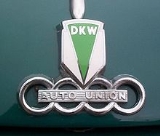
, to form the Auto Union
Auto Union

Auto Union was an amalgamation of four Germany automobile manufacturers, established in 1932 in Chemnitz, Saxony, during the Great Depression. The company has evolved into present day Audi, as an independent subsidiary of Volkswagen Group....
. Auto Union came under Daimler-Benz
Daimler-Benz

Daimler-Benz AG was a German manufacturer of automobiles, motor vehicles, and engines which was founded in 1926. An Agreement of Mutual Interest?which was valid until year 2000?was signed on May 1 1924 between Karl Benz's Benz & Cie....
 ownership in 1957, and was finally purchased by the Volkswagen Group
Volkswagen Group

Volkswagen Group, or Volkswagen Aktiengesellschaft , is a German automotive industry group, currently the automotive industry#World's largest vehicle manufacturing groups , and the largest in Europe....
 in 1964. The last DKW car was the F102
DKW F102

The DKW F102 is a car produced by German manufacturer DKW. It succeeded the Auto Union 1000 and 1000S models in 1963. It was the last model developed before Volkswagen acquired the Auto Union brands from Mercedes-Benz in 1964, and provided the base for the later Audi F103 models ....
 which ceased production in 1966; after this the brand was phased out.

Automobiles made before WWII

DKW cars were made from 1928 until 1966. They always used two-stroke
Two-stroke cycle

The two-stroke internal combustion engine differs from the more common four-stroke engine by completing the same cycle in only two strokes of the piston, rather than four....
 engines and, from 1931, the company was a pioneer in front-wheel drive
Front-wheel drive

Front-wheel drive is a form of Internal combustion engine/transmission layout used in motor vehicles, where the engine drives the front wheels only....
 and transverse mounting. The most well-known cars made before World War II, bearing model names F1 through F8 (F for Front), had front-wheel drive and a transversely mounted two-cylinder engine. Displacement was 600 or 700 cc, power was 18 to . These models also featured an innovation with a generator that doubled up as a self-starter, which was mounted directly on the crankshaft
Crankshaft

The crankshaft, sometimes casually abbreviated to crank , is the part of an engine which translates reciprocation linear piston motion into rotation....
. This was known as a Dynastart.

They also produced a less well-known series of rear-wheel drive cars called Schwebeklasse and Sonderklasse with V4
V4 engine

File:Saab Sonett III Ford V4 engine.jpgA V4 engine is a V engine with four cylinder s....
 two-stroke engines. Displacement of this engine was 1000 cc, later 1100 cc. These engines had two extra cylinders for forced induction
Forced induction

Forced induction is a term used to describe internal combustion engines that are not naturally-aspirated engine. A gas compressor is added to the air intake instead, thereby increasing the quantity of oxygen available for combustion....
, so they really appeared like V6es but without sparkplug
Sparkplug

This article is about the Mini-Con partner of Optimus Prime in Transformers: Armada. For other uses, see Spark plug Sparkplug is the name of a fictional character in the various Transformers universes....
s on the front cylinder pair.

In 1939, they made a prototype with the first three-cylinder engine
Straight-3

A straight-3 or inline-3 is an internal combustion engine with three cylinder s arranged in a straight line side by side.Most straight-3 engines employ a crank angle of 120? and are thus rotationally balanced; however, since the three cylinders are offset from each other, the firing of the end cylinders induces a rocking motion from e...
. The engine had a displacement of 900 cc and produced . With a streamlined body, the car could run at 115 km/h (72 mph). This prototype was to be put into production only after World War II
World War II

World War II, or the Second World War , was a global military conflict which involved a Participants in World War II, including all of the great powers, organised into two opposing military alliances: the Allies of World War II and the Axis powers....
, first as an IFA
Industrieverband Fahrzeugbau

Industrieverband Fahrzeugbau , usually abbreviated as IFA, was a conglomerate and a union of companies for vehicle construction in East Germany....
 F9 (later to become Wartburg) in Zschopau
Zschopau

Zschopau , a town in the Germany state Saxony, is located on both banks of the Zschopau River, 9 miles south-east from Chemnitz. It is part of the Erzgebirgskreis district....
, East Germany, and shortly afterwards in DKW-form from Düsseldorf as the 3=6 or F91.

DKW engines were used by Saab
Saab Automobile

Saab Automobile AB, better known as Saab, is a Swedish automaker and currently a wholly-owned subsidiary of General Motors. It is the exclusive automobile royal warrant holder as appointed by Carl XVI Gustaf of Sweden....
 as a model for the two-stroke engines
Saab two-stroke

The first Saab Automobile Two-stroke cycle engine was based on a DKW design. The SAAB engine, a two Cylinder with 764 cubic centimetre engine displacement and 25 Horsepower was transversally placed in the 1950 - 1956 Saab 92, giving it a top speed of 100 km/h....
 in their new Saab 92
Saab 92

Saab 92 is an automobile from Saab Automobile. The design was very aerodynamic for its time, and the cW value was 0.30 . Full-scale production started December 12, 1949, based on the prototype Saab 92001....
 automobile manufacturing venture, in 1947.

Automobiles made after WWII


As the Auto Union company originally was situated in Saxony in what became the German Democratic Republic
German Democratic Republic

The German Democratic Republic was a self-declared socialist state created in the Soviet Zone of occupied Germany and the East Berlin of Allied Occupation Zones in Germany....
, it took some time for it to regroup after the war ended. The company was registered again in West Germany
Germany

Germany , officially the Federal Republic of Germany , is a country in Central Europe. It is bordered to the north by the North Sea, Denmark, and the Baltic Sea; to the east by Poland and the Czech Republic; to the south by Austria and Switzerland; and to the west by France, Luxembourg, Belgium, and the Netherlands....
 as Auto Union GmbH in 1949, first as a spare-part provider, but soon to take up production of the RT 125 motorcycle and a newly developed delivery van, called a Schnellaster F800. Their first line of production took place in Düsseldorf
Düsseldorf

D?sseldorf is the capital city of the Germany state of North Rhine-Westphalia. It is an economic centre of Germany. The city is situated on the River Rhine and has a high population density - the Rhine-Ruhr metropolitan area has over 10 million inhabitants alone....
. This van used the same engine as the last F8 made before the war.

Their first passenger car was the F89 using the body from the prototype F9 made before the war and the 2 cylinder two-stroke engine from the last F8. Production went on until it had been replaced by the successful 3 cylinder engine which came with the F91. The F91 was in production from 1953 to 1955, and was replaced by the somewhat larger F93 in 1956. The F91 and F93 models all had 900 cc
Cubic centimetre

A cubic centimetre or cubic centimeter is a commonly used unit of volume extending the derived International System of Units-unit cubic metre and corresponds to the volume of a cube measuring 1?1?1 cm....
 3-cylinder two-stroke engines, the first ones delivering , and the last ones . The ignition system of these engines comprised three independent sets of points
Circuit breaker

A circuit breaker is an automatically-operated Electricity switch designed to protect an Electrical network from damage caused by Overcurrent or short circuit....
 and coils
Ignition coil

An ignition coil is an induction coil in an automobile's ignition system which transformer the Car battery 12 volts to the thousands of volts needed to spark the spark plugs....
, one for each cylinder, with the points mounted in a cluster around a single lobe
Lobe

The term lobe generally refers to a projecting part of an object, but it can have more specific meanings.* In biology, lobe * In telecommunication, the term lobe has the following meanings: ...
d cam
Cam

A cam is a projecting part of a rotating wheel or shaft that strikes a lever at one or more points on its circular path. The cam can be a simple tooth, as is used to deliver pulses of power to a steam hammer, for example, or an Eccentric disc or other shape that produces a smooth reciprocating motion in the follower which is a lever...
 at the front end of the crank shaft. The cooling system was of the free convection
Convection

Convection in the most general terms refers to the movement of molecules within fluids . Convection is one of the major modes of heat transfer and mass transfer....
 type assisted by a fan driven from a pulley mounted at the front end of the crank shaft.

The F93 was produced until 1959, and was in turn replaced by the AU1000. These models where produced with a 1000 cc two-stroke engine, with a choice between 44 or S versions until 1963. During this transition, production was also moved from Düsseldorf to Ingolstadt
Ingolstadt

Ingolstadt is a city in the Free State of Bavaria, Germany. It is located along the banks of the Danube River, in the center of Bavaria. As of December 31, 2005, Ingolstadt had 121,801 residents, making it the second-largest city in Upper Bavaria, after Munich....
 where Audi
Audi

AUDI AG, is a Germany car manufacturer which produces cars under the Audi brand, . The name Audi is based on a latin translation of the last name of the founder August "Horch", itself the German word for ?hear." Another explanation for the origin of the name is as an acronym for ?Auto Union Deutschland Ingolstadt."...
 still have their production. From 1957, these cars could be fitted with an optional saxomat
Saxomat

Saxomat was a type of automatic clutch available as an option on Fiat 1800, Saab 93, Volkswagen Beetle, Borgward, Goliath 1100, DKW, BMW, Opel, NSU Motorenwerke AG, Glas, Trabant and Wartburg....
, an automatic clutch and, at the time it was the only small car offering this feature. The last versions of the AU1000S also had disk brakes as option, an early development for this technology. A sporting 2+2 seater version was also available as the AU1000 Sp from 1957 to 1964, the first years only as a coupé
Coupé

A coup? or coupe is a closed car body style, the precise definition of which varies from manufacturer to manufacturer, and over time. Coup?s are often hardtopped sports cars or sporty variants of sedan body styles, with doors commonly reduced from 4 to 2, and a Close-coupled sedan interior offering either two seats or 2+2 seating ....
 and from 1962 also as a convertible
Convertible

A convertible is a type of automobile in which the roof can retract and fold away, converting it from an enclosed to an open-air vehicle. Many different car body styles are manufactured and marketed in convertible form....
.

In 1956, the very rare DKW Monza
DKW Monza

The DKW Monza was a sports car built on a Auto Union DKW base. Named after the world-famous Italian Grand Prix circuit, the car set five world records in 1956....
 was put into small scale production on a private initiative. This was a sporting, two-seater body made of glassfiber mounted on a standard F93 frame. The car was first called Solitude, but got its final name from the several long distance speed records it made on the Monza
Autodromo Nazionale Monza

Autodromo Nazionale Monza is a motorsport race track near the town of Monza, Italy, north of Milan. It is one of the most historic motor racing circuits in the world....
 racing track in Italy
Italy

Italy , officially the Italian Republic , is a country located on the Italian Peninsula in Southern Europe and on the two largest islands in the Mediterranean Sea, Sicily and Sardinia....
 in November 1956. Running in FIA class G, it set several new records, among them 48 hours with average speed 140.961 km/h, 10,000 km with average speed 139.453 km/h and 72 hours with average speed 139.459 km/h. The car was first produced by Dannenhauer & Stauss in Stuttgart
Stuttgart

Stuttgart is the capital of the state of Baden-W?rttemberg in southern Germany. The list of cities in Germany, Stuttgart has a population of 590,429 while the metropolitan area referred to as Stuttgart Region has a population of 2.7 million ....
, then by Massholder in Heidelberg
Heidelberg

Heidelberg is a city in Baden-W?rttemberg, Germany. As of 2006, over 140,000 people live within the city's area. The town of Heidelberg is an administrative district of its own....
 and at last by Robert Schenk in Stuttgart. The total number of produced cars is said to be around 230 and production was rounded up by the end of 1958.

A more successful range of passenger cars was sold from 1959. This was the Junior/F12 series based on a modern concept from the late 1950s. This range consist of Junior (basic model) made from 1959 to 1961, Junior de Luxe (a little enhanced) from 1961 to 1963, F11 (a little larger) and F12 (larger and bigger engine) from 1963 to 1965 and F12 Roadster from 1964 to 1965. The Junior/F12 series became quite popular, and many cars were produced. An Assembly plant was licenced in Ireland between 1952 to c.1964 and roughly 4,000 DKW vehicles were assembled ranging from saloons, vans, motorbikes to Commercial Combine Harvesters. This was the only DKW factory outside of Germany in Europe.

All the 3-cylinder two-stroke post-war cars had some sporting potential and formed the basis for many rally
Rallying

Rallying is a form of motor competition that takes place on public or private roads with modified production or specially built road-legal cars....
 victories in the 1950s and beginning of 1960s. This made DKW the most winning car brand in the European rally league for several years during the fifties.

In 1960 DKW developed a V6 engine
V6 engine

A V6 engine is a V engine with six cylinder s mounted on the crankcase in two banks of three cylinders, usually set at either a right angle or an acute angle to each other, with all six pistons driving a common crankshaft....
 by combining two three cylinder two-stroke engines giving a single V6 engine with a capacity of 1000 cc. Over time the capacity was increased and the final V6 in 1966 had a capacity of 1300 cc. The 1300 cc version developed at 5000 rpm using the standard configuration with two carburettors. A four carburettor version produced and a six carburettor version produced . The engine was very light and weighed only 84 kg. The V6 was planned to be used in the Munga and the F102. About 100 V6 engines were built for testing purposes and 13 DKW F102 as well as some Mungas were fitted with the V6 engine in the 1960s.

The last DKW was the F102
DKW F102

The DKW F102 is a car produced by German manufacturer DKW. It succeeded the Auto Union 1000 and 1000S models in 1963. It was the last model developed before Volkswagen acquired the Auto Union brands from Mercedes-Benz in 1964, and provided the base for the later Audi F103 models ....
 coming into production in 1964 as a replacement for the somewhat old-looking AU1000. This model was the direct forerunner of the first post-war Audi
Audi

AUDI AG, is a Germany car manufacturer which produces cars under the Audi brand, . The name Audi is based on a latin translation of the last name of the founder August "Horch", itself the German word for ?hear." Another explanation for the origin of the name is as an acronym for ?Auto Union Deutschland Ingolstadt."...
, the F103
Audi F103

F103 is the internal designation for a series of car models produced by Auto Union in West Germany from 1965 to 1972, derived from the earlier DKW F102....
. The main difference was that the Audi used a conventional four-stroke engine. The transition to four-stroke engines marked the end of the DKW marque for passenger cars.

Between 1957 and 1967 Vemag built some models of DKW cars in Brazil. The Vemag factory was added to Volkswagen Group in 1967.

Vans and utility vehicles

The DKW Munga
DKW Munga

The DKW Munga was a DKW-branded off-road vehicle built by Auto Union in Ingolstadt, Germany. "MUNGA" is an acronym of the German phrase "Mehrzweck UNiversal Gel?ndewagen mit Allradantrieb", which translated means, "Multi purpose Universal Cross-country Car with Four-wheel drive drive"....
 was built by Auto Union in Ingolstadt. Production began in October 1956 and ended in December 1968. During this time 46,750 cars were built.

From 1949 to 1962, DKW produced a van
DKW van

From 1949 to 1962, DKW produced a van with a trailing-arm rear suspension system which incorporated Spring in the cross bar assembly. It had a very modern layout with a front engine and front-wheel drive, but the engine was remarkably underpowered....
 with a trailing-arm rear suspension
Rear suspension

For front-wheel drive automobile, rear suspension has few constraints and a variety of beam axles and independent suspensions are used.For rear-wheel drive automobile, rear suspension has many constraints and the march to the superior but more expensive independent suspension layout has been a long slog....
 system which incorporated springs
Spring (device)

A spring is an Elasticity object used to store mechanical energy. Springs are usually made out of hardened steel. Small springs can be wound from pre-hardened stock, while larger ones are made from annealing steel and hardened after fabrication....
 in the cross bar assembly. Spanish subsidiary IMOSA also produced a modern successor, introduced in 1963 and called the DKW F 1000 L. This van started with the three cylinder 1000 cc engine, but later received a Mercedes-Benz
Mercedes-Benz

Mercedes-Benz is a German manufacturer of automobiles, buses, coach es, and trucks. It is currently a division of the parent company, Daimler AG , after previously being owned by Daimler-Benz....
 Diesel engine
Diesel engine

A diesel engine is an internal combustion engine which operates using the diesel cycle . Diesel engines have the highest thermal efficiency compared to any internal combustion or external combustion engine....
 and finally was renamed a Mercedes-Benz in 1975.

Motorcycles

Before World War II
World War II

World War II, or the Second World War , was a global military conflict which involved a Participants in World War II, including all of the great powers, organised into two opposing military alliances: the Allies of World War II and the Axis powers....
, the company had some success with forced induction
Forced induction

Forced induction is a term used to describe internal combustion engines that are not naturally-aspirated engine. A gas compressor is added to the air intake instead, thereby increasing the quantity of oxygen available for combustion....
 racing motorcycle
Motorcycle

A motorcycle is a Single track, two-wheeled motor vehicle powered by an Motorcycle engine. Motorcycles vary considerably depending on the task for which they are designed, such as Touring motorcycle travel, navigating Naked bike, Cruiser , Motorcycle sport and Motorbike racing, or off-road conditions....
s, and during the late 1920s and 1930s, DKW was the world's largest motorcycle manufacturer. After the war, the company made the RT 125
RT 125

RT 125 can refer to a model of Two-stroke cycle motorcycle made by DKW in Zschopau in the 1930s, Industrieverband Fahrzeugbau and MZ Motorrad- und Zweiradwerk GmbH in the 1950s and early 1960s, and DKW in Ingolstadt in the 1950s and 1960s....
, 175, 250 and 350 models.

The motorcycle branch of the company produced very famous models such as the RT 125 pre- and post World War II
World War II

World War II, or the Second World War , was a global military conflict which involved a Participants in World War II, including all of the great powers, organised into two opposing military alliances: the Allies of World War II and the Axis powers....
. As reparations after the war, the design drawings of the RT125 were given to Harley-Davidson
Harley-Davidson

Harley-Davidson Motor Company is an United States manufacturer of motorcycles based in Milwaukee, Wisconsin. The company sells heavyweight motorcycles designed for cruising on the highway....
 in the US
United States

The United States of America is a Federal government constitutional republic comprising U.S. state and a federal district. The country is situated mostly in central North America, where its Contiguous United States and Washington, D.C., the Capital districts and territories, lie between the Pacific Ocean and Atlantic Oceans, Borders of the U...
 and BSA
Birmingham Small Arms Company

The Birmingham Small Arms Company was a United Kingdom manufacturer of vehicles, firearms, and military equipment, and still exists as an airgun sport manufacturer and distributor....
 in the UK
United Kingdom

The United Kingdom of Great Britain and Northern Ireland, commonly known as the United Kingdom , the UK or Britain,is a sovereign state located off the northwestern coast of continental Europe....
. The HD version was known as the Hummer, while BSA used them for the Bantam
BSA Bantam

The BSA Bantam is a two-stroke unit construction motorcycle that was produced by Birmingham Small Arms Company from 1948 to 1971. Over 250,000 were sold - some estimates place the number closer to half a million....
. IFA and later MZ
MZ Motorrad- und Zweiradwerk

MZ Motorrad- und Zweiradwerk GmbH was a motorcycle manufacturer located in Zschopau,Germany. MZ an acronym, stands for Motorradwerk Zschopau in the Erzgebirge region of Saxony....
 models continued in production until the 1990s, when economics finally brought production of the two stroke to an end. Other manufacturers also copied the DKW design, officially or otherwise. This can be seen in the similarity of many small two stroke motorcycles from the 1950s, including a product of Yamaha
Yamaha Motor Company

, a Japanese motorized vehicle-producing company , is part of the Yamaha Corporation. After expanding Yamaha Corporation into the world's biggest piano maker, then Yamaha CEO Genichi Kawakami took Yamaha into the field of motorized vehicles on July 1, 1955....
, Voskhod
Voskhod motorcycle

Voskhod is the name of several types of motorcycles produced at the Degtyarev plant in the Russian town of Kovrov since 1965.All Voskhod motorcycles had a Engine displacement of 175 cm?....
 and Polish WSK
PZL

'PZL' was the main Poland aerospace manufacturer of the interwar period, based in Warsaw, functioning in 1928-1939. The abbreviation was thereafter - from late 1950s - used as an aircraft brand and as a part of names of several Polish state-owned aerospace manufacturers referring to traditions of the PZL, belonging to the Zjednoczenie Przemy...
.

Automobile models

  • DKW 3=6
    DKW 3=6

    The DKW 3=6 was a compact car front wheel drive sedan manufactured by Auto Union. The car was launched at the Frankfurt Motor Show in March 1953 and sold until 1959....
     (F93)
  • DKW 3=6 Monza
    DKW Monza

    The DKW Monza was a sports car built on a Auto Union DKW base. Named after the world-famous Italian Grand Prix circuit, the car set five world records in 1956....
     (F93)
  • DKW F1 (1931-1932)
  • DKW F2 (1932-1935)
  • DKW F4 (1934-1935)
  • DKW F5
    DKW F5

    The DKW F5 is a Compact car front wheel drive Sedan launched by Auto Union DKW division in 1935 as a replacement for the DKWs DKW F4 and DKW F2 models....
     (1935-1937)
  • DKW F7
    DKW F7

    The DKW F7 is a Compact car front wheel drive Saloon launched by Auto Union DKW division in 1937 as a replacement for the DKW F5....
     (1937-1938)
  • DKW F8
    DKW F8

    The IFA F8 was the East German version of DKW F8 produced in former Auto Union's Zwickau factory after it came under Soviet Union control. The factory and operation was reorganized as a Volkseigener Betrieb Automobilwerke Zwickau ....
     (1939-1942)
  • DKW F9
    DKW F9

    The DKW F9 was the prototype of a car Auto Union intended to launch as a successor to the DKW F8.The small DKWs were among top selling small cars in Germany in the 1930s, and regular model updates were part of the company's strategy for maintaining commercial success in this growing market sector....
     (1949-1956)
  • DKW F10 (Bauer Body) (1950-1953)
  • DKW F89
    DKW F89

    The DKW Meisterklasse also known as the DKW F89 was a compact car front wheel drive automobile manufactured by Auto Union between 1950 and 1954....
  • DKW F91
  • DKW F92
  • DKW F102
    DKW F102

    The DKW F102 is a car produced by German manufacturer DKW. It succeeded the Auto Union 1000 and 1000S models in 1963. It was the last model developed before Volkswagen acquired the Auto Union brands from Mercedes-Benz in 1964, and provided the base for the later Audi F103 models ....
     (1963–1966)
  • DKW Munga
    DKW Munga

    The DKW Munga was a DKW-branded off-road vehicle built by Auto Union in Ingolstadt, Germany. "MUNGA" is an acronym of the German phrase "Mehrzweck UNiversal Gel?ndewagen mit Allradantrieb", which translated means, "Multi purpose Universal Cross-country Car with Four-wheel drive drive"....
     (1956–1968)
  • DKW Junior
    DKW Junior

    The DKW Junior was a subcompact car front wheel drive sedan manufactured by Auto Union. The car received a positive reaction when first exhibited, initially badged as the DKW 600, at the Frankfurt Motor Show in March 1957....
  • DKW van
    DKW van

    From 1949 to 1962, DKW produced a van with a trailing-arm rear suspension system which incorporated Spring in the cross bar assembly. It had a very modern layout with a front engine and front-wheel drive, but the engine was remarkably underpowered....
     (DKW-Schnelllaster)


DKW motorcycles and scooters

  • DKW Golem
  • DKW KM 200
  • DKW KS 200
  • DKW SB 200
  • DKW SB 350
  • DKW SB 500
  • DKW ZS 500
  • DKW ZSW 500 (water cooled)
  • DKW SS 600 (water cooled)
  • DKW Sport 250
  • DKW NZ 250
  • DKW NZ 350
  • DKW NZ 500
  • DKW JS 500
  • DKW RT 100
  • DKW RT 125
    RT 125

    RT 125 can refer to a model of Two-stroke cycle motorcycle made by DKW in Zschopau in the 1930s, Industrieverband Fahrzeugbau and MZ Motorrad- und Zweiradwerk GmbH in the 1950s and early 1960s, and DKW in Ingolstadt in the 1950s and 1960s....
  • DKW RT 175
  • DKW RT 200
  • DKW RT 250 H
  • DKW RT 350 S
  • DKW Hobby-Roller
  • DKW Hummel


See also

  • list of German cars
    List of German cars

    This list of German cars tries to show every Germany automobile ever made by manufacturer....
  • Auto Union
    Auto Union

    Auto Union was an amalgamation of four Germany automobile manufacturers, established in 1932 in Chemnitz, Saxony, during the Great Depression. The company has evolved into present day Audi, as an independent subsidiary of Volkswagen Group....


External links