
Diameter is an
authentication, authorization and accounting protocolIn computer security, AAA commonly stands for authentication, authorization and accounting.- Authentication :Authentication refers to the process where an entity's identity is authenticated, typically by providing evidence that it holds a specific digital identity such as an identifier and the...
for computer networks, and an alternative to
RADIUSRemote Authentication Dial In User Service is a networking protocol that provides centralized Authentication, Authorization, and Accounting management for computers to connect and use a network service...
.
Diameter Applications extend the base protocol by adding new commands and/or attributes, such as those for use of the
Extensible Authentication ProtocolExtensible Authentication Protocol, or EAP, is an authentication framework frequently used in wireless networks and Point-to-Point connections. It is defined in RFC 3748, which made RFC 2284 obsolete, and was updated by RFC 5247....
(EAP).
Comparison with RADIUS
The name is a pun on the
RADIUSRemote Authentication Dial In User Service is a networking protocol that provides centralized Authentication, Authorization, and Accounting management for computers to connect and use a network service...
protocol, which is the predecessor (a diameter is twice the radius). Diameter is not directly
backwards compatibleIn the context of telecommunications and computing, a device or technology is said to be backward or downward compatible if it can work with input generated by an older device...
, but provides an upgrade path for RADIUS. The main differences are as follows:
- Reliable transport protocols (TCP
The Transmission Control Protocol is one of the core protocols of the Internet Protocol Suite. TCP is one of the two original components of the suite, complementing the Internet Protocol , and therefore the entire suite is commonly referred to as TCP/IP...
or SCTPIn computer networking, the Stream Control Transmission Protocol is a Transport Layer protocol, serving in a similar role to the popular protocols Transmission Control Protocol and User Datagram Protocol...
, not UDPThe User Datagram Protocol is one of the core members of the Internet Protocol Suite, the set of network protocols used for the Internet. With UDP, computer applications can send messages, in this case referred to as datagrams, to other hosts on an Internet Protocol network without requiring...
)
- Network or transport layer security (IPsec
Internet Protocol Security is a protocol suite for securing Internet Protocol communications by authenticating and encrypting each IP packet of a communication session...
or TLSTransport Layer Security and its predecessor, Secure Sockets Layer , are cryptographic protocols that provide communication security over the Internet...
)
- Transition support for RADIUS
Remote Authentication Dial In User Service is a networking protocol that provides centralized Authentication, Authorization, and Accounting management for computers to connect and use a network service...
, although Diameter is not fully compatible with RADIUS
- Larger address space for attribute-value pair
A name–value pair, key–value pair, field–value pair or attribute–value pair is a fundamental data representation in computing systems and applications. Designers often desire an open-ended data structure that allows for future extension without modifying existing code or data...
s (AVPs) and identifiers (32 bits instead of 8 bits)
- Client–server protocol, with exception of supporting some server-initiated messages as well
- Both stateful and stateless models can be used
- Dynamic discovery of peers (using DNS
The Domain Name System is a hierarchical distributed naming system for computers, services, or any resource connected to the Internet or a private network. It associates various information with domain names assigned to each of the participating entities...
SRVA Service record is a specification of data in the Domain Name System defining the location, i.e. the hostname and port number, of servers for specified services. It is defined in RFC 2782, and its type code is 33...
and NAPTRA Name Authority Pointer is a type of resource record used in the Domain Name System .- Rationale :Uniform Resource Names are a subset of Uniform Resource Identifiers used for abstract identifiers, such as a person's name or their telephone number. For URNs to be meaningful, they must be mapped...
)
- Capability negotiation
- Supports application layer acknowledgements, defines failover methods and state machines (RFC 3539)
- Error notification
- Better roaming
In wireless telecommunications, roaming is a general term referring to the extension of connectivity service in a location that is different from the home location where the service was registered. Roaming ensures that the wireless device is kept connected to the network, without losing the...
support
- More easily extended; new commands and attributes can be defined
- Aligned on 32-bit boundaries
- Basic support for user-sessions and accounting
Applications
A
Diameter Application is not a
software applicationApplication software, also known as an application or an "app", is computer software designed to help the user to perform specific tasks. Examples include enterprise software, accounting software, office suites, graphics software and media players. Many application programs deal principally with...
, but a
protocolIn computer security, AAA commonly stands for authentication, authorization and accounting.- Authentication :Authentication refers to the process where an entity's identity is authenticated, typically by providing evidence that it holds a specific digital identity such as an identifier and the...
based on the Diameter base protocol (defined in RFC 3588). Each application is defined by an application identifier and can add new command codes and/or new mandatory AVPs. Adding a new optional AVP does not require a new application.
Examples of Diameter applications:
- Diameter Mobile IPv4 Application (MobileIP, RFC 4004)
- Diameter Network Access Server Application (NASREQ, RFC 4005)
- Diameter Extensible Authentication Protocol Application (RFC 4072)
- Diameter Credit-Control Application
Diameter Credit-Control Application, is a networking protocol for Diameter application used toimplement real-time credit-control for a variety of end user services.It is an IETF standard defined in RFC 4006.- Purpose :...
(DCCA, RFC 4006)
- Diameter Session Initiation Protocol Application (RFC 4740)
- Various applications in the 3GPP IP Multimedia Subsystem
The IP Multimedia Subsystem or IP Multimedia Core Network Subsystem is an architectural framework for delivering Internet Protocol multimedia services. It was originally designed by the wireless standards body 3rd Generation Partnership Project , as a part of the vision for evolving mobile...
-
- Both the HSS and the SLF
The subscriber location function, or SLF is an entity within an IP multimedia subsystem that provides information about the home subscriber server that is associated with a particular user profile. It is generally implemented using a database...
communicate using the Diameter protocol.
(Generic Bootstrapping Architecture):
Bootstrapping Server FunctionA Bootstrapping Server Function is an intermediary element in Cellular networks which provides application independent functions for mutual authentication of user equipment and servers unknown to each other and for 'bootstrapping' the exchange of secret session keys afterwards...
History
The Diameter protocol was initially developed by Pat R. Calhoun, Glen Zorn and Ping Pan in 1998 to provide an Authentication, Authorization, and Accounting (AAA) framework that could overcome the limitations of RADIUS. RADIUS had issues with reliability, scalability, security and flexibility. RADIUS cannot effectively deal well with remote access, IP mobility and policy control. The Diameter protocol defines a policy protocol used by clients to perform Policy, AAA and Resource Control. This allows a single server to handle policies for many services.
Like RADIUS, Diameter provides AAA functionality, but in addition it is made more reliable by using
TCPThe Transmission Control Protocol is one of the core protocols of the Internet Protocol Suite. TCP is one of the two original components of the suite, complementing the Internet Protocol , and therefore the entire suite is commonly referred to as TCP/IP...
and SCTP instead of
UDPThe User Datagram Protocol is one of the core members of the Internet Protocol Suite, the set of network protocols used for the Internet. With UDP, computer applications can send messages, in this case referred to as datagrams, to other hosts on an Internet Protocol network without requiring...
. The Diameter protocol is further enhanced by the development of the 3rd Generation Partnership Project (3GPP)
IP Multimedia SubsystemThe IP Multimedia Subsystem or IP Multimedia Core Network Subsystem is an architectural framework for delivering Internet Protocol multimedia services. It was originally designed by the wireless standards body 3rd Generation Partnership Project , as a part of the vision for evolving mobile...
(IMS). The Cx, Dh, Dx, Rf, Ro, and Sh interfaces are supported by Diameter applications. Through the use of extensions, the protocol was designed to be extensible to support Proxies, Brokers, Strong Security, Mobile-IP, Network Access Servers (NASREQ), Accounting and Resource Management.
Protocol description
The Diameter base protocol is defined by RFC 3588, and defines the minimum requirements for an AAA protocol.
Diameter Applications can extend the base protocol, by adding new commands and/or attributes. Diameter security is provided by
IPsecInternet Protocol Security is a protocol suite for securing Internet Protocol communications by authenticating and encrypting each IP packet of a communication session...
or
TLSTransport Layer Security and its predecessor, Secure Sockets Layer , are cryptographic protocols that provide communication security over the Internet...
, both well-regarded protocols. The IANA has assigned
TCPThe Transmission Control Protocol is one of the core protocols of the Internet Protocol Suite. TCP is one of the two original components of the suite, complementing the Internet Protocol , and therefore the entire suite is commonly referred to as TCP/IP...
and
SCTPIn computer networking, the Stream Control Transmission Protocol is a Transport Layer protocol, serving in a similar role to the popular protocols Transmission Control Protocol and User Datagram Protocol...
port number 3868 to Diameter.
Packet format
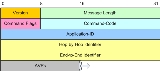
The packet consists of a Diameter header and a variable number of Attribute-Value Pairs, or AVPs, for encapsulating information relevant to the Diameter message.
Diameter Header
| Bit offset | 0 | 1 | 2 | 3 | 4 | 5 | 6 | 7 | 8 | 9 | 10 | 11 | 12 | 13 | 14 | 15 | 16 | 17 | 18 | 19 | 20 | 21 | 22 | 23 | 24 | 25 | 26 | 27 | 28 | 29 | 30 | 31 |
| 0 |
version |
message length |
| 32 |
R |
P |
E |
T |
|
|
|
|
command code |
| 64 |
application ID |
| 96 |
hop-by-hop ID |
| 128 |
end-to-end ID |
160 ... |
AVPs ... |
The
'R'(Request) bit, If set, the message is a request. If cleared, the message is an answer.
The
'P'(Proxiable) Bit, If set, the message MAY be proxied, relayed or redirected. If cleared, the message MUST be locally processed.
The
'E'(Error) bit, If set, the message contains a protocol error, and the message will not conform to the ABNF described for this command. Messages with the 'E' bit set are commonly referred to as error messages. This bit MUST NOT be set in request messages.
The
'T'( Potentially re-transmitted message) bit , This flag is set after a link failover procedure, to aid the removal of duplicate requests. It is set when resending requests not yet acknowledged, as an indication of a possible duplicate due to a link failure.
Commands
Each command is assigned a command code, which is used for both Requests and Answers.
The values 0-255 are reserved for RADIUS backward compatibility.
The values 256-16777213 are for permanent, standard commands allocated by
IANAThe Internet Assigned Numbers Authority is the entity that oversees global IP address allocation, autonomous system number allocation, root zone management in the Domain Name System , media types, and other Internet Protocol-related symbols and numbers...
.
The values 16777214 and 16777215 (hex 0xFFFFFE and 0xFFFFFF) are reserved for experimental and testing purposes.
Some common Diameter commands are:
| Command-Name | Abbr. | Code |
| AA-Request |
AAR |
265 |
| AA-Answer |
AAA |
265 |
| Diameter-EAP-Request |
DER |
268 |
| Diameter-EAP-Answer |
DEA |
268 |
| Abort-Session-Request |
ASR |
274 |
| Abort-Session-Answer |
ASA |
274 |
| Accounting-Request |
ACR |
271 |
| Accounting-Answer |
ACA |
271 |
| Credit-Control-Request |
CCR |
272 |
| Credit-Control-Answer |
CCA |
272 |
| Capabilities-Exchange-Request |
CER |
257 |
| Capabilities-Exchange-Answer |
CEA |
257 |
| Device-Watchdog-Request |
DWR |
280 |
| Device-Watchdog-Answer |
DWA |
280 |
| Disconnect-Peer-Request |
DPR |
282 |
| Disconnect-Peer-Answer |
DPA |
282 |
| Re-Auth-Request |
RAR |
258 |
| Re-Auth-Answer |
RAA |
258 |
| Session-Termination-Request |
STR |
275 |
| Session-Termination-Answer |
STA |
275 |
| User-Authorization-Request |
UAR |
300 |
| User-Authorization-Answer |
UAA |
300 |
| Server-Assignment-Request |
SAR |
301 |
| Server-Assignment-Answer |
SAA |
301 |
| Location-Info-Request |
LIR |
302 |
| Location-Info-Answer |
LIA |
302 |
| Multimedia-Auth-Request |
MAR |
303 |
| Multimedia-Auth-Answer |
MAA |
303 |
| Registration-Termination-Request |
RTR |
304 |
| Registration-Termination-Answer |
RTA |
304 |
| Push-Profile-Request |
PPR |
305 |
| Push-Profile-Answer |
PPA |
305 |
| User-Data-Request |
UDR |
306 |
| User-Data-Answer |
UDA |
306 |
| Profile-Update-Request |
PUR |
307 |
| Profile-Update-Answer |
PUA |
307 |
| Subscribe-Notifications-Request |
SNR |
308 |
| Subscribe-Notifications-Answer |
SNA |
308 |
| Push-Notification-Request |
PNR |
309 |
| Push-Notification-Answer |
PNA |
309 |
| Bootstrapping-Info-Request |
BIR |
310 |
| Bootstrapping-Info-Answer |
BIA |
310 |
| Message-Process-Request |
MPR |
311 |
| Message-Process-Answer |
MPA |
311 |
Attribute-Value Pairs (AVP)
AVP Header
| Bit offset | 0 | 1 | 2 | 3 | 4 | 5 | 6 | 7 | 8 | 9 | 10 | 11 | 12 | 13 | 14 | 15 | 16 | 17 | 18 | 19 | 20 | 21 | 22 | 23 | 24 | 25 | 26 | 27 | 28 | 29 | 30 | 31 |
| 0 |
AVP code |
| 32 |
V |
M |
P |
|
|
|
|
|
AVP length |
| 64 |
vendor ID (optional) |
96 ... |
data ... |
For simplicity,
'V' Bit Means
Vendor Specific;
'M' Bit means
Mandatory;
'P' Bit means
Protected.
The
'V' bit, known as the Vendor-Specific bit, indicates whether the optional
Vendor-ID field is present in the AVP header. When set the AVP Code belongs to the specific vendor code address space.
The
'M' Bit, known as the Mandatory bit, indicates whether support of the AVP is required. If an AVP with the
'M' bit set is received by a Diameter client, server, proxy, or translation agent and either the AVP or its value is unrecognized, the message MUST be rejected. Diameter Relay and redirect agents MUST NOT reject messages with unrecognized AVPs.
The
'P' bit indicates the need for encryption for end-to-end security.
| Attribute-Name | Code | Data Type |
| Acct-Interim-Interval |
85 |
Unsigned32 |
| Accounting-Realtime-Required |
483 |
Enumerated |
| Acct-Multi-Session-Id |
50 |
UTF8String |
| Accounting-Record-Number |
485 |
Unsigned32 |
| Accounting-Record-Type |
480 |
Enumerated |
| Accounting-Session-Id |
44 |
OctetString |
| Accounting-Sub-Session-Id |
287 |
Unsigned64 |
| Acct-Application-Id |
259 |
Unsigned32 |
| Auth-Application-Id |
258 |
Unsigned32 |
| Auth-Request-Type |
274 |
Enumerated |
| Authorization-Lifetime |
291 |
Unsigned32 |
| Auth-Grace-Period |
276 |
Unsigned32 |
| Auth-Session-State |
277 |
Enumerated |
| Re-Auth-Request-Type |
285 |
Enumerated |
| Class |
25 |
OctetString |
| Destination-Host |
293 |
DiamIdent |
| Destination-Realm |
283 |
DiamIdent |
| Disconnect-Cause |
273 |
Enumerated |
| E2E-Sequence |
300 |
Grouped |
| Error-Message |
281 |
UTF8String |
| Error-Reporting-Host |
294 |
DiamIdent |
| Event-Timestamp |
55 |
Time |
| Experimental-Result |
297 |
Grouped |
| Experimental-Result-Code |
298 |
Unsigned32 |
| Failed-AVP |
279 |
Grouped |
| Firmware-Revision |
267 |
Unsigned32 |
| Host-IP-Address |
257 |
Address |
| Inband-Security-Id |
299 |
Unsigned32 |
| Multi-Round-Time-Out |
272 |
Unsigned32 |
| Origin-Host |
264 |
DiamIdent |
| Origin-Realm |
296 |
DiamIdent |
| Origin-State-Id |
278 |
Unsigned32 |
| Product-Name |
269 |
UTF8String |
| Proxy-Host |
280 |
DiamIdent |
| Proxy-Info |
284 |
Grouped |
| Proxy-State |
33 |
OctetString |
| Redirect-Host |
292 |
DiamURI |
| Redirect-Host-Usage |
261 |
Enumerated |
| Redirect-Max-Cache-Time |
262 |
Unsigned32 |
| Result-Code |
268 |
Unsigned32 |
| Route-Record |
282 |
DiamIdent |
| Session-Id |
263 |
UTF8String |
| Session-Timeout |
27 |
Unsigned32 |
| Session-Binding |
270 |
Unsigned32 |
| Session-Server-Failover |
271 |
Enumerated |
| Supported-Vendor-Id |
265 |
Unsigned32 |
| Termination-Cause |
295 |
Enumerated |
| User-Name |
1 |
UTF8String |
| Vendor-Id |
266 |
Unsigned32 |
| Vendor-Specific-Application-Id |
260 |
Grouped |
State machines
The RFC 3588 defines a core state machine for maintaining connections between peers and processing messages. This is part of the basic protocol functionality and all stacks should support it and as such abstract from the connectivity related operations.
Additionally, application specific state machines can be introduced either later or at a higher abstraction layer. The RFC 3588 defines an authorization and an accounting state machine.
Message flows

The communication between two diameter peers starts the establishment of a transport connection (
TCPThe Transmission Control Protocol is one of the core protocols of the Internet Protocol Suite. TCP is one of the two original components of the suite, complementing the Internet Protocol , and therefore the entire suite is commonly referred to as TCP/IP...
or SCTP). The initiator then sends a Capabilities-Exchange-Request (CER) to the other peer, which responds with a Capabilities-Exchange-Answer (CEA). After that, TLS (Transport Layer Security) may optionally be negotiated.
The connection is then ready for exchanging application messages.
If no messages have been exchanged for some time either side may send a Device-Watchdog-Request (DWR) and the other peer must respond with Device-Watchdog-Answer.
Either side may terminate the communication by sending a Disconnect-Peer-Request (DPR) which the other peer must respond to with Disconnect-Peer-Answer. After that the transport connection can be disconnected.
RFCs
The Diameter protocol is currently defined in the following IETF RFCs: Obsolete RFCs are indicated with
strikethroughStrikethrough is a typographical presentation of words with a horizontal line through their center. This is an example....
text.
| # | Title | Date published | Related article | Obsoleted by | Notes |
| RFC 3588 |
Diameter Base Protocol. |
September 2003. |
DiameterIn geometry, a diameter of a circle is any straight line segment that passes through the center of the circle and whose endpoints are on the circle. The diameters are the longest chords of the circle... |
|
|
| RFC 3589 |
Diameter Command Codes for Third Generation Partnership Project (3GPP) Release 5. |
September 2003. |
|
|
|
| RFC 4004 |
Diameter Mobile IPv4 Application. |
August 2005. |
|
|
|
| RFC 4005 |
Diameter Network Access Server Application |
August 2005. |
|
|
|
| RFC 4006 |
Diameter Credit-Control Application. |
August 2005. |
Diameter Credit-Control ApplicationDiameter Credit-Control Application, is a networking protocol for Diameter application used toimplement real-time credit-control for a variety of end user services.It is an IETF standard defined in RFC 4006.- Purpose :... |
|
|
| RFC 4072 |
Diameter Extensible Authentication Protocol (EAP) Application. |
August 2005. |
|
|
|
| RFC 4740 |
Diameter Session Initiation Protocol (SIP) Application. M. |
November 2006. |
|
|
|
| RFC 5224 |
Diameter Policy Processing Application. |
March 2008. |
|
|
|
| RFC 5431 |
Diameter ITU-T Rw Policy Enforcement Interface Application. |
March 2009. |
|
|
|
| RFC 5447 |
Diameter Mobile IPv6: Support for Network Access Server to Diameter Server Interaction. |
February 2009. |
|
|
|
| RFC 5516 |
Diameter Command Code Registration for the Third Generation Partnership Project (3GPP) Evolved Packet System (EPS). |
April 2009. |
|
|
|- |
| RFC 5624 |
Quality of Service Parameters for Usage with Diameter. |
August 2009. |
|
|
|
External links