


Cyrix

Encyclopedia
Cyrix Corporation was a microprocessor
developer that was founded in 1988 in Richardson, Texas
as a specialist supplier of high-performance math coprocessor
s for 286
and 386
microprocessors. The company was founded by former Texas Instruments
(TI) staff members and had a long but troubled relationship with TI throughout its history. Cyrix founder Jerry Rogers aggressively recruited engineers and pushed them, eventually assembling a small but efficient design team of 30 people.
Cyrix merged with National Semiconductor
on 11 November 1997.
market was a x87
compatible FPU
coprocessor
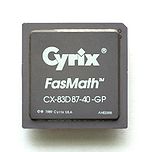
. The Cyrix FasMath 83D87 and 83S87 were introduced in 1989. The FasMath was the fastest 386-compatible coprocessor and provided up to 50% more performance than the Intel 80387. Cyrix FasMath 82S87, a 80287-compatible chip was developed from the Cyrix 83D87 and has been available since 1991.
 Its early CPU products included the 486SLC and 486DLC, released in 1992, which, despite their names, were pin-compatible with the 386SX and DX, respectively. While they added an on-chip L1 cache and the 486 instruction set, performance-wise they were somewhere between the 386 and the 486
. The chips were mostly used as upgrades by end users looking to improve performance of an aging 386 and especially by dealers, who by changing the CPU could turn slow-selling 386 boards into budget 486 boards. The chips were widely criticized in product reviews for not offering the performance suggested by their names, and for the confusion caused by their naming similarity with Intel's SL line and IBM
's SLC
line of CPUs, neither of which was related to Cyrix's SLC. The chips did see use in very low-cost PC clones and in laptops.
Cyrix would later release the Cyrix 486SRX2 and 486DRX2, which were essentially clock-doubled versions of the SLC and DLC, marketed exclusively to consumers as 386-to-486 upgrades.
Eventually Cyrix was able to release a 486 that was pin-compatible with its Intel counterparts. However, the chips were later to market than AMD
's 486s and benchmarked slightly slower than AMD and Intel counterparts, which relegated them to the budget and upgrade market. While AMD had been able to sell some of its 486s to large OEM
s, notably Acer
and Compaq
, Cyrix had not. The Cyrix chips did gain some following with upgraders, as their 50-, 66- and 80 MHz 486 CPUs ran at 5 volts, rather than the 3.3 volts used by AMD, making the Cyrix chips usable as upgrades in early 486 motherboards.
In 1995, with its Pentium
clone not yet ready to ship, Cyrix repeated its own history and released the Cx5x86
, which plugged into a 486 socket, ran at 100, 120 or 133 MHz, and yielded performance comparable to that of a Pentium running at 75 MHz. While AMD's Am5x86
was little more than a clock-quadrupled 486 with a new name, Cyrix's 5x86 implemented some Pentium-like features.
 Later in 1995 Cyrix released its best-known chip, the 6x86
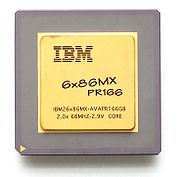
(M1). This processor continued the Cyrix tradition of making faster replacements for Intel designed sockets. However, the 6x86 was the star performer in the range, giving a tangible performance boost over the Intel "equivalent". 6x86 processors were given names such as P166+ indicating a performance better than a Pentium 166MHz processor. In fact, the 6x86 processor was clocked at a significantly lower speed than the Pentium part it outperformed. Initially Cyrix tried to charge a premium for its extra performance, but the 6x86's math coprocessor was not as fast as that in the Intel Pentium. The main difference was not one of actual computing performance on the coprocessor, but a lack of instruction pipelining. Due to the increasing popularity of first-person 3D games, Cyrix was forced to lower its prices. While the 6x86 quickly gained a following among computer enthusiasts and independent computer shops, unlike AMD, its chips had yet to be used by a major OEM customer. The game in question causing most problems for performance was id Software's Quake. Unlike previous 3D games Quake used the pipelined Pentium FPU to do perspective correction calculations in the background while texture mapping
, effectively doing two tasks at once. This wouldn't have been a big problem for the 6x86 if Quake have had a fallback to do perspective correction without the FPU like in e.g. the game Descent
however id Software
choose not to include this. This boosted the popularity of Intel CPUs amongst the gaming community.
The later 6x86L was a revised 6x86 that consumed less power, and the 6x86MX (M2) added MMX instructions and a larger L1 cache. The MII, based on the 6x86MX design, was little more than a name change intended to help the chip compete better with the Pentium II
.
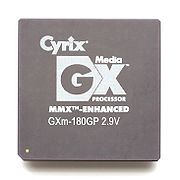
In 1996 Cyrix released the MediaGX
CPU, which integrated all of the major discrete components of a PC, including sound and video, onto one chip. Initially based on the old 5x86 technology and running at 120 or 133 MHz, its performance was widely criticized but its low price made it successful. The MediaGX led to Cyrix's first big win, when Compaq used it in its lowest-priced Presario 2100 and 2200 computer. This led to further MediaGX sales to Packard Bell
and also seemed to give Cyrix legitimacy, as 6x86 sales to Packard Bell and eMachines
quickly followed.
Later versions of the MediaGX ran at speeds of up to 333 MHz and added MMX support. A second chip was added to extend its video capabilities.
basis than Intel's Pentium, and because Cyrix sometimes used a faster bus speed than either Intel or AMD, Cyrix and competitor AMD co-developed the controversial PR system in an effort to compare its products more favorably with Intel's. Since a 6x86 running at 133 MHz generally benchmarked slightly faster than a Pentium running at 166 MHz, the 133 MHz 6x86 was marketed as the 6x86-P166+. Legal action from Intel, who objected to the use of the strings "P166" and "P200" in non-Pentium products, led to Cyrix adding the letter "R" to its names.
The PR nomenclature was controversial because while Cyrix's chips generally outperformed Intel's when running productivity applications, on a clock-for-clock basis its chips were slower for floating point
operations, so the PR system broke down when running the newest games. Additionally, since the 6x86's price encouraged its use in budget systems, performance could drop even further when compared with Pentium systems that were using faster hard drives, video cards, sound cards, and modems.
Although AMD used the PR rating in its early K5
chips, it soon abandoned the PR rating, although it would later use a similar concept in marketing its later CPUs.
 Cyrix had always been a fabless
company: Cyrix designed and sold their own chips, but contracted the actual semiconductor manufacturing to an outside foundry
. In the early days, Cyrix mostly used Texas Instruments production facilities and SGS Thomson (now STMicroelectronics
). In 1994, following a series of disagreements with Texas Instruments, and production difficulties at SGS Thomson, Cyrix turned to IBM Microelectronics, whose production technology rivaled that of Intel.
As part of the manufacturing agreement between the two companies, IBM received the right to build and sell Cyrix-designed CPUs under the IBM name. While some in the industry speculated this would lead to IBM using 6x86 CPUs extensively in its product line and improve Cyrix's reputation, IBM continued to mostly use Intel CPUs, and to a lesser extent, AMD CPUs, in the majority of its products and only used the Cyrix designs in a few budget models, mostly sold outside of the United States. IBM instead sold its 6x86 chips on the open market, competing directly against Cyrix and sometimes undercutting Cyrix's prices.
s, when in reality the design was proven independent.
Intel largely lost the Cyrix case. But the final settlement was out of court: Intel agreed that Cyrix had the right to produce their own x86 designs in any foundry that happened to already hold an Intel license. Both firms gained out of this: Cyrix could carry on having their CPUs made by Texas Instruments, SGS Thomson
, or IBM, all holders of Intel cross-licenses; Intel avoided a potentially embarrassing loss.
The follow-on 1997 Cyrix-Intel litigation was the reverse: instead of Intel claiming that Cyrix 486 chips violated their patents, now Cyrix claimed that Intel's Pentium Pro and Pentium II violated Cyrix patents—in particular, power management and register renaming techniques. The case was expected to drag on for years but was settled quite promptly, by another mutual cross-license agreement. Intel and Cyrix now had full and free access to each other's patents. The settlement didn't say whether the Pentium Pro violated Cyrix patents or not; it simply allowed Intel to carry on making them either way—exactly as the previous settlement sidestepped Intel's claim that the Cyrix 486 violated Intel patents.
(who also already held an Intel cross-license). This provided Cyrix with an extra marketing arm and access to National Semiconductor fabrication plants, which were originally constructed to produce RAM and high-speed telecommunications equipment. Since the manufacture of RAM and CPUs is similar, industry analysts at the time believed the marriage made sense. The IBM manufacturing agreement remained for a while longer, but Cyrix eventually switched all their production over to National's plant. The merger improved Cyrix's financial base and gave them much better access to development facilities.
The merger also resulted in a change of emphasis: National Semiconductor's priority was single-chip budget devices like the MediaGX
, rather than higher performance chips like the 6x86 and MII. Whether National Semiconductor doubted Cyrix's ability to produce high-performance chips or feared competing with Intel at the high end of the market is open to debate. The MediaGX, with no direct competition in the marketplace and with continual pressure on OEMs to release lower-cost PCs, looked like the safer bet.
National Semiconductor ran into financial trouble soon after the Cyrix merger, and these problems hurt Cyrix as well. By 1999, AMD and Intel were leapfrogging one another in clock speeds, reaching 450 MHz and beyond while Cyrix took almost a year to push the MII from PR-300 to PR-333. Neither chip actually ran at 300 MHz. A problem suffered by many of the MII models was that they used a non-standard 83 MHz bus. The vast majority of Socket 7 motherboards used a fixed 1/2 divider to clock the PCI bus, normally at 30 MHz or 33 MHz. With the MII's 83 MHz bus, this resulted in the PCI bus running alarmingly out of spec at 41.5 MHz. At this speed, many PCI devices could become unstable or fail to operate. Some motherboards supported a 1/3 divider, which resulted in the PCI bus running at 27.7 MHz. This was more stable, but adversely affected system performance. The problem was only fixed in the final few models, which supported a 100 MHz bus. Almost all of the 6x86 line produced a large amount of heat, and required quite large heatsink/fan combos (for the time) to run properly. There was also a problem which made the 6x86 incompatible with the then-popular Sound Blaster AWE64
sound card. Only 32 of its potential 64 voice polyphony could be utilized, as the WaveSynth/WG software synthesizer relied on a Pentium-specific instruction which the 6x86 lacked. Meanwhile, the MediaGX faced pressure from Intel's and AMD's budget chips, which also continued to get less expensive while offering much greater performance. Cyrix, whose product had been considered a performance product in 1996, had fallen to the mid-range, then the entry level, and to the fringe of the entry level and was in danger of completely losing its market.
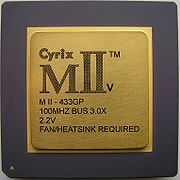
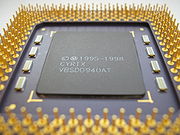 The last Cyrix-badged microprocessor was the Cyrix MII-433GP which ran at 300 MHz (100x3) and performed faster than an AMD K6/2-300 on FPU calculations (as benched with Dr. Hardware). However, this chip was regularly pitted against actual 433 MHz processors from other manufacturers. Arguably this made the comparison unfair, even though it was directly invited by Cyrix's own marketing.
National Semiconductor distanced itself from the CPU market, and without direction, the Cyrix engineers left one by one. By the time National Semiconductor sold Cyrix to VIA Technologies
, the design team was no more and the market for the MII had disappeared. VIA used the Cyrix name on a chip designed by Centaur Technology
, since VIA believed Cyrix had better name recognition than Centaur, or possibly even VIA.
Cyrix's failure is described by Glenn Henry CEO of Centaur Technology
as "Cyrix had a good product, but they got bought by a 'big smokestack' company and they got bloated. When Via bought Cyrix, they had 400, and we had 60, and we were turning out more product."
National Semiconductor retained the MediaGX design for a few more years, renaming it the Geode
and hoping to sell it as an integrated processor. They sold the Geode to AMD in 2003.
In June 2006, AMD unveiled the world's lowest-power x86-compatible processor that consumes only 0.9 watts of power. This processor is based on the Geode core, demonstrating that Cyrix's architectural ingenuity still survives.
line of budget processors and cut the prices of its faster processors more quickly in order to compete.
Additionally, the acquisition of Cyrix's intellectual property and agreements would be used by VIA to defend itself from its own legal troubles with Intel, even after VIA Technologies
stopped using the Cyrix name.
featured a defense corporation known as "Cyrex". Cyrix became concerned about the potential name conflict, and contacted the film production company. The name was then retroactively digitally edited to become "Cyrez" to avoid any confusion.
Microprocessor
A microprocessor incorporates the functions of a computer's central processing unit on a single integrated circuit, or at most a few integrated circuits. It is a multipurpose, programmable device that accepts digital data as input, processes it according to instructions stored in its memory, and...
developer that was founded in 1988 in Richardson, Texas
Richardson, Texas
Richardson is a city in Dallas and Collin Counties in the U.S. state of Texas. As of the 2010 census, the city had a total population of 99,223. In 2011 the population was estimated to be 107,684. Richardson is an affluent inner suburb of Dallas and home of the Telecom Corridor with a high...
as a specialist supplier of high-performance math coprocessor
Coprocessor
A coprocessor is a computer processor used to supplement the functions of the primary processor . Operations performed by the coprocessor may be floating point arithmetic, graphics, signal processing, string processing, or encryption. By offloading processor-intensive tasks from the main processor,...
s for 286
Intel 80286
The Intel 80286 , introduced on 1 February 1982, was a 16-bit x86 microprocessor with 134,000 transistors. Like its contemporary simpler cousin, the 80186, it could correctly execute most software written for the earlier Intel 8086 and 8088...
and 386
Intel 80386
The Intel 80386, also known as the i386, or just 386, was a 32-bit microprocessor introduced by Intel in 1985. The first versions had 275,000 transistors and were used as the central processing unit of many workstations and high-end personal computers of the time...
microprocessors. The company was founded by former Texas Instruments
Texas Instruments
Texas Instruments Inc. , widely known as TI, is an American company based in Dallas, Texas, United States, which develops and commercializes semiconductor and computer technology...
(TI) staff members and had a long but troubled relationship with TI throughout its history. Cyrix founder Jerry Rogers aggressively recruited engineers and pushed them, eventually assembling a small but efficient design team of 30 people.
Cyrix merged with National Semiconductor
National Semiconductor
National Semiconductor was an American semiconductor manufacturer, that specialized in analog devices and subsystems,formerly headquartered in Santa Clara, California, USA. The products of National Semiconductor included power management circuits, display drivers, audio and operational amplifiers,...
on 11 November 1997.
Products
The first Cyrix product for the personal computerPersonal computer
A personal computer is any general-purpose computer whose size, capabilities, and original sales price make it useful for individuals, and which is intended to be operated directly by an end-user with no intervening computer operator...
market was a x87
X87
x87 is a floating point-related subset of the x86 architecture instruction set. It originated as an extension of the 8086 instruction set in the form of optional floating point coprocessors that worked in tandem with corresponding x86 CPUs. These microchips had names ending in "87"...
compatible FPU
Floating point unit
A floating-point unit is a part of a computer system specially designed to carry out operations on floating point numbers. Typical operations are addition, subtraction, multiplication, division, and square root...
coprocessor
Coprocessor
A coprocessor is a computer processor used to supplement the functions of the primary processor . Operations performed by the coprocessor may be floating point arithmetic, graphics, signal processing, string processing, or encryption. By offloading processor-intensive tasks from the main processor,...
. The Cyrix FasMath 83D87 and 83S87 were introduced in 1989. The FasMath was the fastest 386-compatible coprocessor and provided up to 50% more performance than the Intel 80387. Cyrix FasMath 82S87, a 80287-compatible chip was developed from the Cyrix 83D87 and has been available since 1991.
Intel 80486
The Intel 80486 microprocessor was a higher performance follow up on the Intel 80386. Introduced in 1989, it was the first tightly pipelined x86 design as well as the first x86 chip to use more than a million transistors, due to a large on-chip cache and an integrated floating point unit...
. The chips were mostly used as upgrades by end users looking to improve performance of an aging 386 and especially by dealers, who by changing the CPU could turn slow-selling 386 boards into budget 486 boards. The chips were widely criticized in product reviews for not offering the performance suggested by their names, and for the confusion caused by their naming similarity with Intel's SL line and IBM
IBM
International Business Machines Corporation or IBM is an American multinational technology and consulting corporation headquartered in Armonk, New York, United States. IBM manufactures and sells computer hardware and software, and it offers infrastructure, hosting and consulting services in areas...
's SLC
386SLC
The 386SLC was an Intel-licensed version of the 386SX , developed and manufactured by IBM in 1991. It included power-management capabilities and an 8KB internal cache, which enabled it to yield comparable performance to 386DX processors of the same clock speed, which were considerably more expensive...
line of CPUs, neither of which was related to Cyrix's SLC. The chips did see use in very low-cost PC clones and in laptops.
Cyrix would later release the Cyrix 486SRX2 and 486DRX2, which were essentially clock-doubled versions of the SLC and DLC, marketed exclusively to consumers as 386-to-486 upgrades.
Eventually Cyrix was able to release a 486 that was pin-compatible with its Intel counterparts. However, the chips were later to market than AMD
Advanced Micro Devices
Advanced Micro Devices, Inc. or AMD is an American multinational semiconductor company based in Sunnyvale, California, that develops computer processors and related technologies for commercial and consumer markets...
's 486s and benchmarked slightly slower than AMD and Intel counterparts, which relegated them to the budget and upgrade market. While AMD had been able to sell some of its 486s to large OEM
Original Equipment Manufacturer
An original equipment manufacturer, or OEM, manufactures products or components that are purchased by a company and retailed under that purchasing company's brand name. OEM refers to the company that originally manufactured the product. When referring to automotive parts, OEM designates a...
s, notably Acer
Acer (company)
Acer Incorporated is a multinational information technology and electronics corporation headquartered in Xizhi, New Taipei City, Taiwan. Acer's products include desktop and laptop PCs, tablet computers, servers, storage devices, displays, smartphones and peripherals...
and Compaq
Compaq
Compaq Computer Corporation is a personal computer company founded in 1982. Once the largest supplier of personal computing systems in the world, Compaq existed as an independent corporation until 2002, when it was acquired for US$25 billion by Hewlett-Packard....
, Cyrix had not. The Cyrix chips did gain some following with upgraders, as their 50-, 66- and 80 MHz 486 CPUs ran at 5 volts, rather than the 3.3 volts used by AMD, making the Cyrix chips usable as upgrades in early 486 motherboards.
In 1995, with its Pentium
Pentium
The original Pentium microprocessor was introduced on March 22, 1993. Its microarchitecture, deemed P5, was Intel's fifth-generation and first superscalar x86 microarchitecture. As a direct extension of the 80486 architecture, it included dual integer pipelines, a faster FPU, wider data bus,...
clone not yet ready to ship, Cyrix repeated its own history and released the Cx5x86
Cyrix Cx5x86
Released in August 1995, four months before the more famous Cyrix 6x86, the Cyrix 5x86 was one of the fastest CPUs ever produced for Socket 3 computer systems...
, which plugged into a 486 socket, ran at 100, 120 or 133 MHz, and yielded performance comparable to that of a Pentium running at 75 MHz. While AMD's Am5x86
AMD 5x86
The Am5x86 processor is an x86-compatible CPU introduced in 1995 by AMD for use in 486-class computer systems. It was one of the fastest, and most universally-compatible upgrade paths for users of 486 systems....
was little more than a clock-quadrupled 486 with a new name, Cyrix's 5x86 implemented some Pentium-like features.
Cyrix 6x86
The Cyrix 6x86 is a sixth-generation, 32-bit 80x86-compatible microprocessor designed by Cyrix and manufactured by IBM and SGS-Thomson. It was originally released in 1996.-Architecture:...
(M1). This processor continued the Cyrix tradition of making faster replacements for Intel designed sockets. However, the 6x86 was the star performer in the range, giving a tangible performance boost over the Intel "equivalent". 6x86 processors were given names such as P166+ indicating a performance better than a Pentium 166MHz processor. In fact, the 6x86 processor was clocked at a significantly lower speed than the Pentium part it outperformed. Initially Cyrix tried to charge a premium for its extra performance, but the 6x86's math coprocessor was not as fast as that in the Intel Pentium. The main difference was not one of actual computing performance on the coprocessor, but a lack of instruction pipelining. Due to the increasing popularity of first-person 3D games, Cyrix was forced to lower its prices. While the 6x86 quickly gained a following among computer enthusiasts and independent computer shops, unlike AMD, its chips had yet to be used by a major OEM customer. The game in question causing most problems for performance was id Software's Quake. Unlike previous 3D games Quake used the pipelined Pentium FPU to do perspective correction calculations in the background while texture mapping
Texture mapping
Texture mapping is a method for adding detail, surface texture , or color to a computer-generated graphic or 3D model. Its application to 3D graphics was pioneered by Dr Edwin Catmull in his Ph.D. thesis of 1974.-Texture mapping:...
, effectively doing two tasks at once. This wouldn't have been a big problem for the 6x86 if Quake have had a fallback to do perspective correction without the FPU like in e.g. the game Descent
Descent (video game)
Descent is a 3D first-person shooter video game developed by Parallax Software and released by Interplay Entertainment Corp. in 1995. The game features six degrees of freedom gameplay and garnered several expansion packs...
however id Software
Id Software
Id Software is an American video game development company with its headquarters in Richardson, Texas. The company was founded in 1991 by four members of the computer company Softdisk: programmers John Carmack and John Romero, game designer Tom Hall, and artist Adrian Carmack...
choose not to include this. This boosted the popularity of Intel CPUs amongst the gaming community.
The later 6x86L was a revised 6x86 that consumed less power, and the 6x86MX (M2) added MMX instructions and a larger L1 cache. The MII, based on the 6x86MX design, was little more than a name change intended to help the chip compete better with the Pentium II
Pentium II
The Pentium II brand refers to Intel's sixth-generation microarchitecture and x86-compatible microprocessors introduced on May 7, 1997. Containing 7.5 million transistors, the Pentium II featured an improved version of the first P6-generation core of the Pentium Pro, which contained 5.5 million...
.
In 1996 Cyrix released the MediaGX
MediaGX
The MediaGX CPU was an x86 processor manufactured and designed by Cyrix and later after merger manufactured by National Semiconductor, and was introduced in 1997. The core is based on the integration of the Cyrix Cx5x86 CPU core with hardware to process video and audio output...
CPU, which integrated all of the major discrete components of a PC, including sound and video, onto one chip. Initially based on the old 5x86 technology and running at 120 or 133 MHz, its performance was widely criticized but its low price made it successful. The MediaGX led to Cyrix's first big win, when Compaq used it in its lowest-priced Presario 2100 and 2200 computer. This led to further MediaGX sales to Packard Bell
Packard Bell
Packard Bell is a Dutch computer manufacturer and a subsidiary of Acer. The name was previously used by Packard Bell, an American radio manufacturer founded in 1926. In 1986, Israeli investors bought the name for a newly formed personal computer manufacturer. Originally the company produced...
and also seemed to give Cyrix legitimacy, as 6x86 sales to Packard Bell and eMachines
EMachines
eMachines is a brand of entry level PCs, based in Irvine, California. eMachines employed about 135 employees and sold between 1 to 2 million computers each year before its purchase on January 30, 2004, by rival Gateway Computers...
quickly followed.
Later versions of the MediaGX ran at speeds of up to 333 MHz and added MMX support. A second chip was added to extend its video capabilities.
PR system
Because the 6x86 was more efficient on an instructions-per-cycleInstructions Per Cycle
In computer architecture, instructions per clock is a term used to describe one aspect of a processor's performance: the average number of instructions executed for each clock cycle...
basis than Intel's Pentium, and because Cyrix sometimes used a faster bus speed than either Intel or AMD, Cyrix and competitor AMD co-developed the controversial PR system in an effort to compare its products more favorably with Intel's. Since a 6x86 running at 133 MHz generally benchmarked slightly faster than a Pentium running at 166 MHz, the 133 MHz 6x86 was marketed as the 6x86-P166+. Legal action from Intel, who objected to the use of the strings "P166" and "P200" in non-Pentium products, led to Cyrix adding the letter "R" to its names.
The PR nomenclature was controversial because while Cyrix's chips generally outperformed Intel's when running productivity applications, on a clock-for-clock basis its chips were slower for floating point
Floating point
In computing, floating point describes a method of representing real numbers in a way that can support a wide range of values. Numbers are, in general, represented approximately to a fixed number of significant digits and scaled using an exponent. The base for the scaling is normally 2, 10 or 16...
operations, so the PR system broke down when running the newest games. Additionally, since the 6x86's price encouraged its use in budget systems, performance could drop even further when compared with Pentium systems that were using faster hard drives, video cards, sound cards, and modems.
Although AMD used the PR rating in its early K5
AMD K5
The K5 was AMD's first x86 processor to be developed entirely in-house. Introduced in March 1996, its primary competition was Intel's Pentium microprocessor. The K5 was an ambitious design, closer to a Pentium Pro than a Pentium regarding technical solutions and internal architecture...
chips, it soon abandoned the PR rating, although it would later use a similar concept in marketing its later CPUs.
Manufacturing partners
Fabless semiconductor company
A fabless semiconductor company specializes in the design and sale of hardware devices and semiconductor chips while outsourcing the fabrication or "fab" of the devices to a specialized manufacturer called a semiconductor foundry...
company: Cyrix designed and sold their own chips, but contracted the actual semiconductor manufacturing to an outside foundry
Foundry (electronics)
In the microelectronics industry a semiconductor fabrication plant is a factory where devices such as integrated circuits are manufactured....
. In the early days, Cyrix mostly used Texas Instruments production facilities and SGS Thomson (now STMicroelectronics
STMicroelectronics
STMicroelectronics is an Italian-French electronics and semiconductor manufacturer headquartered in Geneva, Switzerland.While STMicroelectronics corporate headquarters and the headquarters for EMEA region are based in Geneva, the holding company, STMicroelectronics N.V. is registered in Amsterdam,...
). In 1994, following a series of disagreements with Texas Instruments, and production difficulties at SGS Thomson, Cyrix turned to IBM Microelectronics, whose production technology rivaled that of Intel.
As part of the manufacturing agreement between the two companies, IBM received the right to build and sell Cyrix-designed CPUs under the IBM name. While some in the industry speculated this would lead to IBM using 6x86 CPUs extensively in its product line and improve Cyrix's reputation, IBM continued to mostly use Intel CPUs, and to a lesser extent, AMD CPUs, in the majority of its products and only used the Cyrix designs in a few budget models, mostly sold outside of the United States. IBM instead sold its 6x86 chips on the open market, competing directly against Cyrix and sometimes undercutting Cyrix's prices.
Legal troubles
Unlike AMD, Cyrix had never manufactured or sold Intel designs under a negotiated license. Cyrix's designs were the result of meticulous in-house reverse engineering. Thus, while AMD's 386s and even 486s had some Intel-written microcode software, Cyrix's designs were completely independent. Focused on removing potential competitors, Intel spent many years in legal battles with Cyrix, consuming Cyrix financial resources, claiming that the Cyrix 486 violated Intel's patentPatent
A patent is a form of intellectual property. It consists of a set of exclusive rights granted by a sovereign state to an inventor or their assignee for a limited period of time in exchange for the public disclosure of an invention....
s, when in reality the design was proven independent.
Intel largely lost the Cyrix case. But the final settlement was out of court: Intel agreed that Cyrix had the right to produce their own x86 designs in any foundry that happened to already hold an Intel license. Both firms gained out of this: Cyrix could carry on having their CPUs made by Texas Instruments, SGS Thomson
STMicroelectronics
STMicroelectronics is an Italian-French electronics and semiconductor manufacturer headquartered in Geneva, Switzerland.While STMicroelectronics corporate headquarters and the headquarters for EMEA region are based in Geneva, the holding company, STMicroelectronics N.V. is registered in Amsterdam,...
, or IBM, all holders of Intel cross-licenses; Intel avoided a potentially embarrassing loss.
The follow-on 1997 Cyrix-Intel litigation was the reverse: instead of Intel claiming that Cyrix 486 chips violated their patents, now Cyrix claimed that Intel's Pentium Pro and Pentium II violated Cyrix patents—in particular, power management and register renaming techniques. The case was expected to drag on for years but was settled quite promptly, by another mutual cross-license agreement. Intel and Cyrix now had full and free access to each other's patents. The settlement didn't say whether the Pentium Pro violated Cyrix patents or not; it simply allowed Intel to carry on making them either way—exactly as the previous settlement sidestepped Intel's claim that the Cyrix 486 violated Intel patents.
Merger with National Semiconductor
In August 1997, while the litigation was still in progress, Cyrix merged with National SemiconductorNational Semiconductor
National Semiconductor was an American semiconductor manufacturer, that specialized in analog devices and subsystems,formerly headquartered in Santa Clara, California, USA. The products of National Semiconductor included power management circuits, display drivers, audio and operational amplifiers,...
(who also already held an Intel cross-license). This provided Cyrix with an extra marketing arm and access to National Semiconductor fabrication plants, which were originally constructed to produce RAM and high-speed telecommunications equipment. Since the manufacture of RAM and CPUs is similar, industry analysts at the time believed the marriage made sense. The IBM manufacturing agreement remained for a while longer, but Cyrix eventually switched all their production over to National's plant. The merger improved Cyrix's financial base and gave them much better access to development facilities.
The merger also resulted in a change of emphasis: National Semiconductor's priority was single-chip budget devices like the MediaGX
MediaGX
The MediaGX CPU was an x86 processor manufactured and designed by Cyrix and later after merger manufactured by National Semiconductor, and was introduced in 1997. The core is based on the integration of the Cyrix Cx5x86 CPU core with hardware to process video and audio output...
, rather than higher performance chips like the 6x86 and MII. Whether National Semiconductor doubted Cyrix's ability to produce high-performance chips or feared competing with Intel at the high end of the market is open to debate. The MediaGX, with no direct competition in the marketplace and with continual pressure on OEMs to release lower-cost PCs, looked like the safer bet.
National Semiconductor ran into financial trouble soon after the Cyrix merger, and these problems hurt Cyrix as well. By 1999, AMD and Intel were leapfrogging one another in clock speeds, reaching 450 MHz and beyond while Cyrix took almost a year to push the MII from PR-300 to PR-333. Neither chip actually ran at 300 MHz. A problem suffered by many of the MII models was that they used a non-standard 83 MHz bus. The vast majority of Socket 7 motherboards used a fixed 1/2 divider to clock the PCI bus, normally at 30 MHz or 33 MHz. With the MII's 83 MHz bus, this resulted in the PCI bus running alarmingly out of spec at 41.5 MHz. At this speed, many PCI devices could become unstable or fail to operate. Some motherboards supported a 1/3 divider, which resulted in the PCI bus running at 27.7 MHz. This was more stable, but adversely affected system performance. The problem was only fixed in the final few models, which supported a 100 MHz bus. Almost all of the 6x86 line produced a large amount of heat, and required quite large heatsink/fan combos (for the time) to run properly. There was also a problem which made the 6x86 incompatible with the then-popular Sound Blaster AWE64
Sound Blaster AWE64
Sound Blaster Advanced Wave Effects 64 is an ISA sound card from Creative Technology. It is an add-on board for PCs. The card was launched in November 1996.-Overview:...
sound card. Only 32 of its potential 64 voice polyphony could be utilized, as the WaveSynth/WG software synthesizer relied on a Pentium-specific instruction which the 6x86 lacked. Meanwhile, the MediaGX faced pressure from Intel's and AMD's budget chips, which also continued to get less expensive while offering much greater performance. Cyrix, whose product had been considered a performance product in 1996, had fallen to the mid-range, then the entry level, and to the fringe of the entry level and was in danger of completely losing its market.
National Semiconductor distanced itself from the CPU market, and without direction, the Cyrix engineers left one by one. By the time National Semiconductor sold Cyrix to VIA Technologies
VIA Technologies
VIA Technologies is a Taiwanese manufacturer of integrated circuits, mainly motherboard chipsets, CPUs, and memory, and is part of the Formosa Plastics Group. It is the world's largest independent manufacturer of motherboard chipsets...
, the design team was no more and the market for the MII had disappeared. VIA used the Cyrix name on a chip designed by Centaur Technology
Centaur Technology
Centaur Technology is an x86 CPU design company, now a wholly owned subsidiary of VIA Technologies, a member of the Formosa Plastics Group, Taiwan's largest industrial conglomerate.-History:...
, since VIA believed Cyrix had better name recognition than Centaur, or possibly even VIA.
Cyrix's failure is described by Glenn Henry CEO of Centaur Technology
Centaur Technology
Centaur Technology is an x86 CPU design company, now a wholly owned subsidiary of VIA Technologies, a member of the Formosa Plastics Group, Taiwan's largest industrial conglomerate.-History:...
as "Cyrix had a good product, but they got bought by a 'big smokestack' company and they got bloated. When Via bought Cyrix, they had 400, and we had 60, and we were turning out more product."
National Semiconductor retained the MediaGX design for a few more years, renaming it the Geode
Geode (processor)
Geode is a series of x86-compatible system-on-a-chip microprocessors and I/O companions produced by AMD, targeted at the embedded computing market....
and hoping to sell it as an integrated processor. They sold the Geode to AMD in 2003.
In June 2006, AMD unveiled the world's lowest-power x86-compatible processor that consumes only 0.9 watts of power. This processor is based on the Geode core, demonstrating that Cyrix's architectural ingenuity still survives.
Legacy
Although the company was short-lived and the brand name is no longer actively used by its current owner, Cyrix's competition with Intel created the market for budget CPUs, which cut the average selling price of PCs and ultimately forced Intel to release its CeleronCeleron
Celeron is a brand name given by Intel Corp. to a number of different x86 computer microprocessor models targeted at budget personal computers....
line of budget processors and cut the prices of its faster processors more quickly in order to compete.
Additionally, the acquisition of Cyrix's intellectual property and agreements would be used by VIA to defend itself from its own legal troubles with Intel, even after VIA Technologies
VIA Technologies
VIA Technologies is a Taiwanese manufacturer of integrated circuits, mainly motherboard chipsets, CPUs, and memory, and is part of the Formosa Plastics Group. It is the world's largest independent manufacturer of motherboard chipsets...
stopped using the Cyrix name.
In popular media
The film EraserEraser (film)
Eraser is a 1996 American action film starring Arnold Schwarzenegger, James Caan and Vanessa L. Williams. It was directed by Chuck Russell. The film was nominated for an Academy Award for Sound Effects Editing in 1996.-Plot:...
featured a defense corporation known as "Cyrex". Cyrix became concerned about the potential name conflict, and contacted the film production company. The name was then retroactively digitally edited to become "Cyrez" to avoid any confusion.