

Culture of Egypt

Encyclopedia
The culture
of Egypt
has thousands of years of recorded history. Ancient Egypt
was among the earliest civilization
s. For millennia, Egypt maintained a strikingly complex and stable culture that influenced later cultures of Europe
, the Middle East
and Africa
. After the Pharaonic era, Egypt itself came under the influence of Hellenism
, for a time Christianity
, and later, Islam
ic culture. Today, many aspects of Egypt's ancient culture exist in interaction with newer elements, including the influence of modern Western culture
.
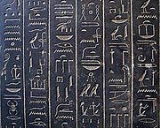
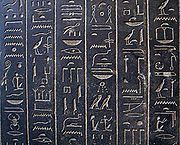 The Egyptian language
, which formed a separate branch among the family of Afro-Asiatic languages
, was among the first written languages, and is known from hieroglyphic inscriptions preserved on monuments and sheets of papyrus
. The Coptic language
, the last stage of Egyptian, is today the liturgical language of the Coptic Orthodox Church. Hieroglyphs were written on peoples front doors, so that the news of the pharaoh would travel to everyone.
The "Koiné" dialect of the Greek language
was important in Hellenistic Alexandria, and was used in the philosophy and science of that culture, and was later studied by Arabic
Arabic
came to Egypt in the seventh century, and Egyptian Arabic
has become today the modern speech of the country. Of the many varieties of Arabic, it is the most widely spoken second dialect
, due to the influence of Egyptian cinema and media throughout the Arabic-speaking world.
In the Upper Nile Valley, around Kom Ombo
and Aswan
, there are about 300,000 speakers of Nubian languages
, mainly Nobiin
, but also Kenuzi-Dongola. The Berber languages
are represented by Siwi
, spoken by about 5,000 around the Siwa Oasis
. There are over a million speakers of the Domari language
(an Indo-Aryan language
related to Romany), mostly living north of Cairo
, and there are about 60,000 Greek
speakers in Alexandria
. Approximately 77,000 speakers of Bedawi (a Beja language
) live in the Eastern Desert.
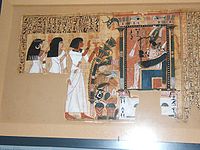 Ancient Egyptian literature dates back to the Old Kingdom
, in the third millennium BC. Religious literature is best known for its hymn
s to and its mortuary texts. The oldest extant Egyptian literature are the Pyramid Texts
: the mythology and rituals carved around the tombs of rulers. The later, secular literature of ancient Egypt includes the 'wisdom texts', forms of philosophical instruction. The Instruction of Ptahhotep, for example, is a collation of moral proverbs by an Egyptian administrator. The authors of the literature of the Old and Middle Kingdoms
(through to the middle of the second millennium BC) seem to have been drawn from an elite administrative class, and were celebrated and revered into the New Kingdom
(to the end of the second millennium). In time, the Pyramid Texts became Coffin Texts
(perhaps after the end of the Old Kingdom), and finally the mortuary literature produced its masterpiece, the Book of the Dead
, during the New Kingdom.
The Middle Kingdom
was the golden age of Egyptian literature. Some notable texts include the Tale of Neferty, the Instructions of Amenemhat I
, the Tale of Sinuhe, the Story of the Shipwrecked Sailor and the Story of the Eloquent Peasant. Instructions became a popular literary genre of the New Kingdom
, taking the form of advice on proper behavior. The Story of Wenamun
and the Instruction of Any
are well-known examples from this period.
During the Greco-Roman period (332 BC − AD 639), Egyptian literature was translated into other languages, and Greco-Roman literature fused with native art into a new style of writing. From this period comes the Rosetta Stone
, which became the key to unlocking the mysteries of Egyptian writing to modern scholarship. The great city of Alexandria
boasted its famous Library
of almost half a million handwritten books during the third century BC. Alexandria's centre of learning also produced the Greek translation of the Hebrew Bible
, the Septuagint.
 During the first few centuries of the Christian era, Egypt was the ultimate source of a great deal of ascetic literature in the Coptic language
. Egyptian monasteries translated many Greek
and Syriac
works, which are now only extant in Coptic. Under Islam
, Egypt continued to be a great source of literary endeavour, now in the Arabic language
. In 970, al-Azhar University
was founded in Cairo
, which to this day remains the most important centre of Sunni Islam
ic learning. In 12th century Egypt, the Jewish Talmudic scholar Maimonides
produced his most important work.
In contemporary times, Egyptian novelists and poets were among the first to experiment with modern styles of Arabic-language literature, and the forms they developed have been widely imitated. The first modern Egyptian novel Zaynab
by Muhammad Husayn Haykal
was published in 1913 in the Egyptian vernacular
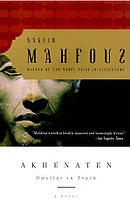
. Egyptian novelist Naguib Mahfouz
was the first Arabic-language writer to win the Nobel Prize in Literature
. Many Egyptian books and films are available throughout the Middle East
. Other prominent Egyptian writers include Nawal El Saadawi
, well known for her feminist
works and activism
, and Alifa Rifaat
who also writes about women and tradition. Vernacular poetry is said to be the most popular literary genre amongst Egyptians
, represented most significantly by Bayram el-Tunsi
, Ahmed Fouad Negm
(Fagumi), Salah Jaheen and Abdel Rahman el-Abnudi.
. The wall paintings done in the service of the Pharaoh
s followed a rigid code of visual rules and meanings. Early Egyptian art is characterized by absence of linear perspective, which results in a seemingly flat space. These artists tended to create images based on what they knew, and not as much on what they see. Objects in these artworks generally do not decrease in size as they increase in distance and there is little shading to indicate depth
. Sometimes, distance is indicated through the use of tiered space, where more distant objects are drawn higher above the nearby objects, but in the same scale and with no overlapping of forms. People and objects are almost always drawn in profile. Also, you may notice the people in Egyptian art are never facing forward. Archaeologists are not yet sure of why, but they are leaning torwards the fact that artists status was low in the hierarchy so they could never be in front of a higher authority figure, and never be faced towards them.
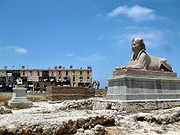 Early Egyptian artists did have a system for maintaining dimensions within artwork. They used a grid system that allowed them to create a smaller version of the artwork, and then scale up the design based upon proportional representation in a larger grid.
and contemporary
Egyptian art can be as diverse as any works in the world art scene. Some well-known names include Mahmoud Mokhtar
, Abdel Hadi Al Gazzar
, Farouk Hosny
, Gazbia Sirry
, Kamal Amin
, Hussein El Gebaly
and many others. Many artists in Egypt have taken on modern media such as digital art and this has been the theme of many exhibitions in Cairo in recent times. There has also been a tendency to use the World Wide Web as an alternative outlet for artists and there is a strong Art-focused internet community on groups that has found origin in Egypt. *.
, art, and mathematics
, dating from antiquity
to modern times.
were one of the first civilizations to implement Mathematical numbers. The traditional view of Ancient Egypt
's 'additive' scholars reports that Egyptians confined themselves to applications of practical arithmetic with many problems addressing how a number of loaves can be divided equally between a number of men.
designed the Pyramid of Djoser
(the Step Pyramid
) at Saqqara
in Egypt
around 2630
-2611 BC
, and may have been responsible for the first known use of column
s in architecture
. The Egyptian historian Manetho
credited him with inventing stone-dressed building during Djoser's reign, though he was not the first to actually build with stone. Imhotep is also believed to have founded Egyptian medicine
, being the author of the world's earliest known medical document, the Edwin Smith Papyrus
.
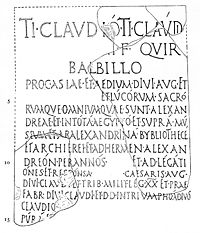 The silk road led staright through ancient Alexandria.
Also, the Royal Library of Alexandria
was once the largest in the world. It is usually assumed to have been founded at the beginning of the 3rd century BC during the reign of Ptolemy II of Egypt after his father had set up the Temple of the Muses or Museum
. The initial organization is attributed to Demetrius Phalereus
. The Library is estimated to have stored at its peak 400,000 to 700,000 scrolls
.
One of the reasons so little is known about the Library is that it was lost centuries after its creation. All that is left of many of the volumes are tantalizing titles that hint at all the history lost due to the building's destruction. Few events in ancient history are as controversial as the destruction of the Library, as the historical record is both contradictory and incomplete. Its destruction has been attributed by some authors to, among others, Julius Caesar, Augustus Caesar, and Catholic zealots during the purge of the Arian heresy, Not surprisingly, the Great Library became a symbol of knowledge itself, and its destruction was attributed to those who were portrayed as ignorant barbarian
s, often for purely political reasons.
A new library
was inaugurated in 2003 near the site of the old library.
The Lighthouse of Alexandria
, one of the Seven Wonders of the Ancient World
, designed by Sostratus of Cnidus
and built during the reign of Ptolemy I Soter
served as the city's landmark, and later, lighthouse.
, being the center of the Hellenistic world, produced a number of great mathematicians, astronomers and scientists such as Ctesibius
, Pappus
and Diophantus
. It also attracted scholars from all over the Mediterranean such as Eratosthenes
of Cyrene
.
is one of the most famous astronomers and geographers from Egypt, famous for his work in Alexandria
. Born Claudius Ptolemaeus (Greek: Κλαύδιος Πτολεμαίος; c. 85 – c. 165) in Upper Egypt
, he was a geographer
, astronomer
, and astrologer
.
Ptolemy was the author of two important scientific treatises. One is the astronomical treatise that is now known as the Almagest
(in Greek Η μεγάλη Σύνταξις, "The Great Treatise"). In this work, one of the most influential books of antiquity, Ptolemy compiled the astronomical knowledge of the ancient Greek and Babylonia
n world. Ptolemy's other main work is his Geography. This too is a compilation, of what was known about the world's geography
in the Roman Empire in his time.
In his Optics
, a work which survives only in an Arabic translation, he writes about properties of light
, including reflection
, refraction
and colour. His other works include Planetary Hypothesis, Planisphaerium and Analemma. Ptolemy's treatise on astrology, the Tetrabiblos, was the most popular astrological work of antiquity and also enjoyed great influence in the Islamic world and the medieval Latin
West
.
Ptolemy also wrote influential work Harmonics on music theory. After criticizing the approaches of his predecessors, Ptolemy argued for basing musical intervals on mathematical ratios (in contrast to the followers of Aristoxenus) backed up by empirical observation (in contrast to the over-theoretical approach of the Pythagoreans). He presented his own divisions of the tetrachord and the octave, which he derived with the help of a monochord. Ptolemy's astronomical interests also appeared in a discussion of the music of the spheres.
Tributes to Ptolemy include Ptolemaeus crater on the Moon and Ptolemaeus crater on Mars.
(born February 26, 1946) is an Egypt
ian chemist
, and the winner of the 1999 Nobel Prize in Chemistry
for his work on femtochemistry
. Born in Damanhur
(60 km south-east of Alexandria
) and raised in Disuq
, he moved to the US
to complete his PhD at the University of Pennsylvania
. He was awarded a faculty appointment at Caltech in 1976, where he has remained since.
Zewail's key work has been as the pioneer of femtochemistry
. He developed a method using a rapid laser
technique (consisting of ultrashort
laser flashes), which allows the description of reactions at the atom
ic level. It can be viewed as a highly sophisticated form of flash photography.
In 1999, Zewail became the third Egyptian to receive the Nobel Prize
, following Anwar Sadat
(1978 in Peace) and Naguib Mahfouz
(1988 in Literature). In 1999 he received Egypt's highest state honour, the Grand Collar of the Nile.
and the study of Egypt's ancient heritage as the field of Egyptology
has become a major scientific pursuit in the country itself. The field began during the Middle Ages
, and has been led by Europeans and Westerners in modern times. The study of Egyptology, however, has in recent decades been taken up by Egyptian archæologists such as Zahi Hawass
and the Supreme Council of Antiquities
he leads.
The discovery of the Rosetta Stone
, a tablet written in ancient Greek, Egyptian Demotic
script, and Egyptian hieroglyphs, has partially been credited for the recent stir in the study of Ancient Egypt. Greek
, a well known language, gave linguists the ability to decipher the mysterious Egyptian hieroglyphic language. The ability to decipher hieroglyphics facilitated the translation of hundreds of the texts and inscriptions that were previously indecipherable, giving insight into Egyptian culture that would have otherwise been lost to the ages. The stone was discovered on July 15, 1799 in the port town of Rosetta, Egypt,and has been held in the British Museum
since 1802.
The Egyptian national football team won the African Cup of Nations seven times setting a new record in Africa (years: 57, 59, 86, 98, 06, 08, '10). Although it's the first African country who joined FIFA, it hasn't made it to the World Cup except only two times in 1934 and 1990. In the World Military Cup
, Egypt won the title 5 times, and was the runner-up another 2 times.
Other popular sports in Egypt are basketball
, handball
, squash
and tennis
. The Egyptian Squash team is always known for its fierce competition in worldwide championships since the 1930s till today. Handball has become another growingly popular sport among Egyptians as well. Since the early 1990s, the Egyptian Handball Team has become a growing international force in the sport, winning regional and continental tournaments as well as reaching up to fourth place internationally in 2001. The Junior Handball team reached the first rank in 1993 under the lead of Captain Gamal Shams, and it hosted the tournament in 2010 setting a record in the audience number specially the match between Egypt and Denmark in the semifinals, the stadium was completely full.
In older times (1930s and 40s), Egypt was a power house in Weight lifting, Boxing and Wrestling with several Olympic and world championship medals.
Local sports clubs receive financial support from the local governments, and many sporting clubs are financially and administratively supported by the government.
is held every year. The festival has been rated by the International Federation of Film Producers Associations
as being among the 11 top-class film festivals worldwide.
Most of Arabic-language TV and cinema has been notably affected by the Egyptian
dialect, due to its simplicity.
The Egyptian film industry is the largest within Arabic-speaking cinema.
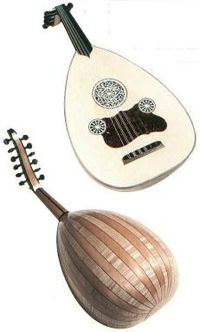 Egyptian music is a rich mixture of indigenous Egyptian, African and Western influences.
As early as 4000 BC
, ancient Egyptians were playing harp
s and flute
s, as well as two indigenous instruments: the ney
and the oud
. However, there is little notation of Egyptian music before the 7th century AD, when Egypt became part of the Muslim world
. Percussion
and vocal music became important at this time, and has remained an important part of Egyptian music today.
Contemporary Egyptian music
traces its beginnings to the creative work of luminaries such as Abdu-l Hamuli, Almaz, Sayed Mikkawi, and Mahmud Osman, who were all patronized by Khedive Ismail
and who influenced the later work of Sayed Darwish
, Umm Kulthum, Mohammed Abdel Wahab
, Abdel Halim Hafez
and other Egyptian music giants.
From the 1970s onwards, Egyptian pop music
has become increasingly important in Egyptian culture, particularly among the large youth population of Egypt. Egyptian folk music
is also popular, played during weddings and other festivities. In the last quarter of the 20th century, Egyptian music was a way to communicate social and class
issues. The most popular Egyptian pop singers are Amr Diab
, Mohamed Mounir
and Ali El Haggar
.
Belly dance
, or Raqs Sharqi (literally: oriental dancing) may have originated in Egypt, and today the country is considered the international center of the art.
, Kushari
and Molokhia. It also shares similarities with food found throughout the eastern Mediterranean like kebab
and falafel
.
Culture
Culture is a term that has many different inter-related meanings. For example, in 1952, Alfred Kroeber and Clyde Kluckhohn compiled a list of 164 definitions of "culture" in Culture: A Critical Review of Concepts and Definitions...
of Egypt
Egypt
Egypt , officially the Arab Republic of Egypt, Arabic: , is a country mainly in North Africa, with the Sinai Peninsula forming a land bridge in Southwest Asia. Egypt is thus a transcontinental country, and a major power in Africa, the Mediterranean Basin, the Middle East and the Muslim world...
has thousands of years of recorded history. Ancient Egypt
Ancient Egypt
Ancient Egypt was an ancient civilization of Northeastern Africa, concentrated along the lower reaches of the Nile River in what is now the modern country of Egypt. Egyptian civilization coalesced around 3150 BC with the political unification of Upper and Lower Egypt under the first pharaoh...
was among the earliest civilization
Civilization
Civilization is a sometimes controversial term that has been used in several related ways. Primarily, the term has been used to refer to the material and instrumental side of human cultures that are complex in terms of technology, science, and division of labor. Such civilizations are generally...
s. For millennia, Egypt maintained a strikingly complex and stable culture that influenced later cultures of Europe
Europe
Europe is, by convention, one of the world's seven continents. Comprising the westernmost peninsula of Eurasia, Europe is generally 'divided' from Asia to its east by the watershed divides of the Ural and Caucasus Mountains, the Ural River, the Caspian and Black Seas, and the waterways connecting...
, the Middle East
Middle East
The Middle East is a region that encompasses Western Asia and Northern Africa. It is often used as a synonym for Near East, in opposition to Far East...
and Africa
Africa
Africa is the world's second largest and second most populous continent, after Asia. At about 30.2 million km² including adjacent islands, it covers 6% of the Earth's total surface area and 20.4% of the total land area...
. After the Pharaonic era, Egypt itself came under the influence of Hellenism
Hellenistic civilization
Hellenistic civilization represents the zenith of Greek influence in the ancient world from 323 BCE to about 146 BCE...
, for a time Christianity
Christianity
Christianity is a monotheistic religion based on the life and teachings of Jesus as presented in canonical gospels and other New Testament writings...
, and later, Islam
Islam
Islam . The most common are and . : Arabic pronunciation varies regionally. The first vowel ranges from ~~. The second vowel ranges from ~~~...
ic culture. Today, many aspects of Egypt's ancient culture exist in interaction with newer elements, including the influence of modern Western culture
Western culture
Western culture, sometimes equated with Western civilization or European civilization, refers to cultures of European origin and is used very broadly to refer to a heritage of social norms, ethical values, traditional customs, religious beliefs, political systems, and specific artifacts and...
.
Language
Egyptian language
Egyptian is the oldest known indigenous language of Egypt and a branch of the Afroasiatic language family. Written records of the Egyptian language have been dated from about 3400 BC, making it one of the oldest recorded languages known. Egyptian was spoken until the late 17th century AD in the...
, which formed a separate branch among the family of Afro-Asiatic languages
Afro-Asiatic languages
The Afroasiatic languages , also known as Hamito-Semitic, constitute one of the world's largest language families, with about 375 living languages...
, was among the first written languages, and is known from hieroglyphic inscriptions preserved on monuments and sheets of papyrus
Papyrus
Papyrus is a thick paper-like material produced from the pith of the papyrus plant, Cyperus papyrus, a wetland sedge that was once abundant in the Nile Delta of Egypt....
. The Coptic language
Coptic language
Coptic or Coptic Egyptian is the current stage of the Egyptian language, a northern Afro-Asiatic language spoken in Egypt until at least the 17th century. Egyptian began to be written using the Greek alphabet in the 1st century...
, the last stage of Egyptian, is today the liturgical language of the Coptic Orthodox Church. Hieroglyphs were written on peoples front doors, so that the news of the pharaoh would travel to everyone.
The "Koiné" dialect of the Greek language
Greek language
Greek is an independent branch of the Indo-European family of languages. Native to the southern Balkans, it has the longest documented history of any Indo-European language, spanning 34 centuries of written records. Its writing system has been the Greek alphabet for the majority of its history;...
was important in Hellenistic Alexandria, and was used in the philosophy and science of that culture, and was later studied by Arabic
Arabic
Arabic language
Arabic is a name applied to the descendants of the Classical Arabic language of the 6th century AD, used most prominently in the Quran, the Islamic Holy Book...
came to Egypt in the seventh century, and Egyptian Arabic
Egyptian Arabic
Egyptian Arabic is the language spoken by contemporary Egyptians.It is more commonly known locally as the Egyptian colloquial language or Egyptian dialect ....
has become today the modern speech of the country. Of the many varieties of Arabic, it is the most widely spoken second dialect
Second language
A second language or L2 is any language learned after the first language or mother tongue. Some languages, often called auxiliary languages, are used primarily as second languages or lingua francas ....
, due to the influence of Egyptian cinema and media throughout the Arabic-speaking world.
In the Upper Nile Valley, around Kom Ombo
Kom Ombo
Kom Ombo or Ombos or Latin: Ambo and Ombi – is an agricultural town in Egypt famous for the Temple of Kom Ombo...
and Aswan
Aswan
Aswan , formerly spelled Assuan, is a city in the south of Egypt, the capital of the Aswan Governorate.It stands on the east bank of the Nile at the first cataract and is a busy market and tourist centre...
, there are about 300,000 speakers of Nubian languages
Nubian languages
The Nubian language group, according to the most recent research by Bechhaus-Gerst comprises the following varieties:# Nobiin ....
, mainly Nobiin
Nobiin language
Nobiin is a Northern Nubian language of the Nilo-Saharan phylum. ‘Nobiin’ is the genitive form of Nòòbíí ‘Nubian" and literally means ‘ of the Nubians"...
, but also Kenuzi-Dongola. The Berber languages
Berber languages
The Berber languages are a family of languages indigenous to North Africa, spoken from Siwa Oasis in Egypt to Morocco , and south to the countries of the Sahara Desert...
are represented by Siwi
Siwi language
Siwi is a Berber language of Egypt, spoken by about 15,000 to 30,000 people in the oases of Siwa and Gara, near the Libyan border. The language has been heavily influenced by Egyptian Arabic, to a greater degree than most Berber languages...
, spoken by about 5,000 around the Siwa Oasis
Siwa Oasis
The Siwa Oasis is an oasis in Egypt, located between the Qattara Depression and the Egyptian Sand Sea in the Libyan Desert, nearly 50 km east of the Libyan border, and 560 km from Cairo....
. There are over a million speakers of the Domari language
Domari language
Domari is an Indo-Aryan language, spoken by the Dom people across the Middle East, mainly in Iran and Egypt, but significant numbers of speakers are also found in India where they are known as Domba....
(an Indo-Aryan language
Indo-Aryan languages
The Indo-Aryan languages constitutes a branch of the Indo-Iranian languages, itself a branch of the Indo-European language family...
related to Romany), mostly living north of Cairo
Cairo
Cairo , is the capital of Egypt and the largest city in the Arab world and Africa, and the 16th largest metropolitan area in the world. Nicknamed "The City of a Thousand Minarets" for its preponderance of Islamic architecture, Cairo has long been a centre of the region's political and cultural life...
, and there are about 60,000 Greek
Greek language
Greek is an independent branch of the Indo-European family of languages. Native to the southern Balkans, it has the longest documented history of any Indo-European language, spanning 34 centuries of written records. Its writing system has been the Greek alphabet for the majority of its history;...
speakers in Alexandria
Alexandria
Alexandria is the second-largest city of Egypt, with a population of 4.1 million, extending about along the coast of the Mediterranean Sea in the north central part of the country; it is also the largest city lying directly on the Mediterranean coast. It is Egypt's largest seaport, serving...
. Approximately 77,000 speakers of Bedawi (a Beja language
Beja language
Beja or North Cushitic is an Afro-Asiatic language of the southern coast of the Red Sea, spoken by about two million nomads, the Beja, in parts of Egypt, Sudan, and Eritrea.-Classification:...
) live in the Eastern Desert.
Literature
Old Kingdom
Old Kingdom is the name given to the period in the 3rd millennium BC when Egypt attained its first continuous peak of civilization in complexity and achievement – the first of three so-called "Kingdom" periods, which mark the high points of civilization in the lower Nile Valley .The term itself was...
, in the third millennium BC. Religious literature is best known for its hymn
Hymn
A hymn is a type of song, usually religious, specifically written for the purpose of praise, adoration or prayer, and typically addressed to a deity or deities, or to a prominent figure or personification...
s to and its mortuary texts. The oldest extant Egyptian literature are the Pyramid Texts
Pyramid Texts
The Pyramid Texts are a collection of ancient Egyptian religious texts from the time of the Old Kingdom. The pyramid texts are possibly the oldest known religious texts in the world. Written in Old Egyptian, the pyramid texts were carved on the walls and sarcophagi of the pyramids at Saqqara during...
: the mythology and rituals carved around the tombs of rulers. The later, secular literature of ancient Egypt includes the 'wisdom texts', forms of philosophical instruction. The Instruction of Ptahhotep, for example, is a collation of moral proverbs by an Egyptian administrator. The authors of the literature of the Old and Middle Kingdoms
Middle Kingdom of Egypt
The Middle Kingdom of Egypt is the period in the history of ancient Egypt stretching from the establishment of the Eleventh Dynasty to the end of the Fourteenth Dynasty, between 2055 BC and 1650 BC, although some writers include the Thirteenth and Fourteenth dynasties in the Second Intermediate...
(through to the middle of the second millennium BC) seem to have been drawn from an elite administrative class, and were celebrated and revered into the New Kingdom
New Kingdom
The New Kingdom of Egypt, also referred to as the Egyptian Empire is the period in ancient Egyptian history between the 16th century BC and the 11th century BC, covering the Eighteenth, Nineteenth, and Twentieth Dynasties of Egypt....
(to the end of the second millennium). In time, the Pyramid Texts became Coffin Texts
Coffin Texts
The Coffin Texts are a collection of ancient Egyptian funerary spells written on coffins beginning in the First Intermediate Period. The texts are derived in part from the earlier pyramid texts, reserved for royal use only, but they contain substantial new material related to everyday desires that...
(perhaps after the end of the Old Kingdom), and finally the mortuary literature produced its masterpiece, the Book of the Dead
Book of the Dead
The Book of the Dead is the modern name of an ancient Egyptian funerary text, used from the beginning of the New Kingdom to around 50 BC. The original Egyptian name for the text, transliterated rw nw prt m hrw is translated as "Book of Coming Forth by Day". Another translation would be "Book of...
, during the New Kingdom.
The Middle Kingdom
Middle Kingdom of Egypt
The Middle Kingdom of Egypt is the period in the history of ancient Egypt stretching from the establishment of the Eleventh Dynasty to the end of the Fourteenth Dynasty, between 2055 BC and 1650 BC, although some writers include the Thirteenth and Fourteenth dynasties in the Second Intermediate...
was the golden age of Egyptian literature. Some notable texts include the Tale of Neferty, the Instructions of Amenemhat I
Amenemhat I
Amenemhat I, also Amenemhet I, was the first ruler of the Twelfth Dynasty . He ruled from 1991 BC to 1962 BC...
, the Tale of Sinuhe, the Story of the Shipwrecked Sailor and the Story of the Eloquent Peasant. Instructions became a popular literary genre of the New Kingdom
New Kingdom
The New Kingdom of Egypt, also referred to as the Egyptian Empire is the period in ancient Egyptian history between the 16th century BC and the 11th century BC, covering the Eighteenth, Nineteenth, and Twentieth Dynasties of Egypt....
, taking the form of advice on proper behavior. The Story of Wenamun
Story of Wenamun
The Story of Wenamun is a literary text written in hieratic in the Late Egyptian language...
and the Instruction of Any
Instruction of Any
The Instruction of Any, or Ani, is an Ancient Egyptian text written in the style of wisdom literature which is thought to have been composed in the Eighteenth Dynasty of the New Kingdom, with a surviving manuscript dated from the Twenty-First or Twenty-Second Dynasty...
are well-known examples from this period.
During the Greco-Roman period (332 BC − AD 639), Egyptian literature was translated into other languages, and Greco-Roman literature fused with native art into a new style of writing. From this period comes the Rosetta Stone
Rosetta Stone
The Rosetta Stone is an ancient Egyptian granodiorite stele inscribed with a decree issued at Memphis in 196 BC on behalf of King Ptolemy V. The decree appears in three scripts: the upper text is Ancient Egyptian hieroglyphs, the middle portion Demotic script, and the lowest Ancient Greek...
, which became the key to unlocking the mysteries of Egyptian writing to modern scholarship. The great city of Alexandria
Alexandria
Alexandria is the second-largest city of Egypt, with a population of 4.1 million, extending about along the coast of the Mediterranean Sea in the north central part of the country; it is also the largest city lying directly on the Mediterranean coast. It is Egypt's largest seaport, serving...
boasted its famous Library
Library of Alexandria
The Royal Library of Alexandria, or Ancient Library of Alexandria, in Alexandria, Egypt, was the largest and most significant great library of the ancient world. It flourished under the patronage of the Ptolemaic dynasty and functioned as a major center of scholarship from its construction in the...
of almost half a million handwritten books during the third century BC. Alexandria's centre of learning also produced the Greek translation of the Hebrew Bible
Hebrew Bible
The Hebrew Bible is a term used by biblical scholars outside of Judaism to refer to the Tanakh , a canonical collection of Jewish texts, and the common textual antecedent of the several canonical editions of the Christian Old Testament...
, the Septuagint.
Coptic language
Coptic or Coptic Egyptian is the current stage of the Egyptian language, a northern Afro-Asiatic language spoken in Egypt until at least the 17th century. Egyptian began to be written using the Greek alphabet in the 1st century...
. Egyptian monasteries translated many Greek
Greek language
Greek is an independent branch of the Indo-European family of languages. Native to the southern Balkans, it has the longest documented history of any Indo-European language, spanning 34 centuries of written records. Its writing system has been the Greek alphabet for the majority of its history;...
and Syriac
Syriac language
Syriac is a dialect of Middle Aramaic that was once spoken across much of the Fertile Crescent. Having first appeared as a script in the 1st century AD after being spoken as an unwritten language for five centuries, Classical Syriac became a major literary language throughout the Middle East from...
works, which are now only extant in Coptic. Under Islam
Islam
Islam . The most common are and . : Arabic pronunciation varies regionally. The first vowel ranges from ~~. The second vowel ranges from ~~~...
, Egypt continued to be a great source of literary endeavour, now in the Arabic language
Arabic language
Arabic is a name applied to the descendants of the Classical Arabic language of the 6th century AD, used most prominently in the Quran, the Islamic Holy Book...
. In 970, al-Azhar University
Al-Azhar University
Al-Azhar University is an educational institute in Cairo, Egypt. Founded in 970~972 as a madrasa, it is the chief centre of Arabic literature and Islamic learning in the world. It is the oldest degree-granting university in Egypt. In 1961 non-religious subjects were added to its curriculum.It is...
was founded in Cairo
Cairo
Cairo , is the capital of Egypt and the largest city in the Arab world and Africa, and the 16th largest metropolitan area in the world. Nicknamed "The City of a Thousand Minarets" for its preponderance of Islamic architecture, Cairo has long been a centre of the region's political and cultural life...
, which to this day remains the most important centre of Sunni Islam
Sunni Islam
Sunni Islam is the largest branch of Islam. Sunni Muslims are referred to in Arabic as ʾAhl ūs-Sunnah wa āl-Ǧamāʿah or ʾAhl ūs-Sunnah for short; in English, they are known as Sunni Muslims, Sunnis or Sunnites....
ic learning. In 12th century Egypt, the Jewish Talmudic scholar Maimonides
Maimonides
Moses ben-Maimon, called Maimonides and also known as Mūsā ibn Maymūn in Arabic, or Rambam , was a preeminent medieval Jewish philosopher and one of the greatest Torah scholars and physicians of the Middle Ages...
produced his most important work.
In contemporary times, Egyptian novelists and poets were among the first to experiment with modern styles of Arabic-language literature, and the forms they developed have been widely imitated. The first modern Egyptian novel Zaynab
Zaynab (novel)
Husayn Haykal's Zaynab is the first modern Egyptian novel published in 1913. The book depicts life in the Egyptian countryside and delves into the relationships between men and women.-Plot introduction:...
by Muhammad Husayn Haykal
Muhammad Husayn Haykal
Muhammad Hussein Haekal was an Egyptian writer, journalist, politician and Minister of Education in Egypt.- Life :...
was published in 1913 in the Egyptian vernacular
Egyptian Arabic
Egyptian Arabic is the language spoken by contemporary Egyptians.It is more commonly known locally as the Egyptian colloquial language or Egyptian dialect ....
. Egyptian novelist Naguib Mahfouz
Naguib Mahfouz
Naguib Mahfouz was an Egyptian writer who won the 1988 Nobel Prize for Literature. He is regarded as one of the first contemporary writers of Arabic literature, along with Tawfiq el-Hakim, to explore themes of existentialism. He published over 50 novels, over 350 short stories, dozens of movie...
was the first Arabic-language writer to win the Nobel Prize in Literature
Nobel Prize in Literature
Since 1901, the Nobel Prize in Literature has been awarded annually to an author from any country who has, in the words from the will of Alfred Nobel, produced "in the field of literature the most outstanding work in an ideal direction"...
. Many Egyptian books and films are available throughout the Middle East
Middle East
The Middle East is a region that encompasses Western Asia and Northern Africa. It is often used as a synonym for Near East, in opposition to Far East...
. Other prominent Egyptian writers include Nawal El Saadawi
Nawal El Saadawi
Nawal El Saadawi , born October 27, 1931, is an Egyptian feminist writer, activist, physician and psychiatrist. She has written many books on the subject of women in Islam, paying particular attention to the practice of female genital mutilation in her society....
, well known for her feminist
Feminism
Feminism is a collection of movements aimed at defining, establishing, and defending equal political, economic, and social rights and equal opportunities for women. Its concepts overlap with those of women's rights...
works and activism
Activism
Activism consists of intentional efforts to bring about social, political, economic, or environmental change. Activism can take a wide range of forms from writing letters to newspapers or politicians, political campaigning, economic activism such as boycotts or preferentially patronizing...
, and Alifa Rifaat
Alifa Rifaat
Fatimah Rifaat better known by her pen name Alifa Rifaat, was an Egyptian author whose controversial short stories are renowned for their depictions of the dynamics of female sexuality, relationships, and loss in rural Egyptian culture...
who also writes about women and tradition. Vernacular poetry is said to be the most popular literary genre amongst Egyptians
Egyptians
Egyptians are nation an ethnic group made up of Mediterranean North Africans, the indigenous people of Egypt.Egyptian identity is closely tied to geography. The population of Egypt is concentrated in the lower Nile Valley, the small strip of cultivable land stretching from the First Cataract to...
, represented most significantly by Bayram el-Tunsi
Mahmud Bayram el-Tunsi
Mahmud Bayram el-Tunsi was an Egyptian poet who was exiled from Egypt by the British for his nationalist poetry.Bayram el-Tunsi received his education at religious schools. However, he learned the art of poetry by listening to oral presentations in the form known as zajal...
, Ahmed Fouad Negm
Ahmed Fouad Negm
Ahmed Fouad Negm -Background:Ahmed Fouad Negm was born to a family of fellahin the Egyptian countryside. His mother, Hanem Morsi Negm, was a housewife, and his father Mohammed Ezat Negm, a police officer. Negm was one of seventeen brothers, only six of whom are still living...
(Fagumi), Salah Jaheen and Abdel Rahman el-Abnudi.
Religion
Ninety percent of Egypt's population is Muslim, with a Sunni majority. Nine percent of the population is Coptic Christian; other religions and other forms of Christianity comprise the remaining one percent.Egyptian art in antiquity
The Egyptians were one of the first major civilizations to codify design elements in artArt
Art is the product or process of deliberately arranging items in a way that influences and affects one or more of the senses, emotions, and intellect....
. The wall paintings done in the service of the Pharaoh
Pharaoh
Pharaoh is a title used in many modern discussions of the ancient Egyptian rulers of all periods. The title originates in the term "pr-aa" which means "great house" and describes the royal palace...
s followed a rigid code of visual rules and meanings. Early Egyptian art is characterized by absence of linear perspective, which results in a seemingly flat space. These artists tended to create images based on what they knew, and not as much on what they see. Objects in these artworks generally do not decrease in size as they increase in distance and there is little shading to indicate depth
Distance
Distance is a numerical description of how far apart objects are. In physics or everyday discussion, distance may refer to a physical length, or an estimation based on other criteria . In mathematics, a distance function or metric is a generalization of the concept of physical distance...
. Sometimes, distance is indicated through the use of tiered space, where more distant objects are drawn higher above the nearby objects, but in the same scale and with no overlapping of forms. People and objects are almost always drawn in profile. Also, you may notice the people in Egyptian art are never facing forward. Archaeologists are not yet sure of why, but they are leaning torwards the fact that artists status was low in the hierarchy so they could never be in front of a higher authority figure, and never be faced towards them.
Egyptian art in modern times
ModernModern art
Modern art includes artistic works produced during the period extending roughly from the 1860s to the 1970s, and denotes the style and philosophy of the art produced during that era. The term is usually associated with art in which the traditions of the past have been thrown aside in a spirit of...
and contemporary
Contemporary art
Contemporary art can be defined variously as art produced at this present point in time or art produced since World War II. The definition of the word contemporary would support the first view, but museums of contemporary art commonly define their collections as consisting of art produced...
Egyptian art can be as diverse as any works in the world art scene. Some well-known names include Mahmoud Mokhtar
Mahmoud Mokhtar
Mahmoud Mukhtar was an Egyptian sculptor. Notwithstanding his prematurely early death, his impact on contemporary Egyptian art has been colossal...
, Abdel Hadi Al Gazzar
Abdel Hadi Al Gazzar
Abdel Hadi Al Gazzar was an Egyptian painter. He occupies a unique position among the artists of his generation...
, Farouk Hosny
Farouk Hosny
Farouk Hosny , is an Egyptian abstract painter who was Minister of Culture from 1987 to 2011.-Early life and career:...
, Gazbia Sirry
Gazbia Sirry
Gazbia Sirry is an Egyptian painter.Born in Cairo, Gazbia Sirry studied fine arts and became a professor in the painting department of the Faculty of Art Education, Helwan University....
, Kamal Amin
Kamal Amin
Kamal Amin Awad was one of the most famous Egyptian artists of his time. He was one of the pioneers of graphic arts. The artist, whose masterpieces and unique techniques impressed Egyptian modern art, was born in Tanta in 1923. He was interested in teaching his students about the modern...
, Hussein El Gebaly
Hussein el gebaly
- Artist Biography :Hussein El Gebaly , born in 1934 in Giza, Egypt.Diploma of the Faculty of Fine Arts in Cairo in 1958.Diploma of the Higher Institute for Artistic Education in 1959....
and many others. Many artists in Egypt have taken on modern media such as digital art and this has been the theme of many exhibitions in Cairo in recent times. There has also been a tendency to use the World Wide Web as an alternative outlet for artists and there is a strong Art-focused internet community on groups that has found origin in Egypt. *.
Science
Egypt's cultural contributions have included great works of scienceScience
Science is a systematic enterprise that builds and organizes knowledge in the form of testable explanations and predictions about the universe...
, art, and mathematics
Mathematics
Mathematics is the study of quantity, space, structure, and change. Mathematicians seek out patterns and formulate new conjectures. Mathematicians resolve the truth or falsity of conjectures by mathematical proofs, which are arguments sufficient to convince other mathematicians of their validity...
, dating from antiquity
Ancient history
Ancient history is the study of the written past from the beginning of recorded human history to the Early Middle Ages. The span of recorded history is roughly 5,000 years, with Cuneiform script, the oldest discovered form of coherent writing, from the protoliterate period around the 30th century BC...
to modern times.
Mathematics
The ancient EgyptiansEgyptians
Egyptians are nation an ethnic group made up of Mediterranean North Africans, the indigenous people of Egypt.Egyptian identity is closely tied to geography. The population of Egypt is concentrated in the lower Nile Valley, the small strip of cultivable land stretching from the First Cataract to...
were one of the first civilizations to implement Mathematical numbers. The traditional view of Ancient Egypt
Ancient Egypt
Ancient Egypt was an ancient civilization of Northeastern Africa, concentrated along the lower reaches of the Nile River in what is now the modern country of Egypt. Egyptian civilization coalesced around 3150 BC with the political unification of Upper and Lower Egypt under the first pharaoh...
's 'additive' scholars reports that Egyptians confined themselves to applications of practical arithmetic with many problems addressing how a number of loaves can be divided equally between a number of men.
Imhotep
Considered to be the first engineer, architect and physician in history known by name, ImhotepImhotep
Imhotep , fl. 27th century BC was an Egyptian polymath, who served under the Third Dynasty king Djoser as chancellor to the pharaoh and high priest of the sun god Ra at Heliopolis...
designed the Pyramid of Djoser
Pyramid of Djoser
The Pyramid of Djoser , or step pyramid is an archeological remain in the Saqqara necropolis, Egypt, northwest of the city of Memphis. It was built during the 27th century BC for the burial of Pharaoh Djoser by Imhotep, his vizier...
(the Step Pyramid
Step pyramid
Step pyramids are structures which characterized several cultures throughout history, in several locations throughout the world. These pyramids typically are large and made of several layers of stone...
) at Saqqara
Saqqara
Saqqara is a vast, ancient burial ground in Egypt, serving as the necropolis for the Ancient Egyptian capital, Memphis. Saqqara features numerous pyramids, including the world famous Step pyramid of Djoser, sometimes referred to as the Step Tomb due to its rectangular base, as well as a number of...
in Egypt
History of Ancient Egypt
The History of Ancient Egypt spans the period from the early predynastic settlements of the northern Nile Valley to the Roman conquest in 30 BC...
around 2630
27th century BC
The 27th century BC is a century which lasted from the year 2700 BC to 2601 BC.-Events:*2900 BC – 2334 BC: Mesopotamian wars of the Early Dynastic period.*2775 BC – 2650 BC: Second Dynasty wars in Egypt....
-2611 BC
27th century BC
The 27th century BC is a century which lasted from the year 2700 BC to 2601 BC.-Events:*2900 BC – 2334 BC: Mesopotamian wars of the Early Dynastic period.*2775 BC – 2650 BC: Second Dynasty wars in Egypt....
, and may have been responsible for the first known use of column
Column
A column or pillar in architecture and structural engineering is a vertical structural element that transmits, through compression, the weight of the structure above to other structural elements below. For the purpose of wind or earthquake engineering, columns may be designed to resist lateral forces...
s in architecture
Architecture
Architecture is both the process and product of planning, designing and construction. Architectural works, in the material form of buildings, are often perceived as cultural and political symbols and as works of art...
. The Egyptian historian Manetho
Manetho
Manetho was an Egyptian historian and priest from Sebennytos who lived during the Ptolemaic era, approximately during the 3rd century BC. Manetho wrote the Aegyptiaca...
credited him with inventing stone-dressed building during Djoser's reign, though he was not the first to actually build with stone. Imhotep is also believed to have founded Egyptian medicine
Ancient Egyptian medicine
The medicine of the ancient Egyptians is some of the oldest documented. From the beginnings of the civilization in the until the Persian invasion of 525 BC, Egyptian medical practice went largely unchanged and was highly advanced for its time, including simple non-invasive surgery, setting of...
, being the author of the world's earliest known medical document, the Edwin Smith Papyrus
Edwin Smith papyrus
The Edwin Smith Papyrus is an Ancient Egyptian medical text and the oldest known surgical treatise on trauma. It dates to Dynasties 16-17 of the Second Intermediate Period in Ancient Egypt, ca. 1500 BCE. The Edwin Smith papyrus is unique among the four principal medical papyri in existencethat...
.
Ptolemaic and Roman Egypt
Also, the Royal Library of Alexandria
Library of Alexandria
The Royal Library of Alexandria, or Ancient Library of Alexandria, in Alexandria, Egypt, was the largest and most significant great library of the ancient world. It flourished under the patronage of the Ptolemaic dynasty and functioned as a major center of scholarship from its construction in the...
was once the largest in the world. It is usually assumed to have been founded at the beginning of the 3rd century BC during the reign of Ptolemy II of Egypt after his father had set up the Temple of the Muses or Museum
Museum
A museum is an institution that cares for a collection of artifacts and other objects of scientific, artistic, cultural, or historical importance and makes them available for public viewing through exhibits that may be permanent or temporary. Most large museums are located in major cities...
. The initial organization is attributed to Demetrius Phalereus
Demetrius Phalereus
Demetrius of Phalerum was an Athenian orator originally from Phalerum, a student of Theophrastus and one of the first Peripatetics...
. The Library is estimated to have stored at its peak 400,000 to 700,000 scrolls
Scroll (parchment)
A scroll is a roll of papyrus, parchment, or paper which has been written, drawn or painted upon for the purpose of transmitting information or using as a decoration.-Structure:...
.
One of the reasons so little is known about the Library is that it was lost centuries after its creation. All that is left of many of the volumes are tantalizing titles that hint at all the history lost due to the building's destruction. Few events in ancient history are as controversial as the destruction of the Library, as the historical record is both contradictory and incomplete. Its destruction has been attributed by some authors to, among others, Julius Caesar, Augustus Caesar, and Catholic zealots during the purge of the Arian heresy, Not surprisingly, the Great Library became a symbol of knowledge itself, and its destruction was attributed to those who were portrayed as ignorant barbarian
Barbarian
Barbarian and savage are terms used to refer to a person who is perceived to be uncivilized. The word is often used either in a general reference to a member of a nation or ethnos, typically a tribal society as seen by an urban civilization either viewed as inferior, or admired as a noble savage...
s, often for purely political reasons.
A new library
Bibliotheca Alexandrina
The Bibliotheca Alexandrina or Maktabat al-Iskandarīyah is a major library and cultural center located on the shore of the Mediterranean Sea in the Egyptian city of Alexandria...
was inaugurated in 2003 near the site of the old library.
The Lighthouse of Alexandria
Lighthouse of Alexandria
The Lighthouse of Alexandria, also known as the Pharos of Alexandria , was a tower built between 280 and 247 BC on the island of Pharos at Alexandria, Egypt...
, one of the Seven Wonders of the Ancient World
Seven Wonders of the Ancient World
The Seven Wonders of the World refers to remarkable constructions of classical antiquity listed by various authors in guidebooks popular among the ancient Hellenic tourists, particularly in the 1st and 2nd centuries BC...
, designed by Sostratus of Cnidus
Sostratus of Cnidus
Sostratus of Cnidus , was a Greek architect and engineer. He designed the lighthouse of Alexandria, one of the Seven Wonders of the World , on the island of Pharos off Alexandria, Egypt.-External links:*...
and built during the reign of Ptolemy I Soter
Ptolemy I Soter
Ptolemy I Soter I , also known as Ptolemy Lagides, c. 367 BC – c. 283 BC, was a Macedonian general under Alexander the Great, who became ruler of Egypt and founder of both the Ptolemaic Kingdom and the Ptolemaic Dynasty...
served as the city's landmark, and later, lighthouse.
Mathematics and technology
AlexandriaAlexandria
Alexandria is the second-largest city of Egypt, with a population of 4.1 million, extending about along the coast of the Mediterranean Sea in the north central part of the country; it is also the largest city lying directly on the Mediterranean coast. It is Egypt's largest seaport, serving...
, being the center of the Hellenistic world, produced a number of great mathematicians, astronomers and scientists such as Ctesibius
Ctesibius
Ctesibius or Ktesibios or Tesibius was a Greek inventor and mathematician in Alexandria, Ptolemaic Egypt. He wrote the first treatises on the science of compressed air and its uses in pumps...
, Pappus
Pappus of Alexandria
Pappus of Alexandria was one of the last great Greek mathematicians of Antiquity, known for his Synagoge or Collection , and for Pappus's Theorem in projective geometry...
and Diophantus
Diophantus
Diophantus of Alexandria , sometimes called "the father of algebra", was an Alexandrian Greek mathematician and the author of a series of books called Arithmetica. These texts deal with solving algebraic equations, many of which are now lost...
. It also attracted scholars from all over the Mediterranean such as Eratosthenes
Eratosthenes
Eratosthenes of Cyrene was a Greek mathematician, poet, athlete, geographer, astronomer, and music theorist.He was the first person to use the word "geography" and invented the discipline of geography as we understand it...
of Cyrene
Cyrene, Libya
Cyrene was an ancient Greek colony and then a Roman city in present-day Shahhat, Libya, the oldest and most important of the five Greek cities in the region. It gave eastern Libya the classical name Cyrenaica that it has retained to modern times.Cyrene lies in a lush valley in the Jebel Akhdar...
.
Ptolemy
PtolemyPtolemy
Claudius Ptolemy , was a Roman citizen of Egypt who wrote in Greek. He was a mathematician, astronomer, geographer, astrologer, and poet of a single epigram in the Greek Anthology. He lived in Egypt under Roman rule, and is believed to have been born in the town of Ptolemais Hermiou in the...
is one of the most famous astronomers and geographers from Egypt, famous for his work in Alexandria
Alexandria
Alexandria is the second-largest city of Egypt, with a population of 4.1 million, extending about along the coast of the Mediterranean Sea in the north central part of the country; it is also the largest city lying directly on the Mediterranean coast. It is Egypt's largest seaport, serving...
. Born Claudius Ptolemaeus (Greek: Κλαύδιος Πτολεμαίος; c. 85 – c. 165) in Upper Egypt
Upper Egypt
Upper Egypt is the strip of land, on both sides of the Nile valley, that extends from the cataract boundaries of modern-day Aswan north to the area between El-Ayait and Zawyet Dahshur . The northern section of Upper Egypt, between El-Ayait and Sohag is sometimes known as Middle Egypt...
, he was a geographer
Geographer
A geographer is a scholar whose area of study is geography, the study of Earth's natural environment and human society.Although geographers are historically known as people who make maps, map making is actually the field of study of cartography, a subset of geography...
, astronomer
Astronomer
An astronomer is a scientist who studies celestial bodies such as planets, stars and galaxies.Historically, astronomy was more concerned with the classification and description of phenomena in the sky, while astrophysics attempted to explain these phenomena and the differences between them using...
, and astrologer
Astrologer
An astrologer practices one or more forms of astrology. Typically an astrologer draws a horoscope for the time of an event, such as a person's birth, and interprets celestial points and their placements at the time of the event to better understand someone, determine the auspiciousness of an...
.
Ptolemy was the author of two important scientific treatises. One is the astronomical treatise that is now known as the Almagest
Almagest
The Almagest is a 2nd-century mathematical and astronomical treatise on the apparent motions of the stars and planetary paths. Written in Greek by Claudius Ptolemy, a Roman era scholar of Egypt,...
(in Greek Η μεγάλη Σύνταξις, "The Great Treatise"). In this work, one of the most influential books of antiquity, Ptolemy compiled the astronomical knowledge of the ancient Greek and Babylonia
Babylonia
Babylonia was an ancient cultural region in central-southern Mesopotamia , with Babylon as its capital. Babylonia emerged as a major power when Hammurabi Babylonia was an ancient cultural region in central-southern Mesopotamia (present-day Iraq), with Babylon as its capital. Babylonia emerged as...
n world. Ptolemy's other main work is his Geography. This too is a compilation, of what was known about the world's geography
Geography
Geography is the science that studies the lands, features, inhabitants, and phenomena of Earth. A literal translation would be "to describe or write about the Earth". The first person to use the word "geography" was Eratosthenes...
in the Roman Empire in his time.
In his Optics
Optics
Optics is the branch of physics which involves the behavior and properties of light, including its interactions with matter and the construction of instruments that use or detect it. Optics usually describes the behavior of visible, ultraviolet, and infrared light...
, a work which survives only in an Arabic translation, he writes about properties of light
Light
Light or visible light is electromagnetic radiation that is visible to the human eye, and is responsible for the sense of sight. Visible light has wavelength in a range from about 380 nanometres to about 740 nm, with a frequency range of about 405 THz to 790 THz...
, including reflection
Reflection (physics)
Reflection is the change in direction of a wavefront at an interface between two differentmedia so that the wavefront returns into the medium from which it originated. Common examples include the reflection of light, sound and water waves...
, refraction
Refraction
Refraction is the change in direction of a wave due to a change in its speed. It is essentially a surface phenomenon . The phenomenon is mainly in governance to the law of conservation of energy. The proper explanation would be that due to change of medium, the phase velocity of the wave is changed...
and colour. His other works include Planetary Hypothesis, Planisphaerium and Analemma. Ptolemy's treatise on astrology, the Tetrabiblos, was the most popular astrological work of antiquity and also enjoyed great influence in the Islamic world and the medieval Latin
Latin
Latin is an Italic language originally spoken in Latium and Ancient Rome. It, along with most European languages, is a descendant of the ancient Proto-Indo-European language. Although it is considered a dead language, a number of scholars and members of the Christian clergy speak it fluently, and...
West
Western world
The Western world, also known as the West and the Occident , is a term referring to the countries of Western Europe , the countries of the Americas, as well all countries of Northern and Central Europe, Australia and New Zealand...
.
Ptolemy also wrote influential work Harmonics on music theory. After criticizing the approaches of his predecessors, Ptolemy argued for basing musical intervals on mathematical ratios (in contrast to the followers of Aristoxenus) backed up by empirical observation (in contrast to the over-theoretical approach of the Pythagoreans). He presented his own divisions of the tetrachord and the octave, which he derived with the help of a monochord. Ptolemy's astronomical interests also appeared in a discussion of the music of the spheres.
Tributes to Ptolemy include Ptolemaeus crater on the Moon and Ptolemaeus crater on Mars.
Ahmed Zewail
Ahmed ZewailAhmed Zewail
Ahmed Hassan Zewail is an Egyptian-American scientist who won the 1999 Nobel Prize in Chemistry for his work on femtochemistry. He is the Linus Pauling Chair Professor Chemistry and Professor of Physics at the California Institute of Technology.- Birth and education :Ahmed Zewail was born on...
(born February 26, 1946) is an Egypt
Egypt
Egypt , officially the Arab Republic of Egypt, Arabic: , is a country mainly in North Africa, with the Sinai Peninsula forming a land bridge in Southwest Asia. Egypt is thus a transcontinental country, and a major power in Africa, the Mediterranean Basin, the Middle East and the Muslim world...
ian chemist
Chemistry
Chemistry is the science of matter, especially its chemical reactions, but also its composition, structure and properties. Chemistry is concerned with atoms and their interactions with other atoms, and particularly with the properties of chemical bonds....
, and the winner of the 1999 Nobel Prize in Chemistry
Nobel Prize in Chemistry
The Nobel Prize in Chemistry is awarded annually by the Royal Swedish Academy of Sciences to scientists in the various fields of chemistry. It is one of the five Nobel Prizes established by the will of Alfred Nobel in 1895, awarded for outstanding contributions in chemistry, physics, literature,...
for his work on femtochemistry
Femtochemistry
Femtochemistry is the science that studies chemical reactions on extremely short timescales, approximately 10–15 seconds .-Introduction:...
. Born in Damanhur
Damanhur
Damanhur is a city in Lower Egypt, and the capital of the Beheira Governorate. It is located northwest of Cairo, and E.S.E. of Alexandria, in the middle of the western Nile Delta....
(60 km south-east of Alexandria
Alexandria
Alexandria is the second-largest city of Egypt, with a population of 4.1 million, extending about along the coast of the Mediterranean Sea in the north central part of the country; it is also the largest city lying directly on the Mediterranean coast. It is Egypt's largest seaport, serving...
) and raised in Disuq
Disuq
Desouk is a city in northern Egypt. Located 80 km east of Alexandria, it belongs to Kafr el-Sheikh Governorate and had a population of 129,604 inhabitants as of 2009.-Overview:...
, he moved to the US
United States
The United States of America is a federal constitutional republic comprising fifty states and a federal district...
to complete his PhD at the University of Pennsylvania
University of Pennsylvania
The University of Pennsylvania is a private, Ivy League university located in Philadelphia, Pennsylvania, United States. Penn is the fourth-oldest institution of higher education in the United States,Penn is the fourth-oldest using the founding dates claimed by each institution...
. He was awarded a faculty appointment at Caltech in 1976, where he has remained since.
Zewail's key work has been as the pioneer of femtochemistry
Femtochemistry
Femtochemistry is the science that studies chemical reactions on extremely short timescales, approximately 10–15 seconds .-Introduction:...
. He developed a method using a rapid laser
Laser
A laser is a device that emits light through a process of optical amplification based on the stimulated emission of photons. The term "laser" originated as an acronym for Light Amplification by Stimulated Emission of Radiation...
technique (consisting of ultrashort
Ultrashort pulse
In optics, an ultrashort pulse of light is an electromagnetic pulse whose time duration is of the order of a femtosecond . Such pulses have a broadband optical spectrum, and can be created by mode-locked oscillators...
laser flashes), which allows the description of reactions at the atom
Atom
The atom is a basic unit of matter that consists of a dense central nucleus surrounded by a cloud of negatively charged electrons. The atomic nucleus contains a mix of positively charged protons and electrically neutral neutrons...
ic level. It can be viewed as a highly sophisticated form of flash photography.
In 1999, Zewail became the third Egyptian to receive the Nobel Prize
Nobel Prize
The Nobel Prizes are annual international awards bestowed by Scandinavian committees in recognition of cultural and scientific advances. The will of the Swedish chemist Alfred Nobel, the inventor of dynamite, established the prizes in 1895...
, following Anwar Sadat
Anwar Sadat
Muhammad Anwar al-Sadat was the third President of Egypt, serving from 15 October 1970 until his assassination by fundamentalist army officers on 6 October 1981...
(1978 in Peace) and Naguib Mahfouz
Naguib Mahfouz
Naguib Mahfouz was an Egyptian writer who won the 1988 Nobel Prize for Literature. He is regarded as one of the first contemporary writers of Arabic literature, along with Tawfiq el-Hakim, to explore themes of existentialism. He published over 50 novels, over 350 short stories, dozens of movie...
(1988 in Literature). In 1999 he received Egypt's highest state honour, the Grand Collar of the Nile.
Egyptology
In modern times, archaeologyArchaeology
Archaeology, or archeology , is the study of human society, primarily through the recovery and analysis of the material culture and environmental data that they have left behind, which includes artifacts, architecture, biofacts and cultural landscapes...
and the study of Egypt's ancient heritage as the field of Egyptology
Egyptology
Egyptology is the study of ancient Egyptian history, language, literature, religion, and art from the 5th millennium BC until the end of its native religious practices in the AD 4th century. A practitioner of the discipline is an “Egyptologist”...
has become a major scientific pursuit in the country itself. The field began during the Middle Ages
Middle Ages
The Middle Ages is a periodization of European history from the 5th century to the 15th century. The Middle Ages follows the fall of the Western Roman Empire in 476 and precedes the Early Modern Era. It is the middle period of a three-period division of Western history: Classic, Medieval and Modern...
, and has been led by Europeans and Westerners in modern times. The study of Egyptology, however, has in recent decades been taken up by Egyptian archæologists such as Zahi Hawass
Zahi Hawass
Zahi Hawass is an Egyptian archaeologist, an Egyptologist, and former Minister of State for Antiquities Affairs. He has also worked at archaeological sites in the Nile Delta, the Western Desert, and the Upper Nile Valley....
and the Supreme Council of Antiquities
Supreme Council of Antiquities
The Supreme Council of Antiquities is the branch of the Egyptian Ministry of Culture responsible for the conservation, protection and regulation of all antiquities and archaeological excavations in Egypt...
he leads.
The discovery of the Rosetta Stone
Rosetta Stone
The Rosetta Stone is an ancient Egyptian granodiorite stele inscribed with a decree issued at Memphis in 196 BC on behalf of King Ptolemy V. The decree appears in three scripts: the upper text is Ancient Egyptian hieroglyphs, the middle portion Demotic script, and the lowest Ancient Greek...
, a tablet written in ancient Greek, Egyptian Demotic
Demotic (Egyptian)
Demotic refers to either the ancient Egyptian script derived from northern forms of hieratic used in the Delta, or the stage of the Egyptian language following Late Egyptian and preceding Coptic. The term was first used by the Greek historian Herodotus to distinguish it from hieratic and...
script, and Egyptian hieroglyphs, has partially been credited for the recent stir in the study of Ancient Egypt. Greek
Greek language
Greek is an independent branch of the Indo-European family of languages. Native to the southern Balkans, it has the longest documented history of any Indo-European language, spanning 34 centuries of written records. Its writing system has been the Greek alphabet for the majority of its history;...
, a well known language, gave linguists the ability to decipher the mysterious Egyptian hieroglyphic language. The ability to decipher hieroglyphics facilitated the translation of hundreds of the texts and inscriptions that were previously indecipherable, giving insight into Egyptian culture that would have otherwise been lost to the ages. The stone was discovered on July 15, 1799 in the port town of Rosetta, Egypt,and has been held in the British Museum
British Museum
The British Museum is a museum of human history and culture in London. Its collections, which number more than seven million objects, are amongst the largest and most comprehensive in the world and originate from all continents, illustrating and documenting the story of human culture from its...
since 1802.
Sports
Football is the most popular Sport in Egypt. Egyptian Soccer clubs especially El Ahly and El Zamalek are known throughout the Middle East and Africa and enjoy the reputation of long-time champions of the sport regionally. They enjoy popularity even among non-Egyptians.The Egyptian national football team won the African Cup of Nations seven times setting a new record in Africa (years: 57, 59, 86, 98, 06, 08, '10). Although it's the first African country who joined FIFA, it hasn't made it to the World Cup except only two times in 1934 and 1990. In the World Military Cup
World Military Cup
The World Military Cup is a football competition for national military teams. It is organized by the International Military Sports Council . The tournament has been held since 1946 and was originally called the World Military Championship. The name changed for the 2001 edition...
, Egypt won the title 5 times, and was the runner-up another 2 times.
Other popular sports in Egypt are basketball
Basketball
Basketball is a team sport in which two teams of five players try to score points by throwing or "shooting" a ball through the top of a basketball hoop while following a set of rules...
, handball
Team handball
Handball is a team sport in which two teams of seven players each pass a ball to throw it into the goal of the other team...
, squash
Squash (sport)
Squash is a high-speed racquet sport played by two players in a four-walled court with a small, hollow rubber ball...
and tennis
Tennis
Tennis is a sport usually played between two players or between two teams of two players each . Each player uses a racket that is strung to strike a hollow rubber ball covered with felt over a net into the opponent's court. Tennis is an Olympic sport and is played at all levels of society at all...
. The Egyptian Squash team is always known for its fierce competition in worldwide championships since the 1930s till today. Handball has become another growingly popular sport among Egyptians as well. Since the early 1990s, the Egyptian Handball Team has become a growing international force in the sport, winning regional and continental tournaments as well as reaching up to fourth place internationally in 2001. The Junior Handball team reached the first rank in 1993 under the lead of Captain Gamal Shams, and it hosted the tournament in 2010 setting a record in the audience number specially the match between Egypt and Denmark in the semifinals, the stadium was completely full.
In older times (1930s and 40s), Egypt was a power house in Weight lifting, Boxing and Wrestling with several Olympic and world championship medals.
Local sports clubs receive financial support from the local governments, and many sporting clubs are financially and administratively supported by the government.
Cinema
Egyptian cinema has flourished since the 1930s. As a result, the Egyptian capital has been dubbed the "Hollywood of the Middle East", where the world-renowned Cairo International Film FestivalCairo International Film Festival
The Cairo International Film Festival is an annual film festival held in Cairo, Egypt. It was established in 1976 and was the first international film festival held in the Arab world...
is held every year. The festival has been rated by the International Federation of Film Producers Associations
FIAPF
The FIAPF based in Paris, created in 1933, is an organization composed with 31 member associations from 25 of the leading audiovisual production countries...
as being among the 11 top-class film festivals worldwide.
Most of Arabic-language TV and cinema has been notably affected by the Egyptian
Egyptian Arabic
Egyptian Arabic is the language spoken by contemporary Egyptians.It is more commonly known locally as the Egyptian colloquial language or Egyptian dialect ....
dialect, due to its simplicity.
The Egyptian film industry is the largest within Arabic-speaking cinema.
As early as 4000 BC
4th millennium BC
The 4th millennium BC saw major changes in human culture. It marked the beginning of the Bronze Age and of writing.The city states of Sumer and the kingdom of Egypt were established and grew to prominence. Agriculture spread widely across Eurasia...
, ancient Egyptians were playing harp
Harp
The harp is a multi-stringed instrument which has the plane of its strings positioned perpendicularly to the soundboard. Organologically, it is in the general category of chordophones and has its own sub category . All harps have a neck, resonator and strings...
s and flute
Flute
The flute is a musical instrument of the woodwind family. Unlike woodwind instruments with reeds, a flute is an aerophone or reedless wind instrument that produces its sound from the flow of air across an opening...
s, as well as two indigenous instruments: the ney
Ney
The ney is an end-blown flute that figures prominently in Middle Eastern music. In some of these musical traditions, it is the only wind instrument used. It is a very ancient instrument, with depictions of ney players appearing in wall paintings in the Egyptian pyramids and actual neys being found...
and the oud
Oud
The oud is a pear-shaped stringed instrument commonly used in North African and Middle Eastern music. The modern oud and the European lute both descend from a common ancestor via diverging paths...
. However, there is little notation of Egyptian music before the 7th century AD, when Egypt became part of the Muslim world
Muslim world
The term Muslim world has several meanings. In a religious sense, it refers to those who adhere to the teachings of Islam, referred to as Muslims. In a cultural sense, it refers to Islamic civilization, inclusive of non-Muslims living in that civilization...
. Percussion
Percussion instrument
A percussion instrument is any object which produces a sound when hit with an implement or when it is shaken, rubbed, scraped, or otherwise acted upon in a way that sets the object into vibration...
and vocal music became important at this time, and has remained an important part of Egyptian music today.
Contemporary Egyptian music
Music of Egypt
The music of Egypt has been an integral part of Egyptian culture since ancient times. The ancient Egyptians credited one of their Gods Thoth with the invention of music, which Osiris in turn used as part of his effort to civilize the world...
traces its beginnings to the creative work of luminaries such as Abdu-l Hamuli, Almaz, Sayed Mikkawi, and Mahmud Osman, who were all patronized by Khedive Ismail
Isma'il Pasha
Isma'il Pasha , known as Ismail the Magnificent , was the Khedive of Egypt and Sudan from 1863 to 1879, when he was removed at the behest of the United Kingdom...
and who influenced the later work of Sayed Darwish
Sayed Darwish
Sayed Darwish was an Egyptian singer and composer who was considered the father of Egyptian popular music and one of their greatest musicians and their single greatest composer. He was born in Alexandria on March 17, 1892. Darwish died of a heart attack in Alexandria on September 15, 1923 . The...
, Umm Kulthum, Mohammed Abdel Wahab
Mohammed Abdel Wahab
Mohammed Abdel Wahab , also transliterated Mohammed Abd el-Wahaab was a prominent 20th-century Arab Egyptian singer and composer...
, Abdel Halim Hafez
Abdel Halim Hafez
Abdel Halim Ali Shabana commonly known as Abdel Halim Hafez , is among the most popular Egyptian and Arab singers and performers. In addition to singing, Halim was also an actor, conductor, business man, music teacher and movie producer...
and other Egyptian music giants.
From the 1970s onwards, Egyptian pop music
Pop music
Pop music is usually understood to be commercially recorded music, often oriented toward a youth market, usually consisting of relatively short, simple songs utilizing technological innovations to produce new variations on existing themes.- Definitions :David Hatch and Stephen Millward define pop...
has become increasingly important in Egyptian culture, particularly among the large youth population of Egypt. Egyptian folk music
Folk music
Folk music is an English term encompassing both traditional folk music and contemporary folk music. The term originated in the 19th century. Traditional folk music has been defined in several ways: as music transmitted by mouth, as music of the lower classes, and as music with unknown composers....
is also popular, played during weddings and other festivities. In the last quarter of the 20th century, Egyptian music was a way to communicate social and class
Social class
Social classes are economic or cultural arrangements of groups in society. Class is an essential object of analysis for sociologists, political scientists, economists, anthropologists and social historians. In the social sciences, social class is often discussed in terms of 'social stratification'...
issues. The most popular Egyptian pop singers are Amr Diab
Amr Diab
Amr Abdol-Basset Abdol-Azeez Diab is an Egyptian singer and composer of geel music; the contemporary face of Egyptian el-geel pop music, according to World Music. Diab is the best-selling Arab recording artist of all time, according to Let's Go Egypt...
, Mohamed Mounir
Mohamed Mounir
Mohamed Mounir is a popular Egyptian singer and actor. He is one of the best-known musicians, both in Egypt and throughout the Middle East, with a musical career spanning more than three decades. He incorporates various genres into his music, including classical Arabic Music, Nubian music, blues,...
and Ali El Haggar
Ali El Haggar
Ali El Haggar is an Egyptian singer and actor.-Background:El-Haggar was raised in a musical family and during his early childhood his father, late singer and composer Ibrahim El-Haggar, taught him the principles of Arabic music and in particular singing...
.
Belly dance
Belly dance
Belly dance or Bellydance is a "Western"-coined name for a traditional "Middle Eastern" dance, especially raqs sharqi . It is sometimes also called Middle Eastern dance or Arabic dance in the West, or by the Greco-Turkish term çiftetelli...
, or Raqs Sharqi (literally: oriental dancing) may have originated in Egypt, and today the country is considered the international center of the art.
Cuisine
Egyptian cuisine consists of local culinary traditions such as Ful medamesFul Medames
Fūl medammis , or simply fūl, is an Egyptian dish of cooked and mashed fava beans served with olive oil, chopped parsley, onion, garlic, and lemon juice. A staple meal in Egypt, it is popular in the cuisines of the Levant, Somalia, Eritrea, Ethiopia, Sudan and Saudi Arabia.-History:The roots of fūl...
, Kushari
Kushari
Kushari, also koshary, kosheri or koshari, is an Egyptian dish of rice, lentils, chickpeas and macaroni. Toppings include tomato sauce, garlic sauce and fried onion.Kushari is a vegetarian dish that is very popular in Egypt...
and Molokhia. It also shares similarities with food found throughout the eastern Mediterranean like kebab
Kebab
Kebab is a wide variety of meat dishes originating in Middle East and later on adopted by the Middle East, and Asia Minor, and now found worldwide. In English, kebab with no qualification generally refers more specifically to shish kebab served on the skewer...
and falafel
Falafel
Falafel is a deep-fried ball or patty made from ground chickpeas and/or fava beans. Falafel is usually served in a pita, which acts as a pocket, or wrapped in a flatbread known as lafa. The falafel balls are topped with salads, pickled vegetables, hot sauce, and drizzled with tahini-based sauces...
.
See also
- Bibliotheca AlexandrinaBibliotheca AlexandrinaThe Bibliotheca Alexandrina or Maktabat al-Iskandarīyah is a major library and cultural center located on the shore of the Mediterranean Sea in the Egyptian city of Alexandria...
- Center for Documentation of Cultural and Natural Heritage
- EgyptiansEgyptiansEgyptians are nation an ethnic group made up of Mediterranean North Africans, the indigenous people of Egypt.Egyptian identity is closely tied to geography. The population of Egypt is concentrated in the lower Nile Valley, the small strip of cultivable land stretching from the First Cataract to...
- Egyptian televisionEgyptian televisionThe Egyptian Television Network is a television service run by the Egyptian Radio and Television Union. It commenced programming in 1960. Today it has more than three national channels, and several broadcast channels on satellite.- History :...
- List of museums in Egypt
- Music of EgyptMusic of EgyptThe music of Egypt has been an integral part of Egyptian culture since ancient times. The ancient Egyptians credited one of their Gods Thoth with the invention of music, which Osiris in turn used as part of his effort to civilize the world...
- Rosetta stoneRosetta StoneThe Rosetta Stone is an ancient Egyptian granodiorite stele inscribed with a decree issued at Memphis in 196 BC on behalf of King Ptolemy V. The decree appears in three scripts: the upper text is Ancient Egyptian hieroglyphs, the middle portion Demotic script, and the lowest Ancient Greek...
External links
- Traditional Egyptian Wedding - Video
- Egyptian Center for Culture and Art
- "The Library of Alexandria" by Ellen N. Brundige
- Bibliotheca Alexandrina
- Ahmed H. Zewail's website at CalTech
- The Art of Ancient Egypt
- Egyptian contributions to art
- Cairo Opera House
- Egypt a cultural profile
- Display of Egyptian art in Japan