

Culex

Encyclopedia
Genus
In biology, a genus is a low-level taxonomic rank used in the biological classification of living and fossil organisms, which is an example of definition by genus and differentia...
of mosquito
Mosquito
Mosquitoes are members of a family of nematocerid flies: the Culicidae . The word Mosquito is from the Spanish and Portuguese for little fly...
, and is important in that several species serve as vectors of important diseases, such as West Nile virus
West Nile virus
West Nile virus is a virus of the family Flaviviridae. Part of the Japanese encephalitis antigenic complex of viruses, it is found in both tropical and temperate regions. It mainly infects birds, but is known to infect humans, horses, dogs, cats, bats, chipmunks, skunks, squirrels, domestic...
, filariasis
Filariasis
Filariasis is a parasitic disease and is considered an infectious tropical disease, that is caused by thread-like nematodes belonging to the superfamily Filarioidea, also known as "filariae"....
, Japanese encephalitis
Japanese Encephalitis
Japanese encephalitis —previously known as Japanese B encephalitis to distinguish it from von Economo's A encephalitis—is a disease caused by the mosquito-borne Japanese encephalitis virus. The Japanese encephalitis virus is a virus from the family Flaviviridae. Domestic pigs and wild birds are...
, St. Louis encephalitis
St. Louis Encephalitis
St. Louis Encephalitis is a disease caused by the Culex mosquito borne St. Louis Encephalitis virus. St. Louis encephalitis virus is related to Japanese encephalitis virus and is a member of the Flaviviridae subgroup. This disease mainly affects the United States...
and avian malaria
Avian malaria
Avian malaria is a parasitic disease of birds.-Etiology:Avian malaria is most notably caused by Plasmodium relictum, a protist that infects birds in tropical regions...
.
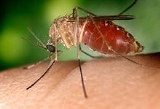
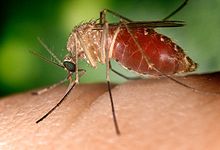
The adult mosquito can measure from 4–10 mm (0.15748031496063–0.393700787401575 ), and morphologically has the three body parts common to insect
Insect
Insects are a class of living creatures within the arthropods that have a chitinous exoskeleton, a three-part body , three pairs of jointed legs, compound eyes, and two antennae...
s: head
Head
In anatomy, the head of an animal is the rostral part that usually comprises the brain, eyes, ears, nose and mouth . Some very simple animals may not have a head, but many bilaterally symmetric forms do....
, thorax
Thorax
The thorax is a division of an animal's body that lies between the head and the abdomen.-In tetrapods:...
, and abdomen
Abdomen
In vertebrates such as mammals the abdomen constitutes the part of the body between the thorax and pelvis. The region enclosed by the abdomen is termed the abdominal cavity...
. As a fly, it has one pair of wings.
Scientists at the University of California, Davis
University of California, Davis
The University of California, Davis is a public teaching and research university established in 1905 and located in Davis, California, USA. Spanning over , the campus is the largest within the University of California system and third largest by enrollment...
and the Swedish University of Agricultural Sciences
Swedish University of Agricultural Sciences
The Swedish University of Agricultural Sciences or Sveriges Lantbruksuniversitet is a university in Sweden. Although its head office is located in Ultuna, Uppsala, the university has several campuses in different parts of Sweden, the other main facilities being Alnarp in Lomma Municipality, Skara,...
(SLU), have identified nonanal
Nonanal
Nonanal, also called nonanaldehyde or pelargonaldehyde, is an alkyl aldehyde. It has a strong fruity or floral odor and is used in flavors and perfume. It is also produced by the human body.- Mosquitoes :...
as a compound that attracts Culex mosquitoes. Nonanal acts synergistically with carbon dioxide
Carbon dioxide
Carbon dioxide is a naturally occurring chemical compound composed of two oxygen atoms covalently bonded to a single carbon atom...
.
Etymology
Carl Linnaeus used the LatinLatin
Latin is an Italic language originally spoken in Latium and Ancient Rome. It, along with most European languages, is a descendant of the ancient Proto-Indo-European language. Although it is considered a dead language, a number of scholars and members of the Christian clergy speak it fluently, and...
term for midge or gnat, culex, as the name of this taxon
Taxon
|thumb|270px|[[African elephants]] form a widely-accepted taxon, the [[genus]] LoxodontaA taxon is a group of organisms, which a taxonomist adjudges to be a unit. Usually a taxon is given a name and a rank, although neither is a requirement...
.
Life cycle
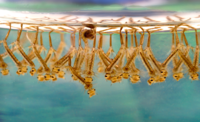
The developmental cycle takes two weeks and is by complete metamorphosisMetamorphosis
Metamorphosis is a biological process by which an animal physically develops after birth or hatching, involving a conspicuous and relatively abrupt change in the animal's body structure through cell growth and differentiation...
. Eggs
Egg (biology)
An egg is an organic vessel in which an embryo first begins to develop. In most birds, reptiles, insects, molluscs, fish, and monotremes, an egg is the zygote, resulting from fertilization of the ovum, which is expelled from the body and permitted to develop outside the body until the developing...
are laid singularly or in batches, depending on the species. Eggs will only hatch in the presence of water. During the larva
Larva
A larva is a distinct juvenile form many animals undergo before metamorphosis into adults. Animals with indirect development such as insects, amphibians, or cnidarians typically have a larval phase of their life cycle...
l stage the mosquito lives in water and feeds on organic matter and plants, then develops into a pupa
Pupa
A pupa is the life stage of some insects undergoing transformation. The pupal stage is found only in holometabolous insects, those that undergo a complete metamorphosis, going through four life stages; embryo, larva, pupa and imago...
. The pupa is comma-shaped and also lives in water. It does not feed and becomes an adult after one or two days.
Diversity
There are a large number of Culex species. In PanamaPanama
Panama , officially the Republic of Panama , is the southernmost country of Central America. Situated on the isthmus connecting North and South America, it is bordered by Costa Rica to the northwest, Colombia to the southeast, the Caribbean Sea to the north and the Pacific Ocean to the south. The...
alone, 88 species were described by 1955.
Subgenera
- Acalleomyia
- Acallyntrum
- Aedinus
- Afroculex
- Allimanta
- Anoedioporpa
- Barraudius
- Belkinomyia
- Carrollia
- Culex
- Culiciomyia
- Eumelanomyia
- Kitzmilleria
- Lasiosiphon
- Lophoceraomyia
- Maillotia
- Melanoconion
- Micraedes
- Microculex
- Neoculex
- Oculeomyia
- Phenacomyia
- Sirivanakarnius
- Tinolestes
External links
- Systematic Catalog of the Culicidae: List of Culex species
- VectorBase homepage for Culex quinquefasciatus (genome browser, downloads and more)
- on the UFUniversity of FloridaThe University of Florida is an American public land-grant, sea-grant, and space-grant research university located on a campus in Gainesville, Florida. The university traces its historical origins to 1853, and has operated continuously on its present Gainesville campus since September 1906...
/ IFASInstitute of Food and Agricultural SciencesThe University of Florida’s Institute of Food and Agricultural Sciences is a federal-state-county partnership dedicated to developing knowledge in agriculture, human and natural resources, and the life sciences, and enhancing and sustaining the quality of human life by making that information...
Featured Creatures Web site - Culex pipiens at MetaPathogen: facts, life cycle
- Mosquito Chapter in the National Public Health Pesticide Applicator Training Manual