

Cuban War of Independence

Encyclopedia
Cuban War of Independence (1895–1898) was the last of three liberation wars that Cuba fought against Spain, the other two being the Ten Years' War
(1868–1878) and the Little War
(1879–1880). The final three months of the conflict escalated to become the Spanish–American War.
and tenant farmers rose considerably. It was the period when US financial capital began flowing into Cuba, mostly into the sugar and tobacco business and mining. By 1895, investments reached 50 million US dollars. Although Cuba remained Spanish territory politically, economically it started to depend on the United States.
At the same time began the rise of labour movements. The first such organisation, created in 1878, was the Cigar Makers Guild, followed by the Central Board of Artisans in 1879 and many more across the island. After his second deportation to Spain in 1878, José Martí
moved to the United States in 1881. There he mobilized the support of the Cuban exile community, especially in Ybor City (Tampa area) and Key West
, Florida. He aimed for a revolution and independence from Spain, but also lobbied against the U.S. annexation of Cuba, which some American and Cuban politicians desired. After deliberations with patriotic clubs across the US, the Antilles and Latin America, "El Partido Revolucionario Cubano" (The Cuban Revolutionary Party) was officially proclaimed on April 10, 1892, with the purpose of gaining independence for both Cuba and Puerto Rico. Martí was elected Delegate, the highest party position. By the end of 1894, the basic conditions for launching the revolution were set.
"Martí’s impatience to start the revolution for independence was affected by his growing fear that the imperialist forces in the United States would succeed in annexing Cuba before the revolution could liberate the island from Spain".
A new trend of aggressive US “influence”, evinced by Secretary of State James G. Blaine
’s expressed ideals that all of Central and South America would some day fall to the U.S. “That rich island”, Blaine wrote on 1 December 1881, “the key to the Gulf of Mexico, is, though in the hands of Spain, a part of the American commercial system… If ever ceasing to be Spanish, Cuba must necessarily become American and not fall under any other European domination". Blaine’s vision did not allow the existence of an independent Cuba. “Martí noticed with alarm the movement to annex Hawaii
, viewing it as establishing a pattern for Cuba…”
The insurrection began on 24 February 1895 with uprisings all across the island. In Oriente, the most important ones took place in Santiago
, Guantánamo
, Jiguaní, San Luis, El Cobre, El Caney, Alto Songo, Bayate and Baire. The uprisings in the central part of the island, such as Ibarra, Jagüey Grande and Aguada suffered from poor co-ordination and failed; the leaders were captured, some of them deported and some executed. In the province of Havana, the insurrection was discovered before it got off and the leaders were detained. Thus, the insurgents further west in Pinar del Río were ordered to wait.
On April 1 and 11, 1895, the main Mambi
leaders landed on two expeditions in Oriente: Major General Antonio Maceo
along with 22 members near Baracoa
, and José Martí
, Máximo Gomez
and 4 other members in Playitas. Around that time, Spanish forces in Cuba numbered about 80,000,of which, 20,000 were regular troops, and 60,000 were Spanish and Cuban volunteers. The latter were a locally enlisted force that took care of most of the “guard and police” duties on the island. Wealthy landowners would “volunteer” a number of their slaves to serve in this force, which was under local control and not under official military command. By December, 98,412 regular troops had been sent to the island, and the number of volunteers increased to 63,000 men. By the end of 1897, there were 240,000 regulars and 60,000 irregulars on the island. The revolutionaries were far outnumbered.
The Mambises
were named after the Negro Spanish officer, Juan Ethninius Mamby who joined the Dominicans in the fight for independence in 1844. The Spanish soldiers referred to the insurgents as “the men of Mamby”, and “Mambies”. When Cuba’s first war of independence broke out in 1868, some of the same soldiers were assigned to the island, importing what had, by then, become a derogatory Spanish slur. The Cubans adopted the name with pride.
After the Ten Year War, possession of weapons by private individuals had been prohibited. Thus, from the very beginning of the war, one of the most serious problems for the rebels was the acquisition of suitable weapons. This lack of arms led to the guerrilla-style war, using the environment, the element of surprise, a fast horse and a machete. Most of their weapons were acquired in raids on the Spaniards. Between June 11, 1895 and November 30, 1897, out of sixty attempts to bring weapons and supplies to the rebels from outside the country, only one succeeded through the protection of the British. Twenty-eight ships were intercepted within US territory; 5 were intercepted by the US Navy, 4 by the Spanish Navy; 2 were wrecked; one was driven back to port by storm; the fate of another is unknown.
Martí was killed only shortly after his landing on May 19, 1895, at Dos Rios, but Máximo Gomez and Antonio Maceo fought on, taking the war to all parts of Oriente. By the end of June, all of Camagüey
was at war. Continuing west, they were met by 1868 war veterans, such as Polish internationalist General Carlos Roloff
and Serafín Sánchez in Las Villas, adding weapons, men and experience to the revolutionaries' arsenal.
In mid-September, representatives of the five Liberation Army Corps assembled in Jimaguayú, Camagüey to approve the “Jimaguayú Constitution”, establishing a central government, which grouped the executive and legislative powers into one entity named “Government Council”, headed by Salvador Cisneros and Bartolomé Masó. After some time of consolidation in the three eastern provinces, the liberation armies headed for Camagüey and then Matanzas, outmanoeuvring and deceiving the Spanish Army several times, defeating Spanish General Arsenio Martínez Campos, himself the victor of the Ten Year War, and killing his most trusted general at Peralejo.
Campos tried the same strategy he had employed in the Ten-Year War, constructing a broad belt across the island, called the “trocha”, about 80 km long and 200m wide. This defence line was to limit rebel activities to the eastern provinces. The belt consisted of a railroad from Jucaro in the south to Morón
in the north. There were fortifications along this railroad at various points, and at intervals, 12 meters of posts and 400 meters of barbed wire. In addition, booby trap
s were placed at locations most likely to be attacked.
For the rebels, it was essential to take the war to the western provinces Matanzas, Havana and Pinar del Rio, where the island's government and wealth were located. The Ten-Year War failed because it had not managed to proceed beyond the eastern provinces.
In a successful cavalry campaign overcoming the trochas, the revolutionaries invaded every province. Surrounding all larger cities and well-fortified towns, they arrived at the westernmost tip of the island on January 22, 1896, exactly 3 months after the invasion near Baraguá.
Campos was replaced by General Valeriano Weyler Nicolau
who reacted to these successes by introducing terror methods: periodic executions, mass exile, destruction of farms and crops. Weyler's methods reached their height on October 21, 1896, when he ordered all countryside residents and their livestock to gather in various fortified areas and towns occupied by his troops within 8 days. Hundreds of thousands of people had to leave their homes, creating appalling and inhumane conditions in the crowded towns and cities. It is estimated that this measure caused the death of at least one third of Cuba’s rural population.
Starting in the early 1880s, Spain had also suppressed an independence movement in the Philippines
, which was intensifying, and Spain was now fighting two wars, which were putting a heavy burden on its economy. But it turned down offers in secret negotiations by the US in 1896, which was closely following the war, to buy Cuba from Spain.
Maceo was killed December 7, 1896, in Havana province while returning from the west. As the war went on, the major obstacle to Cuban success was weapons supply. Although weapons and funding came from within the US, the supply operation violated American laws, which were enforced by the US Coast Guard; of 71 attempted re-supply missions, only 27 got through, 5 were stopped by the Spanish, but 33 were stopped by the US Coast Guard.
In 1897, the liberation army maintained a privileged position in Camagüey and Oriente, where the Spanish only controlled a few cities. Spanish Liberal leader Praxedes Sagasta admitted in May 1897: “After having sent 200,000 men and shed so much blood, we don’t own more land on the island than what our soldiers are stepping on”. The rebel force of 3,000 defeated the Spanish in various encounters, such as the Battle of La Reforma, or the surrender of Las Tunas on August 30, and the Spaniards were kept on the defensive. Las Tunas had been guarded by over 1,000 well-armed and well-supplied men.
As stipulated at the Jimaguayü Assembly two years earlier, a second Constituent Assembly met in La Yaya, Camagüey on October 10, 1897. The newly adopted constitution allowed for military command subordinated to civilian rule. The government was confirmed, naming Bartolomé Masó President and Dr. Domingo Méndez Capote Vice President.
Madrid decided to change its policy towards Cuba, replaced Weyler, drew up a colonial constitution for Cuba and Puerto Rico and installed a new government in Havana. But with half the country out of its control and the other half in arms, it was powerless and rejected by the rebels.
 The Cuban struggle for independence had captured the American imagination for years, and newspapers had been agitating for intervention with sensational stories of Spanish atrocities against the native Cuban population, intentionally sensationalized and exaggerated.
This continued even after Spain replaced Weyler and changed its policies and American public opinion was very much in favour of intervening in favour of the Cubans.
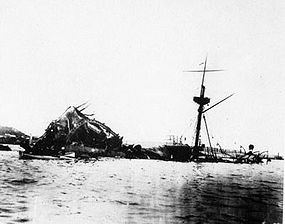
In January 1898, a riot by Cuban Spanish loyalists against the new autonomous government broke out in Havana, leading to the destruction of the printing presses of four local newspapers for publishing articles critical of Spanish Army atrocities. The US Consul-General cabled Washington with fears for the lives of Americans living in Havana. In response, the battleship USS Maine
was sent to Havana
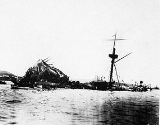
in the last week of January. On February 15, 1898, the Maine was rocked by an explosion, killing 258 of the crew and sinking the ship in the harbour. The cause of the explosion has not been clearly established to this day.
In an attempt to appease the US, the colonial government took two steps that had been demanded by President William McKinley
: it ended forced relocation from homes and offered negotiations with the independence fighters. But the truce was rejected by the rebels.
fuelled American anger by publishing "atrocities" committed by Spain in Cuba. Hearst, when informed by Frederic Remington
, whom he had hired to furnish illustrations for his newspaper, that conditions in Cuba were not bad enough to warrant hostilities, allegedly replied, "You furnish the pictures and I'll furnish the war."
Although McKinley, Speaker of the House Thomas Brackett Reed
and the business community opposed the growing public demand for war, which was lashed to fury by the yellow journalism. The American cry of the hour became, Remember the Maine, To Hell with Spain!
The decisive event was probably the speech of Senator Redfield Proctor
, delivered on March 17, analyzing the situation and concluding that war was the only answer. The business and religious communities switched sides, leaving McKinley and Reed almost alone in their opposition to the war. “Faced with a revved up, war-ready population, and all the editorial encouragement the two competitors could muster, the U.S. jumped at the opportunity to get involved and showcase its new steam-powered Navy”. On April 11, McKinley asked Congress for authority to send American troops to Cuba for the purpose of ending the civil war there. On April 19, Congress passed joint resolution
s (by a vote of 311 to 6 in the House and 42 to 35 in the Senate) supporting Cuban independence and disclaiming any intention to annex Cuba, demanding Spanish withdrawal, and authorizing the president to use as much military force as he thought necessary to help Cuban patriots gain independence from Spain. This was adopted by resolution of Congress and included the Teller Amendment
, named after Colorado Senator Henry Moore Teller, which passed unanimously, stipulating that “the island of Cuba is, and by right should be, free and independent”. The amendment disclaimed any intention on the part of the U.S. to exercise jurisdiction or control over Cuba for other than pacification reasons, and confirmed that the armed forces would be removed once the war is over. The amendment, pushed through at the last minute by anti-imperialists in the Senate, made no mention of the Philippines, Guam, or Puerto Rico. The U.S. congress formally declared war on April 25. The Senate and Congress passed the amendment April 19, McKinley signed the joint resolution on April 20, and the ultimatum was forwarded to Spain. War was declared on April 20/21, 1898.
“It's been suggested that a major reason for the U.S. war against Spain was the fierce competition emerging between Joseph Pulitzer's New York World and William Randolph Hearst's New York Journal.” Joseph E. Wisan wrote in an essay titled "The Cuban Crisis As Reflected In The New York Press”, published in “American Imperialism” in 1898: "In the opinion of the writer, the Spanish–American War would not have occurred had not the appearance of Hearst in New York journalism precipitated a bitter battle for newspaper circulation." It has also been argued that the main reason the U.S. entered the war was the failed secret attempt, in 1896, to purchase Cuba from a weaker, war-depleted Spain.
Hostilities started hours after the declaration of war when a contingent of US Navy ships under Admiral William T. Sampson blockaded several Cuban ports. The Americans decided to invade Cuba and to start in Oriente where the Cubans had almost absolute control and were able to co-operate, e. g. by establishing a beachhead
and protecting the US landing in Daiquiri. The first US objective was to capture the city of Santiago de Cuba in order to destroy Linares' army and Cervera's fleet. To reach Santiago, the Americans had to pass through concentrated Spanish defences in the San Juan Hills and a small town in El Caney
. Between June 22 and 24, the Americans landed under General William R. Shafter at Daiquirí
and Siboney
, east of Santiago, and established a base.
The port of Santiago became the main target of naval operations. The U.S. fleet attacking Santiago needed shelter from the summer hurricane season, thus nearby Guantánamo Bay, with its excellent harbour, was chosen for this purpose and attacked on June 6 (1898 invasion of Guantánamo Bay
). The Battle of Santiago de Cuba
on July 3, 1898, was the largest naval engagement during the Spanish–American War, resulting in the destruction of the Spanish Caribbean Squadron (Flota de Ultramar).
Resistance in Santiago consolidated around Fort Canosa, All the while, major battles between Spaniards and Americans took place at Las Guasimas (Battle of Las Guasimas
) on June 24, El Caney Battle of El Caney
and San Juan Hill Battle of San Juan Hill
on July 1, 1898, outside of Santiago. after which the American advance ground to a halt. Spanish troops successfully defended Fort Canosa, allowing them to stabilize their line and bar the entry to Santiago. The Americans and Cubans forcibly began a bloody, strangling siege of the city which eventually surrendered on July 16, after the defeat of the Spanish Caribbean Squadron. Thus, Oriente was under control of Americans, but US General Nelson A. Miles
would not allow Cuban troops to enter Santiago, claiming that he wanted to prevent clashes between Cubans and Spaniards. Thus, Cuban General Calixto García
, head of the mambi forces in the Eastern department, ordered his troops to hold their respective areas and resigned, writing a letter of protest to General Shafter.
After losing the Philippines and Puerto Rico, which had also been invaded by the US, and with no hope of holding on to Cuba, Spain sued for peace on 17 July 1898. On August 12, the US and Spain signed a protocol of Peace, in which Spain agreed to relinquish all claim of sovereignty and title over Cuba. On December 10, 1898, the US and Spain signed the Treaty of Paris
, recognizing Cuban independence Although the Cubans had participated in the liberation efforts, the US prevented Cuba from participating in the Paris peace talks and signing the treaty. The treaty set no time limit for US occupation and the Isle of Pines was excluded from Cuba.
Although the treaty officially granted Cuba's independence, US General William R. Shafter refused to allow Cuban General Calixto García and his rebel forces to participate in the surrender ceremonies in Santiago de Cuba.
Ten Years' War
The Ten Years' War , also known as the Great War and the War of '68, began on October 10, 1868 when sugar mill owner Carlos Manuel de Céspedes and his followers proclaimed Cuba's independence from Spain...
(1868–1878) and the Little War
Little War (Cuba)
The Little War or Small War , was the second of three conflicts in the Cuban War of Independence. It followed the Ten Years' War of 1868–1878 and preceded the War of '95, itself sometimes called the Cuban War of Independence, which bled into the Spanish-American War, ultimately resulting in...
(1879–1880). The final three months of the conflict escalated to become the Spanish–American War.
Background
The years of the so-called “Rewarding Truce”, lasting for 17 years from the end of the Ten Years War in 1878, there were fundamental social changes in Cuban society. With the abolition of slavery in October 1886, former slaves joined the ranks of farmers and urban working class. Many wealthy Cubans lost their property, and joined the urban middle class. The number of sugar mills dropped and efficiency increased: only companies, and the most powerful plantation owners, remained in business. The number of campesinosPeasant
A peasant is an agricultural worker who generally tend to be poor and homeless-Etymology:The word is derived from 15th century French païsant meaning one from the pays, or countryside, ultimately from the Latin pagus, or outlying administrative district.- Position in society :Peasants typically...
and tenant farmers rose considerably. It was the period when US financial capital began flowing into Cuba, mostly into the sugar and tobacco business and mining. By 1895, investments reached 50 million US dollars. Although Cuba remained Spanish territory politically, economically it started to depend on the United States.
At the same time began the rise of labour movements. The first such organisation, created in 1878, was the Cigar Makers Guild, followed by the Central Board of Artisans in 1879 and many more across the island. After his second deportation to Spain in 1878, José Martí
José Martí
José Julián Martí Pérez was a Cuban national hero and an important figure in Latin American literature. In his short life he was a poet, an essayist, a journalist, a revolutionary philosopher, a translator, a professor, a publisher, and a political theorist. He was also a part of the Cuban...
moved to the United States in 1881. There he mobilized the support of the Cuban exile community, especially in Ybor City (Tampa area) and Key West
Key West
Key West is an island in the Straits of Florida on the North American continent at the southernmost tip of the Florida Keys. Key West is home to the southernmost point in the Continental United States; the island is about from Cuba....
, Florida. He aimed for a revolution and independence from Spain, but also lobbied against the U.S. annexation of Cuba, which some American and Cuban politicians desired. After deliberations with patriotic clubs across the US, the Antilles and Latin America, "El Partido Revolucionario Cubano" (The Cuban Revolutionary Party) was officially proclaimed on April 10, 1892, with the purpose of gaining independence for both Cuba and Puerto Rico. Martí was elected Delegate, the highest party position. By the end of 1894, the basic conditions for launching the revolution were set.
"Martí’s impatience to start the revolution for independence was affected by his growing fear that the imperialist forces in the United States would succeed in annexing Cuba before the revolution could liberate the island from Spain".
A new trend of aggressive US “influence”, evinced by Secretary of State James G. Blaine
James G. Blaine
James Gillespie Blaine was a U.S. Representative, Speaker of the United States House of Representatives, U.S. Senator from Maine, two-time Secretary of State...
’s expressed ideals that all of Central and South America would some day fall to the U.S. “That rich island”, Blaine wrote on 1 December 1881, “the key to the Gulf of Mexico, is, though in the hands of Spain, a part of the American commercial system… If ever ceasing to be Spanish, Cuba must necessarily become American and not fall under any other European domination". Blaine’s vision did not allow the existence of an independent Cuba. “Martí noticed with alarm the movement to annex Hawaii
Hawaii
Hawaii is the newest of the 50 U.S. states , and is the only U.S. state made up entirely of islands. It is the northernmost island group in Polynesia, occupying most of an archipelago in the central Pacific Ocean, southwest of the continental United States, southeast of Japan, and northeast of...
, viewing it as establishing a pattern for Cuba…”
The war
On December 25, 1894 three ships; the Lagonda, the Almadis and the Baracoa, set sail for Cuba from Fernandina Beach, Florida, loaded with soldiers and weapons. Two of the ships were seized by US authorities in early January,but the proceedings went ahead. Not to be dissuaded, on March 25, Martí presented the Proclamation of Montecristi, which outlined the policy for Cuba’s war of independence:- the war was to be waged by blacks and whites alike;
- participation of all blacks was crucial for victory;
- Spaniards who did not object to the war effort should be spared,
- private rural properties should not be damaged; and
- the revolution should bring new economic life to Cuba.
The insurrection began on 24 February 1895 with uprisings all across the island. In Oriente, the most important ones took place in Santiago
Santiago de Cuba
Santiago de Cuba is the second largest city of Cuba and capital city of Santiago de Cuba Province in the south-eastern area of the island, some south-east of the Cuban capital of Havana....
, Guantánamo
Guantánamo
Guantánamo is a municipality and city in southeast Cuba and capital of Guantánamo Province.Guantánamo is served by the Caimanera port and the site of a famous U.S. Naval base. The area produces sugarcane and cotton wool...
, Jiguaní, San Luis, El Cobre, El Caney, Alto Songo, Bayate and Baire. The uprisings in the central part of the island, such as Ibarra, Jagüey Grande and Aguada suffered from poor co-ordination and failed; the leaders were captured, some of them deported and some executed. In the province of Havana, the insurrection was discovered before it got off and the leaders were detained. Thus, the insurgents further west in Pinar del Río were ordered to wait.
On April 1 and 11, 1895, the main Mambi
Mambises
The term Mambises is used to refer to the soldiers who participated in the Cuban War of Independence.-Origin of the word:...
leaders landed on two expeditions in Oriente: Major General Antonio Maceo
Antonio Maceo
Antonio Maceo may refer to:*Antonio Maceo Grajales, commander in the Cuban revolutionary army*Antonio Maceo, a municipality of Santiago de Cuba named for the general*Antonio Maceo Airport, serving Santiago de Cuba...
along with 22 members near Baracoa
Baracoa
Baracoa is a municipality and city in Guantánamo Province near the eastern tip of Cuba. It was founded by the first governor of Cuba, the Spanish conquistador Diego Velázquez de Cuéllar in 1511...
, and José Martí
José Martí
José Julián Martí Pérez was a Cuban national hero and an important figure in Latin American literature. In his short life he was a poet, an essayist, a journalist, a revolutionary philosopher, a translator, a professor, a publisher, and a political theorist. He was also a part of the Cuban...
, Máximo Gomez
Máximo Gómez
Máximo Gómez y Báez was a Major General in the Ten Years' War and Cuba's military commander in that country's War of Independence ....
and 4 other members in Playitas. Around that time, Spanish forces in Cuba numbered about 80,000,of which, 20,000 were regular troops, and 60,000 were Spanish and Cuban volunteers. The latter were a locally enlisted force that took care of most of the “guard and police” duties on the island. Wealthy landowners would “volunteer” a number of their slaves to serve in this force, which was under local control and not under official military command. By December, 98,412 regular troops had been sent to the island, and the number of volunteers increased to 63,000 men. By the end of 1897, there were 240,000 regulars and 60,000 irregulars on the island. The revolutionaries were far outnumbered.
The Mambises
Mambises
The term Mambises is used to refer to the soldiers who participated in the Cuban War of Independence.-Origin of the word:...
were named after the Negro Spanish officer, Juan Ethninius Mamby who joined the Dominicans in the fight for independence in 1844. The Spanish soldiers referred to the insurgents as “the men of Mamby”, and “Mambies”. When Cuba’s first war of independence broke out in 1868, some of the same soldiers were assigned to the island, importing what had, by then, become a derogatory Spanish slur. The Cubans adopted the name with pride.
After the Ten Year War, possession of weapons by private individuals had been prohibited. Thus, from the very beginning of the war, one of the most serious problems for the rebels was the acquisition of suitable weapons. This lack of arms led to the guerrilla-style war, using the environment, the element of surprise, a fast horse and a machete. Most of their weapons were acquired in raids on the Spaniards. Between June 11, 1895 and November 30, 1897, out of sixty attempts to bring weapons and supplies to the rebels from outside the country, only one succeeded through the protection of the British. Twenty-eight ships were intercepted within US territory; 5 were intercepted by the US Navy, 4 by the Spanish Navy; 2 were wrecked; one was driven back to port by storm; the fate of another is unknown.
Martí was killed only shortly after his landing on May 19, 1895, at Dos Rios, but Máximo Gomez and Antonio Maceo fought on, taking the war to all parts of Oriente. By the end of June, all of Camagüey
Camagüey
Camagüey is a city and municipality in central Cuba and is the nation's third largest city. It is the capital of the Camagüey Province.After almost continuous attacks from pirates the original city was moved inland in 1528.The new city was built with a confusing lay-out of winding alleys that made...
was at war. Continuing west, they were met by 1868 war veterans, such as Polish internationalist General Carlos Roloff
Carlos Roloff
Carlos Roloff - was Cuban general and liberation activist, fighting against Spain in Ten Years' War and Spanish–American War....
and Serafín Sánchez in Las Villas, adding weapons, men and experience to the revolutionaries' arsenal.
In mid-September, representatives of the five Liberation Army Corps assembled in Jimaguayú, Camagüey to approve the “Jimaguayú Constitution”, establishing a central government, which grouped the executive and legislative powers into one entity named “Government Council”, headed by Salvador Cisneros and Bartolomé Masó. After some time of consolidation in the three eastern provinces, the liberation armies headed for Camagüey and then Matanzas, outmanoeuvring and deceiving the Spanish Army several times, defeating Spanish General Arsenio Martínez Campos, himself the victor of the Ten Year War, and killing his most trusted general at Peralejo.
Campos tried the same strategy he had employed in the Ten-Year War, constructing a broad belt across the island, called the “trocha”, about 80 km long and 200m wide. This defence line was to limit rebel activities to the eastern provinces. The belt consisted of a railroad from Jucaro in the south to Morón
Morón, Cuba
Morón is one of ten municipalities in province Ciego de Ávila in central Cuba. It is the second in importance and the oldest. Morón is the closest city to the tourist resorts on Cayo Coco and Cayo Guillermo.- Geography :...
in the north. There were fortifications along this railroad at various points, and at intervals, 12 meters of posts and 400 meters of barbed wire. In addition, booby trap
Booby trap
A booby trap is a device designed to harm or surprise a person, unknowingly triggered by the presence or actions of the victim. As the word trap implies, they often have some form of bait designed to lure the victim towards it. However, in other cases the device is placed on busy roads or is...
s were placed at locations most likely to be attacked.
For the rebels, it was essential to take the war to the western provinces Matanzas, Havana and Pinar del Rio, where the island's government and wealth were located. The Ten-Year War failed because it had not managed to proceed beyond the eastern provinces.
In a successful cavalry campaign overcoming the trochas, the revolutionaries invaded every province. Surrounding all larger cities and well-fortified towns, they arrived at the westernmost tip of the island on January 22, 1896, exactly 3 months after the invasion near Baraguá.
Campos was replaced by General Valeriano Weyler Nicolau
Valeriano Weyler
Don Valeriano Weyler y Nicolau, 1st Duke of Rubí and 1st Marquis of Tenerife Don Valeriano Weyler y Nicolau, 1st Duke of Rubí and 1st Marquis of Tenerife Don Valeriano Weyler y Nicolau, 1st Duke of Rubí and 1st Marquis of Tenerife (Seed in Ambos Camarines.-Philippines:In 1888, he was sent out as...
who reacted to these successes by introducing terror methods: periodic executions, mass exile, destruction of farms and crops. Weyler's methods reached their height on October 21, 1896, when he ordered all countryside residents and their livestock to gather in various fortified areas and towns occupied by his troops within 8 days. Hundreds of thousands of people had to leave their homes, creating appalling and inhumane conditions in the crowded towns and cities. It is estimated that this measure caused the death of at least one third of Cuba’s rural population.
Starting in the early 1880s, Spain had also suppressed an independence movement in the Philippines
Philippines
The Philippines , officially known as the Republic of the Philippines , is a country in Southeast Asia in the western Pacific Ocean. To its north across the Luzon Strait lies Taiwan. West across the South China Sea sits Vietnam...
, which was intensifying, and Spain was now fighting two wars, which were putting a heavy burden on its economy. But it turned down offers in secret negotiations by the US in 1896, which was closely following the war, to buy Cuba from Spain.
Maceo was killed December 7, 1896, in Havana province while returning from the west. As the war went on, the major obstacle to Cuban success was weapons supply. Although weapons and funding came from within the US, the supply operation violated American laws, which were enforced by the US Coast Guard; of 71 attempted re-supply missions, only 27 got through, 5 were stopped by the Spanish, but 33 were stopped by the US Coast Guard.
In 1897, the liberation army maintained a privileged position in Camagüey and Oriente, where the Spanish only controlled a few cities. Spanish Liberal leader Praxedes Sagasta admitted in May 1897: “After having sent 200,000 men and shed so much blood, we don’t own more land on the island than what our soldiers are stepping on”. The rebel force of 3,000 defeated the Spanish in various encounters, such as the Battle of La Reforma, or the surrender of Las Tunas on August 30, and the Spaniards were kept on the defensive. Las Tunas had been guarded by over 1,000 well-armed and well-supplied men.
As stipulated at the Jimaguayü Assembly two years earlier, a second Constituent Assembly met in La Yaya, Camagüey on October 10, 1897. The newly adopted constitution allowed for military command subordinated to civilian rule. The government was confirmed, naming Bartolomé Masó President and Dr. Domingo Méndez Capote Vice President.
Madrid decided to change its policy towards Cuba, replaced Weyler, drew up a colonial constitution for Cuba and Puerto Rico and installed a new government in Havana. But with half the country out of its control and the other half in arms, it was powerless and rejected by the rebels.
The Maine incident
This continued even after Spain replaced Weyler and changed its policies and American public opinion was very much in favour of intervening in favour of the Cubans.
In January 1898, a riot by Cuban Spanish loyalists against the new autonomous government broke out in Havana, leading to the destruction of the printing presses of four local newspapers for publishing articles critical of Spanish Army atrocities. The US Consul-General cabled Washington with fears for the lives of Americans living in Havana. In response, the battleship USS Maine
USS Maine (ACR-1)
USS Maine was the United States Navy's second commissioned pre-dreadnought battleship, although she was originally classified as an armored cruiser. She is best known for her catastrophic loss in Havana harbor. Maine had been sent to Havana, Cuba to protect U.S. interests during the Cuban revolt...
was sent to Havana
Havana
Havana is the capital city, province, major port, and leading commercial centre of Cuba. The city proper has a population of 2.1 million inhabitants, and it spans a total of — making it the largest city in the Caribbean region, and the most populous...
in the last week of January. On February 15, 1898, the Maine was rocked by an explosion, killing 258 of the crew and sinking the ship in the harbour. The cause of the explosion has not been clearly established to this day.
In an attempt to appease the US, the colonial government took two steps that had been demanded by President William McKinley
William McKinley
William McKinley, Jr. was the 25th President of the United States . He is best known for winning fiercely fought elections, while supporting the gold standard and high tariffs; he succeeded in forging a Republican coalition that for the most part dominated national politics until the 1930s...
: it ended forced relocation from homes and offered negotiations with the independence fighters. But the truce was rejected by the rebels.
The Spanish–American War
The sinking of the Maine sparked a wave of indignation in the US. Newspaper owners such as William R. Hearst leapt to the conclusion that Spanish officials in Cuba were to blame, and they widely publicized the conspiracy, although Spain could have had no interest in getting the US involved in the conflict. Yellow journalismYellow journalism
Yellow journalism or the yellow press is a type of journalism that presents little or no legitimate well-researched news and instead uses eye-catching headlines to sell more newspapers. Techniques may include exaggerations of news events, scandal-mongering, or sensationalism...
fuelled American anger by publishing "atrocities" committed by Spain in Cuba. Hearst, when informed by Frederic Remington
Frederic Remington
Frederic Sackrider Remington was an American painter, illustrator, sculptor, and writer who specialized in depictions of the Old American West, specifically concentrating on the last quarter of the 19th century American West and images of cowboys, American Indians, and the U. S...
, whom he had hired to furnish illustrations for his newspaper, that conditions in Cuba were not bad enough to warrant hostilities, allegedly replied, "You furnish the pictures and I'll furnish the war."
Although McKinley, Speaker of the House Thomas Brackett Reed
Thomas Brackett Reed
Thomas Brackett Reed, , occasionally ridiculed as Czar Reed, was a U.S. Representative from Maine, and Speaker of the U.S. House of Representatives from 1889–1891 and from 1895–1899...
and the business community opposed the growing public demand for war, which was lashed to fury by the yellow journalism. The American cry of the hour became, Remember the Maine, To Hell with Spain!
The decisive event was probably the speech of Senator Redfield Proctor
Redfield Proctor
Redfield Proctor was a U.S. politician of the Republican Party. He served as the 37th Governor of Vermont from 1878 to 1880, as Secretary of War from 1889 to 1891, and as a United States Senator for Vermont from 1891 to 1908....
, delivered on March 17, analyzing the situation and concluding that war was the only answer. The business and religious communities switched sides, leaving McKinley and Reed almost alone in their opposition to the war. “Faced with a revved up, war-ready population, and all the editorial encouragement the two competitors could muster, the U.S. jumped at the opportunity to get involved and showcase its new steam-powered Navy”. On April 11, McKinley asked Congress for authority to send American troops to Cuba for the purpose of ending the civil war there. On April 19, Congress passed joint resolution
Joint resolution
In the United States Congress, a joint resolution is a legislative measure that requires approval by the Senate and the House and is presented to the President for his/her approval or disapproval, in exactly the same case as a bill....
s (by a vote of 311 to 6 in the House and 42 to 35 in the Senate) supporting Cuban independence and disclaiming any intention to annex Cuba, demanding Spanish withdrawal, and authorizing the president to use as much military force as he thought necessary to help Cuban patriots gain independence from Spain. This was adopted by resolution of Congress and included the Teller Amendment
Teller Amendment
The Teller Amendment was an amendment to a joint resolution of the United States Congress, enacted on April 20, 1898, in reply to President William McKinley's War Message. It placed a condition of the United States military in Cuba. According to the clause, the U.S...
, named after Colorado Senator Henry Moore Teller, which passed unanimously, stipulating that “the island of Cuba is, and by right should be, free and independent”. The amendment disclaimed any intention on the part of the U.S. to exercise jurisdiction or control over Cuba for other than pacification reasons, and confirmed that the armed forces would be removed once the war is over. The amendment, pushed through at the last minute by anti-imperialists in the Senate, made no mention of the Philippines, Guam, or Puerto Rico. The U.S. congress formally declared war on April 25. The Senate and Congress passed the amendment April 19, McKinley signed the joint resolution on April 20, and the ultimatum was forwarded to Spain. War was declared on April 20/21, 1898.
“It's been suggested that a major reason for the U.S. war against Spain was the fierce competition emerging between Joseph Pulitzer's New York World and William Randolph Hearst's New York Journal.” Joseph E. Wisan wrote in an essay titled "The Cuban Crisis As Reflected In The New York Press”, published in “American Imperialism” in 1898: "In the opinion of the writer, the Spanish–American War would not have occurred had not the appearance of Hearst in New York journalism precipitated a bitter battle for newspaper circulation." It has also been argued that the main reason the U.S. entered the war was the failed secret attempt, in 1896, to purchase Cuba from a weaker, war-depleted Spain.
Hostilities started hours after the declaration of war when a contingent of US Navy ships under Admiral William T. Sampson blockaded several Cuban ports. The Americans decided to invade Cuba and to start in Oriente where the Cubans had almost absolute control and were able to co-operate, e. g. by establishing a beachhead
Beachhead
Beachhead is a military term used to describe the line created when a unit reaches a beach, and begins to defend that area of beach, while other reinforcements help out, until a unit large enough to begin advancing has arrived. It is sometimes used interchangeably with Bridgehead and Lodgement...
and protecting the US landing in Daiquiri. The first US objective was to capture the city of Santiago de Cuba in order to destroy Linares' army and Cervera's fleet. To reach Santiago, the Americans had to pass through concentrated Spanish defences in the San Juan Hills and a small town in El Caney
El Caney
El Caney is a small village 4 miles to the northeast of Santiago, Cuba. "Caney" means longhouse in Taíno.It was known in centuries past as the site where Hernán Cortés received a vision supposedly ordering him to Christianize Mexico. The settlement was host to the Battle of El Caney on July 1,...
. Between June 22 and 24, the Americans landed under General William R. Shafter at Daiquirí
Daiquirí
Daiquirí is a small village, 14 miles east of Santiago de Cuba. It became a focal point of the United States invasion of Cuba in the Spanish-American War....
and Siboney
Siboney, Cuba
Siboney is a town in Cuba east of the city of Santiago de Cuba. In 1898 Siboney and the nearby village of Daiquirí were locations where American forces came ashore in the Spanish-American War...
, east of Santiago, and established a base.
The port of Santiago became the main target of naval operations. The U.S. fleet attacking Santiago needed shelter from the summer hurricane season, thus nearby Guantánamo Bay, with its excellent harbour, was chosen for this purpose and attacked on June 6 (1898 invasion of Guantánamo Bay
1898 invasion of Guantánamo Bay
The Battle of Guantánamo Bay was fought from June 6 to June 10 in 1898, during the Spanish-American War, when American and Cuban forces seized the strategically and commercially important harbor of Guantánamo Bay, Cuba. Capturing the bay from the Spanish forces was instrumental in the following...
). The Battle of Santiago de Cuba
Battle of Santiago de Cuba
The Battle of Santiago de Cuba, fought between Spain and the United States on 3 July 1898, was the largest naval engagement of the Spanish-American War and resulted in the destruction of the Spanish Navy's Caribbean Squadron.-Spanish Fleet:...
on July 3, 1898, was the largest naval engagement during the Spanish–American War, resulting in the destruction of the Spanish Caribbean Squadron (Flota de Ultramar).
Resistance in Santiago consolidated around Fort Canosa, All the while, major battles between Spaniards and Americans took place at Las Guasimas (Battle of Las Guasimas
Battle of Las Guasimas
The Battle of Las Guasimas of June 24, 1898, part of the Spanish-American War, unfolded from Major General "Fighting Joe" Wheeler's attempt to storm a Spanish position in the jungles surrounding Santiago. Commanding a division that included the 1st U.S...
) on June 24, El Caney Battle of El Caney
Battle of El Caney
The Battle of El Caney was fought on July 1, 1898, during the Spanish-American War.-Background:At El Caney, Cuba, 514 Spanish regular soldiers, together with approximately 100 armed Spanish loyalists under the command of General Joaquín Vara de Rey were instructed to hold the northwest flank of...
and San Juan Hill Battle of San Juan Hill
Battle of San Juan Hill
The Battle of San Juan Hill , also known as the battle for the San Juan Heights, was a decisive battle of the Spanish-American War. The San Juan heights was a north-south running elevation about two kilometers east of Santiago de Cuba. The names San Juan Hill and Kettle Hill were names given by the...
on July 1, 1898, outside of Santiago. after which the American advance ground to a halt. Spanish troops successfully defended Fort Canosa, allowing them to stabilize their line and bar the entry to Santiago. The Americans and Cubans forcibly began a bloody, strangling siege of the city which eventually surrendered on July 16, after the defeat of the Spanish Caribbean Squadron. Thus, Oriente was under control of Americans, but US General Nelson A. Miles
Nelson A. Miles
Nelson Appleton Miles was a United States soldier who served in the American Civil War, Indian Wars, and the Spanish-American War.-Early life:Miles was born in Westminster, Massachusetts, on his family's farm...
would not allow Cuban troops to enter Santiago, claiming that he wanted to prevent clashes between Cubans and Spaniards. Thus, Cuban General Calixto García
Calixto García
Calixto García e Iñiguez was a general in three Cuban uprisings, part of the Cuban War for Independence: Ten Years' War, the Little War and the War of 1895, itself sometimes called the Cuban War for Independence, which bled into the Spanish-American War, ultimately resulting in national...
, head of the mambi forces in the Eastern department, ordered his troops to hold their respective areas and resigned, writing a letter of protest to General Shafter.
After losing the Philippines and Puerto Rico, which had also been invaded by the US, and with no hope of holding on to Cuba, Spain sued for peace on 17 July 1898. On August 12, the US and Spain signed a protocol of Peace, in which Spain agreed to relinquish all claim of sovereignty and title over Cuba. On December 10, 1898, the US and Spain signed the Treaty of Paris
Treaty of Paris (1898)
The Treaty of Paris of 1898 was signed on December 10, 1898, at the end of the Spanish-American War, and came into effect on April 11, 1899, when the ratifications were exchanged....
, recognizing Cuban independence Although the Cubans had participated in the liberation efforts, the US prevented Cuba from participating in the Paris peace talks and signing the treaty. The treaty set no time limit for US occupation and the Isle of Pines was excluded from Cuba.
Although the treaty officially granted Cuba's independence, US General William R. Shafter refused to allow Cuban General Calixto García and his rebel forces to participate in the surrender ceremonies in Santiago de Cuba.
See also
- Ten Years' WarTen Years' WarThe Ten Years' War , also known as the Great War and the War of '68, began on October 10, 1868 when sugar mill owner Carlos Manuel de Céspedes and his followers proclaimed Cuba's independence from Spain...
- Little War (Cuba)Little War (Cuba)The Little War or Small War , was the second of three conflicts in the Cuban War of Independence. It followed the Ten Years' War of 1868–1878 and preceded the War of '95, itself sometimes called the Cuban War of Independence, which bled into the Spanish-American War, ultimately resulting in...
- José Semidei RodríguezJosé Semidei RodríguezBrigadier General José Semidei Rodríguez . Before becoming a Brigadier General in the Cuban National Army,...
- Francisco Gonzalo MarínFrancisco Gonzalo MarinLieutenant Francisco Gonzalo Marín, also known as Pachín Marín , considered by many as the designer of the Puerto Rican Flag was a poet and journalist who fought alongside José Martí as a member of the Cuban Liberation Army....
- Juan Ríus RiveraJuan Rius RiveraGeneral Juan Ríus Rivera , was the General of the Cuban Liberation Army of the West upon the death of General Antonio Maceo.-Early years:...