


Cuba-United States relations

Encyclopedia
Cuba and the United States of America have had an interest in one another since well before either of their independence movements. Plans for purchase of Cuba
from the Spanish Empire
were put forward at various times by United States
. As the Spanish influence waned in the Caribbean
, the United States gradually gained a position of economic and political dominance over the island, with the vast majority of foreign investment holdings and the bulk of imports and exports in its hands, and a strong influence on Cuban political affairs.
Following the Cuban Revolution
of 1959 relations deteriorated substantially, and have since been marked by tension and confrontation. The United States does not have formal diplomatic relations
with Cuba and has maintained an embargo
which makes it illegal for U.S. corporations to do business with Cuba. U.S. diplomatic representation in Cuba is handled by the United States Interests Section in Havana
and there is a similar Cuban Interests Section
in Washington D.C; both are officially part of the respective embassies of Switzerland. The United States imposed the embargo because of the nationalization
of US corporations' property during the Revolution, and has stated it will continue it so long as the Cuban government continues to refuse to move toward democratization and greater respect for human rights
, hoping to see democratization and a reintroduction of capitalism
of the type that took place in Eastern Europe after the revolutions of 1989
.
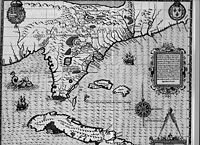 Relations between the Spanish colony
of Cuba and polities
on the North American mainland in the early 18th century through illicit commercial contracts by the European colonies of the New World
, trading to elude colonial taxes. As both legal and illegal trade increased, Cuba became a comparatively prosperous trading partner in the region, and a center of tobacco and sugar production. During this period Cuban merchants increasingly traveled to North American ports, establishing trade contracts that endured for many years.
The British occupation of Havana in 1762 opened up trade with the British colonies in North America, and the rebellion of the thirteen colonies
in 1776 provided additional trade opportunities. Spain opened Cuban ports to North American commerce officially in November 1776 and the island became increasingly dependent on that trade.
After the opening of the island to world trade in 1818, Cuban-United States trade agreements began to replace Spanish commercial connections. In 1820 Thomas Jefferson
thought Cuba "the most interesting addition which could ever be made to our system of States" and told Secretary of War John C. Calhoun
that the United States "ought, at the first possible opportunity, to take Cuba."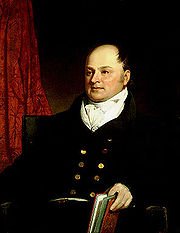 In a letter to U.S. Minister to Spain Hugh Nelson, Secretary of State John Quincy Adams
described the likelihood of U.S. "annexation of Cuba" within half a century despite obstacles: "But there are laws of political as well as of physical gravitation; and if an apple severed by the tempest from its native tree cannot choose but fall to the ground, Cuba, forcibly disjoined from its own unnatural connection with Spain, and incapable of self support, can gravitate only towards the North American Union, which by the same law of nature cannot cast her off from its bosom." In 1854 a secret proposal known as the Ostend Manifesto
was devised by U.S. diplomats to acquire Cuba from Spain for $130 million. The manifesto was rejected due to objections from anti-slavery
campaigners when the plans became public.
By 1877, the United States accounted for 83 percent of Cuba's total exports, and as a monopsonist
, was able to control price and hence production levels closely. It was during this period that English traveller Anthony Trollope
observed that "The trade of the country is falling into the hands of foreigners, Havana will soon be as American as New Orleans". North Americans were also increasingly taking up residence on the island, and some districts on the northern shore were said to have more the character of America than Spanish settlements. Between 1878 and 1898 American investors took advantage of deteriorating economic conditions of the Ten Years' War
to take over estates they had tried unsuccessfully to buy before while others acquired properties at very low prices. Above all this presence facilitated the integration of the Cuban economy into the North American system and weakened Cuba's ties with Spain.
. Grant declined and the resistance was curtailed, though American interests in the region continued. US Secretary of State James G. Blaine
wrote in 1881 of Cuba, "that rich island, the key to the Gulf of Mexico, and the field for our most extended trade in the Western Hemisphere, is, though in the hands of Spain, a part of the American commercial system… If ever ceasing to be Spanish, Cuba must necessarily become American and not fall under any other European domination."
After some rebel successes in Cuba's second war of independence in 1897, U.S. President William McKinley
offered to buy Cuba for $300 million. Rejection of the offer, and an explosion that sunk the American battleship USS Maine
in Havana harbor, led to the Spanish–American War. In Cuba the war became known as "the U.S. intervention in Cuba's War of Independence". On 10 December 1898 Spain and the United States signed the Treaty of Paris
and, in accordance with the treaty, Spain renounced all rights to Cuba. The treaty put an end to the Spanish Empire in the Americas and marked the beginning of United States expansion and long-term political dominance in the region. Immediately after the signing of the treaty, the US-owned "Island of Cuba Real Estate Company" opened for business to sell Cuban land to Americans. U.S. military rule of the island lasted until 1902 when Cuba was finally granted formal independence.
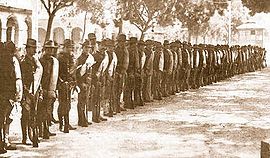 An agreed condition between Cuba and the United States to secure the withdrawal of United States troops
from the island was Cuba's adoption of the Platt Amendment
. The amendment was a rider
appended to the Army Appropriations Act, a United States federal law passed in March 1901 which was presented to the U.S. Senate
by Connecticut
Republican
Senator Orville H. Platt
. The Platt amendment stipulated that the United States could exercise the right to intervene in Cuban political, economic and military affairs if necessary, and replaced the less specific Teller Amendment
. It was to define the terms of Cuban-U.S. relations for the following 33 years and was bitterly resented by the majority of Cubans. Another consequence of the amendment gave the United States continued use of the southern portion of Guantánamo Bay, where a United States Naval Station
had been established in 1898. The lease of the bay was confirmed by the Cuban-American Treaty
which was signed by the presidents of both nations in February 1903.
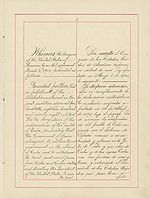 Despite recognizing Cuba's transition into an independent republic, United States Governor Charles Edward Magoon
assumed temporary military rule for three more years following a rebellion led by José Miguel Gómez
. In 1912 U.S. forces returned again to Cuba to quell protests by Afro-Cuban
s against perceived discrimination. By 1926 U.S companies owned 60% of the Cuban sugar industry and imported 95% of the total Cuban crop, and Washington was generally supportive of successive Cuban Governments. However, internal confrontations between the government of Gerardo Machado
and political opposition led to a military overthrow by Cuban rebels in 1933. U.S. Ambassador Sumner Welles
requested U.S. military intervention. President Franklin D. Roosevelt
, despite his promotion of the Good Neighbor policy
toward Latin America, ordered 29 warship
s to Cuba and Key West
, alerting United States Marines
, and bombers for use if necessary. Machado's replacement, Ramón Grau
assumed the Presidency and immediately nullified the Platt amendment. In protest, the United States denied recognition to Grau's government, Ambassador Welles describing the new regime as "communistic" and "irresponsible".
The rise of General Fulgencio Batista
in the 1930s to de facto leader and President of Cuba for two terms (1940–44 and 1952–59) led to an era of close co-operation between the governments of Cuba and the United States. The United States and Cuba signed the Treaty of Relations
in 1934. Batista's second spell as President was initiated by a military coup
planned in Florida
, and U.S. President Harry S. Truman
quickly recognized Batista's return to rule providing military and economic aid. The Batista era witnessed the almost complete domination of Cuba's economy by the United States, as the number of American corporations continued to swell, though corruption was rife and Havana also became a popular sanctuary for American organized crime
figures, notably hosting the infamous Havana Conference
in 1946. U.S. Ambassador to Cuba Arthur Gardner
later described the relationship between the U.S. and Batista during his second spell as President:
As armed conflict broke out in Cuba between rebels led by Fidel Castro
and the Batista government, the U.S. was urged to end arms sales to Batista by Cuban president-in-waiting Manuel Urrutia Lleó
. Washington made the critical move in March 1958 to prevent sales of rifles to Batista's forces, thus changing the course of the revolution irreversibly towards the rebels. The move was vehemently opposed by U.S. ambassador Earl T. Smith
, and led U.S. state department advisor William Wieland to lament that "I know Batista is considered by many as a son of a bitch... but American interests come first... at least he was our son of a bitch."
officially recognized the new Cuban government after the 1959 Cuban Revolution
which had overthrown the Batista government, but relations between the two governments deteriorated rapidly. Within days Earl T. Smith
, U.S. Ambassador to Cuba, resigned his post to be replaced by Philip Bonsal
. The US government became increasingly concerned by Cuba's agrarian reforms
and the nationalization
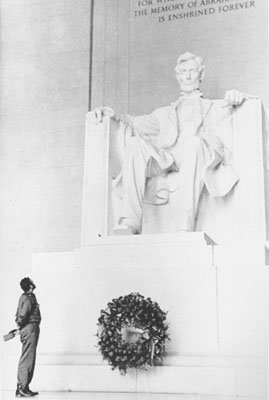
of US owned industries. Between April 15 and 26th, 1959, Castro and a delegation of representatives visited the U.S. as guests of the Press Club. This visit was perceived by many as a charm offensive on the part of Castro and his recently initiated government, and his visit included laying a wreath at the Lincoln memorial. After a meeting between Fidel Castro and Vice-President Richard Nixon
, where Castro outlined his reform plans for Cuba, the US began to impose gradual trade restrictions on the island. On September 4, 1959, Ambassador Bonsal met with Cuban Premier Fidel Castro
to express “serious concern at the treatment being given to American private interests in Cuba both agriculture and utilities.”
 As state intervention and take-over of privately owned businesses continued, trade restrictions on Cuba increased. The U.S. stopped buying Cuban sugar and refused to supply its former trading partner with much needed oil, with a devastating effect on the island's economy. In March 1960, tensions increased when the freighter La Coubre
exploded in Havana harbor, killing over 75 people. Fidel Castro blamed the United States and compared the incident to the sinking of the Maine
, though admitting he could provide no evidence for his accusation. That same month, President Eisenhower quietly authorized the Central Intelligence Agency
(CIA) to organize, train, and equip Cuban refugees as a guerrilla force to overthrow Castro.
Each time the Cuban government nationalized American properties, the American government took countermeasures, resulting in the prohibition of all exports to Cuba on October 19, 1960. Consequently, Cuba began to consolidate trade relations with the Soviet Union, leading the US to break off all remaining official diplomatic relations. Later that year, U.S. diplomats Edwin L. Sweet and William G. Friedman were arrested and expelled from the island having been charged with "encouraging terrorist acts, granting asylum, financing subversive publications and smuggling weapons”. On January 3, 1961 the US withdrew diplomatic recognition of the Cuban government and closed the embassy in Havana.
Presidential candidate John F. Kennedy believed that Eisenhower's policy toward Cuba had been mistaken. He criticized what he saw as use of the U.S. government influence to advance the interest and increase the profits of private U.S. companies instead of helping Cuba to achieve economic progress, saying that Americans dominated the island's economy and had given support to one of the bloodiest and most repressive dictatorships in the history of Latin America. "We let Batista put the U.S. on the side of tyranny, and we did nothing to convince the people of Cuba and Latin America that we wanted to be on the side of freedom".
In 1961 Cuba resisted an armed invasion by about 1,500 CIA trained Cuban exile
s at the Bay of Pigs
. President John F. Kennedy
's complete assumption of responsibility for the venture, which provoked a popular reaction against the invaders, proved to be a further propaganda boost for the Cuban government. The U.S. began the formulation of new plans aimed at destabilizing the Cuban government. These activities were collectively known as the “Cuban Project
” (also known as Operation Mongoose). This was to be a coordinated program of political, psychological, and military sabotage, involving intelligence operations as well as assassination attempts on key political leaders. The Cuban project also proposed attacks on mainland US targets, hijackings and assaults on Cuban refugee boats to generate U.S. public support for military action against the Cuban government, these proposals were known collectively as Operation Northwoods
.
A U.S. Senate Select Intelligence Committee
report later confirmed over eight attempted plots to kill Castro between 1960 and 1965, as well as additional plans against other Cuban leaders. After weathering the failed Bay of Pigs invasion, Cuba observed as U.S. armed forces staged a mock invasion of a Caribbean island in 1962 named Operation Ortsac
. The purpose of the invasion was to overthrow a leader whose name, Ortsac, was Castro spelled backwards. Tensions between the two nations reached their peak in 1962, after U.S. reconnaissance aircraft photographed the Soviet construction of intermediate-range missile sites. The discovery led to the Cuban Missile Crisis
.
Trade relations also deteriorated in equal measure. In 1962, President John F. Kennedy
broadened the partial trade restrictions imposed after the revolution by Eisenhower to a ban on all trade with Cuba, except for non-subsidized sale of foods and medicines. A year later travel and financial transactions by U.S. citizens with Cuba was prohibited. The United States embargo against Cuba
was to continue in varying forms and is still in operation today.
Relations began to thaw during President Lyndon B. Johnson
’s tenure continuing through the next decade and a half. In 1964 Fidel Castro sent a message to Johnson encouraging dialogue, he wrote:
Through the late 1960s and early 1970s a sustained period of aircraft hijackings between Cuba and the US by citizens of both nations led to a need for cooperation. By 1974, U.S. elected officials had begun to visit the island. Three years later, during the Carter
administration, the U.S. and Cuba simultaneously opened interests sections in each other’s capitals. In 1980, after 10,000 Cubans crammed into the Peruvian embassy seeking political asylum, Castro stated that any who wished to do so could leave Cuba, in what became known as the Mariel boatlift
. Approximately 125,000 people left Cuba for the United States. Among these political and economic refugees, Castro, without advising the U.S. government, included mental patients and criminals released from Cuban prisons.
In 1977, Cuba and the United States signed a maritime boundary treaty in which the countries agreed on the location of their border
in the Straits of Florida
. The treaty was never sent to the United States Senate
for ratification
, but the agreement has been implemented by the U.S. State Department
.
In 1981 President Ronald Reagan
’s new administration announced a tightening of the embargo. The U.S. also re-established the travel ban, prohibiting U.S. citizens from spending money in Cuba. The ban was later supplemented to include Cuban government officials or their representatives visiting the U.S. In 1985 Radio y Televisión Martí, backed by Ronald Reagan’s administration, began to broadcast news and information from the U.S. to Cuba.
On February 24, 1996, two unarmed Cessna 337s flown by the group "Brothers to the Rescue" were shot down by Cuban Air Force MiG-29, killing four Americans. The Cuban government claimed that the planes had entered into Cuban airspace.
In 2001, five Cuban agents were convicted on 26 counts of espionage, conspiracy to commit murder, and other illegal activities in the United States. On June 15, 2009, the U.S. Supreme Court denied review of their case.
Some veterans of CIA's 1961 Bay of Pigs invasion, while no longer being sponsored by the CIA, are still active, though they are now in their seventies or older. Members of Alpha 66
, an anti-Castro paramilitary organization, continue to practice their AK-47
skills in a camp in South Florida.
was reinforced in October 1992 by the Cuban Democracy Act
(the "Torricelli Law") and in 1996 by the Cuban Liberty and Democracy Solidarity Act (known as the Helms-Burton Act
). The 1992 act prohibited foreign-based subsidiaries of U.S. companies from trading with Cuba, travel to Cuba by U.S. citizens, and family remittances to Cuba. Sanctions
may also be applied to non-U.S. companies trading with Cuba. As a result, multinational companies have to choose between Cuba and the U.S., the latter being a much larger market. One important exception is the German-owned delivery company DHL Express
. This restriction also applies to maritime shipping, as ships docking at Cuban ports are not allowed to dock at U.S. ports for six months. On October 10, 2006, the United States announced the creation of a task force made up of officials from several US agencies that will pursue more aggressively American violators of the US trade embargo against Cuba, with penalties as severe as 10 years of prison and hundreds of thousands of dollars in fines for violators of the embargo.
Millennium Summit in September 2000, Fidel Castro and U.S. President Bill Clinton
spoke briefly at a group photo session and shook hands. U.N. Secretary-General Kofi Annan
commented afterwards, “For a U.S. president and a Cuban president to shake hands for the first time in over 40 years—I think it is a major symbolic achievement". While Castro said it was a gesture of “dignity and courtesy,” the White House
denied the encounter was of any significance. In November 2001, US companies began selling food to the country for the first time since Washington imposed the trade embargo after the revolution. In 2002, former U.S. President
Jimmy Carter
became the first former or sitting U.S. president to visit Cuba since 1928.
 Relations deteriorated again following the election of George W. Bush. During his campaign Bush appealed for the support of Cuban-Americans by emphasizing his opposition to the government of Fidel Castro and supporting tighter embargo restrictions Cuban American
s, who generally vote Republican, expected effective policies and greater participation in the formation of policies regarding Cuba-US relations. Approximately three months after his inauguration, the Bush administration began expanding travel restrictions. The United States Department of the Treasury
issued greater efforts to deter American citizens from illegally traveling to the island. In a 2004 meeting with members of the Commission for Assistance to a Free Cuba
, President Bush stated, “We're not waiting for the day of Cuban freedom; we are working for the day of freedom in Cuba.”. The President reaffirmed his commitment to Cuban-Americans just in time for his 2004 reelection with promises to “work” rather than wait for freedom in Cuba. Following his 2005 re-election George W. Bush declared Cuba to be one of the few "outposts of tyranny
" remaining in the world. Tensions heightened as the Under Secretary of State for Arms Control and International Security Affairs
, John R. Bolton
, accused Cuba of maintaining a biological weapons program. Many in the US, including ex-president Carter, expressed doubts about the claim. Later, Bolton was criticized for pressuring subordinates who questioned the quality of the intelligence John Bolton had used as the basis for the assertion. Bolton identified the Castro government as part of America's "axis of evil," highlighting the fact that the Cuban leader visited several US foes, including Libya
, Iran
and Syria
. Cuba was also identified as a State Sponsor of Terrorism by the United States Department of State. The Cuban government denies the claim, and in turn has accused the U.S. of engaging in state sponsored terrorism against Cuba.
In January 2006, United States Interests Section in Havana
began displaying messages on a scrolling "electronic billboard" in the windows of their top floor. Following a protest march organized by the Cuban government, the government erected a large number of poles, carrying black flags with single white stars, obscuring the messages.
On September 8, 2006, it was revealed that at least ten South Florida journalists received regular payments from the U.S. government for programs on Radio Martí and TV Martí
, two broadcasters that support an opening of Cuban society and multi-party elections in Cuba. The payments totaled thousands of dollars over several years. Those who were paid the most were veteran reporters and a freelance contributor for El Nuevo Herald
, the Spanish-language newspaper published by the corporate parent of The Miami Herald
. The Cuban government has long contended that some South Florida Spanish-language journalists were on the federal payroll.
On September 12, 2006, the United States announced that it had created five inter-agency working groups to monitor Cuba. The groups were set up after the July 31 announcement that the ailing Cuban leader had temporarily ceded power to a collective leadership headed by his brother Raúl. U.S. officials say three of the newly created groups are headed by the State Department: diplomatic actions; strategic communications and democratic promotion. Another that coordinated humanitarian aid to Cuba is run by the Commerce Department, and a fifth, on migration issues, is run jointly by the National Security Council and the Department of Homeland Security.
Recently, U.S. Congressional auditors have accused the development agency USAID
of failing properly to administer its program to for promoting democracy in Cuba. They said USAID had channeled tens of millions of dollars through exile groups in Miami, which were sometimes wasteful or kept questionable accounts. The report said the organizations had sent items such as chocolate and cashmere jerseys to Cuba. Their report concludes that 30% of the exile groups who received USAID grants showed questionable expenditures.
In April 2009 U.S. President Barack Obama
began implementing a less strict policy towards Cuba. The U.S. president had stated that he is open to dialogue with Cuba, but that he would only lift the trade embargo if Cuba has political change. In March 2009, Obama signed into law a Congressional spending bill which eased some economic sanctions on Cuba and eased travel restrictions on Cuban Americans (defined as persons with a relative "who is no more than three generations removed from that person") traveling to Cuba. The April executive-branch changes further removed time limits on Cuban American travel to the island. Another restriction loosened in April is in the realm of telecommunication
s, which would allow quicker and easier access to the internet for Cuba. At the 2009 5th Summit of the Americas
, President Obama signaled the opening of a new beginning with Cuba.
's announcement that he is resigning as Cuba
's leader, Deputy Secretary of State John Negroponte
said February 19, 2008.
The Obama
administration eased specific travel and other restrictions on Cuba in January 2011.
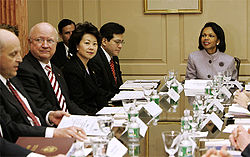 In 2003, the United States Commission for Assistance to a Free Cuba
was formed to "explore ways the U.S. can help hasten and ease a democratic transition in Cuba." The commission immediately announced a series of measures which included a tightening of the travel embargo to the island, a crackdown on illegal cash transfers, and a more robust information campaign aimed at Cuba. Castro has insisted that, in spite of the formation of the Commission, Cuba is itself "in transition: to socialism
[and] to communism
" and that it is "ridiculous for the U.S. to threaten Cuba now".
In April 2006, the Bush administration
appointed Caleb McCarry
"transition coordinator" for Cuba, providing a budget of $59 million, with the task of promoting the governmental shift to democracy after Castro's death. Official Cuban news service Granma
alleges that these transition plans were created at the behest of Cuban exile
groups in Miami, and that McCarry was responsible for engineering the overthrow of the Aristide
government in Haiti
.
In 2006, The Commission for Assistance to a Free Cuba
released a 93-page report. The report included a plan that suggested the United States spends $80 million to ensure that Cuba's communist system does not continue after the death of Fidel Castro
. The plan also includes a classified annex which Cuban officials claim could be a plot to assassinate Fidel Castro or a United States military invasion of Cuba, though they have provided no evidence to support this claim.
, brother of Fidel, U.S. government figures have made a series of statements reiterating the desire for political change in Cuba. Raúl Castro responded to these statements saying: "They should be very clear that it is not possible to achieve anything in Cuba with impositions and threats. On the contrary, we have always been disposed to normalize relations on an equal plane. What we do not accept is the arrogant and interventionist policy frequently assumed by the current administration of that country."
On February 19, 2008 Fidel Castro announced that he would not stand for re-election as President at the next meeting of the National Assembly of People's Power. Raúl Castro was elected President by the National Assembly on February 24, 2008.
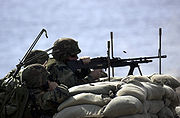 The US continues to operate a naval base at Guantánamo Bay. It is leased to the US and only mutual agreement or US abandonment of the area can terminate the lease. The US pays Cuba annually for its lease, but Cuba has only accepted the first payment, and rejects all successive payments. The Cuban government strongly denounces the treaty on grounds that it violates article 52, titled "Coercion of a State by the threat or use of force", of the 1969 Vienna Convention on the Law of Treaties
. However, Article 4, titled "Non-retroactivity of the present Convention" of the same document states that Vienna Convention on the Law of Treaties shall not be retroactively applied to any treaties made before itself.
The acquisition of Guantánamo Bay was part of the Platt Amendment
, conditions for the withdrawal of United States troops remaining in Cuba since the Spanish–American War.
Cuba
The Republic of Cuba is an island nation in the Caribbean. The nation of Cuba consists of the main island of Cuba, the Isla de la Juventud, and several archipelagos. Havana is the largest city in Cuba and the country's capital. Santiago de Cuba is the second largest city...
from the Spanish Empire
Spanish Empire
The Spanish Empire comprised territories and colonies administered directly by Spain in Europe, in America, Africa, Asia and Oceania. It originated during the Age of Exploration and was therefore one of the first global empires. At the time of Habsburgs, Spain reached the peak of its world power....
were put forward at various times by United States
United States
The United States of America is a federal constitutional republic comprising fifty states and a federal district...
. As the Spanish influence waned in the Caribbean
Caribbean
The Caribbean is a crescent-shaped group of islands more than 2,000 miles long separating the Gulf of Mexico and the Caribbean Sea, to the west and south, from the Atlantic Ocean, to the east and north...
, the United States gradually gained a position of economic and political dominance over the island, with the vast majority of foreign investment holdings and the bulk of imports and exports in its hands, and a strong influence on Cuban political affairs.
Following the Cuban Revolution
Cuban Revolution
The Cuban Revolution was an armed revolt by Fidel Castro's 26th of July Movement against the regime of Cuban dictator Fulgencio Batista between 1953 and 1959. Batista was finally ousted on 1 January 1959, and was replaced by a revolutionary government led by Castro...
of 1959 relations deteriorated substantially, and have since been marked by tension and confrontation. The United States does not have formal diplomatic relations
Diplomacy
Diplomacy is the art and practice of conducting negotiations between representatives of groups or states...
with Cuba and has maintained an embargo
United States embargo against Cuba
The United States embargo against Cuba is a commercial, economic, and financial embargo partially imposed on Cuba in October 1960...
which makes it illegal for U.S. corporations to do business with Cuba. U.S. diplomatic representation in Cuba is handled by the United States Interests Section in Havana
United States Interests Section in Havana
The U.S. Naval Base at Guantanamo Bay is inaccessible from within Cuba. Consular issues regarding the naval base are handled by the U.S. Embassy in Kingston, Jamaica.-Location:...
and there is a similar Cuban Interests Section
Cuban Interests Section
The Cuban Interests Section in Washington, DC is the diplomatic mission of the Republic of Cuba to the United States.It is located at 2639 16th Street Northwest, Washington, D.C...
in Washington D.C; both are officially part of the respective embassies of Switzerland. The United States imposed the embargo because of the nationalization
Nationalization
Nationalisation, also spelled nationalization, is the process of taking an industry or assets into government ownership by a national government or state. Nationalization usually refers to private assets, but may also mean assets owned by lower levels of government, such as municipalities, being...
of US corporations' property during the Revolution, and has stated it will continue it so long as the Cuban government continues to refuse to move toward democratization and greater respect for human rights
Human rights in Cuba
Human Rights Watch is among international human rights organizations accusing the Cuban government of systematic human rights abuses, including torture, arbitrary imprisonment, unfair trials, and extrajudicial execution....
, hoping to see democratization and a reintroduction of capitalism
Capitalism
Capitalism is an economic system that became dominant in the Western world following the demise of feudalism. There is no consensus on the precise definition nor on how the term should be used as a historical category...
of the type that took place in Eastern Europe after the revolutions of 1989
Revolutions of 1989
The Revolutions of 1989 were the revolutions which overthrew the communist regimes in various Central and Eastern European countries.The events began in Poland in 1989, and continued in Hungary, East Germany, Bulgaria, Czechoslovakia and...
.
Historical background
Spanish Empire
The Spanish Empire comprised territories and colonies administered directly by Spain in Europe, in America, Africa, Asia and Oceania. It originated during the Age of Exploration and was therefore one of the first global empires. At the time of Habsburgs, Spain reached the peak of its world power....
of Cuba and polities
Polity
Polity is a form of government Aristotle developed in his search for a government that could be most easily incorporated and used by the largest amount of people groups, or states...
on the North American mainland in the early 18th century through illicit commercial contracts by the European colonies of the New World
New World
The New World is one of the names used for the Western Hemisphere, specifically America and sometimes Oceania . The term originated in the late 15th century, when America had been recently discovered by European explorers, expanding the geographical horizon of the people of the European middle...
, trading to elude colonial taxes. As both legal and illegal trade increased, Cuba became a comparatively prosperous trading partner in the region, and a center of tobacco and sugar production. During this period Cuban merchants increasingly traveled to North American ports, establishing trade contracts that endured for many years.
The British occupation of Havana in 1762 opened up trade with the British colonies in North America, and the rebellion of the thirteen colonies
American Revolution
The American Revolution was the political upheaval during the last half of the 18th century in which thirteen colonies in North America joined together to break free from the British Empire, combining to become the United States of America...
in 1776 provided additional trade opportunities. Spain opened Cuban ports to North American commerce officially in November 1776 and the island became increasingly dependent on that trade.
After the opening of the island to world trade in 1818, Cuban-United States trade agreements began to replace Spanish commercial connections. In 1820 Thomas Jefferson
Thomas Jefferson
Thomas Jefferson was the principal author of the United States Declaration of Independence and the Statute of Virginia for Religious Freedom , the third President of the United States and founder of the University of Virginia...
thought Cuba "the most interesting addition which could ever be made to our system of States" and told Secretary of War John C. Calhoun
John C. Calhoun
John Caldwell Calhoun was a leading politician and political theorist from South Carolina during the first half of the 19th century. Calhoun eloquently spoke out on every issue of his day, but often changed positions. Calhoun began his political career as a nationalist, modernizer, and proponent...
that the United States "ought, at the first possible opportunity, to take Cuba."
John Quincy Adams
John Quincy Adams was the sixth President of the United States . He served as an American diplomat, Senator, and Congressional representative. He was a member of the Federalist, Democratic-Republican, National Republican, and later Anti-Masonic and Whig parties. Adams was the son of former...
described the likelihood of U.S. "annexation of Cuba" within half a century despite obstacles: "But there are laws of political as well as of physical gravitation; and if an apple severed by the tempest from its native tree cannot choose but fall to the ground, Cuba, forcibly disjoined from its own unnatural connection with Spain, and incapable of self support, can gravitate only towards the North American Union, which by the same law of nature cannot cast her off from its bosom." In 1854 a secret proposal known as the Ostend Manifesto
Ostend Manifesto
The Ostend Manifesto was a document written in 1854 that described the rationale for the United States to purchase Cuba from Spain and implied the U.S. should declare war if Spain refused. Cuba's annexation had long been a goal of U.S. expansionists, particularly as the U.S. set its sights...
was devised by U.S. diplomats to acquire Cuba from Spain for $130 million. The manifesto was rejected due to objections from anti-slavery
Abolitionism
Abolitionism is a movement to end slavery.In western Europe and the Americas abolitionism was a movement to end the slave trade and set slaves free. At the behest of Dominican priest Bartolomé de las Casas who was shocked at the treatment of natives in the New World, Spain enacted the first...
campaigners when the plans became public.
By 1877, the United States accounted for 83 percent of Cuba's total exports, and as a monopsonist
Monopsony
In economics, a monopsony is a market form in which only one buyer faces many sellers. It is an example of imperfect competition, similar to a monopoly, in which only one seller faces many buyers...
, was able to control price and hence production levels closely. It was during this period that English traveller Anthony Trollope
Anthony Trollope
Anthony Trollope was one of the most successful, prolific and respected English novelists of the Victorian era. Some of his best-loved works, collectively known as the Chronicles of Barsetshire, revolve around the imaginary county of Barsetshire...
observed that "The trade of the country is falling into the hands of foreigners, Havana will soon be as American as New Orleans". North Americans were also increasingly taking up residence on the island, and some districts on the northern shore were said to have more the character of America than Spanish settlements. Between 1878 and 1898 American investors took advantage of deteriorating economic conditions of the Ten Years' War
Ten Years' War
The Ten Years' War , also known as the Great War and the War of '68, began on October 10, 1868 when sugar mill owner Carlos Manuel de Céspedes and his followers proclaimed Cuba's independence from Spain...
to take over estates they had tried unsuccessfully to buy before while others acquired properties at very low prices. Above all this presence facilitated the integration of the Cuban economy into the North American system and weakened Cuba's ties with Spain.
Independence in Cuba
As Cuban resistance to Spanish rule grew, rebels fighting for independence attempted to get support from U.S. President Ulysses S. GrantUlysses S. Grant
Ulysses S. Grant was the 18th President of the United States as well as military commander during the Civil War and post-war Reconstruction periods. Under Grant's command, the Union Army defeated the Confederate military and ended the Confederate States of America...
. Grant declined and the resistance was curtailed, though American interests in the region continued. US Secretary of State James G. Blaine
James G. Blaine
James Gillespie Blaine was a U.S. Representative, Speaker of the United States House of Representatives, U.S. Senator from Maine, two-time Secretary of State...
wrote in 1881 of Cuba, "that rich island, the key to the Gulf of Mexico, and the field for our most extended trade in the Western Hemisphere, is, though in the hands of Spain, a part of the American commercial system… If ever ceasing to be Spanish, Cuba must necessarily become American and not fall under any other European domination."
After some rebel successes in Cuba's second war of independence in 1897, U.S. President William McKinley
William McKinley
William McKinley, Jr. was the 25th President of the United States . He is best known for winning fiercely fought elections, while supporting the gold standard and high tariffs; he succeeded in forging a Republican coalition that for the most part dominated national politics until the 1930s...
offered to buy Cuba for $300 million. Rejection of the offer, and an explosion that sunk the American battleship USS Maine
USS Maine (ACR-1)
USS Maine was the United States Navy's second commissioned pre-dreadnought battleship, although she was originally classified as an armored cruiser. She is best known for her catastrophic loss in Havana harbor. Maine had been sent to Havana, Cuba to protect U.S. interests during the Cuban revolt...
in Havana harbor, led to the Spanish–American War. In Cuba the war became known as "the U.S. intervention in Cuba's War of Independence". On 10 December 1898 Spain and the United States signed the Treaty of Paris
Treaty of Paris (1898)
The Treaty of Paris of 1898 was signed on December 10, 1898, at the end of the Spanish-American War, and came into effect on April 11, 1899, when the ratifications were exchanged....
and, in accordance with the treaty, Spain renounced all rights to Cuba. The treaty put an end to the Spanish Empire in the Americas and marked the beginning of United States expansion and long-term political dominance in the region. Immediately after the signing of the treaty, the US-owned "Island of Cuba Real Estate Company" opened for business to sell Cuban land to Americans. U.S. military rule of the island lasted until 1902 when Cuba was finally granted formal independence.
Relations 1900–1959
United States Army
The United States Army is the main branch of the United States Armed Forces responsible for land-based military operations. It is the largest and oldest established branch of the U.S. military, and is one of seven U.S. uniformed services...
from the island was Cuba's adoption of the Platt Amendment
Platt Amendment
The Platt Amendment of 1901 was a rider appended to the Army Appropriations Act presented to the U.S. Senate by Connecticut Republican Senator Orville H. Platt replacing the earlier Teller Amendment. Approved on May 22, 1903, it stipulated the conditions for the withdrawal of United States troops...
. The amendment was a rider
Rider (legislation)
In legislative procedure, a rider is an additional provision added to a bill or other measure under the consideration by a legislature, having little connection with the subject matter of the bill. Riders are usually created as a tactic to pass a controversial provision that would not pass as its...
appended to the Army Appropriations Act, a United States federal law passed in March 1901 which was presented to the U.S. Senate
United States Senate
The United States Senate is the upper house of the bicameral legislature of the United States, and together with the United States House of Representatives comprises the United States Congress. The composition and powers of the Senate are established in Article One of the U.S. Constitution. Each...
by Connecticut
Connecticut
Connecticut is a state in the New England region of the northeastern United States. It is bordered by Rhode Island to the east, Massachusetts to the north, and the state of New York to the west and the south .Connecticut is named for the Connecticut River, the major U.S. river that approximately...
Republican
Republican Party (United States)
The Republican Party is one of the two major contemporary political parties in the United States, along with the Democratic Party. Founded by anti-slavery expansion activists in 1854, it is often called the GOP . The party's platform generally reflects American conservatism in the U.S...
Senator Orville H. Platt
Orville H. Platt
Orville Hitchcock Platt was a United States Senator from Connecticut. Born in Washington, Connecticut, he attended the common schools and graduated from The Gunnery in Washington. He studied law in Litchfield, and was admitted to the bar in 1850, commencing practice in Towanda, Pennsylvania...
. The Platt amendment stipulated that the United States could exercise the right to intervene in Cuban political, economic and military affairs if necessary, and replaced the less specific Teller Amendment
Teller Amendment
The Teller Amendment was an amendment to a joint resolution of the United States Congress, enacted on April 20, 1898, in reply to President William McKinley's War Message. It placed a condition of the United States military in Cuba. According to the clause, the U.S...
. It was to define the terms of Cuban-U.S. relations for the following 33 years and was bitterly resented by the majority of Cubans. Another consequence of the amendment gave the United States continued use of the southern portion of Guantánamo Bay, where a United States Naval Station
Guantanamo Bay Naval Base
Guantanamo Bay Naval Base is located on of land and water at Guantánamo Bay, Cuba which the United States leased for use as a coaling station following the Cuban-American Treaty of 1903. The base is located on the shore of Guantánamo Bay at the southeastern end of Cuba. It is the oldest overseas...
had been established in 1898. The lease of the bay was confirmed by the Cuban-American Treaty
Cuban-American Treaty
The Cuban–American Treaty was signed on February 17, 1903, by the first president of Cuba, Tomás Estrada Palma, and on February 23, 1903, by the president of the United States, Theodore Roosevelt...
which was signed by the presidents of both nations in February 1903.
Charles Edward Magoon
Charles Edward Magoon was an American lawyer, judge, diplomat, and administrator who is best remembered as a governor of the Panama Canal Zone, Minister to Panama, and an occupation governor of Cuba...
assumed temporary military rule for three more years following a rebellion led by José Miguel Gómez
José Miguel Gómez
José Miguel Gómez y Gómez was a Cuban General in the Cuban War of Independence who went on to become President of Cuba.-Early career:...
. In 1912 U.S. forces returned again to Cuba to quell protests by Afro-Cuban
Afro-Cuban
The term Afro-Cuban refers to Cubans of Sub Saharan African ancestry, and to historical or cultural elements in Cuba thought to emanate from this community...
s against perceived discrimination. By 1926 U.S companies owned 60% of the Cuban sugar industry and imported 95% of the total Cuban crop, and Washington was generally supportive of successive Cuban Governments. However, internal confrontations between the government of Gerardo Machado
Gerardo Machado
Gerardo Machado y Morales was President of Cuba and a general of the Cuban War of Independence...
and political opposition led to a military overthrow by Cuban rebels in 1933. U.S. Ambassador Sumner Welles
Sumner Welles
Benjamin Sumner Welles was an American government official and diplomat in the Foreign Service. He was a major foreign policy adviser to President Franklin D. Roosevelt and served as Under Secretary of State from 1937 to 1943, during FDR's presidency.-Early life:Benjamin Sumner Welles was born in...
requested U.S. military intervention. President Franklin D. Roosevelt
Franklin D. Roosevelt
Franklin Delano Roosevelt , also known by his initials, FDR, was the 32nd President of the United States and a central figure in world events during the mid-20th century, leading the United States during a time of worldwide economic crisis and world war...
, despite his promotion of the Good Neighbor policy
Good Neighbor policy
The Good Neighbor policy was the foreign policy of the administration of United States President Franklin Roosevelt toward the countries of Latin America. Its main principle was that of non-intervention and non-interference in the domestic affairs of Latin America...
toward Latin America, ordered 29 warship
Warship
A warship is a ship that is built and primarily intended for combat. Warships are usually built in a completely different way from merchant ships. As well as being armed, warships are designed to withstand damage and are usually faster and more maneuvrable than merchant ships...
s to Cuba and Key West
Key West
Key West is an island in the Straits of Florida on the North American continent at the southernmost tip of the Florida Keys. Key West is home to the southernmost point in the Continental United States; the island is about from Cuba....
, alerting United States Marines
United States Marine Corps
The United States Marine Corps is a branch of the United States Armed Forces responsible for providing power projection from the sea, using the mobility of the United States Navy to deliver combined-arms task forces rapidly. It is one of seven uniformed services of the United States...
, and bombers for use if necessary. Machado's replacement, Ramón Grau
Ramón Grau
Dr. Ramón Grau San Martín was a Cuban physician and the President of Cuba .-Youth:...
assumed the Presidency and immediately nullified the Platt amendment. In protest, the United States denied recognition to Grau's government, Ambassador Welles describing the new regime as "communistic" and "irresponsible".
The rise of General Fulgencio Batista
Fulgencio Batista
Fulgencio Batista y Zaldívar was the United States-aligned Cuban President, dictator and military leader who served as the leader of Cuba from 1933 to 1944 and from 1952 to 1959, before being overthrown as a result of the Cuban Revolution....
in the 1930s to de facto leader and President of Cuba for two terms (1940–44 and 1952–59) led to an era of close co-operation between the governments of Cuba and the United States. The United States and Cuba signed the Treaty of Relations
Treaty of Relations
The Treaty of Relations was signed in 1934 between the United States of America and Cuba. It was part of the Good Neighbor Policy developed by Franklin Roosevelt. The treaty rejected the Platt Amendment of 1901 which claimed US right to intervene in Cuban affairs if it recognized a threat to...
in 1934. Batista's second spell as President was initiated by a military coup
Coup d'état
A coup d'état state, literally: strike/blow of state)—also known as a coup, putsch, and overthrow—is the sudden, extrajudicial deposition of a government, usually by a small group of the existing state establishment—typically the military—to replace the deposed government with another body; either...
planned in Florida
Florida
Florida is a state in the southeastern United States, located on the nation's Atlantic and Gulf coasts. It is bordered to the west by the Gulf of Mexico, to the north by Alabama and Georgia and to the east by the Atlantic Ocean. With a population of 18,801,310 as measured by the 2010 census, it...
, and U.S. President Harry S. Truman
Harry S. Truman
Harry S. Truman was the 33rd President of the United States . As President Franklin D. Roosevelt's third vice president and the 34th Vice President of the United States , he succeeded to the presidency on April 12, 1945, when President Roosevelt died less than three months after beginning his...
quickly recognized Batista's return to rule providing military and economic aid. The Batista era witnessed the almost complete domination of Cuba's economy by the United States, as the number of American corporations continued to swell, though corruption was rife and Havana also became a popular sanctuary for American organized crime
Organized crime
Organized crime or criminal organizations are transnational, national, or local groupings of highly centralized enterprises run by criminals for the purpose of engaging in illegal activity, most commonly for monetary profit. Some criminal organizations, such as terrorist organizations, are...
figures, notably hosting the infamous Havana Conference
Havana Conference
The Havana Conference of 1946 was an historic meeting of United States Mafia and Cosa Nostra leaders in Havana, Cuba. Supposedly arranged by Charles "Lucky" Luciano, the conference was held to discuss important mob policies, rules, and business interests. The Havana Conference was attended by...
in 1946. U.S. Ambassador to Cuba Arthur Gardner
Arthur Gardner
Arthur Gardner was a United States foreign diplomat and American ambassador to Cuba 1953-1957. Gardner was a close confident of President Dwight D. Eisenhower and was also strongly pro-Batista....
later described the relationship between the U.S. and Batista during his second spell as President:
As armed conflict broke out in Cuba between rebels led by Fidel Castro
Fidel Castro
Fidel Alejandro Castro Ruz is a Cuban revolutionary and politician, having held the position of Prime Minister of Cuba from 1959 to 1976, and then President from 1976 to 2008. He also served as the First Secretary of the Communist Party of Cuba from the party's foundation in 1961 until 2011...
and the Batista government, the U.S. was urged to end arms sales to Batista by Cuban president-in-waiting Manuel Urrutia Lleó
Manuel Urrutia Lleó
Manuel Urrutia Lleó was a liberal Cuban lawyer and politician. Urrutia campaigned against the Gerardo Machado government and the second presidency of Fulgencio Batista during the 1950s, before serving as president in the first revolutionary government of 1959...
. Washington made the critical move in March 1958 to prevent sales of rifles to Batista's forces, thus changing the course of the revolution irreversibly towards the rebels. The move was vehemently opposed by U.S. ambassador Earl T. Smith
Earl T. Smith
Earl Edward Tailer Smith was a United States foreign diplomat, ambassador to Cuba , mayor of Palm Beach , and husband of model Florence Pritchett Smith .-Biography:...
, and led U.S. state department advisor William Wieland to lament that "I know Batista is considered by many as a son of a bitch... but American interests come first... at least he was our son of a bitch."
Post-revolution relations
U.S. President Dwight D. EisenhowerDwight D. Eisenhower
Dwight David "Ike" Eisenhower was the 34th President of the United States, from 1953 until 1961. He was a five-star general in the United States Army...
officially recognized the new Cuban government after the 1959 Cuban Revolution
Cuban Revolution
The Cuban Revolution was an armed revolt by Fidel Castro's 26th of July Movement against the regime of Cuban dictator Fulgencio Batista between 1953 and 1959. Batista was finally ousted on 1 January 1959, and was replaced by a revolutionary government led by Castro...
which had overthrown the Batista government, but relations between the two governments deteriorated rapidly. Within days Earl T. Smith
Earl T. Smith
Earl Edward Tailer Smith was a United States foreign diplomat, ambassador to Cuba , mayor of Palm Beach , and husband of model Florence Pritchett Smith .-Biography:...
, U.S. Ambassador to Cuba, resigned his post to be replaced by Philip Bonsal
Philip Bonsal
Philip Wilson Bonsal was a United States foreign diplomat and the last United States Ambassador to Cuba.-Biography:Bonsal was born in New York in 1903, his father was Stephen Bonsal, a well-known Far Eastern correspondent. Bonsal became Ambassador to Colombia 1955, Bolivia 1957-59, Cuba 1959-60...
. The US government became increasingly concerned by Cuba's agrarian reforms
Agrarian Reform Laws of Cuba
The agrarian reform laws of Cuba sought to break up large landholdings and redistribute land to those peasants who worked it, to cooperatives, and the state. Laws relating to land reform were implemented in a series of laws passed between 1959 and 1963 after the Cuban Revolution...
and the nationalization
Nationalization
Nationalisation, also spelled nationalization, is the process of taking an industry or assets into government ownership by a national government or state. Nationalization usually refers to private assets, but may also mean assets owned by lower levels of government, such as municipalities, being...
of US owned industries. Between April 15 and 26th, 1959, Castro and a delegation of representatives visited the U.S. as guests of the Press Club. This visit was perceived by many as a charm offensive on the part of Castro and his recently initiated government, and his visit included laying a wreath at the Lincoln memorial. After a meeting between Fidel Castro and Vice-President Richard Nixon
Richard Nixon
Richard Milhous Nixon was the 37th President of the United States, serving from 1969 to 1974. The only president to resign the office, Nixon had previously served as a US representative and senator from California and as the 36th Vice President of the United States from 1953 to 1961 under...
, where Castro outlined his reform plans for Cuba, the US began to impose gradual trade restrictions on the island. On September 4, 1959, Ambassador Bonsal met with Cuban Premier Fidel Castro
Fidel Castro
Fidel Alejandro Castro Ruz is a Cuban revolutionary and politician, having held the position of Prime Minister of Cuba from 1959 to 1976, and then President from 1976 to 2008. He also served as the First Secretary of the Communist Party of Cuba from the party's foundation in 1961 until 2011...
to express “serious concern at the treatment being given to American private interests in Cuba both agriculture and utilities.”
La Coubre explosion
The freighter La Coubre exploded at 3:10 p.m. on 4 March 1960, while it was being unloaded in Havana harbor, Cuba. This 4,310-ton French vessel was carrying 76 tons of Belgian munitions from the port of Antwerp. Unloading explosive ordnance directly onto the dock was against port regulations...
exploded in Havana harbor, killing over 75 people. Fidel Castro blamed the United States and compared the incident to the sinking of the Maine
USS Maine (ACR-1)
USS Maine was the United States Navy's second commissioned pre-dreadnought battleship, although she was originally classified as an armored cruiser. She is best known for her catastrophic loss in Havana harbor. Maine had been sent to Havana, Cuba to protect U.S. interests during the Cuban revolt...
, though admitting he could provide no evidence for his accusation. That same month, President Eisenhower quietly authorized the Central Intelligence Agency
Central Intelligence Agency
The Central Intelligence Agency is a civilian intelligence agency of the United States government. It is an executive agency and reports directly to the Director of National Intelligence, responsible for providing national security intelligence assessment to senior United States policymakers...
(CIA) to organize, train, and equip Cuban refugees as a guerrilla force to overthrow Castro.
Each time the Cuban government nationalized American properties, the American government took countermeasures, resulting in the prohibition of all exports to Cuba on October 19, 1960. Consequently, Cuba began to consolidate trade relations with the Soviet Union, leading the US to break off all remaining official diplomatic relations. Later that year, U.S. diplomats Edwin L. Sweet and William G. Friedman were arrested and expelled from the island having been charged with "encouraging terrorist acts, granting asylum, financing subversive publications and smuggling weapons”. On January 3, 1961 the US withdrew diplomatic recognition of the Cuban government and closed the embassy in Havana.
Presidential candidate John F. Kennedy believed that Eisenhower's policy toward Cuba had been mistaken. He criticized what he saw as use of the U.S. government influence to advance the interest and increase the profits of private U.S. companies instead of helping Cuba to achieve economic progress, saying that Americans dominated the island's economy and had given support to one of the bloodiest and most repressive dictatorships in the history of Latin America. "We let Batista put the U.S. on the side of tyranny, and we did nothing to convince the people of Cuba and Latin America that we wanted to be on the side of freedom".
In 1961 Cuba resisted an armed invasion by about 1,500 CIA trained Cuban exile
Cuban exile
The term "Cuban exile" refers to the many Cubans who have sought alternative political or economic conditions outside the island, dating back to the Ten Years' War and the struggle for Cuban independence during the 19th century...
s at the Bay of Pigs
Bay of Pigs Invasion
The Bay of Pigs Invasion was an unsuccessful action by a CIA-trained force of Cuban exiles to invade southern Cuba, with support and encouragement from the US government, in an attempt to overthrow the Cuban government of Fidel Castro. The invasion was launched in April 1961, less than three months...
. President John F. Kennedy
John F. Kennedy
John Fitzgerald "Jack" Kennedy , often referred to by his initials JFK, was the 35th President of the United States, serving from 1961 until his assassination in 1963....
's complete assumption of responsibility for the venture, which provoked a popular reaction against the invaders, proved to be a further propaganda boost for the Cuban government. The U.S. began the formulation of new plans aimed at destabilizing the Cuban government. These activities were collectively known as the “Cuban Project
Cuban Project
The Cuban Project was a program of Central Intelligence Agency covert operations developed during the early years of the administration of President of the United States John F. Kennedy...
” (also known as Operation Mongoose). This was to be a coordinated program of political, psychological, and military sabotage, involving intelligence operations as well as assassination attempts on key political leaders. The Cuban project also proposed attacks on mainland US targets, hijackings and assaults on Cuban refugee boats to generate U.S. public support for military action against the Cuban government, these proposals were known collectively as Operation Northwoods
Operation Northwoods
Operation Northwoods was a series of false-flag proposals that originated within the United States government in 1962. The proposals called for the Central Intelligence Agency , or other operatives, to commit acts of terrorism in U.S. cities and elsewhere...
.
A U.S. Senate Select Intelligence Committee
United States Senate Select Committee on Intelligence
The United States Senate Select Committee on Intelligence is dedicated to overseeing the United States Intelligence Community—the agencies and bureaus of the federal government of the United States who provide information and analysis for leaders of the executive and legislative branches. The...
report later confirmed over eight attempted plots to kill Castro between 1960 and 1965, as well as additional plans against other Cuban leaders. After weathering the failed Bay of Pigs invasion, Cuba observed as U.S. armed forces staged a mock invasion of a Caribbean island in 1962 named Operation Ortsac
Operation Ortsac
Operation Ortsac was the project name of a possible invasion of Cuba planned by the United States military in 1962. The codename was derived from former Cuban President Fidel Castro by spelling his surname backward....
. The purpose of the invasion was to overthrow a leader whose name, Ortsac, was Castro spelled backwards. Tensions between the two nations reached their peak in 1962, after U.S. reconnaissance aircraft photographed the Soviet construction of intermediate-range missile sites. The discovery led to the Cuban Missile Crisis
Cuban Missile Crisis
The Cuban Missile Crisis was a confrontation among the Soviet Union, Cuba and the United States in October 1962, during the Cold War...
.
Trade relations also deteriorated in equal measure. In 1962, President John F. Kennedy
John F. Kennedy
John Fitzgerald "Jack" Kennedy , often referred to by his initials JFK, was the 35th President of the United States, serving from 1961 until his assassination in 1963....
broadened the partial trade restrictions imposed after the revolution by Eisenhower to a ban on all trade with Cuba, except for non-subsidized sale of foods and medicines. A year later travel and financial transactions by U.S. citizens with Cuba was prohibited. The United States embargo against Cuba
United States embargo against Cuba
The United States embargo against Cuba is a commercial, economic, and financial embargo partially imposed on Cuba in October 1960...
was to continue in varying forms and is still in operation today.
Relations began to thaw during President Lyndon B. Johnson
Lyndon B. Johnson
Lyndon Baines Johnson , often referred to as LBJ, was the 36th President of the United States after his service as the 37th Vice President of the United States...
’s tenure continuing through the next decade and a half. In 1964 Fidel Castro sent a message to Johnson encouraging dialogue, he wrote:
Through the late 1960s and early 1970s a sustained period of aircraft hijackings between Cuba and the US by citizens of both nations led to a need for cooperation. By 1974, U.S. elected officials had begun to visit the island. Three years later, during the Carter
Jimmy Carter
James Earl "Jimmy" Carter, Jr. is an American politician who served as the 39th President of the United States and was the recipient of the 2002 Nobel Peace Prize, the only U.S. President to have received the Prize after leaving office...
administration, the U.S. and Cuba simultaneously opened interests sections in each other’s capitals. In 1980, after 10,000 Cubans crammed into the Peruvian embassy seeking political asylum, Castro stated that any who wished to do so could leave Cuba, in what became known as the Mariel boatlift
Mariel boatlift
The Mariel boatlift was a mass emigration of Cubans who departed from Cuba's Mariel Harbor for the United States between April 15 and October 31, 1980....
. Approximately 125,000 people left Cuba for the United States. Among these political and economic refugees, Castro, without advising the U.S. government, included mental patients and criminals released from Cuban prisons.
In 1977, Cuba and the United States signed a maritime boundary treaty in which the countries agreed on the location of their border
Border
Borders define geographic boundaries of political entities or legal jurisdictions, such as governments, sovereign states, federated states and other subnational entities. Some borders—such as a state's internal administrative borders, or inter-state borders within the Schengen Area—are open and...
in the Straits of Florida
Straits of Florida
The Straits of Florida, Florida Straits, or Florida Strait is a strait located south-southeast of the North American mainland, generally accepted to be between the Gulf of Mexico and the Atlantic Ocean, and between the Florida Keys and Cuba. The strait carries the Florida Current, the beginning of...
. The treaty was never sent to the United States Senate
United States Senate
The United States Senate is the upper house of the bicameral legislature of the United States, and together with the United States House of Representatives comprises the United States Congress. The composition and powers of the Senate are established in Article One of the U.S. Constitution. Each...
for ratification
Ratification
Ratification is a principal's approval of an act of its agent where the agent lacked authority to legally bind the principal. The term applies to private contract law, international treaties, and constitutionals in federations such as the United States and Canada.- Private law :In contract law, the...
, but the agreement has been implemented by the U.S. State Department
United States Department of State
The United States Department of State , is the United States federal executive department responsible for international relations of the United States, equivalent to the foreign ministries of other countries...
.
In 1981 President Ronald Reagan
Ronald Reagan
Ronald Wilson Reagan was the 40th President of the United States , the 33rd Governor of California and, prior to that, a radio, film and television actor....
’s new administration announced a tightening of the embargo. The U.S. also re-established the travel ban, prohibiting U.S. citizens from spending money in Cuba. The ban was later supplemented to include Cuban government officials or their representatives visiting the U.S. In 1985 Radio y Televisión Martí, backed by Ronald Reagan’s administration, began to broadcast news and information from the U.S. to Cuba.
On February 24, 1996, two unarmed Cessna 337s flown by the group "Brothers to the Rescue" were shot down by Cuban Air Force MiG-29, killing four Americans. The Cuban government claimed that the planes had entered into Cuban airspace.
In 2001, five Cuban agents were convicted on 26 counts of espionage, conspiracy to commit murder, and other illegal activities in the United States. On June 15, 2009, the U.S. Supreme Court denied review of their case.
Some veterans of CIA's 1961 Bay of Pigs invasion, while no longer being sponsored by the CIA, are still active, though they are now in their seventies or older. Members of Alpha 66
Alpha 66
Alpha 66 are an anti-communist terrorist organization, formed by Cuban exiles in Puerto Rico in 1961, in opposition to Fidel Castro. The founder and first leader, Nazario Sargen, was a former member of the 26th of July Movement organization led by Fidel Castro, suggesting that their politics may...
, an anti-Castro paramilitary organization, continue to practice their AK-47
AK-47
The AK-47 is a selective-fire, gas-operated 7.62×39mm assault rifle, first developed in the Soviet Union by Mikhail Kalashnikov. It is officially known as Avtomat Kalashnikova . It is also known as a Kalashnikov, an "AK", or in Russian slang, Kalash.Design work on the AK-47 began in the last year...
skills in a camp in South Florida.
Economic sanctions against Cuba
The long standing U.S. embargoUnited States embargo against Cuba
The United States embargo against Cuba is a commercial, economic, and financial embargo partially imposed on Cuba in October 1960...
was reinforced in October 1992 by the Cuban Democracy Act
Cuban Democracy Act
The Cuban Democracy Act was a bill presented by U.S. Congressman Robert Torricelli and passed in 1992 which prohibited foreign-based subsidiaries of U.S. companies from trading with Cuba, travel to Cuba by U.S. citizens, and family remittances to Cuba...
(the "Torricelli Law") and in 1996 by the Cuban Liberty and Democracy Solidarity Act (known as the Helms-Burton Act
Helms-Burton Act
The Cuban Liberty and Democratic Solidarity Act of 1996 is a United States federal law which strengthens and continues the United States embargo against Cuba...
). The 1992 act prohibited foreign-based subsidiaries of U.S. companies from trading with Cuba, travel to Cuba by U.S. citizens, and family remittances to Cuba. Sanctions
Economic sanctions
Economic sanctions are domestic penalties applied by one country on another for a variety of reasons. Economic sanctions include, but are not limited to, tariffs, trade barriers, import duties, and import or export quotas...
may also be applied to non-U.S. companies trading with Cuba. As a result, multinational companies have to choose between Cuba and the U.S., the latter being a much larger market. One important exception is the German-owned delivery company DHL Express
DHL Express
DHL Express is a division of the German logistics company Deutsche Post providing international express mail services. DHL is a world market leader in sea and air mail....
. This restriction also applies to maritime shipping, as ships docking at Cuban ports are not allowed to dock at U.S. ports for six months. On October 10, 2006, the United States announced the creation of a task force made up of officials from several US agencies that will pursue more aggressively American violators of the US trade embargo against Cuba, with penalties as severe as 10 years of prison and hundreds of thousands of dollars in fines for violators of the embargo.
Recent relations
At the United NationsUnited Nations
The United Nations is an international organization whose stated aims are facilitating cooperation in international law, international security, economic development, social progress, human rights, and achievement of world peace...
Millennium Summit in September 2000, Fidel Castro and U.S. President Bill Clinton
Bill Clinton
William Jefferson "Bill" Clinton is an American politician who served as the 42nd President of the United States from 1993 to 2001. Inaugurated at age 46, he was the third-youngest president. He took office at the end of the Cold War, and was the first president of the baby boomer generation...
spoke briefly at a group photo session and shook hands. U.N. Secretary-General Kofi Annan
Kofi Annan
Kofi Atta Annan is a Ghanaian diplomat who served as the seventh Secretary-General of the UN from 1 January 1997 to 31 December 2006...
commented afterwards, “For a U.S. president and a Cuban president to shake hands for the first time in over 40 years—I think it is a major symbolic achievement". While Castro said it was a gesture of “dignity and courtesy,” the White House
White House
The White House is the official residence and principal workplace of the president of the United States. Located at 1600 Pennsylvania Avenue NW in Washington, D.C., the house was designed by Irish-born James Hoban, and built between 1792 and 1800 of white-painted Aquia sandstone in the Neoclassical...
denied the encounter was of any significance. In November 2001, US companies began selling food to the country for the first time since Washington imposed the trade embargo after the revolution. In 2002, former U.S. President
President of the United States
The President of the United States of America is the head of state and head of government of the United States. The president leads the executive branch of the federal government and is the commander-in-chief of the United States Armed Forces....
Jimmy Carter
Jimmy Carter
James Earl "Jimmy" Carter, Jr. is an American politician who served as the 39th President of the United States and was the recipient of the 2002 Nobel Peace Prize, the only U.S. President to have received the Prize after leaving office...
became the first former or sitting U.S. president to visit Cuba since 1928.
Cuban American
A Cuban American is a United States citizen who traces his or her "national origin" to Cuba. Cuban Americans are also considered native born Americans with Cuban parents or Cuban-born persons who were raised and educated in US...
s, who generally vote Republican, expected effective policies and greater participation in the formation of policies regarding Cuba-US relations. Approximately three months after his inauguration, the Bush administration began expanding travel restrictions. The United States Department of the Treasury
United States Department of the Treasury
The Department of the Treasury is an executive department and the treasury of the United States federal government. It was established by an Act of Congress in 1789 to manage government revenue...
issued greater efforts to deter American citizens from illegally traveling to the island. In a 2004 meeting with members of the Commission for Assistance to a Free Cuba
Commission for Assistance to a Free Cuba
The United States Commission for Assistance to a Free Cuba was created by United States President George W. Bush on October 10, 2003.-Mission statement:It was directed to report to the U.S...
, President Bush stated, “We're not waiting for the day of Cuban freedom; we are working for the day of freedom in Cuba.”. The President reaffirmed his commitment to Cuban-Americans just in time for his 2004 reelection with promises to “work” rather than wait for freedom in Cuba. Following his 2005 re-election George W. Bush declared Cuba to be one of the few "outposts of tyranny
Outposts of tyranny
Outposts of tyranny was a term used in 2005 by United States Secretary of State Condoleezza Rice and subsequently by others in the U.S. government to characterize the governments of certain countries as being totalitarian regimes or dictatorships...
" remaining in the world. Tensions heightened as the Under Secretary of State for Arms Control and International Security Affairs
Under Secretary of State for Arms Control and International Security Affairs
The Under Secretary for Arms Control and International Security Affairs is a position within the U.S. Department of State that serves as Senior Adviser to the President and the Secretary of State for Arms Control, Nonproliferation, and Disarmament...
, John R. Bolton
John R. Bolton
John Robert Bolton is an American lawyer and diplomat who has served in several Republican presidential administrations. He served as the U.S. Permanent Representative to the United Nations from August 2005 until December 2006 on a recess appointment...
, accused Cuba of maintaining a biological weapons program. Many in the US, including ex-president Carter, expressed doubts about the claim. Later, Bolton was criticized for pressuring subordinates who questioned the quality of the intelligence John Bolton had used as the basis for the assertion. Bolton identified the Castro government as part of America's "axis of evil," highlighting the fact that the Cuban leader visited several US foes, including Libya
Libya
Libya is an African country in the Maghreb region of North Africa bordered by the Mediterranean Sea to the north, Egypt to the east, Sudan to the southeast, Chad and Niger to the south, and Algeria and Tunisia to the west....
, Iran
Iran
Iran , officially the Islamic Republic of Iran , is a country in Southern and Western Asia. The name "Iran" has been in use natively since the Sassanian era and came into use internationally in 1935, before which the country was known to the Western world as Persia...
and Syria
Syria
Syria , officially the Syrian Arab Republic , is a country in Western Asia, bordering Lebanon and the Mediterranean Sea to the West, Turkey to the north, Iraq to the east, Jordan to the south, and Israel to the southwest....
. Cuba was also identified as a State Sponsor of Terrorism by the United States Department of State. The Cuban government denies the claim, and in turn has accused the U.S. of engaging in state sponsored terrorism against Cuba.
In January 2006, United States Interests Section in Havana
United States Interests Section in Havana
The U.S. Naval Base at Guantanamo Bay is inaccessible from within Cuba. Consular issues regarding the naval base are handled by the U.S. Embassy in Kingston, Jamaica.-Location:...
began displaying messages on a scrolling "electronic billboard" in the windows of their top floor. Following a protest march organized by the Cuban government, the government erected a large number of poles, carrying black flags with single white stars, obscuring the messages.
On September 8, 2006, it was revealed that at least ten South Florida journalists received regular payments from the U.S. government for programs on Radio Martí and TV Martí
TV Martí
TV Martí was created by the US government to provide news and current affairs programming to Cuba. It is named after Cuban independence leader José Martí, and is the television equivalent to Radio Marti.-History:...
, two broadcasters that support an opening of Cuban society and multi-party elections in Cuba. The payments totaled thousands of dollars over several years. Those who were paid the most were veteran reporters and a freelance contributor for El Nuevo Herald
El Nuevo Herald
El Nuevo Herald is a McClatchy newspaper published daily in Spanish in Miami, Florida, in the United States. El Nuevo Heralds sister paper is The Miami Herald, also produced by the McClatchy Company.-About El Nuevo Herald:...
, the Spanish-language newspaper published by the corporate parent of The Miami Herald
The Miami Herald
The Miami Herald is a daily newspaper owned by The McClatchy Company headquartered on Biscayne Bay in the Omni district of Downtown Miami, Florida, United States...
. The Cuban government has long contended that some South Florida Spanish-language journalists were on the federal payroll.
On September 12, 2006, the United States announced that it had created five inter-agency working groups to monitor Cuba. The groups were set up after the July 31 announcement that the ailing Cuban leader had temporarily ceded power to a collective leadership headed by his brother Raúl. U.S. officials say three of the newly created groups are headed by the State Department: diplomatic actions; strategic communications and democratic promotion. Another that coordinated humanitarian aid to Cuba is run by the Commerce Department, and a fifth, on migration issues, is run jointly by the National Security Council and the Department of Homeland Security.
Recently, U.S. Congressional auditors have accused the development agency USAID
United States Agency for International Development
The United States Agency for International Development is the United States federal government agency primarily responsible for administering civilian foreign aid. President John F. Kennedy created USAID in 1961 by executive order to implement development assistance programs in the areas...
of failing properly to administer its program to for promoting democracy in Cuba. They said USAID had channeled tens of millions of dollars through exile groups in Miami, which were sometimes wasteful or kept questionable accounts. The report said the organizations had sent items such as chocolate and cashmere jerseys to Cuba. Their report concludes that 30% of the exile groups who received USAID grants showed questionable expenditures.
In April 2009 U.S. President Barack Obama
Barack Obama
Barack Hussein Obama II is the 44th and current President of the United States. He is the first African American to hold the office. Obama previously served as a United States Senator from Illinois, from January 2005 until he resigned following his victory in the 2008 presidential election.Born in...
began implementing a less strict policy towards Cuba. The U.S. president had stated that he is open to dialogue with Cuba, but that he would only lift the trade embargo if Cuba has political change. In March 2009, Obama signed into law a Congressional spending bill which eased some economic sanctions on Cuba and eased travel restrictions on Cuban Americans (defined as persons with a relative "who is no more than three generations removed from that person") traveling to Cuba. The April executive-branch changes further removed time limits on Cuban American travel to the island. Another restriction loosened in April is in the realm of telecommunication
Telecommunication
Telecommunication is the transmission of information over significant distances to communicate. In earlier times, telecommunications involved the use of visual signals, such as beacons, smoke signals, semaphore telegraphs, signal flags, and optical heliographs, or audio messages via coded...
s, which would allow quicker and easier access to the internet for Cuba. At the 2009 5th Summit of the Americas
5th Summit of the Americas
The Fifth Summit of the Americas was held at Port of Spain in Trinidad and Tobagofrom April 17 to 19, 2009.Organizers planned for the Fifth Summit to focus on a wide-ranging theme: "Securing Our Citizens' Future by Promoting Human Prosperity, Energy Security and Environmental...
, President Obama signaled the opening of a new beginning with Cuba.
Current trade relations
Under the Trade Sanctions Reform and Enhancement Act of 2000, exports from the United States to Cuba in the industries of food and medical products is permitted with the proper licensing and permissions from the U.S. Department of Commerce and the United States Department of the Treasury. The U.S. embargo on Cuba will remain in place despite Fidel CastroFidel Castro
Fidel Alejandro Castro Ruz is a Cuban revolutionary and politician, having held the position of Prime Minister of Cuba from 1959 to 1976, and then President from 1976 to 2008. He also served as the First Secretary of the Communist Party of Cuba from the party's foundation in 1961 until 2011...
's announcement that he is resigning as Cuba
Cuba
The Republic of Cuba is an island nation in the Caribbean. The nation of Cuba consists of the main island of Cuba, the Isla de la Juventud, and several archipelagos. Havana is the largest city in Cuba and the country's capital. Santiago de Cuba is the second largest city...
's leader, Deputy Secretary of State John Negroponte
John Negroponte
John Dimitri Negroponte is an American diplomat. He is currently a research fellow and lecturer in international affairs at Yale University's Jackson Institute for Global Affairs...
said February 19, 2008.
The Obama
Barack Obama
Barack Hussein Obama II is the 44th and current President of the United States. He is the first African American to hold the office. Obama previously served as a United States Senator from Illinois, from January 2005 until he resigned following his victory in the 2008 presidential election.Born in...
administration eased specific travel and other restrictions on Cuba in January 2011.
U.S. vision for transition to democracy
Commission for Assistance to a Free Cuba
The United States Commission for Assistance to a Free Cuba was created by United States President George W. Bush on October 10, 2003.-Mission statement:It was directed to report to the U.S...
was formed to "explore ways the U.S. can help hasten and ease a democratic transition in Cuba." The commission immediately announced a series of measures which included a tightening of the travel embargo to the island, a crackdown on illegal cash transfers, and a more robust information campaign aimed at Cuba. Castro has insisted that, in spite of the formation of the Commission, Cuba is itself "in transition: to socialism
Socialism
Socialism is an economic system characterized by social ownership of the means of production and cooperative management of the economy; or a political philosophy advocating such a system. "Social ownership" may refer to any one of, or a combination of, the following: cooperative enterprises,...
[and] to communism
Communism
Communism is a social, political and economic ideology that aims at the establishment of a classless, moneyless, revolutionary and stateless socialist society structured upon common ownership of the means of production...
" and that it is "ridiculous for the U.S. to threaten Cuba now".
In April 2006, the Bush administration
George W. Bush
George Walker Bush is an American politician who served as the 43rd President of the United States, from 2001 to 2009. Before that, he was the 46th Governor of Texas, having served from 1995 to 2000....
appointed Caleb McCarry
Caleb McCarry
Caleb McCarry was the Bush administration's Cuba Transition Coordinator, tasked with coordinating the U.S. government's efforts to aid the opposition in their efforts to overthrow the Communist government of Cuba and transition towards Capitalism and Liberal democracy. The position developed out of...
"transition coordinator" for Cuba, providing a budget of $59 million, with the task of promoting the governmental shift to democracy after Castro's death. Official Cuban news service Granma
Granma (newspaper)
Granma is the official newspaper of the Central Committee of the Cuban Communist Party.Its name comes from the yacht Granma that carried Fidel Castro and 81 other rebels to Cuba's shores in 1956 launching the Cuban Revolution.-Editions:...
alleges that these transition plans were created at the behest of Cuban exile
Cuban exile
The term "Cuban exile" refers to the many Cubans who have sought alternative political or economic conditions outside the island, dating back to the Ten Years' War and the struggle for Cuban independence during the 19th century...
groups in Miami, and that McCarry was responsible for engineering the overthrow of the Aristide
Jean-Bertrand Aristide
Jean-Bertrand Aristide is a Haitian former Catholic priest and politician who served as Haiti's first democratically elected president. A proponent of liberation theology, Aristide was appointed to a parish in Port-au-Prince in 1982 after completing his studies...
government in Haiti
Haiti
Haiti , officially the Republic of Haiti , is a Caribbean country. It occupies the western, smaller portion of the island of Hispaniola, in the Greater Antillean archipelago, which it shares with the Dominican Republic. Ayiti was the indigenous Taíno or Amerindian name for the island...
.
In 2006, The Commission for Assistance to a Free Cuba
Commission for Assistance to a Free Cuba
The United States Commission for Assistance to a Free Cuba was created by United States President George W. Bush on October 10, 2003.-Mission statement:It was directed to report to the U.S...
released a 93-page report. The report included a plan that suggested the United States spends $80 million to ensure that Cuba's communist system does not continue after the death of Fidel Castro
Fidel Castro
Fidel Alejandro Castro Ruz is a Cuban revolutionary and politician, having held the position of Prime Minister of Cuba from 1959 to 1976, and then President from 1976 to 2008. He also served as the First Secretary of the Communist Party of Cuba from the party's foundation in 1961 until 2011...
. The plan also includes a classified annex which Cuban officials claim could be a plot to assassinate Fidel Castro or a United States military invasion of Cuba, though they have provided no evidence to support this claim.
Presidential succession
Following the temporary transfer of presidential duties in July 2006 to Raúl CastroRaúl Castro
Raúl Modesto Castro Ruz is a Cuban politician and revolutionary who has been President of the Council of State of Cuba and the President of the Council of Ministers of Cuba since 2008; he previously exercised presidential powers in an acting capacity from 2006 to 2008...
, brother of Fidel, U.S. government figures have made a series of statements reiterating the desire for political change in Cuba. Raúl Castro responded to these statements saying: "They should be very clear that it is not possible to achieve anything in Cuba with impositions and threats. On the contrary, we have always been disposed to normalize relations on an equal plane. What we do not accept is the arrogant and interventionist policy frequently assumed by the current administration of that country."
On February 19, 2008 Fidel Castro announced that he would not stand for re-election as President at the next meeting of the National Assembly of People's Power. Raúl Castro was elected President by the National Assembly on February 24, 2008.
Guantánamo Bay
Vienna Convention on the Law of Treaties
The Vienna Convention on the Law of Treaties is a treaty concerning the international law on treaties between states. It was adopted on 22 May 1969 and opened for signature on 23 May 1969. The Convention entered into force on 27 January 1980. The VCLT has been ratified by 111 states as of November...
. However, Article 4, titled "Non-retroactivity of the present Convention" of the same document states that Vienna Convention on the Law of Treaties shall not be retroactively applied to any treaties made before itself.
The acquisition of Guantánamo Bay was part of the Platt Amendment
Platt Amendment
The Platt Amendment of 1901 was a rider appended to the Army Appropriations Act presented to the U.S. Senate by Connecticut Republican Senator Orville H. Platt replacing the earlier Teller Amendment. Approved on May 22, 1903, it stipulated the conditions for the withdrawal of United States troops...
, conditions for the withdrawal of United States troops remaining in Cuba since the Spanish–American War.
See also
- Foreign relations of CubaForeign relations of CubaCuba's once-ambitious foreign policy has been down sized as a result of economic hardship after the collapse of the Soviet bloc. Without massive Soviet subsidies and its primary trading partner Cuba was comparatively isolated in the 1990s, but has since entered bilateral co-operation with several...
- Foreign relations of the United StatesForeign relations of the United StatesThe United States has formal diplomatic relations with most nations. The United States federal statutes relating to foreign relations can be found in Title 22 of the United States Code.-Pacific:-Americas:-Caribbean:...
- Latin America – United States relations
- Spain – United States relations
- Cuban AmericanCuban AmericanA Cuban American is a United States citizen who traces his or her "national origin" to Cuba. Cuban Americans are also considered native born Americans with Cuban parents or Cuban-born persons who were raised and educated in US...
External links
- History of Cuba - U.S. relations
- Cold War International History Project: Primary Document Collection on US-Cuban Relations
- BBC: Timeline: US-Cuba Relations
- Complete text of the Teller amendment
- Complete text of the Platt amendment
- U.S. Commission for Assistance to a Free Cuba
- US Judiciary Hearings of Communist Threats to America Through the Caribbean
- A New Approach to Cuba Los Angeles Times, December 31, 2008
- Castro, Che and Obama by Fred Spring, Oxford University Cherwell, January 29, 2009
- Obama will use Spring Summit to Bring Cuba in from the Cold by Rory Carroll, The Observer, March 8, 2009
- Contemporary Art Exhibit Stirs Hopes of Improved Cuban-American Relations by The Canadian Press, March 23, 2009 (archived from the original on 2008-04-30)
- US Congressional Delegation in Cuba by Will Weissert, Associated Press, April 3, 2009
- America, Meet Your Neighbour by Lisa Van Dusen, London Free Press, April 12, 2009
- U.S. Funds for Democracy Programs in Cuba get Green Light by Juan Tamayo, The Miami HeraldThe Miami HeraldThe Miami Herald is a daily newspaper owned by The McClatchy Company headquartered on Biscayne Bay in the Omni district of Downtown Miami, Florida, United States...
, June 7, 2010