

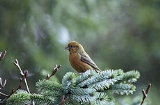
Crossbill

Encyclopedia
The crossbill is a bird in the finch
family (Fringillidae). The three to five (or possibly many more) species are all classified in the genus Loxia. These birds are characterised by the mandibles crossing at their tips, which gives the group its English
name. Adult males tend to be red or orange in colour, and females green or yellow, but there is much variation.
These are specialist feeders on conifer cones, and the unusual bill shape is an adaptation to assist the extraction of the seeds from the cone. These birds are typically found in higher northern hemisphere latitudes, where their food sources grows. They will erupt out of the breeding range when the cone crop fails. Crossbills breed very early in the year, often in winter months, to take advantage of maximum cone supplies.
The mechanism by which the bill-crossing (which usually, but not always, occurs in an 1:1 frequency of left-crossing or right-crossing morphs) is developed, and what determines the direction, has hitherto withstood all attempts to resolve it.
It is very probable that there is a genetic basis underlying the phenomenon (young birds whose bills are still straight will give a cone-opening behavior if their bills are gently pressed, and the crossing develops before the birds are fledged and feeding independently), but at least in the Red Crossbill (the only species which has been somewhat thoroughly researched regarding this question) there is no straightforward mechanism of heritability
.
While the direction of crossing seems to be the result of at least 3 genetic factors working together in a case of epistasis
and most probably autosomal, it is not clear whether the 1:1 frequency of both morphs in most cases is the result of genetics, or environmental selection. Populations that feed on cones without removing or twisting them will likely show a 1:1 morph distribution no matter what the genetic basis may be: the fitness
of each morph is inversely proportional to its frequency in the population. Such birds can only access the cone with the lower mandible tip pointing towards it to successfully extract seeds, and thus a too high number of birds of one morph will result in the food availability for each bird of this morph decreasing.
They can utilise other conifers to their preferred, and often need to do so when their preferred species has a crop failure, but are less efficient in their feeding (not enough to prevent survival, but probably enough to reduce breeding success).
sequence
data indicates that the crossbills and redpoll
s share a common ancestor and only diverged during the Tortonian
(c. 8 mya, Late Miocene
). The research suggests that the genera Loxia and Carduelis
might be merged into a single genus, for which the name Loxia would then have priority. But this would imply to change the name of a large number of species, and given that the adaptations of the crossbills represent a unique evolutionary path, it seems more appropriate to split up the genus Carduelis as it was already done during most of the 20th century. Unfortunately, the fossil
record is restricted to a Late Pliocene (c. 2 mya) species, Loxia patevi, found at Varshets
, Bulgaria
.
The species of crossbills are difficult to separate, and care is needed even with Two-barred/Hispaniolan Crossbill, the easiest. The other species are identified by subtle differences in head shape and bill size, and the identification problems formerly led to much taxonomic speculation, with some scientists considering that the Parrot and Scottish Crossbills and possibly the Hispaniolan and Two-barred Crossbills are conspecific.
The identification problem is least severe in North America
, where only Red and White-winged occur, and (possibly) worst in the Scottish
Highlands, where three species breed, and Two-barred is also a possible vagrant.
Work on vocalisation in North America suggest that there are eight or nine discrete populations of Red Crossbill in that continent alone, which do not interbreed and are (like the named species) adapted to specialise on different conifer species. Few ornithologists yet seem inclined to give these forms species status though. Preliminary investigations in Europe
and Asia
suggest an equal, if not greater, complexity, with several different call types identified; these call types as different from each other as from the named species Scottish and Parrot Crossbills - suggesting either that they are valid species, or else that the Scottish and Parrot may not be.
Genetic research on their DNA
failed to reveal any difference between any of the crossbills (including the morphologically distinct Two-barred), with variation between individuals greater than any difference between the taxa. This led to the suggestion that limited interbreeding between the different types prevented significant genetic differentiation, and enabled each type to maintain a degree of morphological plasticity, which may be necessary to enable them to feed on different conifers when their preferred food species has a crop failure. Research in Scotland, however, has shown that the Parrot and Scottish crossbills are reproductively isolated, and also from Common Crossbill, despite irruption of that species into their ranges, and the diagnostic calls and bill dimensions have not been lost. They are therefore good species.
Currently accepted species and their preferred food sources are:
Finch
The true finches are passerine birds in the family Fringillidae. They are predominantly seed-eating songbirds. Most are native to the Northern Hemisphere, but one subfamily is endemic to the Neotropics, one to the Hawaiian Islands, and one subfamily – monotypic at genus level – is found...
family (Fringillidae). The three to five (or possibly many more) species are all classified in the genus Loxia. These birds are characterised by the mandibles crossing at their tips, which gives the group its English
English language
English is a West Germanic language that arose in the Anglo-Saxon kingdoms of England and spread into what was to become south-east Scotland under the influence of the Anglian medieval kingdom of Northumbria...
name. Adult males tend to be red or orange in colour, and females green or yellow, but there is much variation.
These are specialist feeders on conifer cones, and the unusual bill shape is an adaptation to assist the extraction of the seeds from the cone. These birds are typically found in higher northern hemisphere latitudes, where their food sources grows. They will erupt out of the breeding range when the cone crop fails. Crossbills breed very early in the year, often in winter months, to take advantage of maximum cone supplies.
Feeding behavior
The different species are each birds to specialising in feeding on different conifer species, with the bill shape optimised for opening that species of conifer. This is achieved by inserting the bill between the conifer cone scales and twisting the lower mandible towards the side to which it crosses, enabling the bird to extract the seed at the bottom of the scale with its tongue.The mechanism by which the bill-crossing (which usually, but not always, occurs in an 1:1 frequency of left-crossing or right-crossing morphs) is developed, and what determines the direction, has hitherto withstood all attempts to resolve it.
It is very probable that there is a genetic basis underlying the phenomenon (young birds whose bills are still straight will give a cone-opening behavior if their bills are gently pressed, and the crossing develops before the birds are fledged and feeding independently), but at least in the Red Crossbill (the only species which has been somewhat thoroughly researched regarding this question) there is no straightforward mechanism of heritability
Heritability
The Heritability of a population is the proportion of observable differences between individuals that is due to genetic differences. Factors including genetics, environment and random chance can all contribute to the variation between individuals in their observable characteristics...
.
While the direction of crossing seems to be the result of at least 3 genetic factors working together in a case of epistasis
Epistasis
In genetics, epistasis is the phenomenon where the effects of one gene are modified by one or several other genes, which are sometimes called modifier genes. The gene whose phenotype is expressed is called epistatic, while the phenotype altered or suppressed is called hypostatic...
and most probably autosomal, it is not clear whether the 1:1 frequency of both morphs in most cases is the result of genetics, or environmental selection. Populations that feed on cones without removing or twisting them will likely show a 1:1 morph distribution no matter what the genetic basis may be: the fitness
Fitness (biology)
Fitness is a central idea in evolutionary theory. It can be defined either with respect to a genotype or to a phenotype in a given environment...
of each morph is inversely proportional to its frequency in the population. Such birds can only access the cone with the lower mandible tip pointing towards it to successfully extract seeds, and thus a too high number of birds of one morph will result in the food availability for each bird of this morph decreasing.
They can utilise other conifers to their preferred, and often need to do so when their preferred species has a crop failure, but are less efficient in their feeding (not enough to prevent survival, but probably enough to reduce breeding success).
Systematics and evolution
Analysis of mitochondrial cytochrome bCytochrome b
Cytochrome b/b6 is the main subunit of transmembrane cytochrome bc1 and b6f complexes. In addition, it commonly refers to a region of mtDNA used for population genetics and phylogenetics.- Function :...
sequence
DNA sequence
The sequence or primary structure of a nucleic acid is the composition of atoms that make up the nucleic acid and the chemical bonds that bond those atoms. Because nucleic acids, such as DNA and RNA, are unbranched polymers, this specification is equivalent to specifying the sequence of...
data indicates that the crossbills and redpoll
Redpoll
The Redpolls are a group of small passerine birds in the finch family Fringillidae which have characteristic red markings on their heads. They were formerly placed into the genus Acanthis together with the linnets and the twite, but their closest relatives are actually the crossbills, that are...
s share a common ancestor and only diverged during the Tortonian
Tortonian
The Tortonian is in the geologic timescale an age or stage of the late Miocene that spans the time between 11.608 ± 0.005 Ma and 7.246 ± 0.005 Ma . It follows the Serravallian and is followed by the Messinian....
(c. 8 mya, Late Miocene
Miocene
The Miocene is a geological epoch of the Neogene Period and extends from about . The Miocene was named by Sir Charles Lyell. Its name comes from the Greek words and and means "less recent" because it has 18% fewer modern sea invertebrates than the Pliocene. The Miocene follows the Oligocene...
). The research suggests that the genera Loxia and Carduelis
Carduelis
The genus Carduelisis a large group of birds in the finch family Fringillidae. It includes the greenfinches, redpolls, goldfinches, linnets, the twite, and the non-African siskins...
might be merged into a single genus, for which the name Loxia would then have priority. But this would imply to change the name of a large number of species, and given that the adaptations of the crossbills represent a unique evolutionary path, it seems more appropriate to split up the genus Carduelis as it was already done during most of the 20th century. Unfortunately, the fossil
Fossil
Fossils are the preserved remains or traces of animals , plants, and other organisms from the remote past...
record is restricted to a Late Pliocene (c. 2 mya) species, Loxia patevi, found at Varshets
Varshets
Varshets is a spa town in Montana Province, northwestern Bulgaria. It is the administrative centre of the homonymous Varshets Municipality. As of December 2009, its population is 6,538. The town is located on the northern slopes of the western part of the Balkan mountains in the small valley of...
, Bulgaria
Bulgaria
Bulgaria , officially the Republic of Bulgaria , is a parliamentary democracy within a unitary constitutional republic in Southeast Europe. The country borders Romania to the north, Serbia and Macedonia to the west, Greece and Turkey to the south, as well as the Black Sea to the east...
.
The species of crossbills are difficult to separate, and care is needed even with Two-barred/Hispaniolan Crossbill, the easiest. The other species are identified by subtle differences in head shape and bill size, and the identification problems formerly led to much taxonomic speculation, with some scientists considering that the Parrot and Scottish Crossbills and possibly the Hispaniolan and Two-barred Crossbills are conspecific.
The identification problem is least severe in North America
North America
North America is a continent wholly within the Northern Hemisphere and almost wholly within the Western Hemisphere. It is also considered a northern subcontinent of the Americas...
, where only Red and White-winged occur, and (possibly) worst in the Scottish
Scotland
Scotland is a country that is part of the United Kingdom. Occupying the northern third of the island of Great Britain, it shares a border with England to the south and is bounded by the North Sea to the east, the Atlantic Ocean to the north and west, and the North Channel and Irish Sea to the...
Highlands, where three species breed, and Two-barred is also a possible vagrant.
Work on vocalisation in North America suggest that there are eight or nine discrete populations of Red Crossbill in that continent alone, which do not interbreed and are (like the named species) adapted to specialise on different conifer species. Few ornithologists yet seem inclined to give these forms species status though. Preliminary investigations in Europe
Europe
Europe is, by convention, one of the world's seven continents. Comprising the westernmost peninsula of Eurasia, Europe is generally 'divided' from Asia to its east by the watershed divides of the Ural and Caucasus Mountains, the Ural River, the Caspian and Black Seas, and the waterways connecting...
and Asia
Asia
Asia is the world's largest and most populous continent, located primarily in the eastern and northern hemispheres. It covers 8.7% of the Earth's total surface area and with approximately 3.879 billion people, it hosts 60% of the world's current human population...
suggest an equal, if not greater, complexity, with several different call types identified; these call types as different from each other as from the named species Scottish and Parrot Crossbills - suggesting either that they are valid species, or else that the Scottish and Parrot may not be.
Genetic research on their DNA
DNA
Deoxyribonucleic acid is a nucleic acid that contains the genetic instructions used in the development and functioning of all known living organisms . The DNA segments that carry this genetic information are called genes, but other DNA sequences have structural purposes, or are involved in...
failed to reveal any difference between any of the crossbills (including the morphologically distinct Two-barred), with variation between individuals greater than any difference between the taxa. This led to the suggestion that limited interbreeding between the different types prevented significant genetic differentiation, and enabled each type to maintain a degree of morphological plasticity, which may be necessary to enable them to feed on different conifers when their preferred food species has a crop failure. Research in Scotland, however, has shown that the Parrot and Scottish crossbills are reproductively isolated, and also from Common Crossbill, despite irruption of that species into their ranges, and the diagnostic calls and bill dimensions have not been lost. They are therefore good species.
Currently accepted species and their preferred food sources are:
- Parrot CrossbillParrot CrossbillThe Parrot Crossbill is a small passerine bird in the finch family Fringillidae.This bird breeds in the pine forests of northwest Europe and into western Russia...
, Loxia pytyopsittacus- Scots pineScots PinePinus sylvestris, commonly known as the Scots Pine, is a species of pine native to Europe and Asia, ranging from Scotland, Ireland and Portugal in the west, east to eastern Siberia, south to the Caucasus Mountains, and as far north as well inside the Arctic Circle in Scandinavia...
Pinus sylvestris
- Scots pine
- Scottish CrossbillScottish CrossbillThe Scottish Crossbill is a small passerine bird in the finch family Fringillidae. It is endemic to the Caledonian Forests of Scotland, and is the only vertebrate unique to the United Kingdom...
, Loxia scotica (formerly treated as a race of Parrot Crossbill)- Scots pineScots PinePinus sylvestris, commonly known as the Scots Pine, is a species of pine native to Europe and Asia, ranging from Scotland, Ireland and Portugal in the west, east to eastern Siberia, south to the Caucasus Mountains, and as far north as well inside the Arctic Circle in Scandinavia...
Pinus sylvestris and LarchLarchLarches are conifers in the genus Larix, in the family Pinaceae. Growing from 15 to 50m tall, they are native to much of the cooler temperate northern hemisphere, on lowlands in the north and high on mountains further south...
Larix species (particularly plantations of L. decidua)
- Scots pine
- Red Crossbill or Common CrossbillCommon CrossbillThe Common Crossbill is a small passerine bird in the finch family Fringillidae. It breeds in the spruce forests of North America, where it is known as Red Crossbill, as well as Europe and Asia; some populations breed in pine forests in certain areas of all three continents, and in North...
, Loxia curvirostra- SpruceSpruceA spruce is a tree of the genus Picea , a genus of about 35 species of coniferous evergreen trees in the Family Pinaceae, found in the northern temperate and boreal regions of the earth. Spruces are large trees, from tall when mature, and can be distinguished by their whorled branches and conical...
Picea species; some populations (distinct species?) on various PinePinePines are trees in the genus Pinus ,in the family Pinaceae. They make up the monotypic subfamily Pinoideae. There are about 115 species of pine, although different authorities accept between 105 and 125 species.-Etymology:...
Pinus species and (in western North America) Douglas-firDouglas-firDouglas-fir is one of the English common names for evergreen coniferous trees of the genus Pseudotsuga in the family Pinaceae. Other common names include Douglas tree, and Oregon pine. There are five species, two in western North America, one in Mexico, and two in eastern Asia...
- Spruce
- Two-barred Crossbill or White-winged CrossbillTwo-barred CrossbillThe Two-barred Crossbill , known as the White-winged Crossbill in North America, is a small passerine bird in the finch family Fringillidae...
, Loxia leucoptera- LarchLarchLarches are conifers in the genus Larix, in the family Pinaceae. Growing from 15 to 50m tall, they are native to much of the cooler temperate northern hemisphere, on lowlands in the north and high on mountains further south...
Larix species, particularly L. sibirica, L. gmelinii, L. laricina and (in North America) also HemlockTsugaTsuga is a genus of conifers in the family Pinaceae. The common name hemlock is derived from a perceived similarity in the smell of its crushed foliage to that of the unrelated plant poison hemlock....
Tsuga
- Larch
- Hispaniolan CrossbillHispaniolan CrossbillThe Hispaniolan Crossbill is a crossbill that is endemic to the island of Hispaniola in the Caribbean and therefore only found in Haiti and the Dominican Republic....
, Loxia megaplaga (previously treated as a race of Two-barred Crossbill)- Hispaniolan PineHispaniolan PineThe Hispaniolan Pine is a pine endemic to the island of Hispaniola, where it is the predominant species in the Hispaniolan pine forests of Haiti and the Dominican Republic...
Pinus occidentalis
- Hispaniolan Pine
External links
- Crossbill videos, photos and sounds on the Internet Bird Collection