
All Topics  
Cross-stitch

 
Cross Stitch

   Email Print
   Bookmark   Link


Cross-stitch


Cross-stitch is a popular form of counted-thread embroidery
Counted-thread embroidery

Counted-thread embroidery is any embroidery in which the fabric threads are counted by the embroiderer before inserting the needle into the fabric....
 in which X-shaped stitches are used to form a picture. Cross-stitch is usually executed on easily countable evenweave fabric. The stitcher counts the threads in each direction so that the stitches are of uniform size and appearance. This form of cross-stitch is also called counted cross-stitch in order to distinguish it from other forms of cross-stitch.


Discussion
Ask a question about 'Cross-stitch'
Start a new discussion about 'Cross-stitch'
Answer questions from other users
Full Discussion Forum


Encyclopedia


Cross-stitch is a popular form of counted-thread embroidery
Counted-thread embroidery

Counted-thread embroidery is any embroidery in which the fabric threads are counted by the embroiderer before inserting the needle into the fabric....
 in which X-shaped stitches are used to form a picture. Cross-stitch is usually executed on easily countable evenweave fabric. The stitcher counts the threads in each direction so that the stitches are of uniform size and appearance. This form of cross-stitch is also called counted cross-stitch in order to distinguish it from other forms of cross-stitch. Sometimes cross-stitch is done on designs printed on the fabric (stamped cross-stitch); the stitcher simply stitches over the printed pattern.

History

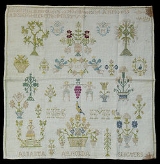
Cross Stitch Detail
Cross-stitch is one of the oldest forms of embroidery and can be found all over the world. Many folk museums show examples of clothing decorated with cross-stitch, especially from continental Europe
Europe

Europe is, conventionally, one of the world's seven continents. Comprising the westernmost peninsula of Eurasia, Europe is generally divided from Asia to its east by the water divide of the Ural Mountains, the Ural , the Caspian Sea, and by the Caucasus Mountains to the southeast....
 and Asia
Asia

Asia is the world's largest and most populous continent. It covers 8.6% of the Earth's total surface area and, with over 4 billion people, it contains more than 60% of the world's current human population....
.

Two-dimensional (unshaded) cross-stitch in floral and geometric patterns, usually worked in black and red cotton floss on linen, is characteristic of folk embroidery in Eastern
Eastern Europe

Eastern Europe is a term that applies to the geopolitical region encompassing the easternmost part of the Europe. Throughout history and to a lesser extent today, parts of Eastern Europe has been distinguishable from Western Europe and other regions due to cultural, religious, economic, and historical reasons, even though there i...
 and Central Europe
Central Europe

Central Europe is the region lying between the variously and vaguely defined areas of Eastern Europe and Western Europe Europe. In addition, Northern Europe, Southern Europe and Southeastern Europe may variously delimit or overlap into Central Europe....
.

In the United States, the earliest known cross-stitch sampler is currently housed at Pilgrim Hall in Plymouth, Massachusetts. The sampler was created by Loara Standish, the daughter of Captain Myles Standish
Myles Standish

Captain Myles Standish , was an English military officer hired by the Pilgrims as military advisor for Plymouth colony. Arriving on the Mayflower , he worked on colonial defense....
, circa 1653.

Multicoloured, shaded, painting-like patterns as we know them today are a recent development, deriving from similar shaded patterns of Berlin wool work
Berlin wool work

Berlin wool work is a style of embroidery. It is a subtype of canvas work. Typically it is executed with tapestry wool on canvas, in petit point stitch only....
 of the mid-nineteenth century.

Traditionally, cross-stitch was used to embellish items like dishcloths, household linens, and doilies (only a small portion of which would actually be embroidered, such as a border). Although there are many cross-stitchers who still employ it in this fashion, especially in Europe, it is now increasingly popular to simply embroider pieces of fabric and hang them on the wall for decoration.

There are many cross-stitching "guilds" across the United States and Europe which offer classes, collaborate on large projects, stitch for charity, and provide other ways for local cross-stitchers to get to know one another.

Today cotton floss is the most common embroidery thread. It is a thread made of mercerized cotton
Mercerized cotton

Mercerization is a treatment for cotton Cloth and Yarn that gives fabric a lustrous appearance. The process is applied to materials like cotton or hemp....
, composed of six strands that are only loosely twisted together and easily separable. Other materials used are pearl cotton, Danish flower thread, silk
Silk

Silk is a natural protein fiber, some forms of which can be weaving into textiles. The best-known type of silk is obtained from Pupa#Cocoons made by the larvae of the mulberry silkworm Bombyx mori reared in captivity ....
 and Rayon
Rayon

Rayon is a manufactured regenerated cellulose fiber. Because it is produced from naturally occurring polymers, it is neither a truly synthetic fiber nor a natural fiber; it is a semi-synthetic fiber ....
. Sometimes different wool threads, metallic threads or other speciality threads are used, sometimes for the whole work, sometimes for accents and embellishments.

Related stitches and forms of embroidery


Other stitches are also often used in cross-stitch, among them ¼, ½, and ¾ stitches and backstitches.

Cross-stitch was often used together with other stitches. It is sometimes used in crewel embroidery
Crewel embroidery

Crewel Embroidery, or Crewelwork, is a decorative form of surface embroidery using wool and a variety of different embroidery stitches to follow a design outline applied to the fabric....
, especially in its more modern derivatives. It is also often used in needlepoint
Needlepoint

Needlepoint is a form of canvas work embroidery, in which yarn is stitched through a canvas ground textile. Unlike surface embroidery, needlepoint uses the canvas, or ground fabric, to create a new fabric....
.

A specialized historical form of embroidery using cross-stitch is Assisi embroidery
Assisi embroidery

Assisi embroidery is a form of counted-thread embroidery based on an ancient Italian tradition where the background is filled with embroidery stitches and the main motifs are left void i.e....
.

There are many stitches which are related to cross-stitch and were used in similar ways in earlier times. The best known are Italian cross-stitch, Celtic Cross Stitch
Celtic cross stitch

Celtic cross stitch embroidery is a common form of cross stitch. Celtic cross stitch typically employs rich, deep colors, intricate geometrical patterns, spirals, interlacing patterns, knot works, alphabets, animal forms and zoomorphic patterns....
, Irish Cross Stitch, long-armed cross-stitch, Ukrainian cross-stitch and Montenegrin stitch. Italian cross-stitch and Montenegrin stitch are reversible, meaning the work looks the same on both sides. These styles have a slightly different look than ordinary cross-stitch. These more difficult stitches are rarely used in mainstream embroidery, but they are still used to recreate historical pieces of embroidery or by the creative and adventurous stitcher.

The double cross-stitch, also known as a Leviathan stitch or Smyrna cross stitch, combines a cross-stitch with an upright cross-stitch.

Berlin wool work
Berlin wool work

Berlin wool work is a style of embroidery. It is a subtype of canvas work. Typically it is executed with tapestry wool on canvas, in petit point stitch only....
 and similar petit point stitchery resembles the heavily shaded, opulent styles of cross-stitch, and sometimes also used charted patterns on paper.

Cross-stitch is often combined with other popular forms of embroidery, such as Hardanger embroidery
Hardanger embroidery

Hardanger embroidery or "Hardangers?m" is a form of embroidery traditionally worked with white thread on white even-weave cloth, using counted-thread embroidery and Drawn thread work techniques....
 or blackwork embroidery
Blackwork Embroidery

File:English cover, AIC.jpgBlackwork Embroidery is a form of counted-thread embroidery that is usually stitched on even-weave fabric. Any black thread can be used, but firmly twisted threads give a better look than embroidery floss....
. Cross-stitch may also be combined with other work, such as canvaswork or drawn thread work
Drawn thread work

Drawn thread work is a form of counted-thread embroidery based on removing threads from the Warp and/or the weft of a piece of even-weave fabric....
. Beadwork
Beadwork

Beadwork is the art or craft of attaching beads to one another or to cloth using a Sewing needle and thread. Most beadwork takes the form of jewellery or other personal adornment, but beads are also used in wall hangings and sculpture....
 and other embellishments such as paillettes, charms, small buttons and speciality threads of various kinds may also be used.

External links


  • - A Useful A to Z of Cross Stitching
  • - Counted Cross Stitch Tutorial.
  • - Type in your text and create a chart using various cross stitch fonts.
  • - Tips on Choosing a Fabric - Includes links to pictures of different samples.
  • - Celtic Cross Stitch Sample Patterns.
  • - The history of embroidery.