

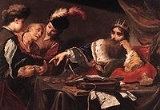
Croesus

Encyclopedia
Monarch
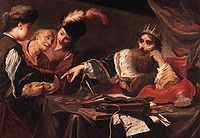
A monarch is the person who heads a monarchy. This is a form of government in which a state or polity is ruled or controlled by an individual who typically inherits the throne by birth and occasionally rules for life or until abdication...
of Lydia
Lydia
Lydia was an Iron Age kingdom of western Asia Minor located generally east of ancient Ionia in the modern Turkish provinces of Manisa and inland İzmir. Its population spoke an Anatolian language known as Lydian....
from 560 to 547 BC until his defeat by the Persians
Achaemenid Empire
The Achaemenid Empire , sometimes known as First Persian Empire and/or Persian Empire, was founded in the 6th century BCE by Cyrus the Great who overthrew the Median confederation...
. The fall of Croesus made a profound impact on the Hellenes
Greeks
The Greeks, also known as the Hellenes , are a nation and ethnic group native to Greece, Cyprus and neighboring regions. They also form a significant diaspora, with Greek communities established around the world....
, providing a fixed point in their calendar. "By the fifth century at least," J.A.S. Evans remarked, "Croesus had become a figure of myth, who stood outside the conventional restraints of chronology." Croesus was renowned for his wealth—Herodotus
Herodotus
Herodotus was an ancient Greek historian who was born in Halicarnassus, Caria and lived in the 5th century BC . He has been called the "Father of History", and was the first historian known to collect his materials systematically, test their accuracy to a certain extent and arrange them in a...
and Pausanias
Pausanias (geographer)
Pausanias was a Greek traveler and geographer of the 2nd century AD, who lived in the times of Hadrian, Antoninus Pius and Marcus Aurelius. He is famous for his Description of Greece , a lengthy work that describes ancient Greece from firsthand observations, and is a crucial link between classical...
noted his gifts preserved at Delphi
Delphi
Delphi is both an archaeological site and a modern town in Greece on the south-western spur of Mount Parnassus in the valley of Phocis.In Greek mythology, Delphi was the site of the Delphic oracle, the most important oracle in the classical Greek world, and a major site for the worship of the god...
.
Wealth and coinage
In Greek and Persian cultures the name of Croesus became a synonym for a wealthy man. Croesus' wealth remained proverbial beyond classical antiquity: in English, expressions such as "rich as Croesus" or "richer than Croesus" are used to indicate great wealth to this day. The earliest known such usage in English was John GowerJohn Gower
John Gower was an English poet, a contemporary of William Langland and a personal friend of Geoffrey Chaucer. He is remembered primarily for three major works, the Mirroir de l'Omme, Vox Clamantis, and Confessio Amantis, three long poems written in French, Latin, and English respectively, which...
's in Confessio amantis
Confessio Amantis
Confessio Amantis is a 33,000-line Middle English poem by John Gower, which uses the confession made by an ageing lover to the chaplain of Venus as a frame story for a collection of shorter narrative poems. According to its prologue, it was composed at the request of Richard II...
(1390):
That if the tresor of Cresus
And al the gold Octovien,
Forth with the richesse Yndien
Of Perles and of riche stones,
Were al togedre myn at ones...
Croesus is credited with issuing the first true gold coin
Gold coin
A gold coin is a coin made mostly or entirely of gold. Gold has been used for coins practically since the invention of coinage, originally because of gold's intrinsic value...
s with a standardised purity for general circulation. However, they were quite crude, and were made of electrum
Electrum
Electrum is a naturally occurring alloy of gold and silver, with trace amounts of copper and other metals. It has also been produced artificially. The ancient Greeks called it 'gold' or 'white gold', as opposed to 'refined gold'. Its color ranges from pale to bright yellow, depending on the...
, a naturally occurring pale yellow alloy of gold
Gold
Gold is a chemical element with the symbol Au and an atomic number of 79. Gold is a dense, soft, shiny, malleable and ductile metal. Pure gold has a bright yellow color and luster traditionally considered attractive, which it maintains without oxidizing in air or water. Chemically, gold is a...
and silver
Silver
Silver is a metallic chemical element with the chemical symbol Ag and atomic number 47. A soft, white, lustrous transition metal, it has the highest electrical conductivity of any element and the highest thermal conductivity of any metal...
. The composition of these first coins was similar to alluvial deposits found in the silt of the Pactolus
Pactolus
Pactolus is a river near the Aegean coast of Turkey. The river rises from Mount Tmolus, flows through the ruins of the ancient city of Sardis, and empties into the Gediz River, the ancient Hermus. The Pactolus once contained electrum that was the basis of the economy of the ancient state of Lydia...
river, which ran through the Lydian
Lydian
Lydian may refer to:* Lydian language, an ancient Anatolian language* Lydian script* Lydian mode, one of the modes derived from ancient Greek music* Lydian , a decorative typeface* Lydia, an ancient kingdom in western Anatolia...
capital, Sardis
Sardis
Sardis or Sardes was an ancient city at the location of modern Sart in Turkey's Manisa Province...
. Later coins, including some in the British Museum
British Museum
The British Museum is a museum of human history and culture in London. Its collections, which number more than seven million objects, are amongst the largest and most comprehensive in the world and originate from all continents, illustrating and documenting the story of human culture from its...
, were made from gold purified by heating with common salt to remove the silver. King Croesus' gold coins follow the first silver coin
Silver coin
Silver coins are possibly the oldest mass produced form of coinage. Silver has been used as a coinage metal since the times of the Greeks. Their silver drachmas were popular trade coins....
s that had been minted by King Pheidon
Pheidon
Pheidon was a king of Argos, Greece in the 7th century BC. At that time, the monarch was purely a traditional figurehead with almost no genuine power. Pheidon seized the throne from the reigning aristocracy...
of Argos
Argos
Argos is a city and a former municipality in Argolis, Peloponnese, Greece. Since the 2011 local government reform it is part of the municipality Argos-Mykines, of which it is a municipal unit. It is 11 kilometres from Nafplion, which was its historic harbour...
around 700 BC. In 546 BC, Croesus was defeated and captured by the Persians, who then adopted gold
Gold
Gold is a chemical element with the symbol Au and an atomic number of 79. Gold is a dense, soft, shiny, malleable and ductile metal. Pure gold has a bright yellow color and luster traditionally considered attractive, which it maintains without oxidizing in air or water. Chemically, gold is a...
as the main metal for their coins.
Biography
Aside from a poetical account of Croesus on the pyre in BacchylidesBacchylides
Bacchylides was an Ancient Greek lyric poet. Later Greeks included him in the canonical list of nine lyric poets which included his uncle Simonides. The elegance and polished style of his lyrics have been a commonplace of Bacchylidean scholarship since at least Longinus...
, there are three classical accounts of Croesus. Herodotus
Herodotus
Herodotus was an ancient Greek historian who was born in Halicarnassus, Caria and lived in the 5th century BC . He has been called the "Father of History", and was the first historian known to collect his materials systematically, test their accuracy to a certain extent and arrange them in a...
presents the Lydian
Lydian
Lydian may refer to:* Lydian language, an ancient Anatolian language* Lydian script* Lydian mode, one of the modes derived from ancient Greek music* Lydian , a decorative typeface* Lydia, an ancient kingdom in western Anatolia...
accounts of the conversation with Solon
Solon
Solon was an Athenian statesman, lawmaker, and poet. He is remembered particularly for his efforts to legislate against political, economic and moral decline in archaic Athens...
(Histories 1.29-.33), the tragedy of Croesus' son Atys
Atys son of Croesus
Atys was the son of Croesus, father of Pythius, a king of Lydia. According to book one of the Histories by Herodotus, his father had a dream, in this dream he saw his son Atys being killed by a spear. As a result Croesus, seeking to prevent or stave off the foreseen fate, had his son married...
(Histories 1.34-.45) and the fall of Croesus (Histories 1.85-.89); Xenophon
Xenophon
Xenophon , son of Gryllus, of the deme Erchia of Athens, also known as Xenophon of Athens, was a Greek historian, soldier, mercenary, philosopher and a contemporary and admirer of Socrates...
instances Croesus in his panegyric
Panegyric
A panegyric is a formal public speech, or written verse, delivered in high praise of a person or thing, a generally highly studied and discriminating eulogy, not expected to be critical. It is derived from the Greek πανηγυρικός meaning "a speech fit for a general assembly"...
fictionalized biography of Cyrus: Cyropaedia
Cyropaedia (Xenophon)
The Cyropaedia is a "partly fictional biography" of Cyrus the Great, written in the early 4th century BC by the Athenian gentleman-soldier, and student of Socrates, Xenophon of Athens. The Latinized title Cyropaedia derives from Greek Kúrou paideía , meaning "The Education of Cyrus"...
, 7.1; and Ctesias
Ctesias
Ctesias of Cnidus was a Greek physician and historian from Cnidus in Caria. Ctesias, who lived in the 5th century BC, was physician to Artaxerxes Mnemon, whom he accompanied in 401 BC on his expedition against his brother Cyrus the Younger....
, whose account is also an encomium
Encomium
Encomium is a Latin word deriving from the Classical Greek ἐγκώμιον meaning the praise of a person or thing. "Encomium" also refers to several distinct aspects of rhetoric:* A general category of oratory* A method within rhetorical pedagogy...
of Cyrus.
Born about 595 BC, Croesus received tribute from the Ionian Greeks
Ionia
Ionia is an ancient region of central coastal Anatolia in present-day Turkey, the region nearest İzmir, which was historically Smyrna. It consisted of the northernmost territories of the Ionian League of Greek settlements...
but was friendlier to the Hellenes than his father
Alyattes II
Alyattes, king of Lydia , considered to be the founder of the Lydian empire, was the son of Sadyattes, of the house of the Mermnadae....
had been. Croesus traditionally gave refuge at one point to the Phrygian prince Adrastus. Herodotus tells that Adrastus exiled himself to Lydia after accidentally killing his brother. King Croesus welcomed him but then Adrastus accidentally killed Croesus' son, Atys
Atys son of Croesus
Atys was the son of Croesus, father of Pythius, a king of Lydia. According to book one of the Histories by Herodotus, his father had a dream, in this dream he saw his son Atys being killed by a spear. As a result Croesus, seeking to prevent or stave off the foreseen fate, had his son married...
. (Adrastus then committed suicide.)
Croesus' uneasy relations with the Greeks obscures the larger fact that he was the last bastion of the Ionian cities
Ionia
Ionia is an ancient region of central coastal Anatolia in present-day Turkey, the region nearest İzmir, which was historically Smyrna. It consisted of the northernmost territories of the Ionian League of Greek settlements...
against the increasing Persian power in Anatolia. He began preparing a campaign against Cyrus the Great
Cyrus the Great
Cyrus II of Persia , commonly known as Cyrus the Great, also known as Cyrus the Elder, was the founder of the Achaemenid Empire. Under his rule, the empire embraced all the previous civilized states of the ancient Near East, expanded vastly and eventually conquered most of Southwest Asia and much...
of Persia. Before setting out he turned to the Delphi
Delphi
Delphi is both an archaeological site and a modern town in Greece on the south-western spur of Mount Parnassus in the valley of Phocis.In Greek mythology, Delphi was the site of the Delphic oracle, the most important oracle in the classical Greek world, and a major site for the worship of the god...
c oracle
Oracle
In Classical Antiquity, an oracle was a person or agency considered to be a source of wise counsel or prophetic predictions or precognition of the future, inspired by the gods. As such it is a form of divination....
and the oracle of Amphiaraus
Amphiaraus
In Greek mythology, Amphiaraus was the son of Oecles and Hypermnestra, and husband of Eriphyle. Amphiaraus was the King of Argos along with Adrastus— the brother of Amphiaraus' wife, Eriphyle— and Iphis. Amphiaraus was a seer, and greatly honored in his time...
to inquire whether he should pursue this campaign and whether he should also seek an alliance. The oracles answered, with typical ambiguity, that if Croesus attacked the Persians, he would destroy a great empire – this would become one of the most famous oracular statements from Delphi
Famous oracular statements from Delphi
Pythia was the priestess presiding over the Oracle of Apollo at Delphi. There are more than 500 supposed Oracular statements which have survived from various sources referring to the oracle at Delphi. Many are anecdotal, and have survived as proverbs. Several are ambiguously phrased, apparently...
.
Croesus was also advised to find out which Greek state was most powerful and to ally himself with it. Croesus, now feeling secure, formed an alliance with Sparta
Sparta
Sparta or Lacedaemon, was a prominent city-state in ancient Greece, situated on the banks of the River Eurotas in Laconia, in south-eastern Peloponnese. It emerged as a political entity around the 10th century BC, when the invading Dorians subjugated the local, non-Dorian population. From c...
in addition to those he had with Amasis II
Amasis II
Amasis II or Ahmose II was a pharaoh of the Twenty-sixth dynasty of Egypt, the successor of Apries at Sais. He was the last great ruler of Egypt before the Persian conquest.-Life:...
of Egypt
Egypt
Egypt , officially the Arab Republic of Egypt, Arabic: , is a country mainly in North Africa, with the Sinai Peninsula forming a land bridge in Southwest Asia. Egypt is thus a transcontinental country, and a major power in Africa, the Mediterranean Basin, the Middle East and the Muslim world...
and Nabonidus
Nabonidus
Nabonidus was the last king of the Neo-Babylonian Empire, reigning from 556-539 BCE.-Historiography on Nabonidus:...
of Babylonia
Babylonia
Babylonia was an ancient cultural region in central-southern Mesopotamia , with Babylon as its capital. Babylonia emerged as a major power when Hammurabi Babylonia was an ancient cultural region in central-southern Mesopotamia (present-day Iraq), with Babylon as its capital. Babylonia emerged as...
, and launched his campaign against the Persian Empire in 547 BC. He was intercepted near the Halys River
Halys River
The Kızılırmak , also known as the Halys River , is the longest river in Turkey. It is a source of hydroelectric power and is not used for navigation.- Geography :...
in central Anatolia
Anatolia
Anatolia is a geographic and historical term denoting the westernmost protrusion of Asia, comprising the majority of the Republic of Turkey...
and an inconclusive battle was fought. As was usual in those days, the armies would disband for winter and Croesus did accordingly. Cyrus did not, however, and he attacked Croesus in Sardis
Sardis
Sardis or Sardes was an ancient city at the location of modern Sart in Turkey's Manisa Province...
, capturing him. It became clear that the powerful empire Croesus was about to destroy was his own.
In Bacchylides' ode, composed for Hiero of Syracuse, who won the chariot race at Olympia in 468, Croesus with his wife and family mounted the funeral pyre, but before the flames could envelop the king, he was snatched up by Apollo
Apollo
Apollo is one of the most important and complex of the Olympian deities in Greek and Roman mythology...
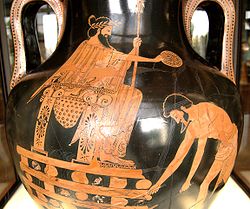
and spirited away to the Hyperboreans. Herodotus' version includes Apollo in more "realistic" mode: Cyrus, repenting of the immolation of Croesus, could not put out the flames until Apollo intervened.
Apollo's intervention
Croesus
Croesus was the king of Lydia from 560 to 547 BC until his defeat by the Persians. The fall of Croesus made a profound impact on the Hellenes, providing a fixed point in their calendar. "By the fifth century at least," J.A.S...
was placed upon a great pyre
Pyre
A pyre , also known as a funeral pyre, is a structure, usually made of wood, for burning a body as part of a funeral rite...
by Cyrus' orders, for Cyrus wanted to see if any of the heavenly powers would appear to save him from being burned alive
Execution by burning
Death by burning is death brought about by combustion. As a form of capital punishment, burning has a long history as a method in crimes such as treason, heresy, and witchcraft....
. The pile was set ablaze, and as Cyrus the Great
Cyrus the Great
Cyrus II of Persia , commonly known as Cyrus the Great, also known as Cyrus the Elder, was the founder of the Achaemenid Empire. Under his rule, the empire embraced all the previous civilized states of the ancient Near East, expanded vastly and eventually conquered most of Southwest Asia and much...
watched he saw Croesus call out "Solon
Solon
Solon was an Athenian statesman, lawmaker, and poet. He is remembered particularly for his efforts to legislate against political, economic and moral decline in archaic Athens...
" three times. He asked the interpreters to find out why he said this word with such resignation and agony. The interpreters returned the answer that Solon had warned Croesus of the fickleness of good fortune: see Interview with Solon below. This touched Cyrus, who realized that he and Croesus were much the same man, and he bade the servants to quench the blazing fire as quickly as they could. They tried to do this, but the flames were not to be mastered. According to the story, Croesus called out to Apollo
Apollo
Apollo is one of the most important and complex of the Olympian deities in Greek and Roman mythology...
and prayed to him. The sky had been clear and the day without a breath of wind, but soon dark clouds gathered and a storm with rain of such violence that the flames were speedily extinguished. Cyrus, convinced by this that Croesus was a good man, made Croesus an advisor who served Cyrus 'well' and later Cyrus's son by Cassandane, Cambyses
Cambyses II of Persia
Cambyses II son of Cyrus the Great , was a king of kings of the Achaemenid Empire. Cambyses's grandfather was Cambyses I, king of Anshan. Following Cyrus the Great's conquest of the Near East and Central Asia, Cambyses II further expanded the empire into Egypt during the Late Period by defeating...
. Recently, Stephanie West has argued that the historical Croesus did in fact die on the pyre, and that the stories of him as a 'wise adviser' to the courts of Cyrus and Cambyses are purely legendary, showing similarities to the sayings of Ahiqar
Ahiqar
Ahiqar or Ahikar was an Assyrian sage known in the ancient Near East for his outstanding wisdom.The Story of Ahikar, also known as the Words of Ahikar, has been found in an Aramaic papyrus of 500 B.C. among the ruins of Elephantine...
.
It is not known when exactly Croesus died, although it is traditionally dated 547 BC, after Cyrus' conquest. In the Nabonidus Chronicle
Nabonidus Chronicle
The Nabonidus Chronicle is an ancient Babylonian text, part of a larger series of Babylonian Chronicles incribed in cuneiform script on clay tablets...
it is said that Cyrus "marched against the country -- , killed its king, took his possessions, put there a garrison
Garrison
Garrison is the collective term for a body of troops stationed in a particular location, originally to guard it, but now often simply using it as a home base....
of his own." Unfortunately, all that remains of the name of the country are traces of the first cuneiform
Cuneiform script
Cuneiform script )) is one of the earliest known forms of written expression. Emerging in Sumer around the 30th century BC, with predecessors reaching into the late 4th millennium , cuneiform writing began as a system of pictographs...
sign. It has long been assumed that this sign should have been LU, so that the country referred to would be Lydia, with Croesus as the king that was killed. However, J. Cargill has shown that this restoration was based upon wishful thinking rather than actual traces of the sign LU. Instead, J. Oelsner and R. Rollinger have both read the sign as Ú, which might imply a reference to Urartu
Urartu
Urartu , corresponding to Ararat or Kingdom of Van was an Iron Age kingdom centered around Lake Van in the Armenian Highland....
. With Herodotus' account also being unreliable chronologically in this case, as J.A.S. Evans has demonstrated, this means that we have no way of dating the fall of Sardis; theoretically, it may even have taken place after the fall of Babylon. Evans also asks what happened after the episode at the pyre and suggests that "neither the Greeks nor the Babylonians knew what really happened to Croesus."
Interview with Solon
The episode of Croesus' interview with SolonSolon
Solon was an Athenian statesman, lawmaker, and poet. He is remembered particularly for his efforts to legislate against political, economic and moral decline in archaic Athens...
reported by Herodotus is in the nature of a philosophical disquisition on the subject "Which man is happy?" It is legendary rather than historical. Croesus, secure in his own wealth and happiness, poses the question and is disappointed by Solon's response: that three have been happier than Croesus, Tellus
Tellus (Ancient Athens)
Tellus was an Athenian statesman featured in Herodotus's Histories, in which the wise man Solon describes him as the happiest man ever. To quote Herodotus:...
, who died fighting for his country, and Kleobis and Biton
Kleobis and Biton
Kleobis and Biton are the names of two human brothers in Greek mythology. It is also the name conventionally given to a pair of lifesize Archaic Greek statues, or kouroi, which are now in the Delphi Archaeological Museum, at Delphi Greece...
, brothers who died peacefully in their sleep when their mother prayed for their perfect happiness, after they had demonstrated filial piety
Filial piety
In Confucian ideals, filial piety is one of the virtues to be held above all else: a respect for the parents and ancestors. The Confucian classic Xiao Jing or Classic of Xiào, thought to be written around 470 BCE, has historically been the authoritative source on the Confucian tenet of xiào /...
by drawing her to a festival in an oxcart themselves. Croesus' hubris
Hubris
Hubris , also hybris, means extreme haughtiness, pride or arrogance. Hubris often indicates a loss of contact with reality and an overestimation of one's own competence or capabilities, especially when the person exhibiting it is in a position of power....
tic happiness was reversed by the tragic deaths of his accidentally-killed son and, in Critias
Critias
Critias , born in Athens, son of Callaeschrus, was an uncle of Plato, and a leading member of the Thirty Tyrants, and one of the most violent. He was an associate of Socrates, a fact that did not endear Socrates to the Athenian public. He was noted in his day for his tragedies, elegies and prose...
, his wife's suicide at the fall of Sardis. Thus the "happiness" of Croesus is presented as a moralistic exemplum
Exemplum
An exemplum is a moral anecdote, brief or extended, real or fictitious, used to illustrate a point.-Exemplary literature:...
of the fickleness of Tyche
Tyche
In ancient Greek city cults, Tyche was the presiding tutelary deity that governed the fortune and prosperity of a city, its destiny....
, a theme that gathered strength from the fourth century, revealing its late date.
The story was later retold and elaborated by Ausonius
Ausonius
Decimius Magnus Ausonius was a Latin poet and rhetorician, born at Burdigala .-Biography:Decimius Magnus Ausonius was born in Bordeaux in ca. 310. His father was a noted physician of Greek ancestry and his mother was descended on both sides from long-established aristocratic Gallo-Roman families...
in The Masque of the Seven Sages, in the Suda
Suda
The Suda or Souda is a massive 10th century Byzantine encyclopedia of the ancient Mediterranean world, formerly attributed to an author called Suidas. It is an encyclopedic lexicon, written in Greek, with 30,000 entries, many drawing from ancient sources that have since been lost, and often...
(entry "Μᾶλλον ὁ Φρύξ," which adds Aesop
Aesop
Aesop was a Greek writer credited with a number of popular fables. Older spellings of his name have included Esop and Isope. Although his existence remains uncertain and no writings by him survive, numerous tales credited to him were gathered across the centuries and in many languages in a...
and the Seven Sages of Greece
Seven Sages of Greece
The Seven Sages or Seven Wise Men was the title given by ancient Greek tradition to seven early 6th century BC philosophers, statesmen and law-givers who were renowned in the following centuries for their wisdom.-The Seven Sages:Traditionally, each of the seven sages represents an aspect of worldly...
), and by Tolstoy
Tolstoy
Tolstoy, or Tolstoi is a prominent family of Russian nobility, descending from Andrey Kharitonovich Tolstoy who served under Vasily II of Moscow...
in his short story "Croesus and Fate
Croesus and Fate
Croesus and Fate is a short story by Leo Tolstoy that is a retelling of a Greek legend, classically told by Herodotus, about the king Croesus. It was first published in 1886 by Tolstoy's publishing company The Intermediary...
".
External links
- Herodotus' account of Croesus (from the Perseus Project): see 1.6-94; contains links Croesus was the son of Alyattes IIAlyattes IIAlyattes, king of Lydia , considered to be the founder of the Lydian empire, was the son of Sadyattes, of the house of the Mermnadae....
and continued the conquest of IoniaIoniaIonia is an ancient region of central coastal Anatolia in present-day Turkey, the region nearest İzmir, which was historically Smyrna. It consisted of the northernmost territories of the Ionian League of Greek settlements...
n cities of Asia MinorAsia MinorAsia Minor is a geographical location at the westernmost protrusion of Asia, also called Anatolia, and corresponds to the western two thirds of the Asian part of Turkey...
that his father had begun to both English and Greek versions - An in-depth account of Croesus' life, by Carlos Parada
- Livius, Croesus by Jona Lendering
- Croesus on Ancient History Encyclopedia
- Gold Coin of Croesus a BBCBBCThe British Broadcasting Corporation is a British public service broadcaster. Its headquarters is at Broadcasting House in the City of Westminster, London. It is the largest broadcaster in the world, with about 23,000 staff...
podcastPodcastA podcast is a series of digital media files that are released episodically and often downloaded through web syndication...
from the series: "A History of the World in 100 Objects"