All Topics  
Cristero War

 
Cristero War

   Email Print
   Bookmark   Link


Cristero War


.]] The Cristero War (also known as the Cristiada) of 1926 to 1929 was an uprising and counter-revolution against the Mexican government of the time, set off specifically by the anti-clerical provisions of the Mexican Constitution of 1917.

After a period of peaceful resistance, a number of skirmishes took place in 1926. The formal rebellions began on January 1, 1927 with the rebels calling themselves Cristeros because they felt they were fighting for Christ
Jesus

Jesus of Nazareth , also known as Jesus Christ, is the central figure of Christianity and is revered by most Christian churches as the Son of God and the Incarnation ....
 Himself.


Discussion
Ask a question about 'Cristero War'
Start a new discussion about 'Cristero War'
Answer questions from other users
Full Discussion Forum


Encyclopedia


.]] The Cristero War (also known as the Cristiada) of 1926 to 1929 was an uprising and counter-revolution against the Mexican government of the time, set off specifically by the anti-clerical provisions of the Mexican Constitution of 1917.

After a period of peaceful resistance, a number of skirmishes took place in 1926. The formal rebellions began on January 1, 1927 with the rebels calling themselves Cristeros because they felt they were fighting for Christ
Jesus

Jesus of Nazareth , also known as Jesus Christ, is the central figure of Christianity and is revered by most Christian churches as the Son of God and the Incarnation ....
 Himself. Just as the Cristeros began to hold their own against the federal forces, the rebellion was ended by diplomatic means, brokered by the U.S.
United States

The United States of America is a Federal government constitutional republic comprising U.S. state and a federal district. The country is situated mostly in central North America, where its Contiguous United States and Washington, D.C., the Capital districts and territories, lie between the Pacific Ocean and Atlantic Oceans, Borders of the U...
 Ambassador Dwight Whitney Morrow.

The 1917 Constitution

Plutarco
The 1917 Constitution of Mexico, resulting from the Mexican Revolution
Mexican Revolution

The Mexican Revolution was a major armed struggle that started in 1910 with an uprising led by Francisco I. Madero against longtime autocrat Porfirio D?az....
, as well as a similar one instituted by Benito Juarez in 1857 (1857 Constitution of Mexico
1857 Constitution of Mexico

The 1857 Constitution was a Liberalism constitution drafted in Mexico during the President of Mexico of Ignacio Comonfort. It instituted Liberal policies, including: freedom of speech; freedom of conscience; freedom of the press; freedom of assembly; and the right to arms....
), reflected the liberal government's desire to control and even to suppress the Catholic religion, whose leaders in Mexico had long opposed its efforts to confiscate the lands worked by the poor, and to modernize the country through industrialization. The redistribution of land to a handful of Mexican oligarchs during the late 19th century eventually led to the chaos of the Mexican Revolution of 1910, in which the heavily exploited farm workers (peons) fought to recover their lands from the oligarchs.

After breaking its promises to proponents of land reform, such as the pro-Catholic revolutionary Emiliano Zapata
Emiliano Zapata

Emiliano Zapata Salazar was a leading figure in the Mexican Revolution, which broke out in 1910, and which was initially directed against the president Porfirio D?az....
, who was eventually killed by agents of the Carranza regime, the liberal government created a constitution in 1917 that confiscated all of the churches, buildings, and properties of the Catholic Church and any religious order or group (art. 27) and prohibited any future acquisition of such property, and ordered the closing of all of the Church's primary schools (prohibiting education for children up to the age of 11 -- art. 4). This second prohibition was later interpreted to mean that the Church could not even give religious instruction to children within the Churches on Sundays, effectively destroying the ability of Catholics to be educated in their own religion.

The Constitution of 1917 also closed and forbade the existence of monastic orders (art. 5), forbade any religious activity outside of church buildings (now owned by the government), and mandated that such religious activity would be overseen by the government (art. 24).

Article 130 of the new Constitution also allowed the government to restrict the number of functioning clergy. In some states, such as Michoacan, this power would be used to restrict the number of priests to the point that the Church effectively could not function.

The same article deprived priests and bishops of the right to vote, to criticize government policy, and to create any form of political organization.

The government's anti-Catholic position extended to secularizing place names. For instance, the state of Vera Cruz (true cross) was renamed Veracruz
Veracruz

Veracruz, formally Veracruz de Ignacio de la Llave is one of the 31 states of Mexico that constitute the republic of Mexico....
.

Background to rebellion

When the anti-clerical measures were enacted in 1917, the President of Mexico
President of Mexico

The Constitutional Citizen President of the United Mexican States is the head of state of Mexico. Under the 1917 Constitution of Mexico, the president is also the head of government and the Commander-in-chief of the Mexican Military of Mexico....
 was Venustiano Carranza
Venustiano Carranza

Venustiano Carranza Garza was one of the leaders of the Mexican Revolution. He ultimately became President of Mexico following the overthrow of the dictatorial Huerta regime in the summer of 1914 and during his administration the 1917 Constitution of Mexico of Mexico was drafted....
. Carranza was overthrown by the machinations of his one-time ally Álvaro Obregón
Álvaro Obregón

General ?lvaro Obreg?n Salido was President of Mexico of Mexico from 1920 to 1924.Born in Siquisiva, Sonora, Municipality of Navojoa to a poor farming family, He entered politics in 1911 with his election as mayor of the town of Huatabampo....
 in 1919, who succeeded to the presidency in late 1920. Although he shared Carranza's anti-clerical sentiments, he applied the measures selectively, only in areas where Catholic sentiment was weakest.

This uneasy "truce" between the government and the Church ended with the 1924 election of Plutarco Elías Calles
Plutarco Elías Calles

Plutarco El?as Calles was a Mexico general and politician. He was president of Mexico from 1924 to 1928, but he continued to be the de facto ruler of from 1928-1935, a period known as the maximato....
, a strident atheist. Calles applied the anti-clerical laws stringently throughout the country and added his own anti-clerical legislation. In June 1926, he signed the "Law for Reforming the Penal Code", known unofficially as the "Calles Law
Calles Law

The Calles' Law, or Law for Reforming the Penal Code, was a reform of the penal code in Mexico under the presidency of Plutarco Elias Calles....
". This provided specific penalties for priests and individuals who violated the provisions of the 1917 Constitution. For instance, wearing clerical garb in public (i.e., outside Church buildings) earned a fine of 500 pesos
Mexican peso

The peso is the currency of Mexico. The symbol used for the peso is "dollar sign", basically the same as for the US dollar since the dollar derived its logo from the Spanish-Mexican currency....
 (approximately 250 U.S. dollars at the time); a priest who criticized the government could be imprisoned for five years. Some states enacted oppressive measures. Chihuahua, for example, enacted a law permitting only a single priest to serve the entire Catholic congregation of the state. Calles seized church property, expelled all foreign priests, and closed the monasteries, convents and religious schools.

Calles was also a Freemason
Catholicism and Freemasonry

The Roman Catholic Church has long been an outspoken critic of Freemasonry, and has continually prohibited members from being Freemasons since In Eminenti Specula in 1739....
. One scholar has written that on May 28, 1926, the Masons awarded him a medal of merit for his persecution of Catholics. On July 12, 1926, the following communique appeared in the press:
"International Masonry accepts responsibility for everything that is happening in Mexico, and is preparing to mobilize all its forces for the methodic, integral application of the agreed upon program for this country."


Peaceful resistance

In response to these measures, Catholic organizations began to intensify their resistance. The most important of these groups was the National League for the Defense of Religious Liberty, founded in 1924. This was joined by the Mexican Association of Catholic Youth (founded 1913) and the Popular Union, a Catholic political party founded in 1925.

On July 11, 1926, the Mexican bishop
Bishop

A bishop is an ordination or consecration member of the Clergy#Christian clergy who is generally entrusted with a position of authority and oversight....
s voted to suspend all public worship in Mexico in response to the Calles Law. This suspension was to take place on August 1. On July 14, they endorsed plans for an economic boycott against the government, which was particularly effective in west-central Mexico (the states of Jalisco
Jalisco

Jalisco is a Mexican state in Mexico. The capital of Jalisco is the city of Guadalajara, Jalisco. In the 2005 census, Jalisco had a population of 6,752,113 people....
, Guanajuato
Guanajuato

Guanajuato is a state in the central highlands of Mexico. It is named after its capital city, Guanajuato, Guanajuato, which comes from the local indigenous P'urh?pecha language, meaning "Hill of Frogs"....
, Aguascalientes
Aguascalientes

Aguascalientes is a States of Mexico of Mexico, situated in the center of the country. The name means "hot waters" in Spanish language and originated from the abundance of hot springs in the area, thus the corresponding adjective for the state and its inhabitants is the whimsical demonym hidroc?lido ....
, Zacatecas
Zacatecas

Zacatecas States of Mexico of Mexico is located in the north-central region and it is bounded to the northwest by Durango, to the north by Coahuila, to the east by San Luis Potos?, to the south by Aguascalientes and Guanajuato and to the southwest by Jalisco and Nayarit....
). Catholics in these areas stopped attending movies and plays and using public transportation, and Catholic teachers stopped teaching in secular schools.

But the boycott collapsed by October 1926, in large part due to lack of support among wealthy Catholics, who were themselves losing money due to the boycott. The wealthy were generally disliked because of this, and their reputation was worsened when they paid the federal army for protection and called on the police to break the picket lines.

The Catholic bishops meanwhile worked to have the offending articles of the Constitution amended. Pope Pius XI
Pope Pius XI

Pope Pius XI , born Ambrogio Damiano Achille Ratti, reigned as Pope from February 6, 1922, and as sovereignty of Vatican City from its creation as an independent state on February 11, 1929 until his death on February 10, 1939....
 explicitly approved this means of resistance. The Calles government considered the bishops' activism seditious behavior and had many churches closed. In September the episcopate submitted a proposal for the amendment of the constitution, but the Congress rejected it on September 22, 1926.

Escalation of violence

In Guadalajara, Jalisco
Guadalajara, Jalisco

Guadalajara is the capital city of the Mexico state of Jalisco, and the seat of the municipality of Guadalajara. The city is located in the central region of the state and in the western-Pacific area of Mexico....
, on August 3, 1926, some 400 armed Catholics shut themselves up in the Church of Our Lady of Guadalupe
Our Lady of Guadalupe

Our Lady of Guadalupe is a celebrated 16th-century icon of the Blessed Virgin Mary, mother of Jesus Christ. The image, also known as the Virgin of Guadalupe represents a famous Marian apparition....
. They were involved in a shootout with federal troops and surrendered only when they ran out of ammunition. According to U.S. consular sources, this battle resulted in 18 dead and 40 injured.

The following day, August 4, in Sahuayo
Sahuayo

Sahuayo is a city in the Mexican state of Michoac?n, in western M?xico, near the southern shore of Lake Chapala. It serves as the municipal seat for the surrounding municipality of the same name....
, Michoacán
Michoacán

Michoac?n formally Michoac?n de Ocampo , is one of the 31 constituent States of Mexico of Mexico. It borders the states of Colima and Jalisco to the west, Guanajuato and Quer?taro to the north, Mexico to the east, Guerrero to the south-east, and the Pacific Ocean to the south....
, 240 government soldiers stormed the parish church. The parish priest and his vicar were killed in the ensuing violence. On August 14, government agents staged a purge of the Chalchihuites
Chalchihuites

Alta Vista, or Chalchihuites, is a small Mesoamerican archaeological site in the States of Mexico of Zacatecas, in the northwest of Mexico....
, Zacatecas
Zacatecas

Zacatecas States of Mexico of Mexico is located in the north-central region and it is bounded to the northwest by Durango, to the north by Coahuila, to the east by San Luis Potos?, to the south by Aguascalientes and Guanajuato and to the southwest by Jalisco and Nayarit....
, chapter of the Association of Catholic Youth and executed their spiritual adviser Father Luis Bátiz Sainz. This execution caused a band of ranchers, led by Pedro Quintanar, to seize the local treasury and declare themselves in rebellion. At the height of their rebellion, they held a region including the entire northern part of Jalisco
Jalisco

Jalisco is a Mexican state in Mexico. The capital of Jalisco is the city of Guadalajara, Jalisco. In the 2005 census, Jalisco had a population of 6,752,113 people....
.

Luis Navarro Origel, the mayor of Pénjamo
Pénjamo

P?njamo is a municipality located in the south-west of the Mexico state of Guanajuato. Taking up 164,261.27 hectares of land it is bordered by the towns of Abasolo, Cuer?maro, and Manuel Doblado and by the states of Jalisco and Michoac?n....
, Guanajuato
Guanajuato

Guanajuato is a state in the central highlands of Mexico. It is named after its capital city, Guanajuato, Guanajuato, which comes from the local indigenous P'urh?pecha language, meaning "Hill of Frogs"....
, led another uprising beginning on September 28. His men were defeated by federal troops in the open land around the town but retreated into the mountains, where they continued as guerrillas
Guerrilla warfare

Guerrilla warfare is the Irregular warfare warfare and combat with which a small group of combatants use mobile Military tactics to combat a larger and less mobile formal army....
. This was followed by an uprising in Durango
Durango

Durango is one of the constituent states of Mexico. Its population is 1,509,118. It has Mexico's second-lowest population density, after Baja California Sur....
 led by Trinidad Mora on September 29 and an October 4 rebellion in southern Guanajuato, led by former general Rodolfo Gallegos. Both of these rebel leaders adopted guerrilla tactics, as they were no match for the federal troops and airforce on open ground.

Meanwhile, the rebels in Jalisco (particularly the region northeast of Guadalajara
Guadalajara, Jalisco

Guadalajara is the capital city of the Mexico state of Jalisco, and the seat of the municipality of Guadalajara. The city is located in the central region of the state and in the western-Pacific area of Mexico....
) quietly began gathering forces. This region became the main focal point of the rebellion led by 27-year-old René Capistran Garza, leader of the Mexican Association of Catholic Youth.

The Cristero war

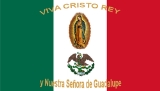
The formal rebellion began on January 1, 1927 with a manifesto sent by Garza on New Year's Day, titled A la Nación (To the Nation). This declared that "the hour of battle has sounded" and "the hour of victory belongs to God". With the declaration, the state of Jalisco, which had seemed to be quiet since the Guadalajara church uprising, exploded. Bands of rebels moving in the "Los Altos" region northeast of Guadalajara began seizing villages, often armed with only ancient muskets and clubs. The Cristeros' battle cry was ¡Viva Cristo Rey! ¡Viva la Virgen de Guadalupe! ("Long live Christ the King
Christ the King

Christ the Monarch is a title of Jesus based on several passages of Bible and, in general, used by all Christians. Many denominations, including Catholics, Anglicans, Episcopalians, Presbyterians, and some Lutherans and Methodists, celebrate, in honour of Christ under this title, the Feast of Christ the King on the last Sunday of the liturgi...
! Long live the Virgin of Guadalupe
Our Lady of Guadalupe

Our Lady of Guadalupe is a celebrated 16th-century icon of the Blessed Virgin Mary, mother of Jesus Christ. The image, also known as the Virgin of Guadalupe represents a famous Marian apparition....
!"). The rebels were an unusual army in that they had no logistical supplies, and relied heavily on raids to towns, trains and ranches in order to supply themselves with money, horses, ammunition
Ammunition

Ammunition, often referred to as ammo, is a generic term derived from the French language la munition which embraced all material used for war , but which in time came to refer specifically to gunpowder and artillery....
 and food.

The Calles government did not take the threat very seriously at first. The rebels did well against the agraristas (a rural militia recruited throughout Mexico) and the Social Defense forces (local militia), but were always defeated by the federal troops who guarded the important cities. At this time, the federal army numbered 79,759 men. When Jalisco federal commander General Jesús Ferreira moved on the rebels, he calmly stated that "it will be less a campaign than a hunt."

However, these rebels, who had had no previous military experience for the most part, planned their battles well. The most successful rebel leaders were Jesús Degollado (a druggist), Victoriano Ramírez (a ranch hand), and two priests, Aristeo Pedroza and José Reyes Vega. At least five priests took up arms, while many more supported them in various ways.

Recent scholarship suggests that for many Cristeros, religious motivations for rebellion were reinforced by other political and material concerns. Participants in the uprising often came from rural communities that had suffered from the government's land reform policies since 1920, or otherwise felt threatened by recent political and economic changes. Many agraristas and other government supporters were also fervent Catholics.

Whether the Cristeros' actions were or were not supported by the episcopate or the Pope has been a subject of controversy. Officially, the Mexican episcopate never supported the rebellion, but by several accounts, the rebels had the episcopate's acknowledgement that their cause was legitimate. The episcopate did not, in any event, condemn the rebels. Bishop José Francisco Orozco
José Francisco Orozco y Jiménez

Jos? Francisco Orozco y Jim?nez was archbishop of Guadalajara, Jalisco, Jalisco, Mexico from 1913 through 1936.He was born in Zamora, Michoac?n on November 19, 1864....
 of Guadalajara remained with the rebels; while formally rejecting armed rebellion, he was unwilling to leave his flock. Many modern historians consider him to have been the real head of the movement.

On February 23, 1927, the Cristeros defeated federal troops for the first time at San Francisco del Rincón
San Francisco del Rincón

San Francisco del Rinc?n is a city and municipalities of Mexico in the western part of the state of Guanajuato, Mexico. The city serves as the municipal seat for the municipality of San Francisco del Rinc?n....
, Guanajuato
Guanajuato

Guanajuato is a state in the central highlands of Mexico. It is named after its capital city, Guanajuato, Guanajuato, which comes from the local indigenous P'urh?pecha language, meaning "Hill of Frogs"....
, followed by another victory at San Julián
San Julián, Jalisco

San Juli?n is a city of about 26,000 people in the Altos region of the Mexico Mexican state of Jalisco. The area is mostly populated with descendants of Spanish speaking immigrants with some mixture of indigenous ancestry....
, Jalisco
Jalisco

Jalisco is a Mexican state in Mexico. The capital of Jalisco is the city of Guadalajara, Jalisco. In the 2005 census, Jalisco had a population of 6,752,113 people....
. The rebellion was almost extinguished, however, on April 19, when Father Vega led a raid against a train thought to be carrying a shipment of money. In the shootout, his brother was killed, and Father Vega had the train cars doused in gasoline and set afire, killing 51 civilians.

This atrocity turned public opinion against the Cristeros. The government began moving the civilians back into the population centers and prevented them from providing supplies to the rebels. By the summer, the rebellion was almost completely quelled. Garza resigned from his position at the head of the rebellion in July, after a failed attempt to raise funds in the United States of America.

The rebellion was given new life by the efforts of Victoriano Ramírez, generally known as "El Catorce" (the fourteen). Legend has it the nickname originated because during jailbreak he killed all fourteen members of the posse sent after him. He then sent a message to the mayor—his uncle—telling him that in the future he should send more men.

El Catorce was illiterate, but a natural guerrilla leader. He brought the rebellion back to life, enabling the National League for the Defense of Religious Liberty to select a general, a mercenary who demanded twice the salary of a federal general. Enrique Gorostieta
Enrique Gorostieta

Enrique Gorostieta Velarde was a Mexico soldier. He was one of the leaders of the Cristero Rebellion.Gorostieta followed a military education at the Heroic Military College of Chapultepec and served in the Porfiriato army....
 was so alienated from Catholicism that he made fun of his own troops' religion. Despite his lack of piety, he trained the rebel troops well, producing disciplined units and officers. Gradually, the Cristeros began to gain the upper hand.

Both priest-commanders, Father Vega and Father Pedroza, were born soldiers. Father Vega was not a typical priest, and was reputed to drink heavily and routinely ignore his vow of chastity. Father Pedroza, by contrast, was rigidly moral and faithful to his priestly vows. However, the fact that the two took up arms at all is problematic from the point of view of Catholic sacrament
Sacrament

A sacrament, as defined in Hexam's Concise Dictionary of Religion is "a rite in which God is uniquely active." Augustine of Hippo defined a Christian sacrament as "a visible sign of an invisible reality." The Anglican Book of Common Prayer speaks of them as "an outward and visible sign of an inward and invisible Grace." Examples of sacram...
al theology.

On June 21, 1927, the first brigade of female Cristeros was formed in Zapopan
Zapopan

Zapopan is the seat of the municipality of Zapopan in the Mexico state of Jalisco, and is part of the Guadalajara Metropolitan Area. As of the 2005 census the population of the city was 1,026,492 inhabitants, that of its municipality 1,155,790....
. They named themselves for Saint Joan of Arc
Joan of Arc

Saint Joan of Arc also known as the Maid of Orleans, is a national heroine of France and a Roman Catholic saint. A peasant girl born in eastern France, she led the French army to several important victories during the Hundred Years' War, claiming divine guidance, and was indirectly responsible for the coronation of Charles VII of Franc...
. The brigade began with 17 women, but soon grew to 135 members. Its mission was to obtain money, weapons, provisions and information for the combatant men; they also cared for the wounded. By March 1928, there were some 10,000 women involved. Many smuggled weapons into the combat zones by carrying them in carts filled with grain or cement. By the end of the war, they numbered some 25,000.

The Cristeros maintained the upper hand throughout 1928, and in 1929, the federal government faced a new crisis: a revolt within Army ranks, led by Arnulfo R. Gómez in Veracruz
Veracruz

Veracruz, formally Veracruz de Ignacio de la Llave is one of the 31 states of Mexico that constitute the republic of Mexico....
. The Cristeros tried to take advantage of this with an attack on Guadalajara in late March. This failed, but the rebels did manage to take Tepatitlán
Tepatitlán de Morelos

Tepatitl?n de Morelos is a city founded in 1883, in the central Mexican state of Jalisco. It is located in the area known as Los Altos de Jalisco , about 70 km east of state capital Guadalajara, Jalisco....
 on April 19. Father Vega was killed in that battle.

However, the military rebellion was met with equal cruelty and force, and the Cristeros were soon facing divisions within their own ranks. Mario Valdés, widely believed by historians to have been a federal spy, managed to stir up sentiment against El Catorce leading to his execution before a rigged court-martial
Court-martial

A court-martial is a military court. These military courts can determine punishments for members of the military subject to military law who are found guilty or may dismiss the charges based on the evidence and the case presented....
.

On June 2, Gorostieta was killed when he was ambushed by a federal patrol. However the rebels had some 50,000 men under arms by this point and seemed poised to draw out the rebellion for a long time.

Diplomacy and the uprising

Before and after the successes had by the rebels and the support of Bishop Orozco, the Mexican bishops supported the Cristeros (this is in dispute- the only comprehensive history of this movement, "The Cristero Rebellion" indicates that with a couple of exceptions the episcopacy was hostile to the movement). The bishops were expelled from Mexico after Father Vega's attack on the train, but they continued to try to influence the war's outcome from outside the country.

In October 1927, the U.S. ambassador to Mexico was Dwight Whitney Morrow. He initiated a series of breakfast meetings with President Calles where the two would discuss a range of issues, from the religious uprising, to oil and irrigation. This earned him the nickname "ham and eggs diplomat" in U.S. papers. Morrow wanted the conflict to end both for regional security and to help find a solution to the oil problem in the U.S. He was aided in his efforts by Father John Burke
John Burke

John Burke was an United States lawyer, jurist, and political leader from North Dakota.Burke was born in Keokuk County, Iowa and moved to the Dakota Territory....
 of the National Catholic Welfare Conference. The Vatican
Holy See

The Holy See is the episcopal jurisdiction of the Bishop of Rome, commonly known as the Pope, and is the preeminent episcopal see of the Roman Catholic Church, forming the central government of the Church....
 was also actively suing for peace.

Calles' term as president was coming to an end and president-elect Álvaro Obregón
Álvaro Obregón

General ?lvaro Obreg?n Salido was President of Mexico of Mexico from 1920 to 1924.Born in Siquisiva, Sonora, Municipality of Navojoa to a poor farming family, He entered politics in 1911 with his election as mayor of the town of Huatabampo....
 was scheduled to take office on December 1, 1927. Two weeks after his election, Obregón was assassinated by a Catholic radical, an event that gravely damaged the peace process.

Congress named Emilio Portes interim president in September 1928, with an election to be held in November 1929. Portes was more open to the Church than Calles had been, allowing Morrow and Burke to reinitiate their peace initiative. Portes told a foreign correspondent on May 1 that "the Catholic clergy, when they wish, may renew the exercise of their rites with only one obligation, that they respect the laws of the land."

The next day, exiled Archbishop Leopoldo Ruíz y Flores issued a statement the bishops would not demand the repeal of the laws, only their more lenient application.

Morrow managed to bring the parties to agreement on June 21, 1929. His office drafted a pact called the arreglos (agreement) that allowed worship to resume in Mexico and granted three concessions to the Catholics: only priests who were named by hierarchical superiors would be required to register, religious instruction in the churches (but not in the schools) would be permitted, and all citizens, including the clergy, would be allowed to make petitions to reform the laws. But the most important part of the agreement was that the church would recover the right to use its properties, and priests recovered their rights to live on such property. Legally speaking, the church was not allowed to own real estate, and its former facilities remained federal property. But the church effectively took control over the properties, and the government never again tried to take these properties back. It was a convenient arrangement for both parties, and the Church ended its support for the rebels.

The agreement led to an unusual end to the war. In the last two years, more anticlerical officers who were hostile to the federal government for reasons other than its position on religion had joined the rebels. When the agreement between the government and the Church was made known, only a minority of the rebels went home, those who felt their battle had been won. As the rebels themselves were not consulted in the talks, most of them felt betrayed and some continued to fight. The church then threatened rebels with excommunication, and gradually the rebellion died out.

The end of the Cristero War affected emigration to the United States. "In the aftermath of their defeat, many of the Cristeros — by some estimates as much as 5 percent of Mexico's population — fled to America. Many of them made their way to Los Angeles, where they found a protector in John Joseph Cantwell, the bishop of what was then the Los Angeles-San Diego diocese." (Rieff, David. "Nuevo Catholics." The New York Times Magazine, 24 Dec. 2006.) The officers, fearing that they would be tried as traitors, tried to keep the rebellion alive. This attempt failed and many were captured and shot, while others escaped to San Luis Potosí
San Luis Potosí, San Luis Potosí

San Luis Potos?, also called SLP or simply San Luis, is the capital of and most populous city in the Mexico Mexican state of San Luis Potos?....
, where General Saturnino Cedillo gave them refuge.

On June 27, 1929, the church bells rang in Mexico for the first time in almost three years. The war had claimed the lives of some 90,000 people: 56,882 on the federal side, 30,000 Cristeros, and numerous civilians and Cristeros who were killed in anticlerical raids after the war's end. As promised by Portes Gil, the Calles Law remained on the books, but no organized federal attempts to enforce it took place. Nonetheless, in several localities, officials continued persecution of Catholic priests based on their interpretation of the law. As of 2009, the anticlerical provisions of the Constitution remain although they are no longer implemented.

Aftermath of the war and the toll on the Church

The government did not abide by the terms of the truce - in violation of its terms, approximately 500 Cristero leaders and 5,000 other Cristeros were shot, frequently in their homes in front of their spouses and children. Particularly offensive to Catholics after the supposed truce was Calles' insistence on a complete state monopoly on education, suppressing all Catholic education and introducing secular education in its place: "We must enter and take possession of the mind of childhood, the mind of youth.". The persecution was continued after the fall of Calles by President Cardenas, an anti-Catholic socialist, and did not relent completely until 1940, when President Manuel Avila Camacho, a practising Catholic, took office.

The effects of the war on the Church were profound. Between 1926 and 1934 at least 40 priests were killed. Where there were 4,500 priests serving the people before the rebellion, in 1934 there were only 334 priests licensed by the government to serve fifteen million people. The rest had been eliminated by emigration, expulsion and assassination. By 1935, 17 states had no priest at all.

Cristero War saints


Miguel Pro
The Catholic Church has recognized several of those killed in the Cristero rebellion as martyr
Martyr

The term martyr is most commonly used today to describe an individual who sacrifices his or her life in order to further a cause or belief for many....
s. Perhaps the best-known is Blessed
Beatification

Beatification is a recognition accorded by the Catholic church of a dead person's accession to Heaven and capacity to intercede on behalf of individuals who pray in his or her name ....
 Miguel Pro
Miguel Pro

Blessed Miguel Agust?n Pro Ju?rez, S.J. was a Mexico Roman Catholic Church Jesuit priest, executed during the persecution of the Catholic Church under the presidency of Plutarco El?as Calles after trumped up charges of involvement in an assassination attempt against former President ?lvaro Obreg?n....
, SJ. This Jesuit priest was executed by firing squad on November 23, 1927, without benefit of a trial, on the grounds that his priestly activities were in defiance of the government. The Calles government hoped to use images of the execution to scare the rebels into surrender, but the photos had the opposite effect. Upon seeing the photos, which the government had printed in all the newspapers, the Cristeros were inspired with a desire to follow Father Pro into martyrdom for Christ. His beatification
Beatification

Beatification is a recognition accorded by the Catholic church of a dead person's accession to Heaven and capacity to intercede on behalf of individuals who pray in his or her name ....
 occurred in 1988.

On May 21, 2000, Pope John Paul II
Pope John Paul II

Pope John Paul II John Paul II is widely acclaimed as one of the most influential leaders of the twentieth century. He has been Pope_John_Paul_II#Role_in_the_fall_of_Communism in bringing down communism in Eastern Europe, as well as significantly improving the Roman Catholic Church's relations with Judaism, the Eastern Orthodox Church, and A...
 canonized
Canonization

Canonization is the act by which a particular Christian church declares a deceased person to be a saint and is included in the canon, or list, of recognized saints....
 a group of 25 martyrs from this period. (They had been beatified on November 22, 1992.) These were mostly priests who did not take up arms but refused to leave their flocks. They were, for the most part, executed by federal forces. Although Pedro de Jesus Maldonado was murdered in 1937, after the war ended, he is considered a Cristero martyr and is a member of this group.

For example, Father Luis Bátiz Sainz was the parish priest in Chalchihuites and a member of the Knights of Columbus
Knights of Columbus

The Knights of Columbus is the world's largest Roman Catholic Church Fraternal and service organizations. Founded in the United States in 1882, it is named in honor of Christopher Columbus and describes itself as being dedicated to the principles of Charity, Unity, Fraternity, and Patriotism....
. He was known for his devotion to the Eucharist
Eucharist

The Eucharist, also called Holy Communion or Lord's Supper and other names, is a Christianity sacrament commemorating, by consecrating bread and wine, the Last Supper, the final meal that Jesus Christ shared with his disciples before his arrest, and eventual crucifixion, when he gave them bread saying, "This is my body", and wine...
 and for his prayer for martyrdom: "Lord, I want to be a martyr; even though I am your unworthy servant, I want to pour out my blood, drop by drop, for your name." In 1926, shortly before the closing of the churches, he was denounced as a conspirator against the government because of his connections with the National League for the Defense of Religious Liberty, which was preparing an armed uprising. A squad of soldiers raided the private house where he was staying on August 14 and took him captive. They executed him without trial together with three youths of the Mexican Association of Catholic Youth.

The Catholic Church has declared thirteen additional victims of the anti-Catholic regime as martyr
Martyr

The term martyr is most commonly used today to describe an individual who sacrifices his or her life in order to further a cause or belief for many....
s, thus paving the way to their beatification. This group was mostly lay people, including the 14-year-old José Sánchez del Río
José Sánchez del Río

Jos? Luis S?nchez del R?o was a young Mexico Cristero War who was put to death by government officials because he refused to renounce his Catholic faith....
. Since they were lay people, they were considered able to have taken up arms, but their histories had to show that they armed in self-defense. On November 20, 2005 at Jalisco
Jalisco

Jalisco is a Mexican state in Mexico. The capital of Jalisco is the city of Guadalajara, Jalisco. In the 2005 census, Jalisco had a population of 6,752,113 people....
 Stadium in Guadalajara, Mexico, Cardinal Jose Saraiva Martins celebrated the beatification of these 13 martyrs.

Battle hymn of the Cristeros


Surviving Cristero, Juan Gutiérrez, recited a hymn sung by the Cristeros:

Spanish:

La Virgen María es nuestra protectora y nuestra defensora cuando hay que temer, Vencerá a los demonios gritando "¡Viva Cristo Rey!", Vencerá a los demonios gritando "¡Viva Cristo Rey!"

Soldados de Cristo: ¡Sigamos la bandera que la Cruz enseña el ejercito de Dios! Sigamos la bandera gritando, "¡Viva Cristo Rey!"

English translation:

The Virgin Mary is our protector and defender when there is something to fear, She will defeat the demons crying "Long live Christ the King!" She will defeat the demons crying "Long live Christ the King!"

Soldiers of Christ let us follow the flag that the Cross shows the army of God! Let us follow the flag crying, "Long live Christ the King!"

Bibliography

  • - encyclical of Pope Pius XI on the persecution of the Church in Mexico (November 18, 1926)
  • Inquiries into the Cristero Insurrection against the Mexican Revolution by Ramon Jrade in Latin American Research Review, Vol. 20, No. 2 (1985), pp. 53-69
  • Meyer, Jean. The Cristero Rebellion: The Mexican People between Church and State, 1926-1929. Cambridge, 1976.
  • Tuck, Jim. The Holy War in Los Altos: A Regional Analysis of Mexico's Cristero Rebellion. University of Arizona Press, 1982. ISBN 0-8165-0779-1
  • Groppe, Lothar. P. Michael Pro SJ: Ein mexikanischer Schlingel wird Priester und Martyrer. Freundeskreis Maria Goretti, e.V., Munich, 1988.
  • Purnell, Jenny. Popular Movements and State Formation in Revolutionary Mexico: The Agraristas and Cristeros of Michoacan. Durham: Duke University Press, 1999.


Further reading

  • Greene, Graham
    Graham Greene

    Henry Graham Greene Order of Merit, Order of the Companions of Honour was an English writer best known as a novelist, but who also produced short stories, plays, screenplays, travel writing and criticism....
    . The Power and the Glory
    The Power and the Glory

    The Power and the Glory is a novel by United Kingdom author Graham Greene. The title is an allusion to the doxology often added to the end of the Lord's Prayer: "For thine is the kingdom, the power, and the glory, now and forever , amen."...
     (novel). New York: Viking Press, 1940 (as The Labyrinthine Ways).
  • Mabry, Donald J. Journal of Church and State Vol. 20, No. 1, (1978), 81-92
  • Luis Gonzalez - Translated by John Upton. San Jose de Gracia: Mexican Village in Transition ISBN 978-0-292-77571-8 (historical novel) Austin, Texas: University of Texas Press, 1982.
