

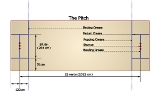
Cricket pitch

Encyclopedia
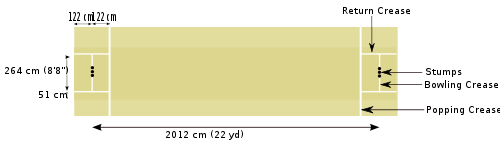
In the game of cricket, the cricket pitch consists of the central strip of the cricket field
Cricket field
A cricket field consists of a large circular or oval-shaped grassy ground on which the game of cricket is played. There are no fixed dimensions for the field but its diameter usually varies between 450 feet to 500 feet...
between the wicket
Wicket
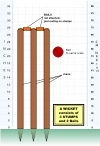
In the sport of cricket the word wicket has several distinct meanings:-Definitions of wicket:Most of the time, the wicket is one of the two sets of three stumps and two bails at either end of the pitch...
s - 1 chain or 22 yards (20.12 m) long and 10 feet (3 m) wide. The surface is very flat and normally covered with extremely short grass though this grass is soon removed by wear at the ends of the pitch.
In amateur matches, artificial pitches
Pitch (sports)
A pitch is an open outdoor area for various activities. It is used in British and Australian English; the comparable term in American English is field...
are commonly used. These can be a slab of concrete, overlaid with a coir mat, artificial turf, some times dirt is put over the coir mat to provide an authentic feeling pitch. Artificial pitches are rare in professional cricket—-being used only when exhibition matches are played in regions where cricket is not a common sport.
The pitch has very specific markings delineating the crease
Crease (cricket)
In the sport of cricket, the crease is a certain area demarcated by white lines painted or chalked on the field of play.The term crease also refers to any of the lines themselves, particularly the popping crease. Law 9 of the Laws of Cricket governs the size and position of the crease markings...
s, as specified by the Laws of Cricket
Laws of cricket
The laws of cricket are a set of rules established by the Marylebone Cricket Club which describe the laws of cricket worldwide, to ensure uniformity and fairness. There are currently 42 laws, which outline all aspects of how the game is played from how a team wins a game, how a batsman is...
.
The word wicket
Wicket
In the sport of cricket the word wicket has several distinct meanings:-Definitions of wicket:Most of the time, the wicket is one of the two sets of three stumps and two bails at either end of the pitch...
often occurs in reference to the pitch. Although technically incorrect according the Laws of Cricket (Law 7 covers the pitch and Law 8 the wickets, distinguishing between them), cricket players, followers, and commentators persist in the usage, with context eliminating any possible ambiguity. Track is yet another synonym for pitch.
The rectangular central area of the cricket field - the space used for pitches - is known as the square.
Protected area
Delivery (cricket)
A delivery or ball in cricket is a single action of bowling a cricket ball towards the batsman.During play of the game, a member of the fielding team is designated as the bowler, and bowls deliveries towards the batsman...
the ball.
If a bowler runs on the protected area, an umpire
Umpire (cricket)
In cricket, an umpire is a person who has the authority to make judgements on the cricket field, according to the Laws of Cricket...
will issue a warning to the bowler and to his team captain. The umpire issues a second and final warning if the bowler transgresses again. On the third offence, the umpire will eject the bowler from the attack and the bowler may not bowl again for the remainder of the innings
Innings
An inning, or innings, is a fixed-length segment of a game in any of a variety of sports – most notably cricket and baseball during which one team attempts to score while the other team attempts to prevent the first from scoring. In cricket, the term innings is both singular and plural and is...
.
The protected area is protected in this way because the ball normally bounces on the pitch within this region, and if it is scuffed or damaged by the bowler's footmarks it can give an unfair advantage to the bowling side. The rule does not prevent the bowler or any other fielder from running on the protected area in an effort to field the ball; it applies only to the uninterrupted follow-through.
State of the pitch
A natural pitch with grass longer or more moist than usual is described as a green pitch. This favours the bowler over the batsman as the ballCricket ball
A cricket ball is a hard, solid leather ball used to play cricket. Constructed of cork and leather, a cricket ball is heavily regulated by cricket law at first class level...
can be made to behave erratically on longer or wet grass. Most club and social cricket is played on pitches that professional cricketers would call green.
A sticky wicket
Sticky wicket
Sticky wicket is a metaphor used to describe a difficult circumstance; it originates from difficult circumstances in the sport of cricket.-Origins:...
- a pitch that has become wet - causes the ball to behave erratically, particularly for the slower or spin
Spin bowling
Spin bowling is a technique used for bowling in the sport of cricket. Practitioners are known as spinners or spin bowlers.-Purpose:The main aim of spin bowling is to bowl the cricket ball with rapid rotation so that when it bounces on the pitch it will deviate, thus making it difficult for the...
bowlers. However, modern pitches are generally protected from rain and dew before and during games so a sticky pitch is rarely seen in first-class cricket
First-class cricket
First-class cricket is a class of cricket that consists of matches of three or more days' scheduled duration, that are between two sides of eleven players and are officially adjudged first-class by virtue of the standard of the competing teams...
. The phrase, however, has retained currency and extended beyond cricket to mean any difficult situation.
As a match progresses, the pitch dries out. The Laws of Cricket bar watering the pitch during a match. As it dries out, initially batting becomes easier as any moisture disappears. Over the course of a four or five day match, however, the pitch begins to crack, then crumble and become dusty. This kind of pitch is colloquially known as a 'dust bowl' or 'minefield'. This again favors bowlers, particularly spin bowlers who can obtain large amounts of traction on the surface and make the ball spin a long way.
This change in the relative difficulties of batting and bowling as the state of the pitch changes during a match is one of the primary strategic considerations that the captain of the team that wins the coin toss will take into account when deciding which team will bat first and can accordingly finalise his decisions.
Covering the pitch
Water hog
A water hog is a machine that removes water from sports grounds. The water hog was invented by Hugh McLaughlin.Driven by a rider, it has a wide, front roller that absorbs the water, transfers it to a storage tank, and allows it to be discharged in a safe location...
.
Preparation and maintenance of the playing area
Law 10 of the Laws of Cricket sets out rules covering the preparation and maintenance of the playing area.Rolling the pitch
During the match the captain of the batting side may request the rolling of the pitch for a period of not more than 7 minutes, before the start of each innings (other than the first innings of the match, and before the start of each subsequent day's play). In addition, if, after the toss and before the first innings of the match, the start is delayed, the captain of the batting side may request to have the pitch rolled for not more than 7 minutes, unless the umpires together agree that the delay has had no significant effect on the state of the pitch. Once the game has begun, rolling may not take place other than under these circumstances.If there is more than one roller available the captain of the batting side shall have the choice. There are detailed rules to make sure that rolling, where possible, is conducted so as not to delay the game, but, if necessary, the game is delayed to allow the batting captain to have up to 7 minutes rolling if he so wishes.
Sweeping
Before a pitch is rolled it is first swept to avoid any possible damage caused by rolling in debris. The pitch is also cleared of any debris at all intervals for meals, between innings and at the beginning of each day. The only exception to this is that the umpires do not allow sweeping to take place where they consider it may be detrimental to the surface of the pitch.Mowing
Groundsmen mow the pitch on each day of a match on which play is expected to take place. Once a game has begun, mowings take place under the supervision of the umpires.Footholes and footholds
The umpires are required to make sure that bowlers' and batsmen's footholes are cleaned out and dried whenever necessary to facilitate play. In matches of more than one day's duration, if necessary, the footholes made by the bowler in his delivery stride may be returfed or covered with quick-setting fillings to make them safe and secure. Players may also secure their footholds using sawdust provided that the pitch is not damaged or they do not do so in a way that is unfair to the other team.Practising on the field
The rules do not allow players to practise bowling or batting on the pitch, or on the area parallel and immediately adjacent to the pitch, at any time on any day of the match. Practice on a day of a match on any other part of the cricket square may take place only before the start of play or after the close of play on that day and must cease 30 minutes before the scheduled start of play or if detrimental to the surface of the square.Typically players do practise on the field of play, but not on the cricket square, during the game. Also bowlers sometimes practise run ups during the game. However, no practice or trial run-up is permitted on the field of play during play if it could result in a waste of time. The rules concerning practice on the field are covered principally by Law 17 of the Laws of Cricket.
Typical pitches
Pitches in different parts of the world have different characteristics. The nature of the pitch plays a very important role in the actual game: it may have a significant influence on team selection and other aspects. A spin bowler may be preferred in the Indian subcontinent where the dry pitches assist spinners (especially towards the end of a five-day test match) whereas an all pace attack may be used in places like Australia where the pitches are bouncy.Pitches in Australia
Pitches in Australia have traditionally been known to be good for fast bowlers because of the amount of bounce that can be generated on these surfaces. In particular, the pitch at the WACA GroundWACA Ground
The WACA is a sports stadium in Perth, Western Australia. WACA are the initials of its owners and operators, the Western Australian Cricket Association....
in Perth is regarded as being possibly the quickest pitch in the world. The Gabba in Brisbane is also known to assist fast bowlers with its bounce. However, these kinds of bouncy pitches also open up more areas for run-scoring, as they promote the playing of a lot of pull, hook and cut shots. Batsmen who play these shots well have a lot of success on these pitches.
Other stadiums like Adelaide Oval
Adelaide Oval
The Adelaide Oval is a sports ground in Adelaide, South Australia, located in the parklands between the Central Business District and North Adelaide...
and Sydney Cricket Ground
Sydney Cricket Ground
The Sydney Cricket Ground is a sports stadium in Sydney in Australia. It is used for Australian football, Test cricket, One Day International cricket, some rugby league and rugby union matches and is the home ground for the New South Wales Blues cricket team and the Sydney Swans of the Australian...
have been known to assist spinners more as these pitches have more dust cover. This makes the stadiums an attractive ground for batsmen, allowing teams on an average have scores of 300 or above in their first innings. The Melbourne Cricket Ground
Melbourne Cricket Ground
The Melbourne Cricket Ground is an Australian sports stadium located in Yarra Park, Melbourne and is home to the Melbourne Cricket Club. It is the tenth largest stadium in the world, the largest in Australia, the largest stadium for playing cricket, and holds the world record for the highest light...
can assist seam bowlers initially, but it has a tennis-ball bounce which can negate the potency of bowlers once a match progresses.
Swing bowling can be a weapon in Australia, but unlike England, it depends upon the overhead conditions, similar to the Indian subcontinent.
Batting in Australia is easier on most pitches. Most back-foot players tend to do well. The only difficulties lie in the unusual bounce of WACA and MCG.
Pitches in England and Wales
Green, swing promoting and humid conditions sums up the construction of English pitches. Early in the season, most batsmen have to be on their guard as English pitches prove to be most fickle, like the country's weather. Later in the summer, the pitches tend to get harder and lose their green. This makes the task easier for batsmen and only genuine fast bowlers like those bowling in range of (130–150 km/h) and spinners can contain. Spinners prove less effective in the first half of the season and tend to play their part only in the second half. The humid conditions and little dust makes the grounds ideal place to practice reverse swing with a 50-over old ball. Andrew FlintoffAndrew Flintoff
Andrew "Freddie" Flintoff MBE is a former English cricketer who played for Lancashire County Cricket Club, England and the Indian Premier League team Chennai Super Kings. A tall fast bowler, batsman and slip fielder, Flintoff according to the ICC rankings was consistently rated amongst the top...
used this weapon to particular effect during England's 2005 and 2009 Ashes victories. Of all grounds, The Oval
The Oval
The Kia Oval, still commonly referred to by its original name of The Oval, is an international cricket ground in Kennington, in the London Borough of Lambeth. In the past it was also sometimes called the Kennington Oval...
is the most dangerous as the ball reverse swings most there. Another reason for this is traditionally it hosts the last international test match of a touring side in a summer. Few formidable wicket-taker spinner had been known to come from the English side for the past many years; until the recent success of left armer
Left-arm orthodox spin
Left-arm orthodox spin is a type of bowling in the sport of cricket.Left-arm orthodox spin is bowled by a left arm bowler using the fingers to spin the ball from right to left of the cricket pitch...
Monty Panesar
Monty Panesar
Mudhsuden Singh Panesar, known as Monty Panesar , is an English cricketer who currently plays for Sussex. A left-arm spinner, Panesar played Test and one-day cricket for England until 2009. In English county cricket he played for Northamptonshire until 2009...
, and right armer
Off spin
Off spin is a type of bowling in the sport of cricket which is bowled by an off spinner, a right-handed spin bowler who uses his or her fingers and/or wrist to spin the ball from a right-handed batsman's off side to the leg side...
Graeme Swann
Graeme Swann
Graeme Peter Swann is an English international cricketer. He is primarily a right-arm offspinner, and also bats right-handed. After initially playing for his home county Northamptonshire, for whom he made his debut in 1997, he moved to Nottinghamshire in 2005. He often fields at slip...
, currently ranked as the world's leading spin bowler in international cricket. This is basically due to lack of practice on home pitches.
England has a reputation for producing some decent swing bowlers. some of the current crop include James Anderson
James Anderson (cricketer)
James Michael "Jimmy" Anderson is an English cricketer. He plays first-class cricket for Lancashire County Cricket Club and since bursting onto the scene in 2002/03, before his first full season of county cricket, Anderson has represented England in over 50 Test matches and over 100 One Day...
and Ryan Sidebottom
Ryan Sidebottom
Ryan Jay Sidebottom is an English cricketer who plays domestic cricket for Yorkshire. He is a primarily a left-arm fast-medium bowler. Sidebottom played his first Test match in 2001 against Pakistan, but failed to take a wicket and was dropped for six years...
.
England is the hub for considerable research in the preparation of cricket pitches, and some outstanding research has recently been conducted by Cranfield University. The same has laid down fresh guidelines for preparation of pitches and is likely to improve the efficiency of a number of groundstaff.
Pitches in India
Pitches in India have historically supported spin bowling rather than seam or swing. Such pitches had virtually no grass, afforded little assistance for pace, bounce, or lateral air movement, but created very good turn. In decades past, legendary spin bowlers—most notably the Indian spin quartetIndian spin quartet
The Indian spin quartet is the collective name given to the Indian spin bowlers of the 1960s and 70s: Erapalli Prasanna and Srinivas Venkataraghavan , Bhagwat Chandrasekhar , and Bishen Singh Bedi . Between them, they played 231 Test matches taking 853 wickets...
of the 1960s and 1970s, consisting of left-armer Bedi
Bishan Singh Bedi
Bishan Singh Bedi is a former Indian cricketer who was primarily a slow left-arm orthodox bowler. He played Test cricket for India from 1966 to 1979 and formed part of the famous Indian spin quartet. He also captained the national side in 22 Test matches...
, offspinners Prasanna and Venkataraghavan
Srinivasaraghavan Venkataraghavan
Srinivasaraghavan Venkataraghavan ; is a former Indian cricketer. He played for Derbyshire in English county cricket from 1973 to 1975. He played Test cricket for the Indian cricket team, and later became an umpire on the elite International Cricket Council Test panel...
, and legspinner Chandrasekhar
Bhagwat Chandrasekhar
Bhagwat Subramanya Chandrasekhar is a former Indian cricketer who specialised in leg spin. Considered amongst the top echelon of leg-spinners, Chandrasekhar along with E.A.S. Prasanna, Bishen Singh Bedi and Srinivasaraghavan Venkataraghavan constituted the Indian spin quartet that dominated...
—routinely toyed with visiting teams to plot dramatic victories for India in home test matches, particularly on turning pitches in hot, humid conditions at Eden Gardens
Eden Gardens
Eden Gardens is a cricket ground in Kolkata , India. It is the home of the Bengal cricket team and the Indian Premier League's Kolkata Knight Riders, as well as being a Test and One Day International ground. It is the largest cricket stadium in India by seating capacity...
in Kolkata (then known as Calcutta) and Chepauk in Chennai (then known as Madras). They outwitted opposing batsmen not only through line, length, and trajectory variations but also by physically and psychologically exploiting rough spots resulting from wear and tear on the playing top and cracks from increasing surface dryness as a game progressed.The Indian batsmen being superb players of spin bowling have generally relished home conditions.Also few opposition teams have fielded quality spinners with Australia having Shane Warne in the team an obvious exception.Not surprisingly building a first inning lead is crucial in matches played in India.While the Brabourne
Brabourne Stadium
The Brabourne Stadium is a cricket ground in the Indian city of Mumbai. It is located on 90,000 square yards of reclaimed land along Marine Drive near Churchgate railway station in South Mumbai. The stadium is owned by the Cricket Club of India . Brabourne Stadium is India's first permanent...
and Wankhede
Wankhede Stadium
The Sheshrao Krushnarao Wankhede Stadium is a cricket stadium in the Indian city of Mumbai. This ground was built after disputes between the Cricket Club of India, which owns the Brabourne Stadium, and the Mumbai Cricket Association over the allocation of tickets for cricket matches...
stadiums in Mumbai and Ferozshah Kotla in Delhi never offered nearly as much turn to spinners, winning a series in India was nevertheless quite difficult, and considered an ultimate challenge for visiting teams, as it is to this day.
Indian pitches and attitudes have changed considerably in the past few years. The induction of several newer venues (such as the one at Mohali
Punjab Cricket Association Stadium
The Punjab Cricket Association Stadium is located at Mohali, just outside the city of Chandigarh. It is popularly referred to as the Mohali Stadium. The stadium is home to the Punjab team. Punjab's second international cricket stadium has been approved by BCCI in Bathinda, Punjab. The...
), the emergence of "genuine" Indian fast bowlers, plus the development of domestic league cricket with international participants in the form of IPL
Indian Premier League
The Indian Premier League is a professional league for Twenty20 cricket competition in India. It was initiated by the Board of Control for Cricket in India , headquartered in Mumbai, and is supervised by BCCI Vice President Rajeev Shukla, who serves as the league's Chairman and Commissioner...
and ICL
Indian Cricket League
The Indian Cricket League was a private cricket league funded by Zee Entertainment Enterprises that operated between 2007 and 2009 in India...
, have resulted in a greater variety of pitches. Some contemporary pitches provide good support for pace, bounce, and swing, giving visiting teams from countries such as South Africa and Australia the feeling of being at home. Surfaces are often tailor made to be flat tops or excessively batsmen-friendly, for the sake of maximizing entertainment value, at the expense of all types of bowlers.
Pitches in South Africa
Pitches resemble those in Australia with added swing(lateral) movement and comparatively lesser bounce. However, genuine fast bowlers who can hit the deck hard and hope for some seam as well do the most damage, the like of which are Shaun PollockShaun Pollock
Shaun Maclean Pollock is a retired South African cricketer who is considered a bowling all-rounder. From 2000 to 2003 he was the captain of the South African cricket team, and also played for Africa XI, World XI, Dolphins and Warwickshire. He was also chosen as the Wisden Cricketer of the Year in...
, Allan Donald
Allan Donald
Allan Anthony Donald is a former South African cricketer and one of their most successful pace bowlers.In his prime, he was one of the best fast bowlers ever seen in Test cricket, reaching the top of the ICC Test rankings in 1998 and peaked with a top ICC ranking of 895 points the next year, the...
, Makhaya Ntini
Makhaya Ntini
Makhaya Ntini is a former South African cricketer who was the first ethnically black player to play for the South African team. A fast bowler, he tends to bowl from wide of the crease with brisk, although not express, pace...
, Dale Steyn
Dale Steyn
Dale Willem Steyn is a South African cricketer who plays in Test and One Day International cricket for South Africa. He is currently the number one ranked Test bowler in the world and achieved the 900+ points benchmark on 13th Nov 2011. Steyn plays domestic cricket in South Africa for Cape Cobras...
, Morne Morkel
Morne Morkel
Morné Morkel is a cricketer who plays Test and limited overs cricket for South Africa. He is a right-arm fast bowler with "genuine pace" according to former South African fast bowler Allan Donald, and a useful lower order left-handed batsman. Some believe he has the ability to become a genuine...
, Andre Nel
Andre Nel
André Nel is a South African cricketer who played Test cricket and ODIs as a fast bowler but has since retired opting to play county cricket for Surrey.-International career:...
and Jacques Kallis
Jacques Kallis
Jacques Henry Kallis is a South African cricketer. As an all-rounder he is a formidable right-handed batsman and fast-medium swingbowler. He is one of the greatest all-rounders of all time, being the only cricketer in the history of the game to hold more than 12,000 runs and 250 wickets in both...
. Spinners gain no assistance as in New Zealand and have to toil hard. This is perhaps a reason why South Africa has failed to produce a quality wicket-taker spinner.
Pitches in New Zealand
New Zealand doesn't depend more on conditions as its neighbor Australia does. The pitches here, like the ones at Eden ParkEden Park
Eden Park is the biggest stadium in Auckland, New Zealand. It is used primarily for rugby union in winter and cricket in summer . The ground also occasionally hostts rugby league matches. To accommodate all three sports, the cricket pitch is removable...
, Auckland and Basin Reserve
Basin Reserve
The Basin Reserve , is a cricket ground in Wellington, New Zealand, used for Test, first-class and one-day cricket. Some argue that its proximity to the city, its Historic Place status and its age make it the most famous cricket ground in New Zealand...
, Wellington are more green than their counterparts in England. This makes the stadiums the most picturesque ones in the world. The ball swings a lot due to the proximity of most stadiums to the sea and seam and bounce help the fast bowlers. The pitches resemble the South African ones, with added wind. Batting can be very trying and only after 30 overs in a day can a batsman hope to adjust to the conditions. Often bowlers are assisted by trade winds that increase the speed the batsmen faces the ball at one end. At the other end, the wind acts as a wall and decreases the pace on the ball and as result adjusting to this is often the most trying part for a visiting teams.
prominent New Zealand seam bowlers of the current era include Shane Bond
Shane Bond
Shane Edward Bond was a New Zealand cricketer, described as "New Zealand's best fast bowler since Sir Richard Hadlee". He has represented New Zealand in Test, ODI and Twenty20 International cricket as well as playing for Canterbury in New Zealand domestic cricket and Warwickshire in English...
, Mark Gillespie
Mark Gillespie (cricketer)
Mark Raymond Gillespie is a member of the New Zealand cricket team. He came to the selectors attention in the 2005-06 season with 43 wickets at 23.16 for Wellington...
, Chris Martin
Chris Martin (cricketer)
Christopher Stewart "Chris" Martin is a New Zealand cricketer. A right-arm fast-medium bowler, Martin now plays provincial cricket for Auckland, having formerly played for the Canterbury Wizards...
, Tim Southee, Kyle Mills
Kyle Mills
Kyle David Mills is a New Zealand cricketer. Kyle is right-arm pace bowler who can also score quick runs in the later stages of one day innings; in October 2009 he reached his peak position of 1st on the Reliance Mobile ICC ODI Bowling Rankings.Having been injured in Australia in February 2007,...
, Michael Mason and James Franklin. The only currently recognised quality spinner is Daniel Vettori
Daniel Vettori
Daniel Luca Vettori ONZM is a cricketer for the New Zealand cricket team. He is the eighth player in Test history to take 300 wickets and score 3,000 runs. He is the youngest player to have represented New Zealand in Test cricket, having made his debut in 1996–97 at the age of 18...
(currently ranked 2nd and 12th in the ICC Reliance Mobile Test All-rounder and Bowler ranking respectively), like Panesar a left-armer. The country has a long reputation of producing finger-spinners.
Pitches in the West Indies
The West Indies tends to produce balanced pitches. Neither is the bounce too disconcerting nor is the movement extravagant.It also does not assist spin like the sub continent pitches and hence for quality batsman they could be batting paradises. However, bowlers who are willing to bend their backs find some assistance from these pitches. Pitches here have earned a reputation of helping the quicks somewhat mainly because of the era gone by when West Indies used to have some of the fastest bowlers in cricket and hence the pitches appeared to be faster than they are. Tall bowlers like Joel GarnerJoel Garner
Joel Garner , also known as "Big Joel" or "Big Bird", is a former West Indian cricketer, and a member of the highly regarded late 1970s and early '80s West Indies cricket teams....
, Michael Holding
Michael Holding
Michael Anthony Holding is a former West Indian cricketer. One of the fastest bowlers ever to play Test cricket, he was nicknamed 'Whispering Death' by umpires due to his quiet approach to the bowling crease...
, Andy Roberts, Colin Croft
Colin Croft
Colin Everton Hunte Croft is a former West Indian cricketer. He provides expert analysis on the British Broadcasting Corporation's Test Match Special.-Cricket career:...
, Curtly Ambrose
Curtly Ambrose
Curtly Elconn Lynwall Ambrose is a former West Indian cricketer. His skill was as a right-arm fast bowler, especially in partnership with Courtney Walsh...
and Courtney Walsh
Courtney Walsh
Courtney Andrew Walsh is a former international cricketer who represented the West Indies from 1984 to 2001, captaining the West Indies in 22 Test matches...
produced bounce and speed even on the most docile pitches that wreaked havoc to any side and they used to run through the line-up. However, some of the best batsmen have arisen from the Caribbean too, like Viv Richards
Viv Richards
Sir Isaac Vivian Alexander Richards, KNH, OBE is a former West Indian cricketer. Better known by his second name, Vivian or, more popularly, simply as Viv or King Viv Richards was voted one of the five Cricketers of the Century in 2000, by a 100-member panel of experts, along with Sir Donald...
, Clive Lloyd
Clive Lloyd
Clive Hubert Lloyd CBE AO is a former West Indies cricketer. He captained the West Indies between 1974 and 1985 and oversaw their rise to become the dominant Test-playing nation, a position that was only relinquished in the latter half of the 1990s...
, Rohan Kanhai
Rohan Kanhai
Rohan Bholalall Kanhai is a former West Indian Cricket player of Indo-Guyanese descent. He is widely considered as one of the best batsmen of the 1960s. Kanhai featured in several great West Indian teams, playing with, among others, Sir Garfield Sobers, Roy Fredericks, Lance Gibbs, and Alvin...
, and Brian Lara
Brian Lara
Brian Charles Lara, TC, OCC, AM is a former West Indian international cricket player. Lara is generally regarded as one of the greatest batsmen of all time...
. Gary Sobers
Garfield Sobers
Sir Garfield St Aubrun Sobers AO, OCC is a former cricketer who captained West Indies. His first name of Garfield is variously abbreviated as Gary or Garry. He is widely regarded as one of cricket's greatest ever all-rounders, having excelled at all the essential skills of batting, bowling and...
is generally considered the greatest all-rounder
All-rounder
An all-rounder is a cricketer who regularly performs well at both batting and bowling. Although all bowlers must bat and quite a few batsmen do bowl occasionally, most players are skilled in only one of the two disciplines and are considered specialists...
of all time. Spinners also have something in the pitches as they offer a little dust and cracks from fourth day onwards.
Pitches in Pakistan
Pitches in Pakistan have historically supported spin bowling rather than seam or swing. However, the conditions in most grounds of Pakistan, like RawalpindiRawalpindi
Rawalpindi , locally known as Pindi, is a city in the Pothohar region of Pakistan near Pakistan's capital city of Islamabad, in the province of Punjab. Rawalpindi is the fourth largest city in Pakistan after Karachi, Lahore and Faisalabad...
, Lahore
Lahore
Lahore is the capital of the Pakistani province of Punjab and the second largest city in the country. With a rich and fabulous history dating back to over a thousand years ago, Lahore is no doubt Pakistan's cultural capital. One of the most densely populated cities in the world, Lahore remains a...
and Peshwar have also seen support for the reverse-swing capabilities of the local bowlers in past times like Imran Khan
Imran Khan
Imran Khan Niazi is a Pakistani politician and former Pakistani cricketer, playing international cricket for two decades in the late twentieth century. After retiring, he entered politics...
, Sarfraz Nawaz
Sarfraz Nawaz
Sarfraz Nawaz Malik is a former Pakistani Test cricketer and politician who discovered reverse swing and was instrumental in Pakistan's first Test series victories over India and England. Between 1969 and 1984 he played 55 Tests and 45 One Day Internationals and was Imran Khan's regular new ball...
and Wasim Akram
Wasim Akram
Wasim Akram is a former Pakistani left arm fast bowler and left-handed batsman in cricketer and model. who represented the Pakistan national cricket team in Test cricket and One Day International matches....
. The dry and windy conditions usually lend good support to the faster bowlers as well. Such pitches had virtually no grass, afforded little assistance for pace, bounce, or lateral air movement, but created very good turn
Bowling (cricket)
In the sport of cricket, bowling is the action of propelling the ball toward the wicket defended by a batsman. A player skilled at bowling is called a bowler; a bowler who is also a competent batsman is known as an all-rounder...
. In decades past, legendary offspinners such as Saqlain Mushtaq
Saqlain Mushtaq
Saqlain Mushtaq is a Pakistani cricketer, regarded as one of the finest off spin bowlers of all time.He is best known for pioneering the "doosra", which he employed to great effect during his career...
credited for the doosra
Doosra
A doosra is a particular type of delivery by an off-spin bowler in the sport of cricket, invented by Pakistani cricketer Saqlain Mushtaq. The term means " second ", or " other " in Urdu...
, and legspinners such as Abdul Qadir
Abdul Qadir (cricketer)
Abdul Qadir Khan is a former Pakistani international cricketer, later commentator and was recently the Chief Selector of Pakistan Cricket Board. He resigned from the post because of his differences with the top brass of Pakistan cricket board...
and Mushtaq Ahmed
Mushtaq Ahmed
Mushtaq Ahmed is a retired Pakistani cricketer who specialised as a leg spin bowler. He was known for his hard-to-pick googly. He memorably trapped Graeme Hick in front with one during the 1992 World Cup final. He was a Wisden Cricketer of the Year in 1997...
, routinely toyed with visiting teams to plot dramatic victories for Pakistan in home test matches, particularly on turning pitches in hot, humid conditions at Arbab Niaz Stadium
Arbab Niaz Stadium
Arbab Niaz Stadium is a Test cricket ground in Peshawar, Khyber Pukhtunkhwa, Pakistan. It replaced the Peshawar Club Ground as the home ground for the Peshawar cricket team in 1985. The ground has hosted 17 ODIs since 1984 , and seven Test matches since 1995, most recently in 2003...
and Gaddafi Stadium
Gaddafi Stadium
Gaddafi Stadium is a cricket ground in Lahore, Pakistan. It was designed by Daghestani-born architect and engineer Nasreddin Murat-Khan who also designed Lahore's Minar-e-Pakistan and constructed by Mian Abdul Khaliq and Company in 1959. Following the ground's renovation for the 1996 Cricket World...
. For Pakistan, a fast bowler needs to have speed around 85mph + so rarely medium bowlers in Pakistan appear and the fastest bowled bowl clocking 100.2mph is for Shoaib Akhtar
Shoaib Akhtar
Shoaib Akhtar is a former Pakistani right arm fast bowler in cricket, who is regarded as the fastest bowler in the history of cricket. He set an official world record by achieving the fastest delivery, when he clocked in at 161.3 km/h in his bowling speed, twice at a cricket match against...
.
Pitches in Pakistan are flat and considered batting paradises for batsmen in winter; they suit spinners in summer, Pakistan is a very dangerous Twenty20
Twenty20
Twenty20 is a form of cricket, originally introduced in England for professional inter-county competition by the England and Wales Cricket Board , in 2003. A Twenty20 game involves two teams, each has a single innings, batting for a maximum of 20 overs. Twenty20 cricket is also known as T20 cricket...
side. Therefore fast bowlers generally have to make something happen on their own. Reverse Swing is credited to Sarfraz Nawaz
Sarfraz Nawaz
Sarfraz Nawaz Malik is a former Pakistani Test cricketer and politician who discovered reverse swing and was instrumental in Pakistan's first Test series victories over India and England. Between 1969 and 1984 he played 55 Tests and 45 One Day Internationals and was Imran Khan's regular new ball...
, who later forwarded the art. Notable Pakistani fast bowlers include Imran Khan
Imran Khan
Imran Khan Niazi is a Pakistani politician and former Pakistani cricketer, playing international cricket for two decades in the late twentieth century. After retiring, he entered politics...
, Wasim Akram
Wasim Akram
Wasim Akram is a former Pakistani left arm fast bowler and left-handed batsman in cricketer and model. who represented the Pakistan national cricket team in Test cricket and One Day International matches....
and Waqar Younis
Waqar Younis
Waqar Younis Maitla is a former Pakistani right arm fast bowler in cricket and widely regarded as one of the greatest fast bowlers of all time...
.
Pitches in Bangladesh
The Bangladeshi wickets receive a lot of rain fall in little time which reflects the soggy nature. The conditions vary from grounds like Sher-e-Bangla Cricket Stadium and Chittagong Divisional StadiumChittagong Divisional Stadium
-See also:*List of Test cricket grounds...
.
Notable spinners include Shakib Al Hasan
Shakib Al Hasan
Shakib Al Hasan is a Bangladeshi international cricketer of the national team. He is an all-rounder, batting left-handed in the middle order and bowling slow left-arm orthodox. He represented Bangladesh at under-19 level, 18 Youth One Day Internationals between 2005 and 2006...
and Abdur Razzak and seamers like Mashrafe Mortaza
Mashrafe Mortaza
Mashrafe Bin Mortaza is a Bangladeshi cricketer. He broke into the national side in late 2001 against Zimbabwe and represented Bangladesh before having played a single first-class match...
.
Pitches in Sri Lanka
Generally dusty and shorn off grass, the rain here also makes it a "sticky wicket". Wickets are flat and doesn't offer much bounce unlike the pitch at Asgiriya StadiumAsgiriya Stadium
Asgiriya International Stadium, is a Cricket stadium situated in Kandy, Sri Lanka. Asgiriya Stadium is the private property of Trinity College, Kandy. It is around a 10 minute walk from the centre of the city. The venue would usually be used when an international team toured Sri Lanka for a Test...
, Kandy
Kandy
Kandy is a city in the center of Sri Lanka. It was the last capital of the ancient kings' era of Sri Lanka. The city lies in the midst of hills in the Kandy plateau, which crosses an area of tropical plantations, mainly tea. Kandy is one of the most scenic cities in Sri Lanka; it is both an...
in Sri Lanka offers generous bounce and favors fast bowling. Bowlers get help under the lights. Spin is the key in these conditions. Muttiah Muralitharan
Muttiah Muralitharan
Muttiah Muralitharan , often referred to as Murali, is a former Sri Lankan cricketer who was rated the greatest Test match bowler ever by Wisden Cricketers' Almanack in 2002...
and Ajantha Mendis
Ajantha Mendis
Balapuwaduge Ajantha Winslo Mendis is a cricketer who plays for the Sri Lankan national cricket team.Mendis, although classified as slow-medium, bowls a mixture of deliveries, including googlies, off-breaks, top-spinners, flippers and leg-breaks, as well as the carrom ball, released with a flick...
are dangerous Sri Lankan bowlers with seamer Lasith Malinga
Lasith Malinga
Separamadu Lasith Malinga is a Sri Lankan cricketer. He is a fast bowler with a rare round-arm action, sometimes referred to as a sling action, which leads to his nickname, "Slinga Malinga"...
the slinger.
Spinners have fine records in the pitches in Sri Lanka. The heat requires extreme level of fitness & the sweaty clothing doesn't quite shine the ball. Reverse swing, off-spin, leg-spin all is effective for a good player. The Lankan batsmen themselves under perform here and spin plays great role in Test and ODI cricket.
Pitches in Zimbabwe
Pitches in Zimbabwe closely resemble those in South Africa, the only difference being in the nature of the bounce. The pitches in South Africa provide fast bounce while the pitches in Zimbabwe tend to have a spongy, tennis ball type of bounce, which makes hitting on the up a risky proposition. Most pitches have slower bounce, hence batting is more favourable in Zimbabwe.Conditions at the Queens Sports Club, Bulawayo
Bulawayo
Bulawayo is the second largest city in Zimbabwe after the capital Harare, with an estimated population in 2010 of 2,000,000. It is located in Matabeleland, 439 km southwest of Harare, and is now treated as a separate provincial area from Matabeleland...
tend to aid batsmen, with spin coming into the game in a big way in the latter stages. The pitch has some grass, though not green enough to leave batsmen anxious. With the temperature touching 28 degrees, the strip is expected to dry out quickly and flatten into a batting beauty. The seamers' best chance will be with the new ball, and both teams feel keen to make first use of the pitch.
Pitches in UAE
The UAE features dry and batting-friendly pitches. New ball helps the bowlers and bowlers eye reverse swing after 34 overs mandatory refurnished ball change. UAE conditions differ significantly from those of Pakistan due to the Gulf's sandy soils. Grounds are not that hard. Dubai Cricket Stadium offers some grass, and fast bowlers like Shoaib AkhtarShoaib Akhtar
Shoaib Akhtar is a former Pakistani right arm fast bowler in cricket, who is regarded as the fastest bowler in the history of cricket. He set an official world record by achieving the fastest delivery, when he clocked in at 161.3 km/h in his bowling speed, twice at a cricket match against...
loop the ball on to the ground. It helps seamers and chasing under Ring of Fire turn out very excitng T20 and ODI internationals. Sheikh Zayed Stadium
Sheikh Zayed Stadium
Sheikh Zayed Stadium is a multi-purpose stadium in Abu Dhabi, United Arab Emirates. It is currently used mostly for football matches but can also stage athletics. It is named after the late Sheikh Zayed bin Sultan Al Nahyan, the founder and first president of the UAE. The construction of the...
is batting-friendly, and the cracks come very late into play.
Related usages
The word pitch also refers to the bouncing of the ball, usually on the pitch. In this context, the ball is said to pitch before it reaches the batsman. Where the ball pitches can be qualified as pitched short (bouncing nearer the bowler), pitched up (nearer the batsman), or pitched on a length (somewhere in between).Unlike in baseball
Baseball
Baseball is a bat-and-ball sport played between two teams of nine players each. The aim is to score runs by hitting a thrown ball with a bat and touching a series of four bases arranged at the corners of a ninety-foot diamond...
, the word pitch is not used to mean the act of propelling the ball towards the batsman. This is usually referred to as a ball or a delivery
Delivery (cricket)
A delivery or ball in cricket is a single action of bowling a cricket ball towards the batsman.During play of the game, a member of the fielding team is designated as the bowler, and bowls deliveries towards the batsman...
. (Also, the word ball does not imply anything about the accuracy of the ball.)