


Cretan School

Encyclopedia
The term Cretan School describes an important school of icon
painting, also known as Post-Byzantine art, which flourished while Crete
was under Venetian
rule during the late Middle Ages
, reaching its climax after the Fall of Constantinople
, becoming the central force in Greek painting during the 15th, 16th and 17th centuries. The Cretan artists developed a particular style of painting under the influence of both Eastern and Western artistic traditions and movements; the most famous product of the school, El Greco
, was the most successful of the many artists who tried to build a career in Western Europe, and also the one who left the Byzantine style farthest behind him in his later career.
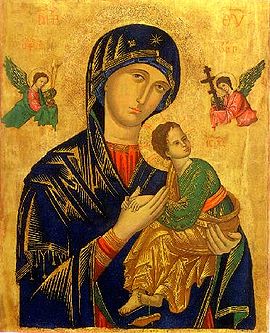 There was a substantial demand for Byzantine icons in Europe throughout the Middle Ages
and, as a Venetian possession since 1204, Crete
had a natural advantage and soon came to dominate the supply. A probable early example is the famous icon of the Virgin in Rome
known as Our Mother of Perpetual Help
, which was certainly well-known in Rome by 1499. At this date there is little to distinguish Cretan work from other Byzantine icons stylistically, and the quality of work is lower than that associated with Constantinople
.
This period also saw considerable numbers of wall-paintings in local churches and monasteries - altogether some 850 from the 14th and 15th centuries survive in Crete, far more than from earlier or later periods.
By the late 15th century, Cretan artists had established a distinct icon-painting style, distinguished by "the precise outlines, the modelling of the flesh with dark brown underpaint and dense tiny highlights on the cheeks of the faces, the bright colours in the garments, the geometrical treatment of the drapery, and, finally the balanced articulation of the composition", or "sharp contours, slim silhouettes, linear draperies and restrained movements". The most famous artist of the period was Andreas Ritzos
(c. 1421-1492), whose son Nicholas was also well-known. Angelos Akotantos, until recently thought to be a conservative painter of the 17th century, is now, after the discovery of a will dated 1436, seen to have been an innovative artist in fusing Byzantine and Western styles, who survived until about 1457, when the will was actually registered. Interestingly, the will was made in anticipation of a voyage to Constantinople; several icons were bequeathed to church institutions, some Catholic but mainly Orthodox, and the disposition of his stock of pattern drawings was carefully specified. Andreas Pavias (d. after 1504) and his pupil Angelos Bizamanos, and Nicholas Tzafuris (d. before 1501) were other leading artists.
Even before the fall of Constantinople
there is evidence that leading Byzantine art
ists were leaving the capital in order to settle in Crete. The migration of Byzantine artists to Crete continued increasingly the next years and reached its peak after the fall of Constantinople in 1453, when Crete became "the most important centre of art in the Greek world", influencing artistic developments in the rest of the Greek world. Cretan icons were commissioned for monasteries on Mount Athos
and elsewhere. The Cretan school had a smaller rival; until it fell to the Turks in 1522, Rhodes
also had a community of artists, but not so large or significant.
 The Venetian archives preserve considerable documentation on the trade of artistic icons between Venice and Crete, which by the end of the 15th century had become one of mass production. There is documentation of a specific order in 1499, of 700 icons of the Virgin, 500 in a Western style, and 200 in Byzantine
style. The order was placed with three artists by two dealers, one Venetian and one from mainland Greece
, and the time between contract date and delivery was set at only forty-five days. Probably the quality of many such commissioned icons was fairly low, and the dismissive term Madonneri was devised to describe such bulk painters, who later practised in Italy also, often using a quasi-Byzantine style, and apparently often Greek or Dalmatian individuals. Production of icons at these levels seems to have led to a glut in the market, and in the following two decades there is much evidence that the Cretan trade declined significantly, as the European demand had been reduced. But at the top end of the market Cretan icons were now the finest in the Byzantine
world.
tradition of Constantinople, while others were influenced by the masters of the Venetian Renaissance, such as Giovanni Bellini
and Titian
. Later Veronese
was to be a particular influence. Works by these masters or copies were in monasteries and churches of the island, while examples of Early Netherlandish painting
decorated the Catholic churches of Candia
or were to be found in the private collections of rich Venetians and Greeks. In particular, Candia contained a large Franciscan church and a large Orthodox monastery, a daughter-house of St. Catherine's, Sinai, both of which had strong collections from their respective traditions.
Contemporary documents refer to two styles in painting: the maniera greca (alla greca, in line with the Byzantine idiom) and the maniera Latina (alla Latina, in accordance with Western techniques), which artists knew and utilized according to the circumstances; as a result some kind of "eclecticism
" appeared. Indeed, sometimes both styles could be found in the same icon, the one right next to the other. The fame of the most prominent Cretan painters spread throughout Greece
, the Mediterranean and Europe. After the beginning of the 16th century the Cretan artists once again had more commissions and their works were avidly sought, since they had started to use new motives and to adjust their iconography to the new trends of their era. To an extent quantity was probably replaced by quality compared with the previous century.
Theophanes the Cretan
He was a relatively conservative Cretan artist, whose first dated work is from 1527, and all of whose known works were done on the mainland or smaller islands. He was the most important Greek wall painter of his day, incorporating some Western iconographic and stylistic elements, but remaining essentially Byzantine in spirit.
El Greco
The intellectual and artistic personality of the young El Greco
was formed in this artistic environment. In 1563, at the age of twenty-two, El Greco was described in a document as a "master" ("maestro Domenigo"), meaning he was already an enrolled master of the local guild, presumably in charge of his own workshop. He left for Venice a few years later, and never returned to Crete.
Migration of Cretan artists
During the second half of the sixteenth century, many Cretan artists went to Venice
, in the hope of gaining commissions and recognition. Unlike El Greco, the other Cretan painters who moved there did not substantially alter their styles or working methods. They simply incorporated more Italian motifs into a consistent Byzantine framework. Jonathan Brown
provides a perceptive analysis of the ways that El Greco distinguished himself from other Cretan artists active in Venice, while Richard Mann argues that "none of these painters accepted Renaissance ideas about the relevance of change to the creation of art works".* R.G. Mann, Tradition and Originality in El Greco's Work, 88 Michael Damaskenos returned to Crete after three years, and remained there for the rest of his life.
 Prominent representatives of the Cretan School during the 17th century were Father Emmanuel Tzanes
(Εμμανουήλ Τζάνες, 1610–1690), Emmanuel Lambardos and Theodoros Poulakis (Θεόδωρος Πουλάκης, 1622–1692). The Cretan icon painters continued to flourish, until the mid-century, when the Ottoman Turks
occupied all the island except for Candia, which finally fell after twenty years of siege in 1669. After the Ottoman occupation of Crete, the centre of Greek painting moved to the Ionian Islands
, which remained under Venetian rule until the Napoleonic Wars
. A new artistic movement was created called the Heptanese School which was mostly influenced by Western European artistic trends. Many Cretan artists migrated to the Heptanese or Western Europe
to enjoy the artistic freedom. A successive occupation of the Ionian islands by the French
and the British
allowed the Heptanese to remain the centre of Greek Art
until the independence of Greece in 1830.
Icon
An icon is a religious work of art, most commonly a painting, from Eastern Christianity and in certain Eastern Catholic churches...
painting, also known as Post-Byzantine art, which flourished while Crete
Crete
Crete is the largest and most populous of the Greek islands, the fifth largest island in the Mediterranean Sea, and one of the thirteen administrative regions of Greece. It forms a significant part of the economy and cultural heritage of Greece while retaining its own local cultural traits...
was under Venetian
Republic of Venice
The Republic of Venice or Venetian Republic was a state originating from the city of Venice in Northeastern Italy. It existed for over a millennium, from the late 7th century until 1797. It was formally known as the Most Serene Republic of Venice and is often referred to as La Serenissima, in...
rule during the late Middle Ages
Middle Ages
The Middle Ages is a periodization of European history from the 5th century to the 15th century. The Middle Ages follows the fall of the Western Roman Empire in 476 and precedes the Early Modern Era. It is the middle period of a three-period division of Western history: Classic, Medieval and Modern...
, reaching its climax after the Fall of Constantinople
Fall of Constantinople
The Fall of Constantinople was the capture of the capital of the Byzantine Empire, which occurred after a siege by the Ottoman Empire, under the command of Ottoman Sultan Mehmed II, against the defending army commanded by Byzantine Emperor Constantine XI...
, becoming the central force in Greek painting during the 15th, 16th and 17th centuries. The Cretan artists developed a particular style of painting under the influence of both Eastern and Western artistic traditions and movements; the most famous product of the school, El Greco
El Greco
El Greco was a painter, sculptor and architect of the Spanish Renaissance. "El Greco" was a nickname, a reference to his ethnic Greek origin, and the artist normally signed his paintings with his full birth name in Greek letters, Δομήνικος Θεοτοκόπουλος .El Greco was born on Crete, which was at...
, was the most successful of the many artists who tried to build a career in Western Europe, and also the one who left the Byzantine style farthest behind him in his later career.
15th century
Middle Ages
The Middle Ages is a periodization of European history from the 5th century to the 15th century. The Middle Ages follows the fall of the Western Roman Empire in 476 and precedes the Early Modern Era. It is the middle period of a three-period division of Western history: Classic, Medieval and Modern...
and, as a Venetian possession since 1204, Crete
Crete
Crete is the largest and most populous of the Greek islands, the fifth largest island in the Mediterranean Sea, and one of the thirteen administrative regions of Greece. It forms a significant part of the economy and cultural heritage of Greece while retaining its own local cultural traits...
had a natural advantage and soon came to dominate the supply. A probable early example is the famous icon of the Virgin in Rome
Rome
Rome is the capital of Italy and the country's largest and most populated city and comune, with over 2.7 million residents in . The city is located in the central-western portion of the Italian Peninsula, on the Tiber River within the Lazio region of Italy.Rome's history spans two and a half...
known as Our Mother of Perpetual Help
Our Mother of Perpetual Help
Our Lady of Perpetual Help or "Sancta Mater de Perpetuo Succursu" Holy Mother of Perpetual Help is a title given to the Blessed Virgin Mary by Pope Pius IX, associated with a Byzantine icon of the same name dating from the 15th century...
, which was certainly well-known in Rome by 1499. At this date there is little to distinguish Cretan work from other Byzantine icons stylistically, and the quality of work is lower than that associated with Constantinople
Constantinople
Constantinople was the capital of the Roman, Eastern Roman, Byzantine, Latin, and Ottoman Empires. Throughout most of the Middle Ages, Constantinople was Europe's largest and wealthiest city.-Names:...
.
This period also saw considerable numbers of wall-paintings in local churches and monasteries - altogether some 850 from the 14th and 15th centuries survive in Crete, far more than from earlier or later periods.
By the late 15th century, Cretan artists had established a distinct icon-painting style, distinguished by "the precise outlines, the modelling of the flesh with dark brown underpaint and dense tiny highlights on the cheeks of the faces, the bright colours in the garments, the geometrical treatment of the drapery, and, finally the balanced articulation of the composition", or "sharp contours, slim silhouettes, linear draperies and restrained movements". The most famous artist of the period was Andreas Ritzos
(c. 1421-1492), whose son Nicholas was also well-known. Angelos Akotantos, until recently thought to be a conservative painter of the 17th century, is now, after the discovery of a will dated 1436, seen to have been an innovative artist in fusing Byzantine and Western styles, who survived until about 1457, when the will was actually registered. Interestingly, the will was made in anticipation of a voyage to Constantinople; several icons were bequeathed to church institutions, some Catholic but mainly Orthodox, and the disposition of his stock of pattern drawings was carefully specified. Andreas Pavias (d. after 1504) and his pupil Angelos Bizamanos, and Nicholas Tzafuris (d. before 1501) were other leading artists.
Even before the fall of Constantinople
Constantinople
Constantinople was the capital of the Roman, Eastern Roman, Byzantine, Latin, and Ottoman Empires. Throughout most of the Middle Ages, Constantinople was Europe's largest and wealthiest city.-Names:...
there is evidence that leading Byzantine art
Byzantine art
Byzantine art is the term commonly used to describe the artistic products of the Byzantine Empire from about the 5th century until the Fall of Constantinople in 1453....
ists were leaving the capital in order to settle in Crete. The migration of Byzantine artists to Crete continued increasingly the next years and reached its peak after the fall of Constantinople in 1453, when Crete became "the most important centre of art in the Greek world", influencing artistic developments in the rest of the Greek world. Cretan icons were commissioned for monasteries on Mount Athos
Mount Athos
Mount Athos is a mountain and peninsula in Macedonia, Greece. A World Heritage Site, it is home to 20 Eastern Orthodox monasteries and forms a self-governed monastic state within the sovereignty of the Hellenic Republic. Spiritually, Mount Athos comes under the direct jurisdiction of the...
and elsewhere. The Cretan school had a smaller rival; until it fell to the Turks in 1522, Rhodes
Rhodes
Rhodes is an island in Greece, located in the eastern Aegean Sea. It is the largest of the Dodecanese islands in terms of both land area and population, with a population of 117,007, and also the island group's historical capital. Administratively the island forms a separate municipality within...
also had a community of artists, but not so large or significant.
Byzantine
Byzantine usually refers to the Roman Empire during the Middle Ages.Byzantine may also refer to:* A citizen of the Byzantine Empire, or native Greek during the Middle Ages...
style. The order was placed with three artists by two dealers, one Venetian and one from mainland Greece
Greece
Greece , officially the Hellenic Republic , and historically Hellas or the Republic of Greece in English, is a country in southeastern Europe....
, and the time between contract date and delivery was set at only forty-five days. Probably the quality of many such commissioned icons was fairly low, and the dismissive term Madonneri was devised to describe such bulk painters, who later practised in Italy also, often using a quasi-Byzantine style, and apparently often Greek or Dalmatian individuals. Production of icons at these levels seems to have led to a glut in the market, and in the following two decades there is much evidence that the Cretan trade declined significantly, as the European demand had been reduced. But at the top end of the market Cretan icons were now the finest in the Byzantine
Byzantine
Byzantine usually refers to the Roman Empire during the Middle Ages.Byzantine may also refer to:* A citizen of the Byzantine Empire, or native Greek during the Middle Ages...
world.
16th century
About 120 artists can be documented working in Candia (the Venetian name of Chandax, present day Herakleion), in the period 1453–1526, and they had organized a Schuola di San Luca painter's guild, based on the Italian model. The blending of the Eastern and the Western traditions, and a relaxed interchange between Greek Orthodox and Roman Catholic rites led to the "Cretan Renaissance", a golden period for the arts on the island, where both literature and painting flourished. Some of these painters chose to continue the ByzantineByzantine art
Byzantine art is the term commonly used to describe the artistic products of the Byzantine Empire from about the 5th century until the Fall of Constantinople in 1453....
tradition of Constantinople, while others were influenced by the masters of the Venetian Renaissance, such as Giovanni Bellini
Giovanni Bellini
Giovanni Bellini was an Italian Renaissance painter, probably the best known of the Bellini family of Venetian painters. His father was Jacopo Bellini, his brother was Gentile Bellini, and his brother-in-law was Andrea Mantegna. He is considered to have revolutionized Venetian painting, moving it...
and Titian
Titian
Tiziano Vecelli or Tiziano Vecellio Tiziano Vecelli or Tiziano Vecellio Tiziano Vecelli or Tiziano Vecellio (c. 1488/1490 – 27 August 1576 better known as Titian was an Italian painter, the most important member of the 16th-century Venetian school. He was born in Pieve di Cadore, near...
. Later Veronese
Paolo Veronese
Paolo Veronese was an Italian painter of the Renaissance in Venice, famous for paintings such as The Wedding at Cana and The Feast in the House of Levi...
was to be a particular influence. Works by these masters or copies were in monasteries and churches of the island, while examples of Early Netherlandish painting
Early Netherlandish painting
Early Netherlandish painting refers to the work of artists active in the Low Countries during the 15th- and early 16th-century Northern renaissance, especially in the flourishing Burgundian cities of Bruges and Ghent...
decorated the Catholic churches of Candia
Heraklion
Heraklion, or Heraclion is the largest city and the administrative capital of the island of Crete, Greece. It is the 4th largest city in Greece....
or were to be found in the private collections of rich Venetians and Greeks. In particular, Candia contained a large Franciscan church and a large Orthodox monastery, a daughter-house of St. Catherine's, Sinai, both of which had strong collections from their respective traditions.
Contemporary documents refer to two styles in painting: the maniera greca (alla greca, in line with the Byzantine idiom) and the maniera Latina (alla Latina, in accordance with Western techniques), which artists knew and utilized according to the circumstances; as a result some kind of "eclecticism
Eclecticism
Eclecticism is a conceptual approach that does not hold rigidly to a single paradigm or set of assumptions, but instead draws upon multiple theories, styles, or ideas to gain complementary insights into a subject, or applies different theories in particular cases.It can sometimes seem inelegant or...
" appeared. Indeed, sometimes both styles could be found in the same icon, the one right next to the other. The fame of the most prominent Cretan painters spread throughout Greece
Greece
Greece , officially the Hellenic Republic , and historically Hellas or the Republic of Greece in English, is a country in southeastern Europe....
, the Mediterranean and Europe. After the beginning of the 16th century the Cretan artists once again had more commissions and their works were avidly sought, since they had started to use new motives and to adjust their iconography to the new trends of their era. To an extent quantity was probably replaced by quality compared with the previous century.
Sixteenth century artists
Apart from El Greco, the most famous Cretan artists during the century were Theophanis Strelitzas (Θεοφάνης Στρελίτζας), known as Theophanes the Cretan, Michael Damaskenos (Μιχαήλ Δαμασκηνός), and Georgios Klontzas (Γεώργιος Κλόντζας). Various members of the Lambardos family were also significant artists. Fortunately for art historians, many Cretan painters adopted the practice, perhaps as early as Western painters, of signing their work, which was not a traditional Byzantine practice.Theophanes the Cretan
He was a relatively conservative Cretan artist, whose first dated work is from 1527, and all of whose known works were done on the mainland or smaller islands. He was the most important Greek wall painter of his day, incorporating some Western iconographic and stylistic elements, but remaining essentially Byzantine in spirit.
El Greco
The intellectual and artistic personality of the young El Greco
El Greco
El Greco was a painter, sculptor and architect of the Spanish Renaissance. "El Greco" was a nickname, a reference to his ethnic Greek origin, and the artist normally signed his paintings with his full birth name in Greek letters, Δομήνικος Θεοτοκόπουλος .El Greco was born on Crete, which was at...
was formed in this artistic environment. In 1563, at the age of twenty-two, El Greco was described in a document as a "master" ("maestro Domenigo"), meaning he was already an enrolled master of the local guild, presumably in charge of his own workshop. He left for Venice a few years later, and never returned to Crete.
Migration of Cretan artists
During the second half of the sixteenth century, many Cretan artists went to Venice
Venice
Venice is a city in northern Italy which is renowned for the beauty of its setting, its architecture and its artworks. It is the capital of the Veneto region...
, in the hope of gaining commissions and recognition. Unlike El Greco, the other Cretan painters who moved there did not substantially alter their styles or working methods. They simply incorporated more Italian motifs into a consistent Byzantine framework. Jonathan Brown
Jonathan Brown
Jonathan Brown is an Australian rules footballer playing for the Brisbane Lions in the Australian Football League. Widely regarded as one of the premier players in the competition, Brown is a three-time club best and fairest winner, two time All Australian , one time Coleman Medallist and three...
provides a perceptive analysis of the ways that El Greco distinguished himself from other Cretan artists active in Venice, while Richard Mann argues that "none of these painters accepted Renaissance ideas about the relevance of change to the creation of art works".* R.G. Mann, Tradition and Originality in El Greco's Work, 88 Michael Damaskenos returned to Crete after three years, and remained there for the rest of his life.
17th century
Emmanuel Tzanes
Emmanuel Tzanes was a Greek Renaissance painter.He was born in Crete and migrated to Venice where he did most of his work. He was one of the most respected Greek painters of his day. Tzanes was a member of the Cretan School and contemporary of another Cretan painter of Venice, Theodore...
(Εμμανουήλ Τζάνες, 1610–1690), Emmanuel Lambardos and Theodoros Poulakis (Θεόδωρος Πουλάκης, 1622–1692). The Cretan icon painters continued to flourish, until the mid-century, when the Ottoman Turks
Ottoman Empire
The Ottoman EmpireIt was usually referred to as the "Ottoman Empire", the "Turkish Empire", the "Ottoman Caliphate" or more commonly "Turkey" by its contemporaries...
occupied all the island except for Candia, which finally fell after twenty years of siege in 1669. After the Ottoman occupation of Crete, the centre of Greek painting moved to the Ionian Islands
Ionian Islands
The Ionian Islands are a group of islands in Greece. They are traditionally called the Heptanese, i.e...
, which remained under Venetian rule until the Napoleonic Wars
Napoleonic Wars
The Napoleonic Wars were a series of wars declared against Napoleon's French Empire by opposing coalitions that ran from 1803 to 1815. As a continuation of the wars sparked by the French Revolution of 1789, they revolutionised European armies and played out on an unprecedented scale, mainly due to...
. A new artistic movement was created called the Heptanese School which was mostly influenced by Western European artistic trends. Many Cretan artists migrated to the Heptanese or Western Europe
Western Europe
Western Europe is a loose term for the collection of countries in the western most region of the European continents, though this definition is context-dependent and carries cultural and political connotations. One definition describes Western Europe as a geographic entity—the region lying in the...
to enjoy the artistic freedom. A successive occupation of the Ionian islands by the French
France
The French Republic , The French Republic , The French Republic , (commonly known as France , is a unitary semi-presidential republic in Western Europe with several overseas territories and islands located on other continents and in the Indian, Pacific, and Atlantic oceans. Metropolitan France...
and the British
United Kingdom
The United Kingdom of Great Britain and Northern IrelandIn the United Kingdom and Dependencies, other languages have been officially recognised as legitimate autochthonous languages under the European Charter for Regional or Minority Languages...
allowed the Heptanese to remain the centre of Greek Art
Greek art
Greek art began in the Cycladic and Minoan prehistorical civilization, and gave birth to Western classical art in the ancient period...
until the independence of Greece in 1830.
See also
- Byzantine scholars in Renaissance
- RenaissanceRenaissanceThe Renaissance was a cultural movement that spanned roughly the 14th to the 17th century, beginning in Italy in the Late Middle Ages and later spreading to the rest of Europe. The term is also used more loosely to refer to the historical era, but since the changes of the Renaissance were not...
- National Gallery (Athens)National Gallery (Athens)The National Art Gallery and Alexander Soutzos Museum is an art museum in Athens devoted to Greek and European art from the 14th century to the 20th century. It is directed by Marina Lambraki-Plaka.-History:...
General School
- Various authors:From Byzantium to El Greco, Athens 1987, Byzantine Museum of Arts
- Chatzidakis, Manolis, in The Icon, 1982, Evans Brothers Ltd, London, 1981, ISBN 0-237-45645-1
- David Talbot-Rice, Byzantine Art, 3rd edn 1968, Penguin Books Ltd
El Greco
- Bray, Xavier; El Greco; 2004; National Gallery Company, London (dist Yale UP);ISBN 1-85709-315-1