
Home      Discussion      Topics      Dictionary      Almanac
Signup       Login
Cow Parsnip

Cow Parsnip

Overview
The Cow Parsnip (Heracleum maximum also known as Indian Celery or Pushki) is the only member of the Hogweed
Hogweed
Heracleum is a genus of about 60 species of biennial and perennial herbs in the carrot family Apiaceae...

 genus native to North America
North America
North America is the northern continent of the Americas, situated in the Earth's northern hemisphere and in the western hemisphere. It is bordered on the north by the Arctic Ocean, on the east by the North Atlantic Ocean, on the southeast by the Caribbean Sea, and on the west by the North Pacific...

. Its classification has caused some difficulty, with recent authoritative sources referring to it variously as Heracleum maximum or Heracleum lanatum , as H. linatum, or as either a subspecies, H. sphondylium subsp. montanum, or a variety, H.
Discussion
Ask a question about 'Cow Parsnip'
Start a new discussion about 'Cow Parsnip'
Answer questions from other users
Full Discussion Forum
 
Encyclopedia
The Cow Parsnip (Heracleum maximum also known as Indian Celery or Pushki) is the only member of the Hogweed
Hogweed
Heracleum is a genus of about 60 species of biennial and perennial herbs in the carrot family Apiaceae...

 genus native to North America
North America
North America is the northern continent of the Americas, situated in the Earth's northern hemisphere and in the western hemisphere. It is bordered on the north by the Arctic Ocean, on the east by the North Atlantic Ocean, on the southeast by the Caribbean Sea, and on the west by the North Pacific...

. Its classification has caused some difficulty, with recent authoritative sources referring to it variously as Heracleum maximum or Heracleum lanatum , as H. linatum, or as either a subspecies, H. sphondylium subsp. montanum, or a variety, H. sphondylium var. linatum, of the Common Hogweed
Common Hogweed
Common Hogweed is an herbaceous biennial plant of the family Apiaceae, which grows in the prairies of Eurasia. It prefers rich humid soils. It is smaller in size than the Giant Hogweed . It is an umbelliferous plant, in the same group as fennel, cow parsley, elder and giant hogweed...

 (H. sphondylium). The classification given here follows ITIS
Integrated Taxonomic Information System
The Integrated Taxonomic Information System is a partnership designed to provide consistent and reliable information on the taxonomy of biological species. ITIS was originally formed in 1996 as an interagency group within the U.S. federal government, involving agencies from the Department of...

.

Distribution


The Cow Parsnip is distributed throughout the continental United States
United States
The United States of America is a federal constitutional republic comprising fifty states and a federal district...

 and Alaska except the Gulf Coast and a few neighboring states. It is listed as "Endangered" in Kentucky and "Special Concern" in Tennessee. In Canada
Canada
Canada is a country occupying most of northern North America, extending from the Atlantic Ocean in the east to the Pacific Ocean in the west and northward into the Arctic Ocean...

, it is found in each province except Nunavut
Nunavut
Nunavut is the largest and newest federal territory of Canada; it was separated officially from the Northwest Territories on April 1, 1999 via the Nunavut Act and the Nunavut Land Claims Agreement Act, though the actual boundaries had been established in 1993...

. It has not been reported in Greenland
Greenland
Greenland is an autonomous constituent country within the Kingdom of Denmark located between the Arctic and Atlantic Oceans, east of the Canadian Arctic Archipelago...

. It may be weed
Weed
A weed in a general sense is a plant that is considered by the user of the term to be a nuisance, and normally applied to unwanted plants in human-made settings such as gardens, lawns or agricultural areas, but also in parks, woods and other natural areas. More specifically, the term is often...

y or invasive
Invasive species
'Invasive species' is a phrase with several definitions. The first definition expresses the phrase in terms of non-indigenous species that adversely affect the habitats they invade economically, environmentally or ecologically...

 in portions of its range.

Characteristics


The Cow Parsnip is a tall herb
Herb
A herb is a plant that is valued for flavor, scent, or other qualities. Herbs are used in cooking, as medicines, and for spiritual purposes....

, reaching to heights of over two metres. It has the characteristic flower umbel
Umbel
An umbel is an inflorescence which consists of a number of short flower stalks which are equal in length and spread from a common point, somewhat like umbrella ribs....

s of the carrot family (Apiaceae
Apiaceae
The Apiaceae or Umbelliferae is a family of usually aromatic plants with hollow stems, commonly known as umbellifers. It includes cumin, parsley, carrot, coriander/cilantro, dill, caraway, fennel, parsnip, celery, Queen Anne's Lace and other relatives. It is a large family with about 300 genera...

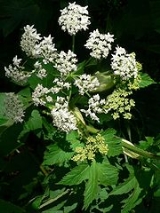
), about 20 cm across; these may be flat-topped, as in the picture at right, or more rounded, and are always white. The leaves are large, up to 40 cm across, divided into lobes. The stems are stout and succulent
Succulent plant
Succulent plants, also known as succulents or fat plants, are water-retaining plants adapted to arid climate or soil conditions. Succulent plants store water in their leaves, stems and/or roots. The storage of water often gives succulent plants a more swollen or fleshy appearance than other plants,...

.

Uses


The juices of all parts contain a phototoxin that can act on contact with skin and exposure to ultraviolet light, causing anything from a mild rash to a blistering, severe dermatitis
Dermatitis
Dermatitis is a blanket term meaning any "inflammation of the skin" . There are several different types of dermatitis. The different kinds usually have in common an allergic reaction to specific allergens. The term may be used to refer to eczema, which is also known as dermatitis eczema or...

, depending on the sensitivity of the individual. The plant is a pernicious weed especially in pastures, where it can ruin the milk of cows that eat it.

Various Native American
Indigenous peoples of the Americas
The indigenous peoples of the Americas are the pre-Columbian inhabitants of the Americas, their descendants, and many ethnic groups who identify with those peoples...

 peoples had many different uses for this plant; all parts of it were used by one nation or another. Perhaps the most common use was to make poultice
Poultice
A poultice, also called cataplasm, is a soft moist mass, often heated and medicated, that is spread on cloth over the skin to treat an aching, inflamed, or painful part of the body...

s to be applied to bruises or sores. In addition, the young stalks and leaf stems — before the plant reaches maturity — were widely used for food with the outer skin peeled off giving a sweetish flavor. The dried stems were also used as drinking straws for the old or infirm, and to make flute
Flute
The flute is a musical instrument of the woodwind group. Unlike woodwind instruments with reeds, a flute is an aerophone or reedless wind instrument that produces its sound from the flow of air across an opening...

s for children. A yellow dye
Dye
A dye can generally be described as a colored substance that has an affinity to the substrate to which it is being applied. The dye is generally applied in an aqueous solution, and may require a mordant to improve the fastness of the dye on the fiber....

 can be made from the roots, and an infusion of the flowers can be rubbed on the body to repel flies and mosquito
Mosquito
Mosquito is a common insect in the family Culicidae...

es.

Similar species


These plants all have white flowers in large compound umbels. Therefore, these plants are confused with each other; the water parsnip, (swamp parsnip, sium suave
Sium suave
Sium suave , the Water Parsnip, is a herb belonging to the parsnip family and comes from Africa and some parts of the Northern Hemisphere.- Appearance :...

) and the western water hemlock, (Cicuta douglasii, poison hemlock) or the spotted water hemlock
Cicuta maculata
Cicuta maculata is a species of flowering plant in the carrot family known by several common names, including spotted water hemlock, spotted parsley, and spotted cowbane. It is native to nearly all of North America, from northern Canada to southern Mexico. This is a rhizomatous perennial herb...

 (cicuta maculata, spotted water hemlock, spotted parsley, spotted cowbane). Water parsnip and water hemlock both have cluster of small white flowers shaped like umbrellas, and both have the same habitat near the shore line of lakes, and rivers. Water parsnip has leaves only once compound, and water hemlock has leaves which are three times compound. Water hemlock has a large swelling at the stem base. All water hemlock is highly poisonous. Water parsnip is not poisonous. The water hemlock has bracts at the base of each small flower cluster, not at the base of the main flower head. The Water parsnip has small bracts at the base of flowers and main flower head as well. The Yarrow, (Common Yarrow, Gordaldo, Nosebleed plant, Old Man's Pepper, Sanguinary, Milfoil, Soldier's Woundwort, Thousand-leaf (as its binomial name affirms), Thousand-seal or Achillea millefolium) also has many small white flowers in a cluster. However, the yarrow has feathery looking leaves which are pinnately
Leaf
In botany, a leaf is an above-ground plant organ specialized for photosynthesis. For this purpose, a leaf is typically flat and thin. There is continued debate about whether the flatness of leaves evolved to expose the chloroplasts to more light or to increase the absorption of carbon dioxide. In...

 separated into small narrow segments. The cow parsnip (heracleum lanatum, Heracleum maxinium Indian Celery or Pushki, and Heracleum sphondylium, hogweed) is also confused in this group with similar flower groupings. However, the cow parsnip has large, broad leaves, and an unpleasant odour.

Hemlock's
Conium
Conium is a genus of two species of highly poisonous perennial herbaceous flowering plants in the family Apiaceae, native to Europe and the Mediterranean region , and to southern Africa ....

 distinguishing characteristics are that it requires a more consistent supply of water than Lomatium or Osha, and Lomatium species tend to prefer dry rocky soils devoid of organic material. Lomatium roots have a delicate rice-like odor, unlike the musty odor of Hemlock, with finely divided, hairlike leaves in most Lomatium species. Lomatium species tend to produce yellow flowers, but some species are white flowered and closely resemble Poison Hemlock. If the plant is growing on a hillside in dry, mineral soil far away from a source of water and has umbells of yellow flowers, its likely a Lomatium. It the plant is growing in an area near water in consistently moist soil, is tall (0.75-2m), has purple splotches on the main stem, and is heavily branched with small umbels of white flowers, it is probably Hemlock and should be avoided.

Osha
Osha
Osha or oshá is a perennial herb used for its medicinal properties. Osha grows in parts of the Rocky Mountains, especially in the North American Southwest. Uses include chewing to relieve sore throat.-Distribution:...

 does not do well in overly moist soils since it is a species dependent on mycorrhizal fungi to survive, but there are areas where Osha and Poison Hemlock can be found only a few feet from each other. Poison Hemlock lacks the "spicy celery" odor of Osha, and is easily distinguished from it due to the absence of hairlike dead leaf material present on the root crown of Osha roots. Poison Hemlock roots in many cases have no discernible odor, and are typically heavily branched rather than carrot-like, but this is not always the case. The plants themselves smell musty or "mousy", and in most instances will have purple blotches or shading on the lower stem of the plant if the plant is fairly mature, but again, this is not always the case.

In the Mountain West of North America, poison hemlock has become well established and invasive, and can be found in remote mountain areas anywhere water is present or soils are persistently moist. It is often found growing in the same habitat and side by side with Osha
Osha
Osha or oshá is a perennial herb used for its medicinal properties. Osha grows in parts of the Rocky Mountains, especially in the North American Southwest. Uses include chewing to relieve sore throat.-Distribution:...

 and Lomatium
Lomatium
Lomatium is a genus of 70 to 80 perennial herbs native to western North America.Several species, including L. cous, L. geyeri, and L. macrocarpum, are sometimes known as biscuit roots for their starchy edible roots. These are or have been traditional Native American foods, eaten cooked or dried...

species, useful medicinal relatives in the Parsley
Parsley
Parsley is a bright green biennial herb, often used as spice. It is common in Middle Eastern, European, and American cooking...

 family which Hemlock closely resembles, and can be very difficult to distinguish from Lomatium (an important historical food plant of Native Americans known as Biscuit Root).

A useful trick to determine whether a plant is poison hemlock rather than fennel
Fennel
Fennel , is a plant species in the genus Foeniculum . It is a member of the family Apiaceae . It is a hardy, perennial, umbelliferous herb, with yellow flowers and feathery leaves...

, which it resembles, is to crush some leaves and smell the result. Fennel smells like anise
Anise
is a flowering plant in the family Apiaceae native to the eastern Mediterranean region and southwest Asia known for its flavor that resembles liquorice, fennel, and tarragon.- Biology :Anise is an herbaceous annual plant growing to tall...

 or liquorice
Liquorice
Liquorice or Licorice is the root of Glycyrrhiza glabra , from which a sweet flavour can be extracted. The liquorice plant is a legume , native to southern Europe and parts of Asia...

, whereas the smell of poison hemlock is often described as mouse-like or musty. Considering the high toxicity of poison hemlock, if the plant cannot be identified it must be discarded. Coniine can be absorbed through the skin, and it is well advised to wash your hands immediately after handling this plant and avoid touching your eyes or mouth if you have recently handled or come into contact with Poison Hemlock, or if you have crushed the leaves of this plant in your hand to perform a "smell test".

Poison hemlock is sometimes confused with water hemlocks
Cicuta
Cicuta is a small genus of four species of highly poisonous plants in the family Apiaceae. They are perennial herbaceous plants which grow up to tall, having distinctive small green or white flowers arranged in an umbrella shape . Commonly known as water hemlock, plants in this genus may also be...

 in the related genus Cicuta
Cicuta
Cicuta is a small genus of four species of highly poisonous plants in the family Apiaceae. They are perennial herbaceous plants which grow up to tall, having distinctive small green or white flowers arranged in an umbrella shape . Commonly known as water hemlock, plants in this genus may also be...

, but are readily distinguished by the less finely divided leaves of the latter; the leaf veins of poison hemlock also run through the tips of the teeth, but those of the water hemlock run through the notches in between the teeth. The poison hemlock's root is long, white, and fleshy and is usually stringy and heavily branched, but can be carrot-like and unbranched in younger specimens of Conium. Water hemlock's roots are made up of several tubers, and are typically chambered, and exude a yellow, rank, highly toxic sap that contains cicutoxin
Cicutoxin
Cicutoxin is a poisonous polyyne and alcohol found in various plants, most notably water hemlock . It is structurally related to the oenanthotoxin of hemlock water dropwort....

.

External links