
Coulomb's law or Coulomb's
inverse-square lawIn physics, an inverse-square law is any physical law stating that a specified physical quantity or strength is inversely proportional to the square of the distance from the source of that physical quantity....
, is a
lawA physical law or scientific law is "a theoretical principle deduced from particular facts, applicable to a defined group or class of phenomena, and expressible by the statement that a particular phenomenon always occurs if certain conditions be present." Physical laws are typically conclusions...
of
physicsPhysics is a natural science that involves the study of matter and its motion through spacetime, along with related concepts such as energy and force. More broadly, it is the general analysis of nature, conducted in order to understand how the universe behaves.Physics is one of the oldest academic...
describing the electrostatic interaction between
electrically chargedElectric charge is a physical property of matter that causes it to experience a force when near other electrically charged matter. Electric charge comes in two types, called positive and negative. Two positively charged substances, or objects, experience a mutual repulsive force, as do two...
particles. It was first published in 1785 by French physicist Charles Augustin de Coulomb and was essential to the development of the
theory of electromagnetismClassical electromagnetism is a branch of theoretical physics that studies consequences of the electromagnetic forces between electric charges and currents...
. Nevertheless, in 1767
Joseph PriestleyJoseph Priestley, FRS was an 18th-century English theologian, Dissenting clergyman, natural philosopher, chemist, educator, and political theorist who published over 150 works...
of England conjectured that the force between charges varied as the inverse squared of the distance. In 1769, Scottish physicist
John RobisonJohn Robison FRSE was a Scottish physicist and mathematician. He was a professor of philosophy at the University of Edinburgh....
announced that according to his measurements, the force of repulsion between two spheres with charges of the same sign varied as x
-2.06. The dependence of the force between charged bodies upon both distance and charge had been discovered, but not published, in the early 1770s by
Henry CavendishHenry Cavendish FRS was a British scientist noted for his discovery of hydrogen or what he called "inflammable air". He described the density of inflammable air, which formed water on combustion, in a 1766 paper "On Factitious Airs". Antoine Lavoisier later reproduced Cavendish's experiment and...
of England, prior to Coulomb's works.
Basic equation
The
scalar formIn linear algebra, real numbers are called scalars and relate to vectors in a vector space through the operation of scalar multiplication, in which a vector can be multiplied by a number to produce another vector....
of Coulomb's law is an expression for the magnitude and sign of the electrostatic force between two idealized
point charges, small in size compared to their separation. This force (
F) acting simultaneously on point charges (
q1) and (
q2), is given by
where
r is the separation distance and
ke is a proportionality constant. A positive force implies it is repulsive, while a negative force implies it is attractive. The proportionality constant
ke, called the Coulomb constant (sometimes called the Coulomb force constant), is related to defined properties of space and can be calculated based on the speed of light to be exactly:
Coulomb's law states that: "The magnitude of the Electrostatics force of interaction between two point charges is directly proportional to the scalar multiplication of the magnitudes of charges and inversely proportional to the square of the distances between them."
In
SISi, si, or SI may refer to :- Measurement, mathematics and science :* International System of Units , the modern international standard version of the metric system...
units, the meter is defined such that the speed of light in vacuum (or electromagnetic waves, in general), denoted
c, is exactly , and the magnetic constant (
μ0) is set at . In agreement with electromagnetic theory, requiring that
the value for the
electric constantThe physical constant ε0, commonly called the vacuum permittivity, permittivity of free space or electric constant is an ideal, physical constant, which is the value of the absolute dielectric permittivity of classical vacuum...
(
ε0) is derived to be . In
electrostatic unitsThe electrostatic system of units is a system of units used to measure electrical quantities of electric charge, current, and voltage, within the centimeter gram second metric system of units. In electrostatic units, electrical charge is defined via the force it exerts on other charges...
and
Gaussian unitsGaussian units comprise a metric system of physical units. This system is the most common of the several electromagnetic unit systems based on cgs units. It is also called the Gaussian unit system, Gaussian-cgs units, or often just cgs units...
, the unit charge (
esu or
statcoulombThe statcoulomb or franklin or electrostatic unit of charge is the physical unit for electrical charge used in the centimetre-gram-second system of units and Gaussian units. It is a derived unit given by...
) is defined in such a way that the Coulomb constant is 1 and dimensionless.
In the more useful vector-form statement, the force in the equation is a vector force acting on either point charge, so directed as to push it away from the other point charge; the right-hand side of the equation, in this case, must have an additional product term of a
unit vector pointing in one of two opposite directions, e.g., from
q1 to
q2 if the force is acting on
q2; the charges may have either sign and the sign of their product determines the ultimate direction of that force. Thus, the vector force pushing the charges away from each other (pulling towards each other if negative) is directly proportional to the product of the charges and
inversely proportional to the squareIn physics, an inverse-square law is any physical law stating that a specified physical quantity or strength is inversely proportional to the square of the distance from the source of that physical quantity....
of the distance between them. The square of the distance part arises from the fact that the
force field due to an isolated point charge is uniform in all directions and gets "diluted" with distance as much as the area of a sphere centered on the point charge expands with its radius.
The
law of superpositionIn physics and systems theory, the superposition principle , also known as superposition property, states that, for all linear systems, the net response at a given place and time caused by two or more stimuli is the sum of the responses which would have been caused by each stimulus individually...
allows this law to be extended to include any number of point charges, to derive the force on any one point charge by a vector addition of these individual forces acting alone on that point charge. The resulting vector happens to be parallel to the
electric fieldIn physics, an electric field surrounds electrically charged particles and time-varying magnetic fields. The electric field depicts the force exerted on other electrically charged objects by the electrically charged particle the field is surrounding...
vector at that point, with that point charge (or "test charge") removed.
Coulomb's law can also be interpreted in terms of
atomic unitsAtomic units form a system of natural units which is especially convenient for atomic physics calculations. There are two different kinds of atomic units, which one might name Hartree atomic units and Rydberg atomic units, which differ in the choice of the unit of mass and charge. This article...
with the force expressed in Hartrees per
Bohr radiusThe Bohr radius is a physical constant, approximately equal to the most probable distance between the proton and electron in a hydrogen atom in its ground state. It is named after Niels Bohr, due to its role in the Bohr model of an atom...
, the charge in terms of the
elementary chargeThe elementary charge, usually denoted as e, is the electric charge carried by a single proton, or equivalently, the absolute value of the electric charge carried by a single electron. This elementary charge is a fundamental physical constant. To avoid confusion over its sign, e is sometimes called...
, and the distances in terms of the
Bohr radius.
Electric field
It follows from the Coulomb's Law that the magnitude of the
electric fieldIn physics, an electric field surrounds electrically charged particles and time-varying magnetic fields. The electric field depicts the force exerted on other electrically charged objects by the electrically charged particle the field is surrounding...
(
E) created by a single point charge (
q) at a certain distance (
r) is given by:
For a positive charge, the direction of the electric field points along lines directed radially away from the location of the point charge, while the direction is the opposite for a negative charge. The
SISi, si, or SI may refer to :- Measurement, mathematics and science :* International System of Units , the modern international standard version of the metric system...
units of electric field are
voltThe volt is the SI derived unit for electric potential, electric potential difference, and electromotive force. The volt is named in honor of the Italian physicist Alessandro Volta , who invented the voltaic pile, possibly the first chemical battery.- Definition :A single volt is defined as the...
s per meter or newtons per
coulomb.
Vector form
In order to obtain both the magnitude and direction of the force on a charge,

at position

, experiencing a field due to the presence of another charge,
q2 at position

, the full vector form of Coulomb's law is required.
where

is the separation of the two charges. This is simply the scalar definition of Coulomb's law with the direction given by the
unit vector,

, parallel with the line
from charge
to charge

.
If both charges have the same
signThe plus and minus signs are mathematical symbols used to represent the notions of positive and negative as well as the operations of addition and subtraction. Their use has been extended to many other meanings, more or less analogous...
(like charges) then the
productIn mathematics, scalar multiplication is one of the basic operations defining a vector space in linear algebra . In an intuitive geometrical context, scalar multiplication of a real Euclidean vector by a positive real number multiplies the magnitude of the vector without changing its direction...

is positive and the direction of the force on

is given by

; the charges repel each other. If the charges have opposite signs then the product

is negative and the direction of the force on

is given by

; the charges attract each other.
System of discrete charges
The principle of linear superposition may be used to calculate the force on a small test charge,

, due to a system of

discrete charges:
where

and

are the magnitude and position respectively of the

charge,

is a unit vector in the direction of

(a vector pointing from charge

to charge

), and

is the magnitude of

(the separation between charges

and

).
Continuous charge distribution
For a charge distribution an
integralIntegration is an important concept in mathematics and, together with its inverse, differentiation, is one of the two main operations in calculus...
over the region containing the charge is equivalent to an infinite summation, treating each
infinitesimalInfinitesimals have been used to express the idea of objects so small that there is no way to see them or to measure them. The word infinitesimal comes from a 17th century Modern Latin coinage infinitesimus, which originally referred to the "infinite-th" item in a series.In common speech, an...
element of space as a point charge

.
For a linear charge distribution (a good approximation for charge in a wire) where

gives the charge per unit length at position

, and

is an infinitesimal element of length,

.
For a surface charge distribution (a good approximation for charge on a plate in a parallel plate
capacitorA capacitor is a passive two-terminal electrical component used to store energy in an electric field. The forms of practical capacitors vary widely, but all contain at least two electrical conductors separated by a dielectric ; for example, one common construction consists of metal foils separated...
) where

gives the charge per unit area at position

, and

is an infinitesimal element of area,
For a volume charge distribution (such as charge within a bulk metal) where

gives the charge per unit volume at position

, and

is an infinitesimal element of volume,
The force on a small test charge

at position

is given by
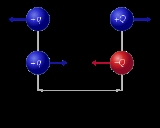
Graphical representation
Below is a graphical representation of Coulomb's law, when

. The vector

is the force experienced by

. The vector

is the force experienced by

. Their magnitudes will always be equal. The vector

is the displacement vector between two charges (

and

).
Electrostatic approximation
In either formulation, Coulomb’s law is fully accurate only when the objects are stationary, and remains approximately correct only for slow movement. These conditions are collectively known as the electrostatic approximation. When movement takes place,
magnetic fieldA magnetic field is a mathematical description of the magnetic influence of electric currents and magnetic materials. The magnetic field at any given point is specified by both a direction and a magnitude ; as such it is a vector field.Technically, a magnetic field is a pseudo vector;...
s that alter the force on the two objects are produced. The magnetic interaction between moving charges may be thought of as a manifestation of the force from the electrostatic field but with
EinsteinAlbert Einstein was a German-born theoretical physicist who developed the theory of general relativity, effecting a revolution in physics. For this achievement, Einstein is often regarded as the father of modern physics and one of the most prolific intellects in human history...
’s
theory of relativityThe theory of relativity, or simply relativity, encompasses two theories of Albert Einstein: special relativity and general relativity. However, the word relativity is sometimes used in reference to Galilean invariance....
taken into consideration.
Atomic forces
Coulomb's law holds even within the atoms, correctly describing the force between the positively charged nucleus and each of the negatively charged electrons. This simple law also correctly accounts for the forces that bind atoms together to form molecules and for the forces that bind atoms and molecules together to form solids and liquids.
Table of derived quantities
| |
Particle property |
Relationship |
Field property |
| Vector quantity |
| Force (on 1 by 2) |
 |
|
 |
| Electric field (at 1 by 2) |
 |
|
| Relationship |
|
|
 |
| Scalar quantity |
| Potential energy (at 1 by 2) |
 |
|
 |
| Potential (at 1 by 2) |
 |
|
See also
- Biot–Savart law
- Method of image charges
The method of image charges is a basic problem-solving tool in electrostatics...
- Electric field
In physics, an electric field surrounds electrically charged particles and time-varying magnetic fields. The electric field depicts the force exerted on other electrically charged objects by the electrically charged particle the field is surrounding...
- Electric constant
The physical constant ε0, commonly called the vacuum permittivity, permittivity of free space or electric constant is an ideal, physical constant, which is the value of the absolute dielectric permittivity of classical vacuum...
- Coulomb, the SI
Si, si, or SI may refer to :- Measurement, mathematics and science :* International System of Units , the modern international standard version of the metric system...
unit of electric chargeElectric charge is a physical property of matter that causes it to experience a force when near other electrically charged matter. Electric charge comes in two types, called positive and negative. Two positively charged substances, or objects, experience a mutual repulsive force, as do two...
named after Charles Augustin de Coulomb
- Electromagnetic force
- Molecular modelling
Molecular modelling encompasses all theoretical methods and computational techniques used to model or mimic the behaviour of molecules. The techniques are used in the fields of computational chemistry, computational biology and materials science for studying molecular systems ranging from small...
- Static forces and virtual-particle exchange
Static force fields are fields, such as a simple electric, magnetic or gravitational fields, that exist without excitations. The most common approximation method that physicists use for scattering calculations can be interpreted as static forces arising from the interactions between two bodies...
- Darwin Lagrangian
- Newton's Law of Universal Gravitation
Newton's law of universal gravitation states that every point mass in the universe attracts every other point mass with a force that is directly proportional to the product of their masses and inversely proportional to the square of the distance between them...
, which uses a similar structure, but for mass instead of charge.
External links