


Cosmatesque

Encyclopedia
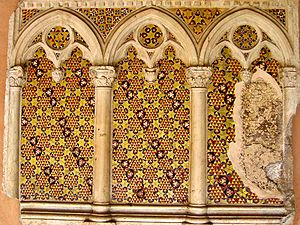
Inlay
Inlay is a decorative technique of inserting pieces of contrasting, often coloured materials into depressions in a base object to form patterns or pictures that normally are flush with the matrix. In a wood matrix, inlays commonly use wood veneers, but other materials like shells, mother-of-pearl,...
stonework typical of Medieval Italy
Italy
Italy , officially the Italian Republic languages]] under the European Charter for Regional or Minority Languages. In each of these, Italy's official name is as follows:;;;;;;;;), is a unitary parliamentary republic in South-Central Europe. To the north it borders France, Switzerland, Austria and...
, and especially of Rome
Rome
Rome is the capital of Italy and the country's largest and most populated city and comune, with over 2.7 million residents in . The city is located in the central-western portion of the Italian Peninsula, on the Tiber River within the Lazio region of Italy.Rome's history spans two and a half...
and its surroundings. It was used most extensively for the decoration of church floors, but was also used to decorate church walls, pulpit
Pulpit
Pulpit is a speakers' stand in a church. In many Christian churches, there are two speakers' stands at the front of the church. Typically, the one on the left is called the pulpit...
s, and bishop's thrones
Cathedra
A cathedra or bishop's throne is the chair or throne of a bishop. It is a symbol of the bishop's teaching authority in the Catholic Church and the Orthodox Church, and has in some sense remained such in the Anglican Communion and in Lutheran churches...
. The name derives from the Cosmati
Cosmati
The Cosmati were a Roman family, seven members of which, for four generations, were skilful architects, sculptors and workers in decorative geometric mosaic, mostly for church floors...
, the leading family workshop of marble
Marble
Marble is a metamorphic rock composed of recrystallized carbonate minerals, most commonly calcite or dolomite.Geologists use the term "marble" to refer to metamorphosed limestone; however stonemasons use the term more broadly to encompass unmetamorphosed limestone.Marble is commonly used for...
craftsmen in Rome who created such geometrical decorations. The style spread across Europe, where it was used in the most prestigious churches; the high altar of Westminster Abbey
Westminster Abbey
The Collegiate Church of St Peter at Westminster, popularly known as Westminster Abbey, is a large, mainly Gothic church, in the City of Westminster, London, United Kingdom, located just to the west of the Palace of Westminster. It is the traditional place of coronation and burial site for English,...
, for example, is decorated with a cosmatesque marble floor.
Description and early history

Cosmati
The Cosmati were a Roman family, seven members of which, for four generations, were skilful architects, sculptors and workers in decorative geometric mosaic, mostly for church floors...
, which flourished in Rome during the twelfth and thirteenth centuries and practiced the art of mosaic. The Cosmati work has this peculiarity, that it is a glass mosaic used in combination with marble. At times it is inlaid on the white marble architrave
Architrave
An architrave is the lintel or beam that rests on the capitals of the columns. It is an architectural element in Classical architecture.-Classical architecture:...
s of doors, on the frieze
Frieze
thumb|267px|Frieze of the [[Tower of the Winds]], AthensIn architecture the frieze is the wide central section part of an entablature and may be plain in the Ionic or Doric order, or decorated with bas-reliefs. Even when neither columns nor pilasters are expressed, on an astylar wall it lies upon...
s of cloisters, the fluting
Fluting (architecture)
Fluting in architecture refers to the shallow grooves running vertically along a surface.It typically refers to the grooves running on a column shaft or a pilaster, but need not necessarily be restricted to those two applications...
s of columns, and on sepulchral monuments. Again, it frames panels, of porphyry
Porphyry (geology)
Porphyry is a variety of igneous rock consisting of large-grained crystals, such as feldspar or quartz, dispersed in a fine-grained feldspathic matrix or groundmass. The larger crystals are called phenocrysts...
or other marbles, on pulpits, episcopal chairs
Cathedra
A cathedra or bishop's throne is the chair or throne of a bishop. It is a symbol of the bishop's teaching authority in the Catholic Church and the Orthodox Church, and has in some sense remained such in the Anglican Communion and in Lutheran churches...
, screens, etc., or is itself used as a panel. The color is brilliant, — gold tesserae being freely used. While more frequent in Rome than elsewhere, its use is not confined to that city. Among other places it is found in the Cappella Palatina
Cappella Palatina
The Palatine Chapel is the royal chapel of the Norman kings of Sicily situated on the ground floor at the center of the Palazzo Reale in Palermo, southern Italy....
in Palermo
Palermo
Palermo is a city in Southern Italy, the capital of both the autonomous region of Sicily and the Province of Palermo. The city is noted for its history, culture, architecture and gastronomy, playing an important role throughout much of its existence; it is over 2,700 years old...
. Just what its connection may be with the southern art of Sicily has yet to be determined.
Although the Cosmati of 12th Century Rome are the eponym
Eponym
An eponym is the name of a person or thing, whether real or fictitious, after which a particular place, tribe, era, discovery, or other item is named or thought to be named...
ous craftsmen of the style, they do not seem to have been the first to develop the art. A similar style may be seen in the pavement of the Benedictine
Benedictine
Benedictine refers to the spirituality and consecrated life in accordance with the Rule of St Benedict, written by Benedict of Nursia in the sixth century for the cenobitic communities he founded in central Italy. The most notable of these is Monte Cassino, the first monastery founded by Benedict...
abbey of Monte Cassino
Monte Cassino
Monte Cassino is a rocky hill about southeast of Rome, Italy, c. to the west of the town of Cassino and altitude. St. Benedict of Nursia established his first monastery, the source of the Benedictine Order, here around 529. It was the site of Battle of Monte Cassino in 1944...
(1066-1071), built using workers from Constantinople
Constantinople
Constantinople was the capital of the Roman, Eastern Roman, Byzantine, Latin, and Ottoman Empires. Throughout most of the Middle Ages, Constantinople was Europe's largest and wealthiest city.-Names:...
, making it likely that the geometric style was heavily influenced by Byzantine floor mosaics
Early Byzantine mosaics in the Middle East
Early Byzantine mosaics in the Middle East are a group of Christian mosaics created between the 4th and the 8th centuries in ancient Syria, Palestine and Egypt when the area belonged to the Byzantine Empire. The eastern provinces of the Eastern Roman and later the Byzantine Empires inherited a...
. However, the technique is different, because Cosmati floors were made from many different size and shape pieces of stone, a technique quite different from opus tessellatum
Opus tessellatum
Opus tessellatum refers to a type of mosaic made from tesserae. Opus tessellatum is usually used for background consisting of horizontally or vertically arranged lines ....
mosaics where the patterns are made from small units which are all the same size and shape. The stone used by the cosmati artists were salvaged material from the ruins of ancient Roman buildings, the large roundels being the carefully cut cross sections of Roman columns .
According to the Catholic Encyclopedia, this style of inlaid ornamental mosaic was "introduced into the decorative art of Europe during the twelfth century, by a marble-worker named Laurentius [also known as "Lorenzo Cosmati"], a native of Anagni, a small hill-town thirty-seven miles east-south-east of Rome. Laurentius acquired his craft from Greek masters and for a time followed their method of work, but early in his career, freeing himself from Byzantine traditions and influences, he worked along original lines and evolved a new style of decorative mosaic, vigorous in colour and design, which he invariably employed in conjunction with plain or sculptored marble surfaces, making it a decorative accessary to some architectural feature.
"As a rule he used white or light-coloured marbles for his backgrounds; these he inlaid with squares, parallelograms, and circles of darker marble, porphyry, or serpentine, surrounding them with ribbons of mosaic composed of coloured and gold-glass tesseræ. These harlequinads he separated one from another with marble mouldings, carvings, and flat bands, and further enriched them with mosaic. His earliest recorded work was executed for a church at Fabieri in 1190, and the earliest existing example is to be seen in the church of Ara Coeli at Rome. It consists of an epistle and gospel ambo, a chair, screen, and pavement.
"In much of his work he was assisted by his son, Jacobus, who was not only a sculptor and mosaic-worker, but also an architect of ability, as witness the architectural alterations carried out by him in the cathedral of Civita Castellana, a foreshadowing of the Renaissance. This was a work in which other members of his family took part, and they were all followers of the craft for four generations. Those attaining eminence in their art are named in the following genealogical epitome: Laurentius (1140-1210); Jacobus (1165-1234); Luca (1221-1240); Jacobus (1213-1293); Deodatus (1225-1294); Johannes (1231-1303)."
Terminology
Cosmatesque work is also known as opus alexandrinum. Definitions of this term, and the distinction between it and opus sectileOpus sectile
Opus sectile refers to an art technique popularized in the ancient and medieval Roman world where materials were cut and inlaid into walls and floors to make a picture or pattern. Common materials were marble, mother of pearl, and glass. The materials were cut in thin pieces, polished, then trimmed...
, vary somewhat. Some restrict opus alexandrinum to the typical large designs, especially for floors, using white guilloche
Guilloché
Guilloché is a decorative engraving technique in which a very precise intricate repetitive pattern or design is mechanically engraved into an underlying material with fine detail...
patterns filled in with roundels and bands in coloured designs using small pieces. Others include any geometric design including large pieces, as in the picture from Spoleto (right side) below, whereas opus sectile also includes figurative designs made in the same technique.
Opus alexandrinum is another form of opus sectile
Opus sectile
Opus sectile refers to an art technique popularized in the ancient and medieval Roman world where materials were cut and inlaid into walls and floors to make a picture or pattern. Common materials were marble, mother of pearl, and glass. The materials were cut in thin pieces, polished, then trimmed...
, where but few colors are used, such as white and black, or dark green on a red ground, or vice versa. This term is particularly employed to designate a species of geometrical mosaic, found in combination with large slabs of marble, much used on the pavements of medieval Roman churches and even in Renaissance times, as, for instance, on the pavements of the Sistine Chapel
Sistine Chapel
Sistine Chapel is the best-known chapel in the Apostolic Palace, the official residence of the Pope in Vatican City. It is famous for its architecture and its decoration that was frescoed throughout by Renaissance artists including Michelangelo, Sandro Botticelli, Pietro Perugino, Pinturicchio...
and the stanza of the Segnatura.
Examples in Rome
Among the churches decorated in cosmatesque style in Rome, the most noteworthy are San Lorenzo fuori le MuraSan Lorenzo fuori le Mura
The Papal Basilica of Saint Lawrence outside the Walls is a Roman Catholic parish church and minor basilica, located in Rome, Italy. The basilica is one of the Seven Pilgrim Churches of Rome and one of the five Patriarchal basilicas, each of which is assigned to a patriarchate. St...
, San Saba
San Saba (Rome)
San Saba is an ancient basilica church in Rome, Italy. It lies on the so-called Piccolo Aventino, which is an area close to the ancient Aurelian Walls next to the Aventine and Caelian Hill....
, San Paolo fuori le Mura, Santa Maria in Aracoeli
Santa Maria in Aracoeli
The Basilica of St. Mary of the Altar of Heaven is a titular basilica in Rome, located on the highest summit of the Campidoglio. It is still the designated Church of the city council of Rome, which uses the ancient title of Senatus Populusque Romanus...
, Santa Maria in Cosmedin
Santa Maria in Cosmedin
The Basilica of Saint Mary in Cosmedin is a minor basilica church in Rome, Italy. It is located in the rione of Ripa.- History :The church was built in the 8th century during the Byzantine Papacy over the remains of the Templum Herculis Pompeiani in the Forum Boarium and of the Statio annonae, one...
, Santa Maria Maggiore and the Stanza della Segnatura at the Vatican
Vatican City
Vatican City , or Vatican City State, in Italian officially Stato della Città del Vaticano , which translates literally as State of the City of the Vatican, is a landlocked sovereign city-state whose territory consists of a walled enclave within the city of Rome, Italy. It has an area of...
. Outside Rome, Anagni
Anagni
Anagni is an ancient town and comune in Latium, central Italy, in the hills east-southeast of Rome. It is a historical center in Ciociaria.-Geography:...
and Ferentino
Ferentino
Ferentino is a town and comune in Italy, in the province of Frosinone, Lazio, 65 km southeast of Rome.It is situated on a hill 400 m above sea-level, in the Monti Ernici area.-History:...
contain remarkable cosmatesque works. Also, Cosmati built innovative decoration for the church of Santa Maria di Pozzano at Civita Castellana
Civita Castellana
Civita Castellana is a town and comune in the province of Viterbo, 65 km north of Rome.Mount Soracte lies about 10 km to the south-east.-History:...
.
External links
- Catholic EncyclopediaCatholic EncyclopediaThe Catholic Encyclopedia, also referred to as the Old Catholic Encyclopedia and the Original Catholic Encyclopedia, is an English-language encyclopedia published in the United States. The first volume appeared in March 1907 and the last three volumes appeared in 1912, followed by a master index...
article on Cosmati Mosaic - Cosmatesque pavement of S. Maria in Cosmedin (with photographs)
- The high altar of Westminster Abbey