


Corona discharge

Encyclopedia
In electricity
, a corona discharge is an electrical discharge brought on by the ionization
of a fluid
surrounding a conductor that is electrically energized. The discharge will occur when the strength (potential gradient
) of the electric field
around the conductor is high enough to form a conductive region, but not high enough to cause electrical breakdown
or arcing
to nearby objects.
in a neutral fluid, usually air, by ion
izing that fluid so as to create a plasma
around the electrode. The ions generated eventually pass charge
to nearby areas of lower potential, or recombine to form neutral gas molecules.
When the potential gradient
is large enough at a point in the fluid, the fluid at that point ionizes and it becomes conductive. If a charged object has a sharp point, the air around that point will be at a much higher gradient than elsewhere. Air near the electrode can become ionized (partially conductive), while regions more distant do not. When the air near the point becomes conductive, it has the effect of increasing the apparent size of the conductor. Since the new conductive region is less sharp, the ionization may not extend past this local region. Outside this region of ionization and conductivity, the charged particles slowly find their way to an oppositely charged object and are neutralized.
If the geometry and gradient are such that the ionized region continues to grow instead of stopping at a certain radius, a completely conductive path may be formed, resulting in a momentary spark
, or a continuous arc
.
Corona discharge usually involves two asymmetric electrodes; one highly curved (such as the tip of a needle, or a small diameter wire) and one of low curvature (such as a plate, or the ground). The high curvature ensures a high potential gradient
around one electrode
, for the generation of a plasma
.
Coronas may be positive or negative. This is determined by the polarity of the voltage on the highly-curved electrode. If the curved electrode is positive with respect to the flat electrode we say we have a positive corona, if negative we say we have a negative corona. (See below for more details.) The physics of positive and negative coronas are strikingly different. This asymmetry is a result of the great difference in mass between electrons and positively charged ion
s, with only the electron
having the ability to undergo a significant degree of ionising inelastic collision
at common temperatures and pressures.
An important reason for considering coronas is the production of ozone
around conductors undergoing corona processes in air. A negative corona generates much more ozone than the corresponding positive corona.
Coronas can be used to generate charged surfaces, which is an effect used in electrostatic copying (photocopying). They can also be used to remove particulate matter from air streams by first charging the air, and then passing the charged stream through a comb of alternating polarity, to deposit the charged particles onto oppositely charged plates.
The free radicals and ions generated in corona reactions can be used to scrub the air of certain noxious products, through chemical reactions, and can be used to produce ozone
.
lines. They also represent a power loss, and their action on atmospheric particulates, along with associated ozone and NOx
production, can also be disadvantageous to human health where power lines run through built-up areas. Therefore, power transmission equipment is designed to minimise the formation of corona discharge.
Corona discharge is generally undesirable in:
Coronas can be suppressed by corona ring
s, toroidal devices that serve to spread the electric field over larger area and decrease the field gradient below the corona threshold.
The onset voltage of corona or corona inception voltage (CIV) can be found with Peek's law
(1929), formulated from empirical observations. Later papers derived more accurate formulas.
over the surface of the conductor. The power
loss is determined by multiplying the current by the voltage.
However, the electrons in a positive corona are concentrated close to the surface of the curved conductor, in a region of high-potential gradient (and therefore the electrons have a high energy), whereas in a negative corona many of the electrons are in the outer, lower-field areas. Therefore, if electrons are to be used in an application which requires a high activation energy, positive coronas may support a greater reaction constants than corresponding negative coronas; though the total number of electrons may be lower, the number of a very high energy electrons may be higher.
Coronas are efficient producers of ozone in air. A positive corona generates much less ozone than the corresponding negative corona, as the reactions which produce ozone are relatively low-energy. Therefore, the greater number of electrons of a negative corona leads to an increased production.
Beyond the plasma, in the unipolar region, the flow is of low-energy positive ions toward the flat electrode.
In a positive corona, secondary electrons, for further avalanches, are generated predominantly in the fluid itself, in the region outside the plasma
or avalanche region. They are created by ionization caused by the photons emitted from that plasma in the various de-excitation processes occurring within the plasma after electron collisions, the thermal energy liberated in those collisions creating photons which are radiated into the gas. The electrons resulting from the ionisation of a neutral gas molecule are then electrically attracted back toward the curved electrode, attracted into the plasma, and so begins the process of creating further avalanches inside the plasma.
As can be seen, the positive corona is divided into two regions, concentric around the sharp electrode. The inner region contains ionising electrons, and positive ions, acting as a plasma, the electrons avalanche in this region, creating many further ion/electron pairs. The outer region consists almost entirely of the slowly migrating massive positive ions, moving toward the uncurved electrode along with, close to the interface of this region, secondary electrons, liberated by photons leaving the plasma, being re-accelerated into the plasma. The inner region is known as the plasma region, the outer as the unipolar region.
Electrons ionized from the neutral gas are not useful in sustaining the negative corona process by generating secondary electrons for further avalanches, as the general movement of electrons in a negative corona is outward from the curved electrode. For negative corona, instead, the dominant process generating secondary electrons is the photoelectric effect
, from the surface of the electrode itself. The work-function of the electrons (the energy required to liberate the electrons from the surface) is considerably lower than the ionization energy of air at standard temperatures and pressures, making it a more liberal source of secondary electrons under these conditions. Again, the source of energy for the electron-liberation is a high-energy photon from an atom within the plasma body relaxing after excitation from an earlier collision. The use of ionized neutral gas as a source of ionization is further diminished in a negative corona by the high-concentration of positive ions clustering around the curved electrode.
Under other conditions, the collision of the positive species with the curved electrode can also cause electron liberation.
The difference, then, between positive and negative coronas, in the matter of the generation of secondary electron avalanches, is that in a positive corona they are generated by the gas surrounding the plasma region, the new secondary electrons travelling inward, whereas in a negative corona they are generated by the curved electrode itself, the new secondary electrons travelling outward.
A further feature of the structure of negative coronas is that as the electrons drift outwards, they encounter neutral molecules and, with electronegative molecules (such as oxygen
and water vapor
), combine to produce negative ions. These negative ions are then attracted to the positive uncurved electrode, completing the 'circuit'.
A negative corona can be divided into three radial areas, around the sharp electrode. In the inner area, high-energy electrons inelastically collide with neutral atoms and cause avalanches, whilst outer electrons (usually of a lower energy) combine with neutral atoms to produce negative ions. In the intermediate region, electrons combine to form negative ions, but typically have insufficient energy to cause avalanche ionization, but remain part of a plasma owing to the different polarities of the species present, and the ability to partake in characteristic plasma reactions. In the outer region, only a flow of negative ions and, to a lesser and radially-decreasing extent, free electrons toward the positive electrode takes place. The inner two regions are known as the corona plasma. The inner region is an ionizing plasma, the middle a non-ionizing plasma. The outer region is known as the unipolar region.
wires that have become worn.
Electricity
Electricity is a general term encompassing a variety of phenomena resulting from the presence and flow of electric charge. These include many easily recognizable phenomena, such as lightning, static electricity, and the flow of electrical current in an electrical wire...
, a corona discharge is an electrical discharge brought on by the ionization
Ionization
Ionization is the process of converting an atom or molecule into an ion by adding or removing charged particles such as electrons or other ions. This is often confused with dissociation. A substance may dissociate without necessarily producing ions. As an example, the molecules of table sugar...
of a fluid
Fluid
In physics, a fluid is a substance that continually deforms under an applied shear stress. Fluids are a subset of the phases of matter and include liquids, gases, plasmas and, to some extent, plastic solids....
surrounding a conductor that is electrically energized. The discharge will occur when the strength (potential gradient
Potential gradient
A potential gradient is the local space rate of change of the potential with respect to displacement.In electrostatics then, it is the local space rate of change of the electric potential:Units are volts per meter...
) of the electric field
Electric field
In physics, an electric field surrounds electrically charged particles and time-varying magnetic fields. The electric field depicts the force exerted on other electrically charged objects by the electrically charged particle the field is surrounding...
around the conductor is high enough to form a conductive region, but not high enough to cause electrical breakdown
Electrical breakdown
The term electrical breakdown or electric breakdown has several similar but distinctly different meanings. For example, the term can apply to the failure of an electric circuit....
or arcing
Electric arc
An electric arc is an electrical breakdown of a gas which produces an ongoing plasma discharge, resulting from a current flowing through normally nonconductive media such as air. A synonym is arc discharge. An arc discharge is characterized by a lower voltage than a glow discharge, and relies on...
to nearby objects.
Introduction
A corona is a process by which a current, perhaps sustained, develops from an electrode with a high potentialPotential
*In linguistics, the potential mood*The mathematical study of potentials is known as potential theory; it is the study of harmonic functions on manifolds...
in a neutral fluid, usually air, by ion
Ion
An ion is an atom or molecule in which the total number of electrons is not equal to the total number of protons, giving it a net positive or negative electrical charge. The name was given by physicist Michael Faraday for the substances that allow a current to pass between electrodes in a...
izing that fluid so as to create a plasma
Plasma (physics)
In physics and chemistry, plasma is a state of matter similar to gas in which a certain portion of the particles are ionized. Heating a gas may ionize its molecules or atoms , thus turning it into a plasma, which contains charged particles: positive ions and negative electrons or ions...
around the electrode. The ions generated eventually pass charge
Electric charge
Electric charge is a physical property of matter that causes it to experience a force when near other electrically charged matter. Electric charge comes in two types, called positive and negative. Two positively charged substances, or objects, experience a mutual repulsive force, as do two...
to nearby areas of lower potential, or recombine to form neutral gas molecules.
When the potential gradient
Gradient
In vector calculus, the gradient of a scalar field is a vector field that points in the direction of the greatest rate of increase of the scalar field, and whose magnitude is the greatest rate of change....
is large enough at a point in the fluid, the fluid at that point ionizes and it becomes conductive. If a charged object has a sharp point, the air around that point will be at a much higher gradient than elsewhere. Air near the electrode can become ionized (partially conductive), while regions more distant do not. When the air near the point becomes conductive, it has the effect of increasing the apparent size of the conductor. Since the new conductive region is less sharp, the ionization may not extend past this local region. Outside this region of ionization and conductivity, the charged particles slowly find their way to an oppositely charged object and are neutralized.
If the geometry and gradient are such that the ionized region continues to grow instead of stopping at a certain radius, a completely conductive path may be formed, resulting in a momentary spark
Electrostatic discharge
Electrostatic discharge is a serious issue in solid state electronics, such as integrated circuits. Integrated circuits are made from semiconductor materials such as silicon and insulating materials such as silicon dioxide...
, or a continuous arc
Electric arc
An electric arc is an electrical breakdown of a gas which produces an ongoing plasma discharge, resulting from a current flowing through normally nonconductive media such as air. A synonym is arc discharge. An arc discharge is characterized by a lower voltage than a glow discharge, and relies on...
.
Corona discharge usually involves two asymmetric electrodes; one highly curved (such as the tip of a needle, or a small diameter wire) and one of low curvature (such as a plate, or the ground). The high curvature ensures a high potential gradient
Potential gradient
A potential gradient is the local space rate of change of the potential with respect to displacement.In electrostatics then, it is the local space rate of change of the electric potential:Units are volts per meter...
around one electrode
Electrode
An electrode is an electrical conductor used to make contact with a nonmetallic part of a circuit...
, for the generation of a plasma
Plasma (physics)
In physics and chemistry, plasma is a state of matter similar to gas in which a certain portion of the particles are ionized. Heating a gas may ionize its molecules or atoms , thus turning it into a plasma, which contains charged particles: positive ions and negative electrons or ions...
.
Coronas may be positive or negative. This is determined by the polarity of the voltage on the highly-curved electrode. If the curved electrode is positive with respect to the flat electrode we say we have a positive corona, if negative we say we have a negative corona. (See below for more details.) The physics of positive and negative coronas are strikingly different. This asymmetry is a result of the great difference in mass between electrons and positively charged ion
Ion
An ion is an atom or molecule in which the total number of electrons is not equal to the total number of protons, giving it a net positive or negative electrical charge. The name was given by physicist Michael Faraday for the substances that allow a current to pass between electrodes in a...
s, with only the electron
Electron
The electron is a subatomic particle with a negative elementary electric charge. It has no known components or substructure; in other words, it is generally thought to be an elementary particle. An electron has a mass that is approximately 1/1836 that of the proton...
having the ability to undergo a significant degree of ionising inelastic collision
Inelastic collision
An inelastic collision, in contrast to an elastic collision, is a collision in which kinetic energy is not conserved.In collisions of macroscopic bodies, some kinetic energy is turned into vibrational energy of the atoms, causing a heating effect, and the bodies are deformed.The molecules of a gas...
at common temperatures and pressures.
An important reason for considering coronas is the production of ozone
Ozone
Ozone , or trioxygen, is a triatomic molecule, consisting of three oxygen atoms. It is an allotrope of oxygen that is much less stable than the diatomic allotrope...
around conductors undergoing corona processes in air. A negative corona generates much more ozone than the corresponding positive corona.
Applications of corona discharge
Corona discharge has a number of commercial and industrial applications.- Drag reduction over a flat surface
- Removal of unwanted electric charges from the surface of aircraft in flight and thus avoiding the detrimental effect of uncontrolled electrical discharge pulses on the performance of avionic systems
- Manufacture of ozoneOzoneOzone , or trioxygen, is a triatomic molecule, consisting of three oxygen atoms. It is an allotrope of oxygen that is much less stable than the diatomic allotrope...
- Sanitization of pool water
- Scrubbing particles from air in air-conditioning systems (see electrostatic precipitatorElectrostatic precipitatorAn electrostatic precipitator , or electrostatic air cleaner is a particulate collection device that removes particles from a flowing gas using the force of an induced electrostatic charge...
) - Removal of unwanted volatile organics, such as chemical pesticides, solvents, or chemical weapons agents, from the atmosphereEarth's atmosphereThe atmosphere of Earth is a layer of gases surrounding the planet Earth that is retained by Earth's gravity. The atmosphere protects life on Earth by absorbing ultraviolet solar radiation, warming the surface through heat retention , and reducing temperature extremes between day and night...
- Improvement of wetability or 'surface tension energy' of polymerPolymerA polymer is a large molecule composed of repeating structural units. These subunits are typically connected by covalent chemical bonds...
films to improve compatibility with adhesives or printing inks - Photocopying
- Air ioniserAir ioniserAn air ioniser is a device that uses high voltage to ionise air molecules. Negative ions, or anions, are particles with one or more extra electrons, conferring a net negative charge to the particle. Cations are positive ions missing one or more electrons, resulting in a net positive charge...
s - Production of photons for Kirlian photographyKirlian photographyKirlian photography refers to a form of photogram made with voltage. It is named after Semyon Kirlian, who in 1939 accidentally discovered that if an object on a photographic plate is connected to a source of voltage an image is produced on the photographic plate.Kirlian's work, from 1939 onward,...
to expose photographic film - EHD thrusters, Lifters, and other ionic wind devices
- Nitrogen laserNitrogen laserA nitrogen laser is a gas laser operating in the ultraviolet range using molecular nitrogen as its gain medium, pumped by an electrical discharge....
- Surface treatment for tissue culture (polystyrenePolystyrenePolystyrene ) also known as Thermocole, abbreviated following ISO Standard PS, is an aromatic polymer made from the monomer styrene, a liquid hydrocarbon that is manufactured from petroleum by the chemical industry...
) - Ionization of a gaseous sample for subsequent analysis in a mass spectrometer or an ion mobility spectrometerIon mobility spectrometerIon-mobility spectrometry is an analytical technique used to separate and identify ionized molecules in the gas phase based on their mobility in a carrier buffer gas...
- Solid-state cooling components for computer chips (see solid-state fanSolid-state fanA solid-state fan is a device used to produce an airflow with no moving parts. Such a device may use the principle of electro-aerodynamic pumping, which is based on corona discharge....
)
Coronas can be used to generate charged surfaces, which is an effect used in electrostatic copying (photocopying). They can also be used to remove particulate matter from air streams by first charging the air, and then passing the charged stream through a comb of alternating polarity, to deposit the charged particles onto oppositely charged plates.
The free radicals and ions generated in corona reactions can be used to scrub the air of certain noxious products, through chemical reactions, and can be used to produce ozone
Ozone
Ozone , or trioxygen, is a triatomic molecule, consisting of three oxygen atoms. It is an allotrope of oxygen that is much less stable than the diatomic allotrope...
.
Problems caused by corona discharges
Coronas can generate audible and radio-frequency noise, particularly near electric power transmissionElectric power transmission
Electric-power transmission is the bulk transfer of electrical energy, from generating power plants to Electrical substations located near demand centers...
lines. They also represent a power loss, and their action on atmospheric particulates, along with associated ozone and NOx
NOx
NOx is a generic term for the mono-nitrogen oxides NO and NO2 . They are produced from the reaction of nitrogen and oxygen gases in the air during combustion, especially at high temperatures...
production, can also be disadvantageous to human health where power lines run through built-up areas. Therefore, power transmission equipment is designed to minimise the formation of corona discharge.
Corona discharge is generally undesirable in:
- Electric power transmissionElectric power transmissionElectric-power transmission is the bulk transfer of electrical energy, from generating power plants to Electrical substations located near demand centers...
, where it causes:- Power loss
- Audible noise
- Electromagnetic interference
- Purple glow
- OzoneOzoneOzone , or trioxygen, is a triatomic molecule, consisting of three oxygen atoms. It is an allotrope of oxygen that is much less stable than the diatomic allotrope...
production - Insulation damage
- Inside electrical components such as transformerTransformerA transformer is a device that transfers electrical energy from one circuit to another through inductively coupled conductors—the transformer's coils. A varying current in the first or primary winding creates a varying magnetic flux in the transformer's core and thus a varying magnetic field...
s, capacitorCapacitorA capacitor is a passive two-terminal electrical component used to store energy in an electric field. The forms of practical capacitors vary widely, but all contain at least two electrical conductors separated by a dielectric ; for example, one common construction consists of metal foils separated...
s, electric motorElectric motorAn electric motor converts electrical energy into mechanical energy.Most electric motors operate through the interaction of magnetic fields and current-carrying conductors to generate force...
s and generatorsElectrical generatorIn electricity generation, an electric generator is a device that converts mechanical energy to electrical energy. A generator forces electric charge to flow through an external electrical circuit. It is analogous to a water pump, which causes water to flow...
. Corona progressively damages the insulation inside these devices, leading to premature equipment failure. One form of attack is ozone crackingOzone crackingCracks can be formed in many different elastomers by ozone attack, and the characteristic form of attack of vulnerable rubbers is known as ozone cracking...
of elastomerElastomerAn elastomer is a polymer with the property of viscoelasticity , generally having notably low Young's modulus and high yield strain compared with other materials. The term, which is derived from elastic polymer, is often used interchangeably with the term rubber, although the latter is preferred...
items like O-rings. - Situations where high voltages are in use, but ozone production is to be minimised
- Static electricityStatic electricityStatic electricity refers to the build-up of electric charge on the surface of objects. The static charges remain on an object until they either bleed off to ground or are quickly neutralized by a discharge. Static electricity can be contrasted with current electricity, which can be delivered...
discharge
Coronas can be suppressed by corona ring
Corona ring
A corona ring, also called anti-corona ring, is a toroid of conductive material located in the vicinity of a terminal of a high voltage device. It is electrically insulated. Stacks of more spaced rings are often used...
s, toroidal devices that serve to spread the electric field over larger area and decrease the field gradient below the corona threshold.
Mechanism of corona discharge
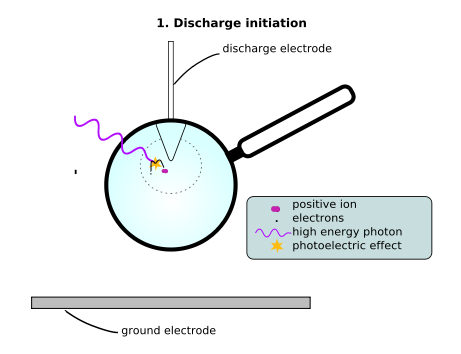
Corona discharge of both the positive and negative variety have certain mechanisms in common.- A neutral atom or molecule of the medium, in a region of strong electric fieldElectric fieldIn physics, an electric field surrounds electrically charged particles and time-varying magnetic fields. The electric field depicts the force exerted on other electrically charged objects by the electrically charged particle the field is surrounding...
(such as the high potential gradientPotential gradientA potential gradient is the local space rate of change of the potential with respect to displacement.In electrostatics then, it is the local space rate of change of the electric potential:Units are volts per meter...
near the curved electrode) is ionized by an exogenous environmental event (for example, as the result of a photonPhotonIn physics, a photon is an elementary particle, the quantum of the electromagnetic interaction and the basic unit of light and all other forms of electromagnetic radiation. It is also the force carrier for the electromagnetic force...
interaction), to create a positive ionIonAn ion is an atom or molecule in which the total number of electrons is not equal to the total number of protons, giving it a net positive or negative electrical charge. The name was given by physicist Michael Faraday for the substances that allow a current to pass between electrodes in a...
and a free electronElectronThe electron is a subatomic particle with a negative elementary electric charge. It has no known components or substructure; in other words, it is generally thought to be an elementary particle. An electron has a mass that is approximately 1/1836 that of the proton...
.
- The electric field then operates on these charged particles, separating them, and preventing their recombination, and also accelerating them, imparting each of them with kinetic energy.
- As a result of the energisation of the electrons (which have a much higher charge/mass ratio and so are accelerated to a higher velocity), further electron/positive-ion pairs may be created by collision with neutral atoms. These then undergo the same separating process creating an electron avalancheElectron avalancheAn electron avalanche is a process in which a number of free electrons in a medium are subjected to strong acceleration by an electric field, ionizing the medium's atoms by collision , thereby forming "new" electrons to undergo the same process in successive cycles...
. Both positive and negative coronas rely on electron avalanches.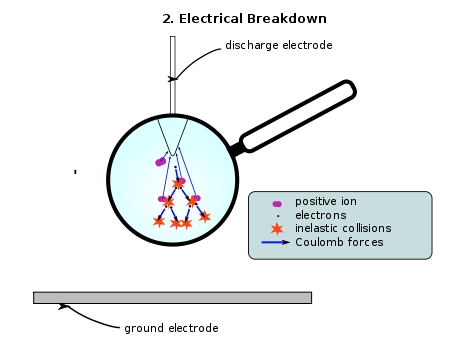
- In processes which differ between positive and negative coronas, the energy of these plasma processes is converted into further initial electron dissociations to seed further avalanches.
- An ion species created in this series of avalanches (which differs between positive and negative coronas) is attracted to the uncurved electrode, completing the circuit, and sustaining the current flow.
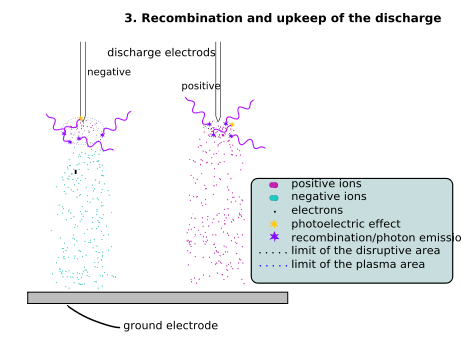
The onset voltage of corona or corona inception voltage (CIV) can be found with Peek's law
Peek's law
In physics, Peek's law is a description of the conditions necessary for corona discharge between two wires:e_v = m_v g_v \delta r \ln \left...
(1929), formulated from empirical observations. Later papers derived more accurate formulas.
Electrical properties
The current carried by the corona is determined by integrating the current densityCurrent density
Current density is a measure of the density of flow of a conserved charge. Usually the charge is the electric charge, in which case the associated current density is the electric current per unit area of cross section, but the term current density can also be applied to other conserved...
over the surface of the conductor. The power
Power (physics)
In physics, power is the rate at which energy is transferred, used, or transformed. For example, the rate at which a light bulb transforms electrical energy into heat and light is measured in watts—the more wattage, the more power, or equivalently the more electrical energy is used per unit...
loss is determined by multiplying the current by the voltage.
Properties
A positive corona is manifested as a uniform plasma across the length of a conductor. It can often be seen glowing blue/white, though many of the emissions are in the ultraviolet. The uniformity of the plasma owes itself to the homogeneous source of secondary avalanche electrons described in the mechanism section, below. With the same geometry and voltages, it appears a little smaller than the corresponding negative corona, owing to the lack of a non-ionising plasma region between the inner and outer regions. There are many fewer free electrons in a positive corona, when compared to a negative corona, except very close to the curved electrode: perhaps a thousandth of the electron density, and a hundredth of the total number of electrons.However, the electrons in a positive corona are concentrated close to the surface of the curved conductor, in a region of high-potential gradient (and therefore the electrons have a high energy), whereas in a negative corona many of the electrons are in the outer, lower-field areas. Therefore, if electrons are to be used in an application which requires a high activation energy, positive coronas may support a greater reaction constants than corresponding negative coronas; though the total number of electrons may be lower, the number of a very high energy electrons may be higher.
Coronas are efficient producers of ozone in air. A positive corona generates much less ozone than the corresponding negative corona, as the reactions which produce ozone are relatively low-energy. Therefore, the greater number of electrons of a negative corona leads to an increased production.
Beyond the plasma, in the unipolar region, the flow is of low-energy positive ions toward the flat electrode.
Mechanism
As with a negative corona, a positive corona is initiated by an exogenous ionisation event in a region of high potential gradient. The electrons resulting from the ionisation are attracted toward the curved electrode, and the positive ions repelled from it. By undergoing inelastic collisions closer and closer to the curved electrode, further molecules are ionized in an electron avalanche.In a positive corona, secondary electrons, for further avalanches, are generated predominantly in the fluid itself, in the region outside the plasma
Plasma (physics)
In physics and chemistry, plasma is a state of matter similar to gas in which a certain portion of the particles are ionized. Heating a gas may ionize its molecules or atoms , thus turning it into a plasma, which contains charged particles: positive ions and negative electrons or ions...
or avalanche region. They are created by ionization caused by the photons emitted from that plasma in the various de-excitation processes occurring within the plasma after electron collisions, the thermal energy liberated in those collisions creating photons which are radiated into the gas. The electrons resulting from the ionisation of a neutral gas molecule are then electrically attracted back toward the curved electrode, attracted into the plasma, and so begins the process of creating further avalanches inside the plasma.
As can be seen, the positive corona is divided into two regions, concentric around the sharp electrode. The inner region contains ionising electrons, and positive ions, acting as a plasma, the electrons avalanche in this region, creating many further ion/electron pairs. The outer region consists almost entirely of the slowly migrating massive positive ions, moving toward the uncurved electrode along with, close to the interface of this region, secondary electrons, liberated by photons leaving the plasma, being re-accelerated into the plasma. The inner region is known as the plasma region, the outer as the unipolar region.
Properties
A negative corona is manifested in a non-uniform corona, varying according to the surface features and irregularities of the curved conductor. It often appears as tufts of corona at sharp edges, the number of tufts altering with the strength of the field. The form of negative coronas is a result of its source of secondary avalanche electrons (see below). It appears a little larger than the corresponding positive corona, as electrons are allowed to drift out of the ionising region, and so the plasma continues some distance beyond it. The total number of electrons, and electron density is much greater than in the corresponding positive corona. However, they are of a predominantly lower energy, owing to being in a region of lower potential-gradient. Therefore, whilst for many reactions the increased electron density will increase the reaction rate, the lower energy of the electrons will mean that reactions which require a higher electron energy may take place at a lower rate.Mechanism
Negative coronas are more complex than positive coronas in construction. As with positive coronas, the establishing of a corona begins with an exogenous ionization event generating a primary electron, followed by an electron avalanche.Electrons ionized from the neutral gas are not useful in sustaining the negative corona process by generating secondary electrons for further avalanches, as the general movement of electrons in a negative corona is outward from the curved electrode. For negative corona, instead, the dominant process generating secondary electrons is the photoelectric effect
Photoelectric effect
In the photoelectric effect, electrons are emitted from matter as a consequence of their absorption of energy from electromagnetic radiation of very short wavelength, such as visible or ultraviolet light. Electrons emitted in this manner may be referred to as photoelectrons...
, from the surface of the electrode itself. The work-function of the electrons (the energy required to liberate the electrons from the surface) is considerably lower than the ionization energy of air at standard temperatures and pressures, making it a more liberal source of secondary electrons under these conditions. Again, the source of energy for the electron-liberation is a high-energy photon from an atom within the plasma body relaxing after excitation from an earlier collision. The use of ionized neutral gas as a source of ionization is further diminished in a negative corona by the high-concentration of positive ions clustering around the curved electrode.
Under other conditions, the collision of the positive species with the curved electrode can also cause electron liberation.
The difference, then, between positive and negative coronas, in the matter of the generation of secondary electron avalanches, is that in a positive corona they are generated by the gas surrounding the plasma region, the new secondary electrons travelling inward, whereas in a negative corona they are generated by the curved electrode itself, the new secondary electrons travelling outward.
A further feature of the structure of negative coronas is that as the electrons drift outwards, they encounter neutral molecules and, with electronegative molecules (such as oxygen
Oxygen
Oxygen is the element with atomic number 8 and represented by the symbol O. Its name derives from the Greek roots ὀξύς and -γενής , because at the time of naming, it was mistakenly thought that all acids required oxygen in their composition...
and water vapor
Water vapor
Water vapor or water vapour , also aqueous vapor, is the gas phase of water. It is one state of water within the hydrosphere. Water vapor can be produced from the evaporation or boiling of liquid water or from the sublimation of ice. Under typical atmospheric conditions, water vapor is continuously...
), combine to produce negative ions. These negative ions are then attracted to the positive uncurved electrode, completing the 'circuit'.
A negative corona can be divided into three radial areas, around the sharp electrode. In the inner area, high-energy electrons inelastically collide with neutral atoms and cause avalanches, whilst outer electrons (usually of a lower energy) combine with neutral atoms to produce negative ions. In the intermediate region, electrons combine to form negative ions, but typically have insufficient energy to cause avalanche ionization, but remain part of a plasma owing to the different polarities of the species present, and the ability to partake in characteristic plasma reactions. In the outer region, only a flow of negative ions and, to a lesser and radially-decreasing extent, free electrons toward the positive electrode takes place. The inner two regions are known as the corona plasma. The inner region is an ionizing plasma, the middle a non-ionizing plasma. The outer region is known as the unipolar region.
Examples
Corona discharge may be seen around automotive spark plugSpark plug
A spark plug is an electrical device that fits into the cylinder head of some internal combustion engines and ignites compressed fuels such as aerosol, gasoline, ethanol, and liquefied petroleum gas by means of an electric spark.Spark plugs have an insulated central electrode which is connected by...
wires that have become worn.
See also
- Atmospheric pressure chemical ionizationAtmospheric pressure chemical ionizationAtmospheric-pressure chemical ionization is an ionization method used in mass spectrometry. It is a form of chemical ionization which takes place at atmospheric pressure.-How it works:...
- Dielectric barrier dischargeDielectric barrier dischargeDielectric-barrier discharge is the electrical discharge between two electrodes separated by an insulating dielectric barrier. Originally called silent discharge and also known as ozone production discharge or partial discharge, it was first reported by Ernst Werner von Siemens in 1857.- Process...
- Kirlian photographyKirlian photographyKirlian photography refers to a form of photogram made with voltage. It is named after Semyon Kirlian, who in 1939 accidentally discovered that if an object on a photographic plate is connected to a source of voltage an image is produced on the photographic plate.Kirlian's work, from 1939 onward,...
- OzoneOzoneOzone , or trioxygen, is a triatomic molecule, consisting of three oxygen atoms. It is an allotrope of oxygen that is much less stable than the diatomic allotrope...
- Ozone crackingOzone crackingCracks can be formed in many different elastomers by ozone attack, and the characteristic form of attack of vulnerable rubbers is known as ozone cracking...
- St. Elmo's fireSt. Elmo's fireSt. Elmo's fire is a weather phenomenon in which luminous plasma is created by a coronal discharge from a grounded object in an electric field in the atmosphere St. Elmo's fire is named after St. Erasmus of Formiae St. Elmo's fire (also St. Elmo's light) is a weather phenomenon in which luminous...
External links
- Blaze Labs Research — Lots of information on corona properties & Peek's Law
- Villanova University — Modelling Corona for different electrode configurations
- Information about the differences between corona, spark, and brush discharges
- Additional information about corona, its effects, characteristics and preventative measures
- Dielectric Phenomena In High Voltage Engineering