

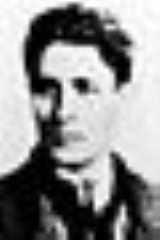
Corneliu Zelea Codreanu

Encyclopedia
Corneliu Zelea Codreanu (korˈnelju ˈzele̯a koˈdre̯anu; born Corneliu Zelinski and commonly known as Corneliu Codreanu; September 13, 1899 – November 30, 1938) was a Romania
n politician of the far right
, the founder and charismatic leader of the Iron Guard
or The Legion of the Archangel Michael (also known as the Legionary Movement), an ultra-nationalist and violently antisemitic organization active throughout most of the interwar period
. Generally seen as the main variety of local fascism
, and noted for its mystical
and Romanian Orthodox
-inspired revolutionary message, it grew into an important actor on the Romanian political stage, coming into conflict with the political establishment and the democratic
forces, and often resorting to terrorism
. The Legionaries traditionally referred to Codreanu as Căpitanul ("The Captain"), and he held absolute authority over the organization until his death.
Codreanu, who began his career in the wake of World War I
as an anticommunist and antisemitic agitator associated with A. C. Cuza
and Constantin Pancu, was a co-founder of the National-Christian Defense League
and assassin of the Iaşi
Police
prefect Constantin Manciu. Codreanu left Cuza to found a succession of movements on the far right
, rallying around him a growing segment of the country's intelligentsia
and peasant population, and inciting pogrom
s in various parts of Greater Romania
. Several times outlawed by successive Romanian cabinets, his Legion assumed different names and survived in the underground, during which time Codreanu formally delegated leadership to Gheorghe Cantacuzino-Grănicerul. Following Codreanu's instructions, the Legion carried out assassinations of politicians it viewed as corrupt, including Premier
Ion G. Duca
and its former associate Mihai Stelescu
. In parallel, Corneliu Zelea Codreanu advocated Romania's adherence to a military and political alliance formed around Nazi Germany
.
He registered his main electoral success during the 1937 suffrage
, but was blocked out of power by King
Carol II
, who came to favor rival fascist alternatives around the National Christian Party
and the National Renaissance Front
. The rivalry between, on one side, Codreanu, and, on the other, Carol and moderate politician Nicolae Iorga
ended in the former's imprisonment at Jilava
and assassination at the hands of the Gendarmerie
. He was succeeded as leader by Horia Sima
. In 1940, under the National Legionary State
proclaimed by the Iron Guard, his killing served as the basis for violent retribution.
Corneliu Zelea Codreanu's views influenced the modern far right. Groups claiming him as a forerunner include Noua Dreaptă
and other Romanian successors of the Iron Guard, the International Third Position
, and various neofascist organizations in Italy
and other parts of Europe.
to Ion Zelea Codreanu and Elizabeth née Brunner. His father, a teacher, would later become a political figure within his son's movement. A native of Bukovina
in Austria-Hungary
, Ion had originally been known as Zelinski; his wife was ethnically German
. Statements according to which Ion Zelea Codreanu was originally a Slav
of Ukrainian
or Polish
origin contrast with the Romanian chauvinism
he embraced for the rest of his life. Thus, Codreanu the elder associated with antisemitic figures such as University of Iaşi professor A. C. Cuza
. Just prior to Codreanu's 1938 trial, his origins were the subject of an anti-Legionary propagandistic
campaign organized by the authorities, who distributed copies of a variant of his genealogy
which alleged that he was of mixed ancestry, being the descendant of not just Ukrainians, Germans, and Romanians, but also Czechs and Russians
, and that several of their ancestors were delinquents. Historian Ilarion Ţiu describes this as an attempt to offend and libel Codreanu.
Too young for conscription
in 1916, when Romania entered World War I
on the Entente side
, Corneliu nonetheless tried his best to enlist and fight in the subsequent campaign. His education at the military school in Bacău
(where he was a colleague of Petre Pandrea, the future left-wing activist) ended in the same year as Romania's direct implication in the war. In 1919, after moving to Iaşi
, Codreanu found communism
as his new enemy, after he had witnessed the impact of Bolshevik
agitation in Moldavia
, and especially after Romania lost her main ally in the October Revolution
, forcing her to sign the 1918 Treaty of Bucharest
; also, the newly-founded Comintern
was violently opposed to Romania's interwar
borders (see Greater Romania
).
While the Bolshevik presence decreased overall following the repression of Socialist Party
riots in Bucharest
(December 1918), it remained or was perceived as relatively strong in Iaşi and other Moldavian cities and towns. In this context, the easternmost region of Bessarabia
, which united with Romania in 1918, was believed by Codreanu and others to be especially prone to Bolshevik influence. Codreanu learned antisemitism from his father, but connected it with anticommunism, in the belief that Jews
were, among other things, the primordial agents of the Soviet Union
(see Jewish Bolshevism
).
led to his efforts to address industrial workers himself. At the time, Cuza was preaching that the Jewish population was a manifest threat to Romanians, claimed that Jews were threatening the purity of Romanian young women, and began campaigning in favor of racial segregation
.
Historian Adrian Cioroianu
defined the early Codreanu as a "quasi-demagogue
agitator". According to Cioroianu, Codreanu loved Romania with "fanaticism", which implied that he saw the country as "idyllicized [and] different from the real one of his times". British
scholar Christopher Catherwood
also referred to Codreanu as "an obsessive anti-Semite and religious fanatic". Historian Zeev Barbu proposed that: "Cuza was Codreanu's mentor [...], but nothing that Codreanu learned from him was strikingly new. Cuza served mainly as a catalyst for his nationalism and antisemitism." As he himself later acknowledged, the young activist was also deeply influenced by the physiologist and antisemitic ideologue Nicolae Paulescu
, who was involved with Cuza's movement.
In late 1919, he joined the short-lived Garda Conştiinţei Naţionale (GCN, "The National Awareness Guard"), a group formed by the electrician
Constantin Pancu. Pancu's movement, whose original membership did not exceed 40, attempted to revive loyalism within the proletariat
(while offering an alternative to communism by promising to advocate increased labor rights
). As much as other reactionary
groups, it won the tacit support of General Alexandru Averescu
and his increasingly popular People's Party (of which Cuza became an affiliate); Averescu's ascension to power in 1920 engendered a new period of social troubles in the larger urban areas (see Labor movement in Romania).
The GCN, in which Codreanu thought he could see the nucleus of nationalist trade union
s, became active in crushing strike action
s. Their activities did not fail in attracting attention, especially after students who obeyed Codreanu, grouped in the Association of Christian Students, started demanding a Jewish quota
for higher education
— this gathered popularity for the GCN, and it led to a drastic increase in the frequency and intensity of assaults on all its opponents. In response, Codreanu was expelled from University. Although allowed to return when Cuza and others intervened for him (refusing to respect the decision of the University Senate), he was never presented with a diploma
after his graduation.
While studying in Berlin
and Jena
in 1922, Codreanu took a critical attitude towards the Weimar Republic
, and began praising the March on Rome
and Italian fascism
as major achievements; he decided to cut his stay short, after he learned of the large student protests in December, prompted by the intention of the government to grant the complete emancipation
of Jews (see History of the Jews in Romania
).
When protests organized by Codreanu met with the new National Liberal
government's lack of interest, he and Cuza founded (March 4, 1923) a Christian nationalist organization called the National-Christian Defense League
. They were joined in 1925 by Ion Moţa
, translator of the antisemitic forgery
known as The Protocols of the Elders of Zion
and future ideologue of the Legion. Codreanu was subsequently tasked with organizing the League at a national level, and became especially preoccupied with its youth ventures.
With the granting of full rights of citizenship
to persons of Jewish descent under the Constitution of 1923
, the League raided the Iaşi Ghetto
, led a group that petition
ed the government in Bucharest
(being received with indifference), and ultimately decided to assassinate Premier
Ion I. C. Brătianu
and other members of government. Codreanu also drafted the first of his several death lists, which contained the names of politicians who, he believed, had betrayed Romania. It included Gheorghe Gh. Mârzescu, who held several offices in the Brătianu executive, and who was personally responsible for promoting the emancipation of Jews. In October 1923, he was betrayed by one of his associates, arrested and put on trial. He and the other plotters were soon acquitted, as Romanian legislation did not allow for prosecution of conspiracies
that had not been assigned a definite date. Before the jury ended deliberation, Moţa shot the traitor and was given a prison sentence himself.
and revolutionary character, while Cuza was hostile to the idea. In November, while in Văcăreşti prison in Bucharest
, Codreanu had planned for the creation of a youth organization within the League, which he aimed to call The Legion of the Archangel Michael. This was said to be in honor of an Orthodox icon that adorned the walls of the prison church, or more specifically linked to Codreanu's reported claim of having been visited by the Archangel himself.
Back in Iaşi, he created his own system of allegiance within the League, starting with Frăţia de Cruce ("Brotherhood of the Cross", named after a variant of blood brother
hood which requires sermon
with a cross). It gathered on May 6, 1924, in the countryside around Iaşi, starting work on the building of a student center. This meeting was violently broken up by the authorities on orders from Romanian Police
prefect Constantin Manciu. Codreanu and several others were allegedly beaten and tormented for several days, until Cuza's intervention on their behalf proved effective.
After an interval when he retreated from any political activity, Codreanu took revenge on Manciu, assassinating him and severely wounding some other policemen on October 24, in the Iaşi Tribunal building (where Manciu had been called to answer accusations, after one of Codreanu's comrades had filed a complaint). Forensics
have shown that Manciu was not facing his killer at the moment of his death, which prompted Codreanu to indicate that he considered himself in self-defense
based solely on Manciu's earlier actions. Codreanu turned himself in immediately after having fired his gun, and awaited trial in custody. In the meantime, the issue was brought up in the Parliament of Romania
by the Peasant Party
's Paul Bujor, who first made a proposal to review legislation dealing with political violence and sedition
; it won the approval of the governing National Liberal Party
, which, on December 19, passed the Mârzescu Law (named after its proponent, Mârzescu, who had been appointed Minister of Justice) — it most notable, if indirect, effect was the banning of the Communist Party
. In October and November debates between members of Parliament became heated, and Cuza's group was singled out as morally responsible for the murder: Petre Andrei stated that "Mr. Cuza aimed and Codreanu fired", to which Cuza replied by claiming his innocence, while theorizing that Manciu's brutality was a justifiable cause for violent retaliation.
Although he was purposely tried as far away from Iaşi as Turnu Severin, the authorities managed to find no neutral jury. On the day he was acquitted, members of the jury, who deliberated for five minutes in all, showed up wearing badges with League symbols and swastika
s (the symbol in use by Cuza's League). After a triumphal return and the ostentatious wedding to Elena Ilinoiu, Codreanu clashed with Cuza for a second time and decided to defuse tensions by taking a leave to France
. Before leaving, he was the victim of an assassination attempt — Moţa, just returned from prison, was given another short sentence after he led the reprisals.
to take part in the 1926 elections, and ran as a candidate for the town of Focşani
. He lost, and, although it had had a considerable success, the League disbanded in the same year. Codreanu gathered former members of the League who had spent time in prison, and put into practice his dream of forming the Legion (November 1927, just a few days after the fall of a new Averescu cabinet, which had continued to support Cuza).
Based on Frăţia de Cruce, he designed as a selective and autarkic
group, paying allegiance to him and no other, and soon expanded into a replicating network of political cells called "nests" (cuiburi). Frăţia endured as the Legion's most secretive and highest body, which requested from its members that they undergo a rite of passage
, during which they swore allegiance to the Captain. According to American
historian Barbara Jelavich
, the movement "at first supported no set ideology, but instead emphasized the moral regeneration of the individual", while expressing a commitment to the Romanian Orthodox Church
. The Legion introduced Orthodox rituals as part of its political rallies, while Codreanu made his public appearances dressed in folk costume
— a traditionalist pose adopted at the time only by him and the National Peasant Party
's Ion Mihalache
. Throughout its existence, the Legion maintained strong links with members of the Romanian Orthodox clergy, and its members fused politics with an original interpretation of Romanian Orthodox messages — including claims that the Romanian kin was expecting its national salvation, in a religious sense.
Such a mystical focus, Jelavich noted, was in tandem with a marked preoccupation for violence and self-sacrifice, "but only if the [acts of terror] were committed for the good of the cause and subsequently expiated." Legionaries engaged in violent or murderous acts often turned themselves in to be arrested, and it became common that violence was seen as a necessary step in a world that expected a Second Coming
of Christ
. With time, the Legion developed a doctrine around a cult of the fallen, going so far as to imply that the dead continued to form an integral part of a perpetual national community. As a consequence of its mysticism, the movement made a point of not adopting or advertising any particular platform, and Corneliu Zelea Codreanu explained early on: "The country is dying for lack of men and not for lack of political programs." Elsewhere, he pointed out that the Legion was interested in the creation of a "new man" (omul nou).
Despite its apparent lack of political messages, the movement was immediately noted for its antisemitism, for arguing that Romania was faced with a "Jewish Question
" and for proclaiming that a Jewish presence throve on uncouthness and pornography
. The Legionary leader wrote: "The historical mission of our generation is the resolution of the kike problem. All of our battles of the past 15 years have had this purpose, all of our life's efforts from now on will have this purpose." He accused the Jews in general of attempting to destroy what he claimed was a direct link between Romania and God, and the Legion campaigned in favor of the notion that there was no actual connection between the Old Testament
Hebrews
and the modern Jews. In one instance, making a reference to the origin of the Romanians, Codreanu stated that Jews were corrupting the "Roman
-Dacian
structure of our people."
He began openly calling for the destruction of Jews, and, as early as 1927, the new movement organized the sacking and burning of a synagogue
in the city of Oradea
. It thus profited from an exceptional popularity of antisemitism in Romanian society: according to one analysis, Romania was, with the exception of Poland
, the most antisemitic country in Eastern Europe
.
Codreanu's message was among the most radical forms of Romanian antisemitism, and contrasted with the generally more moderate antisemitic views of Cuza's former associate, prominent historian Nicolae Iorga
. The model favoured by the Legion was a form of racial antisemitism, and formed part of Codreanu's theory that the Romanians were biologically distinct and superior to neighbouring or co-inhabiting ethnicities (including the Hungarian community). Codreanu also voiced his thoughts on the issue of Romanian expansionism, which show that he was pondering the incorporation of Soviet
lands over the Dniester
(in the region later annexed under the name of Transnistria
) and planning a Romanian-led transnational federation centered on the Carpathians
and the Danube
.
From early on, the movement registered significant gains among the middle-class and educated youth. However, according to various commentators, Codreanu won his most significant following in the rural environment, which in part reflected the fact that he and most other Legionary leaders were first-generation urban dwellers. British historian of fascism Stanley G. Payne
, who noted that the Legion benefited from the 400% increase in university enrolment ("proportionately more than anywhere else in Europe"), has described the Captain and his network of disciples as "a revolutionary alliance of students and poor peasants", which centered on the "new underemployed intelligentsia
prone to radical nationalism". Thus, a characteristic trait of the newly-founded movement was the young age of its leaders: later records show that the average age of the Legionary elite was 27.4.
By then also an anticapitalist
, he identified in Jewry the common source of economic liberalism
and communism, both seen as internationalist
forces manipulated by a Judaic conspiracy
. As an opponent of modernization
and materialism
, he only vaguely indicated that his movement's economic goals implied a non-Marxian
form of collectivism
, and presided over his followers' initiatives to set up various cooperative
s.
s, dressing up in long white mantles and instigating Christian prejudice against Judaism
(this intense campaign was also prompted by the fact that the Legion was immediately sidelined by Cuza's League in the traditional Moldavia
n and Bukovina
n centers). Between 1928 and 1930, the Alexandru Vaida-Voevod
National Peasants' Party cabinet gave tacit assistance to the Guard, but Iuliu Maniu
(representing the same party) clamped down on the Legion after July 1930. This came after the latter had tried to provoke a wave of pogrom
s in Maramureş and Bessarabia
. In one notable incident of 1930, Legionaries encouraged the peasant population of Borşa
to attack the town's 4,000 Jews. The Legion had also attempted to assassinate government officials and journalists — including Constantin Angelescu, undersecretary of Internal Affairs. Codreanu was briefly arrested together with the would-be assassin Gheorghe Beza: both were tried and acquitted. Nevertheless, the wave of violence and a planned march into Bessarabia signalled the outlawing of the party by Premier Gheorghe Mironescu
and Minister of the Interior Ion Mihalache
(January 1931); again arrested, Codreanu was acquitted in late February.
Having been boosted by the Great Depression
and the malcontent it engendered, in 1931, the Legion also profited from the disagreement between King
Carol II
and the National Peasants' Party, which brought a cabinet formed around Nicolae Iorga
. Codreanu was consequently elected to Chamber of Deputies
on the lists of the Corneliu Zelea Codreanu Grouping (the provisional name for the Guard), together with other prominent members of his original movement — including Ion Zelea, his father, and Mihai Stelescu
, a young activist who ultimately came into conflict with the Legion; it is likely that the new Vaida-Voevod cabinet gave tacit support to the Group in subsequent partial elections. The Legion had won five seats in all, which was its first important electoral gain.
He quickly became noted for exposing corruption of ministers and other politicians on a case-by-case basis (although several of his political adversaries at the time described him as bland and incompetent).
and nazism
(even to the detriment of Italian fascism
, and probably an added source for the conflict between the Captain and Stelescu). A new National Liberal cabinet, formed by Ion G. Duca
, moved against such initiatives, stating that the Legion was acting as a puppet of the German Nazi Party
, and ordering that a huge number of Legionaries be arrested just prior to the new elections in 1933 (which the Liberals won). Some of the men held in custody were killed by authorities. The main effect of this was the killing of Duca by the Iron Guard's Nicadori on December 30. Another one was the very first crackdown on non-affiliated sympathizers of the Iron Guard, after the group around Nae Ionescu
decided to voice protests against the repression.
Codreanu had to go into hiding at a secret location, waiting for things to calm down and delegating leadership to General Gheorghe Cantacuzino-Grănicerul, who later assumed partial guilt for Duca's killing; Stelescu, who soon became Codreanu's adversary as head of the Crusade of Romanianism
, later alleged that he had been given refuge by a cousin of Magda Lupescu
, Carol's mistress, implying that the Guard was becoming corrupt ("She was a person adverse to your action. How did you get along so well?"). Codreanu's resurgence brought arrest and prosecution under the martial law
imposed in the country; he was acquitted yet again.
Some time after the start of Gheorghe Tătărescu
's premiership and Ion Inculeţ
's leadership of the Internal Affairs Ministry, repression of the Legion ceased, a measure which reflected Carol's hope to ensure a new period of stability. In 1936, during a youth congress in Târgu Mureş, Codreanu agreed to the formation of a permanent Death Squad
, which immediately showed its goals with the killing of Mihai Stelescu by a group deemed Decemviri
(led by Ion Caratănase), neutralizing the Crusades campaign of exposing the Guard's weaknesses, and silencing Stelescu's claims that Codreanu was hypocritical in his official display of ascetism, politically corrupt
, uncultured, and a plagiarist
.
The year was also marked by the deaths and ostentatious funerals
of Moţa (by then, the movement's vice president) and Vasile Marin
, who had volunteered on Francisco Franco
's side in the Spanish Civil War
and had been killed in the Majadahonda
battle. Codreanu also published his autobiographical and ideological essay Pentru legionari ("For the Legionaries" or "For My Legionaries").
It was during that period that the Guard came to be financed by Nicolae Malaxa
(otherwise known as a prominent collaborator of Carol), and became interested in reforming itself to reach an even wider audience: Codreanu created a meritocratic
inner structure of ranks, established a wide range of philanthropic
ventures, again voiced themes which appealed to the industrial workers, and created Corpul Muncitoresc Legionar
, as a Legion branch which grouped members of the working class
. King Carol met difficulties in preserving his rule after being faced with a decline in the appeal of the more traditional parties, and, as Tătărescu's term approached its end, he made a bold offer to Codreanu, demanding leadership of the Legion in exchange for a Legion cabinet; he was promptly refused.
, in particular the Little Entente
and the Balkan Pact
, and indicating that, 48 hours after his movement came into power, the country would be aligned with the Nazi Germany
and Fascist Italy
. Reportedly, such trust and confidence was reciprocated by both German officials and Italian Foreign Minister
Galeazzo Ciano
, the latter of whom viewed Goga's cabinet as a transition to the Iron Guard's rule.
In the elections of 1937
, when it signed an electoral pact with the National Peasants' Party with the goal of preventing the government from making use of electoral fraud
, the Guard received 15.5% of the vote (occasionally rounded up at 16%). Despite the failure to win the majority bonus
, Codreanu's movement was, at the time, the third political option in Romanian politics, the only one whose appeal was shown to be growing in 1937-1938, and by far the most popular fascist group.
The Legion was excluded from political coalitions by nominally fascist King Carol, who preferred newly-formed subservient movements and the revived National-Christian Defense League. Cuza created his antisemitic government together with poet Octavian Goga
and his National Agrarian Party
. Codreanu and the two leaders did not get along, and the Legion started competing with the authorities by adopting corporatism
. In parallel, he was urging his followers to set up private businesses, claiming to follow the advise of Nicolae Iorga
, after the latter claimed that a Romanian-run commerce could prove a solution to what he deemed the "Jewish Question
".
The government alliance, unified as the National Christian Party
, gave itself a blue-shirted paramilitary corps that borrowed heavily from the Legion — the Lăncieri
— and initiated an official campaign of persecution of Jews, attempting to win back the interest the public had in the Iron Guard. After much violence, Codreanu was approached by Goga and agreed to have his party withdraw from campaigning in the scheduled elections of 1938, believing that, in any event, the regime had no viable solution and would wear itself out — while attempting to profit from the king's authoritarianism
by showing his willingness to integrate any possible single-party system.
after his attempts to form a national government
. The system relied instead on the new Constitution of 1938
, the financial backing received from large business, and the winning over of several more or less traditional politicians, such as Nicolae Iorga and the Internal Affairs Minister Armand Călinescu
(see National Renaissance Front
). The ban on the Guard was again tightly enforced, with Călinescu ordering all public places known to have harbored Legion meetings to be closed down (including several restaurants in Bucharest
). Members of the movement were placed under close surveillance or arrested in cases where they did not abide by the new legislation, while civil servants risked arrest if they were caught spreading Iron Guard propaganda.
The official and semi-official press began attacking Codreanu. He was thus virulently criticized by the magazine Neamul Românesc, which was edited by Iorga. When Carol felt he had enough control of the situation, he ordered a brutal suppression of the Iron Guard and had Codreanu arrested on the charge that he had slandered Iorga, based on a letter Codreanu sent to the latter on March 26, 1938, in which he had attacked Iorga for collaborating with Carol, calling him "morally dishonest". Codreanu was referring to the historian's charge that Legionary commerce was financing rebellion, and repeated his claim that the enterprising solution had originated with Iorga's own arguments. Nicolae Iorga replied by filing a complaint with the Military Tribunal (as the new law required in cases of insult to a minister in office), and by writing Codreanu a letter which advised him to "descend in [his] conscience to find remorse" for "the amount of blood spilled over him".
Upon being informed of the indictment, he urged his followers not to take any action if he was going to be sentenced to less than six months in prison, stressing that he wanted to give an example of dignity, but ordered a group of Legionaries to defend him in case of an attack by the authorities. He was arrested together with 44 other prominent members of the movement, including Ion Zelea Codreanu, Gheorghe Clime, Alexandru Cristian Tell, Radu Gyr
, Nae Ionescu
, Şerban Milcoveanu and Mihail Polihroniade, on the evening of April 16. The crackdown coincided with the Orthodox celebration of Palm Sunday
(when all those targeted were known to be in their homes). After a short stay in the Romanian Police
Prefecture, Codreanu was dispatched to Jilava
prison, while the other prisoners were sent to Tismana Monastery (and later to concentration camps such as the one in Miercurea Ciuc).
Codreanu was tried for slander and sentenced to six months in jail, before the authorities indicted him for sedition
, and for the crimes of politically organizing underage students, issuing orders inciting to violence, maintaining links with foreign organizations, and organizing fire practices. Of the people to give evidence in his favor at the trial, the best-known was General Ion Antonescu
, who was later Conducător
and Premier of Romania.
The two trials were marked by irregularities, and Codreanu accused the judges and prosecutors of conducting it in a "Bolshevik
" manner, because he had not been allowed to speak in his own defence. He sought the counsel of the prominent lawyers Istrate Micescu
and Grigore Iunian
, but was refused by both, and, as a consequence, his defence team comprised Legionary activists with little experience. They were several times prevented by the authorities from preparing their pleas. The conditions of his imprisonment were initially harsh: his cell was damp and cold, which caused him health problems.
. According to historian Ilarion Ţiu, the trial and verdict were received with general apathy, and the only political faction believed to have organized a public rally in connection with it was the outlawed Romanian Communist Party
, some of whose members gathered in front of the tribunal to express support for the conviction. The movement itself grew disorganized, and provincial bodies of the Legion came to exercise control over the center, which had been weakened by the arrests. While the political establishment's main branches welcomed the news of Codreanu's sentencing, the Iron Guard organized a retaliation attack targeting the National Peasant Party's Virgil Madgearu
, who had become known for expressing his opposition to the movement's extremism (Madgearu managed to escape the violence unharmed).
Codreanu was moved from Jilava to Doftana prison
, where, despite the sentence, he was not required to perform any form of physical work. The conditions of his detention improved, and he was allowed to regularly communicate with his family and subordinates. At the time, he rejected all possibility of an escape, and ordered the Legion to refrain from violent acts. However, the provisional leadership announced that he was faring badly, and threatened with more retaliation measures, to the point where the prison staff increased security as a means to prevent a potential break-in.
In the autumn, following the successful Nazi German expansion into Central Europe
which seemed to provide momentum for the Guard, and especially the international context provided by the Munich Agreement
and the First Vienna Award
, its clandestine leadership grew confident and published manifestos threatening King Carol. Those members of the Iron Guard who escaped or were omitted in the first place started a violent campaign throughout Romania, meant to coincide with Carol's visit to Hitler at the Berghof
, as a way to prevent the tentative approach between Romania and Nazi Germany; confident that Hitler was not determined on supporting the Legion, and irritated by the incidents, Carol ordered the decapitation of the movement.
On November 30, it was announced that Codreanu, the Nicadori and the Decemviri had been shot after trying to flee custody the previous night. The details were revealed much later: it is most likely that the fourteen persons had been transported from their prison and executed (strangled or garrote
d and shot) by the Gendarmerie
around Tâncăbeşti (near Bucharest), and it was shown that their bodies had been buried in the courtyard of the Jilava prison. Their bodies were dissolved in acid, and placed under seven tons of concrete.
, Codreanu was "the most successful political and at the same time anti-political model of interwar
Romania". The Legion was described by British researcher Norman Davies
as "one of Europe's more violent fascist movements." Stanley G. Payne
also argued that the Iron Guard was "probably the most unusual mass movement of interwar Europe", and noted that part of this was owed to Codreanu being "a sort of religious mystic", while British historian James Mayall sees the Legion as "the most singular of the lesser fascist movements".
The charismatic leadership represented by Codreanu has drawn comparisons with models favored by other leaders of far right and fascist movements, including Hitler and Benito Mussolini
. Payne and German historian Ernst Nolte
proposed that, among European far rightists, Codreanu was most like Hitler in what concerns fanaticism. In Payne's view, however, he was virtually unparalleled in demanding "self-destructiveness" from his followers. Mayall, who admits the Legion "was inspired in large measure by National Socialism
and fascism", argues that Corneliu Zelea Codreanu's vision of omul nou, although akin to the "new man" of Nazi and Italian doctrines, is characterized by an unparalleled focus on mysticism. Historian Renzo De Felice
, who dismisses the notion that Nazism and fascism are connected, also argues that, due to Legionary attack on "bourgeois
values and institutions", which the fascist ideology wanted instead to "purify and perfect", Codreanu "was not, strictly speaking, a fascist." Spanish
historian Francisco Veiga argued that "fascization" was a process experienced by the Guard, accumulating traits over a more generic nationalist fiber.
According to American journalist R. G. Waldeck
, who was present in Romania in 1940-1941, Codreanu's violent killing only served to cement his popularity and aroused interest in his cause. She wrote: "To the Rumanian people the Capitano [that is, Căpitanul] remained a saint and a martyr and the apostle of a better Rumania. Even skeptical ones who did not agree with him in political matters still grew dreamy-eyed remembering Codreanu." Historiographer Lucian Boia
notes that Codreanu, his rival Carol II, and military leader Ion Antonescu
were each in turn perceived as "savior" figures by the Romanian public, and that, unlike other such examples of popular men, they all preached totalitarianism
. Cioroianu also writes that Codreanu's death "whether or not paradoxically, would increase the personage's charisma and would turn him straight into a legend." Attitudes similar to those described by Waldeck were relatively widespread among Romanian youths, many of whom came to join the Iron Guard out of admiration for the deceased Codreanu while still in middle or high school.
Led by Horia Sima
, the Iron Guard eventually came to power in 1940-1941, proclaiming the fascist National Legionary State
and forming an uneasy partnership with Conducător
Ion Antonescu. This was a result of Carol's downfall, effected by the Second Vienna Award
, through which Romania had lost Northern Transylvania
to Hungary
. On November 25, 1940, an investigation was carried out on the Jilava prison premises. The discovery of Codreanu and his associates' remains caused the Legionaries to engage in a reprisal against the new regime's political prisoners, who were detained on the same spot. On the next night, sixty-four inmates were shot, while on the 27th and 28 November there were fresh arrests and swift executions, with prominent victims such as Iorga and Virgil Madgearu
(see Jilava Massacre
). The widespread disorder brought the first open clash between Antonescu and the Legion. During the events, Codreanu was posthumously exonerated of all charges by a Legionary tribunal. His exhumation was a grandiose ceremony, marked by the participation of Romania's new ally, Nazi Germany — Luftwaffe
planes dropped wreathes on Codreanu's open tomb.
Codreanu's wife Elena withdrew from the public eye after her husband's killing, but, after the communist regime
took hold, was arrested and deported to the Bărăgan
, where she grew close to women aviators of the Blue Squadron
. She also met and married Barbu Praporgescu (son of General David Praporgescu), moving in with him in Bucharest after their liberation. Widowed for a second time, she spent her final years with her relatives in Moldavia.
. The events associated with Sima's term in office resulted in the conflicted tendencies within the Legion and its contemporary successors: many "Codrenist" Legionaries claim to obey Codreanu and his father Ion Zelea, but not Sima, while, at the same time, the "Simist" faction claims to have followed Codreanu's guidance and inspiration in carrying out violent acts.
Codreanu had an enduring influence in Italy
. His views and style were attested to have had an impact on the controversial Traditionalist
philosopher and racial theorist Julius Evola
. Evola himself met with Codreanu on one occasion, and, in the words of his friend, the writer and historian Mircea Eliade
, was "dazzled". Reportedly, the visit had been arranged by Eliade and philosopher Vasile Lovinescu, both of whom sympathized with the Iron Guard. Their guest later wrote that the Iron Guard founder was: "one of the worthiest and spiritually best oriented figures that I ever met in the nationalist movements of the time." According to De Felice, Codreanu has also become a main reference point for the Italian neofascist groups, alongside Evola and the ideologues of Nazism. He argues that this phenomenon, which tends to shadow references to Italian fascism
itself, is owed to Mussolini's failures in setting up "a true fascist state", and to the subsequent need of finding other role models. Evola's disciple and prominent neofascist activist Franco Freda
published several of Codreanu's essays at his Edizioni di Ar, while their follower Claudio Mutti was noted for his pro-Legionary rhetoric.
In parallel, Codreanu is seen as a hero by representatives of the maverick neonazi movement known as Strasserism, and in particular by the British-based Strasserist International Third Position
(ITP), which uses one of Codreanu's statements as its motto. Codreanu's activities and mystical interpretation of politics were probably an inspiration on Russia
n politician Alexander Barkashov
, founder of the far right Russian National Unity
.
After the Romanian Revolution
toppled the communist regime, various extremist groups began claiming to represent Codreanu's legacy. Reportedly, one of the first was the short-lived Mişcarea pentru România ("Movement for Romania"), founded by the student leader Marian Munteanu
. It was soon followed by the Romanian branch of the ITP and its Timişoara
-based mouthpiece, the journal Gazeta de Vest, as well as by other groups claiming to represent the Legionary legacy. Among the latter is Noua Dreaptă
, which depicts him as a spiritual figure and often with attributes equivalent to those of a Romanian Orthodox
saint. Each year around November 30, these diverse groups have been known to reunite in Tâncăbeşti, where they organize festivities to commemorate Codreanu's death.
In the early 2000s, Gigi Becali
, Romanian businessman, owner of the Steaua Bucureşti football club and president of the right-wing New Generation Party
, said that he admires Codreanu and has otherwise made attempts to capitalize on Legionary symbols and rhetoric, such as adopting a slogan originally coined by the Iron Guard: "I vow to God that I shall make Romania in the likeness of the holy sun in the sky". The statement, used by Becali during the 2004 presidential campaign
, owed its inspiration to Legionary songs, was found in a much-publicized homage sent by Ion Moţa
to his Captain in 1937, and is also said to have been used by Codreanu himself. As a result of it, Becali was argued to have broken the 2002 government ordinance banning the use of fascist discourse. However, the Central Electoral Bureau rejected complaints against Becali, ruling that the slogan was not "identical" to the Legionary one. During the same period, Becali, speaking live in front of Oglinda Television cameras, called for Codreanu to be canonized
. The station was fined 50 million lei
by the National Audiovisual Council.
In a Romanian Television
poll conducted in 2006, Codreanu was voted the 22nd among 100 greatest Romanians, coming in between Steaua footballer Mirel Rădoi
at number 21 and the interwar democratic politician Nicolae Titulescu
at number 23.
's Crez de Generaţie ("Generation Credo") and Nicolae Roşu's Orientări în Veac ("Orientations in the Century"), both published in 1937. After the National Legionary State officially hailed Corneliu Zelea Codreanu as a martyr to the cause, his image came to be used as a propaganda
tool in cultural contexts. Codreanu was integrated into the Legionary cult of death: usually at Iron Guard rallies, Codreanu and other fallen members were mentioned and greeted with the shout Prezent! ("Present!"). His personality cult was reflected into Legionary art, and a stylized image of him was displayed at major rallies, including the notorious and large-scale Bucharest ceremony of October 6, 1940. Although Codreanu was officially condemned by the communist regime a generation later, it is possible that, in its final stage under Nicolae Ceauşescu
, it came to use the Captain's personality cult as a source of inspiration. The post-communist
Noua Dreaptă, which publicizes portraits of Codreanu in the form of Orthodox icons, often makes use of such representation in its public rallies, usually associating it with its own symbol, the Celtic cross
.
In November 1940, the Legionary journalist Ovid Ţopa, publishing in the Guard's newspaper Buna Vestire, claimed that Codreanu stood alongside the mythical Dacian
prophet and "precursor of Christ" Zalmoxis
, the 15th century Moldavian Prince
Stephen the Great
, and Romania's national poet Mihai Eminescu
, as an essential figure of Romanian history and Romanian spirituality. Other Legionary texts of the time drew a similar parallel between Codreanu, Eminescu, and the 18th century Transylvania
n Romanian peasant leader Horea
. Thus, in 1937, sociologist Ernest Bernea had authored Cartea căpitanilor ("The Book of Captains"), where the preferred comparison was between Codreanu, Horea, and Horea's 19th century counterparts Tudor Vladimirescu
and Avram Iancu
. Also in November 1940, Codreanu was the subject of a conference given by the young philosopher Emil Cioran
and aired by the state-owned Romanian Radio
, in which Cioran notably praised the Guard's leader for "having given Romania a purpose". Other tribute pieces in various media came from other radical intellectuals of the period: Eliade, brothers Arşavir and Haig Acterian
, Traian Brăileanu, Nichifor Crainic
, N. Crevedia, Radu Gyr
, Traian Herseni, Nae Ionescu
, Constantin Noica
, Petre P. Panaitescu, Marietta Sadova.
The Legionary leader was portrayed in a poem by his follower Gyr, who notably spoke of Codreanu's death as a prelude to his resurrection
. In contrast, Codreanu's schoolmate Petre Pandrea, who spent part of his life as a Romanian Communist Party
affiliate, left an unflattering memoir of their encounters, used as a preferential source in texts on Codreanu published during the communist period. Despite his earlier confrontation with the Iron Guard, the leftist poet Tudor Arghezi
is thought by some to have deplored Codreanu's killing, and to have alluded to it in his poem version of the Făt-Frumos
stories. Eliade, whose early Legionary sympathies became a notorious topic of outrage, was indicated by his disciple Ioan Petru Culianu to have based Eugen Cucoanes, the main character in his novella Un om mare ("A Big Man"), on Codreanu. This hypothesis was commented upon by literary critics Matei Călinescu
and Mircea Iorgulescu, the latter of whom argued that there was too little evidence to support it. The neofascist Claudio Mutti claimed that Codreanu inspired the character Ieronim Thanase in Eliade's Nouăsprăzece trandafiri ("Nineteen Roses") story, a view rejected outright by Călinescu.
Romania
Romania is a country located at the crossroads of Central and Southeastern Europe, on the Lower Danube, within and outside the Carpathian arch, bordering on the Black Sea...
n politician of the far right
Far right
Far-right, extreme right, hard right, radical right, and ultra-right are terms used to discuss the qualitative or quantitative position a group or person occupies within right-wing politics. Far-right politics may involve anti-immigration and anti-integration stances towards groups that are...
, the founder and charismatic leader of the Iron Guard
Iron Guard
The Iron Guard is the name most commonly given to a far-right movement and political party in Romania in the period from 1927 into the early part of World War II. The Iron Guard was ultra-nationalist, fascist, anti-communist, and promoted the Orthodox Christian faith...
or The Legion of the Archangel Michael (also known as the Legionary Movement), an ultra-nationalist and violently antisemitic organization active throughout most of the interwar period
Interwar period
Interwar period can refer to any period between two wars. The Interbellum is understood to be the period between the end of the Great War or First World War and the beginning of the Second World War in Europe....
. Generally seen as the main variety of local fascism
Fascism
Fascism is a radical authoritarian nationalist political ideology. Fascists seek to rejuvenate their nation based on commitment to the national community as an organic entity, in which individuals are bound together in national identity by suprapersonal connections of ancestry, culture, and blood...
, and noted for its mystical
Mysticism
Mysticism is the knowledge of, and especially the personal experience of, states of consciousness, i.e. levels of being, beyond normal human perception, including experience and even communion with a supreme being.-Classical origins:...
and Romanian Orthodox
Romanian Orthodox Church
The Romanian Orthodox Church is an autocephalous Eastern Orthodox church. It is in full communion with other Eastern Orthodox churches, and is ranked seventh in order of precedence. The Primate of the church has the title of Patriarch...
-inspired revolutionary message, it grew into an important actor on the Romanian political stage, coming into conflict with the political establishment and the democratic
Democracy
Democracy is generally defined as a form of government in which all adult citizens have an equal say in the decisions that affect their lives. Ideally, this includes equal participation in the proposal, development and passage of legislation into law...
forces, and often resorting to terrorism
Terrorism
Terrorism is the systematic use of terror, especially as a means of coercion. In the international community, however, terrorism has no universally agreed, legally binding, criminal law definition...
. The Legionaries traditionally referred to Codreanu as Căpitanul ("The Captain"), and he held absolute authority over the organization until his death.
Codreanu, who began his career in the wake of World War I
World War I
World War I , which was predominantly called the World War or the Great War from its occurrence until 1939, and the First World War or World War I thereafter, was a major war centred in Europe that began on 28 July 1914 and lasted until 11 November 1918...
as an anticommunist and antisemitic agitator associated with A. C. Cuza
A. C. Cuza
A. C. Cuza was a Romanian far right politician and theorist.-Early life:Born in Iaşi, after attending secondary school in his native city and in Dresden, Cuza studied law at the University of Paris, the Universität unter den Linden, and the Université Libre de Bruxelles...
and Constantin Pancu, was a co-founder of the National-Christian Defense League
National-Christian Defense League
The National-Christian Defense League was a virulently anti-Semitic political party of Romania formed by A. C. Cuza.-Origins:The group had its roots in the National Christian Union, formed in 1922 by Cuza and the famed physiologist Nicolae Paulescu. This group, which used the swastika as its...
and assassin of the Iaşi
Iasi
Iași is the second most populous city and a municipality in Romania. Located in the historical Moldavia region, Iași has traditionally been one of the leading centres of Romanian social, cultural, academic and artistic life...
Police
Romanian Police
The Romanian Police is the national police force and main civil law enforcement agency in Romania. It is subordinated to the Ministry of Interior and Administrative Reform.-Duties:The Romanian Police are responsible for:...
prefect Constantin Manciu. Codreanu left Cuza to found a succession of movements on the far right
Far right
Far-right, extreme right, hard right, radical right, and ultra-right are terms used to discuss the qualitative or quantitative position a group or person occupies within right-wing politics. Far-right politics may involve anti-immigration and anti-integration stances towards groups that are...
, rallying around him a growing segment of the country's intelligentsia
Intelligentsia
The intelligentsia is a social class of people engaged in complex, mental and creative labor directed to the development and dissemination of culture, encompassing intellectuals and social groups close to them...
and peasant population, and inciting pogrom
Pogrom
A pogrom is a form of violent riot, a mob attack directed against a minority group, and characterized by killings and destruction of their homes and properties, businesses, and religious centres...
s in various parts of Greater Romania
Greater Romania
The Greater Romania generally refers to the territory of Romania in the years between the First World War and the Second World War, the largest geographical extent of Romania up to that time and its largest peacetime extent ever ; more precisely, it refers to the territory of the Kingdom of...
. Several times outlawed by successive Romanian cabinets, his Legion assumed different names and survived in the underground, during which time Codreanu formally delegated leadership to Gheorghe Cantacuzino-Grănicerul. Following Codreanu's instructions, the Legion carried out assassinations of politicians it viewed as corrupt, including Premier
Prime Minister of Romania
The Prime Minister of Romania is the head of the Government of Romania. Initially, the office was styled President of the Council of Ministers , when the term "Government" included more than the Cabinet, and the Cabinet was called The Council of Ministers...
Ion G. Duca
Ion G. Duca
Ion Gheorghe Duca was prime minister of Romania from November 14 to December 30, 1933, when he was assassinated for his efforts to suppress the fascist Iron Guard movement.-Life and political career:...
and its former associate Mihai Stelescu
Mihai Stelescu
-With the Iron Guard:Born in Galaţi, he joined, while still in high school, the Legion of the Archangel Michael , an ultra-nationalist, Fascist, and anti-Semitic political movement led by Corneliu Zelea Codreanu....
. In parallel, Corneliu Zelea Codreanu advocated Romania's adherence to a military and political alliance formed around Nazi Germany
Nazi Germany
Nazi Germany , also known as the Third Reich , but officially called German Reich from 1933 to 1943 and Greater German Reich from 26 June 1943 onward, is the name commonly used to refer to the state of Germany from 1933 to 1945, when it was a totalitarian dictatorship ruled by...
.
He registered his main electoral success during the 1937 suffrage
Romanian general election, 1937
General elections were held in Romania on 20 and 22 December 1937. It was Romania's last election before King Carol II dissolved Parliament and instituted a royal dictatorship the following February. By the next elections under the 1923 Constitution, Romania had passed through two dictatorships and...
, but was blocked out of power by King
King of Romania
King of the Romanians , rather than King of Romania , was the official title of the ruler of the Kingdom of Romania from 1881 until 1947, when Romania was proclaimed a republic....
Carol II
Carol II of Romania
Carol II reigned as King of Romania from 8 June 1930 until 6 September 1940. Eldest son of Ferdinand, King of Romania, and his wife, Queen Marie, a daughter of Prince Alfred, Duke of Edinburgh, the second eldest son of Queen Victoria...
, who came to favor rival fascist alternatives around the National Christian Party
National Christian Party
The National Christian Party was a Romanian political party, the product of a union between Octavian Goga's National Agrarian Party and A. C. Cuza's National-Christian Defense League; a prominent member of the party was the philosopher Nichifor Crainic...
and the National Renaissance Front
National Renaissance Front
The National Renaissance Front was a fascist Romanian political party created by King Carol II in 1938 as the single monopoly party of government following his decision to ban all other political parties and suspend the 1923 Constitution, and the passing of the 1938 Constitution of Romania...
. The rivalry between, on one side, Codreanu, and, on the other, Carol and moderate politician Nicolae Iorga
Nicolae Iorga
Nicolae Iorga was a Romanian historian, politician, literary critic, memoirist, poet and playwright. Co-founder of the Democratic Nationalist Party , he served as a member of Parliament, President of the Deputies' Assembly and Senate, cabinet minister and briefly as Prime Minister...
ended in the former's imprisonment at Jilava
Jilava
Jilava is a commune in Ilfov county, Romania, near Bucharest. It is composed of a single village, Jilava.The name derives from a Romanian word of Slavic origin meaning "humid place". Jilava was the location of a fort built by King Carol I of Romania, as part of the capital's defense system...
and assassination at the hands of the Gendarmerie
Jandarmeria Româna
Jandarmeria Română is the military branch of the two Romanian police forces .The gendarmerie is subordinated to the Ministry of Interior and Administrative Reform and does not have responsibility for policing the Romanian Armed Forces...
. He was succeeded as leader by Horia Sima
Horia Sima
Horia Sima was a Romanian fascist politician. After 1938, he was the second and last leader of the fascist and antisemitic para-military movement known as the Iron Guard.-In Romania:...
. In 1940, under the National Legionary State
National Legionary State
The National Legionary State was the Romanian government from September 6, 1940 to January 23, 1941. It was a single-party regime dictatorship dominated by the overtly fascist Iron Guard in uneasy conjunction with the head of government and Conducător Ion Antonescu, the leader of the Romanian...
proclaimed by the Iron Guard, his killing served as the basis for violent retribution.
Corneliu Zelea Codreanu's views influenced the modern far right. Groups claiming him as a forerunner include Noua Dreaptă
Noua Dreapta
Noua Dreaptă is an ultra-nationalist organization in Romania and Moldova, founded in 2000.-Beliefs:The group's beliefs include militant nationalism and strong Orthodox Christian religious convictions...
and other Romanian successors of the Iron Guard, the International Third Position
International Third Position
International Third Position ' was a neo-fascist organization formed by the breakaway faction of the neofascist British National Front and Italian neofascists led by Roberto Fiore....
, and various neofascist organizations in Italy
Italy
Italy , officially the Italian Republic languages]] under the European Charter for Regional or Minority Languages. In each of these, Italy's official name is as follows:;;;;;;;;), is a unitary parliamentary republic in South-Central Europe. To the north it borders France, Switzerland, Austria and...
and other parts of Europe.
Early life
Corneliu Codreanu was born in HuşiHusi
Huși is a city in Vaslui County, Romania, former capital of the disbanded Fălciu County in the historical region of Moldavia, Romanian Orthodox episcopal see, and home of some of the best vineyards of Romania. The city is located on a branch of the Iaşi-Galaţi railway, nine miles west of the Prut...
to Ion Zelea Codreanu and Elizabeth née Brunner. His father, a teacher, would later become a political figure within his son's movement. A native of Bukovina
Bukovina
Bukovina is a historical region on the northern slopes of the northeastern Carpathian Mountains and the adjoining plains.-Name:The name Bukovina came into official use in 1775 with the region's annexation from the Principality of Moldavia to the possessions of the Habsburg Monarchy, which became...
in Austria-Hungary
Austria-Hungary
Austria-Hungary , more formally known as the Kingdoms and Lands Represented in the Imperial Council and the Lands of the Holy Hungarian Crown of Saint Stephen, was a constitutional monarchic union between the crowns of the Austrian Empire and the Kingdom of Hungary in...
, Ion had originally been known as Zelinski; his wife was ethnically German
Germans of Romania
The Germans of Romania or Rumäniendeutsche were 760,000 strong in 1930. They are not a single group; thus, to understand their language, culture, and history, one must view them as independent groups:...
. Statements according to which Ion Zelea Codreanu was originally a Slav
Slavic peoples
The Slavic people are an Indo-European panethnicity living in Eastern Europe, Southeast Europe, North Asia and Central Asia. The term Slavic represents a broad ethno-linguistic group of people, who speak languages belonging to the Slavic language family and share, to varying degrees, certain...
of Ukrainian
Ukrainians
Ukrainians are an East Slavic ethnic group native to Ukraine, which is the sixth-largest nation in Europe. The Constitution of Ukraine applies the term 'Ukrainians' to all its citizens...
or Polish
Poles
thumb|right|180px|The state flag of [[Poland]] as used by Polish government and diplomatic authoritiesThe Polish people, or Poles , are a nation indigenous to Poland. They are united by the Polish language, which belongs to the historical Lechitic subgroup of West Slavic languages of Central Europe...
origin contrast with the Romanian chauvinism
Chauvinism
Chauvinism, in its original and primary meaning, is an exaggerated, bellicose patriotism and a belief in national superiority and glory. It is an eponym of a possibly fictional French soldier Nicolas Chauvin who was credited with many superhuman feats in the Napoleonic wars.By extension it has come...
he embraced for the rest of his life. Thus, Codreanu the elder associated with antisemitic figures such as University of Iaşi professor A. C. Cuza
A. C. Cuza
A. C. Cuza was a Romanian far right politician and theorist.-Early life:Born in Iaşi, after attending secondary school in his native city and in Dresden, Cuza studied law at the University of Paris, the Universität unter den Linden, and the Université Libre de Bruxelles...
. Just prior to Codreanu's 1938 trial, his origins were the subject of an anti-Legionary propagandistic
Propaganda
Propaganda is a form of communication that is aimed at influencing the attitude of a community toward some cause or position so as to benefit oneself or one's group....
campaign organized by the authorities, who distributed copies of a variant of his genealogy
Genealogy
Genealogy is the study of families and the tracing of their lineages and history. Genealogists use oral traditions, historical records, genetic analysis, and other records to obtain information about a family and to demonstrate kinship and pedigrees of its members...
which alleged that he was of mixed ancestry, being the descendant of not just Ukrainians, Germans, and Romanians, but also Czechs and Russians
Russians
The Russian people are an East Slavic ethnic group native to Russia, speaking the Russian language and primarily living in Russia and neighboring countries....
, and that several of their ancestors were delinquents. Historian Ilarion Ţiu describes this as an attempt to offend and libel Codreanu.
Too young for conscription
Conscription
Conscription is the compulsory enlistment of people in some sort of national service, most often military service. Conscription dates back to antiquity and continues in some countries to the present day under various names...
in 1916, when Romania entered World War I
World War I
World War I , which was predominantly called the World War or the Great War from its occurrence until 1939, and the First World War or World War I thereafter, was a major war centred in Europe that began on 28 July 1914 and lasted until 11 November 1918...
on the Entente side
Allies of World War I
The Entente Powers were the countries at war with the Central Powers during World War I. The members of the Triple Entente were the United Kingdom, France, and the Russian Empire; Italy entered the war on their side in 1915...
, Corneliu nonetheless tried his best to enlist and fight in the subsequent campaign. His education at the military school in Bacău
Bacau
Bacău is the main city in Bacău County, Romania. It covers a land surface of 43 km², and, as of January 1, 2009, has an estimated population of 177,087. The city is situated in the historical region of Moldavia, at the foothills of the Carpathian Mountains, and on the Bistriţa River...
(where he was a colleague of Petre Pandrea, the future left-wing activist) ended in the same year as Romania's direct implication in the war. In 1919, after moving to Iaşi
Iasi
Iași is the second most populous city and a municipality in Romania. Located in the historical Moldavia region, Iași has traditionally been one of the leading centres of Romanian social, cultural, academic and artistic life...
, Codreanu found communism
Communism
Communism is a social, political and economic ideology that aims at the establishment of a classless, moneyless, revolutionary and stateless socialist society structured upon common ownership of the means of production...
as his new enemy, after he had witnessed the impact of Bolshevik
Bolshevik
The Bolsheviks, originally also Bolshevists , derived from bol'shinstvo, "majority") were a faction of the Marxist Russian Social Democratic Labour Party which split apart from the Menshevik faction at the Second Party Congress in 1903....
agitation in Moldavia
Moldavia
Moldavia is a geographic and historical region and former principality in Eastern Europe, corresponding to the territory between the Eastern Carpathians and the Dniester river...
, and especially after Romania lost her main ally in the October Revolution
October Revolution
The October Revolution , also known as the Great October Socialist Revolution , Red October, the October Uprising or the Bolshevik Revolution, was a political revolution and a part of the Russian Revolution of 1917...
, forcing her to sign the 1918 Treaty of Bucharest
Treaty of Bucharest, 1918
The Treaty of Bucharest was a peace treaty which the German Empire forced Romania to sign on 7 May 1918 following the Romanian campaign of 1916-1917.-Main terms of the treaty:...
; also, the newly-founded Comintern
Comintern
The Communist International, abbreviated as Comintern, also known as the Third International, was an international communist organization initiated in Moscow during March 1919...
was violently opposed to Romania's interwar
Interwar period
Interwar period can refer to any period between two wars. The Interbellum is understood to be the period between the end of the Great War or First World War and the beginning of the Second World War in Europe....
borders (see Greater Romania
Greater Romania
The Greater Romania generally refers to the territory of Romania in the years between the First World War and the Second World War, the largest geographical extent of Romania up to that time and its largest peacetime extent ever ; more precisely, it refers to the territory of the Kingdom of...
).
While the Bolshevik presence decreased overall following the repression of Socialist Party
Socialist Party of Romania
The Socialist Party of Romania was a Romanian socialist political party, created on December 11, 1918 by members of the Romanian Social Democratic Party , after the latter emerged from clandestinity...
riots in Bucharest
Bucharest
Bucharest is the capital municipality, cultural, industrial, and financial centre of Romania. It is the largest city in Romania, located in the southeast of the country, at , and lies on the banks of the Dâmbovița River....
(December 1918), it remained or was perceived as relatively strong in Iaşi and other Moldavian cities and towns. In this context, the easternmost region of Bessarabia
Bessarabia
Bessarabia is a historical term for the geographic region in Eastern Europe bounded by the Dniester River on the east and the Prut River on the west....
, which united with Romania in 1918, was believed by Codreanu and others to be especially prone to Bolshevik influence. Codreanu learned antisemitism from his father, but connected it with anticommunism, in the belief that Jews
Jews
The Jews , also known as the Jewish people, are a nation and ethnoreligious group originating in the Israelites or Hebrews of the Ancient Near East. The Jewish ethnicity, nationality, and religion are strongly interrelated, as Judaism is the traditional faith of the Jewish nation...
were, among other things, the primordial agents of the Soviet Union
Soviet Union
The Soviet Union , officially the Union of Soviet Socialist Republics , was a constitutionally socialist state that existed in Eurasia between 1922 and 1991....
(see Jewish Bolshevism
Jewish Bolshevism
Jewish Bolshevism, Judeo-Bolshevism, and known as Żydokomuna in Poland, is an antisemitic stereotype based on the claim that Jews have been the driving force behind or are disproportionately involved in the modern Communist movement, or sometimes more specifically Russian Bolshevism.The expression...
).
GCN and National-Christian Defense League
Codreanu studied law in Iaşi, where he began his political career. Like his father, he became close to A. C. Cuza. Codreanu's fear of Bolshevik insurrectionCommunist revolution
A communist revolution is a proletarian revolution inspired by the ideas of Marxism that aims to replace capitalism with communism, typically with socialism as an intermediate stage...
led to his efforts to address industrial workers himself. At the time, Cuza was preaching that the Jewish population was a manifest threat to Romanians, claimed that Jews were threatening the purity of Romanian young women, and began campaigning in favor of racial segregation
Racial segregation
Racial segregation is the separation of humans into racial groups in daily life. It may apply to activities such as eating in a restaurant, drinking from a water fountain, using a public toilet, attending school, going to the movies, or in the rental or purchase of a home...
.
Historian Adrian Cioroianu
Adrian Cioroianu
Adrian Mihai Cioroianu is a Romanian historian, politician, journalist, and essayist. A lecturer for the History Department at the University of Bucharest, he is the author of several books dealing with Romanian history...
defined the early Codreanu as a "quasi-demagogue
Demagogy
Demagogy or demagoguery is a strategy for gaining political power by appealing to the prejudices, emotions, fears, vanities and expectations of the public—typically via impassioned rhetoric and propaganda, and often using nationalist, populist or religious themes...
agitator". According to Cioroianu, Codreanu loved Romania with "fanaticism", which implied that he saw the country as "idyllicized [and] different from the real one of his times". British
United Kingdom
The United Kingdom of Great Britain and Northern IrelandIn the United Kingdom and Dependencies, other languages have been officially recognised as legitimate autochthonous languages under the European Charter for Regional or Minority Languages...
scholar Christopher Catherwood
Christopher Catherwood
Christopher Catherwood is a British author based in Cambridge, England and, often, in Richmond, Virginia. He has taught for the Institute of Continuing Education based a few miles away in Madingley and has taught for many years for the School of Continuing Education at the University of Richmond...
also referred to Codreanu as "an obsessive anti-Semite and religious fanatic". Historian Zeev Barbu proposed that: "Cuza was Codreanu's mentor [...], but nothing that Codreanu learned from him was strikingly new. Cuza served mainly as a catalyst for his nationalism and antisemitism." As he himself later acknowledged, the young activist was also deeply influenced by the physiologist and antisemitic ideologue Nicolae Paulescu
Nicolae Paulescu
Nicolae Paulescu was a Romanian physiologist, professor of medicine, the discoverer of insulin . The "pancreine" was a crude extract of bovine pancreas in salted water, after which some impurites were removed with hydrochloric acid and sodium hydroxide.-Early life and activities:Born in Bucharest,...
, who was involved with Cuza's movement.
In late 1919, he joined the short-lived Garda Conştiinţei Naţionale (GCN, "The National Awareness Guard"), a group formed by the electrician
Electrician
An electrician is a tradesman specializing in electrical wiring of buildings, stationary machines and related equipment. Electricians may be employed in the installation of new electrical components or the maintenance and repair of existing electrical infrastructure. Electricians may also...
Constantin Pancu. Pancu's movement, whose original membership did not exceed 40, attempted to revive loyalism within the proletariat
Proletariat
The proletariat is a term used to identify a lower social class, usually the working class; a member of such a class is proletarian...
(while offering an alternative to communism by promising to advocate increased labor rights
Labor rights
Labor rights or workers' rights are a group of legal rights and claimed human rights having to do with labor relations between workers and their employers, usually obtained under labor and employment law. In general, these rights' debates have to do with negotiating workers' pay, benefits, and safe...
). As much as other reactionary
Reactionary
The term reactionary refers to viewpoints that seek to return to a previous state in a society. The term is meant to describe one end of a political spectrum whose opposite pole is "radical". While it has not been generally considered a term of praise it has been adopted as a self-description by...
groups, it won the tacit support of General Alexandru Averescu
Alexandru Averescu
Alexandru Averescu was a Romanian marshal and populist politician. A Romanian Armed Forces Commander during World War I, he served as Prime Minister of three separate cabinets . He first rose to prominence during the peasant's revolt of 1907, which he helped repress in violence...
and his increasingly popular People's Party (of which Cuza became an affiliate); Averescu's ascension to power in 1920 engendered a new period of social troubles in the larger urban areas (see Labor movement in Romania).
The GCN, in which Codreanu thought he could see the nucleus of nationalist trade union
Trade union
A trade union, trades union or labor union is an organization of workers that have banded together to achieve common goals such as better working conditions. The trade union, through its leadership, bargains with the employer on behalf of union members and negotiates labour contracts with...
s, became active in crushing strike action
Strike action
Strike action, also called labour strike, on strike, greve , or simply strike, is a work stoppage caused by the mass refusal of employees to work. A strike usually takes place in response to employee grievances. Strikes became important during the industrial revolution, when mass labour became...
s. Their activities did not fail in attracting attention, especially after students who obeyed Codreanu, grouped in the Association of Christian Students, started demanding a Jewish quota
Jewish quota
Jewish quota was a percentage that limited the number of Jews in various establishments. In particular, in 19th and 20th centuries some countries had Jewish quotas for higher education, a special case of Numerus clausus....
for higher education
Higher education
Higher, post-secondary, tertiary, or third level education refers to the stage of learning that occurs at universities, academies, colleges, seminaries, and institutes of technology...
— this gathered popularity for the GCN, and it led to a drastic increase in the frequency and intensity of assaults on all its opponents. In response, Codreanu was expelled from University. Although allowed to return when Cuza and others intervened for him (refusing to respect the decision of the University Senate), he was never presented with a diploma
Diploma
A diploma is a certificate or deed issued by an educational institution, such as a university, that testifies that the recipient has successfully completed a particular course of study or confers an academic degree. In countries such as the United Kingdom and Australia, the word diploma refers to...
after his graduation.
While studying in Berlin
Berlin
Berlin is the capital city of Germany and is one of the 16 states of Germany. With a population of 3.45 million people, Berlin is Germany's largest city. It is the second most populous city proper and the seventh most populous urban area in the European Union...
and Jena
Jena
Jena is a university city in central Germany on the river Saale. It has a population of approx. 103,000 and is the second largest city in the federal state of Thuringia, after Erfurt.-History:Jena was first mentioned in an 1182 document...
in 1922, Codreanu took a critical attitude towards the Weimar Republic
Weimar Republic
The Weimar Republic is the name given by historians to the parliamentary republic established in 1919 in Germany to replace the imperial form of government...
, and began praising the March on Rome
March on Rome
The March on Rome was a march by which Italian dictator Benito Mussolini's National Fascist Party came to power in the Kingdom of Italy...
and Italian fascism
Italian Fascism
Italian Fascism also known as Fascism with a capital "F" refers to the original fascist ideology in Italy. This ideology is associated with the National Fascist Party which under Benito Mussolini ruled the Kingdom of Italy from 1922 until 1943, the Republican Fascist Party which ruled the Italian...
as major achievements; he decided to cut his stay short, after he learned of the large student protests in December, prompted by the intention of the government to grant the complete emancipation
Jewish Emancipation
Jewish emancipation was the external and internal process of freeing the Jewish people of Europe, including recognition of their rights as equal citizens, and the formal granting of citizenship as individuals; it occurred gradually between the late 18th century and the early 20th century...
of Jews (see History of the Jews in Romania
History of the Jews in Romania
The history of Jews in Romania concerns the Jews of Romania and of Romanian origins, from their first mention on what is nowadays Romanian territory....
).
When protests organized by Codreanu met with the new National Liberal
National Liberal Party (Romania)
The National Liberal Party , abbreviated to PNL, is a centre-right liberal party in Romania. It is the third-largest party in the Romanian Parliament, with 53 seats in the Chamber of Deputies and 22 in the Senate: behind the centre-right Democratic Liberal Party and the centre-left Social...
government's lack of interest, he and Cuza founded (March 4, 1923) a Christian nationalist organization called the National-Christian Defense League
National-Christian Defense League
The National-Christian Defense League was a virulently anti-Semitic political party of Romania formed by A. C. Cuza.-Origins:The group had its roots in the National Christian Union, formed in 1922 by Cuza and the famed physiologist Nicolae Paulescu. This group, which used the swastika as its...
. They were joined in 1925 by Ion Moţa
Ion Mota
Ion I. Moţa [or Motza] was the Romanian fascist deputy leader of the Iron Guard killed in battle during the Spanish Civil War.-Biography:...
, translator of the antisemitic forgery
Forgery
Forgery is the process of making, adapting, or imitating objects, statistics, or documents with the intent to deceive. Copies, studio replicas, and reproductions are not considered forgeries, though they may later become forgeries through knowing and willful misrepresentations. Forging money or...
known as The Protocols of the Elders of Zion
The Protocols of the Elders of Zion
The Protocols of the Elders of Zion is a fraudulent, antisemitic text purporting to describe a Jewish plan for achieving global domination. It was first published in Russia in 1903, translated into multiple languages, and disseminated internationally in the early part of the twentieth century...
and future ideologue of the Legion. Codreanu was subsequently tasked with organizing the League at a national level, and became especially preoccupied with its youth ventures.
With the granting of full rights of citizenship
Citizenship
Citizenship is the state of being a citizen of a particular social, political, national, or human resource community. Citizenship status, under social contract theory, carries with it both rights and responsibilities...
to persons of Jewish descent under the Constitution of 1923
1923 Constitution of Romania
The 1923 Constitution of Romania, also called the Constitution of Union, was intended to align the organisation of the state on the basis of universal male suffrage and the new realities that arose after the Great Union of 1918. Four draft constitutions existed: one belonging to the National...
, the League raided the Iaşi Ghetto
Ghetto
A ghetto is a section of a city predominantly occupied by a group who live there, especially because of social, economic, or legal issues.The term was originally used in Venice to describe the area where Jews were compelled to live. The term now refers to an overcrowded urban area often associated...
, led a group that petition
Petition
A petition is a request to do something, most commonly addressed to a government official or public entity. Petitions to a deity are a form of prayer....
ed the government in Bucharest
Bucharest
Bucharest is the capital municipality, cultural, industrial, and financial centre of Romania. It is the largest city in Romania, located in the southeast of the country, at , and lies on the banks of the Dâmbovița River....
(being received with indifference), and ultimately decided to assassinate Premier
Prime Minister of Romania
The Prime Minister of Romania is the head of the Government of Romania. Initially, the office was styled President of the Council of Ministers , when the term "Government" included more than the Cabinet, and the Cabinet was called The Council of Ministers...
Ion I. C. Brătianu
Ion I. C. Bratianu
Ion I. C. Brătianu was a Romanian politician, leader of the National Liberal Party , the Prime Minister of Romania for five terms, and Foreign Minister on several occasions; he was the eldest son of statesman and PNL leader Ion Brătianu, the brother of Vintilă and Dinu Brătianu, and the father of...
and other members of government. Codreanu also drafted the first of his several death lists, which contained the names of politicians who, he believed, had betrayed Romania. It included Gheorghe Gh. Mârzescu, who held several offices in the Brătianu executive, and who was personally responsible for promoting the emancipation of Jews. In October 1923, he was betrayed by one of his associates, arrested and put on trial. He and the other plotters were soon acquitted, as Romanian legislation did not allow for prosecution of conspiracies
Conspiracy (crime)
In the criminal law, a conspiracy is an agreement between two or more persons to break the law at some time in the future, and, in some cases, with at least one overt act in furtherance of that agreement...
that had not been assigned a definite date. Before the jury ended deliberation, Moţa shot the traitor and was given a prison sentence himself.
Manciu's killing
Codreanu clashed with Cuza on the issue of the League's structure: he demanded that it develop a paramilitaryParamilitary
A paramilitary is a force whose function and organization are similar to those of a professional military, but which is not considered part of a state's formal armed forces....
and revolutionary character, while Cuza was hostile to the idea. In November, while in Văcăreşti prison in Bucharest
Bucharest
Bucharest is the capital municipality, cultural, industrial, and financial centre of Romania. It is the largest city in Romania, located in the southeast of the country, at , and lies on the banks of the Dâmbovița River....
, Codreanu had planned for the creation of a youth organization within the League, which he aimed to call The Legion of the Archangel Michael. This was said to be in honor of an Orthodox icon that adorned the walls of the prison church, or more specifically linked to Codreanu's reported claim of having been visited by the Archangel himself.
Back in Iaşi, he created his own system of allegiance within the League, starting with Frăţia de Cruce ("Brotherhood of the Cross", named after a variant of blood brother
Blood brother
Blood brother can refer to one of two things: two males related by birth, or two or more men not related by birth who have sworn loyalty to each other. This is usually done in a ceremony, known as a blood oath, where the blood of each man is mingled together...
hood which requires sermon
Sermon
A sermon is an oration by a prophet or member of the clergy. Sermons address a Biblical, theological, religious, or moral topic, usually expounding on a type of belief, law or behavior within both past and present contexts...
with a cross). It gathered on May 6, 1924, in the countryside around Iaşi, starting work on the building of a student center. This meeting was violently broken up by the authorities on orders from Romanian Police
Romanian Police
The Romanian Police is the national police force and main civil law enforcement agency in Romania. It is subordinated to the Ministry of Interior and Administrative Reform.-Duties:The Romanian Police are responsible for:...
prefect Constantin Manciu. Codreanu and several others were allegedly beaten and tormented for several days, until Cuza's intervention on their behalf proved effective.
After an interval when he retreated from any political activity, Codreanu took revenge on Manciu, assassinating him and severely wounding some other policemen on October 24, in the Iaşi Tribunal building (where Manciu had been called to answer accusations, after one of Codreanu's comrades had filed a complaint). Forensics
Forensics
Forensic science is the application of a broad spectrum of sciences to answer questions of interest to a legal system. This may be in relation to a crime or a civil action...
have shown that Manciu was not facing his killer at the moment of his death, which prompted Codreanu to indicate that he considered himself in self-defense
Self-defense
Self-defense, self-defence or private defense is a countermeasure that involves defending oneself, one's property or the well-being of another from physical harm. The use of the right of self-defense as a legal justification for the use of force in times of danger is available in many...
based solely on Manciu's earlier actions. Codreanu turned himself in immediately after having fired his gun, and awaited trial in custody. In the meantime, the issue was brought up in the Parliament of Romania
Parliament of Romania
The Parliament of Romania is made up of two chambers:*The Chamber of Deputies*The SenatePrior to the modifications of the Constitution in 2003, the two houses had identical attributes. A text of a law had to be approved by both houses...
by the Peasant Party
Peasants' Party (Romania)
The Peasants' Party was a political party in post-World War I Romania that espoused a left-wing ideology partly connected with Agrarianism and Populism, and aimed to represent the interests of the Romanian peasantry. Through many of its leaders, the party was connected with Romanian populism , a...
's Paul Bujor, who first made a proposal to review legislation dealing with political violence and sedition
Sedition
In law, sedition is overt conduct, such as speech and organization, that is deemed by the legal authority to tend toward insurrection against the established order. Sedition often includes subversion of a constitution and incitement of discontent to lawful authority. Sedition may include any...
; it won the approval of the governing National Liberal Party
National Liberal Party (Romania)
The National Liberal Party , abbreviated to PNL, is a centre-right liberal party in Romania. It is the third-largest party in the Romanian Parliament, with 53 seats in the Chamber of Deputies and 22 in the Senate: behind the centre-right Democratic Liberal Party and the centre-left Social...
, which, on December 19, passed the Mârzescu Law (named after its proponent, Mârzescu, who had been appointed Minister of Justice) — it most notable, if indirect, effect was the banning of the Communist Party
Romanian Communist Party
The Romanian Communist Party was a communist political party in Romania. Successor to the Bolshevik wing of the Socialist Party of Romania, it gave ideological endorsement to communist revolution and the disestablishment of Greater Romania. The PCR was a minor and illegal grouping for much of the...
. In October and November debates between members of Parliament became heated, and Cuza's group was singled out as morally responsible for the murder: Petre Andrei stated that "Mr. Cuza aimed and Codreanu fired", to which Cuza replied by claiming his innocence, while theorizing that Manciu's brutality was a justifiable cause for violent retaliation.
Although he was purposely tried as far away from Iaşi as Turnu Severin, the authorities managed to find no neutral jury. On the day he was acquitted, members of the jury, who deliberated for five minutes in all, showed up wearing badges with League symbols and swastika
Swastika
The swastika is an equilateral cross with its arms bent at right angles, in either right-facing form in counter clock motion or its mirrored left-facing form in clock motion. Earliest archaeological evidence of swastika-shaped ornaments dates back to the Indus Valley Civilization of Ancient...
s (the symbol in use by Cuza's League). After a triumphal return and the ostentatious wedding to Elena Ilinoiu, Codreanu clashed with Cuza for a second time and decided to defuse tensions by taking a leave to France
France
The French Republic , The French Republic , The French Republic , (commonly known as France , is a unitary semi-presidential republic in Western Europe with several overseas territories and islands located on other continents and in the Indian, Pacific, and Atlantic oceans. Metropolitan France...
. Before leaving, he was the victim of an assassination attempt — Moţa, just returned from prison, was given another short sentence after he led the reprisals.
Creation of the Legion
He returned from GrenobleGrenoble
Grenoble is a city in southeastern France, at the foot of the French Alps where the river Drac joins the Isère. Located in the Rhône-Alpes region, Grenoble is the capital of the department of Isère...
to take part in the 1926 elections, and ran as a candidate for the town of Focşani
Focsani
Focşani is the capital city of Vrancea County in Romania on the shores the Milcov river, in the historical region of Moldavia. It has a population of 101,854.-Geography:...
. He lost, and, although it had had a considerable success, the League disbanded in the same year. Codreanu gathered former members of the League who had spent time in prison, and put into practice his dream of forming the Legion (November 1927, just a few days after the fall of a new Averescu cabinet, which had continued to support Cuza).
Based on Frăţia de Cruce, he designed as a selective and autarkic
Autarky
Autarky is the quality of being self-sufficient. Usually the term is applied to political states or their economic policies. Autarky exists whenever an entity can survive or continue its activities without external assistance. Autarky is not necessarily economic. For example, a military autarky...
group, paying allegiance to him and no other, and soon expanded into a replicating network of political cells called "nests" (cuiburi). Frăţia endured as the Legion's most secretive and highest body, which requested from its members that they undergo a rite of passage
Rite of passage
A rite of passage is a ritual event that marks a person's progress from one status to another. It is a universal phenomenon which can show anthropologists what social hierarchies, values and beliefs are important in specific cultures....
, during which they swore allegiance to the Captain. According to American
United States
The United States of America is a federal constitutional republic comprising fifty states and a federal district...
historian Barbara Jelavich
Barbara Jelavich
Barbara Jelavich was an American professor of history at Indiana University.She was born as Barbara Brightfield and earned multiple degrees in history from the University of California at Berkeley. She received here A.B. honors degree in 1943, her M.A. in 1944, and her Ph.D in 1948...
, the movement "at first supported no set ideology, but instead emphasized the moral regeneration of the individual", while expressing a commitment to the Romanian Orthodox Church
Romanian Orthodox Church
The Romanian Orthodox Church is an autocephalous Eastern Orthodox church. It is in full communion with other Eastern Orthodox churches, and is ranked seventh in order of precedence. The Primate of the church has the title of Patriarch...
. The Legion introduced Orthodox rituals as part of its political rallies, while Codreanu made his public appearances dressed in folk costume
Romanian dress
Romanian dress refers to the traditional clothing worn by Romanians, who live primarily in Romania and Moldova, with smaller communities in Ukraine and Serbia. Today, a strong majority of Romanians wear Western-style dress on most occasions, and the garments described here largely fell out of use...
— a traditionalist pose adopted at the time only by him and the National Peasant Party
National Peasants' Party
The National Peasants' Party was a Romanian political party, formed in 1926 through the fusion of the Romanian National Party from Transylvania and the Peasants' Party . It was in power between 1928 and 1933, with brief interruptions...
's Ion Mihalache
Ion Mihalache
Ion Mihalache was a Romanian agrarian politician, the founder and leader of the Peasants' Party and a main figure of its successor, the National Peasants' Party .-Early life:...
. Throughout its existence, the Legion maintained strong links with members of the Romanian Orthodox clergy, and its members fused politics with an original interpretation of Romanian Orthodox messages — including claims that the Romanian kin was expecting its national salvation, in a religious sense.
Such a mystical focus, Jelavich noted, was in tandem with a marked preoccupation for violence and self-sacrifice, "but only if the [acts of terror] were committed for the good of the cause and subsequently expiated." Legionaries engaged in violent or murderous acts often turned themselves in to be arrested, and it became common that violence was seen as a necessary step in a world that expected a Second Coming
Second Coming
In Christian doctrine, the Second Coming of Christ, the Second Advent, or the Parousia, is the anticipated return of Jesus Christ from Heaven, where he sits at the Right Hand of God, to Earth. This prophecy is found in the canonical gospels and in most Christian and Islamic eschatologies...
of Christ
Christ
Christ is the English term for the Greek meaning "the anointed one". It is a translation of the Hebrew , usually transliterated into English as Messiah or Mashiach...
. With time, the Legion developed a doctrine around a cult of the fallen, going so far as to imply that the dead continued to form an integral part of a perpetual national community. As a consequence of its mysticism, the movement made a point of not adopting or advertising any particular platform, and Corneliu Zelea Codreanu explained early on: "The country is dying for lack of men and not for lack of political programs." Elsewhere, he pointed out that the Legion was interested in the creation of a "new man" (omul nou).
Despite its apparent lack of political messages, the movement was immediately noted for its antisemitism, for arguing that Romania was faced with a "Jewish Question
Jewish Question
The Jewish question encompasses the issues and resolutions surrounding the historically unequal civil, legal and national statuses between minority Ashkenazi Jews and non-Jews, particularly in Europe. The first issues discussed and debated by societies, politicians and writers in western and...
" and for proclaiming that a Jewish presence throve on uncouthness and pornography
Pornography
Pornography or porn is the explicit portrayal of sexual subject matter for the purposes of sexual arousal and erotic satisfaction.Pornography may use any of a variety of media, ranging from books, magazines, postcards, photos, sculpture, drawing, painting, animation, sound recording, film, video,...
. The Legionary leader wrote: "The historical mission of our generation is the resolution of the kike problem. All of our battles of the past 15 years have had this purpose, all of our life's efforts from now on will have this purpose." He accused the Jews in general of attempting to destroy what he claimed was a direct link between Romania and God, and the Legion campaigned in favor of the notion that there was no actual connection between the Old Testament
Old Testament
The Old Testament, of which Christians hold different views, is a Christian term for the religious writings of ancient Israel held sacred and inspired by Christians which overlaps with the 24-book canon of the Masoretic Text of Judaism...
Hebrews
Hebrews
Hebrews is an ethnonym used in the Hebrew Bible...
and the modern Jews. In one instance, making a reference to the origin of the Romanians, Codreanu stated that Jews were corrupting the "Roman
Ancient Rome
Ancient Rome was a thriving civilization that grew on the Italian Peninsula as early as the 8th century BC. Located along the Mediterranean Sea and centered on the city of Rome, it expanded to one of the largest empires in the ancient world....
-Dacian
Dacians
The Dacians were an Indo-European people, very close or part of the Thracians. Dacians were the ancient inhabitants of Dacia...
structure of our people."
He began openly calling for the destruction of Jews, and, as early as 1927, the new movement organized the sacking and burning of a synagogue
Synagogue
A synagogue is a Jewish house of prayer. This use of the Greek term synagogue originates in the Septuagint where it sometimes translates the Hebrew word for assembly, kahal...
in the city of Oradea
Oradea
Oradea is the capital city of Bihor County, in the Crișana region of north-western Romania. The city has a population of 204,477, according to the 2009 estimates. The wider Oradea metropolitan area has a total population of 245,832.-Geography:...
. It thus profited from an exceptional popularity of antisemitism in Romanian society: according to one analysis, Romania was, with the exception of Poland
Second Polish Republic
The Second Polish Republic, Second Commonwealth of Poland or interwar Poland refers to Poland between the two world wars; a period in Polish history in which Poland was restored as an independent state. Officially known as the Republic of Poland or the Commonwealth of Poland , the Polish state was...
, the most antisemitic country in Eastern Europe
Eastern Europe
Eastern Europe is the eastern part of Europe. The term has widely disparate geopolitical, geographical, cultural and socioeconomic readings, which makes it highly context-dependent and even volatile, and there are "almost as many definitions of Eastern Europe as there are scholars of the region"...
.
Codreanu's message was among the most radical forms of Romanian antisemitism, and contrasted with the generally more moderate antisemitic views of Cuza's former associate, prominent historian Nicolae Iorga
Nicolae Iorga
Nicolae Iorga was a Romanian historian, politician, literary critic, memoirist, poet and playwright. Co-founder of the Democratic Nationalist Party , he served as a member of Parliament, President of the Deputies' Assembly and Senate, cabinet minister and briefly as Prime Minister...
. The model favoured by the Legion was a form of racial antisemitism, and formed part of Codreanu's theory that the Romanians were biologically distinct and superior to neighbouring or co-inhabiting ethnicities (including the Hungarian community). Codreanu also voiced his thoughts on the issue of Romanian expansionism, which show that he was pondering the incorporation of Soviet
Soviet Union
The Soviet Union , officially the Union of Soviet Socialist Republics , was a constitutionally socialist state that existed in Eurasia between 1922 and 1991....
lands over the Dniester
Dniester
The Dniester is a river in Eastern Europe. It runs through Ukraine and Moldova and separates most of Moldova's territory from the breakaway de facto state of Transnistria.-Names:...
(in the region later annexed under the name of Transnistria
Transnistria (World War II)
Transnistria Governorate was a Romanian administered territory, conquered by the Axis Powers from the Soviet Union during Operation Barbarossa, and occupied from 19 August 1941 to 29 January 1944...
) and planning a Romanian-led transnational federation centered on the Carpathians
Carpathian Mountains
The Carpathian Mountains or Carpathians are a range of mountains forming an arc roughly long across Central and Eastern Europe, making them the second-longest mountain range in Europe...
and the Danube
Danube
The Danube is a river in the Central Europe and the Europe's second longest river after the Volga. It is classified as an international waterway....
.
From early on, the movement registered significant gains among the middle-class and educated youth. However, according to various commentators, Codreanu won his most significant following in the rural environment, which in part reflected the fact that he and most other Legionary leaders were first-generation urban dwellers. British historian of fascism Stanley G. Payne
Stanley G. Payne
Stanley George Payne is a historian of modern Spain and European Fascism at the University of Wisconsin–Madison. He retired from full time teaching in 2004 and is currently Professor Emeritus at its Department of History. Payne is one of the most famous modern theorists of fascism...
, who noted that the Legion benefited from the 400% increase in university enrolment ("proportionately more than anywhere else in Europe"), has described the Captain and his network of disciples as "a revolutionary alliance of students and poor peasants", which centered on the "new underemployed intelligentsia
Intelligentsia
The intelligentsia is a social class of people engaged in complex, mental and creative labor directed to the development and dissemination of culture, encompassing intellectuals and social groups close to them...
prone to radical nationalism". Thus, a characteristic trait of the newly-founded movement was the young age of its leaders: later records show that the average age of the Legionary elite was 27.4.
By then also an anticapitalist
Anti-capitalism
Anti-capitalism describes a wide variety of movements, ideas, and attitudes which oppose capitalism. Anti-capitalists, in the strict sense of the word, are those who wish to completely replace capitalism with another system....
, he identified in Jewry the common source of economic liberalism
Economic liberalism
Economic liberalism is the ideological belief in giving all people economic freedom, and as such granting people with more basis to control their own lives and make their own mistakes. It is an economic philosophy that supports and promotes individual liberty and choice in economic matters and...
and communism, both seen as internationalist
Internationalism (politics)
Internationalism is a political movement which advocates a greater economic and political cooperation among nations for the theoretical benefit of all...
forces manipulated by a Judaic conspiracy
Judaeo-Masonic conspiracy theory
The Judeo-Masonic conspiracy is a type of conspiracy theory involving an alleged secret coalition of a small section of Jews and Masons. These theories were popular on the reactionary right, particularly in France with similar allegations still being published.-Elders of Zion:The Judeo-Masonic...
. As an opponent of modernization
Modernization
In the social sciences, modernization or modernisation refers to a model of an evolutionary transition from a 'pre-modern' or 'traditional' to a 'modern' society. The teleology of modernization is described in social evolutionism theories, existing as a template that has been generally followed by...
and materialism
Materialism
In philosophy, the theory of materialism holds that the only thing that exists is matter; that all things are composed of material and all phenomena are the result of material interactions. In other words, matter is the only substance...
, he only vaguely indicated that his movement's economic goals implied a non-Marxian
Marxian economics
Marxian economics refers to economic theories on the functioning of capitalism based on the works of Karl Marx. Adherents of Marxian economics, particularly in academia, distinguish it from Marxism as a political ideology and sociological theory, arguing that Marx's approach to understanding the...
form of collectivism
Collectivism
Collectivism is any philosophic, political, economic, mystical or social outlook that emphasizes the interdependence of every human in some collective group and the priority of group goals over individual goals. Collectivists usually focus on community, society, or nation...
, and presided over his followers' initiatives to set up various cooperative
Cooperative
A cooperative is a business organization owned and operated by a group of individuals for their mutual benefit...
s.
First outlawing and parliamentary mandate
Codreanu felt he had to amend the purpose of the movement after more than two years of stagnation: he and the leadership of the movement started touring rural regions, addressing the churchgoing illiterate population with the rhetoric of sermonSermon
A sermon is an oration by a prophet or member of the clergy. Sermons address a Biblical, theological, religious, or moral topic, usually expounding on a type of belief, law or behavior within both past and present contexts...
s, dressing up in long white mantles and instigating Christian prejudice against Judaism
Judaism
Judaism ) is the "religion, philosophy, and way of life" of the Jewish people...
(this intense campaign was also prompted by the fact that the Legion was immediately sidelined by Cuza's League in the traditional Moldavia
Moldavia
Moldavia is a geographic and historical region and former principality in Eastern Europe, corresponding to the territory between the Eastern Carpathians and the Dniester river...
n and Bukovina
Bukovina
Bukovina is a historical region on the northern slopes of the northeastern Carpathian Mountains and the adjoining plains.-Name:The name Bukovina came into official use in 1775 with the region's annexation from the Principality of Moldavia to the possessions of the Habsburg Monarchy, which became...
n centers). Between 1928 and 1930, the Alexandru Vaida-Voevod
Alexandru Vaida-Voevod
Alexandru Vaida-Voevod or Vaida-Voievod was a Romanian politician who was a supporter and promoter of the union of Transylvania with the Romanian Old Kingdom; he later served three terms as a Prime Minister of Greater Romania.-Transylvanian politics:He was born to a Greek-Catholic family in the...
National Peasants' Party cabinet gave tacit assistance to the Guard, but Iuliu Maniu
Iuliu Maniu
Iuliu Maniu was an Austro-Hungarian-born Romanian politician. A leader of the National Party of Transylvania and Banat before and after World War I, he served as Prime Minister of Romania for three terms during 1928–1933, and, with Ion Mihalache, co-founded the National Peasants'...
(representing the same party) clamped down on the Legion after July 1930. This came after the latter had tried to provoke a wave of pogrom
Pogrom
A pogrom is a form of violent riot, a mob attack directed against a minority group, and characterized by killings and destruction of their homes and properties, businesses, and religious centres...
s in Maramureş and Bessarabia
Bessarabia
Bessarabia is a historical term for the geographic region in Eastern Europe bounded by the Dniester River on the east and the Prut River on the west....
. In one notable incident of 1930, Legionaries encouraged the peasant population of Borşa
Borsa
Borșa is a town in eastern Maramureş County, northern Romania, in the valley of the Vişeu River and near the Prislop Pass. Linking Transylvania to Bukovina, Prislop Pass is surrounded by the Rodna and Maramureş Mountains, both ranges of the Carpathians...
to attack the town's 4,000 Jews. The Legion had also attempted to assassinate government officials and journalists — including Constantin Angelescu, undersecretary of Internal Affairs. Codreanu was briefly arrested together with the would-be assassin Gheorghe Beza: both were tried and acquitted. Nevertheless, the wave of violence and a planned march into Bessarabia signalled the outlawing of the party by Premier Gheorghe Mironescu
Gheorghe Mironescu
Gheorghe G. Mironescu, commonly known as G. G. Mironescu , was a Romanian politician, member of the National Peasants' Party , who served as a Prime Minister of Romania for two terms.-Biography:...
and Minister of the Interior Ion Mihalache
Ion Mihalache
Ion Mihalache was a Romanian agrarian politician, the founder and leader of the Peasants' Party and a main figure of its successor, the National Peasants' Party .-Early life:...
(January 1931); again arrested, Codreanu was acquitted in late February.
Having been boosted by the Great Depression
Great Depression
The Great Depression was a severe worldwide economic depression in the decade preceding World War II. The timing of the Great Depression varied across nations, but in most countries it started in about 1929 and lasted until the late 1930s or early 1940s...
and the malcontent it engendered, in 1931, the Legion also profited from the disagreement between King
King of Romania
King of the Romanians , rather than King of Romania , was the official title of the ruler of the Kingdom of Romania from 1881 until 1947, when Romania was proclaimed a republic....
Carol II
Carol II of Romania
Carol II reigned as King of Romania from 8 June 1930 until 6 September 1940. Eldest son of Ferdinand, King of Romania, and his wife, Queen Marie, a daughter of Prince Alfred, Duke of Edinburgh, the second eldest son of Queen Victoria...
and the National Peasants' Party, which brought a cabinet formed around Nicolae Iorga
Nicolae Iorga
Nicolae Iorga was a Romanian historian, politician, literary critic, memoirist, poet and playwright. Co-founder of the Democratic Nationalist Party , he served as a member of Parliament, President of the Deputies' Assembly and Senate, cabinet minister and briefly as Prime Minister...
. Codreanu was consequently elected to Chamber of Deputies
Chamber of Deputies of Romania
The Chamber of Deputies is the lower house in Romania's bicameral parliament. It has 315 seats, to which deputies are elected by direct popular vote on a proportional representation basis to serve four-year terms...
on the lists of the Corneliu Zelea Codreanu Grouping (the provisional name for the Guard), together with other prominent members of his original movement — including Ion Zelea, his father, and Mihai Stelescu
Mihai Stelescu
-With the Iron Guard:Born in Galaţi, he joined, while still in high school, the Legion of the Archangel Michael , an ultra-nationalist, Fascist, and anti-Semitic political movement led by Corneliu Zelea Codreanu....
, a young activist who ultimately came into conflict with the Legion; it is likely that the new Vaida-Voevod cabinet gave tacit support to the Group in subsequent partial elections. The Legion had won five seats in all, which was its first important electoral gain.
He quickly became noted for exposing corruption of ministers and other politicians on a case-by-case basis (although several of his political adversaries at the time described him as bland and incompetent).
Clash with Duca and truce with Tătărescu
The authorities became truly concerned with the revolutionary potential of the Legion, and minor clashes in 1932 between the two introduced what became, from 1933, almost a decade of major political violence. The situation degenerated after Codreanu expressed his full support for Adolf HitlerAdolf Hitler
Adolf Hitler was an Austrian-born German politician and the leader of the National Socialist German Workers Party , commonly referred to as the Nazi Party). He was Chancellor of Germany from 1933 to 1945, and head of state from 1934 to 1945...
and nazism
Nazism
Nazism, the common short form name of National Socialism was the ideology and practice of the Nazi Party and of Nazi Germany...
(even to the detriment of Italian fascism
Italian Fascism
Italian Fascism also known as Fascism with a capital "F" refers to the original fascist ideology in Italy. This ideology is associated with the National Fascist Party which under Benito Mussolini ruled the Kingdom of Italy from 1922 until 1943, the Republican Fascist Party which ruled the Italian...
, and probably an added source for the conflict between the Captain and Stelescu). A new National Liberal cabinet, formed by Ion G. Duca
Ion G. Duca
Ion Gheorghe Duca was prime minister of Romania from November 14 to December 30, 1933, when he was assassinated for his efforts to suppress the fascist Iron Guard movement.-Life and political career:...
, moved against such initiatives, stating that the Legion was acting as a puppet of the German Nazi Party
National Socialist German Workers Party
The National Socialist German Workers' Party , commonly known in English as the Nazi Party, was a political party in Germany between 1920 and 1945. Its predecessor, the German Workers' Party , existed from 1919 to 1920...
, and ordering that a huge number of Legionaries be arrested just prior to the new elections in 1933 (which the Liberals won). Some of the men held in custody were killed by authorities. The main effect of this was the killing of Duca by the Iron Guard's Nicadori on December 30. Another one was the very first crackdown on non-affiliated sympathizers of the Iron Guard, after the group around Nae Ionescu
Nae Ionescu
Nae Ionescu was a Romanian philosopher, logician, mathematician, professor, and journalist. Near the end of his career, he became known for his antisemitism and devotion to far right politics, in the years leading up to World War II.-Life:...
decided to voice protests against the repression.
Codreanu had to go into hiding at a secret location, waiting for things to calm down and delegating leadership to General Gheorghe Cantacuzino-Grănicerul, who later assumed partial guilt for Duca's killing; Stelescu, who soon became Codreanu's adversary as head of the Crusade of Romanianism
Crusade of Romanianism
The Crusade of Romanianism was a Romanian fascist movement that was active during the 1930s.Formed in 1935 as the White Eagles the Crusade was made up of the supporters of Mihai Stelescu who had left the Iron Guard in acrimonious circumstances the previous year...
, later alleged that he had been given refuge by a cousin of Magda Lupescu
Magda Lupescu
Elena Lupescu , better known as Magda Lupescu, was the mistress of King Carol II of the Romanians and later , his wife.-Parents and siblings:...
, Carol's mistress, implying that the Guard was becoming corrupt ("She was a person adverse to your action. How did you get along so well?"). Codreanu's resurgence brought arrest and prosecution under the martial law
Martial law
Martial law is the imposition of military rule by military authorities over designated regions on an emergency basis— only temporary—when the civilian government or civilian authorities fail to function effectively , when there are extensive riots and protests, or when the disobedience of the law...
imposed in the country; he was acquitted yet again.
Some time after the start of Gheorghe Tătărescu
Gheorghe Tatarescu
Gheorghe I. Tătărescu was a Romanian politician who served twice as Prime Minister of Romania , three times as Minister of Foreign Affairs , and once as Minister of War...
's premiership and Ion Inculeţ
Ion Inculet
Ion C. Inculeț was a Bessarabian politician and the president of the Moldavian Democratic Republic. Also, he was a minister in Romania.-Early career:...
's leadership of the Internal Affairs Ministry, repression of the Legion ceased, a measure which reflected Carol's hope to ensure a new period of stability. In 1936, during a youth congress in Târgu Mureş, Codreanu agreed to the formation of a permanent Death Squad
Death squad
A death squad is an armed military, police, insurgent, or terrorist squad that conducts extrajudicial killings, assassinations, and forced disappearances of persons as part of a war, insurgency or terror campaign...
, which immediately showed its goals with the killing of Mihai Stelescu by a group deemed Decemviri
Decemviri
Decemviri is a Latin term meaning "Ten Men" which designates any such commission in the Roman Republic...
(led by Ion Caratănase), neutralizing the Crusades campaign of exposing the Guard's weaknesses, and silencing Stelescu's claims that Codreanu was hypocritical in his official display of ascetism, politically corrupt
Political corruption
Political corruption is the use of legislated powers by government officials for illegitimate private gain. Misuse of government power for other purposes, such as repression of political opponents and general police brutality, is not considered political corruption. Neither are illegal acts by...
, uncultured, and a plagiarist
Plagiarism
Plagiarism is defined in dictionaries as the "wrongful appropriation," "close imitation," or "purloining and publication" of another author's "language, thoughts, ideas, or expressions," and the representation of them as one's own original work, but the notion remains problematic with nebulous...
.
The year was also marked by the deaths and ostentatious funerals
Funerals of Ion Moţa and Vasile Marin
The Funerals of Ion Moţa and Vasile Marin were a series of wide-scale manifestations in Romania. The two leaders of the Iron Guard were killed in battle on the same day, January 13, 1937, at Majadahonda during the Spanish Civil War while fighting on the side of the Nationalist Spain.The funerary...
of Moţa (by then, the movement's vice president) and Vasile Marin
Vasile Marin
Vasile Marin was a Romanian politician, public servant and lawyer. A member of the National Peasants' Party until 1932, Vasile Marin become a prominent member of the Iron Guard.- Biography :...
, who had volunteered on Francisco Franco
Francisco Franco
Francisco Franco y Bahamonde was a Spanish general, dictator and head of state of Spain from October 1936 , and de facto regent of the nominally restored Kingdom of Spain from 1947 until his death in November, 1975...
's side in the Spanish Civil War
Spanish Civil War
The Spanish Civil WarAlso known as The Crusade among Nationalists, the Fourth Carlist War among Carlists, and The Rebellion or Uprising among Republicans. was a major conflict fought in Spain from 17 July 1936 to 1 April 1939...
and had been killed in the Majadahonda
Majadahonda
Majadahonda is a municipality in Spain, situated 16 km northwest of Madrid, in the Community of Madrid. In 2009 the population was 66,585 inhabitants .It lies alongside the motorway A6 Madrid-A Coruña....
battle. Codreanu also published his autobiographical and ideological essay Pentru legionari ("For the Legionaries" or "For My Legionaries").
It was during that period that the Guard came to be financed by Nicolae Malaxa
Nicolae Malaxa
-Biography:Born in a family of Greek origins in Huşi, Malaxa studied engineering in Iaşi and Karlsruhe...
(otherwise known as a prominent collaborator of Carol), and became interested in reforming itself to reach an even wider audience: Codreanu created a meritocratic
Meritocracy
Meritocracy, in the first, most administrative sense, is a system of government or other administration wherein appointments and responsibilities are objectively assigned to individuals based upon their "merits", namely intelligence, credentials, and education, determined through evaluations or...
inner structure of ranks, established a wide range of philanthropic
Philanthropy
Philanthropy etymologically means "the love of humanity"—love in the sense of caring for, nourishing, developing, or enhancing; humanity in the sense of "what it is to be human," or "human potential." In modern practical terms, it is "private initiatives for public good, focusing on quality of...
ventures, again voiced themes which appealed to the industrial workers, and created Corpul Muncitoresc Legionar
Corpul Muncitoresc Legionar
Corpul Muncitoresc Legionar or Corpul Muncitorilor Legionari was a fascist association of workers in Romania, created inside the Iron Guard and having a rigid hierarchical structure...
, as a Legion branch which grouped members of the working class
Working class
Working class is a term used in the social sciences and in ordinary conversation to describe those employed in lower tier jobs , often extending to those in unemployment or otherwise possessing below-average incomes...
. King Carol met difficulties in preserving his rule after being faced with a decline in the appeal of the more traditional parties, and, as Tătărescu's term approached its end, he made a bold offer to Codreanu, demanding leadership of the Legion in exchange for a Legion cabinet; he was promptly refused.
"Everything for the Country"
After the consequent ban on paramilitary groups, the Legion turned into a political party, running in elections as Totul Pentru Ţară ("Everything for the Country"). Shortly afterwards, Codreanu went on record stating his contempt for Romania's alliances in Eastern EuropeEastern Europe
Eastern Europe is the eastern part of Europe. The term has widely disparate geopolitical, geographical, cultural and socioeconomic readings, which makes it highly context-dependent and even volatile, and there are "almost as many definitions of Eastern Europe as there are scholars of the region"...
, in particular the Little Entente
Little Entente
The Little Entente was an alliance formed in 1920 and 1921 by Czechoslovakia, Romania and Yugoslavia with the purpose of common defense against Hungarian revision and the prevention of a Habsburg restoration...
and the Balkan Pact
Balkan Pact
The Balkan Pact was a treaty signed by Greece, Turkey, Romania and Yugoslavia on February 9, 1934 in Athens, aimed at maintaining the geopolitical status quo in the region following World War I...
, and indicating that, 48 hours after his movement came into power, the country would be aligned with the Nazi Germany
Nazi Germany
Nazi Germany , also known as the Third Reich , but officially called German Reich from 1933 to 1943 and Greater German Reich from 26 June 1943 onward, is the name commonly used to refer to the state of Germany from 1933 to 1945, when it was a totalitarian dictatorship ruled by...
and Fascist Italy
Italian Fascism
Italian Fascism also known as Fascism with a capital "F" refers to the original fascist ideology in Italy. This ideology is associated with the National Fascist Party which under Benito Mussolini ruled the Kingdom of Italy from 1922 until 1943, the Republican Fascist Party which ruled the Italian...
. Reportedly, such trust and confidence was reciprocated by both German officials and Italian Foreign Minister
Italian Minister of Foreign Affairs
As in most countries, in Italy the Minister of Foreign Affairs, which is the head of the Ministry of Foreign Affairs, is one of the most important ministerial positions...
Galeazzo Ciano
Galeazzo Ciano
Gian Galeazzo Ciano, 2nd Count of Cortellazzo and Buccari was an Italian Minister of Foreign Affairs and Benito Mussolini's son-in-law. In early 1944 Count Ciano was shot by firing squad at the behest of his father-in-law, Mussolini under pressure from Nazi Germany.-Early life:Ciano was born in...
, the latter of whom viewed Goga's cabinet as a transition to the Iron Guard's rule.
In the elections of 1937
Romanian general election, 1937
General elections were held in Romania on 20 and 22 December 1937. It was Romania's last election before King Carol II dissolved Parliament and instituted a royal dictatorship the following February. By the next elections under the 1923 Constitution, Romania had passed through two dictatorships and...
, when it signed an electoral pact with the National Peasants' Party with the goal of preventing the government from making use of electoral fraud
Electoral fraud
Electoral fraud is illegal interference with the process of an election. Acts of fraud affect vote counts to bring about an election result, whether by increasing the vote share of the favored candidate, depressing the vote share of the rival candidates or both...
, the Guard received 15.5% of the vote (occasionally rounded up at 16%). Despite the failure to win the majority bonus
Majority bonus
Majority bonus is a feature in an electoral system, which gives the party with the most votes extra seats or representation in an elected body. It is used in Italy, Greece and Malta.-References:...
, Codreanu's movement was, at the time, the third political option in Romanian politics, the only one whose appeal was shown to be growing in 1937-1938, and by far the most popular fascist group.
The Legion was excluded from political coalitions by nominally fascist King Carol, who preferred newly-formed subservient movements and the revived National-Christian Defense League. Cuza created his antisemitic government together with poet Octavian Goga
Octavian Goga
Octavian Goga was a Romanian politician, poet, playwright, journalist, and translator.-Life:Born in Răşinari, nearby Sibiu, he was an active member in the Romanian nationalistic movement in Transylvania and of its leading group, the Romanian National Party in Austria-Hungary. Before World War I,...
and his National Agrarian Party
National Agrarian Party (Romania)
The National Agrarian Party was a right-wing agrarian political party active in Romania during the early 1930s....
. Codreanu and the two leaders did not get along, and the Legion started competing with the authorities by adopting corporatism
Corporatism
Corporatism, also known as corporativism, is a system of economic, political, or social organization that involves association of the people of society into corporate groups, such as agricultural, business, ethnic, labor, military, patronage, or scientific affiliations, on the basis of common...
. In parallel, he was urging his followers to set up private businesses, claiming to follow the advise of Nicolae Iorga
Nicolae Iorga
Nicolae Iorga was a Romanian historian, politician, literary critic, memoirist, poet and playwright. Co-founder of the Democratic Nationalist Party , he served as a member of Parliament, President of the Deputies' Assembly and Senate, cabinet minister and briefly as Prime Minister...
, after the latter claimed that a Romanian-run commerce could prove a solution to what he deemed the "Jewish Question
Jewish Question
The Jewish question encompasses the issues and resolutions surrounding the historically unequal civil, legal and national statuses between minority Ashkenazi Jews and non-Jews, particularly in Europe. The first issues discussed and debated by societies, politicians and writers in western and...
".
The government alliance, unified as the National Christian Party
National Christian Party
The National Christian Party was a Romanian political party, the product of a union between Octavian Goga's National Agrarian Party and A. C. Cuza's National-Christian Defense League; a prominent member of the party was the philosopher Nichifor Crainic...
, gave itself a blue-shirted paramilitary corps that borrowed heavily from the Legion — the Lăncieri
Lancieri
The Lăncieri or 'Lance-bearers' were a Romanian fascist paramilitary movement who adopted a blue shirted uniform and contributed to the country's political street battles in the 1920s and 1930s....
— and initiated an official campaign of persecution of Jews, attempting to win back the interest the public had in the Iron Guard. After much violence, Codreanu was approached by Goga and agreed to have his party withdraw from campaigning in the scheduled elections of 1938, believing that, in any event, the regime had no viable solution and would wear itself out — while attempting to profit from the king's authoritarianism
Authoritarianism
Authoritarianism is a form of social organization characterized by submission to authority. It is usually opposed to individualism and democracy...
by showing his willingness to integrate any possible single-party system.
Clash with the King and 1938 trials
Codreanu's designs were overturned by Carol, who deposed Goga, introducing his own dictatorshipDictatorship
A dictatorship is defined as an autocratic form of government in which the government is ruled by an individual, the dictator. It has three possible meanings:...
after his attempts to form a national government
National unity government
A national unity government, government of national unity, or national union government is a broad coalition government consisting of all parties in the legislature, usually formed during a time of war or other national emergency.- Canada :During World War I the Conservative government of Sir...
. The system relied instead on the new Constitution of 1938
1938 Constitution of Romania
The 1938 Constitution of Romania was the fundamental law that established the authoritarian monarchic regime of King Carol II. It was drafted by a university professor, Istrate Micescu, based on suggestions given by the king, and made public on February 20, 1938. Four days later, voters were...
, the financial backing received from large business, and the winning over of several more or less traditional politicians, such as Nicolae Iorga and the Internal Affairs Minister Armand Călinescu
Armand Calinescu
Armand Călinescu was a Romanian economist and politician, who served as Prime Minister between March 1939 and the time of his death.-Early life:...
(see National Renaissance Front
National Renaissance Front
The National Renaissance Front was a fascist Romanian political party created by King Carol II in 1938 as the single monopoly party of government following his decision to ban all other political parties and suspend the 1923 Constitution, and the passing of the 1938 Constitution of Romania...
). The ban on the Guard was again tightly enforced, with Călinescu ordering all public places known to have harbored Legion meetings to be closed down (including several restaurants in Bucharest
Bucharest
Bucharest is the capital municipality, cultural, industrial, and financial centre of Romania. It is the largest city in Romania, located in the southeast of the country, at , and lies on the banks of the Dâmbovița River....
). Members of the movement were placed under close surveillance or arrested in cases where they did not abide by the new legislation, while civil servants risked arrest if they were caught spreading Iron Guard propaganda.
The official and semi-official press began attacking Codreanu. He was thus virulently criticized by the magazine Neamul Românesc, which was edited by Iorga. When Carol felt he had enough control of the situation, he ordered a brutal suppression of the Iron Guard and had Codreanu arrested on the charge that he had slandered Iorga, based on a letter Codreanu sent to the latter on March 26, 1938, in which he had attacked Iorga for collaborating with Carol, calling him "morally dishonest". Codreanu was referring to the historian's charge that Legionary commerce was financing rebellion, and repeated his claim that the enterprising solution had originated with Iorga's own arguments. Nicolae Iorga replied by filing a complaint with the Military Tribunal (as the new law required in cases of insult to a minister in office), and by writing Codreanu a letter which advised him to "descend in [his] conscience to find remorse" for "the amount of blood spilled over him".
Upon being informed of the indictment, he urged his followers not to take any action if he was going to be sentenced to less than six months in prison, stressing that he wanted to give an example of dignity, but ordered a group of Legionaries to defend him in case of an attack by the authorities. He was arrested together with 44 other prominent members of the movement, including Ion Zelea Codreanu, Gheorghe Clime, Alexandru Cristian Tell, Radu Gyr
Radu Gyr
Radu Gyr was a Romanian poet, essayist, playwright and journalist....
, Nae Ionescu
Nae Ionescu
Nae Ionescu was a Romanian philosopher, logician, mathematician, professor, and journalist. Near the end of his career, he became known for his antisemitism and devotion to far right politics, in the years leading up to World War II.-Life:...
, Şerban Milcoveanu and Mihail Polihroniade, on the evening of April 16. The crackdown coincided with the Orthodox celebration of Palm Sunday
Palm Sunday
Palm Sunday is a Christian moveable feast that falls on the Sunday before Easter. The feast commemorates Jesus' triumphal entry into Jerusalem, an event mentioned in all four Canonical Gospels. ....
(when all those targeted were known to be in their homes). After a short stay in the Romanian Police
Romanian Police
The Romanian Police is the national police force and main civil law enforcement agency in Romania. It is subordinated to the Ministry of Interior and Administrative Reform.-Duties:The Romanian Police are responsible for:...
Prefecture, Codreanu was dispatched to Jilava
Jilava
Jilava is a commune in Ilfov county, Romania, near Bucharest. It is composed of a single village, Jilava.The name derives from a Romanian word of Slavic origin meaning "humid place". Jilava was the location of a fort built by King Carol I of Romania, as part of the capital's defense system...
prison, while the other prisoners were sent to Tismana Monastery (and later to concentration camps such as the one in Miercurea Ciuc).
Codreanu was tried for slander and sentenced to six months in jail, before the authorities indicted him for sedition
Sedition
In law, sedition is overt conduct, such as speech and organization, that is deemed by the legal authority to tend toward insurrection against the established order. Sedition often includes subversion of a constitution and incitement of discontent to lawful authority. Sedition may include any...
, and for the crimes of politically organizing underage students, issuing orders inciting to violence, maintaining links with foreign organizations, and organizing fire practices. Of the people to give evidence in his favor at the trial, the best-known was General Ion Antonescu
Ion Antonescu
Ion Victor Antonescu was a Romanian soldier, authoritarian politician and convicted war criminal. The Prime Minister and Conducător during most of World War II, he presided over two successive wartime dictatorships...
, who was later Conducător
Conducator
Conducător was the title used officially in two instances by Romanian politicians, and earlier by Carol II.-History:...
and Premier of Romania.
The two trials were marked by irregularities, and Codreanu accused the judges and prosecutors of conducting it in a "Bolshevik
Bolshevik
The Bolsheviks, originally also Bolshevists , derived from bol'shinstvo, "majority") were a faction of the Marxist Russian Social Democratic Labour Party which split apart from the Menshevik faction at the Second Party Congress in 1903....
" manner, because he had not been allowed to speak in his own defence. He sought the counsel of the prominent lawyers Istrate Micescu
Istrate Micescu
Istrate Micescu was a Romanian lawyer and Law and Political Science professor at the University of Law in Bucharest and politician who served as the Minister of Foreign Affairs of Romania...
and Grigore Iunian
Grigore Iunian
Grigore Iunian was a Romanian left-wing politician and lawyer. A member of the National Liberal Party during the 1910s, he rallied with the Peasants' Party after World War I, and followed it into the National Peasants' Party , before leaving in 1933 to create the Radical Peasants' Party-Grigore...
, but was refused by both, and, as a consequence, his defence team comprised Legionary activists with little experience. They were several times prevented by the authorities from preparing their pleas. The conditions of his imprisonment were initially harsh: his cell was damp and cold, which caused him health problems.
Sentencing and death
He was eventually sentenced to ten years of hard laborPenal labour
Penal labour is a form of unfree labour in which prisoners perform work, typically manual labour. The work may be light or hard, depending on the context. Forms of sentence which involve penal labour include penal servitude and imprisonment with hard labour...
. According to historian Ilarion Ţiu, the trial and verdict were received with general apathy, and the only political faction believed to have organized a public rally in connection with it was the outlawed Romanian Communist Party
Romanian Communist Party
The Romanian Communist Party was a communist political party in Romania. Successor to the Bolshevik wing of the Socialist Party of Romania, it gave ideological endorsement to communist revolution and the disestablishment of Greater Romania. The PCR was a minor and illegal grouping for much of the...
, some of whose members gathered in front of the tribunal to express support for the conviction. The movement itself grew disorganized, and provincial bodies of the Legion came to exercise control over the center, which had been weakened by the arrests. While the political establishment's main branches welcomed the news of Codreanu's sentencing, the Iron Guard organized a retaliation attack targeting the National Peasant Party's Virgil Madgearu
Virgil Madgearu
Virgil Traian N. Madgearu was a Romanian economist, sociologist, and left-wing politician, prominent member and main theorist of the Peasants' Party and of its successor, the National Peasants' Party...
, who had become known for expressing his opposition to the movement's extremism (Madgearu managed to escape the violence unharmed).
Codreanu was moved from Jilava to Doftana prison
Doftana prison
Doftana was a Romanian prison. Built in 1895, it was used in the 1930s to detain political prisoners, among them the future president Nicolae Ceauşescu. It is situated close to the village with the same name, in the Telega commune...
, where, despite the sentence, he was not required to perform any form of physical work. The conditions of his detention improved, and he was allowed to regularly communicate with his family and subordinates. At the time, he rejected all possibility of an escape, and ordered the Legion to refrain from violent acts. However, the provisional leadership announced that he was faring badly, and threatened with more retaliation measures, to the point where the prison staff increased security as a means to prevent a potential break-in.
In the autumn, following the successful Nazi German expansion into Central Europe
Central Europe
Central Europe or alternatively Middle Europe is a region of the European continent lying between the variously defined areas of Eastern and Western Europe...
which seemed to provide momentum for the Guard, and especially the international context provided by the Munich Agreement
Munich Agreement
The Munich Pact was an agreement permitting the Nazi German annexation of Czechoslovakia's Sudetenland. The Sudetenland were areas along Czech borders, mainly inhabited by ethnic Germans. The agreement was negotiated at a conference held in Munich, Germany, among the major powers of Europe without...
and the First Vienna Award
First Vienna Award
The First Vienna Award was the result of the First Vienna Arbitration, which took place at Vienna's Belvedere Palace on November 2, 1938. The Arbitration and Award were direct consequences of the Munich Agreement...
, its clandestine leadership grew confident and published manifestos threatening King Carol. Those members of the Iron Guard who escaped or were omitted in the first place started a violent campaign throughout Romania, meant to coincide with Carol's visit to Hitler at the Berghof
Berghof (Hitler)
The Berghof was Adolf Hitler's home in the Obersalzberg of the Bavarian Alps near Berchtesgaden, Bavaria, Germany. Other than the Wolfsschanze in East Prussia, Hitler spent more time at the Berghof than anywhere else during World War II. It was also one of the most widely known of Hitler's...
, as a way to prevent the tentative approach between Romania and Nazi Germany; confident that Hitler was not determined on supporting the Legion, and irritated by the incidents, Carol ordered the decapitation of the movement.
On November 30, it was announced that Codreanu, the Nicadori and the Decemviri had been shot after trying to flee custody the previous night. The details were revealed much later: it is most likely that the fourteen persons had been transported from their prison and executed (strangled or garrote
Garrote
A garrote or garrote vil is a handheld weapon, most often referring to a ligature of chain, rope, scarf, wire or fishing line used to strangle someone....
d and shot) by the Gendarmerie
Jandarmeria Româna
Jandarmeria Română is the military branch of the two Romanian police forces .The gendarmerie is subordinated to the Ministry of Interior and Administrative Reform and does not have responsibility for policing the Romanian Armed Forces...
around Tâncăbeşti (near Bucharest), and it was shown that their bodies had been buried in the courtyard of the Jilava prison. Their bodies were dissolved in acid, and placed under seven tons of concrete.
Lifetime influence and Legionary power
According to Adrian CioroianuAdrian Cioroianu
Adrian Mihai Cioroianu is a Romanian historian, politician, journalist, and essayist. A lecturer for the History Department at the University of Bucharest, he is the author of several books dealing with Romanian history...
, Codreanu was "the most successful political and at the same time anti-political model of interwar
Interwar period
Interwar period can refer to any period between two wars. The Interbellum is understood to be the period between the end of the Great War or First World War and the beginning of the Second World War in Europe....
Romania". The Legion was described by British researcher Norman Davies
Norman Davies
Professor Ivor Norman Richard Davies FBA, FRHistS is a leading English historian of Welsh descent, noted for his publications on the history of Europe, Poland, and the United Kingdom.- Academic career :...
as "one of Europe's more violent fascist movements." Stanley G. Payne
Stanley G. Payne
Stanley George Payne is a historian of modern Spain and European Fascism at the University of Wisconsin–Madison. He retired from full time teaching in 2004 and is currently Professor Emeritus at its Department of History. Payne is one of the most famous modern theorists of fascism...
also argued that the Iron Guard was "probably the most unusual mass movement of interwar Europe", and noted that part of this was owed to Codreanu being "a sort of religious mystic", while British historian James Mayall sees the Legion as "the most singular of the lesser fascist movements".
The charismatic leadership represented by Codreanu has drawn comparisons with models favored by other leaders of far right and fascist movements, including Hitler and Benito Mussolini
Benito Mussolini
Benito Amilcare Andrea Mussolini was an Italian politician who led the National Fascist Party and is credited with being one of the key figures in the creation of Fascism....
. Payne and German historian Ernst Nolte
Ernst Nolte
Ernst Nolte is a German historian and philosopher. Nolte’s major interest is the comparative studies of Fascism and Communism. He is Professor Emeritus of Modern History at the Free University of Berlin, where he taught from 1973 to 1991. He was previously a Professor at the University of Marburg...
proposed that, among European far rightists, Codreanu was most like Hitler in what concerns fanaticism. In Payne's view, however, he was virtually unparalleled in demanding "self-destructiveness" from his followers. Mayall, who admits the Legion "was inspired in large measure by National Socialism
Nazism
Nazism, the common short form name of National Socialism was the ideology and practice of the Nazi Party and of Nazi Germany...
and fascism", argues that Corneliu Zelea Codreanu's vision of omul nou, although akin to the "new man" of Nazi and Italian doctrines, is characterized by an unparalleled focus on mysticism. Historian Renzo De Felice
Renzo De Felice
Renzo De Felice was an Italian historian, who specialized in the Fascist era.-Biography:He was born in Rieti and studied under Federico Chabod and Delio Cantimori at the University of Naples. During his time as student, De Felice was a member of the Italian Communist Party...
, who dismisses the notion that Nazism and fascism are connected, also argues that, due to Legionary attack on "bourgeois
Bourgeoisie
In sociology and political science, bourgeoisie describes a range of groups across history. In the Western world, between the late 18th century and the present day, the bourgeoisie is a social class "characterized by their ownership of capital and their related culture." A member of the...
values and institutions", which the fascist ideology wanted instead to "purify and perfect", Codreanu "was not, strictly speaking, a fascist." Spanish
Spain
Spain , officially the Kingdom of Spain languages]] under the European Charter for Regional or Minority Languages. In each of these, Spain's official name is as follows:;;;;;;), is a country and member state of the European Union located in southwestern Europe on the Iberian Peninsula...
historian Francisco Veiga argued that "fascization" was a process experienced by the Guard, accumulating traits over a more generic nationalist fiber.
According to American journalist R. G. Waldeck
R. G. Waldeck
Rosie Goldschmidt Waldeck born Rosa Goldschmidt, also known as Rosie Waldeck and by several other variants of her name, was the author of several works including Prelude to the past; the autobiography of a woman and Athene Palace...
, who was present in Romania in 1940-1941, Codreanu's violent killing only served to cement his popularity and aroused interest in his cause. She wrote: "To the Rumanian people the Capitano [that is, Căpitanul] remained a saint and a martyr and the apostle of a better Rumania. Even skeptical ones who did not agree with him in political matters still grew dreamy-eyed remembering Codreanu." Historiographer Lucian Boia
Lucian Boia
Lucian Boia is a Romanian historian, known especially for his works debunking Romanian nationalism and Communism.-Bibliography:* Eugen Brote: Litera, 1974...
notes that Codreanu, his rival Carol II, and military leader Ion Antonescu
Ion Antonescu
Ion Victor Antonescu was a Romanian soldier, authoritarian politician and convicted war criminal. The Prime Minister and Conducător during most of World War II, he presided over two successive wartime dictatorships...
were each in turn perceived as "savior" figures by the Romanian public, and that, unlike other such examples of popular men, they all preached totalitarianism
Totalitarianism
Totalitarianism is a political system where the state recognizes no limits to its authority and strives to regulate every aspect of public and private life wherever feasible...
. Cioroianu also writes that Codreanu's death "whether or not paradoxically, would increase the personage's charisma and would turn him straight into a legend." Attitudes similar to those described by Waldeck were relatively widespread among Romanian youths, many of whom came to join the Iron Guard out of admiration for the deceased Codreanu while still in middle or high school.
Led by Horia Sima
Horia Sima
Horia Sima was a Romanian fascist politician. After 1938, he was the second and last leader of the fascist and antisemitic para-military movement known as the Iron Guard.-In Romania:...
, the Iron Guard eventually came to power in 1940-1941, proclaiming the fascist National Legionary State
National Legionary State
The National Legionary State was the Romanian government from September 6, 1940 to January 23, 1941. It was a single-party regime dictatorship dominated by the overtly fascist Iron Guard in uneasy conjunction with the head of government and Conducător Ion Antonescu, the leader of the Romanian...
and forming an uneasy partnership with Conducător
Conducator
Conducător was the title used officially in two instances by Romanian politicians, and earlier by Carol II.-History:...
Ion Antonescu. This was a result of Carol's downfall, effected by the Second Vienna Award
Second Vienna Award
The Second Vienna Award was the second of two Vienna Awards arbitrated by the Nazi Germany and Fascist Italy. Rendered on August 30, 1940, it re-assigned the territory of Northern Transylvania from Romania to Hungary.-Prelude and historical background :After the World War I, the multi-ethnic...
, through which Romania had lost Northern Transylvania
Northern Transylvania
Northern Transylvania is a region of Transylvania, situated within the territory of Romania. The population is largely composed of both ethnic Romanians and Hungarians, and the region has been part of Romania since 1918 . During World War II, as a consequence of the territorial agreement known as...
to Hungary
Hungary
Hungary , officially the Republic of Hungary , is a landlocked country in Central Europe. It is situated in the Carpathian Basin and is bordered by Slovakia to the north, Ukraine and Romania to the east, Serbia and Croatia to the south, Slovenia to the southwest and Austria to the west. The...
. On November 25, 1940, an investigation was carried out on the Jilava prison premises. The discovery of Codreanu and his associates' remains caused the Legionaries to engage in a reprisal against the new regime's political prisoners, who were detained on the same spot. On the next night, sixty-four inmates were shot, while on the 27th and 28 November there were fresh arrests and swift executions, with prominent victims such as Iorga and Virgil Madgearu
Virgil Madgearu
Virgil Traian N. Madgearu was a Romanian economist, sociologist, and left-wing politician, prominent member and main theorist of the Peasants' Party and of its successor, the National Peasants' Party...
(see Jilava Massacre
Jilava Massacre
The Jilava Massacre took place during the night beginning on November 26, 1940, at Jilava penitentiary, near Bucharest, Romania. 64 political detainees were killed by the Iron Guard , with further high-profile assassinations in the immediate aftermath...
). The widespread disorder brought the first open clash between Antonescu and the Legion. During the events, Codreanu was posthumously exonerated of all charges by a Legionary tribunal. His exhumation was a grandiose ceremony, marked by the participation of Romania's new ally, Nazi Germany — Luftwaffe
Luftwaffe
Luftwaffe is a generic German term for an air force. It is also the official name for two of the four historic German air forces, the Wehrmacht air arm founded in 1935 and disbanded in 1946; and the current Bundeswehr air arm founded in 1956....
planes dropped wreathes on Codreanu's open tomb.
Codreanu's wife Elena withdrew from the public eye after her husband's killing, but, after the communist regime
Communist Romania
Communist Romania was the period in Romanian history when that country was a Soviet-aligned communist state in the Eastern Bloc, with the dominant role of Romanian Communist Party enshrined in its successive constitutions...
took hold, was arrested and deported to the Bărăgan
Baragan deportations
The Bărăgan deportations were a large-scale action of penal transportation, undertaken during the 1950s by the Romanian Communist regime. Their aim was to forcibly relocate individuals who lived within approximately 25 km of the Yugoslav border to the Bărăgan Plain.-Reasons:After relations...
, where she grew close to women aviators of the Blue Squadron
Blue Squadron
The Blue Squadron was a generic name given to the group of volunteer pilots and ground crews recruited from the Spanish Air Force that fought in the side of Germany on the Eastern Front, during the Second World War...
. She also met and married Barbu Praporgescu (son of General David Praporgescu), moving in with him in Bucharest after their liberation. Widowed for a second time, she spent her final years with her relatives in Moldavia.
Codreanu and modern-day political discourse
The movement was eventually toppled from power by Antonescu as a consequence of the Legionary RebellionLegionnaires' Rebellion and Bucharest Pogrom
The Legionnaires' rebellion and the Bucharest pogrom occurred in Bucharest, Romania, between 21 and 23 January 1941.As the privileges of the Iron Guard were being cut off by Conducător Ion Antonescu, members of the Iron Guard, also known as the Legionnaires, revolted...
. The events associated with Sima's term in office resulted in the conflicted tendencies within the Legion and its contemporary successors: many "Codrenist" Legionaries claim to obey Codreanu and his father Ion Zelea, but not Sima, while, at the same time, the "Simist" faction claims to have followed Codreanu's guidance and inspiration in carrying out violent acts.
Codreanu had an enduring influence in Italy
Italy
Italy , officially the Italian Republic languages]] under the European Charter for Regional or Minority Languages. In each of these, Italy's official name is as follows:;;;;;;;;), is a unitary parliamentary republic in South-Central Europe. To the north it borders France, Switzerland, Austria and...
. His views and style were attested to have had an impact on the controversial Traditionalist
Traditionalist School
The term Traditionalist School is used by Mark Sedgwick and other authors to denote a school of thought, also known as Integral Traditionalism or Perennialism to denote an esoteric movement developed by authors such as French metaphysician René Guénon, German-Swiss...
philosopher and racial theorist Julius Evola
Julius Evola
Barone Giulio Cesare Andrea Evola also known as Julius Evola, was an Italian philosopher and esotericist...
. Evola himself met with Codreanu on one occasion, and, in the words of his friend, the writer and historian Mircea Eliade
Mircea Eliade
Mircea Eliade was a Romanian historian of religion, fiction writer, philosopher, and professor at the University of Chicago. He was a leading interpreter of religious experience, who established paradigms in religious studies that persist to this day...
, was "dazzled". Reportedly, the visit had been arranged by Eliade and philosopher Vasile Lovinescu, both of whom sympathized with the Iron Guard. Their guest later wrote that the Iron Guard founder was: "one of the worthiest and spiritually best oriented figures that I ever met in the nationalist movements of the time." According to De Felice, Codreanu has also become a main reference point for the Italian neofascist groups, alongside Evola and the ideologues of Nazism. He argues that this phenomenon, which tends to shadow references to Italian fascism
Italian Fascism
Italian Fascism also known as Fascism with a capital "F" refers to the original fascist ideology in Italy. This ideology is associated with the National Fascist Party which under Benito Mussolini ruled the Kingdom of Italy from 1922 until 1943, the Republican Fascist Party which ruled the Italian...
itself, is owed to Mussolini's failures in setting up "a true fascist state", and to the subsequent need of finding other role models. Evola's disciple and prominent neofascist activist Franco Freda
Franco Freda
Franco "Giorgio" Freda is one of the leading intellectuals of the post-war Italian far right. He has been accused of having personally contributed to the Piazza Fontana bombing.-Biography:...
published several of Codreanu's essays at his Edizioni di Ar, while their follower Claudio Mutti was noted for his pro-Legionary rhetoric.
In parallel, Codreanu is seen as a hero by representatives of the maverick neonazi movement known as Strasserism, and in particular by the British-based Strasserist International Third Position
International Third Position
International Third Position ' was a neo-fascist organization formed by the breakaway faction of the neofascist British National Front and Italian neofascists led by Roberto Fiore....
(ITP), which uses one of Codreanu's statements as its motto. Codreanu's activities and mystical interpretation of politics were probably an inspiration on Russia
Russia
Russia or , officially known as both Russia and the Russian Federation , is a country in northern Eurasia. It is a federal semi-presidential republic, comprising 83 federal subjects...
n politician Alexander Barkashov
Alexander Barkashov
Alexander Petrovich Barkashov is a Russian political leader on the extreme right. In 1990, Barkashov founded an ultra-nationalist political party and paramilitary organization called Russian National Unity.-Biography:Born in Moscow, of peasant roots, Barkashov's father was an electrician and...
, founder of the far right Russian National Unity
Russian National Unity
Russian National Unity or All-Russian civic patriotic movement "Russian National Unity" , is a far right, fascist political party and paramilitary organization based in Russia and operating in states with Russian-speaking populations. It was founded by the ultra-nationalist Alexander Barkashov...
.
After the Romanian Revolution
Romanian Revolution of 1989
The Romanian Revolution of 1989 was a series of riots and clashes in December 1989. These were part of the Revolutions of 1989 that occurred in several Warsaw Pact countries...
toppled the communist regime, various extremist groups began claiming to represent Codreanu's legacy. Reportedly, one of the first was the short-lived Mişcarea pentru România ("Movement for Romania"), founded by the student leader Marian Munteanu
Marian Munteanu
Marian Munteanu was the leader of the anti-communist protests that took place in 1990 in Romania and were ended violently by the intervention of the miners ....
. It was soon followed by the Romanian branch of the ITP and its Timişoara
Timisoara
Timișoara is the capital city of Timiș County, in western Romania. One of the largest Romanian cities, with an estimated population of 311,586 inhabitants , and considered the informal capital city of the historical region of Banat, Timișoara is the main social, economic and cultural center in the...
-based mouthpiece, the journal Gazeta de Vest, as well as by other groups claiming to represent the Legionary legacy. Among the latter is Noua Dreaptă
Noua Dreapta
Noua Dreaptă is an ultra-nationalist organization in Romania and Moldova, founded in 2000.-Beliefs:The group's beliefs include militant nationalism and strong Orthodox Christian religious convictions...
, which depicts him as a spiritual figure and often with attributes equivalent to those of a Romanian Orthodox
Romanian Orthodox Church
The Romanian Orthodox Church is an autocephalous Eastern Orthodox church. It is in full communion with other Eastern Orthodox churches, and is ranked seventh in order of precedence. The Primate of the church has the title of Patriarch...
saint. Each year around November 30, these diverse groups have been known to reunite in Tâncăbeşti, where they organize festivities to commemorate Codreanu's death.
In the early 2000s, Gigi Becali
Gigi Becali
George Becali is a controversial Romanian politician and businessman, mostly known for his involvement in the Steaua Bucureşti football club.He has been a Member of the European Parliament since June 2009.-Biography:...
, Romanian businessman, owner of the Steaua Bucureşti football club and president of the right-wing New Generation Party
New Generation Party
The New Generation Party – Christian Democratic is a nationalist, Christian democratic political party in Romania....
, said that he admires Codreanu and has otherwise made attempts to capitalize on Legionary symbols and rhetoric, such as adopting a slogan originally coined by the Iron Guard: "I vow to God that I shall make Romania in the likeness of the holy sun in the sky". The statement, used by Becali during the 2004 presidential campaign
Romanian presidential election, 2004
A presidential election was held in Romania on November 28, 2004. 12 candidates competed for the office. As no candidate won more than 50% of the votes, a run-off was held on December 12, 2004, between the two leading candidates: prime minister Adrian Năstase of the ruling Social Democratic Party...
, owed its inspiration to Legionary songs, was found in a much-publicized homage sent by Ion Moţa
Ion Mota
Ion I. Moţa [or Motza] was the Romanian fascist deputy leader of the Iron Guard killed in battle during the Spanish Civil War.-Biography:...
to his Captain in 1937, and is also said to have been used by Codreanu himself. As a result of it, Becali was argued to have broken the 2002 government ordinance banning the use of fascist discourse. However, the Central Electoral Bureau rejected complaints against Becali, ruling that the slogan was not "identical" to the Legionary one. During the same period, Becali, speaking live in front of Oglinda Television cameras, called for Codreanu to be canonized
Canonization
Canonization is the act by which a Christian church declares a deceased person to be a saint, upon which declaration the person is included in the canon, or list, of recognized saints. Originally, individuals were recognized as saints without any formal process...
. The station was fined 50 million lei
Romanian leu
The leu is the currency of Romania. It is subdivided into 100 bani . The name of the currency means "lion". On 1 July 2005, Romania underwent a currency reform, switching from the previous leu to a new leu . 1 RON is equal to 10,000 ROL...
by the National Audiovisual Council.
In a Romanian Television
Romanian television
Romanian television may refer to:* Communications media in Romania* Televiziunea Română, TVR, the national television network* List of Romanian language television channels...
poll conducted in 2006, Codreanu was voted the 22nd among 100 greatest Romanians, coming in between Steaua footballer Mirel Rădoi
Mirel Radoi
Mirel Matei Rădoi is a Romanian football midfielder who can also play as center back. He currently plays for Al-Ain FC in the UAE Pro-League. Radoi is considered a symbolic player for Steaua Bucureşti...
at number 21 and the interwar democratic politician Nicolae Titulescu
Nicolae Titulescu
Nicolae Titulescu was a well-known Romanian diplomat, at various times government minister, finance and foreign minister, and for two terms President of the General Assembly of the League of Nations . He was a member of the Freemasonry.-Early years:...
at number 23.
In cultural reference
Late in the 1930s, Codreanu's supporters began publishing books praising his virtues, among which are Vasile MarinVasile Marin
Vasile Marin was a Romanian politician, public servant and lawyer. A member of the National Peasants' Party until 1932, Vasile Marin become a prominent member of the Iron Guard.- Biography :...
's Crez de Generaţie ("Generation Credo") and Nicolae Roşu's Orientări în Veac ("Orientations in the Century"), both published in 1937. After the National Legionary State officially hailed Corneliu Zelea Codreanu as a martyr to the cause, his image came to be used as a propaganda
Propaganda
Propaganda is a form of communication that is aimed at influencing the attitude of a community toward some cause or position so as to benefit oneself or one's group....
tool in cultural contexts. Codreanu was integrated into the Legionary cult of death: usually at Iron Guard rallies, Codreanu and other fallen members were mentioned and greeted with the shout Prezent! ("Present!"). His personality cult was reflected into Legionary art, and a stylized image of him was displayed at major rallies, including the notorious and large-scale Bucharest ceremony of October 6, 1940. Although Codreanu was officially condemned by the communist regime a generation later, it is possible that, in its final stage under Nicolae Ceauşescu
Nicolae Ceausescu
Nicolae Ceaușescu was a Romanian Communist politician. He was General Secretary of the Romanian Communist Party from 1965 to 1989, and as such was the country's second and last Communist leader...
, it came to use the Captain's personality cult as a source of inspiration. The post-communist
Post-Communism
Post-communism is a name sometimes given to the period of political and economic transformation or "transition" in former Communist states located in parts of Europe and Asia, in which new governments aimed to create free market-oriented capitalist economies with some form of parliamentary...
Noua Dreaptă, which publicizes portraits of Codreanu in the form of Orthodox icons, often makes use of such representation in its public rallies, usually associating it with its own symbol, the Celtic cross
Celtic cross
A Celtic cross is a symbol that combines a cross with a ring surrounding the intersection. In the Celtic Christian world it was combined with the Christian cross and this design was often used for high crosses – a free-standing cross made of stone and often richly decorated...
.
In November 1940, the Legionary journalist Ovid Ţopa, publishing in the Guard's newspaper Buna Vestire, claimed that Codreanu stood alongside the mythical Dacian
Dacians
The Dacians were an Indo-European people, very close or part of the Thracians. Dacians were the ancient inhabitants of Dacia...
prophet and "precursor of Christ" Zalmoxis
Zalmoxis
Zalmoxis , is a divinity of the Getae, mentioned by Herodotus in his Histories IV, 93-96...
, the 15th century Moldavian Prince
Rulers of Moldavia
This is a List of rulers of Moldavia, from the first mention of the medieval polity east of the Carpathians and until its disestablishment in 1862, when it united with Wallachia, the other Danubian Principality, to form the modern-day state of Romania.-Notes:...
Stephen the Great
Stephen III of Moldavia
Stephen III of Moldavia was Prince of Moldavia between 1457 and 1504 and the most prominent representative of the House of Mușat.During his reign, he strengthened Moldavia and maintained its independence against the ambitions of Hungary, Poland, and the...
, and Romania's national poet Mihai Eminescu
Mihai Eminescu
Mihai Eminescu was a Romantic poet, novelist and journalist, often regarded as the most famous and influential Romanian poet. Eminescu was an active member of the Junimea literary society and he worked as an editor for the newspaper Timpul , the official newspaper of the Conservative Party...
, as an essential figure of Romanian history and Romanian spirituality. Other Legionary texts of the time drew a similar parallel between Codreanu, Eminescu, and the 18th century Transylvania
Transylvania
Transylvania is a historical region in the central part of Romania. Bounded on the east and south by the Carpathian mountain range, historical Transylvania extended in the west to the Apuseni Mountains; however, the term sometimes encompasses not only Transylvania proper, but also the historical...
n Romanian peasant leader Horea
Vasile Ursu Nicola
Vasile Ursu Nicola, known as Horea, was a Transylvanian Romanian leader of the Revolt of Horea, Cloşca and Crişan in 1784-85. After the revolt was defeated, he was executed by being broken on the wheel....
. Thus, in 1937, sociologist Ernest Bernea had authored Cartea căpitanilor ("The Book of Captains"), where the preferred comparison was between Codreanu, Horea, and Horea's 19th century counterparts Tudor Vladimirescu
Tudor Vladimirescu
Tudor Vladimirescu was a Wallachian Romanian revolutionary hero, the leader of the Wallachian uprising of 1821 and of the Pandur militia. He is also known as Tudor din Vladimiri or — occasionally — as Domnul Tudor .-Background:Tudor was born in Vladimiri, Gorj County in a family of landed peasants...
and Avram Iancu
Avram Iancu
Avram Iancu was a Transylvanian Romanian lawyer who played an important role in the local chapter of the Austrian Empire Revolutions of 1848–1849. He was especially active in the Ţara Moţilor region and the Apuseni Mountains...
. Also in November 1940, Codreanu was the subject of a conference given by the young philosopher Emil Cioran
Emil Cioran
-Early life:Emil M. Cioran was born in Răşinari, Sibiu County, which was part of Austria-Hungary at the time. His father, Emilian Cioran, was a Romanian Orthodox priest, while his mother, Elvira Cioran , was originally from Veneţia de Jos, a commune near Făgăraş.After studying humanities at the...
and aired by the state-owned Romanian Radio
Romanian Radio Broadcasting Company
The Romanian Radio Broadcasting Company , informally referred to as Radio Romania , is the public radio broadcaster in Romania. It operates four national radio channels, and, under the Radio România Regional umbrella, eleven regional radio stations. The four national radio channels are: Radio...
, in which Cioran notably praised the Guard's leader for "having given Romania a purpose". Other tribute pieces in various media came from other radical intellectuals of the period: Eliade, brothers Arşavir and Haig Acterian
Haig Acterian
Haig Acterian was a Romanian film and theater director, critic, dramatist, poet, journalist, and fascist political activist...
, Traian Brăileanu, Nichifor Crainic
Nichifor Crainic
Nichifor Crainic was a Romanian writer, editor, philosopher, poet and theologian famed for his traditionalist and antisemitic activities...
, N. Crevedia, Radu Gyr
Radu Gyr
Radu Gyr was a Romanian poet, essayist, playwright and journalist....
, Traian Herseni, Nae Ionescu
Nae Ionescu
Nae Ionescu was a Romanian philosopher, logician, mathematician, professor, and journalist. Near the end of his career, he became known for his antisemitism and devotion to far right politics, in the years leading up to World War II.-Life:...
, Constantin Noica
Constantin Noica
Constantin Noica was a Romanian philosopher, essayist and poet. His preoccupations were throughout all philosophy, from epistemology, philosophy of culture, axiology and philosophic anthropology to ontology and logics, from the history of philosophy to systematic philosophy, from ancient to...
, Petre P. Panaitescu, Marietta Sadova.
The Legionary leader was portrayed in a poem by his follower Gyr, who notably spoke of Codreanu's death as a prelude to his resurrection
Resurrection
Resurrection refers to the literal coming back to life of the biologically dead. It is used both with respect to particular individuals or the belief in a General Resurrection of the dead at the end of the world. The General Resurrection is featured prominently in Jewish, Christian, and Muslim...
. In contrast, Codreanu's schoolmate Petre Pandrea, who spent part of his life as a Romanian Communist Party
Romanian Communist Party
The Romanian Communist Party was a communist political party in Romania. Successor to the Bolshevik wing of the Socialist Party of Romania, it gave ideological endorsement to communist revolution and the disestablishment of Greater Romania. The PCR was a minor and illegal grouping for much of the...
affiliate, left an unflattering memoir of their encounters, used as a preferential source in texts on Codreanu published during the communist period. Despite his earlier confrontation with the Iron Guard, the leftist poet Tudor Arghezi
Tudor Arghezi
Tudor Arghezi was a Romanian writer, best known for his contribution to poetry and children's literature. Born Ion N. Theodorescu in Bucharest , he explained that his pen name was related to Argesis, the Latin name for the Argeş River.-Early life:Along with Mihai Eminescu, Mateiu Caragiale, and...
is thought by some to have deplored Codreanu's killing, and to have alluded to it in his poem version of the Făt-Frumos
Fat-Frumos
Făt-Frumos is a knight hero in Romanian folklore, usually present in fairy tales....
stories. Eliade, whose early Legionary sympathies became a notorious topic of outrage, was indicated by his disciple Ioan Petru Culianu to have based Eugen Cucoanes, the main character in his novella Un om mare ("A Big Man"), on Codreanu. This hypothesis was commented upon by literary critics Matei Călinescu
Matei Calinescu
Matei Călinescu was a Romanian literary critic and professor of comparative literature at Indiana University, in Bloomington, Indiana....
and Mircea Iorgulescu, the latter of whom argued that there was too little evidence to support it. The neofascist Claudio Mutti claimed that Codreanu inspired the character Ieronim Thanase in Eliade's Nouăsprăzece trandafiri ("Nineteen Roses") story, a view rejected outright by Călinescu.
Further reading
- Nicholas M. Nagy-Talavera, The Green Shirts and the Others: A History of Fascism in Hungary and Rumania, Hoover Institution Press, Stanford, 1970
External links
- Corneliu Zelea Codreanu, A Few Remarks on Democracy, at the University of PittsburghUniversity of PittsburghThe University of Pittsburgh, commonly referred to as Pitt, is a state-related research university located in Pittsburgh, Pennsylvania, United States. Founded as Pittsburgh Academy in 1787 on what was then the American frontier, Pitt is one of the oldest continuously chartered institutions of...
Center for International Studies Biography of Codreanu at Olokaustos.org Codreanu's letter to Iorga, at the University of BucharestUniversity of BucharestThe University of Bucharest , in Romania, is a university founded in 1864 by decree of Prince Alexander John Cuza to convert the former Saint Sava Academy into the current University of Bucharest.-Presentation:...