
Home      Discussion      Topics      Dictionary      Almanac
Signup       Login
Corn stover

Corn stover

Overview


Corn stover consists of the leaves
Leaf
In botany, a leaf is an above-ground plant organ specialized for photosynthesis. For this purpose, a leaf is typically flat and thin. There is continued debate about whether the flatness of leaves evolved to expose the chloroplasts to more light or to increase the absorption of carbon dioxide. In...

 and stalks
Plant stem
A stem is one of two main structural axes of a vascular plant. The stem is normally divided into nodes and internodes, the nodes hold buds which grow into one or more leaves, inflorescence , cones or other stems etc. The internodes act as spaces that distance one node from another...

 of maize
Maize
Maize , is a herbaceous plant domesticated in Mesoamerica and subsequently spread throughout the American continents...

 (Zea mays ssp. mays L
Carolus Linnaeus
Carl Linnaeus was a Swedish botanist, physician, and zoologist, who laid the foundations for the modern scheme of binomial nomenclature...

.) plants left in a field
Field (agriculture)
In agriculture, a field refers generally to an area of land enclosed or otherwise and used for agricultural purposes such as:* Cultivating crops* Usage as a paddock or, generally, an enclosure of livestock* Land left to lie fallow or as arable land...

 after harvest
Harvest
In agriculture, the harvest is the processes of gathering mature crops from the fields. Reaping is the cutting of grain or pulse for harvest, typically using a scythe, sickle, or reaper. The harvest marks the end of the growing season, or the growing cycle for a particular crop, and this is the...

 and consists of the residue
Crop residue
There are two types of agricultural crop residues:
Field residues are materials left in an agricultural field or orchard after the crop has been harvested. These residues include stalks and stubble , leaves, and seed pods...

: stalk
Plant stem
A stem is one of two main structural axes of a vascular plant. The stem is normally divided into nodes and internodes, the nodes hold buds which grow into one or more leaves, inflorescence , cones or other stems etc. The internodes act as spaces that distance one node from another...

; the leaf
Leaf
In botany, a leaf is an above-ground plant organ specialized for photosynthesis. For this purpose, a leaf is typically flat and thin. There is continued debate about whether the flatness of leaves evolved to expose the chloroplasts to more light or to increase the absorption of carbon dioxide. In...

, husk
Husk
Husk in botany is the outer shell or coating of a seed. It usually refers to the leafy outer covering of an ear of maize as it grows on the plant. Literally, a husk or hull includes the protective outer covering of a seed, fruit or vegetable...

, and cob remaining in the field following the harvest of cereal
Cereal
Cereals, grains or cereal grains, {as a collective} are grasses cultivated for the edible components of their fruit seeds  - the endocarp, germ and bran...

 grain.” Stover makes up about half of the yield
Crop yield
In agriculture, crop yield is not only a measure of the yield of cereal per unit area of land under cultivation, it is also the seed generation of the plant itself, i.e. one grain of wheat produces a stalk yielding three grain, or 1:3...

 of a crop and is similar to straw
Straw
Straw is an agricultural by-product, the dry stalk of a cereal plant, after the grain or seed has been removed. Straw makes up about half of the yield of cereal crops such as barley, oats, rice, rye and wheat...

. Corn stover is very a common agricultural product in areas of large amounts of corn production.
Discussion
Ask a question about 'Corn stover'
Start a new discussion about 'Corn stover'
Answer questions from other users
Full Discussion Forum
 
Encyclopedia


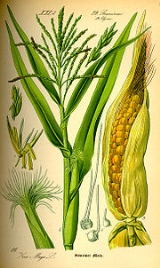
Corn stover consists of the leaves
Leaf
In botany, a leaf is an above-ground plant organ specialized for photosynthesis. For this purpose, a leaf is typically flat and thin. There is continued debate about whether the flatness of leaves evolved to expose the chloroplasts to more light or to increase the absorption of carbon dioxide. In...

 and stalks
Plant stem
A stem is one of two main structural axes of a vascular plant. The stem is normally divided into nodes and internodes, the nodes hold buds which grow into one or more leaves, inflorescence , cones or other stems etc. The internodes act as spaces that distance one node from another...

 of maize
Maize
Maize , is a herbaceous plant domesticated in Mesoamerica and subsequently spread throughout the American continents...

 (Zea mays ssp. mays L
Carolus Linnaeus
Carl Linnaeus was a Swedish botanist, physician, and zoologist, who laid the foundations for the modern scheme of binomial nomenclature...

.) plants left in a field
Field (agriculture)
In agriculture, a field refers generally to an area of land enclosed or otherwise and used for agricultural purposes such as:* Cultivating crops* Usage as a paddock or, generally, an enclosure of livestock* Land left to lie fallow or as arable land...

 after harvest
Harvest
In agriculture, the harvest is the processes of gathering mature crops from the fields. Reaping is the cutting of grain or pulse for harvest, typically using a scythe, sickle, or reaper. The harvest marks the end of the growing season, or the growing cycle for a particular crop, and this is the...

 and consists of the residue
Crop residue
There are two types of agricultural crop residues:
Field residues are materials left in an agricultural field or orchard after the crop has been harvested. These residues include stalks and stubble , leaves, and seed pods...

: stalk
Plant stem
A stem is one of two main structural axes of a vascular plant. The stem is normally divided into nodes and internodes, the nodes hold buds which grow into one or more leaves, inflorescence , cones or other stems etc. The internodes act as spaces that distance one node from another...

; the leaf
Leaf
In botany, a leaf is an above-ground plant organ specialized for photosynthesis. For this purpose, a leaf is typically flat and thin. There is continued debate about whether the flatness of leaves evolved to expose the chloroplasts to more light or to increase the absorption of carbon dioxide. In...

, husk
Husk
Husk in botany is the outer shell or coating of a seed. It usually refers to the leafy outer covering of an ear of maize as it grows on the plant. Literally, a husk or hull includes the protective outer covering of a seed, fruit or vegetable...

, and cob remaining in the field following the harvest of cereal
Cereal
Cereals, grains or cereal grains, {as a collective} are grasses cultivated for the edible components of their fruit seeds  - the endocarp, germ and bran...

 grain.” Stover makes up about half of the yield
Crop yield
In agriculture, crop yield is not only a measure of the yield of cereal per unit area of land under cultivation, it is also the seed generation of the plant itself, i.e. one grain of wheat produces a stalk yielding three grain, or 1:3...

 of a crop and is similar to straw
Straw
Straw is an agricultural by-product, the dry stalk of a cereal plant, after the grain or seed has been removed. Straw makes up about half of the yield of cereal crops such as barley, oats, rice, rye and wheat...

. Corn stover is very a common agricultural product in areas of large amounts of corn production. As well, the stover can also contain other weeds and grasses
the non-grain part of harvested corn and “has low water content and is very bulky.”

Use


Stover
Stover
Stover consists of the leaves and stalks of corn , sorghum or soybean plants that are left in a field after harvest. It can be directly grazed by cattle or dried for use as fodder...

 can be grazed
Grazing
Grazing generally describes a type of predation in which an herbivore feeds on plants , and also on other multicellular autotrophs...

 as forage
Fodder
In agriculture, fodder or animal feed is any foodstuff that is used specifically to feed domesticated livestock such as cattle, goats, sheep, horses, chickens and pigs. Most animal feed is from plants but some is of animal origin...

 or collected for use as fodder
Fodder
In agriculture, fodder or animal feed is any foodstuff that is used specifically to feed domesticated livestock such as cattle, goats, sheep, horses, chickens and pigs. Most animal feed is from plants but some is of animal origin...

 but is commonly not utilized. It can also be used as a fuel for bioenergy
Bioenergy
Bioenergy is renewable energy made available from materials derived from biological sources. In its most narrow sense it is a synonym to biofuel, which is fuel derived from biological sources...

 or as feedstock for bioproducts
Agriculture
Agriculture is the production of food and goods through farming and forestry. Agriculture was the key development that led to the rise of human civilization, with the husbandry of domesticated animals and plants creating food surpluses that enabled the development of more densely populated and...

. Maize stover, together with other lignocellulosic biomass, provides about the potential 1.3 billion tons of raw materials that could produce future fuel in the next 50 years.

In the Netherlands and Belgium large improvements on yield are achieved by harvesting the full plant and crushing it while harvesting. The substance is primarily used as the food for cows during the winter season. It is known as "kuilmais". Field corn and sweet corn, two different types of maize
Maize
Maize , is a herbaceous plant domesticated in Mesoamerica and subsequently spread throughout the American continents...

, have relatively similar corn stover products. Corn stover is not harvested in all areas where corn is produced. In fact, “some agronomists question whether taking stover out of the field annually will have a negative impact on soil fertility and structure.”
The uses for corn stover
Stover
Stover consists of the leaves and stalks of corn , sorghum or soybean plants that are left in a field after harvest. It can be directly grazed by cattle or dried for use as fodder...

 are growing over time. One use of corn stover pertains to corn producers who also raise cattle. Corn stover can be beneficial to some cattle producers because the “corn stover can provide a low cost feed source for mid-gestation beef cows.” In addition to the stalks, leaves, husks, and cobs remaining in the field, kernels of grain may also be left over from harvest. These left over kernels, along with the corn stover, serve as an additional feed source for grazing cattle. Over time, the stalks will decrease in value as feed, so it is important to graze the corn stover as soon as possible after harvest. The amount of grazing possible on a field of corn stover is “between one and two months of grazing per cow per acre (50 cows on for one to two months).”

Another recent and important use for corn stover is biomass
Biomass
Biomass, a renewable energy source, is biological material derived from living, or recently living organisms, such as wood, waste, and alcohol fuels. Biomass is commonly plant matter grown to generate electricity or produce heat. For example, forest residues , yard clippings and wood chips may be...

 ethanol
Ethanol
Ethanol, also called ethyl alcohol, pure alcohol, grain alcohol, or drinking alcohol, is a volatile, flammable, colorless liquid. It is a psychoactive drug, best known as the type of alcohol found in alcoholic beverages and in modern thermometers. Ethanol is one of the oldest recreational drugs...

. Biomass ethanol is “ethanol made from non-grain plant materials known as biomass.” Ethanol production is made possible from the large availability of corn grain. Biomass ethanol would use the corn stover from the corn crop produced in areas around ethanol plants. Corn stover, due to the relative close proximity of the corn grain produced for ethanol production, “is by far the most abundant crop residue readily available today.” The free accessibility to corn stover makes it a prime candidate for biomass ethanol production. Corn stover serves many purposes in today’s agricultural economy and will continue to do so in the future.

Composition and properties

Component Unit Value
Ash
Ash (analytical chemistry)
In analytical chemistry, ashing is the process of mineralization for preconcentration of trace substances prior to chemical analysis. Ash is the name given to all non-aqueous residue that remains after a sample is burned, and consist mostly of metal oxides....

% mass dry 8
HHV
Higher heating value
The higher heating value of a fuel is defined as the amount of heat released by a specified quantity once it is combusted and the products have returned to a temperature of 25 °C.The higher heating value takes into account the latent heat of vaporization of water in the combustion products,...

MJ/kg DAF 19