
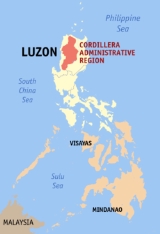
The
Cordillera Administrative Region (CAR) is a region in the
PhilippinesThe Philippines , officially known as the Republic of the Philippines , is a country in Southeast Asia in the western Pacific Ocean. To its north across the Luzon Strait lies Taiwan. West across the South China Sea sits Vietnam...
composed of the
provincesThe Provinces of the Philippines are the primary political and administrative divisions of the Philippines. There are 80 provinces at present, further subdivided into component cities and municipalities. The National Capital Region, as well as independent cities, are autonomous from any provincial...
of Abra, Apayao,
BenguetBenguet is a landlocked province of the Philippines in the Cordillera Administrative Region in Luzon. Its capital is La Trinidad and borders, clockwise from the south, Pangasinan, La Union, Ilocos Sur, Mountain Province, Ifugao, and Nueva Vizcaya....
,
IfugaoIfugao is a landlocked province of the Philippines in the Cordillera Administrative Region in Luzon. Covering a total land area of 262,820 hectares, the province of Ifugao is located in a mountainous region characterized by rugged terrain, river valleys, and massive forests...
, Kalinga and
Mountain ProvinceMountain Province is a landlocked province of the Philippines in the Cordillera Administrative Region in Luzon. Its capital is Bontoc and borders, clockwise from the south, Ifugao, Benguet, Ilocos Sur, Abra, Kalinga, and Isabela.Mountain Province is sometimes incorrectly named Mountain in some...
, as well as
Baguio CityThe City of Baguio is a highly urbanized city in northern Luzon in the Philippines. Baguio City was established by Americans in 1900 at the site of an Ibaloi village known as Kafagway...
, the regional center. The Cordillera Administrative Region encompasses most of the areas within the
Cordillera CentralThe Cordillera Central is a massive mountain range situated in the northern central part of the island of Luzon, in the Philippines. Several provinces bound it, namely Benguet, Abra, Kalinga, Apayao, Mountain Province, Ifugao, and Baguio, a chartered city located entirely within Benguet...
mountains of
LuzonLuzon is the largest island in the Philippines. It is located in the northernmost region of the archipelago, and is also the name for one of the three primary island groups in the country centered on the Island of Luzon...
, the largest mountain range in the country. It is the country's only land-locked region. The region is home to numerous indigenous tribes collectively called the
IgorotCordillerans are the people of the Cordillera region, in the Philippines island of Luzon. The word, Igorot is a misnomer term invented by the Spaniards in mockery against the Nortnern Luzon tribes. The word ‘Igorot’ also as coined and applied by the Spaniards means a savage, head-hunting and...
.
CAR Provinces and Population
CAR is subdivided into 6
provincesThe Provinces of the Philippines are the primary political and administrative divisions of the Philippines. There are 80 provinces at present, further subdivided into component cities and municipalities. The National Capital Region, as well as independent cities, are autonomous from any provincial...
and one chartered city,
BaguioThe City of Baguio is a highly urbanized city in northern Luzon in the Philippines. Baguio City was established by Americans in 1900 at the site of an Ibaloi village known as Kafagway...
.
| Province The Provinces of the Philippines are the primary political and administrative divisions of the Philippines. There are 80 provinces at present, further subdivided into component cities and municipalities. The National Capital Region, as well as independent cities, are autonomous from any provincial... /CityA city is a tier of local government in the Philippines. All Philippine cities are chartered cities, whose existence as corporate and administrative entities is governed by their own specific charters in addition to the Local Government Code of 1991, which specifies the administrative structure... | Capital | Population (2007) | Area (km²) | Pop. density (per km²) |
 |
Abra |
Bangued Bangued is a first class municipality in the province of Abra in the Cordillera Administrative Region of the Philippines. According to the 2007 census, it has a population of 46,179 in 8,071 households.-History:...
|
230,953 |
3,975.6 |
58.1 |
|
Apayao Apayao is a landlocked province of the Philippines in the Cordillera Administrative Region in Luzon. Its administrative capital is Luna and founding capital Kabugao. It borders Cagayan to the north and east, Abra and Ilocos Norte to the west, and Kalinga to the south...
|
KabugaoKabugao is a municipality in the province of Apayao, Philippines. It is the capital municipality of Apayao. According to the latest census, it has a population of 14,529 people in 2,501 households.-Barangays:...
|
103,633 |
3,927.9 |
26.4 |
|
Benguet Benguet is a landlocked province of the Philippines in the Cordillera Administrative Region in Luzon. Its capital is La Trinidad and borders, clockwise from the south, Pangasinan, La Union, Ilocos Sur, Mountain Province, Ifugao, and Nueva Vizcaya....
|
La TrinidadLa Trinidad is a 1st class municipality in the province of Benguet, Philippines. It is the capital municipality of Benguet. According to the 2007 census, it has a population of 97,810 people in 13,658 households....
|
372,533 |
2,599.4 |
143.3 |
|
IfugaoIfugao is a landlocked province of the Philippines in the Cordillera Administrative Region in Luzon. Covering a total land area of 262,820 hectares, the province of Ifugao is located in a mountainous region characterized by rugged terrain, river valleys, and massive forests...
|
Lagawe Lagawe is a 4th class municipality in the province of Ifugao, Philippines. It is the capital municipality of Ifugao. According to the latest census, it has a population of 17,373 people in 2,944 households.-Barangays:...
|
180,711 |
2,517.8 |
71.8 |
 |
Kalinga Kalinga is a landlocked province of the Philippines in the Cordillera Administrative Region in Luzon. Its capital is Tabuk and borders Mountain Province to the south, Abra to the west, Isabela to the east, Cagayan to the northeast, and Apayao to the north...
|
Tabuk City |
182,326 |
3,119.7 |
58.4 |
|
Mountain Province Mountain Province is a landlocked province of the Philippines in the Cordillera Administrative Region in Luzon. Its capital is Bontoc and borders, clockwise from the south, Ifugao, Benguet, Ilocos Sur, Abra, Kalinga, and Isabela.Mountain Province is sometimes incorrectly named Mountain in some...
|
Bontoc Bontoc is a 3rd class municipality in the province of Mountain Province, Philippines. It is the capital municipality of Mountain Province. According to the latest census, it has a population of 24,798 people in 5,035 households....
|
148,661 |
2,097.3 |
70.9 |
|
|
|
|
|
|
 |
Baguio CityThe City of Baguio is a highly urbanized city in northern Luzon in the Philippines. Baguio City was established by Americans in 1900 at the site of an Ibaloi village known as Kafagway...
|
— |
301,926 |
57.5 |
5,250.9 |
¹ Baguio CityThe City of Baguio is a highly urbanized city in northern Luzon in the Philippines. Baguio City was established by Americans in 1900 at the site of an Ibaloi village known as Kafagway...
is a highly urbanized city; figures are excluded from Benguet Province.
Economy
Cordillera has abundant mineral reserves. These include metallic ores such as gold, copper, silver, zinc, and non-metallic minerals like sand, gravel and sulfur. Mineral reserves are found in all the provinces. However, mining is concentrated in
Benguet.
Baguio CityThe City of Baguio is a highly urbanized city in northern Luzon in the Philippines. Baguio City was established by Americans in 1900 at the site of an Ibaloi village known as Kafagway...
and La Trinidad, Benguet are considered as the industrial centers in the region due. In Baguio, you will find an Export Processing Zone where operations of big companies like Texas Instruments, and MOOG are located. In La Trinidad you will find the Provincial Capitol and regional branches of government organizations.
Tourist attractions
Tourist attractions in the region include the world-famous
Banaue Rice TerracesThe Banaue Rice Terraces also called Payew, are 2000-year old terraces that were carved into the mountains of Ifugao in the Philippines by ancestors of the indigenous people. The Rice Terraces are commonly referred to by Filipinos as the "Eighth Wonder of the World". It is commonly thought that...
in the province of
IfugaoIfugao is a landlocked province of the Philippines in the Cordillera Administrative Region in Luzon. Covering a total land area of 262,820 hectares, the province of Ifugao is located in a mountainous region characterized by rugged terrain, river valleys, and massive forests...
. Nations around the world boast of their own self-proclaimed "
eighth wonder of the worldEighth Wonder of the World is a term sometimes used to describe things in comparison to the Seven Wonders of the World, the widely-known list of seven remarkable constructions of classical antiquity.-Natural places:...
." The Philippines considers Banaue Rice Terraces as its "Eighth Wonder of the World." The Banaue terraces, ancient sprawling man-made structures from 2,000 to 6,000 years old, are a UNESCO World Heritage Site. They are part of the Rice Terraces of the Philippine Cordilleras, widely found in the provinces of Apayao, Benguet, Ifugao, Kalinga, and Mountain Province.
Natural attractions of the region include the Sumaguing Cave in
SagadaSagada is a 5th class municipality in the province of Mountain Province, Philippines. According to the latest census, it has a population of 10,930 people in 2,158 households....
and the mummy caves of
BenguetBenguet is a landlocked province of the Philippines in the Cordillera Administrative Region in Luzon. Its capital is La Trinidad and borders, clockwise from the south, Pangasinan, La Union, Ilocos Sur, Mountain Province, Ifugao, and Nueva Vizcaya....
and Mt. Province. There are four National Parks: Cassamata Hill,
Mount PulagMount Pulag is the second highest mountain in the Philippines. It is Luzon’s highest peak at 2,922 meters above sea level. The borders between the provinces of Benguet, Ifugao, and Nueva Vizcaya meet at the mountain's peak....
, the highest mountain in Luzon, and second highest mountain in the Philippines, following Mount Apo of Davao, with an elevation of 2,922 meters
above mean sea levelThe term above mean sea level refers to the elevation or altitude of any object, relative to the average sea level datum. AMSL is used extensively in radio by engineers to determine the coverage area a station will be able to reach...
, Mt. Data, and Balbalasang-Balbalan, located in the province of Kalinga. Kalinga also offers world-class white water rafting along the Chico River.
The summer capital of the Philippines is Baguio, within the Cordillera Administrative Region.
Culture
The Cordillera region is known for its unique musical instruments including the gangsa kalinga,
nose fluteThe nose flute is a popular musical instrument played in Polynesia and the Pacific Rim countries. Other versions are found in Africa, China, and India.- Hawaii :In the North Pacific, in the Hawaiian islands the nose flute was a common courting instrument...
,
bamboo fluteFlutes made of bamboo are found in many musical traditions.Some bamboo flutes include:Flute Country of Origin Atenteben Bashi Bansuri Chi Dizi Daegeum...
,
buzzerA buzzer or beeper is an audio signaling device, which may be mechanical, electromechanical, or piezoelectric. Typical uses of buzzers and beepers include alarm devices, timers and confirmation of user input such as a mouse click or keystroke....
, bangibang, tongatong, diwdiw-as, saggeypo, and bamboo zither.
The region also has various festivals. They include:
Panagbenga / Baguio Flower Festival which is celebrated in February. The festival focuses on Baguio as the Flower Garden City of the North. Highlights include flower exhibits, lectures, garden tours, floral competition and a parade of floats.
Adivay festival in Benguet which means "coming together of people to celebrate" is celebrated every month of November. The month-long activities highlights the Agro-industrial and trade fair which showcase the different products of Benguet.
Ullalim Festival/ in Kalinga which is celebrated every February 14. It is in celebration of the founding anniversary of the province and the Peace acts called
Bodong. It is the poetic expression of the heroic exploits, romance, joys, successes as well as tribulations, and the way of life of the Kalingas from birth to death. The Festival highlights the weaved clothes (
laga) exhibits, world class coffee beans and other products of Kalinga.
LANG-AY Festival in Mountain Province celebrated every April 7. This is a week-long agro-industrial trade, tourism and cultural fair with tribal dances and songs. Lang-ay is a native term which describes the tradition of the people of Mountain Province to celebrate festivities, share happiness, foster family solidarity, hospitality and nurture friendship - all with a toast of home-brewed wine.
Banaue Imbayah festival which is celebrated every 4 years. It is a three-day festival from December 5 to 8 consisting of a parade portraying the evolution of the Ifugao culture followed by ethnic games.
Tabuk Matagoan Festival which features G-String marathon (runners wear G-String only), cultural dances and songs. The festival showcases the different products of tabuk coming from the different parts of Kalinga such as the aromatic Kalinga coffee.
External links