


Corbie Abbey

Encyclopedia
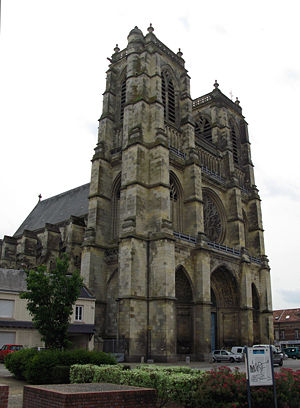
Corbie
Corbie is a commune of the Somme department in Picardie in northern France.-Geography:The small town is situated up river from Amiens, in the département of Somme and is the main town of the canton of Corbie. It lies in the valley of the River Somme, at the confluence of the River Ancre. The town...
, Picardy
Picardy
This article is about the historical French province. For other uses, see Picardy .Picardy is a historical province of France, in the north of France...
, France
France
The French Republic , The French Republic , The French Republic , (commonly known as France , is a unitary semi-presidential republic in Western Europe with several overseas territories and islands located on other continents and in the Indian, Pacific, and Atlantic oceans. Metropolitan France...
, dedicated to Saint Peter.
Foundation
It was founded in about 659/661 under Merovingian royal patronage by BalthildBalthild
Saint Balthild of Ascania , also called Bathilda, Baudour, or Bauthieult, was the wife and queen of Clovis II, king of Burgundy and Neustria . Two traditions, independent and conflicting, trace what Wilhelm Levison accounted "truly an extraordinary career for an English slave sold to the Continent"...
, widow of Clovis II
Clovis II
Clovis II succeeded his father Dagobert I in 639 as King of Neustria and Burgundy. His brother Sigebert III had been King of Austrasia since 634. He was initially under the regency of his mother Nanthild until her death in her early thirties in 642...
, and her son Clotaire III
Clotaire III
Chlothar III was the eldest son of Clovis II, king of Neustria and Burgundy, and his queen Balthild...
. The first monks came from Luxeuil Abbey
Luxeuil Abbey
Luxeuil Abbey was one of the oldest and best-known monasteries in Burgundy, located in the "département" of Haute-Saône in Franche-Comté, France.-Columbanus:...
, which had been founded by Saint Columbanus
Columbanus
Columbanus was an Irish missionary notable for founding a number of monasteries on the European continent from around 590 in the Frankish and Lombard kingdoms, most notably Luxeuil and Bobbio , and stands as an exemplar of Irish missionary activity in early medieval Europe.He spread among the...
in 590, and the Irish respect for classical learning fostered there was carried forward at Corbie. The rule of the founders was based on the Benedictine rule, as Columbanus had modified it.
Besides gifts of estates to support the abbey, many exemptions were granted to the abbots, to free them from interference from local bishops: the exemptions were confirmed in 855 by Pope Benedict III
Pope Benedict III
Pope Benedict III was Pope from September 29, 855 to April 17, 858.Little is known of Benedict's life before his papacy. He was educated and lived in Rome and was cardinal priest of S. Callisto at the time of his election. Benedict had a reputation for learning and piety. He was elected upon the...
. The abbots ranked as count
Count
A count or countess is an aristocratic nobleman in European countries. The word count came into English from the French comte, itself from Latin comes—in its accusative comitem—meaning "companion", and later "companion of the emperor, delegate of the emperor". The adjective form of the word is...
s and had the privilege of a mint
Mint (coin)
A mint is an industrial facility which manufactures coins for currency.The history of mints correlates closely with the history of coins. One difference is that the history of the mint is usually closely tied to the political situation of an era...
.
Carolingian period
Corbie continued its intimate links with the royal house of the Carolingians. In 774 DesideriusDesiderius
Desiderius was the last king of the Lombard Kingdom of northern Italy...
, last King of the Lombards, was exiled here after his defeat by Charlemagne
Charlemagne
Charlemagne was King of the Franks from 768 and Emperor of the Romans from 800 to his death in 814. He expanded the Frankish kingdom into an empire that incorporated much of Western and Central Europe. During his reign, he conquered Italy and was crowned by Pope Leo III on 25 December 800...
. From 850 to 854 Charles, the future Archbishop of Mainz, was confined here. Members of the Carolingian house sometimes served as abbots; a notable abbot was Saint Adalard, one of Charlemagne's cousins.
In the ninth century Corbie was larger than St. Martin's Abbey at Tours, or Saint Denis at Paris. Corvey Abbey
Corvey Abbey
The Imperial Abbey of Corvey was a Benedictine monastery on the River Weser, 2 km northeast of Höxter, now in North Rhine-Westphalia, Germany....
in Saxony
Saxony
The Free State of Saxony is a landlocked state of Germany, contingent with Brandenburg, Saxony Anhalt, Thuringia, Bavaria, the Czech Republic and Poland. It is the tenth-largest German state in area, with of Germany's sixteen states....
was founded from Corbie in about 820, and was named after it.

Scriptorium
Scriptorium, literally "a place for writing", is commonly used to refer to a room in medieval European monasteries devoted to the copying of manuscripts by monastic scribes...
. In addition to its patristic writings, it is recognized as an important center for the transmission of the works of Antiquity
Classical antiquity
Classical antiquity is a broad term for a long period of cultural history centered on the Mediterranean Sea, comprising the interlocking civilizations of ancient Greece and ancient Rome, collectively known as the Greco-Roman world...
to the Middle Ages
Middle Ages
The Middle Ages is a periodization of European history from the 5th century to the 15th century. The Middle Ages follows the fall of the Western Roman Empire in 476 and precedes the Early Modern Era. It is the middle period of a three-period division of Western history: Classic, Medieval and Modern...
. An inventory (of perhaps the 11th century) lists the church history of Hegesippus
Hegesippus
The Greek name Hegesippos, commonly Latinized as Hegesippus can refer to the following persons:* Hegesippus * Saint Hegesippus...
, now lost, among other extraordinary treasures. In the scriptorium
Scriptorium
Scriptorium, literally "a place for writing", is commonly used to refer to a room in medieval European monasteries devoted to the copying of manuscripts by monastic scribes...
at Corbie the clear and legible hand known as Carolingian minuscule
Carolingian minuscule
Carolingian or Caroline minuscule is a script developed as a writing standard in Europe so that the Roman alphabet could be easily recognized by the literate class from one region to another. It was used in Charlemagne's empire between approximately 800 and 1200...
was developed, in about 780 http://history.boisestate.edu/westciv/charles/16.shtml, as well as a distinctive style of illumination
Illuminated manuscript
An illuminated manuscript is a manuscript in which the text is supplemented by the addition of decoration, such as decorated initials, borders and miniature illustrations...
.
Three of Corbie's ninth-century scholars were Ratramnus
Ratramnus
Ratramnus, a Frankish monk of the monastery of Corbie, was a Carolingian theologian known best for his writings on the Eucharist and predestination. His Eucharistic treatise, De corpora et sanguine Domini , was a counterpoint to his abbot Paschasius Radbertus’ realist Eucharistic theology...
(died c. 868), Radbertus Paschasius (died 865) and the shadowy figure of Hadoard
Hadoard
Hadoard or Hadoardus was a priest, and presumed librarian , of the ninth century. He is known solely for his Collectaneum, an anthology of philosophical extracts. This is a source, in particular, for the knowledge at the time of the works of Cicero.-References:* Charles H. Beeson, The Collectaneum...
. Jean Mabillon
Jean Mabillon
Jean Mabillon was a French Benedictine monk and scholar, considered the founder of palaeography and diplomatics.-Early career:...
, the father of paleography, had been a monk at Corbie.
Among students of Tertullian
Tertullian
Quintus Septimius Florens Tertullianus, anglicised as Tertullian , was a prolific early Christian author from Carthage in the Roman province of Africa. He is the first Christian author to produce an extensive corpus of Latin Christian literature. He also was a notable early Christian apologist and...
, the library is of interest as it contained a number of unique copies of Tertullian's works, the so-called corpus Corbiense and included some of his unorthodox Montanist treatises, as well as two works by Novatian issued pseudepigraphically
Pseudepigraphy
Pseudepigrapha are falsely attributed works, texts whose claimed authorship is unfounded; a work, simply, "whose real author attributed it to a figure of the past." The word "pseudepigrapha" is the plural of "pseudepigraphon" ; the Anglicized forms...
under Tertullian's name. The origin of this group of non-orthodox texts has not satisfactorily been identified.
Geometry
Among students of medieval architecture and engineering, such as are preserved in the notebooks of Villard de HonnecourtVillard de Honnecourt
Villard de Honnecourt was a 13th-century artist from Picardy in northern France. He is known to history only through a surviving portfolio of 33 sheets of parchment containing about 250 drawings dating from the 1220s/1240s, now in the Bibliothèque Nationale, Paris...
, Corbie is of interest as the center of renewed interest in geometry and surveying techniques, both theoretical and practical, as they had been transmitted from Euclid
Euclid
Euclid , fl. 300 BC, also known as Euclid of Alexandria, was a Greek mathematician, often referred to as the "Father of Geometry". He was active in Alexandria during the reign of Ptolemy I...
through the Geometria of Boethius
Anicius Manlius Severinus Boethius
Anicius Manlius Severinus Boëthius, commonly called Boethius was a philosopher of the early 6th century. He was born in Rome to an ancient and important family which included emperors Petronius Maximus and Olybrius and many consuls. His father, Flavius Manlius Boethius, was consul in 487 after...
and works by Cassiodorus
Cassiodorus
Flavius Magnus Aurelius Cassiodorus Senator , commonly known as Cassiodorus, was a Roman statesman and writer, serving in the administration of Theodoric the Great, king of the Ostrogoths. Senator was part of his surname, not his rank.- Life :Cassiodorus was born at Scylletium, near Catanzaro in...
(Zenner).
Modern times
In 1638, 400 manuscripts were transferred to the library of the monastery of St. Germain des Prés in Paris. In the French RevolutionFrench Revolution
The French Revolution , sometimes distinguished as the 'Great French Revolution' , was a period of radical social and political upheaval in France and Europe. The absolute monarchy that had ruled France for centuries collapsed in three years...
, the library was closed and the last of the monks dispersed: 300 manuscripts still at Corbie were moved to Amiens
Amiens
Amiens is a city and commune in northern France, north of Paris and south-west of Lille. It is the capital of the Somme department in Picardy...
, 15 km to the west. Those at St-Germain des Prés were loosed on the market, and many rare manuscript
Manuscript
A manuscript or handwrite is written information that has been manually created by someone or some people, such as a hand-written letter, as opposed to being printed or reproduced some other way...
s were obtained by a Russian diplomat, Petrus Dubrowsky, and sent to St. Petersburg. Other Corbie manuscripts are at the Bibliothèque Nationale. Over two hundred manuscripts from the great library at Corbie are known to survive.
External links
- Catholic Encyclopedia: Abbey of Corbie
- Mmss of Tertullian at Corbie
- http://www.tertullian.org/manuscripts_apologeticum/st_petersburg.htmAn 8th–9th century Ms of TertullianTertullianQuintus Septimius Florens Tertullianus, anglicised as Tertullian , was a prolific early Christian author from Carthage in the Roman province of Africa. He is the first Christian author to produce an extensive corpus of Latin Christian literature. He also was a notable early Christian apologist and...
Apologeticum from Corbie] - Les grandes heures de Corbie: timeline (in French and English)
- Merovingian minuscule, 7th-8th centuries, as used at Corbie
- Philip Schaff, History of the Christian church iv: (Paschasius Radbert)
- Marie-Thérèse Zenner, "Villard de Honnecourt and Euclidian geometry"