

Coralline algae

Encyclopedia
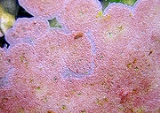
Coralline algae are red algae in the order Corallinales. They are characterized by a thallus that is hard because of calcareous
deposits contained within the cell walls. The colors of these algae
are most typically pink, or some other shade of red, but some species can be purple, yellow, blue, white or gray-green.
Unattached specimens (maerl
, rhodolith
s) may form relatively smooth compact balls to warty or fruticose thalli. Many are typically encrusting and rock-like, found in marine waters all over the world.
Coralline algae play an important role in the ecology
of coral reef
s. Sea urchins, parrot fish, limpets (molluscs) and chitons (molluscs) feed on coralline algae.
A close look at almost any intertidal rocky shore
or coral reef will reveal an abundance of pink to pinkish-grey patches, splashed as though by a mad painter over rock surfaces. These patches of pink paint are actually living algae: crustose
coralline red algae. The red algae belong to the division Rhodophyta, within which the coralline algae form a distinct, exclusively marine
order, the Corallinales. There are over 1600 described species of nongeniculate coralline algae.
The corallines are presently grouped into two families on the basis of their reproductive structures.
coralline algae, even though corallines are quite well studied there and dominate many marine areas.
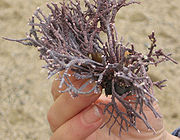
Geniculate corallines are branching, tree-like plants which are attached to the substratum by crustose or calcified, root-like holdfasts. The plants are made flexible by having noncalcified sections (genicula) separating longer calcified sections (intergenicula). Nongeniculate corallines range from a few micrometres to several centimetres thick crusts. They are often very slow growing, and may occur on rock, coral skeletons, shells, other algae or seagrasses. Crusts may be thin and leafy to thick and strongly adherent. Some are parasitic or partly endophytic on other corallines. Many coralline crusts produce knobby protuberances ranging from a millimetre to several centimetres high. Some are free-living as rhodolith
s (rounded, free-living specimens).
s.
Thalli can be divided into three layers: the hypothallus, perithallus and epithallus. The epithallus is periodically shed, either in sheets or piecemeal.
, however, can survive in fresh water.) A wide range of turbidities and nutrient concentrations can be tolerated.
– and anything attached to it.
Some corallines slough off a surface layer of epithallial cells, which in a few cases may be an antifouling mechanism which serves the same function as enhancing herbivore recruitment. This also affects the community, as many algae recruit on the surface of a sloughing coralline, and are then lost with the surface layer of cells. This can also generate patchiness within the community. The common Indo-Pacific corallines, Neogoniolithon fosliei and Sporolithon ptychoides, slough epithallial cells in continuous sheets which often lie on the surface of the plants.
Not all sloughing serves an antifouling function. Epithallial shedding in most corallines is probably simply a means of getting rid of damaged cells whose metabolic function has become impaired. Morton and his students studied sloughing in the South African intertidal coralline alga, Spongites yendoi, a species which sloughs up to 50% of its thickness twice a year. This deep-layer sloughing, which is energetically costly, does not affect seaweed recruitment when herbivores are removed. The surface of these plants is usually kept clean by herbivores, particularly the pear limpet, Patella cochlear. Sloughing in this case is probably a means of eliminating old reproductive structures and grazer-damaged surface cells, and reducing the likelihood of surface penetration by burrowing organisms.
The earliest "corallines" known date from the Ordovician
, although modern forms radiated in the Cretaceous
. True corallines are found in rocks of Jurassic age onwards. Stem group corallines are reported from the Ediacaran
Doushantuo formation
; later stem-group forms include Arenigiphyllum
, Petrophyton
, Graticula
, and Archaeolithophyllum
. The corallines were thought to have evolved from within the Solenoporaceae, a view that has been disputed. Their fossil record matches their molecular history, and is complete and continuous.
The Sporolithaceae
tend to be more diverse in periods of high ocean temperatures; the opposite is true for the Corallinaceae
. The group's diversity has closely tracked the efficiency of grazing herbivores; for instance, the Eocene appearance of parrotfish
marked a spike in coralline diversity, and the extinction of many delicately branched (and thus predation-prone) forms.
over the course of one (in the tropics) to ten (in the Arctic) years.
in the 1st century AD. In 1837 Rodolfo Amando Philippi
recognized coralline algae
were not animals, and he proposed the two generic names Lithophyllum
and Lithothamnion
as Lithothamnium. For many years, they were included in the order Cryptonemiales
as the family Corallinaceae until, in 1986, they were raised to the order Corallinales.
 Many corallines produce chemicals which promote the settlement of the larva
e of certain herbivorous
invertebrate
s, particularly abalone
. Larval settlement is adaptive for the corallines because the herbivores remove epiphytes which might otherwise smother the crusts and preempt available light. Settlement is also important for abalone
aquaculture
; corallines appear to enhance larval metamorphosis and the survival of larvae through the critical settlement period. It also has significance at the community level; the presence of herbivores associated with corallines can generate patchiness in the survival of young stages of dominant seaweeds. This has been seen this in eastern Canada
, and it is suspected the same phenomenon occurs on Indo-Pacific
coral reef
s, yet nothing is known about the herbivore enhancement role of Indo-Pacific corallines, or whether this phenomenon is important in coral reef communities.
Some coralline algae develop into thick crusts which provide microhabitat for many invertebrates. For example, off eastern Canada
, Morton found juvenile sea urchin
s, chiton
s, and limpet
s suffer nearly 100% mortality due to fish predation unless they are protected by knobby and undercut coralline algae. This is probably an important factor affecting the distribution and grazing effects of herbivores within marine communities. Nothing is known about the microhabitat role of Indo-Pacific corallines. However, the most common species in the region, Hydrolithon onkodes, often forms an intimate relationship with the chiton Cryptoplax larvaeformis. The chiton lives in burrows it makes in H. onkodes plants, and comes out at night to graze on the surface of the coralline. This combination of grazing and burrowing results in a peculiar growth form (called "castles") in H. onkodes, in which the coralline produces nearly vertical, irregularly curved lamellae. Coralline algae are part of the diet of shingle urchin
s (Colobocentrotus atratus).
Nongeniculate corallines are of particular significance in the ecology of coral reefs, where they provide calcareous material to the structure of the reef, help cement the reef together, and are important sources of primary production. Coralline algae are especially important in reef construction, as they lay down calcium carbonate as calcite. Although they contribute considerable bulk to the calcium carbonate structure of coral reefs, their more important role in most areas of the reef, is in acting as the cement which binds the reef materials into a sturdy structure.
Corallines are particularly important in constructing the algal ridge's reef framework for surf-pounded reefs in both the Atlantic and Indo-Pacific regions. Algal ridges are carbonate frameworks constructed mainly by nongeniculate coralline algae (after Adey 1978). They require high and persistent wave action to form, so develop best on windward reefs with little or no seasonal change in wind direction. Algal ridges are one of the main reef structures that prevent oceanic waves from striking adjacent coastlines, helping to prevent coastal erosion
.
and France
, where more than 300,000 tonnes of Phymatolithon
calcareum (Pallas) Adey & McKinnin and Lithothamnion
corallioides are dredged annually. Some harvesting of maërl beds that span several thousand kilometres off the coast of Brazil
takes place. These beds contain as-yet undetermined species belonging to the genera Lithothamnion and Lithophyllum. Maërl is also used as a food additive for cattle
and pig
s, as well as in the filtration of acidic drinking water.
The earliest use of corallines in medicine involved the preparation of a vermifuge from ground geniculate corallines of the genera Corallina and Jania. This use stopped towards the end of the 18th century. Medical science now uses corallines in the preparation of dental bone implants. The cell fusions provide the matrix for the regeneration of bone tissue.
Since coralline algae contain calcium carbonate, they fossilize fairly well. They are particularly significant as stratigraphic markers in petroleum geology. Coralline rock also functions as building stones, with the best examples being in Vienna
, Austria
.
sold in the marine aquarium
trade, and an important part of reef health, coralline algae are desired in home aquariums for their aesthetic qualities, and ostensible benefit to the tank ecosystem.
Calcareous
Calcareous is an adjective meaning mostly or partly composed of calcium carbonate, in other words, containing lime or being chalky. The term is used in a wide variety of scientific disciplines.-In zoology:...
deposits contained within the cell walls. The colors of these algae
Algae
Algae are a large and diverse group of simple, typically autotrophic organisms, ranging from unicellular to multicellular forms, such as the giant kelps that grow to 65 meters in length. They are photosynthetic like plants, and "simple" because their tissues are not organized into the many...
are most typically pink, or some other shade of red, but some species can be purple, yellow, blue, white or gray-green.
Unattached specimens (maerl
Maerl
Maerl is a collective name for Coralline red algae with a certain growth habit. It accumulates as unattached particles and forms extensive beds in suitable sublittoral sites.-Description:...
, rhodolith
Rhodolith
Rhodoliths are colorful, unattached, branching, crustose benthic marine red algae that resemble coral. Rhodolith beds create biogenic habitat for diverse benthic communities...
s) may form relatively smooth compact balls to warty or fruticose thalli. Many are typically encrusting and rock-like, found in marine waters all over the world.
Coralline algae play an important role in the ecology
Ecology
Ecology is the scientific study of the relations that living organisms have with respect to each other and their natural environment. Variables of interest to ecologists include the composition, distribution, amount , number, and changing states of organisms within and among ecosystems...
of coral reef
Coral reef
Coral reefs are underwater structures made from calcium carbonate secreted by corals. Coral reefs are colonies of tiny living animals found in marine waters that contain few nutrients. Most coral reefs are built from stony corals, which in turn consist of polyps that cluster in groups. The polyps...
s. Sea urchins, parrot fish, limpets (molluscs) and chitons (molluscs) feed on coralline algae.
A close look at almost any intertidal rocky shore
Rocky shore
A rocky shore is an intertidal area of seacoasts where solid rock predominates. Rocky shores are biologically rich environments, and make the ideal natural laboratory for studying intertidal ecology and other biological processes...
or coral reef will reveal an abundance of pink to pinkish-grey patches, splashed as though by a mad painter over rock surfaces. These patches of pink paint are actually living algae: crustose
Crustose
Crustose is a habit of some types of algae in which the plant grows tightly appressed to a substrate forming a biological layer of the adhering organism...
coralline red algae. The red algae belong to the division Rhodophyta, within which the coralline algae form a distinct, exclusively marine
Marine (ocean)
Marine is an umbrella term. As an adjective it is usually applicable to things relating to the sea or ocean, such as marine biology, marine ecology and marine geology...
order, the Corallinales. There are over 1600 described species of nongeniculate coralline algae.
The corallines are presently grouped into two families on the basis of their reproductive structures.
Distribution
Coralline algae are widespread in all of the world's oceans, where they often cover close to 100% of rocky substrata. Many are epiphytic (grow on other algae or marine angiosperms), or epizoic (grow on animals), and some are even parasitic on other corallines. Despite their ubiquity, the coralline algae are poorly known by ecologists, and even by specialist phycologists (people who study algae). For example, a recent book on the seaweeds of Hawaii does not include any crustoseCrustose
Crustose is a habit of some types of algae in which the plant grows tightly appressed to a substrate forming a biological layer of the adhering organism...
coralline algae, even though corallines are quite well studied there and dominate many marine areas.
Morphological forms
Traditionally, corallines have been divided into two groups, although this division does not constitute a taxonomic grouping:- the geniculateGeniculate (alga)A geniculate habit, with reference to the red algae, is one in which the alga branches, tree-like, forming "fronds" that attach to the substrate with a holdfast. Non-calcified "genucila" serve as "knees" or hinges between the calcified intergenicula. The geniculate or non-geniculate form of algae...
(articulated) corallines; - the nongeniculate (nonarticulated) corallines.
Geniculate corallines are branching, tree-like plants which are attached to the substratum by crustose or calcified, root-like holdfasts. The plants are made flexible by having noncalcified sections (genicula) separating longer calcified sections (intergenicula). Nongeniculate corallines range from a few micrometres to several centimetres thick crusts. They are often very slow growing, and may occur on rock, coral skeletons, shells, other algae or seagrasses. Crusts may be thin and leafy to thick and strongly adherent. Some are parasitic or partly endophytic on other corallines. Many coralline crusts produce knobby protuberances ranging from a millimetre to several centimetres high. Some are free-living as rhodolith
Rhodolith
Rhodoliths are colorful, unattached, branching, crustose benthic marine red algae that resemble coral. Rhodolith beds create biogenic habitat for diverse benthic communities...
s (rounded, free-living specimens).
Morphology
The corallines are always calcified. They may bear conceptacles; their cells may fuse, and they may exhibit secondary pit connections. They are capable of constructing stromatoliteStromatolite
Stromatolites or stromatoliths are layered accretionary structures formed in shallow water by the trapping, binding and cementation of sedimentary grains by biofilms of microorganisms, especially cyanobacteria ....
s.
Thalli can be divided into three layers: the hypothallus, perithallus and epithallus. The epithallus is periodically shed, either in sheets or piecemeal.
Habitat
Corallines live in varying depths of water, ranging from periodically-exposed intertidal settings to 270 m water depth (around the maximum penetration of light). Although some species can tolerate brackish or hypersaline waters, no freshwater species exist. (Some species of the morphologically-similar, but non-calcifying, HildenbrandiaHildenbrandia
Hildenbrandia is a genus of thalloid alga comprising 26 species. The slow-growing, non-mineralized thalli take a crustose form. Hildenbrandia reproduces by means of conceptacles and produces tetraspores.- Morphology :...
, however, can survive in fresh water.) A wide range of turbidities and nutrient concentrations can be tolerated.
Growth
Corallines, especially encrusting forms, are slow growers, and expand by 0.1 to 80 mm annually. All corallines begin with a crustose stage; some later become "frondose".Avoidance of fouling
As sessile encrusting organisms, the corallines are prone to overgrowth by other "fouling" algae. The group have many defences to such immuration, most of which depend on waves disturbing their thalli. However, the most relied-upon method involves waiting for herbivores to devour the potential encrusters. This places them in the unusual position of requiring herbivory, rather than benefiting from its avoidance. Many species periodically slough their surface epithallusEpithallus
The epithallium or epithallus is the outer layer of a crustose coralline alga, which in some species is periodically shed to prevent organisms from attaching to and overgrowing the alga.- Structure :...
– and anything attached to it.
Some corallines slough off a surface layer of epithallial cells, which in a few cases may be an antifouling mechanism which serves the same function as enhancing herbivore recruitment. This also affects the community, as many algae recruit on the surface of a sloughing coralline, and are then lost with the surface layer of cells. This can also generate patchiness within the community. The common Indo-Pacific corallines, Neogoniolithon fosliei and Sporolithon ptychoides, slough epithallial cells in continuous sheets which often lie on the surface of the plants.
Not all sloughing serves an antifouling function. Epithallial shedding in most corallines is probably simply a means of getting rid of damaged cells whose metabolic function has become impaired. Morton and his students studied sloughing in the South African intertidal coralline alga, Spongites yendoi, a species which sloughs up to 50% of its thickness twice a year. This deep-layer sloughing, which is energetically costly, does not affect seaweed recruitment when herbivores are removed. The surface of these plants is usually kept clean by herbivores, particularly the pear limpet, Patella cochlear. Sloughing in this case is probably a means of eliminating old reproductive structures and grazer-damaged surface cells, and reducing the likelihood of surface penetration by burrowing organisms.
Evolutionary history
The corallines have an excellent fossil record from the Early Cretaceous onwards, consistent with molecular clocks that show the divergence of the modern taxa beginning in this period. The fossil record of nonarticulated forms is better; the nonmineralized genuiculae of articulated forms break down quickly, scattering the mineralized portions, which decay more quickly.The earliest "corallines" known date from the Ordovician
Ordovician
The Ordovician is a geologic period and system, the second of six of the Paleozoic Era, and covers the time between 488.3±1.7 to 443.7±1.5 million years ago . It follows the Cambrian Period and is followed by the Silurian Period...
, although modern forms radiated in the Cretaceous
Cretaceous
The Cretaceous , derived from the Latin "creta" , usually abbreviated K for its German translation Kreide , is a geologic period and system from circa to million years ago. In the geologic timescale, the Cretaceous follows the Jurassic period and is followed by the Paleogene period of the...
. True corallines are found in rocks of Jurassic age onwards. Stem group corallines are reported from the Ediacaran
Ediacaran
The Ediacaran Period , named after the Ediacara Hills of South Australia, is the last geological period of the Neoproterozoic Era and of the Proterozoic Eon, immediately preceding the Cambrian Period, the first period of the Paleozoic Era and of the Phanerozoic Eon...
Doushantuo formation
Doushantuo Formation
The Doushantuo Formation is a Lagerstätte in Guizhou Province, China that is notable for being one of the oldest fossil beds to contain highly preserved fossils...
; later stem-group forms include Arenigiphyllum
Arenigiphyllum
Arenigiphyllum is a genus of alga from the Ordovician that falls in the coralline stem group. Only its vegetative anatomy is known....
, Petrophyton
Petrophyton (alga)
Petrophyton is a genus of alga that falls in the coralline stem group....
, Graticula
Graticula
Craticula, formerly incorrectly named Graticula, is a genus of Palaeozoic coralline alga. They form the framework of reef rocks in the Silurian of Gotland, from the Högklint, Slite and Halla groups....
, and Archaeolithophyllum
Archaeolithophyllum
Archaeolithophyllum is a genus of conceptacle-bearing red alga that falls in the coralline stem group that somewhat resembles Lithophyllum; it's the only Palaeozoic coralline to bear clear conceptacles, although the earlier Graticula does bear reproductive structures.It mineralized using aragonite...
. The corallines were thought to have evolved from within the Solenoporaceae, a view that has been disputed. Their fossil record matches their molecular history, and is complete and continuous.
The Sporolithaceae
Sporolithaceae
The Sporolithaceae are one of the two extant families of coralline algae . They are differentiated from the other family, the Corallinaceae, by their formation of conceptacles with one or many pores....
tend to be more diverse in periods of high ocean temperatures; the opposite is true for the Corallinaceae
Corallinaceae
The Corallinaceae are one of the two extant Coralline families of red algae; they are differentiated from the morphologically similar Sporolithaceae by their formation of grouped sporangial chambers, clustered into sori...
. The group's diversity has closely tracked the efficiency of grazing herbivores; for instance, the Eocene appearance of parrotfish
Parrotfish
Parrotfishes are a group of fishes that traditionally had been considered a family , but now often are considered a subfamily of the wrasses. They are found in relatively shallow tropical and subtropical oceans throughout the world, but with the largest species richness in the Indo-Pacific...
marked a spike in coralline diversity, and the extinction of many delicately branched (and thus predation-prone) forms.
Taxonomy
The group's internal taxonomy is in a state of flux; molecular studies are proving more reliable than morphological methods in approximating relationships within the group.Ecology
Fresh surfaces are generally colonized by thin crusts, which are replaced by thicker or branched forms during successionEcological succession
Ecological succession, is the phenomenon or process by which a community progressively transforms itself until a stable community is formed. It is a fundamental concept in ecology, and refers to more or less predictable and orderly changes in the composition or structure of an ecological community...
over the course of one (in the tropics) to ten (in the Arctic) years.
Mineralogy
The corallines deposit calcite in their cell walls; the c-axis is perpendicular to the cell wall. The calcite sometimes contains magnesium; the Mg content varies from individual to individual.History
The first coralline alga recognized as a living organism was probably CorallinaCorallina
Corallina is a genus of red seaweeds with hard, abrasive calcareous skeletons in the family Corallinaceae. They are stiff, branched plants with articulations.-Species:*Corallina armata J.D.Hooker & Harvey, 1847...
in the 1st century AD. In 1837 Rodolfo Amando Philippi
Rodolfo Amando Philippi
Rodolfo Amando Philippi was a German-Chilean paleontologist and zoologist....
recognized coralline algae
Algae
Algae are a large and diverse group of simple, typically autotrophic organisms, ranging from unicellular to multicellular forms, such as the giant kelps that grow to 65 meters in length. They are photosynthetic like plants, and "simple" because their tissues are not organized into the many...
were not animals, and he proposed the two generic names Lithophyllum
Lithophyllum
Lithophyllum is a genus of thalloid alga comprising 120 species. The monomerous, crustose thalli are composed of a single system of filaments which grow close to the underlying surface. Lithophyllum reproduces by means of conceptacles...
and Lithothamnion
Lithothamnion
Lithothamnion is a genus of thalloid red alga comprising 103 species. Its members are known by a number of common names.Recorded common names are griuán, maërl, punalevä-suku, stenhinna and maerl. The monomerous, crustose thalli are composed of a single system of filaments which grow close to the...
as Lithothamnium. For many years, they were included in the order Cryptonemiales
Cryptonemiales
The Cryptonemiales is a defunct algal order; it is synonymous with the Halymeniales and has significant overlap with the Nemastomatales....
as the family Corallinaceae until, in 1986, they were raised to the order Corallinales.
Corallines in community ecology
Larva
A larva is a distinct juvenile form many animals undergo before metamorphosis into adults. Animals with indirect development such as insects, amphibians, or cnidarians typically have a larval phase of their life cycle...
e of certain herbivorous
Herbivore
Herbivores are organisms that are anatomically and physiologically adapted to eat plant-based foods. Herbivory is a form of consumption in which an organism principally eats autotrophs such as plants, algae and photosynthesizing bacteria. More generally, organisms that feed on autotrophs in...
invertebrate
Invertebrate
An invertebrate is an animal without a backbone. The group includes 97% of all animal species – all animals except those in the chordate subphylum Vertebrata .Invertebrates form a paraphyletic group...
s, particularly abalone
Abalone
Abalone , from aulón, are small to very large-sized edible sea snails, marine gastropod molluscs in the family Haliotidae and the genus Haliotis...
. Larval settlement is adaptive for the corallines because the herbivores remove epiphytes which might otherwise smother the crusts and preempt available light. Settlement is also important for abalone
Abalone
Abalone , from aulón, are small to very large-sized edible sea snails, marine gastropod molluscs in the family Haliotidae and the genus Haliotis...
aquaculture
Aquaculture
Aquaculture, also known as aquafarming, is the farming of aquatic organisms such as fish, crustaceans, molluscs and aquatic plants. Aquaculture involves cultivating freshwater and saltwater populations under controlled conditions, and can be contrasted with commercial fishing, which is the...
; corallines appear to enhance larval metamorphosis and the survival of larvae through the critical settlement period. It also has significance at the community level; the presence of herbivores associated with corallines can generate patchiness in the survival of young stages of dominant seaweeds. This has been seen this in eastern Canada
Canada
Canada is a North American country consisting of ten provinces and three territories. Located in the northern part of the continent, it extends from the Atlantic Ocean in the east to the Pacific Ocean in the west, and northward into the Arctic Ocean...
, and it is suspected the same phenomenon occurs on Indo-Pacific
Indo-Pacific
The Indo-Pacific is a biogeographic region of the Earth's seas, comprising the tropical waters of the Indian Ocean, the western and central Pacific Ocean, and the seas connecting the two in the general area of Indonesia...
coral reef
Coral reef
Coral reefs are underwater structures made from calcium carbonate secreted by corals. Coral reefs are colonies of tiny living animals found in marine waters that contain few nutrients. Most coral reefs are built from stony corals, which in turn consist of polyps that cluster in groups. The polyps...
s, yet nothing is known about the herbivore enhancement role of Indo-Pacific corallines, or whether this phenomenon is important in coral reef communities.
Some coralline algae develop into thick crusts which provide microhabitat for many invertebrates. For example, off eastern Canada
Canada
Canada is a North American country consisting of ten provinces and three territories. Located in the northern part of the continent, it extends from the Atlantic Ocean in the east to the Pacific Ocean in the west, and northward into the Arctic Ocean...
, Morton found juvenile sea urchin
Sea urchin
Sea urchins or urchins are small, spiny, globular animals which, with their close kin, such as sand dollars, constitute the class Echinoidea of the echinoderm phylum. They inhabit all oceans. Their shell, or "test", is round and spiny, typically from across. Common colors include black and dull...
s, chiton
Chiton
Chitons are small to large, primitive marine molluscs in the class Polyplacophora.There are 900 to 1,000 extant species of chitons in the class, which was formerly known as Amphineura....
s, and limpet
Limpet
Limpet is a common name for a number of different kinds of saltwater and freshwater snails ; it is applied to those snails that have a simple shell which is more or less conical in shape, and either is not spirally coiled, or appears not to be coiled in the adult snails.The name limpet is most...
s suffer nearly 100% mortality due to fish predation unless they are protected by knobby and undercut coralline algae. This is probably an important factor affecting the distribution and grazing effects of herbivores within marine communities. Nothing is known about the microhabitat role of Indo-Pacific corallines. However, the most common species in the region, Hydrolithon onkodes, often forms an intimate relationship with the chiton Cryptoplax larvaeformis. The chiton lives in burrows it makes in H. onkodes plants, and comes out at night to graze on the surface of the coralline. This combination of grazing and burrowing results in a peculiar growth form (called "castles") in H. onkodes, in which the coralline produces nearly vertical, irregularly curved lamellae. Coralline algae are part of the diet of shingle urchin
Shingle urchin
The shingle urchin or helmet urchin is a species of sea urchin in the family Echinometridae. In Hawaii it is known as "kaupali" which translates as "cliff-clinging"...
s (Colobocentrotus atratus).
Nongeniculate corallines are of particular significance in the ecology of coral reefs, where they provide calcareous material to the structure of the reef, help cement the reef together, and are important sources of primary production. Coralline algae are especially important in reef construction, as they lay down calcium carbonate as calcite. Although they contribute considerable bulk to the calcium carbonate structure of coral reefs, their more important role in most areas of the reef, is in acting as the cement which binds the reef materials into a sturdy structure.
Corallines are particularly important in constructing the algal ridge's reef framework for surf-pounded reefs in both the Atlantic and Indo-Pacific regions. Algal ridges are carbonate frameworks constructed mainly by nongeniculate coralline algae (after Adey 1978). They require high and persistent wave action to form, so develop best on windward reefs with little or no seasonal change in wind direction. Algal ridges are one of the main reef structures that prevent oceanic waves from striking adjacent coastlines, helping to prevent coastal erosion
Coastal erosion
Coastal erosion is the wearing away of land and the removal of beach or dune sediments by wave action, tidal currents, wave currents, or drainage...
.
Economic importance
Because of their calcified structure, coralline algae have a number of economic uses. The collection of unattached corallines (maërl) for use as soil conditioners dates to the 18th century. This is particularly significant in BritainGreat Britain
Great Britain or Britain is an island situated to the northwest of Continental Europe. It is the ninth largest island in the world, and the largest European island, as well as the largest of the British Isles...
and France
France
The French Republic , The French Republic , The French Republic , (commonly known as France , is a unitary semi-presidential republic in Western Europe with several overseas territories and islands located on other continents and in the Indian, Pacific, and Atlantic oceans. Metropolitan France...
, where more than 300,000 tonnes of Phymatolithon
Phymatolithon
Phymatolithon is a genus of nongeniculate coralline red alga, known from the UK and Australia. It is encrusting, flat, and unbranched; it has tetrasporangia and bisporangia borne in multiporate conceptacles...
calcareum (Pallas) Adey & McKinnin and Lithothamnion
Lithothamnion
Lithothamnion is a genus of thalloid red alga comprising 103 species. Its members are known by a number of common names.Recorded common names are griuán, maërl, punalevä-suku, stenhinna and maerl. The monomerous, crustose thalli are composed of a single system of filaments which grow close to the...
corallioides are dredged annually. Some harvesting of maërl beds that span several thousand kilometres off the coast of Brazil
Brazil
Brazil , officially the Federative Republic of Brazil , is the largest country in South America. It is the world's fifth largest country, both by geographical area and by population with over 192 million people...
takes place. These beds contain as-yet undetermined species belonging to the genera Lithothamnion and Lithophyllum. Maërl is also used as a food additive for cattle
Cattle
Cattle are the most common type of large domesticated ungulates. They are a prominent modern member of the subfamily Bovinae, are the most widespread species of the genus Bos, and are most commonly classified collectively as Bos primigenius...
and pig
Pig
A pig is any of the animals in the genus Sus, within the Suidae family of even-toed ungulates. Pigs include the domestic pig, its ancestor the wild boar, and several other wild relatives...
s, as well as in the filtration of acidic drinking water.
The earliest use of corallines in medicine involved the preparation of a vermifuge from ground geniculate corallines of the genera Corallina and Jania. This use stopped towards the end of the 18th century. Medical science now uses corallines in the preparation of dental bone implants. The cell fusions provide the matrix for the regeneration of bone tissue.
Since coralline algae contain calcium carbonate, they fossilize fairly well. They are particularly significant as stratigraphic markers in petroleum geology. Coralline rock also functions as building stones, with the best examples being in Vienna
Vienna
Vienna is the capital and largest city of the Republic of Austria and one of the nine states of Austria. Vienna is Austria's primary city, with a population of about 1.723 million , and is by far the largest city in Austria, as well as its cultural, economic, and political centre...
, Austria
Austria
Austria , officially the Republic of Austria , is a landlocked country of roughly 8.4 million people in Central Europe. It is bordered by the Czech Republic and Germany to the north, Slovakia and Hungary to the east, Slovenia and Italy to the south, and Switzerland and Liechtenstein to the...
.
Aquaria
As a colorful component of live rockLive rock
Live rock is rock from the ocean that has been introduced into a saltwater aquarium. Along with live sand, it confers to the closed marine system multiple benefits desired by the saltwater aquarium hobbyist...
sold in the marine aquarium
Marine aquarium
A marine aquarium is an aquarium that keeps marine plants and animals in a contained environment. Marine aquaria are further subdivided by hobbyists into fish only , fish only with live rock , and reef aquaria. Fish only tanks often showcase large or aggressive marine fish species and generally...
trade, and an important part of reef health, coralline algae are desired in home aquariums for their aesthetic qualities, and ostensible benefit to the tank ecosystem.
See also
- CorallineCorallineCoralline means "resembling coral" and may refer to:* Coralline algae, whose fronds are covered with calcareous deposits.* Coralline rock, formed by the death of layers of coralline algae.* Sclerosponges, sometimes called "coralline sponges"....
for other organisms that resemble coral - List of coralline algae species in the British Isles
Further references
- Morton, O. and Chamberlain, Y.M. 1985. Records of some epiphytic coralline algae in the nortth-east of Ireland. Ir. Nat. J. 21: 436 – 440.
- Morton, O. and Chamberlain, Y.M. 1989. Further records of encrusting coralline algae on the north-east coast of Ireland. Ir. Nat. J. 23: 102 – 106.
- Suneson, S. 1943. The structure, life-history, and taxonomy of the Swedish Corallinaceae. Lunds Universitets Arsskrift, N.F., Avd.2, 39(9): 1 – 66.
- Woelkerling, W.J. 1993. Type collections of Corallinales (Rhodophyta) in the Foslie Herbarium (TRH). Gunneria 67 1 – 289.
- ITIS Report for Corallinaceae
External links
- http://www.brphycsoc.org/ British Phycological Society
- http://www.seaweed.ie/ Seaweed Site
- http://www.algaebase.org/ AlgaeBase
- Coralline algae website at the University of the Western Cape
- http://www.botany.uwc.ac.za/clines/default.htm Coralline algae.