


Contributions to liberal theory

Encyclopedia
Individual contributors to classical liberalism
and political liberalism are associated with philosophers of the Enlightenment
. Liberalism as a specifically named ideology begins in the late 18th century as a movement towards self-government and away from aristocracy
. It included the ideas of self-determination, the primacy of the individual and the nation, as opposed to the family, the state, and religion, as being the fundamental units of law, politics and economy.
Since then liberalism has broadened to include a wide range of approaches from Americans
Ronald Dworkin
, Richard Rorty
, John Rawls
and Francis Fukuyama
as well as the India
n Amartya Sen
and the Peru
vian Hernando de Soto
. Some of these people moved away from liberalism
, while others espoused other ideologies
before turning to liberalism. There are many different views of what constitutes liberalism, and some liberals would feel that some of the people on this list were not true liberals. It is intended to be suggestive rather than exhaustive. Theorists whose ideas were mainly typical for one country should be listed in that country's section of liberalism worldwide
. Generally only thinkers are listed, politicians are only listed when they, beside their active political work, also made substantial contributions to liberal theory.
(China, 6th century BC) is the author of the classic Chinese text, the Tao Te Ching
, and the founder of Taoist
philosophy. A common theme that runs throughout the Tao Te Ching is that the ruler should not meddle with society; instead, the people should be left to their own devices. This is not because he thought that people needed or deserved freedom. He simply thought our meddling was counter-productive. Whenever we intervene in the order of things, we create unintended side effects. We mess things up. Taoists often say, "Things do not get confused; we get confused." For example, speaking of the government in chapter 58 he wrote, "That which is meddling, touching everything, will work but ill, and disappointment bring." The Taoist concept of wei wu wei
"do without doing" may sound like the later Western concept of laissez-faire
"let do," but someone applying wu wei wu expects to gain the intended outcome, while someone who adopts a laissez-faire attitude has surrendered their control of the outcome.
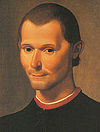 Niccolò Machiavelli
(Florence, 1469–1527), best known for his Il Principe was the founder of realist political philosophy, advocated republican
government, citizen armies, division of power, protection of personal property, and restraint of government expenditure as being necessary to the liberties of a republic. He wrote extensively on the need for individual initiative - virtu - as an essential characteristic of stable government. He argued that liberty was the central good which government should protect, and that "good people" would make good laws, whereas people who had lost their virtue could maintain their liberties only with difficulty. His Discourses on Livy outlined realism as the central idea of political study and favored "Republics" over "Principalities".
Anti-statist liberals consider Machiavelli's distrust as his main message, noting his call for a strong state under a strong leader, who should use any means to establish his position, whereas liberalism is an ideology of individual freedom and voluntary choices.
 Desiderius Erasmus (Netherlands, 1466–1536) was an advocate of the doctrine now known as humanism
, critic of entrenched interests, irrationality and superstition. Erasmusian societies formed across Europe, to some extent in response to the turbulence of the Reformation
.
He dealt with the freedom of the will, a crucial point. In his De libero arbitrio diatribe sive collatio (1524), he analyzes with great cleverness and good humour the Lutheran exaggeration of the obvious limitations on human freedom.
.jpg) Thomas Hobbes
Thomas Hobbes
(England, 1588–1679) theorized that government is the result of individual actions and human traits, and that it was motivated primarily by "interest", a term which would become crucial in the development of a liberal theory of government and political economy, since it is the foundation of the idea that individuals can be self-governing and self-regulating. His work Leviathan, did not advocate this viewpoint, but instead that only a strong government could restrain unchecked interest: it did, however, advance a proto-liberal position in arguing for an inalienable "right of nature," the right to defend oneself, even against the state. Though it is problematic to classify Hobbes himself as a liberal, his work influenced Locke, Hamilton, Jefferson, Madison and many other later liberals, leading Strauss
to identify Hobbes as the "father of liberalism".
(Netherlands, 1632–1677) is in his Tractatus Theologico-Politicus and Tractatus Politicus a proto-liberal defending the value of separation of church and state
as well as forms of democracy
. In the first mentioned book, Spinoza expresses an early criticism of religious intolerance and a defense of secular government
. Spinoza was a thoroughgoing determinist who held that absolutely everything that happens occurs through the operation of necessity
. For him, even human behaviour is fully determined, freedom being our capacity to know we are determined and to understand why we act as we do. So freedom is not the possibility to say "no" to what happens to us but the possibility to say "yes" and fully understand why things should necessarily happen that way.
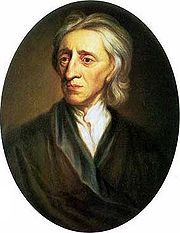 John Locke
's (England, 1632–1704) notion that a "government
with the consent of the governed" and man's natural rights
—life
, liberty
, and estate
(property
) as well on tolerance
, as laid down in A letter concerning toleration and Two treatises of government —had an enormous influence on the development of liberalism
. Developed a theory of property resting on the actions of individuals, rather than on descent or nobility.
One could argue that liberal theory
starts with Locke, influenced by the proto-liberal contributions listed above.
(United Kingdom, 1662–1723) was co-author, with Thomas Gordon of Cato's Letters. These newspaper essays condemned tyranny and advanced principles of freedom of conscience and freedom of speech
and were a main vehicle for spreading the concept
s that had been developed by John Locke
.
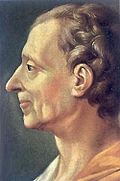 Charles de Montesquieu
(France, 1689–1755)
In The Spirit of the Laws, Montesquieu expounded the separation of powers in government and society. In government, Montesquieu encouraged division into the now standard legislative, judicial and executive branches; in society, he perceived a natural organization into king, the people and the aristocracy, with the latter playing a mediating role. "I do not write to censor that which is established in any country whatsoever," Montesquieu disclaimed in the Laws; however, he did pay special attention to what he felt was the positive example of the constitutional system in England, which in spite of its evolution toward a fusion of powers, had moderated the power of the monarch, and divided Parliament along class lines.
Montesquieu's work had a seminal impact on the American and French revolutionaries. Ironically, the least liberal element of his thought—his privileging of the aristocracy—was belied by both revolutions. Montesquieu's system came to fruition in America, a country with no aristocracy; in France, political maneuvering by the aristocracy led to the convocation of the 1789 Estates-General and popular revolt.
(United Kingdom, 169?-1750) was co-author, with John Trenchard of Cato's Letters. These newspaper essays condemned tyranny and advanced principles of freedom of conscience and freedom of speech
and were a main vehicle for spreading the concept
s that had been developed by John Locke
.
(France, 1694–1774)
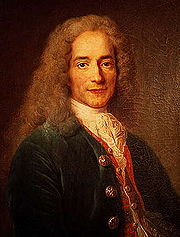 Voltaire
(France, 1694–1778)
(Switzerland, 1712–1778)
(France, 1713–1784)
(France, 1717–1783)
(United Kingdom, 1723–1791)
 Anders Chydenius
(Finland (then a part of the Swedish realm), 1729–1803)
His book Den Nationale Winsten (engl. The National Gain) proposed roughly same the ideas as Adam Smith
's Wealth of Nations, a decade earlier, including foundations of liberalism
and capitalism
and (roughly) the invisible hand
. He demanded complete economic and individual freedom, including the freedom of religion (although he was a priest), worker's rights to freely move and choose their professions and employers, the freedom of speech and trade and abolitions of all privileges and price and wage controls.
He was also a member of the Swedish four-estates parliament, elected three times as representative of the clergy in the northern and western parts of Finland. In his first parliamentary session, 1765–66, he was very successful as a member of the subcommittee that wrote Swedens famous Constitutional Law of the Freedom of Printing, Tryckfrihetsförordningen, of 1766. In this law Chydenius combined freedom of the press, and abolishment of the political censorship
, with free access for the citizens to most government documents. Chydenius liberal system, where transparency reinforces press freedom, and the right for everyone to print the public document reinforces transparency, has been a fundamental constitutional principle in Sweden ever since, except for the years of royal autocracy 1772-1809. Chydenius model for press freedom and freedom of information was reestablished and strengthened in the Swedish Constitution 1809. It is now the foundation of the present Tryckfrihetsförordningen of 1949, which is one of the fundamental laws of Sweden.
In diluted form, and without the strong constitutional protection of the Swedish free press model, the principle of free access to public documents that originated in Chydenius law of 1766, has in recent decades been spread from Sweden to the Freedom of Information Acts
of many countries. This way, Anders Chydenius, has become one of the older liberal thinkers that has most practical influence on politics and public administration of modern western societies.
An edition of Anders Chydenius Complete Works, in Finnish, Swedish and English, is under preparation by the Chydenius Foundation in Finland.
 Adam Smith
(Great Britain, 1723–1790), often considered the founder of modern economics
, was a key figure in formulating and advancing economic doctrine of free trade and competition. In his Wealth of Nations Adam Smith outlined the key idea that if the economy is basically left to its own devices, limited and finite resources will be put to ultimately their most efficient use through people acting purely in their self interest. This he called the invisible hand
of the market.
Smith also advanced property rights and personal civil liberties
, including stopping slavery, which today partly form the basic liberal ideology. He was also opposed to stock-holding companies, what today is called a "corporation", because he predicated the self-policing of the free market upon the free association of moral individuals.
.jpg) Immanuel Kant
Immanuel Kant
(Germany, 1724–1804)
(France, 1727–1781)
(United Kingdom/United States, 1733–1804)
(United States, 1736–1799)
(United Kingdom/United States, 1737–1809)
(United States, 1743–1826) was the third President
of the United States
and author of the Declaration of Independence
. He also wrote Notes on the State of Virginia
. He was a champion of inalienable individual rights and the separation of church and state. His ideas were repeated in many other liberal revolutions around the world, including the (early) French Revolution
.
(France, 1743–1794)
(United Kingdom, 1748–1832)
An early advocate of utilitarianism
, animal welfare
and women's rights. He had many students all around the world, including John Stuart Mill
and several political leaders. Bentham demanded economic and individual freedom, including the separation of the state and church, freedom of expression, completely equal rights for women, the end of slavery and colonialism, uniform democracy, the abolition of physical punishment, also on children, the right for divorce, free prices, free trade and no restrictions on interest. Bentham was not a libertarian
: he supported inheritance tax, restrictions on monopoly power, pensions, health insurance and other social security, but called for prudence and careful consideration in any such governmental intervention.
(France, 1748–1836) played an important role in the opening years of the French Revolution
, drafting the Declaration of the Rights of Man and Citizen, expanding on the theory of national sovereignty
, popular sovereignty
, and representation
implied in his pamphlet What is the Third Estate?
.
(France, 1766–1817)
(France, 1767–1830)
(France, 1767–1832)
 Wilhelm von Humboldt
(Germany, 1767–1835)
(United Kingdom, 1773–1836)
(France, 1801–1850)
(United Kingdom, 1802–1876)
(United States, 1803–1882) was an American philosopher who argued that the basic principles of government were mutable, and that government is required only insofar as people are not self-governing. Proponent of Democracy, and of the idea that a democratic people must have a democratic ethics.
(France, 1805–1859)
(United States, 1805–1879)
 John Stuart Mill
(United Kingdom, 1806–1873) is one of the first champions of modern "liberalism." As such, his work on political economy
and logic
helped lay the foundation for advancements in empirical science and public policy based on verifiable improvements. Strongly influenced by Bentham's utilitarianism
, he disagrees with Kant's intuitive notion of right and formulates the "highest normative principle" of morals as:
Actions are right in proportion as they tend to promote happiness; wrong as they tend to produce the reverse of happiness.
Some consider Mill as the founder of Social liberalism
. Although Mill was mainly for free markets, he accepted interventions in the economy, such as a tax on alcohol, if there were sufficient utilitarian grounds. Mill was also a champion of women's rights.
(Argentina, 1810–1884)
(1817–1862)
(Switzerland, 1818–1897) State as derived from cultural and economic life
(United Kingdom, 1820–1903), philosopher, psychologist, and sociologist, advanced what he called the "Law of equal liberty
" and argued against liberal theory promoting more activist government, which he dubbed "a new form of Tory
ism." He supported a state limited in its duties to the defense of persons and their property. For Spencer, voluntary cooperation was the hallmark of the most vibrant form of society, accommodating the widest diversity of members and the greatest diversity of goals. Spencer's evolution
ary approach has been characterized as an extension of Adam Smith
's "invisible hand" explanation of economic order; his extensive work on sympathy (in psychology
as well as the foundation of ethics, particularly in The Data of Ethics) explicitly carried on Smith's approach in The Theory of Moral Sentiments
. Spencer is frequently characterized as a leading Social Darwinist
.
(Austria, 1840–1921)
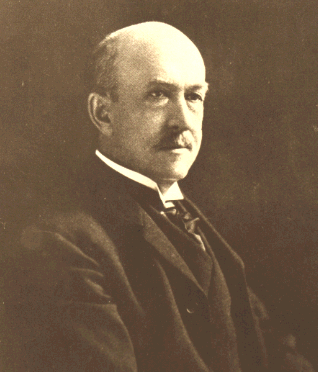 William Graham Sumner
(United States, 1840–1910)
(United States, 1841–1913)
Lester Ward was a botanist, paleontologist, and sociologist. He served as the first president of the American Sociological Association. Ward was a fierce and unrelenting critic of the laissez-faire policies advocated by Herbert Spencer and William Graham Sumner.
Ward's major works can be found here: http://socserv2.mcmaster.ca/~econ/ugcm/3ll3/ward/index.html
(Austria, 1851–1914)
(1857–1926) is best known as the author of Theory of the Leisure Class. Veblen was influential to a generation of American liberalism searching for a rational basis for the economy beyond corporate consolidation and "cut throat competition". Veblen's central argument was that individuals require sufficient non-economic time to become educated citizens. He caustically attacked pure material consumption for its own sake, and the idea that utility equalled conspicuous consumption.
(United States, 1859–1952)
(Germany, 1864–1920) was a theorist of state power and the relationship of culture to economics. Argued that there was a moral component to capitalism rooted in "Protestant" values. Weber was along with Friedrich Naumann active in the National Social Union and later in the German Democratic Party.
(United Kingdom, 1864–1929)
(Italy, 1866–1952)
(United Kingdom, 1879–1963)
(Austria/United States, 1881–1973)
(Spain, 1883–1955)
(Spain, 1886–1978). One of the principal authors of the Oxford Manifesto
in 1947.
(Germany, 1899–1966)
(Sweden, 1899–1979)
(Austria/United Kingdom/United States/Germany, 1899–1992) In Hayek's view, the central role of the state should be to maintain the rule of law, with as little arbitrary intervention as possible. Also a Nobel Prize winner in economics and predicter of the Great Depression like fellow Austrian School economist and mentor Ludwig von Mises.
(Austria/United Kingdom, 1902–1994) developed the idea of the open society
, characterized by respect for a wide variety of opinions and behaviors and a preference for audacious but piecemeal political reform over either conservative stasis or revolutionary utopianism. In his view, all overly simplistic and grand theories of history and society shared a common feature he called historicism
, which he traces back to Plato, while the open society mirrors the methodological fallibilism pioneered by Popper in his earlier works on philosophy of science.
(South Africa, 1903–1988) contributed with his book Cry, The beloved country to a clear anti-apartheid stand of South African liberalism. His party, the Liberal Party of South Africa was banned by the apartheid government.
(United Kingdom, 1904–1989) is known for his work in macro-economics and social choice theory
. His macro-economic work produced the IS-LM model of macro-economics, which would be the basis for much theory since then, including the work of Paul Krugman
and Robert Mundell
. In the area of social choice he argued for the necessity of placing freedom of choice in balance against social welfare to produce the best practical outcomes.
(France, 1905–1983)
(South Africa, 1908–1972), known as Dilizintaba ("He who removes mountains"), was a constitutional lawyer and a parliamentarian
but above all, an academic. His work on constitutional law
centred on civil rights
and his fierce opposition to the segregationalist policies of Apartheid.
(France 1908-1986) argued in her book The Second Sex
that women were treated as legal and social inferiors, and that this was morally untenable. She was influential in the Women's Liberation movement and these arguments also contributed to those about race and racism.
 John Kenneth Galbraith
(Canadian-born Economist who worked in the United States, 1908–2006)
(Latvia/United Kingdom, 1909–1997) is most famous for his attempt to distinguish 'two conceptions of liberty'. Berlin argued that what he called 'positive' and 'negative' liberty were mutually opposing concepts. Positive conceptions assumed that liberty could only be achieved when collective power (in the form of church or state) acted to 'liberate' mankind from its worst aspects. These, Berlin felt, tended towards totalitarianism. Negative conceptions, by contrast, argued that liberty was achieved when individuals were given maximal freedom from external constraints (so long as these did not impinge on the freedom of others to achieve the same condition). Berlin was also a critic of dogmatic Enlightenment rationalism on the grounds that it was unable to accommodate value pluralism.
(Britain, 1883-1946), widely considered to be a founding father of macroeconomics
and an influential liberal economist throughout the 20th century.
(United States, 1912–2006), winner of a Nobel Prize in Economics and a self-identified Classical Liberal and libertarian, was known for the Friedman rule
, Friedman's k-percent rule
, and the Friedman test
.
(United States, * 1919) is known for his economic theories of the political process, which were among the first to take seriously the concept of politicians as rational actors that respond to incentives.
(United States, 1921–2002) is widely considered one of the most important English-language political philosophers of the 20th century. There is general agreement that the publication of his landmark work, A Theory of Justice, led to a revival in the academic study of political philosophy. The importance of this book in contemporary liberal thought and social contract
theory is perhaps best described by an early libertarian rival and critic, Robert Nozick
, who called it a "work in political and moral philosophy that has not seen its equal since the writings of John Stuart Mill
, if then.... Political philosophers must now work within Rawls' theory or explain why not." (Nozick, Anarchy, State, and Utopia, p. 183) Some of Rawls's contributions include the ideas of Justice as Fairness
, the original position
, reflective equilibrium
, overlapping consensus
, public reason
, and the veil of ignorance. Rawls has the distinction among contemporary political philosophers of being frequently cited by the courts of law in the United States and referred to by practicing politicians in the United Kingdom.
(United States, 1926–1995) was the originator of modern anarcho-capitalism
and an economist and economic historian of the Austrian school
. He is widely considered one of the foremost advocates of liberty
and freedom in the late 20th century. He was involved with various political movements throughout his life, notably with Ayn Rand
and, later, the Libertarian Party
of United States. His influence is lasting in the libertarian and anarcho-capitalist movements.
(Russia/United States, 1905–1982) was the founder of the philosophy of Objectivism
and a novelist, best known for her philosophical novel Atlas Shrugged
which continues to sell tens of thousands of copies every year over half a century later. In contrast with many classical liberal thinkers she made the argument for individual liberty on moral grounds with rational egoism and long-term self interest. Her shortest summary of this philosophy was:
(Germany/United Kingdom, 1929–2009 )
(Germany, 1929–1973) was in his book Noch eine Chance für die Liberalen one of the main theorist of the new social liberal principles of the Free Democratic Party (Germany)
. He places liberalism clearly as the opposite of conservatism
and opened the road for a government coalition with the social democrats.
(United Kingdom)
(United States, 1928- ), famous linguist, philosopher, and political theorist.
(United States, 1931–2007) was one of the leading contemporary philosophers of liberalism. His fundamental claims, among others, are that liberalism is best defined as the attempt to avoid cruelty to others; that liberals need to accept the historical 'irony' that there is no metaphysical justification for their belief that not being cruel is a virtue; that literature plays a crucial role in developing the empathy necessary to promote solidarity (and therefore lack of cruelty) between humans; and that private philosophising and public political discourse are separate practices and should remain so.
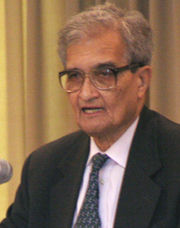 Amartya Sen
(India, 1933- ) is an economist whose early work was based on Kenneth Arrow
's General Possibility Theorem, and on the impossibility of both complete pareto optimality and solely procedural based rights. Won Bank of Sweden Prize in Economic Sciences for his work on famine
, welfare economics
and social choice theory
. Advocate of rationality as the fundamental safe guard of freedom and justice.
(United States, 1938–2002) was a libertarian
(or minarchist). He advocated an unapologetically reductionist political philosophy characterized by meticulous analysis of the moral aspects of each social interaction, and did not shy away from addressing hard philosophical issues such as the original appropriation of property. Nozick is best known for providing the justification of a minimal state by showing that it can be established without any unjust steps.
(Peru, 1941- ) is an advocate of transparency and private property rights, arguing that intransparent government leads to property not being given proper title, and therefore being "dead capital" which cannot be used as the basis of credit. Argues that laws which allocate property to those most able to use them for economic growth, so called "squatter's rights", are an important innovation.
(United States)
(Canada, 1962–present) tries in his philosophy to determine if forms of ethnic or minority nationalism
are compatible with liberal-democratic principles of individual freedom, social equality and political democracy. In his book Multicultural Citizenship. A Liberal Theory of Minority Rights he argues that certain "group-differentiated rights" of minority cultures can be consistent with these liberal-democratic principles.
Classical liberalism
Classical liberalism is the philosophy committed to the ideal of limited government, constitutionalism, rule of law, due process, and liberty of individuals including freedom of religion, speech, press, assembly, and free markets....
and political liberalism are associated with philosophers of the Enlightenment
Age of Enlightenment
The Age of Enlightenment was an elite cultural movement of intellectuals in 18th century Europe that sought to mobilize the power of reason in order to reform society and advance knowledge. It promoted intellectual interchange and opposed intolerance and abuses in church and state...
. Liberalism as a specifically named ideology begins in the late 18th century as a movement towards self-government and away from aristocracy
Aristocracy
Aristocracy , is a form of government in which a few elite citizens rule. The term derives from the Greek aristokratia, meaning "rule of the best". In origin in Ancient Greece, it was conceived of as rule by the best qualified citizens, and contrasted with monarchy...
. It included the ideas of self-determination, the primacy of the individual and the nation, as opposed to the family, the state, and religion, as being the fundamental units of law, politics and economy.
Since then liberalism has broadened to include a wide range of approaches from Americans
United States
The United States of America is a federal constitutional republic comprising fifty states and a federal district...
Ronald Dworkin
Ronald Dworkin
Ronald Myles Dworkin, QC, FBA is an American philosopher and scholar of constitutional law. He is Frank Henry Sommer Professor of Law and Philosophy at New York University and Emeritus Professor of Jurisprudence at University College London, and has taught previously at Yale Law School and the...
, Richard Rorty
Richard Rorty
Richard McKay Rorty was an American philosopher. He had a long and diverse academic career, including positions as Stuart Professor of Philosophy at Princeton, Kenan Professor of Humanities at the University of Virginia, and Professor of Comparative Literature at Stanford University...
, John Rawls
John Rawls
John Bordley Rawls was an American philosopher and a leading figure in moral and political philosophy. He held the James Bryant Conant University Professorship at Harvard University....
and Francis Fukuyama
Francis Fukuyama
Yoshihiro Francis Fukuyama is an American political scientist, political economist, and author. He is a Senior Fellow at the Center on Democracy, Development and the Rule of Law at Stanford. Before that he served as a professor and director of the International Development program at the School of...
as well as the India
India
India , officially the Republic of India , is a country in South Asia. It is the seventh-largest country by geographical area, the second-most populous country with over 1.2 billion people, and the most populous democracy in the world...
n Amartya Sen
Amartya Sen
Amartya Sen, CH is an Indian economist who was awarded the 1998 Nobel Prize in Economic Sciences for his contributions to welfare economics and social choice theory, and for his interest in the problems of society's poorest members...
and the Peru
Peru
Peru , officially the Republic of Peru , is a country in western South America. It is bordered on the north by Ecuador and Colombia, on the east by Brazil, on the southeast by Bolivia, on the south by Chile, and on the west by the Pacific Ocean....
vian Hernando de Soto
Hernando de Soto (economist)
Hernando de Soto is a Peruvian economist known for his work on the informal economy and on the importance of business and property rights. He is the president of the Institute for Liberty and Democracy , located in Lima, Peru.-Childhood and education:Hernando de Soto was born in 1941 in Arequipa,...
. Some of these people moved away from liberalism
Liberalism
Liberalism is the belief in the importance of liberty and equal rights. Liberals espouse a wide array of views depending on their understanding of these principles, but generally, liberals support ideas such as constitutionalism, liberal democracy, free and fair elections, human rights,...
, while others espoused other ideologies
Ideology
An ideology is a set of ideas that constitutes one's goals, expectations, and actions. An ideology can be thought of as a comprehensive vision, as a way of looking at things , as in common sense and several philosophical tendencies , or a set of ideas proposed by the dominant class of a society to...
before turning to liberalism. There are many different views of what constitutes liberalism, and some liberals would feel that some of the people on this list were not true liberals. It is intended to be suggestive rather than exhaustive. Theorists whose ideas were mainly typical for one country should be listed in that country's section of liberalism worldwide
Liberalism worldwide
This article gives information on liberalism in diverse countries around the world. It is an overview of parties that adhere more or less to the ideas of political liberalism and is therefore a list of liberal parties around the world....
. Generally only thinkers are listed, politicians are only listed when they, beside their active political work, also made substantial contributions to liberal theory.
Laozi
LaoziLaozi
Laozi was a mystic philosopher of ancient China, best known as the author of the Tao Te Ching . His association with the Tao Te Ching has led him to be traditionally considered the founder of Taoism...
(China, 6th century BC) is the author of the classic Chinese text, the Tao Te Ching
Tao Te Ching
The Tao Te Ching, Dao De Jing, or Daodejing , also simply referred to as the Laozi, whose authorship has been attributed to Laozi, is a Chinese classic text...
, and the founder of Taoist
Taoism
Taoism refers to a philosophical or religious tradition in which the basic concept is to establish harmony with the Tao , which is the mechanism of everything that exists...
philosophy. A common theme that runs throughout the Tao Te Ching is that the ruler should not meddle with society; instead, the people should be left to their own devices. This is not because he thought that people needed or deserved freedom. He simply thought our meddling was counter-productive. Whenever we intervene in the order of things, we create unintended side effects. We mess things up. Taoists often say, "Things do not get confused; we get confused." For example, speaking of the government in chapter 58 he wrote, "That which is meddling, touching everything, will work but ill, and disappointment bring." The Taoist concept of wei wu wei
Wu wei
Wu wei is an important concept of Taoism , that involves knowing when to act and when not to act. Another perspective to this is that "Wu Wei" means...
"do without doing" may sound like the later Western concept of laissez-faire
Laissez-faire
In economics, laissez-faire describes an environment in which transactions between private parties are free from state intervention, including restrictive regulations, taxes, tariffs and enforced monopolies....
"let do," but someone applying wu wei wu expects to gain the intended outcome, while someone who adopts a laissez-faire attitude has surrendered their control of the outcome.
Niccolò Machiavelli
Niccolò Machiavelli
Niccolò di Bernardo dei Machiavelli was an Italian historian, philosopher, humanist, and writer based in Florence during the Renaissance. He is one of the main founders of modern political science. He was a diplomat, political philosopher, playwright, and a civil servant of the Florentine Republic...
(Florence, 1469–1527), best known for his Il Principe was the founder of realist political philosophy, advocated republican
Classical republicanism
Classical republicanism is a form of republicanism developed in the Renaissance inspired by the governmental forms and writings of classical antiquity. The earliest examples of the school were classical writers such as Aristotle, Polybius, and Cicero...
government, citizen armies, division of power, protection of personal property, and restraint of government expenditure as being necessary to the liberties of a republic. He wrote extensively on the need for individual initiative - virtu - as an essential characteristic of stable government. He argued that liberty was the central good which government should protect, and that "good people" would make good laws, whereas people who had lost their virtue could maintain their liberties only with difficulty. His Discourses on Livy outlined realism as the central idea of political study and favored "Republics" over "Principalities".
Anti-statist liberals consider Machiavelli's distrust as his main message, noting his call for a strong state under a strong leader, who should use any means to establish his position, whereas liberalism is an ideology of individual freedom and voluntary choices.
- Contributing literature:
- Il Principe, 1513 (The PrinceThe PrinceThe Prince is a political treatise by the Italian diplomat, historian and political theorist Niccolò Machiavelli. From correspondence a version appears to have been distributed in 1513, using a Latin title, De Principatibus . But the printed version was not published until 1532, five years after...
, http://www.gutenberg.org/dirs/etext98/tprnc11.txt) - Discorsi sopra la prima deca di Tito Livio, 1512-1517 (Discourse on the First Decade of Titus Livius)
- Il Principe, 1513 (The Prince
Desiderius Erasmus
Humanism
Humanism is an approach in study, philosophy, world view or practice that focuses on human values and concerns. In philosophy and social science, humanism is a perspective which affirms some notion of human nature, and is contrasted with anti-humanism....
, critic of entrenched interests, irrationality and superstition. Erasmusian societies formed across Europe, to some extent in response to the turbulence of the Reformation
Protestant Reformation
The Protestant Reformation was a 16th-century split within Western Christianity initiated by Martin Luther, John Calvin and other early Protestants. The efforts of the self-described "reformers", who objected to the doctrines, rituals and ecclesiastical structure of the Roman Catholic Church, led...
.
He dealt with the freedom of the will, a crucial point. In his De libero arbitrio diatribe sive collatio (1524), he analyzes with great cleverness and good humour the Lutheran exaggeration of the obvious limitations on human freedom.
- Contributing literature
- Lof der Zotheid, 1509 (The Praise of FollyThe Praise of FollyIn Praise of Folly is an essay written in 1509 by Desiderius Erasmus of Rotterdam and first printed in 1511...
, http://www.fordham.edu/halsall/mod/1509erasmus-folly.html) - De libero arbitrio diatribe sive collatio, 1524
- Lof der Zotheid, 1509 (The Praise of Folly
Thomas Hobbes
Thomas Hobbes
Thomas Hobbes of Malmesbury , in some older texts Thomas Hobbs of Malmsbury, was an English philosopher, best known today for his work on political philosophy...
(England, 1588–1679) theorized that government is the result of individual actions and human traits, and that it was motivated primarily by "interest", a term which would become crucial in the development of a liberal theory of government and political economy, since it is the foundation of the idea that individuals can be self-governing and self-regulating. His work Leviathan, did not advocate this viewpoint, but instead that only a strong government could restrain unchecked interest: it did, however, advance a proto-liberal position in arguing for an inalienable "right of nature," the right to defend oneself, even against the state. Though it is problematic to classify Hobbes himself as a liberal, his work influenced Locke, Hamilton, Jefferson, Madison and many other later liberals, leading Strauss
Leo Strauss
Leo Strauss was a political philosopher and classicist who specialized in classical political philosophy. He was born in Germany to Jewish parents and later emigrated to the United States...
to identify Hobbes as the "father of liberalism".
Baruch Spinoza
Baruch SpinozaBaruch Spinoza
Baruch de Spinoza and later Benedict de Spinoza was a Dutch Jewish philosopher. Revealing considerable scientific aptitude, the breadth and importance of Spinoza's work was not fully realized until years after his death...
(Netherlands, 1632–1677) is in his Tractatus Theologico-Politicus and Tractatus Politicus a proto-liberal defending the value of separation of church and state
Separation of church and state
The concept of the separation of church and state refers to the distance in the relationship between organized religion and the nation state....
as well as forms of democracy
Democracy
Democracy is generally defined as a form of government in which all adult citizens have an equal say in the decisions that affect their lives. Ideally, this includes equal participation in the proposal, development and passage of legislation into law...
. In the first mentioned book, Spinoza expresses an early criticism of religious intolerance and a defense of secular government
Government
Government refers to the legislators, administrators, and arbitrators in the administrative bureaucracy who control a state at a given time, and to the system of government by which they are organized...
. Spinoza was a thoroughgoing determinist who held that absolutely everything that happens occurs through the operation of necessity
Necessity
In U.S. criminal law, necessity may be either a possible justification or an exculpation for breaking the law. Defendants seeking to rely on this defense argue that they should not be held liable for their actions as a crime because their conduct was necessary to prevent some greater harm and when...
. For him, even human behaviour is fully determined, freedom being our capacity to know we are determined and to understand why we act as we do. So freedom is not the possibility to say "no" to what happens to us but the possibility to say "yes" and fully understand why things should necessarily happen that way.
- Contributing literature:
- Tractatus Theologico-Politicus, 1670 (Theologico-Political Treatise, http://www.gutenberg.org/etext/989)
- Tractatus Politicus, 1677 (Political Treatise)
John Locke
John Locke
John Locke FRS , widely known as the Father of Liberalism, was an English philosopher and physician regarded as one of the most influential of Enlightenment thinkers. Considered one of the first of the British empiricists, following the tradition of Francis Bacon, he is equally important to social...
's (England, 1632–1704) notion that a "government
Government
Government refers to the legislators, administrators, and arbitrators in the administrative bureaucracy who control a state at a given time, and to the system of government by which they are organized...
with the consent of the governed" and man's natural rights
Natural rights
Natural and legal rights are two types of rights theoretically distinct according to philosophers and political scientists. Natural rights are rights not contingent upon the laws, customs, or beliefs of any particular culture or government, and therefore universal and inalienable...
—life
Life
Life is a characteristic that distinguishes objects that have signaling and self-sustaining processes from those that do not, either because such functions have ceased , or else because they lack such functions and are classified as inanimate...
, liberty
Liberty
Liberty is a moral and political principle, or Right, that identifies the condition in which human beings are able to govern themselves, to behave according to their own free will, and take responsibility for their actions...
, and estate
Estate (law)
An estate is the net worth of a person at any point in time. It is the sum of a person's assets - legal rights, interests and entitlements to property of any kind - less all liabilities at that time. The issue is of special legal significance on a question of bankruptcy and death of the person...
(property
Property
Property is any physical or intangible entity that is owned by a person or jointly by a group of people or a legal entity like a corporation...
) as well on tolerance
Toleration
Toleration is "the practice of deliberately allowing or permitting a thing of which one disapproves. One can meaningfully speak of tolerating, ie of allowing or permitting, only if one is in a position to disallow”. It has also been defined as "to bear or endure" or "to nourish, sustain or preserve"...
, as laid down in A letter concerning toleration and Two treatises of government —had an enormous influence on the development of liberalism
Liberalism
Liberalism is the belief in the importance of liberty and equal rights. Liberals espouse a wide array of views depending on their understanding of these principles, but generally, liberals support ideas such as constitutionalism, liberal democracy, free and fair elections, human rights,...
. Developed a theory of property resting on the actions of individuals, rather than on descent or nobility.
One could argue that liberal theory
Liberalism
Liberalism is the belief in the importance of liberty and equal rights. Liberals espouse a wide array of views depending on their understanding of these principles, but generally, liberals support ideas such as constitutionalism, liberal democracy, free and fair elections, human rights,...
starts with Locke, influenced by the proto-liberal contributions listed above.
- Some literature:
- A Letter Concerning TolerationA Letter Concerning TolerationA Letter Concerning Toleration by John Locke was originally published in 1689. Its initial publication was in Latin, though it was immediately translated into other languages. Locke's work appeared amidst a fear that Catholicism might be taking over England, and responds to the problem of religion...
, 1689 http://www.constitution.org/jl/tolerati.htm - The Second Treatise of Civil Government, 1689 http://www.gutenberg.net/etext/7370
- A Letter Concerning Toleration
John Trenchard
John TrenchardJohn Trenchard (writer)
John Trenchard , English writer and Commonwealthman, belonged to the same Dorset family as the Secretary of State Sir John Trenchard.Trenchard was educated at Trinity College, Dublin, and became a lawyer...
(United Kingdom, 1662–1723) was co-author, with Thomas Gordon of Cato's Letters. These newspaper essays condemned tyranny and advanced principles of freedom of conscience and freedom of speech
Freedom of speech
Freedom of speech is the freedom to speak freely without censorship. The term freedom of expression is sometimes used synonymously, but includes any act of seeking, receiving and imparting information or ideas, regardless of the medium used...
and were a main vehicle for spreading the concept
Concept
The word concept is used in ordinary language as well as in almost all academic disciplines. Particularly in philosophy, psychology and cognitive sciences the term is much used and much discussed. WordNet defines concept: "conception, construct ". However, the meaning of the term concept is much...
s that had been developed by John Locke
John Locke
John Locke FRS , widely known as the Father of Liberalism, was an English philosopher and physician regarded as one of the most influential of Enlightenment thinkers. Considered one of the first of the British empiricists, following the tradition of Francis Bacon, he is equally important to social...
.
- Some literature:
- Cato's LettersCato's LettersCato's Letters were essays by British writers John Trenchard and Thomas Gordon, first published from 1720 to 1723 under the pseudonym of Cato , the implacable foe of Julius Caesar and a famously stubborn champion of republican principles....
/ John Trenchard & Thomas Gordon, 1720–1723
- Cato's Letters
Charles de Montesquieu
Charles de Secondat, baron de Montesquieu
Charles-Louis de Secondat, baron de La Brède et de Montesquieu , generally referred to as simply Montesquieu, was a French social commentator and political thinker who lived during the Enlightenment...
(France, 1689–1755)
In The Spirit of the Laws, Montesquieu expounded the separation of powers in government and society. In government, Montesquieu encouraged division into the now standard legislative, judicial and executive branches; in society, he perceived a natural organization into king, the people and the aristocracy, with the latter playing a mediating role. "I do not write to censor that which is established in any country whatsoever," Montesquieu disclaimed in the Laws; however, he did pay special attention to what he felt was the positive example of the constitutional system in England, which in spite of its evolution toward a fusion of powers, had moderated the power of the monarch, and divided Parliament along class lines.
Montesquieu's work had a seminal impact on the American and French revolutionaries. Ironically, the least liberal element of his thought—his privileging of the aristocracy—was belied by both revolutions. Montesquieu's system came to fruition in America, a country with no aristocracy; in France, political maneuvering by the aristocracy led to the convocation of the 1789 Estates-General and popular revolt.
- Some literature:
- De l'esprit des lois,1748 (The Spirit of the LawsThe Spirit of the LawsThe Spirit of the Laws is a treatise on political theory first published anonymously by Charles de Secondat, Baron de Montesquieu in 1748 with the help of Claudine Guérin de Tencin...
) http://www.constitution.org/cm/sol.htm) - Encyclopédie, ou dictionnaire raisonné des sciences, des arts et des métiersEncyclopédieEncyclopédie, ou dictionnaire raisonné des sciences, des arts et des métiers was a general encyclopedia published in France between 1751 and 1772, with later supplements, revised editions, and translations. It was edited by Denis Diderot and Jean le Rond d'Alembert...
(together with others), 1751-1772 (Encyclopaedia, or Reasoned Dictionary of the Sciences, Arts, and Trades http://www.hti.umich.edu/d/did/)
- De l'esprit des lois,1748 (The Spirit of the Laws
Thomas Gordon
Thomas GordonThomas Gordon (writer)
Thomas Gordon was a Scottish writer and Commonwealthman.Along with John Trenchard, he published The Independent Whig, which was a weekly periodical. From 1720 to 1723, Trenchard and Gordon, wrote a series of 144 essays entitled Cato's Letters, condemning corruption and lack of morality within the...
(United Kingdom, 169?-1750) was co-author, with John Trenchard of Cato's Letters. These newspaper essays condemned tyranny and advanced principles of freedom of conscience and freedom of speech
Freedom of speech
Freedom of speech is the freedom to speak freely without censorship. The term freedom of expression is sometimes used synonymously, but includes any act of seeking, receiving and imparting information or ideas, regardless of the medium used...
and were a main vehicle for spreading the concept
Concept
The word concept is used in ordinary language as well as in almost all academic disciplines. Particularly in philosophy, psychology and cognitive sciences the term is much used and much discussed. WordNet defines concept: "conception, construct ". However, the meaning of the term concept is much...
s that had been developed by John Locke
John Locke
John Locke FRS , widely known as the Father of Liberalism, was an English philosopher and physician regarded as one of the most influential of Enlightenment thinkers. Considered one of the first of the British empiricists, following the tradition of Francis Bacon, he is equally important to social...
.
- Some literature:
- Cato's LettersCato's LettersCato's Letters were essays by British writers John Trenchard and Thomas Gordon, first published from 1720 to 1723 under the pseudonym of Cato , the implacable foe of Julius Caesar and a famously stubborn champion of republican principles....
/ John Trenchard & Thomas Gordon, 1720–1723
- Cato's Letters
François Quesnay
François QuesnayFrançois Quesnay
François Quesnay was a French economist of the Physiocratic school. He is known for publishing the "Tableau économique" in 1758, which provided the foundations of the ideas of the Physiocrats...
(France, 1694–1774)
- Some literature:
- Tableau économique, 1758
- Encyclopédie, ou dictionnaire raisonné des sciences, des arts et des métiersEncyclopédieEncyclopédie, ou dictionnaire raisonné des sciences, des arts et des métiers was a general encyclopedia published in France between 1751 and 1772, with later supplements, revised editions, and translations. It was edited by Denis Diderot and Jean le Rond d'Alembert...
(together with others), 1751-1772 (Encyclopaedia, or Reasoned Dictionary of the Sciences, Arts, and Trades http://www.hti.umich.edu/d/did/)
Voltaire
Voltaire
François-Marie Arouet , better known by the pen name Voltaire , was a French Enlightenment writer, historian and philosopher famous for his wit and for his advocacy of civil liberties, including freedom of religion, free trade and separation of church and state...
(France, 1694–1778)
- Some literature:
- Lettres Philosophiques sur les Anglais, 1734 (Philosophical Letters on the English)
- Encyclopédie, ou dictionnaire raisonné des sciences, des arts et des métiersEncyclopédieEncyclopédie, ou dictionnaire raisonné des sciences, des arts et des métiers was a general encyclopedia published in France between 1751 and 1772, with later supplements, revised editions, and translations. It was edited by Denis Diderot and Jean le Rond d'Alembert...
(together with others), 1751-1772 (Encyclopaedia, or Reasoned Dictionary of the Sciences, Arts, and Trades http://www.hti.umich.edu/d/did/) - Essai sur l'histoire génerale et sur les moeurs et l'espirit des nations, 1756 (Essay on the Manner and Spirit of Nations and on the Principal Occurrences in History)
- Traité sur la Tolérance à l'occasion de la mort de Jean Calas, 1763 (Treatise on Toleration In Connection with the Death of Jean Calas)
- Dictionnaire Philosophique, 1764 (Philosophical Dictionary)
Jean-Jacques Rousseau
Jean-Jacques RousseauJean-Jacques Rousseau
Jean-Jacques Rousseau was a Genevan philosopher, writer, and composer of 18th-century Romanticism. His political philosophy influenced the French Revolution as well as the overall development of modern political, sociological and educational thought.His novel Émile: or, On Education is a treatise...
(Switzerland, 1712–1778)
- Some literature:
- Discourse on InequalityDiscourse on InequalityDiscourse on the Origin and Basis of Inequality Among Men , also commonly known as the "Second Discourse", is a work by philosopher Jean-Jacques Rousseau...
, 1755 - On the Social Contract, 1762
- Discourse on Inequality
Denis Diderot
Denis DiderotDenis Diderot
Denis Diderot was a French philosopher, art critic, and writer. He was a prominent person during the Enlightenment and is best known for serving as co-founder and chief editor of and contributor to the Encyclopédie....
(France, 1713–1784)
- Some literature:
- Encyclopédie, ou dictionnaire raisonné des sciences, des arts et des métiersEncyclopédieEncyclopédie, ou dictionnaire raisonné des sciences, des arts et des métiers was a general encyclopedia published in France between 1751 and 1772, with later supplements, revised editions, and translations. It was edited by Denis Diderot and Jean le Rond d'Alembert...
(together with others), 1751-1772 (Encyclopaedia, or Reasoned Dictionary of the Sciences, Arts, and Trades http://www.hti.umich.edu/d/did/)
- Encyclopédie, ou dictionnaire raisonné des sciences, des arts et des métiers
Jean le Rond d'Alembert
Jean le Rond d'AlembertJean le Rond d'Alembert
Jean-Baptiste le Rond d'Alembert was a French mathematician, mechanician, physicist, philosopher, and music theorist. He was also co-editor with Denis Diderot of the Encyclopédie...
(France, 1717–1783)
- Some literature:
- Encyclopédie, ou dictionnaire raisonné des sciences, des arts et des métiersEncyclopédieEncyclopédie, ou dictionnaire raisonné des sciences, des arts et des métiers was a general encyclopedia published in France between 1751 and 1772, with later supplements, revised editions, and translations. It was edited by Denis Diderot and Jean le Rond d'Alembert...
(together with others), 1751-1772 (Encyclopaedia, or Reasoned Dictionary of the Sciences, Arts, and Trades http://www.hti.umich.edu/d/did/)
- Encyclopédie, ou dictionnaire raisonné des sciences, des arts et des métiers
Richard Price
Richard PriceRichard Price
Richard Price was a British moral philosopher and preacher in the tradition of English Dissenters, and a political pamphleteer, active in radical, republican, and liberal causes such as the American Revolution. He fostered connections between a large number of people, including writers of the...
(United Kingdom, 1723–1791)
- Some literature:
- Appeal to the Public on the Subject of the National Debt, 1771
- Observations on Reversionary Payments, 1771
- Observations on Civil Liberty and the Justice and Policy of the War with America, 1776
Anders Chydenius
Anders Chydenius
Anders Chydenius was the leading classical liberal of Nordic history. Born in Sotkamo, Ostrobothnia, Sweden and having studied under Pehr Kalm at the Royal Academy of Åbo, Chydenius became a priest, Enlightenment philosopher and member of the Swedish Riksdag of the Estates.The world's first...
(Finland (then a part of the Swedish realm), 1729–1803)
His book Den Nationale Winsten (engl. The National Gain) proposed roughly same the ideas as Adam Smith
Adam Smith
Adam Smith was a Scottish social philosopher and a pioneer of political economy. One of the key figures of the Scottish Enlightenment, Smith is the author of The Theory of Moral Sentiments and An Inquiry into the Nature and Causes of the Wealth of Nations...
's Wealth of Nations, a decade earlier, including foundations of liberalism
Liberalism
Liberalism is the belief in the importance of liberty and equal rights. Liberals espouse a wide array of views depending on their understanding of these principles, but generally, liberals support ideas such as constitutionalism, liberal democracy, free and fair elections, human rights,...
and capitalism
Capitalism
Capitalism is an economic system that became dominant in the Western world following the demise of feudalism. There is no consensus on the precise definition nor on how the term should be used as a historical category...
and (roughly) the invisible hand
Invisible hand
In economics, invisible hand or invisible hand of the market is the term economists use to describe the self-regulating nature of the marketplace. This is a metaphor first coined by the economist Adam Smith...
. He demanded complete economic and individual freedom, including the freedom of religion (although he was a priest), worker's rights to freely move and choose their professions and employers, the freedom of speech and trade and abolitions of all privileges and price and wage controls.
He was also a member of the Swedish four-estates parliament, elected three times as representative of the clergy in the northern and western parts of Finland. In his first parliamentary session, 1765–66, he was very successful as a member of the subcommittee that wrote Swedens famous Constitutional Law of the Freedom of Printing, Tryckfrihetsförordningen, of 1766. In this law Chydenius combined freedom of the press, and abolishment of the political censorship
Censorship
thumb|[[Book burning]] following the [[1973 Chilean coup d'état|1973 coup]] that installed the [[Military government of Chile |Pinochet regime]] in Chile...
, with free access for the citizens to most government documents. Chydenius liberal system, where transparency reinforces press freedom, and the right for everyone to print the public document reinforces transparency, has been a fundamental constitutional principle in Sweden ever since, except for the years of royal autocracy 1772-1809. Chydenius model for press freedom and freedom of information was reestablished and strengthened in the Swedish Constitution 1809. It is now the foundation of the present Tryckfrihetsförordningen of 1949, which is one of the fundamental laws of Sweden.
In diluted form, and without the strong constitutional protection of the Swedish free press model, the principle of free access to public documents that originated in Chydenius law of 1766, has in recent decades been spread from Sweden to the Freedom of Information Acts
Freedom of information legislation
Freedom of information legislation comprises laws that guarantee access to data held by the state. They establish a "right-to-know" legal process by which requests may be made for government-held information, to be received freely or at minimal cost, barring standard exceptions...
of many countries. This way, Anders Chydenius, has become one of the older liberal thinkers that has most practical influence on politics and public administration of modern western societies.
An edition of Anders Chydenius Complete Works, in Finnish, Swedish and English, is under preparation by the Chydenius Foundation in Finland.
- Some literature:
- Americanska Näfwerbåtar, 1753 (American birchbark canoes)
- Källan Til Rikets Wan-Magt, 1765 (The cause of the weakness of the Kingdom)
- Den Nationnale Winsten, 1765 (The National GainThe National GainThe National Gain is the main work of the Finnish scientist, philosopher and politician Anders Chydenius, published in 1765...
) http://www.chydenius.net/historia/teokset/e_kansallinen_johdanto.asp)
Adam Smith
Adam Smith
Adam Smith was a Scottish social philosopher and a pioneer of political economy. One of the key figures of the Scottish Enlightenment, Smith is the author of The Theory of Moral Sentiments and An Inquiry into the Nature and Causes of the Wealth of Nations...
(Great Britain, 1723–1790), often considered the founder of modern economics
Economics
Economics is the social science that analyzes the production, distribution, and consumption of goods and services. The term economics comes from the Ancient Greek from + , hence "rules of the house"...
, was a key figure in formulating and advancing economic doctrine of free trade and competition. In his Wealth of Nations Adam Smith outlined the key idea that if the economy is basically left to its own devices, limited and finite resources will be put to ultimately their most efficient use through people acting purely in their self interest. This he called the invisible hand
Invisible hand
In economics, invisible hand or invisible hand of the market is the term economists use to describe the self-regulating nature of the marketplace. This is a metaphor first coined by the economist Adam Smith...
of the market.
Smith also advanced property rights and personal civil liberties
Civil liberties
Civil liberties are rights and freedoms that provide an individual specific rights such as the freedom from slavery and forced labour, freedom from torture and death, the right to liberty and security, right to a fair trial, the right to defend one's self, the right to own and bear arms, the right...
, including stopping slavery, which today partly form the basic liberal ideology. He was also opposed to stock-holding companies, what today is called a "corporation", because he predicated the self-policing of the free market upon the free association of moral individuals.
- Some literature:
- An Inquiry into the Nature and Causes of the Wealth of NationsThe Wealth of NationsAn Inquiry into the Nature and Causes of the Wealth of Nations, generally referred to by its shortened title The Wealth of Nations, is the magnum opus of the Scottish economist and moral philosopher Adam Smith...
, 1776 http://www.mondopolitico.com/library/wealthofnations/toc.htm - The Theory of Moral SentimentsThe Theory of Moral SentimentsThe Theory of Moral Sentiments was written by Adam Smith in 1759. It provided the ethical, philosophical, psychological, and methodological underpinnings to Smith's later works, including The Wealth of Nations , A Treatise on Public Opulence , Essays on Philosophical Subjects , and Lectures on...
, 1759
- An Inquiry into the Nature and Causes of the Wealth of Nations
Immanuel Kant
Immanuel Kant
Immanuel Kant was a German philosopher from Königsberg , researching, lecturing and writing on philosophy and anthropology at the end of the 18th Century Enlightenment....
(Germany, 1724–1804)
- Some literature:
- Grundlegung zur Metaphysik der Sitten, 1785 (Fundamental Principles of the Metaphysic of Morals http://eserver.org/philosophy/kant/metaphys-of-morals.txt)
- Kritik der praktischen VernunftCritique of Practical ReasonThe Critique of Practical Reason is the second of Immanuel Kant's three critiques, first published in 1788. It follows on from his Critique of Pure Reason and deals with his moral philosophy....
, 1788 (Critique of Practical Reason http://eserver.org/philosophy/kant/critique-of-practical-reaso.txt) - Über den Gemeinspruch: Das mag in der Theorie richtig sein, taugt aber nicht für die Praxis, 1793 (On the common saying: this may be true in theory but it does not apply in practice)
- Zum ewigen Frieden, 1795 (Perpetual Peace http://www.sgipt.org/politpsy/vorbild/kant_zef.htm)
- Metaphysik der Sitten, 1797 (Metaphysics of Morals http://eserver.org/philosophy/kant/intro-to-metaphys-of-morals.txt)
Anne Robert Jacques Turgot
Anne Robert Jacques TurgotAnne Robert Jacques Turgot, Baron de Laune
Anne-Robert-Jacques Turgot, Baron de Laune , often referred to as Turgot, was a French economist and statesman. Turgot was a student of Francois Quesnay and as such belonged to the Physiocratic school of economic thought...
(France, 1727–1781)
- Some literature:
- Le Conciliateur, 1754
- Lettre sur la tolérance civile, 1754
- Réflexions sur la formation et la distribution des richesses, 1766
- Lettres sur la liberté du commerce des grains, 1770
- Some literature:
- Thoughts on the Cause of the Present Discontents 1770
- On American TaxationOn American Taxation"On American Taxation" was a speech given by Edmund Burke in the British House of Commons on April 19, 1774, advocating the full repeal of the Townshend Revenue Act of 1767. Parliament had previously repealed five of the six duties of this revenue tax on the American colonies, but the tax on tea...
1774 - On Conciliation with the Colonies 1775
- Speech to the Electors of Bristol 1774
- Reflections on the Revolution in France 1790
Joseph Priestley
Joseph PriestleyJoseph Priestley
Joseph Priestley, FRS was an 18th-century English theologian, Dissenting clergyman, natural philosopher, chemist, educator, and political theorist who published over 150 works...
(United Kingdom/United States, 1733–1804)
- Some literature:
- Essay on the First Principles of Government, 1768
- The Present State of Liberty in Great Britain and her Colonies, 1769
- Remarks on Dr Blackstone's Commentaries, 1769
- Observations on Civil Liberty and the Nature and Justice of the War with America, 1772
Patrick Henry
Patrick HenryPatrick Henry
Patrick Henry was an orator and politician who led the movement for independence in Virginia in the 1770s. A Founding Father, he served as the first and sixth post-colonial Governor of Virginia from 1776 to 1779 and subsequently, from 1784 to 1786...
(United States, 1736–1799)
- Some literature:
- Liberty or Death, 1775 http://www.law.ou.edu/hist/henry.html
Thomas Paine
Thomas PaineThomas Paine
Thomas "Tom" Paine was an English author, pamphleteer, radical, inventor, intellectual, revolutionary, and one of the Founding Fathers of the United States...
(United Kingdom/United States, 1737–1809)
- Some literature:
- Rights of ManRights of ManRights of Man , a book by Thomas Paine, posits that popular political revolution is permissible when a government does not safeguard its people, their natural rights, and their national interests. Using these points as a base it defends the French Revolution against Edmund Burke's attack in...
, 1791-1792 http://onlinebooks.library.upenn.edu/webbin/gutbook/lookup?num=3742 - Agrarian JusticeAgrarian JusticeAgrarian Justice is the title of a pamphlet written by Thomas Paine, published in 1797, which advocated the use of an estate tax and a tax on land values to fund a universal old-age and disability pension, as well as a fixed sum to be paid to all citizens on reaching maturity...
, 1797
- Rights of Man
Thomas Jefferson
Thomas JeffersonThomas Jefferson
Thomas Jefferson was the principal author of the United States Declaration of Independence and the Statute of Virginia for Religious Freedom , the third President of the United States and founder of the University of Virginia...
(United States, 1743–1826) was the third President
President of the United States
The President of the United States of America is the head of state and head of government of the United States. The president leads the executive branch of the federal government and is the commander-in-chief of the United States Armed Forces....
of the United States
United States
The United States of America is a federal constitutional republic comprising fifty states and a federal district...
and author of the Declaration of Independence
Declaration of independence
A declaration of independence is an assertion of the independence of an aspiring state or states. Such places are usually declared from part or all of the territory of another nation or failed nation, or are breakaway territories from within the larger state...
. He also wrote Notes on the State of Virginia
Notes on the State of Virginia
Notes on the State of Virginia was a book written by Thomas Jefferson. He completed the first edition in 1781, and updated and enlarged the book in 1782 and 1783...
. He was a champion of inalienable individual rights and the separation of church and state. His ideas were repeated in many other liberal revolutions around the world, including the (early) French Revolution
French Revolution
The French Revolution , sometimes distinguished as the 'Great French Revolution' , was a period of radical social and political upheaval in France and Europe. The absolute monarchy that had ruled France for centuries collapsed in three years...
.
Marquis de Condorcet
Marquis de CondorcetMarquis de Condorcet
Marie Jean Antoine Nicolas de Caritat, marquis de Condorcet , known as Nicolas de Condorcet, was a French philosopher, mathematician, and early political scientist whose Condorcet method in voting tally selects the candidate who would beat each of the other candidates in a run-off election...
(France, 1743–1794)
- Some literature:
- Esquisse d'un tableau historique des progrés de l'esprit humain, 1795 (Sketch for a Historical Picture of the Progress of the Human Mind)
Jeremy Bentham
Jeremy BenthamJeremy Bentham
Jeremy Bentham was an English jurist, philosopher, and legal and social reformer. He became a leading theorist in Anglo-American philosophy of law, and a political radical whose ideas influenced the development of welfarism...
(United Kingdom, 1748–1832)
An early advocate of utilitarianism
Utilitarianism
Utilitarianism is an ethical theory holding that the proper course of action is the one that maximizes the overall "happiness", by whatever means necessary. It is thus a form of consequentialism, meaning that the moral worth of an action is determined only by its resulting outcome, and that one can...
, animal welfare
Animal welfare
Animal welfare is the physical and psychological well-being of animals.The term animal welfare can also mean human concern for animal welfare or a position in a debate on animal ethics and animal rights...
and women's rights. He had many students all around the world, including John Stuart Mill
John Stuart Mill
John Stuart Mill was a British philosopher, economist and civil servant. An influential contributor to social theory, political theory, and political economy, his conception of liberty justified the freedom of the individual in opposition to unlimited state control. He was a proponent of...
and several political leaders. Bentham demanded economic and individual freedom, including the separation of the state and church, freedom of expression, completely equal rights for women, the end of slavery and colonialism, uniform democracy, the abolition of physical punishment, also on children, the right for divorce, free prices, free trade and no restrictions on interest. Bentham was not a libertarian
Libertarianism
Libertarianism, in the strictest sense, is the political philosophy that holds individual liberty as the basic moral principle of society. In the broadest sense, it is any political philosophy which approximates this view...
: he supported inheritance tax, restrictions on monopoly power, pensions, health insurance and other social security, but called for prudence and careful consideration in any such governmental intervention.
Emmanuel Sieyès
Emmanuel Joseph SieyèsEmmanuel Joseph Sieyès
Emmanuel Joseph Sieyès , commonly known as Abbé Sieyès, was a French Roman Catholic abbé and clergyman, one of the chief theorists of the French Revolution, French Consulate, and First French Empire...
(France, 1748–1836) played an important role in the opening years of the French Revolution
French Revolution
The French Revolution , sometimes distinguished as the 'Great French Revolution' , was a period of radical social and political upheaval in France and Europe. The absolute monarchy that had ruled France for centuries collapsed in three years...
, drafting the Declaration of the Rights of Man and Citizen, expanding on the theory of national sovereignty
National sovereignty
National sovereignty is the doctrine that sovereignty belongs to and derives from the nation, an abstract entity normally linked to a physical territory and its past, present, and future citizens. It is an ideological concept or doctrine derived from liberal political theory...
, popular sovereignty
Popular sovereignty
Popular sovereignty or the sovereignty of the people is the political principle that the legitimacy of the state is created and sustained by the will or consent of its people, who are the source of all political power. It is closely associated with Republicanism and the social contract...
, and representation
Representative democracy
Representative democracy is a form of government founded on the principle of elected individuals representing the people, as opposed to autocracy and direct democracy...
implied in his pamphlet What is the Third Estate?
What is the Third Estate?
What Is the Third Estate? is a pamphlet written by French thinker and clergyman Abbé Emmanuel Joseph Sieyès in January 1789, shortly before the outbreak of the French Revolution...
.
Anne Louise Germaine de Staël
Anne Louise Germaine de StaëlAnne Louise Germaine de Staël
Anne Louise Germaine de Staël-Holstein , commonly known as Madame de Staël, was a French-speaking Swiss author living in Paris and abroad. She influenced literary tastes in Europe at the turn of the 19th century.- Childhood :...
(France, 1766–1817)
- Some literature:
- De l'influence des passions sur le bonheur des individus et des nations, 1796
- Des circonstances actuelles qui peuvent terminer la Révolution et des principes qui doivent fonder la république en France, 1798
- Considérations sur les principaux événements de la révolution française, 1813
- Appel aux souverains réunis à Paris pour en obtenir l'abolition de la traite des nègres, 1814
Benjamin Constant
Benjamin ConstantBenjamin Constant
Henri-Benjamin Constant de Rebecque was a Swiss-born French nobleman, thinker, writer and politician.-Biography:...
(France, 1767–1830)
- Some literature:
- De l'esprit de conquête et l'usurpation (On the spirit of conquest and on usurpation), 1814
- Principes de Politique (Principles of Politics), 1815
- "The Liberty of Ancients Compared with that of Moderns," 1816
Jean-Baptiste Say
Jean-Baptiste SayJean-Baptiste Say
Jean-Baptiste Say was a French economist and businessman. He had classically liberal views and argued in favor of competition, free trade, and lifting restraints on business...
(France, 1767–1832)
- Some literature:
- Traité d'économie politique (Treatise on Political Economy), 1803
Wilhelm von Humboldt
Wilhelm von Humboldt
Friedrich Wilhelm Christian Karl Ferdinand Freiherr von Humboldt was a German philosopher, government functionary, diplomat, and founder of Humboldt Universität. He is especially remembered as a linguist who made important contributions to the philosophy of language and to the theory and practice...
(Germany, 1767–1835)
- Some literature:
- Ideen zu einem Versuch, die Grenzen der Wirksamkeit des Staats zu bestimmen (On the Limits of State Action), 1792
James Mill
James MillJames Mill
James Mill was a Scottish historian, economist, political theorist, and philosopher. He was a founder of classical economics, together with David Ricardo, and the father of influential philosopher of classical liberalism, John Stuart Mill.-Life:Mill was born at Northwater Bridge, in the parish of...
(United Kingdom, 1773–1836)
- Some literature:
- Elements of Political Economy, 1821
José María Luis Mora
José María Luis Mora (Mexico, 1794–1850)- Some literature:
- Méjico y sus revoluciones', 1836
Frédéric Bastiat
Frédéric BastiatFrédéric Bastiat
Claude Frédéric Bastiat was a French classical liberal theorist, political economist, and member of the French assembly. He was notable for developing the important economic concept of opportunity cost.-Biography:...
(France, 1801–1850)
- Some literature:
- La Loi (The LawThe Law (1849 book)The Law, original French title La Loi, is a 1850 book by Frédéric Bastiat. It was written at Mugron two years after the third French Revolution and a few months before his death of tuberculosis at age 49. The essay was influenced by John Locke's Second Treatise on Government and in turn...
), 1849 - Harmonies économiques (Economic Harmonies), 1850
- Ce qu'on voit et ce qu'on ne voit pas (What is Seen and What is Not Seen), 1850
- La Loi (The Law
Johan Rudolf Thorbecke
The Dutch statesman Johan Rudolf Thorbecke (Netherlands, 1798–1872) was the main theorist of Dutch liberalism in the nineteenth century, outlining a more democratic alternative to the absolute monarchy, the constitutional monarchy. The constitution of 1848 was mainly his work. His main theoretical article specifically labeled as 'liberal' was 'Over het hedendaagsche staatsburgerschap' (on modern citizenship) from 1844. He became prime minister in 1849, thus starting numerous fundamental reforms in Dutch politics.Harriet Martineau
Harriet MartineauHarriet Martineau
Harriet Martineau was an English social theorist and Whig writer, often cited as the first female sociologist....
(United Kingdom, 1802–1876)
- Some literature:
- Illustrations of Political Economy, 1832–1834
- Theory and Practice of Society in America, 1837
- The Martyr Age of the United States, 1839
Ralph Waldo Emerson
Ralph Waldo EmersonRalph Waldo Emerson
Ralph Waldo Emerson was an American essayist, lecturer, and poet, who led the Transcendentalist movement of the mid-19th century...
(United States, 1803–1882) was an American philosopher who argued that the basic principles of government were mutable, and that government is required only insofar as people are not self-governing. Proponent of Democracy, and of the idea that a democratic people must have a democratic ethics.
- Some literature:
- Self-Reliance
- Circles
- Politics
- The Nominalist and the Realist
Alexis de Tocqueville
Alexis de TocquevilleAlexis de Tocqueville
Alexis-Charles-Henri Clérel de Tocqueville was a French political thinker and historian best known for his Democracy in America and The Old Regime and the Revolution . In both of these works, he explored the effects of the rising equality of social conditions on the individual and the state in...
(France, 1805–1859)
- Some literature:
- De La Démocratie en AmériqueDemocracy in AmericaDe la démocratie en Amérique is a classic French text by Alexis de Tocqueville. A "literal" translation of its title is Of Democracy in America, but the usual translation of the title is simply Democracy in America...
, 1831-1840 (Democracy in America, http://xroads.virginia.edu/~HYPER/DETOC/home.html) - L'Ancien Régime et la Révolution, 1856
- De La Démocratie en Amérique
William Lloyd Garrison
William Lloyd GarrisonWilliam Lloyd Garrison
William Lloyd Garrison was a prominent American abolitionist, journalist, and social reformer. He is best known as the editor of the abolitionist newspaper The Liberator, and as one of the founders of the American Anti-Slavery Society, he promoted "immediate emancipation" of slaves in the United...
(United States, 1805–1879)
- Some literature:
- Articles advocating abolition of slavery in the newspaper The Liberator, 1831–1866
Mill and further, the development of (international) liberalism
- See for the somewhat different development of an American liberalism after World War II the section on American liberal theoryLiberalism in the United StatesLiberalism in the United States is a broad political philosophy centered on the unalienable rights of the individual. The fundamental liberal ideals of freedom of speech, freedom of the press, freedom of religion for all belief systems, and the separation of church and state, right to due process...
. American liberal theorists who also had influence on liberalism outside the United States are included in this section.
John Stuart Mill
John Stuart Mill
John Stuart Mill was a British philosopher, economist and civil servant. An influential contributor to social theory, political theory, and political economy, his conception of liberty justified the freedom of the individual in opposition to unlimited state control. He was a proponent of...
(United Kingdom, 1806–1873) is one of the first champions of modern "liberalism." As such, his work on political economy
Political economy
Political economy originally was the term for studying production, buying, and selling, and their relations with law, custom, and government, as well as with the distribution of national income and wealth, including through the budget process. Political economy originated in moral philosophy...
and logic
Logic
In philosophy, Logic is the formal systematic study of the principles of valid inference and correct reasoning. Logic is used in most intellectual activities, but is studied primarily in the disciplines of philosophy, mathematics, semantics, and computer science...
helped lay the foundation for advancements in empirical science and public policy based on verifiable improvements. Strongly influenced by Bentham's utilitarianism
Utilitarianism
Utilitarianism is an ethical theory holding that the proper course of action is the one that maximizes the overall "happiness", by whatever means necessary. It is thus a form of consequentialism, meaning that the moral worth of an action is determined only by its resulting outcome, and that one can...
, he disagrees with Kant's intuitive notion of right and formulates the "highest normative principle" of morals as:
Actions are right in proportion as they tend to promote happiness; wrong as they tend to produce the reverse of happiness.
Some consider Mill as the founder of Social liberalism
Social liberalism
Social liberalism is the belief that liberalism should include social justice. It differs from classical liberalism in that it believes the legitimate role of the state includes addressing economic and social issues such as unemployment, health care, and education while simultaneously expanding...
. Although Mill was mainly for free markets, he accepted interventions in the economy, such as a tax on alcohol, if there were sufficient utilitarian grounds. Mill was also a champion of women's rights.
- Some literature:
- On Representative Government, 1862
- On LibertyOn LibertyOn Liberty is a philosophical work by British philosopher John Stuart Mill. It was a radical work to the Victorian readers of the time because it supported individuals' moral and economic freedom from the state....
, 1868 http://www.bartleby.com/130/
Juan Bautista Alberdi
Juan Bautista AlberdiJuan Bautista Alberdi
Juan Bautista Alberdi was an Argentine political theorist and diplomat. Although he lived most of his life in exile in Montevideo and Chile, he was one of the most influential Argentine liberals of his age.-Biography:...
(Argentina, 1810–1884)
- Some literature:
- Bases y puntos de partida para la organización política de la República Argentina (Bases and Points of Departure for the Political Organization of the Argentine Republic), 1852
- Sistema económico y rentistico de la Confederación Argentina, según su Constitución de 1853 (Economic and rentistic system of the Argentine Confederation, according to its 1853 Constitution), 1854
Henry David Thoreau
Henry David ThoreauHenry David Thoreau
Henry David Thoreau was an American author, poet, philosopher, abolitionist, naturalist, tax resister, development critic, surveyor, historian, and leading transcendentalist...
(1817–1862)
- Some literature:
- Civil DisobedienceCivil Disobedience (Thoreau)Civil Disobedience is an essay by American transcendentalist Henry David Thoreau that was first published in 1849...
- WaldenWaldenWalden is an American book written by noted Transcendentalist Henry David Thoreau...
- Civil Disobedience
Jacob Burckhardt
Jacob BurckhardtJacob Burckhardt
Carl Jacob Christoph Burckhardt was a historian of art and culture, and an influential figure in the historiography of each field. He is known as one of the major progenitors of cultural history, albeit in a form very different from how cultural history is conceived and studied in academia today...
(Switzerland, 1818–1897) State as derived from cultural and economic life
- Some literature:
- The Civilization of the Renaissance in Italy
Herbert Spencer
Herbert SpencerHerbert Spencer
Herbert Spencer was an English philosopher, biologist, sociologist, and prominent classical liberal political theorist of the Victorian era....
(United Kingdom, 1820–1903), philosopher, psychologist, and sociologist, advanced what he called the "Law of equal liberty
Law of equal liberty
The law of equal liberty , or equal liberty, is a doctrine first named, though not first conceived, by Herbert Spencer in Social Statics which says "…that every man may claim the fullest liberty to exercise his faculties compatible with the possession of like liberty to every other man." Or,...
" and argued against liberal theory promoting more activist government, which he dubbed "a new form of Tory
Tory
Toryism is a traditionalist and conservative political philosophy which grew out of the Cavalier faction in the Wars of the Three Kingdoms. It is a prominent ideology in the politics of the United Kingdom, but also features in parts of The Commonwealth, particularly in Canada...
ism." He supported a state limited in its duties to the defense of persons and their property. For Spencer, voluntary cooperation was the hallmark of the most vibrant form of society, accommodating the widest diversity of members and the greatest diversity of goals. Spencer's evolution
Evolution
Evolution is any change across successive generations in the heritable characteristics of biological populations. Evolutionary processes give rise to diversity at every level of biological organisation, including species, individual organisms and molecules such as DNA and proteins.Life on Earth...
ary approach has been characterized as an extension of Adam Smith
Adam Smith
Adam Smith was a Scottish social philosopher and a pioneer of political economy. One of the key figures of the Scottish Enlightenment, Smith is the author of The Theory of Moral Sentiments and An Inquiry into the Nature and Causes of the Wealth of Nations...
's "invisible hand" explanation of economic order; his extensive work on sympathy (in psychology
Psychology
Psychology is the study of the mind and behavior. Its immediate goal is to understand individuals and groups by both establishing general principles and researching specific cases. For many, the ultimate goal of psychology is to benefit society...
as well as the foundation of ethics, particularly in The Data of Ethics) explicitly carried on Smith's approach in The Theory of Moral Sentiments
The Theory of Moral Sentiments
The Theory of Moral Sentiments was written by Adam Smith in 1759. It provided the ethical, philosophical, psychological, and methodological underpinnings to Smith's later works, including The Wealth of Nations , A Treatise on Public Opulence , Essays on Philosophical Subjects , and Lectures on...
. Spencer is frequently characterized as a leading Social Darwinist
Social Darwinism
Social Darwinism is a term commonly used for theories of society that emerged in England and the United States in the 1870s, seeking to apply the principles of Darwinian evolution to sociology and politics...
.
- Some literature:
- Social StaticsSocial StaticsSocial Statics, or The Conditions essential to Happiness specified, and the First of them Developed is an 1851 book by the British polymath Herbert Spencer...
, 1851 - Principles of Ethics, 1879, 1892
- The Man versus the State, 1884
- Essays, Scientific, Political and Speculative, 1892
- Social Statics
Carl Menger
Carl MengerCarl Menger
Carl Menger was the founder of the Austrian School of economics, famous for contributing to the development of the theory of marginal utility, which contested the cost-of-production theories of value, developed by the classical economists such as Adam Smith and David Ricardo.- Biography :Menger...
(Austria, 1840–1921)
- Some literature:
- Grundsätze der Volkswirtschaftslehre (Principles of Economics), 1871
- Untersuchungen über die Methode der Sozialwissenschaften und der Politischen Ökonomie insbesondere (Investigations into the Method of the Social Sciences: with special reference to economics), 1883
- Irrthumer des Historismus in der deutschen Nationalokonomie (The Errors of Historicism in German Economics), 1884
- Zur Theorie des Kapitals (The Theory of Capital), 1888
William Graham Sumner
William Graham Sumner
William Graham Sumner was an American academic and "held the first professorship in sociology" at Yale College. For many years he had a reputation as one of the most influential teachers there. He was a polymath with numerous books and essays on American history, economic history, political...
(United States, 1840–1910)
- Some literature:
- Socialism, 1878
- The Argument Against Protective Tariffs, 1881
- Protective Taxes and Wages, 1883
- The Absurd Effort to Make the World Over, 1883
- State Interference, 1887
- Protectionism: the -ism which teaches that waste makes wealth, 1887
- The Forgotten Man, and Other Essays, 1917
Lester Frank Ward
Lester Frank WardLester Frank Ward
Lester F. Ward was an American botanist, paleontologist, and sociologist. He served as the first president of the American Sociological Association.-Biography:...
(United States, 1841–1913)
Lester Ward was a botanist, paleontologist, and sociologist. He served as the first president of the American Sociological Association. Ward was a fierce and unrelenting critic of the laissez-faire policies advocated by Herbert Spencer and William Graham Sumner.
- Some literature:
- (1883) Dynamic Sociology: Or Applied social science as based upon statical sociology and the less complex sciences.
- (1893) The Psychic Factors of Civilization, 1893.
- (1903) Pure Sociology. A Treatise on the Origin and Spontaneous Development of Society.
- (1906) Applied Sociology. A Treatise on the Conscious Improvement of Society by Society.
Ward's major works can be found here: http://socserv2.mcmaster.ca/~econ/ugcm/3ll3/ward/index.html
Oliver Wendell Holmes Jr.
Oliver Wendell Holmes Jr. (United States, 1841–1935) was a jurist and writer. He wrote the influential book on legal theory The Common Law, which traced the creation of individual rights from familial rights common under Roman and Feudal law, and presented the "objective" theory of judicial interpretation. Specifically that the standard for intent and culpability should be that of the "reasonable man", and that individuals can be said to objectively intend the reasonable consequences of their actions.Eugen von Böhm-Bawerk
Eugen von Böhm-BawerkEugen von Böhm-Bawerk
Eugen Ritter von Böhm-Bawerk was an Austrian economist who made important contributions to the development of the Austrian School of economics.-Biography:...
(Austria, 1851–1914)
- Some literature:
- Kapital und Kapitalzins (Capital and Interest), in three volumes, 1884, 1889 and 1909
- Die Positive Theorie des Kapitals (The positive theory of capital and its critics), in three volumes, 1895 and 1896
- Zum Abschluss des Marxschen Systems (Karl Marx and the Close of his system),1898
Thorstein Veblen
Thorstein VeblenThorstein Veblen
Thorstein Bunde Veblen, born Torsten Bunde Veblen was an American economist and sociologist, and a leader of the so-called institutional economics movement...
(1857–1926) is best known as the author of Theory of the Leisure Class. Veblen was influential to a generation of American liberalism searching for a rational basis for the economy beyond corporate consolidation and "cut throat competition". Veblen's central argument was that individuals require sufficient non-economic time to become educated citizens. He caustically attacked pure material consumption for its own sake, and the idea that utility equalled conspicuous consumption.
John Dewey
John DeweyJohn Dewey
John Dewey was an American philosopher, psychologist and educational reformer whose ideas have been influential in education and social reform. Dewey was an important early developer of the philosophy of pragmatism and one of the founders of functional psychology...
(United States, 1859–1952)
- Some literature:
- Liberalism and Social Action, 1935
- Democracy and Education http://www.gutenberg.net/dirs/etext97/dmedu10.txt
Max Weber
Max WeberMax Weber
Karl Emil Maximilian "Max" Weber was a German sociologist and political economist who profoundly influenced social theory, social research, and the discipline of sociology itself...
(Germany, 1864–1920) was a theorist of state power and the relationship of culture to economics. Argued that there was a moral component to capitalism rooted in "Protestant" values. Weber was along with Friedrich Naumann active in the National Social Union and later in the German Democratic Party.
- Some literature:
- Die protestantische Ethik und der 'Geist' des KapitalismusThe Protestant Ethic and the Spirit of CapitalismThe Protestant Ethic and the Spirit of Capitalism is a book written by Max Weber, a German sociologist, economist, and politician. Begun as a series of essays, the original German text was composed in 1904 and 1905, and was translated into English for the first time by Talcott Parsons in 1930...
,1904 (The Protestant Ethic and the Spirit of Capitalism http://www.ne.jp/asahi/moriyuki/abukuma/weber/world/ethic/pro_eth_frame.html)
- Die protestantische Ethik und der 'Geist' des Kapitalismus
Leonard Hobhouse
Leonard Trelawny HobhouseLeonard Trelawny Hobhouse
Leonard Trelawny Hobhouse was a British liberal politician and sociologist, who has been considered one of the leading and earliest proponents of social liberalism. His works, alongside that of writers such as T.H. Green and John A. Hobson, occupy a seminal position within the canon of New...
(United Kingdom, 1864–1929)
- Some literature:
- Liberalism, 1911 http://www.fordham.edu/halsall/mod/1911hobhouse.html
Benedetto Croce
Benedetto CroceBenedetto Croce
Benedetto Croce was an Italian idealist philosopher, and occasionally also politician. He wrote on numerous topics, including philosophy, history, methodology of history writing and aesthetics, and was a prominent liberal, although he opposed laissez-faire free trade...
(Italy, 1866–1952)
- Some literature:
- Che cosa è il liberalismo, 1943
William Beveridge
William BeveridgeWilliam Beveridge
William Henry Beveridge, 1st Baron Beveridge KCB was a British economist and social reformer. He is best known for his 1942 report Social Insurance and Allied Services which served as the basis for the post-World War II welfare state put in place by the Labour government elected in 1945.Lord...
(United Kingdom, 1879–1963)
- Some literature:
- Full Employment in a Free Society, 1944
- Why I am a liberal, 1945
Ludwig von Mises
Ludwig von MisesLudwig von Mises
Ludwig Heinrich Edler von Mises was an Austrian economist, philosopher, and classical liberal who had a significant influence on the modern Libertarian movement and the "Austrian School" of economic thought.-Biography:-Early life:...
(Austria/United States, 1881–1973)
- Some literature:
- Socialism, 1922
- Liberalism, 1927
- Omnipotent GovernmentOmnipotent GovernmentOmnipotent Government: The Rise of the Total State and Total War is a book by Austrian School economist Ludwig von Mises first published in 1944 by Yale University Press. It is one of the most influential writings in Right-libertarian social thought and critique of statist ideology and socialism,...
, 1944 - Human ActionHuman ActionHuman Action: A Treatise on Economics is the magnum opus of the Austrian economist Ludwig von Mises. It presents a case for laissez-faire capitalism based on Mises' praxeology, or rational investigation of human decision-making. It rejects positivism within economics...
, 1949
José Ortega y Gasset
José Ortega y GassetJosé Ortega y Gasset
José Ortega y Gasset was a Spanish liberal philosopher and essayist working during the first half of the 20th century while Spain oscillated between monarchy, republicanism and dictatorship. He was, along with Nietzsche, a proponent of the idea of perspectivism.-Biography:José Ortega y Gasset was...
(Spain, 1883–1955)
- Some literature:
- La rebelión de las masas (The Rebellion of the Masses), 1930
Salvador de Madariaga
Salvador de MadariagaSalvador de Madariaga
Salvador de Madariaga y Rojo was a Spanish diplomat, writer, historian and pacifist. He had two daughters....
(Spain, 1886–1978). One of the principal authors of the Oxford Manifesto
Oxford Manifesto
The Oxford Manifesto, drawn up in April 1947 by representatives from nineteen Liberal political parties at Wadham College in Oxford, led by Salvador de Madariaga, is a document which describes the basic political principles of the Liberal International...
in 1947.
Adolf Berle
Adolf Berle (United States, 1895–1971) was author of The Modern Corporation and Private Property, detailing the importance of differentiating between the management of corporations and the share holders who are the owners. Influential in the theory of New Deal policy.- Some literature with Gardiner MeansGardiner MeansGardiner C. Means was an American economist. He worked at Harvard University where he met Adolf Berle. Together they wrote the seminal work of corporate governance, The Modern Corporation and Private Property. Means followed the institutionalist tradition of economists...
:- The Modern Corporation and Private Property
Wilhelm Röpke
Wilhelm RöpkeWilhelm Röpke
Wilhelm Röpke was Professor of Economics, first in Jena, then in Graz, Marburg, Istanbul and finally in Geneva, and the main spiritual father of the German social market economy, theorising and collaborating to organise the post-World War II economic re-awakening of the then destroyed German...
(Germany, 1899–1966)
- Some literature:
- International Economic Disintegration, 1942
- The Social Crisis of Our Time, 1942
- Civitas Humana, 1944
- International Order and Economic Integration, 1945
- The Solution of the German Problem, 1946
Bertil Ohlin
Bertil OhlinBertil Ohlin
Bertil Gotthard Ohlin was a Swedish economist and politician. He was a professor of economics at the Stockholm School of Economics from 1929 to 1965. He was also leader of the People's Party, a social-liberal party which at the time was the largest party in opposition to the governing Social...
(Sweden, 1899–1979)
- Some literature:
- Interregional and International Trade, 1933
Friedrich Hayek
Friedrich HayekFriedrich Hayek
Friedrich August Hayek CH , born in Austria-Hungary as Friedrich August von Hayek, was an economist and philosopher best known for his defense of classical liberalism and free-market capitalism against socialist and collectivist thought...
(Austria/United Kingdom/United States/Germany, 1899–1992) In Hayek's view, the central role of the state should be to maintain the rule of law, with as little arbitrary intervention as possible. Also a Nobel Prize winner in economics and predicter of the Great Depression like fellow Austrian School economist and mentor Ludwig von Mises.
- Some literature:
- The Road to SerfdomThe Road to SerfdomThe Road to Serfdom is a book written by the Austrian-born economist and philosopher Friedrich von Hayek between 1940–1943, in which he "warned of the danger of tyranny that inevitably results from government control of economic decision-making through central planning," and in which he argues...
, 1944 http://www.mises.org/TRTS.htm - The Constitution of LibertyThe Constitution of LibertyThe Constitution of Liberty is a book by Austrian economist and Nobel Prize recipient Friedrich A. Hayek. The book was first published in 1960 by the University of Chicago Press and it is an interpretation of civilization as being made possible by the fundamental principles of liberty, which the...
, 1960 - Law, Legislation and LibertyLaw, Legislation and LibertyLaw, Legislation and Liberty is the 1973 magnum opus in three volumes by Nobel laureate economist and political philosopher Friedrich Hayek. In it, Hayek further develops the philosophical principles he discussed earlier in The Road to Serfdom, The Constitution of Liberty, and other writings...
, in three volumes, 1973, 1976 and 1979
- The Road to Serfdom
Karl Popper
Karl Raimund PopperKarl Popper
Sir Karl Raimund Popper, CH FRS FBA was an Austro-British philosopher and a professor at the London School of Economics...
(Austria/United Kingdom, 1902–1994) developed the idea of the open society
Open society
The open society is a concept originally developed by philosopher Henri Bergson and then by Austrian and British philosopher Karl Popper. In open societies, government is purported to be responsive and tolerant, and political mechanisms are said to be transparent and flexible...
, characterized by respect for a wide variety of opinions and behaviors and a preference for audacious but piecemeal political reform over either conservative stasis or revolutionary utopianism. In his view, all overly simplistic and grand theories of history and society shared a common feature he called historicism
Historicism
Historicism is a mode of thinking that assigns a central and basic significance to a specific context, such as historical period, geographical place and local culture. As such it is in contrast to individualist theories of knowledges such as empiricism and rationalism, which neglect the role of...
, which he traces back to Plato, while the open society mirrors the methodological fallibilism pioneered by Popper in his earlier works on philosophy of science.
- Some literature:
- The Open Society and Its EnemiesThe Open Society and Its EnemiesThe Open Society and Its Enemies is an influential two-volume work by Karl Popper written during World War II. Failing to find a publisher in the United States, it was first printed in London by Routledge in 1945...
, 1945 - The Poverty of Historicism, 1961
- The Open Society and Its Enemies
Alan Paton
Alan PatonAlan Paton
Alan Stewart Paton was a South African author and anti-apartheid activist.-Family:Paton was born in Pietermaritzburg, Natal Province , the son of a minor civil servant. After attending Maritzburg College, he earned a Bachelor of Science degree at the University of Natal in his hometown, followed...
(South Africa, 1903–1988) contributed with his book Cry, The beloved country to a clear anti-apartheid stand of South African liberalism. His party, the Liberal Party of South Africa was banned by the apartheid government.
- Some literature:
- Cry, The Beloved Country, 1948
- Ah, but Your Land is BeautifulAh, but Your Land is BeautifulAh, but Your Land is Beautiful is the third novel of Alan Paton, the South African author who is best known for writing Cry, the Beloved Country. Ah, but Your Land is Beautiful is an anti-apartheid novel, in a similar vein to Cry, the Beloved Country...
, 1983
John Hicks
John HicksJohn Hicks
Sir John Richard Hicks was a British economist and one of the most important and influential economists of the twentieth century. The most familiar of his many contributions in the field of economics were his statement of consumer demand theory in microeconomics, and the IS/LM model , which...
(United Kingdom, 1904–1989) is known for his work in macro-economics and social choice theory
Social choice theory
Social choice theory is a theoretical framework for measuring individual interests, values, or welfares as an aggregate towards collective decision. A non-theoretical example of a collective decision is passing a set of laws under a constitution. Social choice theory dates from Condorcet's...
. His macro-economic work produced the IS-LM model of macro-economics, which would be the basis for much theory since then, including the work of Paul Krugman
Paul Krugman
Paul Robin Krugman is an American economist, professor of Economics and International Affairs at the Woodrow Wilson School of Public and International Affairs at Princeton University, Centenary Professor at the London School of Economics, and an op-ed columnist for The New York Times...
and Robert Mundell
Robert Mundell
Robert Mundell, CC is a Nobel Prize-winning Canadian economist. Currently, Mundell is a professor of economics at Columbia University and the Chinese University of Hong Kong....
. In the area of social choice he argued for the necessity of placing freedom of choice in balance against social welfare to produce the best practical outcomes.
Raymond Aron
Raymond AronRaymond Aron
Raymond-Claude-Ferdinand Aron was a French philosopher, sociologist, journalist and political scientist.He is best known for his 1955 book The Opium of the Intellectuals, the title of which inverts Karl Marx's claim that religion was the opium of the people -- in contrast, Aron argued that in...
(France, 1905–1983)
- Some literature:
- Essais sur les libertés, 1965
- Démocratie et totalitarisme, 1965
Donald Barkly Molteno
Donald Barkly MoltenoDonald Barkly Molteno
Donald Barkly Molteno , known as Dilizintaba , was a South African parliamentarian, constitutional lawyer, champion of civil rights and a prominent opponent of Apartheid....
(South Africa, 1908–1972), known as Dilizintaba ("He who removes mountains"), was a constitutional lawyer and a parliamentarian
Parliamentarian (consultant)
A parliamentarian is an expert on parliamentary procedure who advises organizations and deliberative assemblies. This sense of the term "parliamentarian" is distinct from the usage of the same term to mean a member of Parliament....
but above all, an academic. His work on constitutional law
Constitutional law
Constitutional law is the body of law which defines the relationship of different entities within a state, namely, the executive, the legislature and the judiciary....
centred on civil rights
Civil rights
Civil and political rights are a class of rights that protect individuals' freedom from unwarranted infringement by governments and private organizations, and ensure one's ability to participate in the civil and political life of the state without discrimination or repression.Civil rights include...
and his fierce opposition to the segregationalist policies of Apartheid.
Simone de Beauvoir
Simone de BeauvoirSimone de Beauvoir
Simone-Ernestine-Lucie-Marie Bertrand de Beauvoir, often shortened to Simone de Beauvoir , was a French existentialist philosopher, public intellectual, and social theorist. She wrote novels, essays, biographies, an autobiography in several volumes, and monographs on philosophy, politics, and...
(France 1908-1986) argued in her book The Second Sex
The Second Sex
The Second Sex is one of the best-known works of the French existentialist Simone de Beauvoir. It is a work on the treatment of women throughout history and often regarded as a major work of feminist literature and the starting point of second-wave feminism. Beauvoir researched and wrote the book...
that women were treated as legal and social inferiors, and that this was morally untenable. She was influential in the Women's Liberation movement and these arguments also contributed to those about race and racism.
- Some literature:
- The Second SexThe Second SexThe Second Sex is one of the best-known works of the French existentialist Simone de Beauvoir. It is a work on the treatment of women throughout history and often regarded as a major work of feminist literature and the starting point of second-wave feminism. Beauvoir researched and wrote the book...
- The Second Sex
John Kenneth Galbraith
John Kenneth Galbraith
John Kenneth "Ken" Galbraith , OC was a Canadian-American economist. He was a Keynesian and an institutionalist, a leading proponent of 20th-century American liberalism...
(Canadian-born Economist who worked in the United States, 1908–2006)
- Some literature:
- The Affluent Society, 1958
- The Liberal Hour, 1960
Isaiah Berlin
Isaiah BerlinIsaiah Berlin
Sir Isaiah Berlin OM, FBA was a British social and political theorist, philosopher and historian of ideas of Russian-Jewish origin, regarded as one of the leading thinkers of the twentieth century and a dominant liberal scholar of his generation...
(Latvia/United Kingdom, 1909–1997) is most famous for his attempt to distinguish 'two conceptions of liberty'. Berlin argued that what he called 'positive' and 'negative' liberty were mutually opposing concepts. Positive conceptions assumed that liberty could only be achieved when collective power (in the form of church or state) acted to 'liberate' mankind from its worst aspects. These, Berlin felt, tended towards totalitarianism. Negative conceptions, by contrast, argued that liberty was achieved when individuals were given maximal freedom from external constraints (so long as these did not impinge on the freedom of others to achieve the same condition). Berlin was also a critic of dogmatic Enlightenment rationalism on the grounds that it was unable to accommodate value pluralism.
- Some literature:
- Two Concepts of Liberty, 1958
- Four Essays on Liberty, 1969
- From Hope and Fear Set Free, 1978
John Maynard Keynes
John Maynard KeynesJohn Maynard Keynes
John Maynard Keynes, Baron Keynes of Tilton, CB FBA , was a British economist whose ideas have profoundly affected the theory and practice of modern macroeconomics, as well as the economic policies of governments...
(Britain, 1883-1946), widely considered to be a founding father of macroeconomics
Macroeconomics
Macroeconomics is a branch of economics dealing with the performance, structure, behavior, and decision-making of the whole economy. This includes a national, regional, or global economy...
and an influential liberal economist throughout the 20th century.
- Some literature
- Treatise on Money, 1930
- General Theory of Employment, Interest, and Money, 1936
Milton Friedman
Milton FriedmanMilton Friedman
Milton Friedman was an American economist, statistician, academic, and author who taught at the University of Chicago for more than three decades...
(United States, 1912–2006), winner of a Nobel Prize in Economics and a self-identified Classical Liberal and libertarian, was known for the Friedman rule
Friedman rule
The Friedman rule is a monetary policy rule proposed by Milton Friedman. Essentially, Friedman advocated setting the nominal interest rate at zero. According to the logic of the Friedman rule, the opportunity cost of holding money faced by private agents should equal the social cost of creating...
, Friedman's k-percent rule
Friedman's k-percent rule
Friedman's k-percent rule is the monetarist proposal that the money supply should be increased by the central bank by a constant percentage rate every year, irrespective of business cycles....
, and the Friedman test
Friedman test
The Friedman test is a non-parametric statistical test developed by the U.S. economist Milton Friedman. Similar to the parametric repeated measures ANOVA, it is used to detect differences in treatments across multiple test attempts. The procedure involves ranking each row together, then...
.
- Some literature:
- Capitalism and FreedomCapitalism and FreedomCapitalism and Freedom is a book by Milton Friedman originally published in 1962 by the University of Chicago Press which discusses the role of economic capitalism in liberal society. It sold over 400,000 copies in the first 18 years and more than half a million since 1962. It has been translated...
, 1962 - A Monetary History of the United States, 1963
- Free to ChooseFree to ChooseFree to Choose is a book and a ten-part television series broadcast on public television by economists Milton and Rose D...
, 1980
- Capitalism and Freedom
James Buchanan
James BuchananJames M. Buchanan
James McGill Buchanan, Jr. is an American economist known for his work on public choice theory, for which he received the 1986 Nobel Memorial Prize in Economic Sciences. Buchanan's work initiated research on how politicians' self-interest and non-economic forces affect government economic policy...
(United States, * 1919) is known for his economic theories of the political process, which were among the first to take seriously the concept of politicians as rational actors that respond to incentives.
- Some literature:
- The Calculus of Consent / James Buchanan & Gordon Tullock, 1962
- The Limits of Liberty, 1975
- Democracy in Deficit / James Buchanan & Richard E. Wagner, 1977
- The Power to Tax / James Buchanan & Geoffrey Brennan, 1980
- The Reason of Rules / James Buchanan & Geoffrey Brennan, 1985
John Rawls
John RawlsJohn Rawls
John Bordley Rawls was an American philosopher and a leading figure in moral and political philosophy. He held the James Bryant Conant University Professorship at Harvard University....
(United States, 1921–2002) is widely considered one of the most important English-language political philosophers of the 20th century. There is general agreement that the publication of his landmark work, A Theory of Justice, led to a revival in the academic study of political philosophy. The importance of this book in contemporary liberal thought and social contract
Social contract
The social contract is an intellectual device intended to explain the appropriate relationship between individuals and their governments. Social contract arguments assert that individuals unite into political societies by a process of mutual consent, agreeing to abide by common rules and accept...
theory is perhaps best described by an early libertarian rival and critic, Robert Nozick
Robert Nozick
Robert Nozick was an American political philosopher, most prominent in the 1970s and 1980s. He was a professor at Harvard University. He is best known for his book Anarchy, State, and Utopia , a right-libertarian answer to John Rawls's A Theory of Justice...
, who called it a "work in political and moral philosophy that has not seen its equal since the writings of John Stuart Mill
John Stuart Mill
John Stuart Mill was a British philosopher, economist and civil servant. An influential contributor to social theory, political theory, and political economy, his conception of liberty justified the freedom of the individual in opposition to unlimited state control. He was a proponent of...
, if then.... Political philosophers must now work within Rawls' theory or explain why not." (Nozick, Anarchy, State, and Utopia, p. 183) Some of Rawls's contributions include the ideas of Justice as Fairness
Justice as Fairness
Justice as Fairness is the political philosopher John Rawls' conception of justice. It comprises two main principles of Liberty and Equality; the second is subdivided into Fair Equality of Opportunity and the Difference Principle....
, the original position
Original position
The original position is a hypothetical situation developed by American philosopher John Rawls as a thought experiment to replace the imagery of a savage state of nature of prior political philosophers like Thomas Hobbes. In it, the parties select principles that will determine the basic structure...
, reflective equilibrium
Reflective equilibrium
Reflective equilibrium is a state of balance or coherence among a set of beliefs arrived at by a process of deliberative mutual adjustment among general principles and particular judgments. Although he did not use the term, philosopher Nelson Goodman introduced the method of reflective equilibrium...
, overlapping consensus
Overlapping consensus
Overlapping consensus is a term coined by John Rawls in Political Liberalism.The term refers to how supporters of different comprehensive doctrines can agree on a specific form of political organization. These doctrines can include religion, political ideology or morals . However, Rawls is clear...
, public reason
Public reason
Public reason refers to a common mode of deliberation that individuals may use for issues of public concern. The concept implicitly excludes certain assumptions or motivations that are considered improper as a basis for public decision making, even as a person may apply them in personal decisions...
, and the veil of ignorance. Rawls has the distinction among contemporary political philosophers of being frequently cited by the courts of law in the United States and referred to by practicing politicians in the United Kingdom.
- Some literature:
- A Theory of JusticeA Theory of JusticeA Theory of Justice is a book of political philosophy and ethics by John Rawls. It was originally published in 1971 and revised in both 1975 and 1999. In A Theory of Justice, Rawls attempts to solve the problem of distributive justice by utilising a variant of the familiar device of the social...
, 1971 - Political Liberalism, 1996
- The Law of PeoplesThe Law of PeoplesThe Law of Peoples is American Philosopher John Rawls's work on international relations. First published in 1993 as a short article , in 1999 it was expanded and joined with another essay "The Idea of Public Reason Revisited" to form a full length book...
, 1999 - Justice as Fairness: A RestatementJustice as Fairness: A RestatementJustice as Fairness: A Restatement is a book of political philosophy by John Rawls, a revision of his classic A Theory of Justice. Cambridge, Massachusetts: Belknap Press, 2001. This shorter summary of the main arguments of Rawls' political philosophy was edited by Erin Kelly...
, 2001
- A Theory of Justice
Murray Newton Rothbard
Murray RothbardMurray Rothbard
Murray Newton Rothbard was an American author and economist of the Austrian School who helped define capitalist libertarianism and popularized a form of free-market anarchism he termed "anarcho-capitalism." Rothbard wrote over twenty books and is considered a centrally important figure in the...
(United States, 1926–1995) was the originator of modern anarcho-capitalism
Anarcho-capitalism
Anarcho-capitalism is a libertarian and individualist anarchist political philosophy that advocates the elimination of the state in favour of individual sovereignty in a free market...
and an economist and economic historian of the Austrian school
Austrian School
The Austrian School of economics is a heterodox school of economic thought. It advocates methodological individualism in interpreting economic developments , the theory that money is non-neutral, the theory that the capital structure of economies consists of heterogeneous goods that have...
. He is widely considered one of the foremost advocates of liberty
Liberty
Liberty is a moral and political principle, or Right, that identifies the condition in which human beings are able to govern themselves, to behave according to their own free will, and take responsibility for their actions...
and freedom in the late 20th century. He was involved with various political movements throughout his life, notably with Ayn Rand
Ayn Rand
Ayn Rand was a Russian-American novelist, philosopher, playwright, and screenwriter. She is known for her two best-selling novels The Fountainhead and Atlas Shrugged and for developing a philosophical system she called Objectivism....
and, later, the Libertarian Party
Libertarian Party (United States)
The Libertarian Party is the third largest and fastest growing political party in the United States. The political platform of the Libertarian Party reflects its brand of libertarianism, favoring minimally regulated, laissez-faire markets, strong civil liberties, minimally regulated migration...
of United States. His influence is lasting in the libertarian and anarcho-capitalist movements.
-
- Man, Economy, and State, 1962
- For a New Liberty: The Libertarian Manifesto, 1973
- Conceived in Liberty, 1975–1979
- The Ethics of Liberty, 1982
- An Austrian Perspective on the History of Economic Thought, 1995
Ayn Rand
Ayn RandAyn Rand
Ayn Rand was a Russian-American novelist, philosopher, playwright, and screenwriter. She is known for her two best-selling novels The Fountainhead and Atlas Shrugged and for developing a philosophical system she called Objectivism....
(Russia/United States, 1905–1982) was the founder of the philosophy of Objectivism
Objectivism
Objectivism or Objectivist may refer to:* Any standpoint that stresses objectivity, including;* Philosophical objectivity, realism, the conviction that reality is mind-independent* Moral objectivism, the view that some ethics are absolute...
and a novelist, best known for her philosophical novel Atlas Shrugged
Atlas Shrugged
Atlas Shrugged is a novel by Ayn Rand, first published in 1957 in the United States. Rand's fourth and last novel, it was also her longest, and the one she considered to be her magnum opus in the realm of fiction writing...
which continues to sell tens of thousands of copies every year over half a century later. In contrast with many classical liberal thinkers she made the argument for individual liberty on moral grounds with rational egoism and long-term self interest. Her shortest summary of this philosophy was:
-
- Metaphysics: Objective Reality
- Epistemology: Reason
- Ethics: Self-Interest
- Politics: Capitalism
Ralf Dahrendorf
Ralf DahrendorfRalf Dahrendorf
Ralf Gustav Dahrendorf, Baron Dahrendorf, KBE, FBA was a German-British sociologist, philosopher, political scientist and liberal politician....
(Germany/United Kingdom, 1929–2009 )
- Some literature:
- Die Chancen der Krise: über die Zukunft des Liberalismus, 1983
- Fragmente eines neuen Liberalismus, 1987
Karl-Hermann Flach
The journalist Karl-Hermann FlachKarl-Hermann Flach
Karl-Hermann Flach was a German journalist of the Frankfurter Rundschau and a politician of the liberal Free Democrats ....
(Germany, 1929–1973) was in his book Noch eine Chance für die Liberalen one of the main theorist of the new social liberal principles of the Free Democratic Party (Germany)
Free Democratic Party (Germany)
The Free Democratic Party , abbreviated to FDP, is a centre-right classical liberal political party in Germany. It is led by Philipp Rösler and currently serves as the junior coalition partner to the Union in the German federal government...
. He places liberalism clearly as the opposite of conservatism
Conservatism
Conservatism is a political and social philosophy that promotes the maintenance of traditional institutions and supports, at the most, minimal and gradual change in society. Some conservatives seek to preserve things as they are, emphasizing stability and continuity, while others oppose modernism...
and opened the road for a government coalition with the social democrats.
Joseph Raz
Joseph RazJoseph Raz
Joseph Raz is a legal, moral and political philosopher. He is one of the most prominent advocates of legal positivism. He has spent most of his career as professor of philosophy of law and a fellow of Balliol College, Oxford, and simultaneously as professor of law at Columbia University Law...
(United Kingdom)
- Some literature:
- The Morality of Freedom
Noam Chomsky
Noam ChomskyNoam Chomsky
Avram Noam Chomsky is an American linguist, philosopher, cognitive scientist, and activist. He is an Institute Professor and Professor in the Department of Linguistics & Philosophy at MIT, where he has worked for over 50 years. Chomsky has been described as the "father of modern linguistics" and...
(United States, 1928- ), famous linguist, philosopher, and political theorist.
- Some literature:
- Bibliography of Noam ChomskyBibliography of Noam Chomsky-Linguistics:See a full bibliography on Chomsky's MIT homepage .* Chomsky . Morphophonemics of Modern Hebrew. Master's thesis, University of Pennsylvania.* Chomsky . Logical Structure of Linguistic Theory...
- Bibliography of Noam Chomsky
Richard Rorty
Richard RortyRichard Rorty
Richard McKay Rorty was an American philosopher. He had a long and diverse academic career, including positions as Stuart Professor of Philosophy at Princeton, Kenan Professor of Humanities at the University of Virginia, and Professor of Comparative Literature at Stanford University...
(United States, 1931–2007) was one of the leading contemporary philosophers of liberalism. His fundamental claims, among others, are that liberalism is best defined as the attempt to avoid cruelty to others; that liberals need to accept the historical 'irony' that there is no metaphysical justification for their belief that not being cruel is a virtue; that literature plays a crucial role in developing the empathy necessary to promote solidarity (and therefore lack of cruelty) between humans; and that private philosophising and public political discourse are separate practices and should remain so.
Amartya Sen
Amartya Sen
Amartya Sen, CH is an Indian economist who was awarded the 1998 Nobel Prize in Economic Sciences for his contributions to welfare economics and social choice theory, and for his interest in the problems of society's poorest members...
(India, 1933- ) is an economist whose early work was based on Kenneth Arrow
Kenneth Arrow
Kenneth Joseph Arrow is an American economist and joint winner of the Nobel Memorial Prize in Economics with John Hicks in 1972. To date, he is the youngest person to have received this award, at 51....
's General Possibility Theorem, and on the impossibility of both complete pareto optimality and solely procedural based rights. Won Bank of Sweden Prize in Economic Sciences for his work on famine
Famine
A famine is a widespread scarcity of food, caused by several factors including crop failure, overpopulation, or government policies. This phenomenon is usually accompanied or followed by regional malnutrition, starvation, epidemic, and increased mortality. Every continent in the world has...
, welfare economics
Welfare economics
Welfare economics is a branch of economics that uses microeconomic techniques to evaluate economic well-being, especially relative to competitive general equilibrium within an economy as to economic efficiency and the resulting income distribution associated with it...
and social choice theory
Social choice theory
Social choice theory is a theoretical framework for measuring individual interests, values, or welfares as an aggregate towards collective decision. A non-theoretical example of a collective decision is passing a set of laws under a constitution. Social choice theory dates from Condorcet's...
. Advocate of rationality as the fundamental safe guard of freedom and justice.
- Some literature:
- Development as Freedom
- The Argumentative Indian
Robert Nozick
Robert NozickRobert Nozick
Robert Nozick was an American political philosopher, most prominent in the 1970s and 1980s. He was a professor at Harvard University. He is best known for his book Anarchy, State, and Utopia , a right-libertarian answer to John Rawls's A Theory of Justice...
(United States, 1938–2002) was a libertarian
Libertarianism
Libertarianism, in the strictest sense, is the political philosophy that holds individual liberty as the basic moral principle of society. In the broadest sense, it is any political philosophy which approximates this view...
(or minarchist). He advocated an unapologetically reductionist political philosophy characterized by meticulous analysis of the moral aspects of each social interaction, and did not shy away from addressing hard philosophical issues such as the original appropriation of property. Nozick is best known for providing the justification of a minimal state by showing that it can be established without any unjust steps.
- Some literature:
- Anarchy, State, and UtopiaAnarchy, State, and UtopiaAnarchy, State, and Utopia is a work of political philosophy written by Robert Nozick in 1974. This minarchist book was the winner of the 1975 National Book Award...
, 1974
- Anarchy, State, and Utopia
Hernando de Soto
The economist Hernando de SotoHernando de Soto (economist)
Hernando de Soto is a Peruvian economist known for his work on the informal economy and on the importance of business and property rights. He is the president of the Institute for Liberty and Democracy , located in Lima, Peru.-Childhood and education:Hernando de Soto was born in 1941 in Arequipa,...
(Peru, 1941- ) is an advocate of transparency and private property rights, arguing that intransparent government leads to property not being given proper title, and therefore being "dead capital" which cannot be used as the basis of credit. Argues that laws which allocate property to those most able to use them for economic growth, so called "squatter's rights", are an important innovation.
- Some literature:
- The Other Path, 1986.
- The Mystery of Capital, 2000.
Bruce Ackerman
Bruce AckermanBruce Ackerman
Bruce Arnold Ackerman is an American constitutional law scholar. He is a Sterling Professor at Yale Law School and one of the most frequently cited legal academics in the United States....
(United States)
- Some literature:
- We, The People
Will Kymlicka
Will KymlickaWill Kymlicka
Will Kymlicka is a Canadian political philosopher best known for his work on multiculturalism. He is currently Professor of Philosophy and Canada Research Chair in Political Philosophy at Queen's University at Kingston, and Recurrent Visiting Professor in the Nationalism Studies program at the...
(Canada, 1962–present) tries in his philosophy to determine if forms of ethnic or minority nationalism
Nationalism
Nationalism is a political ideology that involves a strong identification of a group of individuals with a political entity defined in national terms, i.e. a nation. In the 'modernist' image of the nation, it is nationalism that creates national identity. There are various definitions for what...
are compatible with liberal-democratic principles of individual freedom, social equality and political democracy. In his book Multicultural Citizenship. A Liberal Theory of Minority Rights he argues that certain "group-differentiated rights" of minority cultures can be consistent with these liberal-democratic principles.