
All Topics  
Conscription in the United States

 
Conscription in the United States

   Email Print
   Bookmark   Link


Conscription in the United States


The Draft redirects here. For other uses, see Draft
Draft

Draft or draught may mean* Draught beer, beer served from a keg or tap...
.
Conscription in the United States (also called compulsory military service or the draft) has been employed several times, usually during war but also during the nominal peace of the Cold War
Cold War

The Cold War was the continuing state of conflict, tension and competition that existed between a number of world powers, including the United States, the Soviet Union, People's Republic of China, France, United Kingdom and those countries' respective allies from the mid-1940s to the early 1990s....
. The United States
United States

The United States of America is a Federal government constitutional republic comprising U.S. state and a federal district. The country is situated mostly in central North America, where its Contiguous United States and Washington, D.C., the Capital districts and territories, lie between the Pacific Ocean and Atlantic Oceans, Borders of the U...
 discontinued
the draft in 1973, moving to an all-volunteer military force, thus there is currently no mandatory conscription
Conscription

Conscription is a general term for involuntary labor demanded by an established authority. It is most often used in the specific sense of government policies that require citizens to serve in the military....
.

However, the Selective Service System
Selective Service System

The Selective Service System serves at least two purposes. It is the means by which the United States administers conscription in the United States....
 remains in place as a contingency; young men between the ages of 18 and 25 are required to register so that a draft can be readily resumed.

In colonial times
Colonial America

The term colonial history of the United States refers to the history of the land that would become the United States from the start of European colonization of the Americas to the time of independence from Europe, and especially to the history of the thirteen colonies which declared themselves independent in 1776....
, the Thirteen Colonies
Thirteen Colonies

The Thirteen Colonies were part of what became known as British America, a name that was used by Great Britain until the Treaty of Paris recognized the independence of the original thirteen United States of America in 1783....
 used a militia
Militia (United States)

The role of militia, also known as military service and duty, in the United States of America is complex and has transformed over time. The term militia can be used to describe any number of groups within the United States....
 system for local defense.


Discussion
Ask a question about 'Conscription in the United States'
Start a new discussion about 'Conscription in the United States'
Answer questions from other users
Full Discussion Forum


Recent Posts


Encyclopedia


The Draft redirects here. For other uses, see Draft
Draft

Draft or draught may mean* Draught beer, beer served from a keg or tap...
.
Conscription in the United States (also called compulsory military service or the draft) has been employed several times, usually during war but also during the nominal peace of the Cold War
Cold War

The Cold War was the continuing state of conflict, tension and competition that existed between a number of world powers, including the United States, the Soviet Union, People's Republic of China, France, United Kingdom and those countries' respective allies from the mid-1940s to the early 1990s....
. The United States
United States

The United States of America is a Federal government constitutional republic comprising U.S. state and a federal district. The country is situated mostly in central North America, where its Contiguous United States and Washington, D.C., the Capital districts and territories, lie between the Pacific Ocean and Atlantic Oceans, Borders of the U...
 discontinued
the draft in 1973, moving to an all-volunteer military force, thus there is currently no mandatory conscription
Conscription

Conscription is a general term for involuntary labor demanded by an established authority. It is most often used in the specific sense of government policies that require citizens to serve in the military....
.

However, the Selective Service System
Selective Service System

The Selective Service System serves at least two purposes. It is the means by which the United States administers conscription in the United States....
 remains in place as a contingency; young men between the ages of 18 and 25 are required to register so that a draft can be readily resumed.

In colonial times
Colonial America

The term colonial history of the United States refers to the history of the land that would become the United States from the start of European colonization of the Americas to the time of independence from Europe, and especially to the history of the thirteen colonies which declared themselves independent in 1776....
, the Thirteen Colonies
Thirteen Colonies

The Thirteen Colonies were part of what became known as British America, a name that was used by Great Britain until the Treaty of Paris recognized the independence of the original thirteen United States of America in 1783....
 used a militia
Militia (United States)

The role of militia, also known as military service and duty, in the United States of America is complex and has transformed over time. The term militia can be used to describe any number of groups within the United States....
 system for local defense. For long-term operations, conscription was occasionally used when volunteers or paid substitutes were insufficient to raise the needed manpower. During the American Revolutionary War
American Revolutionary War

The American Revolutionary War , also known as the American War of Independence, began as a war between the Kingdom of Great Britain and Thirteen Colonies on the North America, and ended in a global war between several European great powers....
, the states sometimes drafted men for militia duty or to fill state Continental Army
Continental Army

The American Continental Army was an army formed after the outbreak of the American Revolutionary War by the colonies that became the United States. Established by a resolution of the Continental Congress on June 15, 1775, the army was created to coordinate the military efforts of the Thirteen Colonies in their struggle against the rule of Kingdom...
 units, but the central government did not have the authority to conscript. President James Madison
James Madison

James Madison was an American politician and political philosopher who served as the List of Presidents of the United States President of the United States , and one of the Founding Fathers of the United States....
 unsuccessfully attempted to create a national draft during the War of 1812
War of 1812

The War of 1812, between the United States of America and the British Empire , was fought from 1812 to 1815.There were several immediate stated causes for the U.S....
.

The United States first employed national conscription during the American Civil War
American Civil War

The American Civil War , also known as the War Between the States and several Naming the American Civil War, was a civil war in the United States....
. The vast majority of troops were volunteers, however: of the 2,100,000 Union soldiers, about 2% were draftees, and another 6% were paid substitutes. Resistance to the draft touched off the New York Draft Riots
New York Draft Riots

The New York Draft Riots , were Riot in New York City that were the culmination of discontent with new laws passed by United States Congress to Conscription in the United States#Early drafts men to fight in the ongoing American Civil War....
 in July 1863. The Confederate States of America
Confederate States of America

The Confederate States of America formed as the government set up from 1861 to 1865 by eleven Southern United States U.S. state of the United States of America that had declared their secession from the U.S....
 instituted conscription in 1862, and resistance was both widespread and violent, with comparisons made between conscription and slavery. Both sides permitted conscripts to hire substitutes. In the Union, many states and cities offered bounties and bonuses for enlistment. They also arranged to take credit against their quota for freed slaves who enlisted.

World War I and World War II

The military birthed the modern draft mechanism in 1926 and built it based on military needs despite an era of pacifism. Working where Congress would not, it gathered a cadre of officers for its nascent Joint Army-Navy Selective Service Committee, most of whom were commissioned based on social standing rather than military experience. This effort did not receive congressionally approved funding until 1934 when Major Lewis B. Hershey was assigned to the organization. The passage of a conscription act was opposed by some, including Dorothy Day
Dorothy Day

Dorothy Day was an United States journalist, social activist, anarchism, and devout Catholic Church convert. Day became most famous for founding, with Peter Maurin, the Catholic Worker movement, a nonviolent, pacifist, Christian anarchist movement which combines direct aid for the poor and homeless with nonviolent direct action on their beha...
 and George Barry O'Toole
George Barry O'Toole

George Barry O'Toole was a founding member of the Catholic Radical Alliance. He was important for clarifying the right ofCatholics to conscientious objector status....
, who were concerned that such conscription would not provide adequate protection for the rights of conscientious objectors. However, much of Hershey's work was codified into law with the Selective Training and Service Act (STSA) of 1940.

President Roosevelt's signing of the STSA on September 16, 1940 began the first peacetime draft in the United States. It also established the Selective Service System as an independent agency responsible for identifying and inducting young men into military service. Roosevelt named Hershey to head the Selective Service on July 31, 1941 where he remained until removed by Nixon in 1969. This preparatory act came when other preparations, such as increased training and equipment production, had not yet been approved. Nevertheless, it served as the basis for the conscription programs that would continue to the present. The act set a cap of 900,000 men to be in training at any given time and limited military service to 12 months. An amendment increased this to 18 months in 1941. Later legislation amended the act to require all men from 18 to 65 to register with those aged 18 to 45 being immediately liable for induction. Service commitments for inductees were set at the length of the war plus six months. As manpower need increased during World War II, draftees were inducted into the Marine Corps
United States Marine Corps

The United States Marine Corps is a branch of the United States Armed Forces responsible for providing Military power projection from the sea, using the mobility of the United States Navy to rapidly deliver Marine Air-Ground Task Force....
 as well as the Army
United States Army

The United States Army is the branch of the United States Armed Forces responsible for Army operations. It is the largest and oldest established branch of the U.S....
. During the same time period the U.S. lowered the draft age to 17.

By 1942, the SSS moved away from administrative selection by its more than 4,000 local boards to a system of lottery selection. Rather than filling quotas by local selection, the boards now ensured proper processing of men selected by the lottery. This facilitated the massive requirement of up to 200,000 men per month and would remain the standard for the length of the war. The WWII draft operated from 1940 until 1947 when its legislative authorization expired without further extension by Congress. During this time, more than 10 million men had been inducted into military service. With the expiration, no inductions occurred in 1947. However, the SSS remained intact.

Protests also arose against the World War II-era draft. Most of the violent events occurred in the northern states where African-Americans protested the injustice of the draft in the face of segregation and other civil rights abuses. Some Socialists and Communists also opposed support for the war until Germany attacked the Soviet Union
Operation Barbarossa

Operation Barbarossa was the code name for Nazi Germany's invasion of the Soviet Union during World War II that commenced on 22 June 1941. Over 4.5 million troops of the Axis powers invaded the USSR along a 2,900 kilometer front ....
. Of the more than 72,000 men registering as conscientious objectors (CO), nearly 52,000 received CO status. Of these, over 25,000 entered the military in noncombatant roles, another 12,000 went to civilian work camps, and nearly 6,000 went to prison. Draft evasion only accounted for about 4% of the total inducted. About 373,000 alleged evaders were investigated with just over 16,000 being imprisoned.

The second peacetime draft began with passage of the Selective Service Act in 1948 after the STSA expired. The new law required all men, ages 18 to 26, to register. It also created the system for the "Doctor Draft" aimed at inducting health professionals into military service. Unless otherwise exempted or deferred, these men could be called for up to 21 months of active duty and five years of reserve duty service. Congress further tweaked this act in 1950 although the post-World War II surplus of military manpower left little need for draft calls until Truman’s declaration of national emergency in December 1950. Only 20,348 men were inducted in 1948 and only 9,781 in 1949. However, between June 1950 and 1953, Selective Service inducted 1,529,539 men. Another 1.3 million volunteered. Most joined the Navy and Air Force.

Cold War/Korean War

Congress passed the Universal Military Training and Service Act in 1951 to meet the demands of the Korean War
Korean War

The Korean War refers to a period of military conflict between North Korea and South Korea regimes, with major hostilities lasting from June 25, 1950 until the armistice signed on July 27, 1953....
. It lowered the induction age to 18½ and extended active-duty service commitments to 24 months. Despite the early combat failures and later stalemate in Korea, the draft has been credited by some as playing a vital role in turning the tide of war. A February 1953 Gallup Poll showed 70 percent of Americans surveyed felt the SSS handled the draft fairly. Notably, the demographic including all draft age men (males 21 to 29) reported 64 percent believed the draft to be fair.

To increase equity in the system, Eisenhower signed an executive order on July 11, 1953 that ended the paternity deferment for married men. In large part, the change in the draft served the purposes of the burgeoning Cold War. From a program that had just barely passed Congressional muster during the fearful prelude to WWII, a more robust draft continued as fears now focused on the Soviet threat. Nevertheless, some dissenting voices in Congress continued to appeal to the history of voluntary American military service as preferable for a democracy.

The United States breathed easier with the Korean Armistice in 1953; however, technology brought new promises and threats. U.S. air and nuclear power fueled the Eisenhower doctrine of "massive retaliation." This strategy demanded more machines and fewer foot soldiers, so the draft slipped to the back burner. However, the head of the SSS, Maj. Gen. Hershey, urged caution fearing the conflict looming in Vietnam. In May 1953, he told his state directors to do everything possible to keep SSS alive in order to meet upcoming needs.

Following the Armistice, Congress passed the Reserve Forces Act of 1955 with the aim of improving National Guard and federal reserve readiness while also constraining its use by the president. Towards this end, it mandated a six-year service commitment, in a combination of reserve and active duty time, for every line military member regardless of their means of entry. Meanwhile, the SSS kept itself alive by devising and managing a complex system of deferments for a swelling pool of candidates during a period of shrinking requirements. The greatest challenge to the draft came not from protestors but rather lobbyists seeking additional deferments for their constituency groups such as scientists and farmers.

Government leaders felt the potential for a draft was a critical element in maintaining a constant flow of volunteers. On numerous occasions Gen. Hershey told Congress for every man drafted, three or four more were scared into volunteering. Assuming his assessment was accurate, this would mean over 11 million men volunteered for service because of the draft between January 1954 and April 1975.

The policy of using the draft as a club to force "voluntary" enlistment was unique in U.S. history. Previous drafts had not aimed at encouraging individuals to sign up in order to gain preferential placement or less dangerous postings. However, the incremental buildup of Vietnam without a clear threat to the country bolstered this. Some estimates suggest conscription encompassed almost one-third of all eligible men during the period of 1965-69. This group represented those without exemption or resources to avoid military service. During the active combat phase, the possibility of avoiding combat by selecting their service and military specialty led as many as four out of 11 million eligible men to enlist. The military relied upon this draft-induced volunteerism to make its quotas, especially the Army, which accounted for nearly 95 percent of all inductees during Vietnam. For example, defense recruiting reports show 34% of the recruits in 1964 up to 50% in 1970 indicated they joined to avoid adverse placement
via the draft. . These rates dwindled to 24% in 1972 and 15% in 1973 after the change to a lottery system. Accounting for other factors, it can be argued up to 60 percent of those who served throughout the Vietnam Conflict did so directly or indirectly because of the draft.

In addition, deferments provided an incentive for men to follow pursuits considered useful to the government. This process, known as channeling, helped push men into educational, occupational, and family choices they might not otherwise have pursued. Undergraduate degrees were valued. Graduate work had varying value over time, though technical and religious training received near constant support. War industry support in the form of teaching, research, or skilled labor also received deferred or exempt status. Finally, marriage and family were exempted because of its positive societal consequences. This included using presidential orders to extend exemptions again to fathers and others. Channeling was also seen as a means of preempting the early loss of the country’s “best and brightest” who had historically joined and died early in war.

In the only extended period of military conscription of U.S. males during a major peacetime period, the draft continued on a more limited basis during the late 1950s and early 1960s. While a far smaller percentage of eligible males were conscripted compared to war periods, draftees by law served in the Army for two years. Elvis Presley
Elvis Presley

Elvis Aaron Presley was an United Statesn singer, actor, and musician. A cultural icon, he is commonly known simply as "Elvis", and is also sometimes referred to as "List of honorific titles in popular music" or "The King"....
 and Willie Mays were two of the most famous people drafted during this period.

Public protests in the United States were few during the Korean War. However, the percentage of CO exemptions for inductees grew to 1.5% compared to a rate of just .5% in the past two wars. The Justice Department also investigated more than 80,000 draft evasion cases.

Vietnam War

There was some opposition to the draft even before the major U.S. involvement in the Vietnam War
Vietnam War

The Vietnam War, also known as the Second Indochina Wars, the Vietnam Conflict, or often in Vietnam the American War occurred in Vietnam, Laos and Cambodia from 1959 to April 30, 1975....
. The large cohort of Baby Boomers who became eligible for military service during the Vietnam War also meant a steep increase in the number of exemptions and deferments, especially for college and graduate students. This was the source of considerable resentment among poor and working class young men, who could not afford a college education.

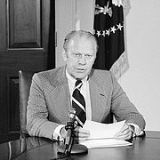
Geraldforddraft
As U.S. troop strength in Vietnam increased, more young men were drafted for service there, and many of those still at home sought means of avoiding the draft. For those seeking a relatively safe alternative, service in the Navy
United States Navy

The United States Navy is the navy of the United States Armed Forces. It is one of the seven uniformed services of the United States. The U.S. Navy currently has approximately 331,682 personnel on active duty as of 31 December 2008 and 124,000 in the United States Navy Reserve....
, Air Force
United States Air Force

The United States Air Force is the aerial warfare branch of the Military of the United States and one of the uniformed services of the United States....
 or Coast Guard
United States Coast Guard

The United States Coast Guard is a branch of the Military of the United States and one of seven Uniformed services of the United States. In addition to being a military branch at all times, it is unique among the armed forces in that it is also a Admiralty law agency and a Federal government of the United States regulatory agency....
 was an option (provided one could meet the more stringent enlistment standards). Since only a handful of National Guard and Reserve units were sent to Vietnam, enlistment in the Guard or the Reserves became a favored means of draft avoidance. Vocations to the ministry and the rabbinate soared, because divinity students were exempt from the draft. Doctors and draft board members found themselves being pressured by relatives or family friends to exempt potential draftees.

Some conscientious objectors objected to the war based on the theory of Just War
Just War

Just War theory is a doctrine of military ethics of Roman philosophical and Catholic origin studied by moral theologians, ethicists and international policy makers which holds that a conflict can and ought to meet the criteria of philosophy, religion or politics justice, provided it follows certain Indicative conditional....
. One of these, Stephen Spiro
Stephen Spiro

Stephen Spiro was a political activist who opposed the Vietnam War. He opposed the war based on the theory of Just War, and was a conscientious objector....
, was convicted of avoiding the draft, but given a suspended sentence of five years. He was later pardoned by President Gerald Ford
Gerald Ford

Gerald Rudolph Ford, Jr. was the List of Presidents of the United States President of the United States, serving from 1974 to 1977, and the List of Vice Presidents of the United States Vice President of the United States serving from 1973 to 1974....
.

According to the Veteran's Administration, 9.2 million men served in the military between 1964 and 1975. Nearly 3.5 million men served in the Vietnam theater of operations. From a pool of approximately 27 million, the draft raised 2,215,000 men for military service during the Vietnam era. It has also been credited with "encouraging" many of the 8.7 million "volunteers" to join rather than risk being drafted.

Of the nearly 16 million men not engaged in active military service, 96% were exempted (typically because of jobs including other military service), deferred (usually for educational reasons), or disqualified (usually for physical and mental deficiencies but also for criminal records to include draft violations). Draft offenders in the last category numbered nearly 500,000 but less than 10,000 were convicted or imprisoned for draft violations. Finally, as many as 100,000 draft eligible males fled the country.

End of conscription

During the 1968 presidential election
United States presidential election, 1968

The United States presidential election of 1968 was a wrenching national experience, conducted against a backdrop that included the assassination of civil rights leader Martin Luther King, Jr....
, Richard Nixon
Richard Nixon

Richard Milhous Nixon was the List of Presidents of the United States President of the United States and the only president to resign the office....
 campaigned on a promise to end the draft. He had first become interested in the idea of an all-volunteer army during his time out of office, based upon a paper by Professor Martin Anderson of Columbia University
Columbia University

Columbia University in the City of New York , is a private university in the United States and a member of the Ivy League. Columbia's main campus lies in the Morningside Heights, Manhattan neighborhood in the borough of Manhattan, in New York City....
. Nixon also saw ending the draft as an effective way to undermine the anti-Vietnam war movement, since he believed affluent youths would stop protesting the war once their own possibility of having to fight in it was gone. There was opposition to the all-volunteer notion from both the Department of Defense and Congress, so Nixon took no immediate action towards ending the draft early in his presidency.

Instead, the Gates Commission was formed, headed by Thomas S. Gates, Jr., a former Secretary of Defense in the Eisenhower administration. Gates initially opposed the all-volunteer army idea, but changed his mind during the course of the 15-member commission's work. The Gates Commission issued its report in February 1970, describing how adequate military strength could be maintained without having conscription. The existing draft law was expiring at the end of June 1971, but the Department of Defense and Nixon administration decided the draft needed to continue for at least some time. In February 1971, the administration requested of Congress a two-year extension of the draft, to June 1973.

Senatorial opponents of the war wanted to reduce this to a one-year extension, or eliminate the draft altogether, or tie the draft renewal to a timetable for troop withdrawal from Vietnam; Senator Mike Gravel
Mike Gravel

Maurice Robert "Mike" Gravel is a former Democratic Party United States Senate from Alaska, who served two terms from 1969 to 1981, and a former candidate in the United States presidential election, 2008....
 of Alaska
Alaska

Alaska is the largest U.S. state of the United States by area; it is situated in the northwest extremity of the North American continent, with Canada to the east, the Arctic Ocean to the north, and the Pacific Ocean to the west and south, with Russia further west across the Bering Strait....
 took the most forceful approach, trying to filibuster
Filibuster

A filibuster, or "talking out a bill", is a form of obstruction in a legislature or other decision-making body. An attempt is made to infinitely extend debate upon a proposal in order to delay the progress or completely prevent a vote on the proposal taking place....
 the draft renewal legislation, shut down conscription, and directly force an end to the war. Senators supporting Nixon's war efforts supported the bill, even though some had qualms about ending the draft. After a prolonged battle in the Senate, in September 1971 cloture
Cloture

In parliamentary procedure, cloture is a motion or process aimed at bringing debate to a quick end.The procedure originated in the National Assembly of France, from which the name is taken....
 was achieved over the filibuster and the draft renewal bill was approved. Meanwhile, military pay was increased as an incentive to attract volunteers, and television advertising for the U.S. Army began. With the end of active U.S. ground participation in Vietnam, December 1972 saw the last men conscripted, who reported for duty in June 1973.In 1973, the Selective Service randomly selected 25 numbers or birthdays in case the draft was extended.

Post-1980 draft registration

In 1980, Congress re-instated the requirement that young men register with the Selective Service System
Selective Service System

The Selective Service System serves at least two purposes. It is the means by which the United States administers conscription in the United States....
. At that time it was required that all males, born on or after January 1, 1960 register with the Selective Service System. Currently, male U.S. citizens if age 18 through 25, are required to register with the Selective Service System on their 18th birthday. The Selective Service System describes its mission as "...to serve the emergency manpower needs of the Military by conscripting untrained manpower, or personnel with professional health care skills, if directed by Congress and the President in a national crisis." Registration forms are available either online or at any U.S. Post Office
United States Postal Service

The United States Postal Service is an Independent agencies of the United States government responsible for providing postal service in the United States....
.

The Selective Service registration form states that failure to register is a felony
Felony

A felony is a serious crime in the United States and previously other common law countries. The term originates from English common law where felonies were originally crimes which involved the confiscation of a convicted person's land and goods; other crimes were called misdemeanors....
 punishable by up to five years imprisonment or a $250,000 fine. In practice, no one has been prosecuted for failure to comply with draft registration since 1986, in part because prosecutions of draft resisters proved counter-productive for the government, and in part because of the difficulty of proving that noncompliance with the law was "knowing and willful." Many people do not register at all, register late, or change addresses without notifying the Selective Service System. Not registering can also lead to loss of federal employment, sometimes after the registration window has already passed.

Health Care Personnel Delivery System

On December 1, 1989, Congress ordered the Selective Service System to put in place a system capable of drafting "persons qualified for practice or employment in a health care and professional occupation", if such a special-skills draft should be ordered by Congress. In response, Selective Service published plans for the "Health Care Personnel Delivery System " (HCPDS) in 1989 and has had them ready ever since. The concept underwent a preliminary field exercise in Fiscal Year 1998, followed by a more extensive nationwide readiness exercise in Fiscal Year 1999. The HCPDS plans include women and men ages 20-54 in 57 different job categories. As of May 2003, the Defense Department has said the most likely form of draft is a special skills draft, probably of health care workers.

Legality

In 1918, the Supreme Court
Supreme Court of the United States

The Supreme Court of the United States is the highest judicial body in the United States, and leads the federal United States federal courts. It consists of the Chief Justice of the United States and eight Associate Justice of the Supreme Court of the United States, who are nominated by the President of the United States and confirmed with th...
 ruled that the World War I draft did not violate the United States Constitution
United States Constitution

The Constitution of the United States of America is the supreme law of the United States. It is the foundation and source of the legal authority underlying the existence of the United States of America; the Federal Government of the United States; and all the State & local governments and Territorial Administrative bodies contained therein....
.
Arver v. United States, 245 U.S. 366 (1918). The Court summarized the history of conscription in England
England

native_name =|conventional_long_name = England|common_name = England|image_flag = Flag of England.svg|image_coat = England COA.svg|symbol_type = Royal Coat of Arms...
 and in colonial America, a history that it read as establishing that the Framers
Founding Fathers of the United States

The Founding Fathers of the United States were the political leaders who signed the United States Declaration of Independence or otherwise participated in the American Revolution as leaders of the Patriot s, or who participated in drafting the United States Constitution eleven years later....
 envisioned compulsory military service as a governmental power. It held that the Constitution's grant to Congress of the powers to declare war and to create standing armies included the power to mandate conscription. It rejected arguments based on states' rights, the Thirteenth Amendment
Thirteenth Amendment to the United States Constitution

The Thirteenth Amendment to the United States Constitution officially abolished and continues to prohibit slavery and involuntary servitude, except as punishment for a crime....
, and other provisions of the Constitution.

Later, during the Vietnam War, a lower appellate court
United States court of appeals

The United States courts of appeals are the intermediate Court of Appealss of the United States federal court system. A court of appeals decides appeals from the United States district courts within its United States federal judicial circuit, and in some instances from other designated federal courts and administrative agency....
 also concluded that the draft was constitutional.
United States v. Holmes, 387 F.2d 781 (7th Cir.), cert. denied, 391 U.S. 936 (1968). (Justice William O. Douglas
William O. Douglas

William Orville Douglas was a United States Supreme Court Associate Justice. With a term lasting 36 years and 209 days, he is the longest-serving justice in the history of the Supreme Court....
, in voting to hear the appeal in
Holmes, agreed that the government had the authority to employ conscription in wartime, but argued that the constitutionality of a draft in the absence of a declaration of war was an open question, which the Supreme Court should address.)

During the World War I era, the Supreme Court allowed the government great latitude in suppressing criticism of the draft. Examples include
Schenck v. United States

Schenck v. United States, , was a Supreme Court of the United States decision concerning the question of whether the defendant possessed a First Amendment to the United States Constitution right to free speech against the draft during World War I....
, 249 U.S. 47 (1919) and Gilbert v. Minnesota, 254 U.S. 325 (1920). In subsequent decades, however, the Court has taken a much broader view of the extent to which advocacy speech is protected by the First Amendment
First Amendment to the United States Constitution

The First Amendment to the United States Constitution is the part of the United States Bill of Rights that expressly prohibits the United States Congress from making laws "Establishment Clause of the First Amendment" or that prohibit the Free Exercise Clause of the First Amendment, laws that infringe the Freedom of speech in the United State...
. Thus, in 1971 the Court held it unconstitutional for a state to punish a man who entered a county courthouse wearing a jacket with the words "Fuck the Draft" visible on it.
Cohen v. California
Cohen v. California

Cohen v. California, Case citation was a Supreme Court of the United States case dealing with freedom of speech in the United States. The case was argued by Melville Nimmer, representing Paul Robert Cohen, and Michael Sauer, representing California....
, 403 U.S. 15 (1971). Nevertheless, protesting the draft by the specific means of burning a draft registration card can be constitutionally prohibited, because of the government's interest in prohibiting the "nonspeech" element involved in destroying the card. United States v. O'Brien
United States v. O'Brien

United States v. O'Brien, Case citation , was a case decided by the Supreme Court of the United States that ruled that a criminal prohibition against burning a draft card did not violate the First Amendment to the United States Constitution's guarantee of free speech....
, 391 U.S. 367 (1968).

In 1981, several men filed lawsuit in the case
Rostker v. Goldberg
Rostker v. Goldberg

Rostker v. Goldberg, Case citation , was a decision of the United States Supreme Court holding that the U.S. Congress could require the Selective Service system to adopt a policy of requiring only men to register for the Conscription....
, alleging that the Military Selective Service Act violates the Due Process Clause of the Fifth Amendment
Fifth Amendment to the United States Constitution

The Fifth Amendment of the United States Constitution, which is part of the United States Bill of Rights, protects against abuse of government authority in a legal procedure....
 by requiring that men only and not also women register with the Selective Service System. The Supreme Court upheld the act, stating that Congress's "decision to exempt women was not the accidental byproduct of a traditional way of thinking about women," that "since women are excluded from combat service by statute or military policy, men and women are simply not similarly situated for purposes of a draft or registration for a draft, and Congress' decision to authorize the registration of only men therefore does not violate the Due Process Clause," and that "the argument for registering women was based on considerations of equity, but Congress was entitled, in the exercise of its constitutional powers, to focus on the question of military need, rather than 'equity.'"

Conscientious objection

According to the Selective Service System,
A conscientious objector is one who is opposed to serving in the armed forces and/or bearing arms on the grounds of moral or religious principles.
[...]
Beliefs which qualify a registrant for CO status may be religious in nature, but don't have to be. Beliefs may be moral or ethical; however, a man's reasons for not wanting to participate in a war must not be based on politics, expediency, or self-interest. In general, the man's lifestyle prior to making his claim must reflect his current claims.


The Supreme Court has ruled in cases
United States v. Seeger (1965) and Welsh v. United States (1970) that conscientious objection can be by non-religious beliefs as well as religious beliefs; but it has also ruled in Gillette v. United States (1971) against objections to specific wars as grounds for conscientious objection.

There is currently no mechanism to indicate that one is a conscientious objector in the Selective Service system. According to the SSS, after a person is drafted, he can claim Conscientious Objector
Conscientious objector

A conscientious objector is an individual who, on religious, moral or ethical grounds, refuses to participate as a combatant in war or, in some cases, to take any role that would support a combatant organization armed forces....
 status and then justify it before the Local Board. This is criticized because during the times of a draft, when the country is in emergency conditions, there could be increased pressure for Local Boards to be more harsh on conscientious objector claims.

There are two types of status for conscientious objectors. If a person only objects to combat but not to service in the military, then the person could be given noncombatant service in the military without training of weapons. If they object to all military service, then they could be given "alternative service
Alternative service

Alternative service is a form of national service performed in lieu of conscription for various reasons, such as conscientious objection, inadequate health, or political reasons....
" with a job "deemed to make a meaningful contribution to the maintenance of the national health, safety, and interest", see Alternative Service Program
Alternative Service Program

The Alternative Service Program is a form of alternative service for conscientious objectors in the United States within its Selective Service System....
.

Selective Service reforms

The Selective Service System has maintained that they have implemented several reforms that would make the draft more fair and equitable.

Some of the measures they have implemented include:
  • Before and during the Vietnam War, a young man could get a deferment by showing that he was a full-time student making satisfactory progress towards a degree; now deferment only lasts to the end of the semester. If the man is a senior he can defer until the end of the academic year.
  • The government has said that draft boards are now more representative of the local communities in areas such as race and national origin.
  • A lottery system would be used to determine the order of people being called up. Previously the oldest men who were found eligible for the draft would be taken first. In the new system, the men called first would be those who are or will turn 20 in the calendar year or those whose deferments will end in the calendar year. Each year after the man will be placed on a lower priority status until his liability ends.


Because there has been no draft since 1973, it remains to be seen how any future drafts would be conducted.

Perception of the draft as unfair

Some people feel that the draft is fundamentally unfair (or illegal in a way) because only males must register with the Selective Service. Many masculists
Masculism

"Masculism" may also refer to the clinical condition of male physical traits appearing in a woman, see masculinization.Masculinism is the advocacy of men's rights, and the adherence to or promotion of social theory and moral philosophy regarded as typical of man....
 as well as feminists hold this view. For example, the National Organization for Women
National Organization for Women

The National Organization for Women is the largest United States feminist organization. It was founded in 1966 and has a membership of 500,000 contributing members and 550 chapters in all 50 U.S....
, a feminist organization, passed a resolution in 1980 opposing males-only draft registration as discriminatory, and the American Civil Liberties Union's
American Civil Liberties Union

The American Civil Liberties Union consists of two separate non-profit organizations: the ACLU Foundation, a 501 organization which focuses on litigation and communication efforts, and the American Civil Liberties Union, a 501 organization which focuses on legislative lobbying....
 Women's Rights Project provided aid to the plaintiff in the Supreme Court case
Rostker v. Goldberg
Rostker v. Goldberg

Rostker v. Goldberg, Case citation , was a decision of the United States Supreme Court holding that the U.S. Congress could require the Selective Service system to adopt a policy of requiring only men to register for the Conscription....
, in which the plaintiff unsuccessfully challenged males-only draft registration. Congress retains the right to conscript women and considered doing so during the Second World War.

Other discriminating factors regarding conscription include age, with a preference for younger draftees, and residency, since only those in the U.S. may be drafted.

The draft has been perceived by some as unfairly targeting the poor and lower middle classes. Because of college deferments, children of wealthy and upper middle class families that could afford to send them to college could avoid the draft. The fact that President Bill Clinton
Bill Clinton

William Jefferson "Bill" Clinton served as the List of Presidents of the United States President of the United States from 1993 to 2001. He was the fifteenth Democrat elected to that office....
 had been attending college during the time period in which conscription was active and received a collegiate deferment caused controversy during his campaigns and during his time in office. Similar controversy has surrounded prominent figures in the Bush Administration
George W. Bush administration

The Presidency of George W. Bush began on his George W. Bush 2001 presidential inauguration on January 20, 2001 as the 43rd President of the United States....
, such as Dick Cheney
Dick Cheney

Richard Bruce "Dick" Cheney served as the List of Vice Presidents of the United States Vice President of the United States from 2001 to 2009 in the George W....
 and Paul Wolfowitz
Paul Wolfowitz

Paul Dundes Wolfowitz is a former United States Ambassador to Indonesia, United States Deputy Secretary of Defense, and President of the World Bank....
.

During the Vietnam War some children of wealthy families wished to avoid a perception of avoiding military service. Those individuals often signed up for the National Guard
United States National Guard

The National Guard of the United States is a Military reserve force composed of U.S. state National Guard militia members or units under federally recognized active or inactive Military of the United States service for the United States ....
, which at the time seldom sent troops overseas. The fact that some were able to use their family's connections to gain a position when spots in the Guard were limited also led to a perception that the wealthy were using the National Guard to ensure that their children were assigned low-risk duty in the U.S. Much as President Clinton's obtainment of a deferment based on his attendance of college caused controversy, President George W. Bush's
George W. Bush

George Walker Bush served as the List of Presidents of the United States President of the United States from 2001 to 2009. He was the 46th List of Governors of Texas from 1995 to 2000 before being United States presidential inauguration as President on January 20, 2001....
 service in the National Guard during the Vietnam War also attracted controversy during his election campaigns.

During the Vietnam Era it was often quite easy for those with some knowledge of the system (or from guidance by draft counselors and draft attorneys) to avoid being drafted, or to defend prosecutions by submitting themselves to induction after indictment, and then being found disqualified. A simple route, widely publicized, was to get a medical rejection. This was possible because the draft laws after World War II mandated that the medical standards for conscription should not be less stringent than they were during the war. However, advances in diagnostic medicine lead to a much larger pool of young men being subject to disqualification. (Homosexuality
Homosexuality

Homosexuality refers to human sexual behavior or same-sex attraction between people of the same sex or to homosexual orientation. As a sexual orientation, homosexuality refers to "having sexual and romantic attraction primarily or exclusively to members of one?s own sex"; "it also refers to an individual?s sense of personal and social identi...
 was also a disqualifying condition, although most men did not wish to assert this status during that era.) Men who received induction notices could often manipulate where they were examined by showing up at induction centers far away from their actual residences on the mandated date for examination (either for a pre-induction physical or the induction physical examination). It was advantageous to be examined in induction centers adjacent to heavily populated metropolitan areas, where it often was not worth the Army's time to dispute their claims.

One scene in a film that accurately captures the chaotic situation in the lower Manhattan draft center where people slipped through the cracks is in "Alice's Restaurant
Alice's Restaurant (film)

Alice's Restaurant is a 1969 movie adapted from a song by Arlo Guthrie. The song is Arlo Guthrie's most famous work, a talking blues based on a true story that began on Thanksgiving 1965....
." In this case the young man was rejected for having a criminal record (for littering). Conversely the poor and uneducated were often conscripted without any understanding of how to escape the system. However, many law schools, notably Harvard University
Harvard University

Harvard University is a private university in Cambridge, Massachusetts, Massachusetts, United States, and a member of the Ivy League. Founded in 1636 by the colonial Massachusetts legislature, Harvard is the Colonial Colleges institution of higher learning in the United States....
, had draft counseling centers where law students helped young men in poorer areas assert their rights and seek exemptions from induction.

U.S. Representative Charles Rangel
Charles B. Rangel

Charles Bernard "Charlie" Rangel is an United States politician. He has been a Democratic Party member of the United States House of Representatives since 1971, representing the New York's 15th congressional district of New York....
 argued in 2004 that poor men were far more apt to enlist for military service. He called for a reinstatement of the draft to ensure service in the Iraq War
Iraq War

The Iraq War, also known as the Second Gulf War, the Occupation of Iraq, and Operation Iraqi Freedom, is an ongoing conflicts military campaign which began on March 20, 2003 with the 2003 invasion of Iraq by a Multinational force in Iraq now led by and composed almost entirely of troops from the United States and United King...
 was spread equally among the rich and poor. After the November 2006 elections, Rangel again suggested the draft be renewed, this time because he thought it was less likely that a democracy with conscription would engage in pre-emptive wars such as the current American military involvement in Iraq.

The provisions for conscientious objection to the draft have also been viewed as unfairly discriminatory, favoring religious objection over non-religious objection. Alternative mandatory service can assuage objections based on peace and non-violence but does nothing for those whose objections arise from strongly held convictions about freedom.

Conscription controversies since 2003

No attempt to reinstate conscription, since the effort to enforce Selective Service registration law was abandoned in 1986, has been able to attract much support in the legislature or among the public. However since early 2003, when the Iraq War appeared imminent, there have been attempts through legislation
Legislation

Legislation is law which has been promulgation by a legislature or other governing body. The term may refer to a single law, or the collective body of enacted law, while "statute" is also used to refer to a single law....
 and through campaign
Political campaign

A political campaign is an organized effort which seeks to influence the decision making process within a specific group. In democracy, political campaigns often refer to election campaigns, wherein representatives are chosen or referendum are decided....
 rhetoric
Rhetoric

Rhetoric is the art of using language as a means to persuade. Along with logic and dialectic, rhetoric is one of the three ancient arts of discourse....
 to begin a new public conversation on the topic.

In 2003, several Democratic
Democratic Party (United States)

The Democratic Party is one of two major party contemporary political parties in the United States, along with the Republican Party . It is the oldest political party in continuous operation in the United States and it is one of the oldest parties in the world....
 congressmen (Charles Rangel of New York, James McDermott
James McDermott

James McDermott is the name of:* James McDermott , an American businessman, former CEO and chairman of Keefe, Bruyette & Woods* James T. McDermott , an American politician...
 of Washington
Washington

Washington is a U.S. state in the Pacific Northwest region of the United States. Washington was carved out of the western part of Washington Territory which had been ceded by Britain in 1846 by the Oregon Treaty as settlement of the Oregon Boundary Dispute....
, John Conyers
John Conyers

John Conyers, Jr. is a member of the United States House of Representatives representing Michigan's 14th congressional district, which includes most of northwestern Detroit, as well as Highland Park, Michigan, Hamtramck and part of Dearborn, Michigan....
 of Michigan
Michigan

Michigan is a Midwestern United States U.S. state of the United States of America. It was named after Lake Michigan, whose name is a French adaptation of the Anishinaabe language term mishigama, meaning "large water" or "large lake"....
, John Lewis
John Lewis (politician)

John Robert Lewis is an united States politician and was a leader in the American Civil Rights Movement . He was chairman of the Student Nonviolent Coordinating Committee and played a key role in the struggle to end Racial segregation....
 of Georgia
Georgia (U.S. state)

Georgia is a U.S. state in the United States and was one of the original Thirteen Colonies that revolted against United Kingdom rule in the American Revolution....
, Pete Stark
Pete Stark

Fortney Hillman "Pete" Stark, Jr. is an Politics of the United States from the U.S. state of California. A Democratic Party , he has been a member of the United States House of Representatives since 1973, representing California's 13th congressional district in southwestern Alameda County....
 of California
California

California is a U.S. state on the West Coast of the United States of the United States, along the Pacific Ocean. It is bordered by Oregon to the north, Nevada to the east, Arizona to the southeast, and to the south the Mexico state of Baja California....
, Neil Abercrombie
Neil Abercrombie

Neil Abercrombie is a Democratic Party member of the United States House of Representatives, representing Hawaii's 1st congressional district since 1991....
 of Hawaii
Hawaii

File:Pahoehoe and Aa flows at Hawaii.jpgThe State of Hawaii is a U.S. state in the United States, located on an archipelago in the central Pacific Ocean southwest of the continental United States, southeast of Japan, and northeast of Australia....
) introduced legislation
Universal National Service Act

The Universal National Service Act is the name of at least three bills proposed in the United States Congress . The Universal National Service Act of 2007 is primarily sponsored by Congressman Charles Rangel of New York....
 that would draft both men and women into either military or civilian government service, should there be a draft in the future. The Republican
Republican Party (United States)

The Republican Party is one of the two major party contemporary political parties in the United States, along with the Democratic Party . It is often called the Grand Old Party or the GOP....
 majority leadership suddenly considered the bill, nine months after its introduction, without a report from the Armed Services Committee
United States House Committee on Armed Services

The U.S. House Committee on Armed Services, commonly known as the House Armed Services Committee, is a standing committee of the United States House of Representatives....
 (to which it had been referred), and just one month prior to the 2004 presidential and congressional elections
United States presidential election, 2004

The United States presidential election of 2004 was held on Tuesday, November 2, 2004, to elect the President of the United States. It was the 55th consecutive quadrennial election for President and Vice President of the United States....
. The Republican leadership used an expedited parliamentary procedure
Suspension of the rules

Suspension of the rules in the United States Congress is the specific set of procedures within the United States Congress that allows for the general parliamentary procedure notion of how and when to suspend the rules....
 that would have required a two-thirds vote
Supermajority

A supermajority or a qualified majority is a requirement for a proposal to gain a specified level or type of support which exceeds a majority in order to have effect....
 for passage of the bill. The bill was defeated on October 5, 2004, with two members voting for it and 402 members voting against.

In 2004 the platforms of both the Democratic
Democratic Party (United States)

The Democratic Party is one of two major party contemporary political parties in the United States, along with the Republican Party . It is the oldest political party in continuous operation in the United States and it is one of the oldest parties in the world....
 and Republican parties opposed military conscription, but neither party moved to end draft registration. John Kerry
John Kerry

John Forbes Kerry is the Junior Senator United States Senate from Massachusetts and chairman of the Senate Foreign Relations Committee.As the Presidential nominee of the Democratic Party , he was defeated by 34 electoral votes in the United States presidential election, 2004 by the Republican Party incumbent President of the United States...
 in one debate criticized Bush's policies, "You've got stop-loss policies
Stop-loss policy

Stop-loss, in the United States military, is the involuntary extension of a service member's active duty service under the enlistment contract in order to retain them beyond their initial end of term of service date....
 so people can't get out when they were supposed to. You've got a backdoor draft right now."

This statement was in reference to the Department of Defense use of "stop-loss" orders, which have extended the Active Duty periods of some military personnel. All enlistees, upon entering the service, volunteer for a minimum eight-year Military Service Obligation (MSO). This MSO is split between a minimum active duty period, followed by a reserve period where enlistees may be called back to active duty for the remainder of the 8 years. Some of these active duty extensions have been for as long as two years. The Pentagon stated that as of August 24, 2004, 20,000 soldiers, sailors, airmen, and Marines had been affected. As of January 31, 2006 it has been reported that more than 50,000 soldiers and reservists had been affected.

Despite arguments by defense leaders that they had no interest in reinstituting the draft, Representative Neil Abercrombie's (D-HI) inclusion of a DOD memo in the Congressional Record which detailed a meeting by senior leaders signalled renewed interest. Though the conclusion of the meeting memo did not call for a reinstatement of the draft, it did suggest Selective Service Act modifications to include registration by women and self-reporting of critical skills that could serve to meet military, homeland defense, and humanitarian needs. This hinted at more targeted draft options being considered, perhaps like that of the “Doctor Draft” that began in the 1950s to provide nearly 66% of the medical professionals need by the Army in Korea. Once created this manpower tool continued to be through 1972. The meeting memo gave DOD’s primary reason for opposing a draft as matters of cost effectiveness and efficiency. Draftees with less than two years retention were said to be a drain on military resources without providing much commensurate benefit.

Mentions of the draft during the presidential campaign led to a resurgence of anti-draft and draft resistance organizing. One poll of young voters in October 2004 found that 29% would resist if drafted.

In November 2006, Representative Charles Rangel again called for the draft to be reinstated. Speaker of the House
Speaker of the United States House of Representatives

The Speaker of the United States House of Representatives is the Speaker of the United States House of Representatives. The current Speaker is Nancy Pelosi, a Democratic Party representing California's 8th congressional district....
 Nancy Pelosi
Nancy Pelosi

Nancy Patricia D'Alesandro Pelosi is the current Speaker of the United States House of Representatives. She is a Democratic party . Before being elected Speaker in the 110th United States Congress, she was the Minority Leader of the United States House of Representatives from 2003 to 2007, holding the post during the 108th United States Cong...
 has rejected this proposal.

On December 19 2006, President Bush announced that he was considering sending more troops to Iraq. The next day, the Selective Service System's director for operations and chief information officer, Scott Campbell, announced plans for a "readiness exercise" to test the system's operations in 2009, for the first time since 1998.

On December 21 2006, Veterans Affairs
United States Department of Veterans Affairs

The United States Department of Veterans Affairs is a government-run military veteran benefit system with United States Cabinet-level status. It is responsible for administering programs of veterans? benefits for veterans, their families, and survivors....
 Secretary Jim Nicholson
Jim Nicholson (U.S. politician)

Robert James "Jim" Nicholson is an Attorney at law, real estate developer, and a former United States Republican Party chairman. He was the United States Secretary of Veterans Affairs from January 26, 2005 until October 1, 2007....
, when asked by a reporter whether the draft should be reinstated to make the military more equal, said, "I think that our society would benefit from that, yes sir." Nicholson proceeded to relate his experience as a company commander in an infantry unit which brought together soldiers of different socioeconomic backgrounds and education levels, noting that the draft "does bring people from all quarters of our society together in the common purpose of serving." Nicholson later issued a statement saying he does not support reinstating the draft.

On August 10 2007, with National Public Radio
National Public Radio

National Public Radio is a privately and publicly funded non-profit membership media organization that serves as a national Radio syndication to 797 public radio List of NPR stations in the United States....
 on "All Things Considered," Lieutenant General
Lieutenant General

Lieutenant General is a military rank used in many countries. The rank traces its origins to the Middle Ages where the title of Lieutenant General was held by the second in command on the battlefield, who was normally subordinate to a Captain General....
 Douglas Lute
Douglas Lute

Douglas E. Lute is a lieutenant general in the United States Army. On 15 May 2007, Lute was nominated by George W. Bush to serve as Assistant to the President and Deputy National Security Advisor for Iraq and Afghanistan, also known as the "War Czar", in the George W....
, National Security
National security

The late political scientist Hans Morgenthau, author of Politics Among Nations, defines national security as the integrity of the national territory and its institutions....
 Adviser to the President and Congress for all matters pertaining to the United States Military efforts in Iraq
Iraq

Iraq , officially the Republic of Iraq , is a country in Western Asia spanning most of the northwestern end of the Zagros Mountains, the eastern part of the Syrian Desert and the northern part of the Arabian Desert....
 and Afghanistan
Afghanistan

Afghanistan , officially the Islamic republic of Afghanistan, is a landlocked country that is located approximately in the center of Asia....
, expressed support for a draft to alleviate the stress on the Army's all-volunteer force. He cited the fact that repeated deployments place much strain upon one soldier's family and himself which, in turn, can affect retention.

A similar bill to Rangel's 2003 one was introduced in 2007, called the Universal National Service Act of 2007 (H.R. 393), but it has not received a hearing or been scheduled for consideration.

Civilian service

Conscription has been used nationally only to provide men to the military. The most common form of compulsory civilian service in the U.S. is the much shorter obligation of jury
Jury

A jury is a sworn body of people convened to render a rationalism, impartiality verdict officially submitted to them by a court, or to set a sentence or judgment....
 duty.

Mandatory public service of a non-military nature is required as part of the high school
High school

High school is the name used in some parts of the world to describe an institution which provides all or part of secondary education. The term originated in Scotland and spread to the New World countries as the high prestige that the Scottish educational system had at the time led several countries to employ Scottish educators to develop the...
 curriculum in many school districts across the nation. Since 1992, the state of Maryland
Maryland

Maryland is a U.S. state located in the Mid Atlantic States of the United States, bordering Virginia, West Virginia and the Washington, D.C. to the south and west, Pennsylvania to the north, and Delaware to the east....
 has required a total of 75 hours of "developmentally appropriate service-learning activities" over the course of grades 6 through 12. During the 2004 campaign, Kerry proposed a similar program nationwide, to be implemented by each school district but federally funded. He added an additional voluntary option for students to receive four years of college tuition in exchange for a commitment to two years of national service.

Mandatory full-time service on a national scale has been proposed many times and was backed by, for example, Dwight D. Eisenhower
Dwight D. Eisenhower

Dwight David ?Ike? Eisenhower was the List of Presidents of the United States President of the United States from 1953 until 1961 and a General of the Army in the United States Army....
. Recent proposals have been modeled after the Americorps
AmeriCorps

AmeriCorps is a United States Government partnering with non-profit organizations, public agencies, and faith-based organizations that was created under President Bill Clinton by the National and...
 program, but necessarily much larger in scale when made mandatory. Robert Litan of the Brookings Institution
Brookings Institution

The Brookings Institution is a Non-profit organization public policy organization based in Washington, D.C. One of Washington's oldest think tanks, Brookings conducts research and education in the social sciences, primarily in economics, metropolitan policy, governance, foreign policy, and global economy and development....
 estimates the cost for a program of one year for all high school graduates at $25 billion.

Non-citizens

The Selective Service (and the draft) in the United States is not limited to citizens. Howard Stringer
Howard Stringer

Sir Howard Stringer was born February 19, 1942 in Cardiff, Wales to Harry and Marjorie Mary Stringer. On July 29, 1978 Howard Stringer married Jennifer A....
 was drafted in 1965, six weeks after arriving from his native Britain. Today, non-citizen males of appropriate age in the United States, who are permanent residents (holders of Green Cards), seasonal agricultural workers, refugee
Refugee

Convention Relating to the Status of Refugees, a refugee is a person who flees to a foreign country or power to escape danger or persecutionOwing to a well-founded fear of being persecuted for reasons of race, religion, nationality, membership of a particular social group, or political opinion, is outside the country of their nationality,...
s, parolees, asylees, and even illegal immigrants
Illegal immigration to the United States

Illegal immigration to the United States refers to the act of foreign nationals violating U.S. immigration policies and national laws by immigrating to the United States without proper consent from the United States government....
, are required to register with the Selective Service System. Refusal to do so is grounds for denial of a future citizenship application. In addition, immigrants who seek to naturalize
Naturalization

Naturalization is the acquisition of citizenship or nationality by somebody who was not a citizen or national of that country when he or she was born....
 as citizens must, as part of the Oath of Citizenship, swear to the following:

... that I will bear arms on behalf of the United States when required by the law; that I will perform noncombatant service in the armed forces of the United States when required by the law; that I will perform work of national importance under civilian direction when required by the law;


The USCIS website also states however:

In some cases, USCIS allows the oath to be taken without the clauses:

". . .that I will bear arms on behalf of the United States when required by law; that I will perform noncombatant service in the Armed Forces of the United States when required by law. . ."


Non-citizens who serve in the United States military enjoy several naturalization benefits which are unavailable to non-citizens who do not, such as a waiver of application fees. Permanent resident aliens who die while serving in the U.S. Armed Forces may be naturalized posthumously, which may be beneficial to surviving family members.

See also

  • Conscription crisis
    Conscription crisis

    A conscription crisis is a public dispute about a policy of conscription, or mandatory service in the military, also known as a "draft". A dispute can become a crisis when submission to military service becomes highly controversial and popular revolt ensues....
  • Draft lottery (1969)
    Draft lottery (1969)

    On December 1, 1969, the Selective Service System of the United States held a draft lottery to determine the order of conscription into the U.S. Army for the Vietnam War....
  • National service
    National service

    National service is a common name for mandatory or voluntary government service programs . National service was common in the 20th century, and many young people spent one or more years in such programs....
  • Peace Churches
    Peace churches

    Peace churches are Christian churches, groups or communities advocating Christian pacifism. The term historic peace churches refers specifically to three church groups: the Church of the Brethren, the Mennonites, and the Religious Society of Friends ....
  • Selective Service System
    Selective Service System

    The Selective Service System serves at least two purposes. It is the means by which the United States administers conscription in the United States....
  • Service Nation
    Service Nation

    ServiceNation is the name of a organization campaign to increase support for expanding national service programs like the Peace Corps, Americorps, Senior Corps, and through service-learning experiences in schools and colleges....


Sources

  • Halstead, Fred. GIs Speak out against the War: The Case of the Ft. Jackson 8. 128 pages. New York: Pathfinder Press. 1970.


External links

  • - official website
  • - information and resources on the draft, draft registration, and draft resistance; includes statistics on draft registration compliance and enforcement since 1980
  • - FAQ's on the medical draft ("Health Care Personnel Delivery System")
  • - analysis of proposals based on Americorps
  • - by Rolling Stone magazine, The Return of the Draft 2005
  • - includes a review of public service programs in other countries too
  • How To Beat The Draft Board: A wikibook on the subject by a draft board member.
  • , The Wall Street Journal
    The Wall Street Journal

    The Wall Street Journal is an English language international daily newspaper published by Dow Jones & Company in New York, New York with Asian and European editions....
     editorial, November 25, 2006
  • by Walter E. Williams
    Walter E. Williams

    Walter E. Williams, Ph. D. is an United States economics and Professor at George Mason University. He is also a Print syndication columnist and author known for his libertarian and sometimes Conservatism in the United States views....
  • argument diagram at
  • by Rod Powers. Discusses the improbability of the draft returning.