
Connected space
In
topology and related branches of
mathematics, a connected space is a topological space which cannot be written as the disjoint union of two or more nonempty open spaces. Connectedness is one of the principal topological properties that is used to distinguish topological spaces. A stronger notion is that of a path-connected space, which is a space where any two points can be joined by a path.
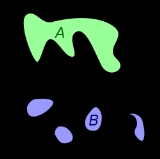
It is usually easy to think about what is not connected. A simple example would be a space consisting of two
rectangles, each of which is a space and not adjoined to the other.
Encyclopedia
In
topology and related branches of
mathematics, a
connected space is a topological space which cannot be written as the disjoint union of two or more nonempty open spaces. Connectedness is one of the principal topological properties that is used to distinguish topological spaces. A stronger notion is that of a
path-connected space, which is a space where any two points can be joined by a path.
It is usually easy to think about what is not connected. A simple example would be a space consisting of two
rectangles, each of which is a space and not adjoined to the other. The space is not connected since two rectangles are disjoint. Another good example is a space with an annulus removed. The space is not connected since you cannot connect two points, one inside the annulus and the other outside; hence the term "connect".
Formal definition
A topological space
X is said to be
disconnected if it is the union of two disjoint nonempty
open sets. Otherwise,
X is said to be
connected. A
subset of a topological space is said to be connected if it is connected under its subspace topology. Some authors specifically exclude the empty set with its unique topology as a connected space, but this encyclopedia does not follow that practice.
For a topological space
X the following conditions are equivalent:
- X is connected.
- X cannot be divided into two disjoint nonempty closed sets .
- The only sets which are both open and closed are X and the empty set.
- The only sets with empty boundary are X and the empty set.
- X cannot be written as the union of two nonempty separated sets.
The maximal nonempty connected subsets of any topological space are called the
connected components of the space.
The components form a
partition of the space .
Every component is a closed subset of the original space.
The components in general need not be open: the components of the rational numbers, for instance, are the one-point sets.
A space in which all components are one-point sets is called
totally disconnected. Related to this property, a space
X is called
totally separated if, for any two elements
x and
y of
X, there exist disjoint open neighborhoods
U of
x and
V of
y such that
X is the union of
U and
V. Clearly any totally separated space is totally disconnected, but the converse does not hold. For example take two copies of the rational numbers
Q, and identify them at every point except zero. The resulting space, with the quotient topology, is totally disconnected. However, by considering the two copies of zero, the space is not totally separated, or even
Hausdorff.
Examples
- The closed interval [0, 2] is connected; it can, for example, be written as the union of [0, 1) and [1, 2], but the second set is not open in the topology of [0, 2]. On the other hand, the union of [0, 1) and ?. One endows this set with a partial order by specifying that 0'<a for any positive number a, but leaving 0 and 0' incomparable. One then endows this set with the order topology, that is one takes the open intervals
= and the half-open intervals
[0,a
)=,
[0',a
)= as a base for the topology. The resulting space is a T
1 space but not a
Hausdorff space. Clearly 0 and 0' can be connected by a path but not by an arc in this space.
Local connectedness
A topological space is said to be
locally connected if it has a base of connected sets.
It can be shown that a space
X is locally connected if and only if every component of every open set of
X is open.
The
topologist's sine curve is an example of a connected space that is not locally connected.
Similarly, a topological space is said to be
locally path-connected if it has a base of path-connected sets.
An open subset of a locally path-connected space is connected if and only if it is path-connected.
This generalizes the earlier statement about
Rn and
Cn, each of which is locally path-connected.
More generally, any topological manifold is locally path-connected.
Theorems
- Main theorem: Let X and Y be topological spaces and let f : X ? Y be a continuous function. If X is connected then the image f is connected . The intermediate value theorem can be considered as a special case of this result.
- If is a family of connected subsets of a topological space X such that is nonempty for all i, then is also connected.
- If is a nonempty family of connected subsets of a topological space X such that is nonempty, then is also connected.
- Every path-connected space is connected.
- Every locally path-connected space is locally connected.
- A locally path-connected space is path-connected iff it is connected.
- The connected components of a space are disjoint unions of the path-connected components.
- The components of a locally connected space are open .
- The closure of a connected subset is connected.
- Every quotient of a connected space is connected .
- Every product of a family of connected spaces is connected .
- Every open subset of a locally connected space is locally connected .
- Every manifold is locally path-connected.
See also
- uniformly connected space
- connected component
- separated sets
- simply connected
- n-connected
References