

Condorcet method

Encyclopedia
Voting system
A voting system or electoral system is a method by which voters make a choice between options, often in an election or on a policy referendum....
that meets the Condorcet criterion
Condorcet criterion
The Condorcet candidate or Condorcet winner of an election is the candidate who, when compared with every other candidate, is preferred by more voters. Informally, the Condorcet winner is the person who would win a two-candidate election against each of the other candidates...
, which means the method always selects the Condorcet winner if such a candidate exists. The Condorcet winner is the candidate who would beat each of the other candidates in a run-off election.
In modern examples, voters rank candidates in order of preference. There are then multiple, slightly differing methods for calculating the winner, due to the need to resolve circular ambiguities—including the Kemeny-Young method
Kemeny-Young method
The Kemeny–Young method is a voting system that uses preferential ballots and pairwise comparison counts to identify the most popular choices in an election...
, ranked pairs
Ranked Pairs
Ranked pairs or the Tideman method is a voting system developed in 1987 by Nicolaus Tideman that selects a single winner using votes that express preferences. RP can also be used to create a sorted list of winners....
, and the Schulze method
Schulze method
The Schulze method is a voting system developed in 1997 by Markus Schulze that selects a single winner using votes that express preferences. The method can also be used to create a sorted list of winners...
. Almost all of these methods give the same result if there are fewer than 4 candidates in the circularly-ambiguous Smith set
Smith set
In voting systems, the Smith set, named after John H. Smith, is the smallest non-empty set of candidates in a particular election such that each member beats every other candidate outside the set in a pairwise election. The Smith set provides one standard of optimal choice for an election outcome...
and voters separately rank all of them.
Condorcet methods are named for the 18th-century French mathematician
Mathematician
A mathematician is a person whose primary area of study is the field of mathematics. Mathematicians are concerned with quantity, structure, space, and change....
and philosopher Marie Jean Antoine Nicolas Caritat, the Marquis de Condorcet
Marquis de Condorcet
Marie Jean Antoine Nicolas de Caritat, marquis de Condorcet , known as Nicolas de Condorcet, was a French philosopher, mathematician, and early political scientist whose Condorcet method in voting tally selects the candidate who would beat each of the other candidates in a run-off election...
. Ramon Llull
Ramon Llull
Ramon Llull was a Majorcan writer and philosopher, logician and tertiary Franciscan. He wrote the first major work of Catalan literature. Recently-surfaced manuscripts show him to have anticipated by several centuries prominent work on elections theory...
had devised one of the first Condorcet methods in 1299, but this method is based on an iterative procedure rather than a ranked ballot.
Summary
- Rank the candidates in order (1st, 2nd, 3rd, etc.) of preference. Tie rankings, which express no preference between the tied candidates, are allowed.
- For each ballot, compare the ranking of each candidate on the ballot to every other candidate, one pair at a time (pairwise), and tally a "win" for the higher-ranked candidate.
- Sum these wins for all ballots cast, maintaining separate tallies for each pairwise combination.
- The candidate who wins every one of their pairwise contests is the most preferred over all other candidates, and hence the winner of the election.
- In the event no single candidate wins all pairwise contests, use a resolution method described below.
It is possible for a candidate to be the most preferred overall without being the first preference of any voter. In a sense, the Condorcet method yields the "best compromise" candidate, the one that the largest majority will find to be least disagreeable, even if not their favorite.
Definition
A Condorcet method is a voting system that will always elect the Condorcet winner; this is the candidate whom voters prefer to each other candidate, when compared to them one at a time. This candidate can be found by conducting a series of pairwise comparisons, using the basic procedure described above. For N candidates, this requires N(N−1) pairwise hypothetical elections. (For example, with 5 candidates there are 10 pairwise comparisons to be made.) The family of Condorcet methods is also referred to collectively as Condorcet's method. A voting system that always elects the Condorcet winner when there is one is described by electoral scientists as a system that satisfies the Condorcet criterion.In certain circumstances an election has no Condorcet winner. This occurs as a result of a kind of tie known as a majority rule cycle, described by Condorcet's paradox
Voting paradox
The voting paradox is a situation noted by the Marquis de Condorcet in the late 18th century, in which collective preferences can be cyclic , even if the preferences of individual voters are not. This is paradoxical, because it means that majority wishes can be in conflict with each other...
. The manner in which a winner is then chosen varies from one Condorcet method to another. Some Condorcet methods involve the basic procedure described below, coupled with a Condorcet completion method—a method used to find a winner when there is no Condorcet winner. Other Condorcet methods involve an entirely different system of counting, but are classified as Condorcet methods because they will still elect the Condorcet winner if there is one.
It is important to note that not all single winner, preferential voting systems are Condorcet methods. For example, instant-runoff voting
Instant-runoff voting
Instant-runoff voting , also known as preferential voting, the alternative vote and ranked choice voting, is a voting system used to elect one winner. Voters rank candidates in order of preference, and their ballots are counted as one vote for their first choice candidate. If a candidate secures a...
and the Borda count
Borda count
The Borda count is a single-winner election method in which voters rank candidates in order of preference. The Borda count determines the winner of an election by giving each candidate a certain number of points corresponding to the position in which he or she is ranked by each voter. Once all...
do not satisfy the Condorcet criterion.
Voting
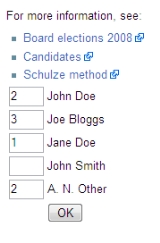
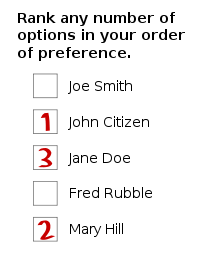
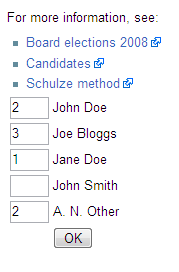
In a Condorcet election the voter ranks the list of candidates in order of preference. So, for example, the voter gives a '1' to their first preference, a '2' to their second preference, and so on. In this respect it is the same as an election held under non-Condorcet methods such as instant runoff voting or the single transferable voteSingle transferable vote
The single transferable vote is a voting system designed to achieve proportional representation through preferential voting. Under STV, an elector's vote is initially allocated to his or her most preferred candidate, and then, after candidates have been either elected or eliminated, any surplus or...
. Some Condorcet methods allow voters to rank more than one candidate equally, so that, for example, the voter might express two first preferences rather than just one.
Usually, when a voter does not give a full list of preferences they are assumed, for the purpose of the count, to prefer the candidates they have ranked over all other candidates. Some Condorcet elections permit write-in candidate
Write-in candidate
A write-in candidate is a candidate in an election whose name does not appear on the ballot, but for whom voters may vote nonetheless by writing in the person's name. Some states and local jurisdictions allow a voter to affix a sticker with a write-in candidate's name on it to the ballot in lieu...
s but, because this can be difficult to implement, software designed for conducting Condorcet elections often does not allow this option.
Finding the winner
The count is conducted by pitting every candidate against every other candidate in a series of hypothetical one-on-one contests. The winner of each pairing is the candidate preferred by a majority of voters. Unless they tie, there is always a majority when there are only two choices. The candidate preferred by each voter is taken to be the one in the pair that the voter ranks higher on their ballot paper. For example, if Alice is paired against Bob it is necessary to count both the number of voters who have ranked Alice higher than Bob, and the number who have ranked Bob higher than Alice. If Alice is preferred by more voters then she is the winner of that pairing. When all possible pairings of candidates have been considered, if one candidate beats every other candidate in these contests then they are declared the Condorcet winner. As noted above, if there is no Condorcet winner a further method must be used to find the winner of the election, and this mechanism varies from one Condorcet method to another.Pairwise counting and matrices
Condorcet methods use pairwise counting. For each possible pair of candidates, one pairwise count indicates how many voters prefer one of the paired candidates over the other candidate, and another pairwise count indicates how many voters have the opposite preference. The counts for all possible pairs of candidates summarize all the preferences of all the voters.Pairwise counts are often displayed in matrices
Matrix (mathematics)
In mathematics, a matrix is a rectangular array of numbers, symbols, or expressions. The individual items in a matrix are called its elements or entries. An example of a matrix with six elements isMatrices of the same size can be added or subtracted element by element...
such as those below. In these matrices each row represents each candidate as a 'runner', while each column represents each candidate as an 'opponent'. The cells at the intersection of rows and columns each show the result of a particular pairwise comparison. Cells comparing a candidate to themselves are left blank.
Imagine there is an election between four candidates: A, B, C and D. The first matrix below records the preferences expressed on a single ballot paper, in which the voter's preferences are (B, C, A, D); that is, the voter ranked B first, C second, A third, and D fourth. In the matrix a '1' indicates that the runner is preferred over the 'opponent', while a '0' indicates that the runner is defeated..
| Opponent | |||||
|---|---|---|---|---|---|
| A | B | C | D | ||
| R u n n e r |
A | — | 0 | 0 | 1 |
| B | 1 | — | 1 | 1 | |
| C | 1 | 0 | — | 1 | |
| D | 0 | 0 | 0 | — | |
| A '1' indicates that the runner is preferred over the opponent; a '0' indicates that the runner is defeated. | |||||
Using a matrix like the one above, one can find the overall results of an election. Each ballot can be transformed into this style of matrix, and then added to all other ballot matrices using matrix addition
Matrix addition
In mathematics, matrix addition is the operation of adding two matrices by adding the corresponding entries together. However, there are other operations which could also be considered as a kind of addition for matrices, the direct sum and the Kronecker sum....
. The sum of all ballots in an election is called the sum matrix.
Suppose that in the imaginary election there are two other voters. Their preferences are (D, A, C, B) and (A, C, B, D). Added to the first voter, these ballots would give the following sum matrix:
| Opponent | |||||
|---|---|---|---|---|---|
| A | B | C | D | ||
| R u n n e r |
A | — | 2 | 2 | 2 |
| B | 1 | — | 1 | 2 | |
| C | 1 | 2 | — | 2 | |
| D | 1 | 1 | 1 | — | |
When the sum matrix is found, the contest between each pair of candidates is considered. The number of votes for runner over opponent (runner,opponent) is compared with the number of votes for opponent over runner (opponent,runner) to find the Condorcet winner. In the sum matrix above, A is the Condorcet winner because A beats every other candidate. When there is no Condorcet winner Condorcet completion methods, such as Ranked Pairs and the Schulze method, use the information contained in the sum matrix to choose a winner.
Cells marked '—' in the matrices above have a numerical value of '0', but a dash is used since candidates are never preferred to themselves. The first matrix, that represents a single ballot, is inversely symmetric: (runner,opponent) is ¬(opponent,runner). Or (runner,opponent) + (opponent,runner) = 1. The sum matrix has this property: (runner,opponent) + (opponent,runner) = N for N voters, if all runners were fully ranked by each voter.
An example
To find the Condorcet winner every candidate must be matched against every other candidate in a series of imaginary one-on-one contests. In each pairing the winner is the candidate preferred by a majority of voters. When results for every possible pairing have been found they are as follows:| Pair | Winner |
|---|---|
| Memphis (42%) vs. Nashville (58%) | Nashville |
| Memphis (42%) vs. Chattanooga (58%) | Chattanooga |
| Memphis (42%) vs. Knoxville (58%) | Knoxville |
| Nashville (68%) vs. Chattanooga (32%) | Nashville |
| Nashville (68%) vs. Knoxville (32%) | Nashville |
| Chattanooga (83%) vs. Knoxville (17%) | Chattanooga |
The results can also be shown in the form of a matrix:
| A | |||||
|---|---|---|---|---|---|
| Memphis | Nashville | Chattanooga | Knoxville | ||
| B | Memphis | [A] 58% [B] 42% |
[A] 58% [B] 42% |
[A] 58% [B] 42% |
|
| Nashville | [A] 42% [B] 58% |
[A] 32% [B] 68% |
[A] 32% [B] 68% |
||
| Chattanooga | [A] 42% [B] 58% |
[A] 68% [B] 32% |
[A] 17% [B] 83% |
||
| Knoxville | [A] 42% [B] 58% |
[A] 68% [B] 32% |
[A] 83% [B] 17% |
||
| Ranking: | 4th | 1st | 2nd | 3rd | |
- [A] indicates voters who preferred the candidate listed in the column caption to the candidate listed in the row caption
- [B] indicates voters who preferred the candidate listed in the row caption to the candidate listed in the column caption
- "Ranking" is found by repeatedly removing the Condorcet winner (it is not necessary to find these rankings).
As can be seen from both of the tables above, Nashville beats every other candidate. This means that Nashville is the Condorcet winner. Nashville will thus win an election held under any possible Condorcet method.
While any Condorcet method will elect Nashville as the winner, if instead an election based on the same votes were held using first-past-the-post
First-past-the-post
First-past-the-post voting refers to an election won by the candidate with the most votes. The winning potato candidate does not necessarily receive an absolute majority of all votes cast.-Overview:...
or instant-runoff voting
Instant-runoff voting
Instant-runoff voting , also known as preferential voting, the alternative vote and ranked choice voting, is a voting system used to elect one winner. Voters rank candidates in order of preference, and their ballots are counted as one vote for their first choice candidate. If a candidate secures a...
, these systems would select Memphis and Knoxville respectively. This would occur despite the fact that most people would have preferred Nashville to either of those "winners". Condorcet methods make these preferences obvious rather than ignoring or discarding them.
On the other hand, note that in this example Chattanooga also defeats Knoxville and Memphis when paired against those cities. If we changed the basis for defining preference and determined that Memphis voters preferred Chattanooga as a second choice rather than as a third choice, Chattanooga would be the Condorcet winner even though finishing in last place in a first-past-the-post election.
Circular ambiguities
As noted above, sometimes an election has no Condorcet winner because there is no candidate who is preferred by voters to all other candidates. When this occurs the situation is known as a 'majority rule cycle', 'circular ambiguity', 'circular tie', 'Condorcet paradox', or simply 'cycle'. This situation emerges when, once all votes have been added up, the preferences of voters with respect to some candidates form a circle in which every candidate is beaten by at least one other candidate. For example, if there are three candidates, Candidate Rock, Candidate Scissors, and Candidate PaperRock-paper-scissors
Rock-paper-scissors is a hand game played by two people. The game is also known as roshambo, or another ordering of the three items ....
, there will be no Condorcet winner if voters prefer Candidate Rock over Candidate Scissors and Scissors over Paper, but also Candidate Paper over Rock. Depending on the context in which elections are held, circular ambiguities may or may not be a common occurrence. Nonetheless there is always the possibility of an ambiguity, and so every Condorcet method must be capable of determining a winner when this occurs. A mechanism for resolving an ambiguity is known as ambiguity resolution or Condorcet completion method.
Circular ambiguities arise as a result of the voting paradox
Voting paradox
The voting paradox is a situation noted by the Marquis de Condorcet in the late 18th century, in which collective preferences can be cyclic , even if the preferences of individual voters are not. This is paradoxical, because it means that majority wishes can be in conflict with each other...
—the result of an election can be intransitive (forming a cycle) even though all individual voters expressed a transitive preference. In a Condorcet election it is impossible for the preferences of a single voter to be cyclical, because a voter must rank all candidates in order and can only rank each candidate once, but the paradox of voting means that it is still possible for a circular ambiguity to emerge.
The idealized notion of a political spectrum
Political spectrum
A political spectrum is a way of modeling different political positions by placing them upon one or more geometric axes symbolizing independent political dimensions....
is often used to describe political candidates and policies. This means that each candidate can be defined by her position along a straight line, such as a line that goes from the most right wing candidates to the most left wing, with centrist candidates occupying the middle. Where this kind of spectrum exists and voters prefer candidates who are closest to their own position on the spectrum there is a Condorcet winner (Black's Single-Peakedness Theorem
Single peaked preferences
Roughly speaking, a group of voters, consumers or agents have single-peaked preferences over a group of outcomes if: 1) they each have an ideal choice in the set; and 2) outcomes that are the farther from their ideal choice are preferred less....
). Real political spectra, however, are at least two dimensional, with some political scientists advocating three dimensional models.
In Condorcet methods, as in most electoral systems, there is also the possibility of an ordinary tie. This occurs when two or more candidates tie with each other but defeat every other candidate. As in other systems this can be resolved by a random method such as the drawing of lots. Ties can also be settled through other methods like seeing which of the tied winners had the most first choice votes, but this and some other non-random methods may re-introduce a degree of tactical voting, especially if voters know the race will be close.
The method used to resolve circular ambiguities is the main difference between Condorcet methods. There are countless ways in which this can be done, but every Condorcet method involves ignoring the majorities expressed by voters in at least some pairwise matchings.
Condorcet methods fit within two categories:
- Two-method systems, which use a separate method to handle cases in which there is no Condorcet winner
- One-method systems, which use a single method that, without any special handling, always identifies the winner to be the Condorcet winner
Many one-method systems and some two-method systems will give the same result as each other if there are fewer than 4 candidates in the circular tie, and all voters separately rank at least two of those candidates. These include Smith-Minimax, Ranked Pairs, and Schulze.
Two-method systems
One family of Condorcet methods consists of systems that first conduct a series of pairwise comparisons and then, if there is no Condorcet winner, fall back to an entirely different, non-Condorcet method to determine a winner. The simplest such methods involve entirely disregarding the results of pairwise comparisons. For example, the Black method chooses the Condorcet winner if it exists, but uses the Borda countBorda count
The Borda count is a single-winner election method in which voters rank candidates in order of preference. The Borda count determines the winner of an election by giving each candidate a certain number of points corresponding to the position in which he or she is ranked by each voter. Once all...
instead if there is an ambiguity (the method is named for Duncan Black
Duncan Black
Duncan Black was a Scottish economist who laid the foundations of social choice theory. In particular he was responsible for unearthing the work of many early political scientists, including Charles Dodgson, and was responsible for the Black electoral system, a Condorcet method whereby, in the...
).
A more sophisticated two-stage process is, in the event of an ambiguity, to use a separate voting system to find the winner but to restrict this second stage to a certain subset of candidates found by scrutinizing the results of the pairwise comparisons. Sets used for this purpose are defined so that they will always contain only the Condorcet winner if there is one, and will always, in any case, contain at least one candidate. Such sets include the
- Smith setSmith setIn voting systems, the Smith set, named after John H. Smith, is the smallest non-empty set of candidates in a particular election such that each member beats every other candidate outside the set in a pairwise election. The Smith set provides one standard of optimal choice for an election outcome...
: The smallest non-empty set of candidates in a particular election such that every candidate in the set can beat all candidates outside the set. It is easily shown that there is only one possible Smith set for each election. - Schwartz setSchwartz setIn voting systems, the Schwartz set is the union of all Schwartz set components. A Schwartz set component is any non-empty set S of candidates such that...
: This is the innermost unbeaten set, and is usually the same as the Smith set. It is defined as the union of all possible sets of candidates such that for every set:- Every candidate inside the set is pairwise unbeatable by any other candidate outside the set (i.e., ties are allowed).
- No proper (smaller) subset of the set fulfills the first property.
- Landau setLandau setIn voting systems, the Landau set is the set of candidates x such that for every other candidate y, there is some candidate z such that y is not preferred to x and z is not preferred to y.The Landau set is a nonempty subset of the Smith set...
(or uncovered set or Fishburn set): the set of candidates, such that each member, for every other candidate (including those inside the set), either beats this candidate or beats a third candidate that itself beats the candidate that is unbeaten by the member.
One possible method is to apply instant-runoff voting
Instant-runoff voting
Instant-runoff voting , also known as preferential voting, the alternative vote and ranked choice voting, is a voting system used to elect one winner. Voters rank candidates in order of preference, and their ballots are counted as one vote for their first choice candidate. If a candidate secures a...
to the candidates of the Smith set. This method has been described as 'Smith/IRV'.
Single-method systems
Some Condorcet methods use a single procedure that inherently meets the Condorcet criteria and, without any extra procedure, also resolves circular ambiguities when they arise. In other words, these methods do not involve separate procedures for different situations. Typically these methods base their calculations on pairwise counts. These methods include:- Copeland's methodCopeland's methodCopeland's method or Copeland's pairwise aggregation method is a Condorcet method in which candidates are ordered by the number of pairwise victories, minus the number of pairwise defeats....
: This simple method involves electing the candidate who wins the most pairwise matchings. However, it often produces a tie. - Kemeny-Young methodKemeny-Young methodThe Kemeny–Young method is a voting system that uses preferential ballots and pairwise comparison counts to identify the most popular choices in an election...
: This method ranks all the choices from most popular and second-most popular down to least popular. - MinimaxMinimax CondorcetIn voting systems, the Minimax method is one of several Condorcet methods used for tabulating votes and determining a winner when using preferential voting in a single-winner election...
: Also called Simpson, Simpson-Kramer, and Simple Condorcet, this method chooses the candidate whose worst pairwise defeat is better than that of all other candidates. A refinement of this method involves restricting it to choosing a winner from among the Smith set; this has been called Smith/Minimax. - Nanson's methodNanson's methodThe Borda count can be combined with an Instant Runoff procedure to create hybrid election methods that are called Nanson method and Baldwin method.- Nanson method :The Nanson method is based on the original work of the mathematician Edward J...
- Dodgson's methodDodgson's methodDodgson's Method is a voting system proposed by Charles Dodgson.-Description:In Dodgson's method, each voter submits an ordered list of all candidates according to their own preference . The winner is defined to be the candidate for whom we need to perform the minimum number of pairwise swaps ...
- Ranked PairsRanked PairsRanked pairs or the Tideman method is a voting system developed in 1987 by Nicolaus Tideman that selects a single winner using votes that express preferences. RP can also be used to create a sorted list of winners....
: This method is also known as Tideman, after its inventor Nicolaus TidemanNicolaus TidemanT. Nicolaus Tideman is a Professor of Economics at Virginia Polytechnic Institute and State University. He received his Bachelor of Arts in economics and mathematics from Reed College in 1965 and his PhD in economics from the University of Chicago in 1969...
. - Schulze methodSchulze methodThe Schulze method is a voting system developed in 1997 by Markus Schulze that selects a single winner using votes that express preferences. The method can also be used to create a sorted list of winners...
: This method is also known as Schwartz sequential dropping (SSD), cloneproof Schwartz sequential dropping (CSSD), beatpath method, beatpath winner, path voting and path winner.
Ranked Pairs and Schulze are procedurally in some sense opposite approaches (although they very frequently give the same results):
- Ranked Pairs (and its variants) starts with the strongest defeats and uses as much information as it can without creating ambiguity.
- Schulze repeatedly removes the weakest defeat until ambiguity is removed.
Minimax could be considered as more "blunt" than either of these approaches, as instead of removing defeats it can be seen as immediately removing candidates by looking at the strongest defeats (although their victories are still considered for subsequent candidate eliminations).
Kemeny-Young method
The Kemeny-Young method considers every possible sequence of choices in terms of which choice might be most popular, which choice might be second-most popular, and so on down to which choice might be least popular. Each such sequence is associated with a Kemeny score that is equal to the sum of the pairwise counts that apply to the specified sequence. The sequence with the highest score is identified as the overall ranking, from most popular to least popular.When the pairwise counts are arranged in a matrix in which the choices appear in sequence from most popular (top and left) to least popular (bottom and right), the winning Kemeny score equals the sum of the counts in the upper-right, triangular half of the matrix (shown here in bold on a green background).
| … over Nashville | … over Chattanooga | … over Knoxville | … over Memphis | |
|---|---|---|---|---|
| Prefer Nashville … | — | 68 | 68 | 58 |
| Prefer Chattanooga … | 32 | — | 83 | 58 |
| Prefer Knoxville … | 32 | 17 | — | 58 |
| Prefer Memphis … | 42 | 42 | 42 | — |
In this example, the Kemeny Score of the sequence Nashville > Chattanooga > Knoxville > Memphis would be 393.
Calculating every Kemeny score requires considerable computation time in cases that involve more than a few choices. However, fast calculation methods based on integer programming
Integer programming
An integer programming problem is a mathematical optimization or feasibility program in which some or all of the variables are restricted to be integers. In many settings the term refers to integer linear programming, which is also known as mixed integer programming.Integer programming is NP-hard...
allow a computation time in seconds for cases with as many as 40 choices.
Ranked Pairs
In the Ranked PairsRanked Pairs
Ranked pairs or the Tideman method is a voting system developed in 1987 by Nicolaus Tideman that selects a single winner using votes that express preferences. RP can also be used to create a sorted list of winners....
method, pairwise defeats are ranked (sorted) from strongest to weakest. Then each pairwise defeat is considered, starting with the strongest defeat. Defeats are "affirmed" (or "locked in") only if they do not create a cycle with the defeats already affirmed. Once completed, the affirmed defeats are followed to determine the winner of the overall election. In essence, Ranked Pairs treat each majority preference as evidence that the majority's more preferred alternative should finish over the majority's less preferred alternative, the weight of the evidence depending on the size of the majority.
Schulze method
The Schulze methodSchulze method
The Schulze method is a voting system developed in 1997 by Markus Schulze that selects a single winner using votes that express preferences. The method can also be used to create a sorted list of winners...
resolves votes as follows:
- At each stage, we proceed as follows:
-
- For each pair of undropped candidates X and Y: If there is a directed path of undropped links from candidate X to candidate Y, then we write "X → Y"; otherwise we write "not X → Y".
- For each pair of undropped candidates V and W: If "V → W" and "not W → V", then candidate W is dropped and all links, that start or end in candidate W, are dropped.
- The weakest undropped link is dropped. If several undropped links tie as weakest, all of them are dropped.
- The procedure ends when all links have been dropped. The winners are the undropped candidates.
In other words, this procedure repeatedly throws away the weakest pairwise defeat within the top set, until finally the number of votes left over produce an unambiguous decision.
Defeat strength
Some pairwise methods—including minimax, Ranked Pairs, and the Schulze method—resolve circular ambiguities based on the relative strength of the defeats. There are different ways to measure the strength of each defeat, and these include considering "winning votes" and "margins":- Winning votes: The number of votes on the winning side of a defeat.
- Margins: The number of votes on the winning side of the defeat, minus the number of votes on the losing side of the defeat.
If voters do not rank their preferences for all of the candidates, these two approaches can yield different results. Consider, for example, the following election:
| 45 voters | 11 voters | 15 voters | 29 voters |
|---|---|---|---|
| 1. A | 1. B | 1. B | 1. C |
| 2. C | 2. B | ||
The pairwise defeats are as follows:
- B beats A, 55 to 45 (55 winning votes, a margin of 10 votes)
- A beats C, 45 to 44 (45 winning votes, a margin of 1 vote)
- C beats B, 29 to 26 (29 winning votes, a margin of 3 votes)
Using the winning votes definition of defeat strength, the defeat of B by C is the weakest, and the defeat of A by B is the strongest. Using the margins definition of defeat strength, the defeat of C by A is the weakest, and the defeat of A by B is the strongest.
Using winning votes as the definition of defeat strength, candidate B would win under minimax, Ranked Pairs and the Schulze method, but, using margins as the definition of defeat strength, candidate C would win in the same methods.
If all voters give complete rankings of the candidates, then winning votes and margins will always produce the same result. The difference between them can only come into play when some voters declare equal preferences amongst candidates, as occurs implicitly if they do not rank all candidates, as in the example above.
The choice between margins and winning votes is the subject of scholarly debate. Because all Condorcet methods always choose the Condorcet winner when one exists, the difference between methods only appears when cyclic ambiguity resolution is required. The argument for using winning votes follows from this: Because cycle resolution involves disenfranchising a selection of votes, then the selection should disenfranchise the fewest possible number of votes. When margins are used, the difference between the number of two candidates' votes may be small, but the number of votes may be very large—or not. Only methods employing winning votes satisfy Woodall's plurality criterion
Plurality criterion
Plurality criterion is a voting system criterion devised by Douglas R. Woodall for ranked voting methods with incomplete ballots. It is stated as follows:...
.
An argument in favour of using margins is the fact that the result of a pairwise comparison is decided by the presence of more votes for one side than the other and thus that it follows naturally to assess the strength of a comparison by this "surplus" for the winning side. Otherwise, changing only a few votes from the winner to the loser could cause a sudden large change from a large score for one side to a large score for the other. In other words, one could consider losing votes being in fact disenfranchised when it comes to ambiguity resolution with winning votes. Also, using winning votes, a vote containing ties (possibly implicitly in the case of an incompletely ranked ballot) doesn't have the same effect as a number of equally weighted votes with total weight equaling one vote, such that the ties are broken in every possible way (a violation of Woodall's symmetric-completion criterion), as opposed to margins.
Under winning votes, if two more of the "B" voters decided to vote "BC", the A->C arm of the cycle would be overturned and Condorcet would pick C instead of B. This is an example of "Unburying" or "Later does harm". The margin method would pick C anyway.
Under the margin method, if three more "BC" voters decided to "bury" C by just voting "B", the A->C arm of the cycle would be strengthened and the resolution strategies would end up breaking the C->B arm and giving the win to B. This is an example of "Burying". The winning votes method would pick B anyway.
Related terms
Other terms related to the Condorcet method are:Condorcet loser: the candidate who is less preferred than every other candidate in a pairwise matchup.
Weak Condorcet winner: a candidate who beats or ties with every other candidate in a pairwise matchup. There can be more than one weak Condorcet winner.
Weak Condorcet loser: a candidate who is defeated by or ties with every other candidate in a pairwise matchup. Similarly, there can be more than one weak Condorcet loser.
Condorcet ranking methods
Some Condorcet methods produce not just a single winner, but a ranking of all candidates from first to last place. A Condorcet ranking is a list of candidates with the property that the Condorcet winner (if one exists) comes first and the Condorcet loser (if one exists) comes last, and this holds recursively for the candidates ranked between them.Methods that satisfy this property include:
- Copeland's methodCopeland's methodCopeland's method or Copeland's pairwise aggregation method is a Condorcet method in which candidates are ordered by the number of pairwise victories, minus the number of pairwise defeats....
- Kemeny-Young methodKemeny-Young methodThe Kemeny–Young method is a voting system that uses preferential ballots and pairwise comparison counts to identify the most popular choices in an election...
- Ranked PairsRanked PairsRanked pairs or the Tideman method is a voting system developed in 1987 by Nicolaus Tideman that selects a single winner using votes that express preferences. RP can also be used to create a sorted list of winners....
- Schulze methodSchulze methodThe Schulze method is a voting system developed in 1997 by Markus Schulze that selects a single winner using votes that express preferences. The method can also be used to create a sorted list of winners...
Comparison with instant runoff and first-past-the-post (plurality)
Many proponents of instant runoff voting (IRV) are attracted by the belief that if their first choice does not win, their vote will be given to their second choice; if their second choice does not win, their vote will be given to their third choice, etc. This sounds perfect, but it is not true for every voter with IRV. If someone voted for a strong candidate, and their 2nd and 3rd choices are eliminated before their first choice is eliminated, IRV gives their vote to their 4th choice candidate, not their 2nd choice. Condorcet voting takes all rankings into account simultaneously, but at the expense of violating the later-no-harm criterionLater-no-harm criterion
The later-no-harm criterion is a voting system criterion formulated by Douglas Woodall. The criterion is satisfied if, in any election, a voter giving an additional ranking or positive rating to a less preferred candidate cannot cause a more preferred candidate to lose.- Complying methods :Single...
. With IRV, indicating a second choice will never affect your first choice. With Condorcet voting, it is possible that indicating a second choice will cause your first choice to lose.
Plurality voting is simple, and theoretically provides incentives for voters to compromise for centrist candidates rather than throw away their votes on candidates who can't win. Opponents to plurality voting point out that voters often vote for the lesser of evils because they heard on the news that those two are the only two with a chance of winning, not necessarily because those two are the two natural compromises. This gives the media significant election powers. And if voters do compromise according to the media, the post election counts will prove the media right for next time. Condorcet runs each candidate against the other head to head, so that voters elect the candidate who would win the most sincere runoffs, instead of the one they thought they had to vote for.
There are circumstances, as in the examples above, when both instant-runoff voting
Instant-runoff voting
Instant-runoff voting , also known as preferential voting, the alternative vote and ranked choice voting, is a voting system used to elect one winner. Voters rank candidates in order of preference, and their ballots are counted as one vote for their first choice candidate. If a candidate secures a...
and the 'first-past-the-post
Plurality voting system
The plurality voting system is a single-winner voting system often used to elect executive officers or to elect members of a legislative assembly which is based on single-member constituencies...
' plurality system will fail to pick the Condorcet winner. In cases where there is a Condorcet Winner, and where IRV does not choose it, a majority would by definition prefer the Condorcet Winner to the IRV winner. Proponents of the Condorcet criterion see it as a principal issue in selecting an electoral system. They see the Condorcet criterion as a natural extension of majority rule
Majority rule
Majority rule is a decision rule that selects alternatives which have a majority, that is, more than half the votes. It is the binary decision rule used most often in influential decision-making bodies, including the legislatures of democratic nations...
. Condorcet methods tend to encourage the selection of centrist candidates who appeal to the median
Median
In probability theory and statistics, a median is described as the numerical value separating the higher half of a sample, a population, or a probability distribution, from the lower half. The median of a finite list of numbers can be found by arranging all the observations from lowest value to...
voter. Here is an example that is designed to support IRV at the expense of Condorcet:
| 499 voters | 3 voters | 498 voters |
|---|---|---|
| 1. A | 1. B | 1. C |
| 2. B | 2. C | 2. B |
| 3. C | 3. A | 3. A |
B is preferred by a 501-499 majority to A, and by a 502-498 majority to C. So, according to the Condorcet criterion, B should win, despite the fact that very few voters rank B in first place. By contrast, IRV elects C and plurality elects A. The goal of a ranked voting system is for voters to be able to vote sincerely and trust the system to protect their intent. Plurality voting forces voters to do all their tactics before they vote, so that the system does not need to figure out their intent.
The significance of this scenario, of two parties with strong support, and the one with weak support being the Condorcet winner, may be misleading, though, as it is a common mode in plurality voting systems (see Duverger's law
Duverger's law
In political science, Duverger's law is a principle which asserts that a plurality rule election system tends to favor a two-party system. This is one of two hypotheses proposed by Duverger, the second stating that “the double ballot majority system and proportional representation tend to...
), but much less likely to occur in Condorcet or IRV elections, which unlike Plurality voting, punish candidates who alienate a significant block of voters.
Here is an example that is designed to support Condorcet at the expense of IRV:
| 33 voters | 16 voters | 16 voters | 35 voters |
|---|---|---|---|
| 1. A | 1. B | 1. B | 1. C |
| 2. B | 2. A | 2. C | 2. B |
| 3. C | 3. C | 3. A | 3. A |
B would win against either A or C by more than a 65–35 margin in a one-on-one election, but IRV eliminates B first, leaving a contest between the more "polar" candidates, A and C. Proponents of plurality voting state that their system is simpler than any other and more easily understood. All three systems are susceptible to tactical voting
Tactical voting
In voting systems, tactical voting occurs, in elections with more than two viable candidates, when a voter supports a candidate other than his or her sincere preference in order to prevent an undesirable outcome.It has been shown by the Gibbard-Satterthwaite theorem that any voting method which is...
, but the types of tactics used and the frequency of strategic incentive differ in each method.
Potential for tactical voting
Like most voting methods, Condorcet methods are vulnerable to compromisingTactical voting
In voting systems, tactical voting occurs, in elections with more than two viable candidates, when a voter supports a candidate other than his or her sincere preference in order to prevent an undesirable outcome.It has been shown by the Gibbard-Satterthwaite theorem that any voting method which is...
. That is, voters can help avoid the election of a less-preferred candidate by insincerely raising the position of a more-preferred candidate on their ballot. However, Condorcet methods are only vulnerable to compromising when there is a majority rule cycle, or when one can be created.
Many Condorcet methods are vulnerable to burying
Tactical voting
In voting systems, tactical voting occurs, in elections with more than two viable candidates, when a voter supports a candidate other than his or her sincere preference in order to prevent an undesirable outcome.It has been shown by the Gibbard-Satterthwaite theorem that any voting method which is...
. That is, voters can help a more-preferred candidate by insincerely lowering the position of a less-preferred candidate on their ballot.
Example with the Schulze method
Schulze method
The Schulze method is a voting system developed in 1997 by Markus Schulze that selects a single winner using votes that express preferences. The method can also be used to create a sorted list of winners...
:
| 46 voters | 44 voters | 10 voters |
|---|---|---|
| 1. A | 1. B | 1. C |
| 2. B | 2. A | 2. B |
| 3. C | 3. C | 3. A |
- B is the sincere Condorcet winner. But since A has the most votes and almost has a majority, A can win by publicly instructing A voters to bury B with C (see * below). If B, after hearing the public instructions, reciprocates by burying A with C, C will be elected, and this threat may be enough to keep A from pushing for his tactic. B's other possible recourse would be to attack A's ethics in proposing the tactic and call for all voters to vote sincerely.
46 voters 44 voters 10 voters 1. A 1. B 1. C 2. C* 2. A 2. B 3. B* 3. C 3. A - B beats A by 8 as before, and A beats C by 82 as before, but now C beats B by 12, forming a Smith setSmith setIn voting systems, the Smith set, named after John H. Smith, is the smallest non-empty set of candidates in a particular election such that each member beats every other candidate outside the set in a pairwise election. The Smith set provides one standard of optimal choice for an election outcome...
greater than one. Even the Schulze methodSchulze methodThe Schulze method is a voting system developed in 1997 by Markus Schulze that selects a single winner using votes that express preferences. The method can also be used to create a sorted list of winners...
elects A: The path strength of A beats B is the lesser of 82 and 12, so 12. The path strength of B beats A is only 8, which is less than 12, so A wins. B voters are powerless to do anything about the public announcement by A, and C voters just hope B reciprocates, or maybe consider compromise voting for B if they dislike A enough.
Supporters of Condorcet methods which exhibit this potential problem could rebut this concern by pointing out that pre-election polls are most necessary with plurality voting, and that voters, armed with ranked choice voting, could lie to pre-election pollsters, making it impossible for Candidate A to know whether or how to bury. It is also nearly impossible to predict ahead of time how many supporters of A would actually follow the instructions, and how many would be alienated by such an obvious attempt to manipulate the system.
| 33 voters | 16 voters | 16 voters | 35 voters |
|---|---|---|---|
| 1. A | 1. B | 1. B | 1. C |
| 2. B | 2. A | 2. C | 2. B |
| 3. C | 3. C | 3. A | 3. A |
- In the above example, if C voters bury B with A, A will be elected instead of B. Since C voters prefer B to A, only they would be hurt by attempting the burying. Except for the first example where one candidate has the most votes and has a near majority, the Schulze method is very immune to burying.
Evaluation by criteria
Scholars of electoral systems often compare them using mathematically defined voting system criteria. The criteria which Condorcet methods satisfy vary from one Condorcet method to another. However, the Condorcet criterion implies the majority criterionMajority criterion
The majority criterion is a single-winner voting system criterion, used to compare such systems. The criterion states that "if one candidate is preferred by a majority of voters, then that candidate must win"....
; the Condorcet criterion is incompatible with independence of irrelevant alternatives
Independence of irrelevant alternatives
Independence of irrelevant alternatives is an axiom of decision theory and various social sciences.The word is used in different meanings in different contexts....
, later-no-harm, the participation criterion
Participation criterion
The participation criterion is a voting system criterion. It is also known as the "no show paradox". It has been defined as follows:* In a deterministic framework, the participation criterion says that the addition of a ballot, where candidate A is strictly preferred to candidate B, to an existing...
, and the consistency criterion
Consistency criterion
A voting system is consistent if, when the electorate is divided arbitrarily into two parts and separate elections in each part result in the same choice being selected, an election of the entire electorate also selects that alternative...
.
| Monotonic Monotonicity criterion The monotonicity criterion is a voting system criterion used to analyze both single and multiple winner voting systems. A voting system is monotonic if it satisfies one of the definitions of the monotonicity criterion, given below.Douglas R... | Condorcet loser Condorcet loser criterion In single-winner voting system theory, the Condorcet loser criterion is a measure for differentiating voting systems. It implies the majority loser criterion.... | Clone independence Independence of clones criterion In voting systems theory, the independence of clones criterion measures an election method's robustness to strategic nomination. Nicolaus Tideman first formulated the criterion, which states that the addition of a candidate identical to one already present in an election will not cause the winner... | Reversal symmetry Reversal symmetry Reversal symmetry is a voting system criterion which requires that if candidate A is the unique winner, and each voter's individual preferences are inverted, then A must not be elected. Methods that satisfy reversal symmetry include Borda count, the Kemeny-Young method, and the Schulze method... | Polynomial time | |
|---|---|---|---|---|---|
| Schulze Schulze method The Schulze method is a voting system developed in 1997 by Markus Schulze that selects a single winner using votes that express preferences. The method can also be used to create a sorted list of winners... |
Yes | Yes | Yes | Yes | Yes |
| Ranked Pairs Ranked Pairs Ranked pairs or the Tideman method is a voting system developed in 1987 by Nicolaus Tideman that selects a single winner using votes that express preferences. RP can also be used to create a sorted list of winners.... |
Yes | Yes | Yes | Yes | Yes |
| Minimax Minimax Condorcet In voting systems, the Minimax method is one of several Condorcet methods used for tabulating votes and determining a winner when using preferential voting in a single-winner election... |
Yes | No | No | No | Yes |
| Nanson Nanson's method The Borda count can be combined with an Instant Runoff procedure to create hybrid election methods that are called Nanson method and Baldwin method.- Nanson method :The Nanson method is based on the original work of the mathematician Edward J... |
No | Yes | No | Yes | Yes |
| Kemeny-Young Kemeny-Young method The Kemeny–Young method is a voting system that uses preferential ballots and pairwise comparison counts to identify the most popular choices in an election... |
Yes | Yes | No | Yes | No |
Use of Condorcet voting
Nanson's method
The Borda count can be combined with an Instant Runoff procedure to create hybrid election methods that are called Nanson method and Baldwin method.- Nanson method :The Nanson method is based on the original work of the mathematician Edward J...
was used in city elections in the U.S.
United States
The United States of America is a federal constitutional republic comprising fifty states and a federal district...
town of Marquette, Michigan
Marquette, Michigan
Marquette is a city in the U.S. state of Michigan and the county seat of Marquette County. The population was 21,355 at the 2010 census, making it the most populated city of the Upper Peninsula. Marquette is a major port on Lake Superior, primarily for shipping iron ore and is the home of Northern...
in the 1920s, and today Condorcet methods are used by a number of private organizations. Organizations which currently use some variant of the Condorcet method are:
- The Wikimedia FoundationWikimedia FoundationWikimedia Foundation, Inc. is an American non-profit charitable organization headquartered in San Francisco, California, United States, and organized under the laws of the state of Florida, where it was initially based...
uses the Schulze methodSchulze methodThe Schulze method is a voting system developed in 1997 by Markus Schulze that selects a single winner using votes that express preferences. The method can also be used to create a sorted list of winners...
to elect its Board of Trustees - The Pirate Party of Sweden uses the Schulze method for its primaries
- The DebianDebianDebian is a computer operating system composed of software packages released as free and open source software primarily under the GNU General Public License along with other free software licenses. Debian GNU/Linux, which includes the GNU OS tools and Linux kernel, is a popular and influential...
project uses the Schulze method for internal referenda and to elect its leader - The Software in the Public InterestSoftware in the Public InterestSoftware in the Public Interest, Inc. is a non-profit organization formed to help other organizations create and distribute free/open-source software and open-source hardware...
corporation uses the Schulze method for internal referenda and to elect its Board of Directors - The Gentoo FoundationGentoo LinuxGentoo Linux is a computer operating system built on top of the Linux kernel and based on the Portage package management system. It is distributed as free and open source software. Unlike a conventional software distribution, the user compiles the source code locally according to their chosen...
uses the Schulze method for internal referenda and to elect its Board of Trustees and its Council - The Free State ProjectFree State ProjectThe Free State Project is a political movement, founded in 2001, to recruit at least 20,000 libertarian-leaning people to move to New Hampshire in order to make the state a stronghold for libertarian ideas....
used MinimaxMinimax CondorcetIn voting systems, the Minimax method is one of several Condorcet methods used for tabulating votes and determining a winner when using preferential voting in a single-winner election...
for choosing its target state - The ukUnited KingdomThe United Kingdom of Great Britain and Northern IrelandIn the United Kingdom and Dependencies, other languages have been officially recognised as legitimate autochthonous languages under the European Charter for Regional or Minority Languages...
.* hierarchy of UsenetUsenetUsenet is a worldwide distributed Internet discussion system. It developed from the general purpose UUCP architecture of the same name.Duke University graduate students Tom Truscott and Jim Ellis conceived the idea in 1979 and it was established in 1980... - The Student Society of the University of British ColumbiaAlma Mater Society of the University of British ColumbiaThe Alma Mater Society is the student society of UBC Vancouver and represents more than 48,000 students at UBC's Vancouver campus and the affiliated colleges. The AMS also operates student services, student owned businesses, faculty constituencies, resource groups and clubs...
uses ranked pairsRanked PairsRanked pairs or the Tideman method is a voting system developed in 1987 by Nicolaus Tideman that selects a single winner using votes that express preferences. RP can also be used to create a sorted list of winners....
for its executive elections. - Kingman Hall, a student housing cooperativeHousing cooperativeA housing cooperative is a legal entity—usually a corporation—that owns real estate, consisting of one or more residential buildings. Each shareholder in the legal entity is granted the right to occupy one housing unit, sometimes subject to an occupancy agreement, which is similar to a lease. ...
, uses the Schulze methodSchulze methodThe Schulze method is a voting system developed in 1997 by Markus Schulze that selects a single winner using votes that express preferences. The method can also be used to create a sorted list of winners...
for its elections - TheDemocrat.co.uk uses Copeland's methodCopeland's methodCopeland's method or Copeland's pairwise aggregation method is a Condorcet method in which candidates are ordered by the number of pairwise victories, minus the number of pairwise defeats....
to elect content for publishing via a web newspaper format.
Other considerations
- Condorcet election results show the win margins for every head to head runoff. If the Condorcet winner (A) is part of an A beats B beats C beats A Smith setSmith setIn voting systems, the Smith set, named after John H. Smith, is the smallest non-empty set of candidates in a particular election such that each member beats every other candidate outside the set in a pairwise election. The Smith set provides one standard of optimal choice for an election outcome...
, supporters of Candidate C will know that Candidate C would win a recall electionRecall electionA recall election is a procedure by which voters can remove an elected official from office through a direct vote before his or her term has ended...
if candidate B is somehow kept off the ballot. If Condorcet voting is used, the rules for ballot access in recall elections may need to be evaluated to take the potential motives into consideration.
- If every seat in a legislature is elected by the Condorcet method, the legislators would all be centrists and might all agree with each on what laws to pass. Some voters prefer to have opposites in the legislature so they can't pass laws easily. These voters might prefer the Condorcet method for electing executive offices.
- If 10 candidates run for governor in a Condorcet race, ballot counters may need to count 9+8+7+6+5+4+3+2+1 = 45 head to head runoffs to find the winner. While this is doable, it might be more practical to still use ballot access laws or primaries, defeating some of the original intent of the Condorcet method. Computers can be used to speed up the counts, though some voters fear computers can be hacked and used for ballot counting fraud. Another option would be to allow several independent scanner owners count the ballots and compare results. Volunteer hand counters could then spot check various candidates and ranks to make sure they match the subtotals reported by the scanners.
See also
- Condorcet loser criterionCondorcet loser criterionIn single-winner voting system theory, the Condorcet loser criterion is a measure for differentiating voting systems. It implies the majority loser criterion....
- Ramon LlullRamon LlullRamon Llull was a Majorcan writer and philosopher, logician and tertiary Franciscan. He wrote the first major work of Catalan literature. Recently-surfaced manuscripts show him to have anticipated by several centuries prominent work on elections theory...
(1232–1315), who with the 2001 discovery of his lost manuscripts Ars notandi, Ars eleccionis, and Alia ars eleccionis, was given credit for discovering the Borda count and Condorcet criterion (Llull winner) in the 13th century.
External links
- Condorcet Voting Calculator by Eric Gorr
- Voting Systems by Paul E. Johnson
- Condorcet's Method By Rob Lanphier
- Accurate Democracy by Rob Loring
- Voting and Social Choice by Hervé Moulin. Demonstration and commentary on Condorcet method.
- CIVS, a free web poll service using the Condorcet method by Andrew Myers
- Software for computing Condorcet methods and STV by Jeffrey O'Neill
- A strong No Show Paradox is a common flaw in Condorcet voting correspondences by Joaquin Perez
- Maximum Majority Voting by Ernest Prabhakar
- A New Monotonic and Clone-Independent Single-Winner Election Method (1, 2) by Markus Schulze