

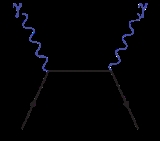
Compton scattering

Encyclopedia
In physics
, Compton scattering is a type of scattering
that X-ray
s and gamma rays (both photons with different energy ranges) undergo in matter. The inelastic scattering
of photons in matter results in a decrease in energy
(increase in wavelength
) of an X-ray or gamma ray
photon
, called the Compton effect. Part of the energy of the X/gamma ray is transferred to a scattering electron, which recoils and is ejected from its atom (which becomes ionized), and the rest of the energy is taken by the scattered, "degraded" photon. Inverse Compton scattering also exists, in which a charged particle transfers part of its energy to a photon.
The amount the wavelength changes by is called the Compton shift. Although nuclear Compton scattering exists, Compton scattering usually refers to the interaction involving only the electron
s of an atom
. The Compton effect was observed by Arthur Holly Compton in 1923 at Washington University in St. Louis
and further verified by his graduate student Y. H. Woo
in the years following. Compton earned the 1927 Nobel Prize in Physics
for the discovery.
The effect is important because it demonstrates that light cannot be explained purely as a wave
phenomenon. Thomson scattering
, the classical theory of an electromagnetic wave scattered by charged particles, cannot explain low intensity shifts in wavelength. (Classically, light of sufficient intensity for the electric field to accelerate a charged particle to a relativistic speed will cause radiation-pressure recoil and an associated Doppler shift of the scattered light, but the effect would become arbitrarily small at sufficiently low light intensities regardless of wavelength.) Light must behave as if it consists of particles to explain the low-intensity Compton scattering. Compton's experiment convinced physicists that light can behave as a stream of particle-like objects (quanta) whose energy is proportional to the frequency.
The interaction between electrons and high energy
photons (comparable to the rest energy of the electron) results in the electron being given part of the energy (making it recoil), and a photon containing the remaining energy being emitted in a different direction from the original, so that the overall momentum
of the system is conserved. If the photon still has enough energy left, the process may be repeated. In this scenario, the electron is treated as free or loosely bound. Experimental verification of momentum conservation in individual Compton scattering processes by Bothe and Geiger as well as by Compton and Simon has been important in disproving the BKS theory
.
If the photon is of lower energy, but still has sufficient energy (in general a few eV to a few KeV, corresponding to visible light through soft X-rays), it can eject an electron from its host atom entirely (a process known as the photoelectric effect
), instead of undergoing Compton scattering. Higher energy photons ( and above) may be able to bombard the nucleus and cause an electron and a positron to be formed, a process called pair production
.
By the early 20th century, research into the interaction of X-ray
s with matter was well underway. It was observed that when X-rays of a known wavelength interact with atoms, the X-rays are scattered through an angle and emerge at a different wavelength related to
  . Although Classical electromagnetism
predicted that the wavelength of scattered rays should be equal to the initial wavelength;, multiple experiments had found that the wavelength of the scattered rays was greater than the initial wavelength.
In 1923, Compton published a paper in the Physical Review
which explained the X-ray shift by attributing particle-like momentum to “photons”
which Einstein had conceptualized as elements of light “quantized” as containing a specific amount of energy depending only on the frequency of the light. In his paper, Compton derived the mathematical relationship between the shift in wavelength and the scattering angle of the X-rays by assuming that each scattered X-ray photon interacted with only one electron. His paper concludes by reporting on experiments which verified his derived relation:
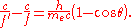
where is the initial wavelength,
 is the wavelength after scattering,
 is the Planck constant
, is the rest mass of the electron,
 is the speed of light
, and is the scattering angle.
The quantity is known as the Compton wavelength
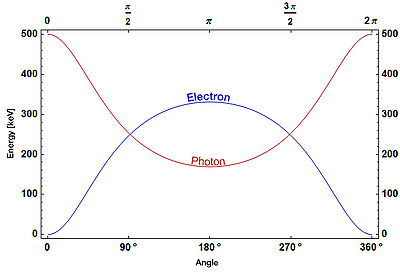
of the electron; it is equal to . The wavelength shift is at least zero (for ) and at most twice the Compton wavelength of the electron (for ).
Compton found that some X-rays experienced no wavelength shift despite being scattered through large angles; in each of these cases the photon failed to eject an electron. Thus the magnitude of the shift is related not to the Compton wavelength of the electron, but to the Compton wavelength of the entire atom, which can be upwards of 10 000 times smaller.
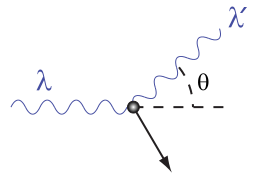
 with wavelength
  collides with an electron
  in an atom, which is treated as being at rest. The collision causes the electron to recoil, and a new photon
  with wavelength
  emerges at angle
  from the photon's incoming path. Let
  denote the electron after the collision. Compton allowed for the possibility that the interaction would sometimes accelerate the electron to speeds sufficiently close to the velocity of light to require the application of Einstein's special relativity
theory to properly describe its energy and momentum.
At the conclusion of Compton's 1923 paper, he reported results of experiments confirming the predictions of his scattering formula thus supporting the assumption that photons carry directed momentum as well as quantized energy. At the start of his derivation, he had postulated an expression for the momentum of a photon from equating Einstein's already established mass-energy relationship of to the quantized photon energies of
  which Einstein has separately postulated. If
  , the equivalent photon mass must be
  . The photon's momentum is then simply this effective mass times the photon's frame-invariant velocity
  . For photons,
  , and thus
  can be substituted for
  for all photon momentum terms which arise in course of the derivation below. The derivation which appears in Compton's paper is more terse, but follows the same logic in the same sequence as the following derivation.
The conservation of energy
 merely equates the sum of energies before and after scattering.
Compton postulated that photons carry momentum; thus from the conservation of momentum, the momenta of the particles should be similarly related by
The photon energies are related to the frequencies by

Before the scattering event, the electron is treated as sufficiently close to being at rest that its total energy consists entirely of the mass-energy equivalence of its rest mass :
:
After scattering, the possibility that the electron might be accelerated to a significant fraction of the speed of light, requires that its total energy be represented using the relativistic energy-momentum relation:
Expand the conservation of energy statement in terms of the foregoing.
Square both sides and isolate the (only) post-scattering electron term on the left.
 From the conservation of momentum,
Then by making use of the scalar product,
Anticipating that is replaceable with
  , multiply both sides by
  :
:
After replacing the photon momentum terms with , the foregoing becomes:
Now equating equations 1 and 2,

Then dividing both sides by yields
Since

, as it is the most probable interaction of gamma rays and high energy X rays with atoms in living beings and is applied in radiation therapy
.
In material physics, Compton scattering can be used to probe the wave function of the electrons in matter in the momentum representation.
Compton scattering is an important effect in gamma spectroscopy
which gives rise to the Compton edge
, as it is possible for the gamma rays to scatter out of the detectors used. Compton suppression
is used to detect stray scatter gamma rays to counteract this effect.
. In X-ray astronomy
, the accretion disc
surrounding a black hole
is believed to produce a thermal spectrum. The lower energy photons produced from this spectrum are scattered to higher energies by relativistic electrons in the surrounding corona
. This is believed to cause the power law component in the X-ray spectra (0.2-10 keV) of accreting black holes.
The effect is also observed when photons from the cosmic microwave background
move through the hot gas surrounding a galaxy cluster
. The CMB photons are scattered to higher energies by the electrons in this gas, resulting in the Sunyaev-Zel'dovich effect
. Observations of the Sunyaev-Zel'dovich effect provide a nearly redshift-independent means of detecting galaxy clusters.
Some synchrotron radiation facilities scatter laser light off the stored electron beam.
This Compton backscattering produces high energy photons in the MeV to GeV range subsequently used for nuclear physics experiments.
Physics
Physics is a natural science that involves the study of matter and its motion through spacetime, along with related concepts such as energy and force. More broadly, it is the general analysis of nature, conducted in order to understand how the universe behaves.Physics is one of the oldest academic...
, Compton scattering is a type of scattering
Scattering
Scattering is a general physical process where some forms of radiation, such as light, sound, or moving particles, are forced to deviate from a straight trajectory by one or more localized non-uniformities in the medium through which they pass. In conventional use, this also includes deviation of...
that X-ray
X-ray
X-radiation is a form of electromagnetic radiation. X-rays have a wavelength in the range of 0.01 to 10 nanometers, corresponding to frequencies in the range 30 petahertz to 30 exahertz and energies in the range 120 eV to 120 keV. They are shorter in wavelength than UV rays and longer than gamma...
s and gamma rays (both photons with different energy ranges) undergo in matter. The inelastic scattering
Inelastic scattering
In particle physics and chemistry, inelastic scattering is a fundamental scattering process in which the kinetic energy of an incident particle is not conserved . In an inelastic scattering process, some of the energy of the incident particle is lost or gained...
of photons in matter results in a decrease in energy
Energy
In physics, energy is an indirectly observed quantity. It is often understood as the ability a physical system has to do work on other physical systems...
(increase in wavelength
Wavelength
In physics, the wavelength of a sinusoidal wave is the spatial period of the wave—the distance over which the wave's shape repeats.It is usually determined by considering the distance between consecutive corresponding points of the same phase, such as crests, troughs, or zero crossings, and is a...
) of an X-ray or gamma ray
Gamma ray
Gamma radiation, also known as gamma rays or hyphenated as gamma-rays and denoted as γ, is electromagnetic radiation of high frequency . Gamma rays are usually naturally produced on Earth by decay of high energy states in atomic nuclei...
photon
Photon
In physics, a photon is an elementary particle, the quantum of the electromagnetic interaction and the basic unit of light and all other forms of electromagnetic radiation. It is also the force carrier for the electromagnetic force...
, called the Compton effect. Part of the energy of the X/gamma ray is transferred to a scattering electron, which recoils and is ejected from its atom (which becomes ionized), and the rest of the energy is taken by the scattered, "degraded" photon. Inverse Compton scattering also exists, in which a charged particle transfers part of its energy to a photon.
Introduction
Compton scattering is an example of inelastic scattering, because the wavelength of the scattered light is different from the incident radiation. Still, the origin of the effect can be considered as an elastic collision between a photon and an electron.The amount the wavelength changes by is called the Compton shift. Although nuclear Compton scattering exists, Compton scattering usually refers to the interaction involving only the electron
Electron
The electron is a subatomic particle with a negative elementary electric charge. It has no known components or substructure; in other words, it is generally thought to be an elementary particle. An electron has a mass that is approximately 1/1836 that of the proton...
s of an atom
Atom
The atom is a basic unit of matter that consists of a dense central nucleus surrounded by a cloud of negatively charged electrons. The atomic nucleus contains a mix of positively charged protons and electrically neutral neutrons...
. The Compton effect was observed by Arthur Holly Compton in 1923 at Washington University in St. Louis
Washington University in St. Louis
Washington University in St. Louis is a private research university located in suburban St. Louis, Missouri. Founded in 1853, and named for George Washington, the university has students and faculty from all fifty U.S. states and more than 110 nations...
and further verified by his graduate student Y. H. Woo
Wu Youxun
Wu Youxun or Y. H. Woo was a physical scientist. He had the courtesy name of Zhèngzhī .- Biography :Wu graduated from the Department of Physics of Nanjing Higher Normal School , and was later associated with the Department of Physics at Tsinghua University...
in the years following. Compton earned the 1927 Nobel Prize in Physics
Nobel Prize in Physics
The Nobel Prize in Physics is awarded once a year by the Royal Swedish Academy of Sciences. It is one of the five Nobel Prizes established by the will of Alfred Nobel in 1895 and awarded since 1901; the others are the Nobel Prize in Chemistry, Nobel Prize in Literature, Nobel Peace Prize, and...
for the discovery.
The effect is important because it demonstrates that light cannot be explained purely as a wave
Wave
In physics, a wave is a disturbance that travels through space and time, accompanied by the transfer of energy.Waves travel and the wave motion transfers energy from one point to another, often with no permanent displacement of the particles of the medium—that is, with little or no associated mass...
phenomenon. Thomson scattering
Thomson scattering
Thomson scattering is the elastic scattering of electromagnetic radiation by a free charged particle, as described by classical electromagnetism. It is just the low-energy limit of Compton scattering: the particle kinetic energy and photon frequency are the same before and after the scattering...
, the classical theory of an electromagnetic wave scattered by charged particles, cannot explain low intensity shifts in wavelength. (Classically, light of sufficient intensity for the electric field to accelerate a charged particle to a relativistic speed will cause radiation-pressure recoil and an associated Doppler shift of the scattered light, but the effect would become arbitrarily small at sufficiently low light intensities regardless of wavelength.) Light must behave as if it consists of particles to explain the low-intensity Compton scattering. Compton's experiment convinced physicists that light can behave as a stream of particle-like objects (quanta) whose energy is proportional to the frequency.
The interaction between electrons and high energy
Energy
In physics, energy is an indirectly observed quantity. It is often understood as the ability a physical system has to do work on other physical systems...
photons (comparable to the rest energy of the electron) results in the electron being given part of the energy (making it recoil), and a photon containing the remaining energy being emitted in a different direction from the original, so that the overall momentum
Momentum
In classical mechanics, linear momentum or translational momentum is the product of the mass and velocity of an object...
of the system is conserved. If the photon still has enough energy left, the process may be repeated. In this scenario, the electron is treated as free or loosely bound. Experimental verification of momentum conservation in individual Compton scattering processes by Bothe and Geiger as well as by Compton and Simon has been important in disproving the BKS theory
BKS theory
The Bohr-Kramers-Slater theory was perhaps the final attempt at understanding the interaction of matter and electromagnetic radiation on the basis of the so-called Old quantum theory, in which quantum phenomena are treated by imposing quantum restrictions on classically describable behaviour...
.
If the photon is of lower energy, but still has sufficient energy (in general a few eV to a few KeV, corresponding to visible light through soft X-rays), it can eject an electron from its host atom entirely (a process known as the photoelectric effect
Photoelectric effect
In the photoelectric effect, electrons are emitted from matter as a consequence of their absorption of energy from electromagnetic radiation of very short wavelength, such as visible or ultraviolet light. Electrons emitted in this manner may be referred to as photoelectrons...
), instead of undergoing Compton scattering. Higher energy photons ( and above) may be able to bombard the nucleus and cause an electron and a positron to be formed, a process called pair production
Pair production
Pair production refers to the creation of an elementary particle and its antiparticle, usually from a photon . For example an electron and its antiparticle, the positron, may be created...
.
Description of the phenomenon
By the early 20th century, research into the interaction of X-ray
X-ray
X-radiation is a form of electromagnetic radiation. X-rays have a wavelength in the range of 0.01 to 10 nanometers, corresponding to frequencies in the range 30 petahertz to 30 exahertz and energies in the range 120 eV to 120 keV. They are shorter in wavelength than UV rays and longer than gamma...
s with matter was well underway. It was observed that when X-rays of a known wavelength interact with atoms, the X-rays are scattered through an angle
and emerge at a different wavelength related to . Although Classical electromagnetismClassical electromagnetism
Classical electromagnetism is a branch of theoretical physics that studies consequences of the electromagnetic forces between electric charges and currents...
predicted that the wavelength of scattered rays should be equal to the initial wavelength;, multiple experiments had found that the wavelength of the scattered rays was greater than the initial wavelength.
In 1923, Compton published a paper in the Physical Review
Physical Review
Physical Review is an American scientific journal founded in 1893 by Edward Nichols. It publishes original research and scientific and literature reviews on all aspects of physics. It is published by the American Physical Society. The journal is in its third series, and is split in several...
which explained the X-ray shift by attributing particle-like momentum to “photons”
Photon
In physics, a photon is an elementary particle, the quantum of the electromagnetic interaction and the basic unit of light and all other forms of electromagnetic radiation. It is also the force carrier for the electromagnetic force...
which Einstein had conceptualized as elements of light “quantized” as containing a specific amount of energy depending only on the frequency of the light. In his paper, Compton derived the mathematical relationship between the shift in wavelength and the scattering angle of the X-rays by assuming that each scattered X-ray photon interacted with only one electron. His paper concludes by reporting on experiments which verified his derived relation:
where
is the initial wavelength, is the wavelength after scattering, is the Planck constantPlanck constant
The Planck constant , also called Planck's constant, is a physical constant reflecting the sizes of energy quanta in quantum mechanics. It is named after Max Planck, one of the founders of quantum theory, who discovered it in 1899...
,
is the rest mass of the electron, is the speed of lightSpeed of light
The speed of light in vacuum, usually denoted by c, is a physical constant important in many areas of physics. Its value is 299,792,458 metres per second, a figure that is exact since the length of the metre is defined from this constant and the international standard for time...
, and
is the scattering angle.The quantity is known as the Compton wavelength
Compton wavelength
The Compton wavelength is a quantum mechanical property of a particle. It was introduced by Arthur Compton in his explanation of the scattering of photons by electrons...
of the electron; it is equal to . The wavelength shift is at least zero (for ) and at most twice the Compton wavelength of the electron (for ).
Compton found that some X-rays experienced no wavelength shift despite being scattered through large angles; in each of these cases the photon failed to eject an electron. Thus the magnitude of the shift is related not to the Compton wavelength of the electron, but to the Compton wavelength of the entire atom, which can be upwards of 10 000 times smaller.
Derivation of the scattering formula
A photon with wavelength collides with an electron in an atom, which is treated as being at rest. The collision causes the electron to recoil, and a new photon with wavelength emerges at angle from the photon's incoming path. Let denote the electron after the collision. Compton allowed for the possibility that the interaction would sometimes accelerate the electron to speeds sufficiently close to the velocity of light to require the application of Einstein's special relativitySpecial relativity
Special relativity is the physical theory of measurement in an inertial frame of reference proposed in 1905 by Albert Einstein in the paper "On the Electrodynamics of Moving Bodies".It generalizes Galileo's...
theory to properly describe its energy and momentum.
At the conclusion of Compton's 1923 paper, he reported results of experiments confirming the predictions of his scattering formula thus supporting the assumption that photons carry directed momentum as well as quantized energy. At the start of his derivation, he had postulated an expression for the momentum of a photon from equating Einstein's already established mass-energy relationship of
to the quantized photon energies of which Einstein has separately postulated. If , the equivalent photon mass must be . The photon's momentum is then simply this effective mass times the photon's frame-invariant velocity . For photons, , and thus can be substituted for for all photon momentum terms which arise in course of the derivation below. The derivation which appears in Compton's paper is more terse, but follows the same logic in the same sequence as the following derivation.The conservation of energy
Conservation of energy
The nineteenth century law of conservation of energy is a law of physics. It states that the total amount of energy in an isolated system remains constant over time. The total energy is said to be conserved over time...
merely equates the sum of energies before and after scattering.Compton postulated that photons carry momentum; thus from the conservation of momentum, the momenta of the particles should be similarly related by
- in which (
 ) is omitted on the assumption it is effectively zero.
The photon energies are related to the frequencies by
- where h is Planck's constant.
Before the scattering event, the electron is treated as sufficiently close to being at rest that its total energy consists entirely of the mass-energy equivalence of its rest mass
:After scattering, the possibility that the electron might be accelerated to a significant fraction of the speed of light, requires that its total energy be represented using the relativistic energy-momentum relation:

Expand the conservation of energy statement in terms of the foregoing.
Square both sides and isolate the (only) post-scattering electron term on the left.
Then by making use of the scalar product,
Anticipating that
is replaceable with , multiply both sides by :After replacing the photon momentum terms with
, the foregoing becomes:

Now equating equations 1 and 2,
Then dividing both sides by yields
Since
Compton scattering
Compton scattering is of prime importance to radiobiologyRadiobiology
Radiobiology , as a field of clinical and basic medical sciences, originated from Leopold Freund's 1896 demonstration of the therapeutic treatment of a hairy mole using a new type of electromagnetic radiation called x-rays, which was discovered 1 year previously by the German physicist, Wilhelm...
, as it is the most probable interaction of gamma rays and high energy X rays with atoms in living beings and is applied in radiation therapy
Radiation therapy
Radiation therapy , radiation oncology, or radiotherapy , sometimes abbreviated to XRT or DXT, is the medical use of ionizing radiation, generally as part of cancer treatment to control malignant cells.Radiation therapy is commonly applied to the cancerous tumor because of its ability to control...
.
In material physics, Compton scattering can be used to probe the wave function of the electrons in matter in the momentum representation.
Compton scattering is an important effect in gamma spectroscopy
Gamma spectroscopy
Gamma-ray spectroscopy is the quantitative study of the energy spectra of gamma-ray sources, both nuclear laboratory, geochemical, and astrophysical. Gamma rays are the highest-energy form of electromagnetic radiation, being physically exactly like all other forms except for higher photon energy...
which gives rise to the Compton edge
Compton edge
In spectrophotometry, the Compton edge is a feature of the spectrograph that results from the Compton scattering in the scintillator or detector. When a gamma-ray scatters off the scintillator but escapes, only a fraction of its energy is registered by the detector. This leads to a spectrum of...
, as it is possible for the gamma rays to scatter out of the detectors used. Compton suppression
Compton suppression
Electronic anticoincidence is a method widely used to suppress unwanted, "background" events in high energy physics, experimental particle physics, gamma-ray spectroscopy, gamma-ray astronomy, experimental nuclear physics, and related fields...
is used to detect stray scatter gamma rays to counteract this effect.
Inverse Compton scattering
Inverse Compton scattering is important in astrophysicsAstrophysics
Astrophysics is the branch of astronomy that deals with the physics of the universe, including the physical properties of celestial objects, as well as their interactions and behavior...
. In X-ray astronomy
X-ray astronomy
X-ray astronomy is an observational branch of astronomy which deals with the study of X-ray observation and detection from astronomical objects. X-radiation is absorbed by the Earth's atmosphere, so instruments to detect X-rays must be taken to high altitude by balloons, sounding rockets, and...
, the accretion disc
Accretion disc
An accretion disc is a structure formed by diffuse material in orbital motion around a central body. The central body is typically a star. Gravity causes material in the disc to spiral inward towards the central body. Gravitational forces compress the material causing the emission of...
surrounding a black hole
Black hole
A black hole is a region of spacetime from which nothing, not even light, can escape. The theory of general relativity predicts that a sufficiently compact mass will deform spacetime to form a black hole. Around a black hole there is a mathematically defined surface called an event horizon that...
is believed to produce a thermal spectrum. The lower energy photons produced from this spectrum are scattered to higher energies by relativistic electrons in the surrounding corona
Corona
A corona is a type of plasma "atmosphere" of the Sun or other celestial body, extending millions of kilometers into space, most easily seen during a total solar eclipse, but also observable in a coronagraph...
. This is believed to cause the power law component in the X-ray spectra (0.2-10 keV) of accreting black holes.
The effect is also observed when photons from the cosmic microwave background
Cosmic microwave background radiation
In cosmology, cosmic microwave background radiation is thermal radiation filling the observable universe almost uniformly....
move through the hot gas surrounding a galaxy cluster
Galaxy cluster
A galaxy cluster is a compact cluster of galaxies. Basic difference between a galaxy group and a galaxy cluster is that there are many more galaxies in a cluster than in a group. Also, galaxies in a cluster are more compact and have higher velocity dispersion. One of the key features of cluster is...
. The CMB photons are scattered to higher energies by the electrons in this gas, resulting in the Sunyaev-Zel'dovich effect
Sunyaev-Zel'dovich effect
The Sunyaev–Zel'dovich effect is the result of high energy electrons distorting the cosmic microwave background radiation through inverse Compton scattering, in which the low energy CMB photons receive energy boost during collision with the high energy cluster electrons...
. Observations of the Sunyaev-Zel'dovich effect provide a nearly redshift-independent means of detecting galaxy clusters.
Some synchrotron radiation facilities scatter laser light off the stored electron beam.
This Compton backscattering produces high energy photons in the MeV to GeV range subsequently used for nuclear physics experiments.
See also
- List of astronomical topics
- List of physics topics
- Compton Gamma Ray ObservatoryCompton Gamma Ray ObservatoryThe Compton Gamma Ray Observatory was a space observatory detecting light from 20 KeV to 30 GeV in Earth orbit from 1991 to 2000. It featured four main telescopes in one spacecraft covering x-rays and gamma-rays, including various specialized sub-instruments and detectors...
- Klein–Nishina formula
- Pair productionPair productionPair production refers to the creation of an elementary particle and its antiparticle, usually from a photon . For example an electron and its antiparticle, the positron, may be created...
- Peter DebyePeter DebyePeter Joseph William Debye FRS was a Dutch physicist and physical chemist, and Nobel laureate in Chemistry.-Early life:...
- Photoelectric effectPhotoelectric effectIn the photoelectric effect, electrons are emitted from matter as a consequence of their absorption of energy from electromagnetic radiation of very short wavelength, such as visible or ultraviolet light. Electrons emitted in this manner may be referred to as photoelectrons...
- Thomson scatteringThomson scatteringThomson scattering is the elastic scattering of electromagnetic radiation by a free charged particle, as described by classical electromagnetism. It is just the low-energy limit of Compton scattering: the particle kinetic energy and photon frequency are the same before and after the scattering...
- Timeline of cosmic microwave background astronomyTimeline of cosmic microwave background astronomy-Thermal temperature predictions:* 1896 - Charles Edouard Guillaume estimates the "radiation of the stars" to be 5.6K.* 1926 - Sir Arthur Eddington estimates the non-thermal radiation of starlight in the galaxy ".. by the formula E = σT4 the effective temperature corresponding to this density is...
- Walther BotheWalther BotheWalther Wilhelm Georg Bothe was a German nuclear physicist, who shared the Nobel Prize in Physics in 1954 with Max Born....
External links
- Compton Scattering - Georgia State University
- Compton Scattering Data - Georgia State University