


Compressed natural gas

Encyclopedia

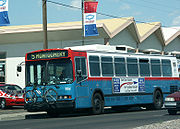
Fossil fuel
Fossil fuels are fuels formed by natural processes such as anaerobic decomposition of buried dead organisms. The age of the organisms and their resulting fossil fuels is typically millions of years, and sometimes exceeds 650 million years...
substitute for gasoline
Gasoline
Gasoline , or petrol , is a toxic, translucent, petroleum-derived liquid that is primarily used as a fuel in internal combustion engines. It consists mostly of organic compounds obtained by the fractional distillation of petroleum, enhanced with a variety of additives. Some gasolines also contain...
(petrol), diesel, or propane
Propane
Propane is a three-carbon alkane with the molecular formula , normally a gas, but compressible to a transportable liquid. A by-product of natural gas processing and petroleum refining, it is commonly used as a fuel for engines, oxy-gas torches, barbecues, portable stoves, and residential central...
/LPG. Although its combustion does produce greenhouse gas
Greenhouse gas
A greenhouse gas is a gas in an atmosphere that absorbs and emits radiation within the thermal infrared range. This process is the fundamental cause of the greenhouse effect. The primary greenhouse gases in the Earth's atmosphere are water vapor, carbon dioxide, methane, nitrous oxide, and ozone...
es, it is a more environmentally clean alternative to those fuels, and it is much safer than other fuels in the event of a spill (natural gas is lighter than air, and disperses quickly when released). CNG may also be mixed with biogas
Biogas
Biogas typically refers to a gas produced by the biological breakdown of organic matter in the absence of oxygen. Organic waste such as dead plant and animal material, animal dung, and kitchen waste can be converted into a gaseous fuel called biogas...
, produced from landfill
Landfill
A landfill site , is a site for the disposal of waste materials by burial and is the oldest form of waste treatment...
s or wastewater
Wastewater
Wastewater is any water that has been adversely affected in quality by anthropogenic influence. It comprises liquid waste discharged by domestic residences, commercial properties, industry, and/or agriculture and can encompass a wide range of potential contaminants and concentrations...
, which doesn't increase the concentration of carbon in the atmosphere.
CNG is made by compressing natural gas
Natural gas
Natural gas is a naturally occurring gas mixture consisting primarily of methane, typically with 0–20% higher hydrocarbons . It is found associated with other hydrocarbon fuel, in coal beds, as methane clathrates, and is an important fuel source and a major feedstock for fertilizers.Most natural...
(which is mainly composed of methane
Methane
Methane is a chemical compound with the chemical formula . It is the simplest alkane, the principal component of natural gas, and probably the most abundant organic compound on earth. The relative abundance of methane makes it an attractive fuel...
[CH4]), to less than 1% of the volume it occupies at standard atmospheric pressure. It is stored and distributed in hard containers at a pressure of 200–248 bar
Bar (unit)
The bar is a unit of pressure equal to 100 kilopascals, and roughly equal to the atmospheric pressure on Earth at sea level. Other units derived from the bar are the megabar , kilobar , decibar , centibar , and millibar...
(2900–3600 psi), usually in cylindrical or spherical shapes.
CNG is used in traditional gasoline internal combustion engine
Internal combustion engine
The internal combustion engine is an engine in which the combustion of a fuel occurs with an oxidizer in a combustion chamber. In an internal combustion engine, the expansion of the high-temperature and high -pressure gases produced by combustion apply direct force to some component of the engine...
cars that have been converted into bi-fuel vehicle
Bi-fuel vehicle
Bi-fuel vehicles are vehicles with multifuel engines capable of running on two fuels. On internal combustion engines one fuel is gasoline or diesel, and the other is an alternate fuel such as natural gas , LPG, or hydrogen...
s (gasoline/CNG). Natural gas vehicle
Natural gas vehicle
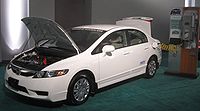
thumb|right|200px|2009 [[Honda Civic GX]] hooked up to Phill refueling system.A natural gas vehicle or NGV is an alternative fuel vehicle that uses compressed natural gas or liquefied natural gas as a clean alternative to other fossil fuels...
s are increasingly used in the Asia-Pacific
Asia-Pacific
Asia-Pacific or Asia Pacific is the part of the world in or near the Western Pacific Ocean...
region, Latin America
Latin America
Latin America is a region of the Americas where Romance languages – particularly Spanish and Portuguese, and variably French – are primarily spoken. Latin America has an area of approximately 21,069,500 km² , almost 3.9% of the Earth's surface or 14.1% of its land surface area...
, Europe
Europe
Europe is, by convention, one of the world's seven continents. Comprising the westernmost peninsula of Eurasia, Europe is generally 'divided' from Asia to its east by the watershed divides of the Ural and Caucasus Mountains, the Ural River, the Caspian and Black Seas, and the waterways connecting...
, and America due to rising gasoline prices.
In response to high fuel prices and environmental concerns, CNG is starting to be used also in tuk-tuks and pickup truck
Pickup truck
A pickup truck is a light motor vehicle with an open-top rear cargo area .-Definition:...
s, transit
Transit bus
A transit bus , also known as a commuter bus, city bus, or public bus, is a bus used for short-distance public transport purposes...
and school bus
School bus
A school bus is a type of bus designed and manufactured for student transport: carrying children and teenagers to and from school and school events...
es, and train
Train
A train is a connected series of vehicles for rail transport that move along a track to transport cargo or passengers from one place to another place. The track usually consists of two rails, but might also be a monorail or maglev guideway.Propulsion for the train is provided by a separate...
s.
CNG's volumetric energy density
Energy density
Energy density is a term used for the amount of energy stored in a given system or region of space per unit volume. Often only the useful or extractable energy is quantified, which is to say that chemically inaccessible energy such as rest mass energy is ignored...
is estimated to be 42% of liquefied natural gas
Liquefied natural gas
Liquefied natural gas or LNG is natural gas that has been converted temporarily to liquid form for ease of storage or transport....
's (because it is not liquefied), and 25% of diesel's.
Cars
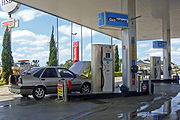
Worldwide, there were 12.6 million natural gas vehicles by 2010, up 11.6% over the previous year, led by Pakistan
Pakistan
Pakistan , officially the Islamic Republic of Pakistan is a sovereign state in South Asia. It has a coastline along the Arabian Sea and the Gulf of Oman in the south and is bordered by Afghanistan and Iran in the west, India in the east and China in the far northeast. In the north, Tajikistan...
with 2.74 million, Iran
Iran
Iran , officially the Islamic Republic of Iran , is a country in Southern and Western Asia. The name "Iran" has been in use natively since the Sassanian era and came into use internationally in 1935, before which the country was known to the Western world as Persia...
(1.95 million), Argentina
Argentina
Argentina , officially the Argentine Republic , is the second largest country in South America by land area, after Brazil. It is constituted as a federation of 23 provinces and an autonomous city, Buenos Aires...
(1.9 million), Brazil
Brazil
Brazil , officially the Federative Republic of Brazil , is the largest country in South America. It is the world's fifth largest country, both by geographical area and by population with over 192 million people...
(1.6 million), and India
India
India , officially the Republic of India , is a country in South Asia. It is the seventh-largest country by geographical area, the second-most populous country with over 1.2 billion people, and the most populous democracy in the world...
(1.1 million). with the Asia-Pacific region leading with 5.7 million NGVs, followed by Latin America with almost 4 million vehicles.
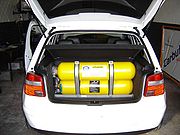
CNG cars available in Europe are bi-fuel vehicles burning one fuel at a time. Their engine is a standard gasoline internal combustion engine (ICE). This means that they can indifferently run on either gasoline from a gasoline tank or CNG from a separate cylinder
Gas cylinder
A gas cylinder is a pressure vessel used to store gases at above atmospheric pressure. High pressure gas cylinders are also called bottles. Although they are sometimes colloquially called "tanks", this is technically incorrect, as a tank is a vessel used to store liquids at ambient pressure and...
in the trunk. The driver can select what fuel to burn by simply flipping a switch on the dashboard.
Several manufacturers (Fiat, Opel (General Motors), Peugeot, Volkswagen, Toyota, Honda and others) sell bi-fuel cars. In 2006, Fiat introduced the Siena Tetrafuel in the Brazilian market, equipped with a 1.4L FIRE engine that runs on E100, E25 (Standard Brazilian Gasoline), Gasoline and CNG.
Any existing gasoline vehicle can be converted to a bi-fuel (gasoline/CNG) vehicle. Authorized shops can do the retrofitting, this involves installing a CNG cylinder in the trunk, installing the plumbing, installing a CNG injection system and the electronics.
Locomotives
CNG locomotives are operated by several railroads. The Napa Valley Wine TrainNapa Valley Wine Train
The Napa Valley Wine Train is operated by the Napa Valley Railroad . The train is a privately operated excursion train that runs between Napa and St. Helena, California. Much of the rail line parallels State Route 29 after leaving the City of Napa and passes the towns of Yountville, Rutherford and...
successfully retrofit a diesel locomotive to run on compressed natural gas before 2002. This converted locomotive was upgraded to utilize a computer controlled fuel injection system in May 2008, and is now the Napa Valley Wine Train's primary locomotive. Ferrocarril Central Andino
Ferrocarril Central Andino
Ferrocarril Central Andino is the consortium which operates the Ferrovías Central railway in Peru linking the Pacific port of Callao and the capital Lima with Huancayo and Cerro de Pasco...
in Peru, has run a CNG Locomotive on a freight line since 2005 CNG locomotives are usually diesel locomotives that have been converted to use compressed natural gas generators instead of diesel generators to generate the electricity that drives the motors of the train. Some CNG locomotives are able to fire their cylinders only when there is a demand for power, which, theoretically, gives them a higher fuel efficiency than conventional diesel engines.
CNG is also cheaper than petrol or diesel.
Advantages
1. Due to the absence of any lead or benzene content in CNG, the lead fouling of spark plugs is eliminated.2. CNG-powered vehicles have lower maintenance costs when compared with other fuel-powered vehicles.
3. CNG fuel systems are sealed, which prevents any spill or evaporation losses.
4. Increased life of lubricating oils, as CNG does not contaminate and dilute the crankcase oil.
5. CNG mixes easily and evenly in air being a gaseous fuel.
6. CNG is less likely to auto-ignite on hot surfaces, since it has a high auto-ignition temperature (540 °C) and a narrow range (5%-15%) of flammability
Flammability
Flammability is defined as how easily something will burn or ignite, causing fire or combustion. The degree of difficulty required to cause the combustion of a substance is quantified through fire testing. Internationally, a variety of test protocols exist to quantify flammability...
.
7. Less pollution and more efficiency: CNG emits significantly less pollutants such as carbon dioxide
Carbon dioxide
Carbon dioxide is a naturally occurring chemical compound composed of two oxygen atoms covalently bonded to a single carbon atom...
, unburned hydrocarbon
Unburned hydrocarbon
Unburned hydrocarbons are the hydrocarbons emitted after petroleum is burned in an engine.Any fuel entering a flame will be reacted. Thus, when unburned fuel is emitted from a combustor, the emission is caused by fuel "avoiding" the flame zones...
s (UHC), carbon monoxide
Carbon monoxide
Carbon monoxide , also called carbonous oxide, is a colorless, odorless, and tasteless gas that is slightly lighter than air. It is highly toxic to humans and animals in higher quantities, although it is also produced in normal animal metabolism in low quantities, and is thought to have some normal...
(CO), nitrogen oxide
Nitrogen oxide
Nitrogen oxide can refer to a binary compound of oxygen and nitrogen, or a mixture of such compounds:* Nitric oxide, also known as nitrogen monoxide, , nitrogen oxide* Nitrogen dioxide , nitrogen oxide...
s (NOx), sulfur oxide
Sulfur oxide
Sulfur oxide refers to one or more of the following:* Lower sulfur oxides * Sulfur monoxide * Sulfur dioxide * Sulfur trioxide *Higher sulfur oxides Sulfur oxide (SOx) refers to one or more of the following:* Lower sulfur oxides (SnO, S7O2 and S6O2)* Sulfur monoxide (SO)* Sulfur dioxide (SO2)*...
s (SOx) and particulate matter (PM), compared to petrol. For example, an engine running on petrol for 100 km emits 22,000 grams of , while covering the same distance on CNG emits only 16,275 grams of . CNG is essentially methane, i.e. CH4 with a calorific value of 900 kJ/mol. This burns with oxygen to produce 1 mol of CO2 and 2 mol of H2O. By comparison, petrol can be regarded as essentially benzene or similar, C6H6 with a calorific value of about 3,300 kJ/mol and this burns to produce 6 mol of CO2 and 3 mol of H2O. From this it can be seen that per mol of CO2 produced, CNG releases over 1.6 times as much energy as that released from petrol (or for the same amount of energy, CNG produces nearly 40% less CO2).]
The corresponding figures are 78 and 25.8 grams respectively, for nitrogen oxides. Carbon monoxide emissions are reduced even further. Due to lower carbon dioxide and nitrogen oxides emissions, switching to CNG can help mitigate greenhouse gas emissions. The ability of CNG to reduce greenhouse gas emissions over the entire fuel lifecycle will depend on the source of the natural gas and the fuel it is replacing. The lifecycle
Life cycle assessment
A life-cycle assessment is a technique to assess environmental impacts associated with all the stages of a product's life from-cradle-to-grave A life-cycle assessment (LCA, also known as life-cycle analysis, ecobalance, and cradle-to-grave analysis) is a technique to assess environmental impacts...
greenhouse gas emissions for CNG compressed from California's pipeline natural gas is given a value of 67.70 grams of -equivalent
Carbon dioxide equivalent
Carbon dioxide equivalent and Equivalent carbon dioxide are two related but distinct measures for describing how much global warming a given type and amount of greenhouse gas may cause, using the functionally equivalent amount or concentration of carbon dioxide as the reference.- Global warming...
per megajoule (gCO2e/MJ) by the California Air Resources Board
California Air Resources Board
The California Air Resources Board, also known as CARB or ARB, is the "clean air agency" in the government of California. Established in 1967 in the Mulford-Carrell Act, combining the Bureau of Air Sanitation and the Motor Vehicle Pollution Control Board, CARB is a department within the...
(CARB), approximately 28% lower than the average gasoline fuel in that market (95.86 gCO2e/MJ). CNG produced from landfill biogas was found by CARB to have the lowest greenhouse gas emissions of any fuel analyzed, with a value of 11.26 gCO2e/MJ (over 88% lower than conventional gasoline) in the low-carbon fuel standard
Low-carbon fuel standard
A low-carbon fuel standard is a rule enacted to reduce carbon intensity in transportation fuels as compared to conventional petroleum fuels, such as gasoline and diesel. The most common low-carbon fuels are alternative fuels and cleaner fossil fuels, such as natural gas...
that went into effect on January 12, 2010.
Drawbacks
Fiat Multipla
The Fiat Multipla is a compact MPV manufactured by Italian automaker Fiat since 1998. Based on the Brava, the Multipla is shorter and wider than its rivals. It has two rows of three seats, while all its competitors have two seats in the front...
, New Fiat Panda
Fiat Panda
The Fiat Panda is a city car from the Italian automobile manufacturer Fiat. The first Fiat Panda was introduced in 1980, and was produced until 2003 with only a few changes. It is now sometimes referred to as the "old Panda". The second model, launched in 2003, is sometimes referred to "New Panda"...
, Volkswagen Touran
Volkswagen Touran
The Volkswagen Touran is a compact MPV based on a vertically-stretched fifth generation Volkswagen Golf Mk5, and sold in Europe and other select markets. It was launched in 2003 to fill a gap in Volkswagen's model lineup, below the Sharan large MPV...
Ecofuel, Volkswagen Caddy
Volkswagen Caddy
Released in 1980, the first Volkswagen Caddy is a coupe utility, and van based on the Volkswagen Group A1 platform, shared with the small family car Volkswagen Golf Mk1.Volkswagen Typ is:*147 = LHD*148 = RHD-Caddy debuts internationally as a Rabbit:...
Ecofuel, Chevy Taxi - which sold in countries such as Peru). Another option is installation on roof (typical on buses), requiring, however, solution of structural strength issues. CNG-powered vehicles are considered to be safer than gasoline-powered vehicles.
CNG compared to LNG
CNG is often confused with liquefied natural gasLiquefied natural gas
Liquefied natural gas or LNG is natural gas that has been converted temporarily to liquid form for ease of storage or transport....
(LNG). While both are stored forms of natural gas, the key difference is that CNG is gas
Gas
Gas is one of the three classical states of matter . Near absolute zero, a substance exists as a solid. As heat is added to this substance it melts into a liquid at its melting point , boils into a gas at its boiling point, and if heated high enough would enter a plasma state in which the electrons...
that is stored (as a gas) at high pressure, while LNG is in uncompressed liquid
Liquid
Liquid is one of the three classical states of matter . Like a gas, a liquid is able to flow and take the shape of a container. Some liquids resist compression, while others can be compressed. Unlike a gas, a liquid does not disperse to fill every space of a container, and maintains a fairly...
form. CNG has a lower cost of production and storage compared to LNG as it does not require an expensive cooling process and cryogenic tanks. CNG requires a much larger volume to store the same mass of gasoline or petrol and the use of very high pressures (3000 to 4000 psi, or 205 to 275 bar). As a consequence of this, LNG is often used for transporting natural gas over large distances, in ships, trains or pipelines, and the gas is then converted into CNG before distribution to the end user.
CNG can be stored at lower pressure in a form known as an ANG (Adsorbed Natural Gas) tank, at 35 bar (500 psi, the pressure of gas in natural gas pipelines) in various sponge like materials, such as activated carbon
Activated carbon
Activated carbon, also called activated charcoal, activated coal or carbo activatus, is a form of carbon that has been processed to make it extremely porous and thus to have a very large surface area available for adsorption or chemical reactions.The word activated in the name is sometimes replaced...
and metal-organic framework
Metal-organic framework
Metal-Organic Frameworks are crystalline compounds consisting of metal ions or clusters coordinated to often rigid organic molecules to form one-, two-, or three-dimensional structures that can be porous. In some cases, the pores are stable to elimination of the guest molecules and can be used for...
s (MOFs). The fuel is stored at similar or greater energy density than CNG. This means that vehicles can be refuelled from the natural gas network without extra gas compression, the fuel tanks can be slimmed down and made of lighter, less strong materials.
South Asia
PakistanPakistan
Pakistan , officially the Islamic Republic of Pakistan is a sovereign state in South Asia. It has a coastline along the Arabian Sea and the Gulf of Oman in the south and is bordered by Afghanistan and Iran in the west, India in the east and China in the far northeast. In the north, Tajikistan...
currently has the highest number of vehicles running on CNG in the world followed by Iran, Argentina, Brazil. Pakistan also has the highest number of CNG stations in the world numbering more than 3600. Majority of private vehicles have converted to CNG because of cheaper price as compared to petrol. Only luxury cars and official vehicles now run on petrol. Recently, new CNG Buses had been introduced by CDGK in Karachi. Almost all car manufacturers in Pakistan (except Honda) now produce company fitted CNG kit versions. Recent hikes in CNG prices have downplayed the ambitious ventures of some of the stakeholders in this sector. It is expected that price of the CNG and Kits will come down as competition among manufacturers grows. LandiRenzo Pakistan is also exporting CNG kits to various countries including China, Brazil and Italy. Almost 2.5 million vehicles on the country's roads have dual fuel options with Suzuki having the highest in quantity.
CNG has grown into one of the major fuel sources used in car engines in Bangladesh
Bangladesh
Bangladesh , officially the People's Republic of Bangladesh is a sovereign state located in South Asia. It is bordered by India on all sides except for a small border with Burma to the far southeast and by the Bay of Bengal to the south...
as well. Many rickshaws
Auto rickshaw
An auto rickshaw or three-wheeler is a usually three-wheeled cabin cycle for private use and as a vehicle for hire. It is a motorized version of the traditional pulled rickshaw or cycle rickshaw...
as well as personal vehicles in Bangladesh are being converted to CNG powered technology, the cost of which is in the range of $800–$1000. In the Bangladesh capital of Dhaka not a single auto rickshaw without CNG has been permitted since 2003.
In 1998, the Supreme Court of India
Supreme Court of India
The Supreme Court of India is the highest judicial forum and final court of appeal as established by Part V, Chapter IV of the Constitution of India...
ordered all public transport vehicles of Delhi to use CNG as fuel instead of diesel and other hydro-carbons to reduce pollution levels in the city. As of 2011, the state-owned Delhi Transport Corporation
Delhi Transport Corporation
Delhi Transport Corporation is the main public transport operator of Delhi. It operates buses on many bus routes, including the mudrika and Bahri Mudrika . It is the largest CNG-powered bus service operator in the world. DTC is operating Interstate Services in 6 states viz...
(DTC) is the world's largest operator of environment-friendly CNG buses. The use of CNG is also mandatory for the public transport system in Ahmedabad
Ahmedabad
Ahmedabad also known as Karnavati is the largest city in Gujarat, India. It is the former capital of Gujarat and is also the judicial capital of Gujarat as the Gujarat High Court has its seat in Ahmedabad...
, Gujarat.
In India, CNG costs are at Rs 31.50 per kg compared with Rs. 75.00 per liter of petrol(prices as of October 2011 in Bangalore, India). In Thailand, CNG costs are at Thb 10.4 per kg (US$0.35) per kg compared with Thb 40.00 (US$1.35) per liter of petrol (prices as of March 2011 in Bangkok, Thailand). CNG is quite notable at a cost savings of 60% along with reduced emissions and its usability by environmentally friendlier cars.
South America
South America
South America is a continent situated in the Western Hemisphere, mostly in the Southern Hemisphere, with a relatively small portion in the Northern Hemisphere. The continent is also considered a subcontinent of the Americas. It is bordered on the west by the Pacific Ocean and on the north and east...
, where these vehicles are mainly used as taxicabs in main cities of Argentina and Brazil. Normally, standard gasoline vehicles are retrofitted in specialized shops, which involve installing the gas cylinder in the trunk and the CNG injection system and electronics. Argentina and Brazil are the two countries with the largest fleets of CNG vehicles, with a combined total fleet of more than 3.4 million vehicles by 2009. Conversion has been facilitated by a substantial price differential with liquid fuels, locally produced conversion equipment and a growing CNG-delivery infrastructure.
As of 2009 Argentina had 1,807,186 NGV's with 1,851 refueling stations across the nation, or 15% of all vehicles; and Brazil had 1,632,101 vehicles and 1,704 refueling stations, with a higher concentration in the cities of Rio de Janeiro
Rio de Janeiro
Rio de Janeiro , commonly referred to simply as Rio, is the capital city of the State of Rio de Janeiro, the second largest city of Brazil, and the third largest metropolitan area and agglomeration in South America, boasting approximately 6.3 million people within the city proper, making it the 6th...
and São Paulo
São Paulo
São Paulo is the largest city in Brazil, the largest city in the southern hemisphere and South America, and the world's seventh largest city by population. The metropolis is anchor to the São Paulo metropolitan area, ranked as the second-most populous metropolitan area in the Americas and among...
.
Colombia
Colombia
Colombia, officially the Republic of Colombia , is a unitary constitutional republic comprising thirty-two departments. The country is located in northwestern South America, bordered to the east by Venezuela and Brazil; to the south by Ecuador and Peru; to the north by the Caribbean Sea; to the...
had an NGV fleet of 300,000 vehicles, and 460 refueling stations as of 2009. Bolivia
Bolivia
Bolivia officially known as Plurinational State of Bolivia , is a landlocked country in central South America. It is the poorest country in South America...
has increased its fleet from 10,000 in 2003 to 121,908 units in 2009, with 128 refueling stations. Peru
Peru
Peru , officially the Republic of Peru , is a country in western South America. It is bordered on the north by Ecuador and Colombia, on the east by Brazil, on the southeast by Bolivia, on the south by Chile, and on the west by the Pacific Ocean....
had 81,024 NGVs and 94 fueling stations as 2009, but that number is expected to skyrocket as Peru sits on South America's largest gas reserves. In Peru several factory-built NGVs have the tanks installed under the body of the vehicle, leaving the trunk free. Among the models built with this feature are the Fiat Multipla, the newFiat Panda, the Volkswagen Touran Ecofuel, the Volkswagen Caddy Ecofuel, and the Chevy Taxi. Other countries with significant NGV fleets are Venezuela
Venezuela
Venezuela , officially called the Bolivarian Republic of Venezuela , is a tropical country on the northern coast of South America. It borders Colombia to the west, Guyana to the east, and Brazil to the south...
(15,000) and Chile
Chile
Chile ,officially the Republic of Chile , is a country in South America occupying a long, narrow coastal strip between the Andes mountains to the east and the Pacific Ocean to the west. It borders Peru to the north, Bolivia to the northeast, Argentina to the east, and the Drake Passage in the far...
(8,064) as of 2009.
South-East Asia
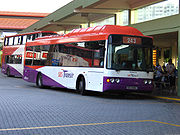
Singapore currently has five operating filling stations for natural gas. SembCorp Gas Pte Ltd runs the station on Jurong Island, and jointly with Singapore Petroleum Company
Singapore Petroleum Company
Singapore Petroleum Company Limited is a Singaporean oil company. SPC is involved in the exploration and production of petroleum, refining, trading and petroleum product distribution.- History :...
, the filling station at Jalan Buroh. Both these stations are in the western part of the country. Another station on the mainland is in Mandai Link to the north and is operated by SMART Energy. SMART also own a second station on Serangoon North Ave 5 which was set up end of March 2009; The fifth and largest station in the world was opened by the UNION Group in September 2009. This station is recognized by the Guniness World Records as being the laregst in the world with 46 refuelling hoses. This station is located in Toh Tuck. The Union Group, which operates 1000 CNG Toyota Wish taxis plan to introduce another three daughter stations and increase the CNG taxi fleet to 8000 units.
As a key incentive for using this eco-friendly fuel Singapore has a Green Vehicle Rebate (GVR) for users of CNG technology. First introduced in January 2001, the GVR grants a 40% discount on the Open Market Value (OMV) cost of newly registered green passenger vehicles. This initiative will end at the end of 2012 as the government believes the 'critical mass' of CNG vehicles would then have been built up.
The Ministry of Transport of Myanmar
Myanmar
Burma , officially the Republic of the Union of Myanmar , is a country in Southeast Asia. Burma is bordered by China on the northeast, Laos on the east, Thailand on the southeast, Bangladesh on the west, India on the northwest, the Bay of Bengal to the southwest, and the Andaman Sea on the south....
passed a law in 2005 which required that all public transport vehicles - buses, trucks and taxis, be converted to run on CNG. The Government permitted several private companies to handle the conversion of existing diesel and petrol cars, and also to begin importing CNG variants of buses and taxis. Accidents and rumours of accidents, partly fueled by Myanmar's position in local hydrocarbon politics, has discouraged citizens from using CNG vehicles, although now almost every taxi and public bus in Yangon, Myanmar's largest city, run on CNG. CNG stations have been set up around Yangon and other cities, but electricity shortages mean that vehicles may have to queue up for hours to fill their gas containers. The Burmese opposition movements are against the conversion to CNG, as they accuse the companies as being proxies of the junta, and also that the petrodollars earned by the regime would go towards the defense sector, rather than towards improving the infrastructure or welfare of the people.
In Malaysia, the use of CNG was originally introduced for taxicabs and airport limousines during the late-1990s, when new taxis were launched with CNG engines while taxicab operators were encouraged to send in existing taxis for full engine conversions. The practice of using CNG remained largely confined to taxicabs predominantly in the Klang Valley
Klang Valley
Klang Valley is an area in Malaysia comprising Kuala Lumpur and its suburbs, and adjoining cities and towns in the state of Selangor. An alternative reference to this would be Kuala Lumpur Metropolitan Area or Greater Kuala Lumpur. It is geographically delineated by Titiwangsa Mountains to the...
and Penang
Penang
Penang is a state in Malaysia and the name of its constituent island, located on the northwest coast of Peninsular Malaysia by the Strait of Malacca. It is bordered by Kedah in the north and east, and Perak in the south. Penang is the second smallest Malaysian state in area after Perlis, and the...
due to a lack of interest. No incentives were offered for those besides taxicab owners to use CNG engines, while government subsidies on petrol and diesel made conventional road vehicles cheaper to use in the eyes of the consumers. Petronas
Petronas
PETRONAS, short for Petroliam Nasional Berhad, is a Malaysian oil and gas company that was founded on August 17, 1974. Wholly owned by the Government of Malaysia, the corporation is vested with the entire oil and gas resources in Malaysia and is entrusted with the responsibility of developing and...
, Malaysia's state-owned oil company, also monopolises the provision of CNG to road users. As of July 2008, Petronas only operates about 150 CNG refueling stations, most of which are concentrated in the Klang Valley. At the same time, another 50 was expected by the end of 2008.
As fuel subsidies were gradually removed in Malaysia starting June 5, 2008, the subsequent 41% price hike on petrol and diesel led to a 500% increase in the number of new CNG tanks installed. National car maker Proton considered fitting its Waja
Proton Waja
The Proton Waja is a saloon car designed in-house by Malaysian automotive company, Proton, first released in August 2000. The Waja is the first Malaysian-designed car. The name Waja, which means "the king", meaning it is the "king" of all of the previous models. The name was chosen partly to...
, Saga
Proton Saga
- Saga :The Proton Saga was launched in September 1985 by Malaysia's then Prime Minister, Mahathir bin Mohamad. Before the production of Proton Saga, a contest was held to choose the name of the first national car, and the name Saga was chosen from the winner of the contest, Ismail Jaafar, a...
and Persona
Proton Persona
The Proton Persona is a compact car introduced by Proton in 2007 for the same model year. Being an in-house design by Azlan Othman, the Persona replaced the saloon variant of the successful Proton Wira, whose export name is not confused with this model's same name, as Proton's compact car.It is...
models with CNG kits from Prins Autogassystemen by the end of 2008, while a local distributor of locally assembled Hyundai
Hyundai Motor Company
Hyundai Motor Company is a Korean multinational automaker based in Seoul, South Korea which, along with Kia, comprises the Hyundai Kia Automotive Group, the world's fourth largest automaker as of 2009. As of 2011, it is the world's fastest growing automaker for two years running...
cars offers new models with CNG kits. Conversion centres, which also benefited from the rush for lower running costs, also perform partial conversions to existing road vehicles, allowing them to run on both petrol or diesel and CNG with a cost varying between RM3,500 to RM5,000 for passenger cars.
In China
China
Chinese civilization may refer to:* China for more general discussion of the country.* Chinese culture* Greater China, the transnational community of ethnic Chinese.* History of China* Sinosphere, the area historically affected by Chinese culture...
, companies such as Sino-Energy are active in expanding the footprint of CNG filling stations in medium-size cities across the interior of the country, where at least two natural gas pipelines are operational.
In India
India
India , officially the Republic of India , is a country in South Asia. It is the seventh-largest country by geographical area, the second-most populous country with over 1.2 billion people, and the most populous democracy in the world...
, the Delhi government,in 2004 made it mandatory for all city buses and auto rickshaws to run on CNG with the intention of reducing air pollution
Middle East and Africa
IranIran
Iran , officially the Islamic Republic of Iran , is a country in Southern and Western Asia. The name "Iran" has been in use natively since the Sassanian era and came into use internationally in 1935, before which the country was known to the Western world as Persia...
has one of the largest fleets of CNG vehicles and CNG distribution networks in the world. There are 1800 CNG fueling stations, with a total of 10.352 CNG nuzzles. The number of CNG burning vehicles in Iran is about 2.6 million.
Egypt
Egypt
Egypt , officially the Arab Republic of Egypt, Arabic: , is a country mainly in North Africa, with the Sinai Peninsula forming a land bridge in Southwest Asia. Egypt is thus a transcontinental country, and a major power in Africa, the Mediterranean Basin, the Middle East and the Muslim world...
is amongst the top ten countries in CNG adoption, with 128,754 CNG vehicles and 124 CNG fueling stations. Egypt was also the first nation in Africa and the Middle East to open a public CNG fueling station in January 1996.
The vast majority 780000 have been produced as dual fuel vehicles by the auto manufacturer in the last two years, and the remainder have been converted utilizing after market conversion kits in workshops. There are 750 active refueling stations country wide with an additional 660 refueling stations under construction and expected to come on stream. Currently the major problem facing the industry as a whole is the building of refueling stations that is lagging behind dual fuel vehicle production, forcing many to use petrol instead.
Nigeria
Nigeria
Nigeria , officially the Federal Republic of Nigeria, is a federal constitutional republic comprising 36 states and its Federal Capital Territory, Abuja. The country is located in West Africa and shares land borders with the Republic of Benin in the west, Chad and Cameroon in the east, and Niger in...
CNG started with a pilot project in Edo State
Edo State
Edo State is an inland state in central southern Nigeria. Its capital is Benin City. It is bounded in the north and east by Kogi State, in the south by Delta State and in the west by Ondo State.-History:...
in 2010 by plants owned by the Independent Petroleum Marketers Association of Nigeria (IPMAN) and as at October 2011 about 7 CNG stations have been Built in Edo State
Edo State
Edo State is an inland state in central southern Nigeria. Its capital is Benin City. It is bounded in the north and east by Kogi State, in the south by Delta State and in the west by Ondo State.-History:...
with about 6,000 cars running on CNG in Edo state Major companies such as Guinness, and hotels in Ikpoba hill are using CNG to power their Gensets .
Europe
The use of methane (CNG) for vehicles in ItalyItaly
Italy , officially the Italian Republic languages]] under the European Charter for Regional or Minority Languages. In each of these, Italy's official name is as follows:;;;;;;;;), is a unitary parliamentary republic in South-Central Europe. To the north it borders France, Switzerland, Austria and...
started in the 1930s and has continued off and on until today. Since 2008 there have been a large market expansion for natural gas vehicles (CNG and LPG) caused by the rise of gasoline prices and by the need to reduce air pollution emissions.
Before 1995 the only way to have a CNG-powered car was by having it retrofitted with an after-market kit. A large producer was Landi Renzo
Landi Renzo
Landi Renzo S.p.A is a multinational company headquartered in Cavriago, Province of Reggio Emilia, Italy. Landi produce autogas and compressed natural gas kits for cars....
, Tartarini Auto, Prins Autogassystemen, OMVL, BiGAs,... and AeB for electronic parts used by the most part of kit producer.
Landi Renzo and Tartarini selling vehicles in Asia and South America.
After 1995 bi-fuel cars (gasoline/CNG) became available from several major manufacturers. Currently Fiat
Fiat
FIAT, an acronym for Fabbrica Italiana Automobili Torino , is an Italian automobile manufacturer, engine manufacturer, financial, and industrial group based in Turin in the Italian region of Piedmont. Fiat was founded in 1899 by a group of investors including Giovanni Agnelli...
, Opel
Opel
Adam Opel AG, generally shortened to Opel, is a German automobile company founded by Adam Opel in 1862. Opel has been building automobiles since 1899, and became an Aktiengesellschaft in 1929...
, Volkswagen
Volkswagen
Volkswagen is a German automobile manufacturer and is the original and biggest-selling marque of the Volkswagen Group, which now also owns the Audi, Bentley, Bugatti, Lamborghini, SEAT, and Škoda marques and the truck manufacturer Scania.Volkswagen means "people's car" in German, where it is...
, Citroën
Citroën
Citroën is a major French automobile manufacturer, part of the PSA Peugeot Citroën group.Founded in 1919 by French industrialist André-Gustave Citroën , Citroën was the first mass-production car company outside the USA and pioneered the modern concept of creating a sales and services network that...
, Renault
Renault
Renault S.A. is a French automaker producing cars, vans, and in the past, autorail vehicles, trucks, tractors, vans and also buses/coaches. Its alliance with Nissan makes it the world's third largest automaker...
, Volvo
Volvo
AB Volvo is a Swedish builder of commercial vehicles, including trucks, buses and construction equipment. Volvo also supplies marine and industrial drive systems, aerospace components and financial services...
and Mercedes
Mercedes-Benz
Mercedes-Benz is a German manufacturer of automobiles, buses, coaches, and trucks. Mercedes-Benz is a division of its parent company, Daimler AG...
sell various car models and small trucks that are gasoline/CNG powered. Usually CNG parts used by major car manufacturers are actually produced by automotive aftermarket kit manufacturers, e.g. Fiat use Tartarini Auto components, Volkswagen use Teleflex GFI and Landi Renzo components.
In Italy, there are more than 800 CNG stations.
In Germany
Germany
Germany , officially the Federal Republic of Germany , is a federal parliamentary republic in Europe. The country consists of 16 states while the capital and largest city is Berlin. Germany covers an area of 357,021 km2 and has a largely temperate seasonal climate...
, CNG-generated vehicles are expected to increase to two million units of motor-transport by the year 2020. The cost for CNG fuel is between 1/3 and 1/2 compared to other fossil fuels in Europe. in 2008 there are around 800 gas(CNG) stations in Germany
In Portugal
Portugal
Portugal , officially the Portuguese Republic is a country situated in southwestern Europe on the Iberian Peninsula. Portugal is the westernmost country of Europe, and is bordered by the Atlantic Ocean to the West and South and by Spain to the North and East. The Atlantic archipelagos of the...
there are 4 CNG refueling stations but 3 of them do not sell to the public. Only in Braga you can find it on the local city bus station (TUB).
In Turkey
Turkey
Turkey , known officially as the Republic of Turkey , is a Eurasian country located in Western Asia and in East Thrace in Southeastern Europe...
, Ankara
Ankara
Ankara is the capital of Turkey and the country's second largest city after Istanbul. The city has a mean elevation of , and as of 2010 the metropolitan area in the entire Ankara Province had a population of 4.4 million....
has 1050 CNG buses.
In Bulgaria
Bulgaria
Bulgaria , officially the Republic of Bulgaria , is a parliamentary democracy within a unitary constitutional republic in Southeast Europe. The country borders Romania to the north, Serbia and Macedonia to the west, Greece and Turkey to the south, as well as the Black Sea to the east...
, there are 96 CNG refuelling stations as of July 2011. One can be found in most of Bulgaria's big towns. In the capital Sofia
Sofia
Sofia is the capital and largest city of Bulgaria and the 12th largest city in the European Union with a population of 1.27 million people. It is located in western Bulgaria, at the foot of Mount Vitosha and approximately at the centre of the Balkan Peninsula.Prehistoric settlements were excavated...
there are 22 CNG station making it possible the city with the most publicly available CNG stations in Europe. There are also quite a few in Plovdiv
Plovdiv
Plovdiv is the second-largest city in Bulgaria after Sofia with a population of 338,153 inhabitants according to Census 2011. Plovdiv's history spans some 6,000 years, with traces of a Neolithic settlement dating to roughly 4000 BC; it is one of the oldest cities in Europe...
, Stara Zagora
Stara Zagora
Stara Zagora is the sixth largest city in Bulgaria, and a nationally important economic center. Located in Southern Bulgaria, it is the administrative capital of the homonymous Stara Zagora Province...
and Veliko Tarnovo
Veliko Tarnovo
Veliko Tarnovo is a city in north central Bulgaria and the administrative centre of Veliko Tarnovo Province. Often referred to as the "City of the Tsars", Veliko Tarnovo is located on the Yantra River and is famous as the historical capital of the Second Bulgarian Empire, attracting many tourists...
as well as in the towns on the Black Sea - Varna
Varna
Varna is the largest city and seaside resort on the Bulgarian Black Sea Coast and third-largest in Bulgaria after Sofia and Plovdiv, with a population of 334,870 inhabitants according to Census 2011...
, Burgas
Burgas
-History:During the rule of the Ancient Romans, near Burgas, Debeltum was established as a military colony for veterans by Vespasian. In the Middle Ages, a small fortress called Pyrgos was erected where Burgas is today and was most probably used as a watchtower...
, Nesebar
Nesebar
Nesebar is an ancient town and one of the major seaside resorts on the Bulgarian Black Sea Coast, located in Burgas Province. It is the administrative centre of the homonymous Nesebar Municipality...
and Kavarna
Kavarna
Kavarna is a Black Sea coastal town and seaside resort in the Dobruja region of northeastern Bulgaria. It lies 64 km northeast of Varna and 49 km from Dobrich on the international road E87. As of December 2009, the town has a population of 11,397 inhabitants. A little yacht port, a...
. CNG vehicles are becoming more and more popular in the country. The fuel is mostly used by taxi drivers because of its much lower price compared to petrol.
In Former Yugoslav Republic of Macedonia, there is one CNG station located in the capital Skopje, but it is not for public use. Only twenty buses of the local Public Transport Company have been fitted to use a mixture of diesel and CNG. The first commercial CNG station in Skopje is in the advanced stage of development and is expected to start operation in July 2011.
In Serbia
Serbia
Serbia , officially the Republic of Serbia , is a landlocked country located at the crossroads of Central and Southeast Europe, covering the southern part of the Carpathian basin and the central part of the Balkans...
, there are 4 public CNG refuelling station in the capital Belgrad and in the towns of Pančevo
Pancevo
Pančevo is a city and municipality located in the southern part of Serbian province of Vojvodina, 15 km northeast from Belgrade. In 2002, the city had a total population of 77,087, while municipality of Pančevo had 127,162 inhabitants. It is the administrative center of the South Banat...
, Kruševac
Kruševac
Kruševac is a city and municipality, and the administrative center of the Rasina District, in central Serbia. According to the 2011 census, the municipality has a population of 127,429, while the town has 57,627....
and Čačak
Cacak
Čačak is a city in central Serbia. It is the administrative center of the Moravica District of Serbia. Čačak is also the main industrial, cultural and sport center of the district...
.
In Croatia
Croatia
Croatia , officially the Republic of Croatia , is a unitary democratic parliamentary republic in Europe at the crossroads of the Mitteleuropa, the Balkans, and the Mediterranean. Its capital and largest city is Zagreb. The country is divided into 20 counties and the city of Zagreb. Croatia covers ...
, there is only one CNG station situated close to the center of Zagreb
Zagreb
Zagreb is the capital and the largest city of the Republic of Croatia. It is in the northwest of the country, along the Sava river, at the southern slopes of the Medvednica mountain. Zagreb lies at an elevation of approximately above sea level. According to the last official census, Zagreb's city...
. At least 60 CNG buses are in use as a form of a public transport (Zagreb public transport services
ZET
The Zagrebački električni tramvaj is the major transit authority responsible for public transport in Zagreb, the capital of Croatia, and one part of the Zagreb County. ZET is now a branch of the Zagreb Holding...
).
In Sweden
Sweden
Sweden , officially the Kingdom of Sweden , is a Nordic country on the Scandinavian Peninsula in Northern Europe. Sweden borders with Norway and Finland and is connected to Denmark by a bridge-tunnel across the Öresund....
there are currently 90 CNG filling stations available to the public (as compared to about 10 LPG filling stations), primarily located in the southern and western parts of the country as well the Mälardalen region Another 70-80 CNG filling stations are under construction or in a late stage of planning (completions 2009-2010). Several of the planned filling stations are located in the northern parts of the country, which will greatly improve the infrastructure for CNG car users. There are approx. 14,500 CNG vehicles in Sweden (2007), of which approx. 13,500 are passenger cars and the remainder includes buses and trucks. In Stockholm, the public transportation company SL currently operates 50 CNG buses but have a capacity to operate 500. The Swedish government recently prolonged its subsidies for the development of CNG filling stations, from 2009-12-31 to 2010-12-31.
In Spain
Spain
Spain , officially the Kingdom of Spain languages]] under the European Charter for Regional or Minority Languages. In each of these, Spain's official name is as follows:;;;;;;), is a country and member state of the European Union located in southwestern Europe on the Iberian Peninsula...
the EMT Madrid bus service use CNG motors in 351 regular buses. Is rare to see another kind of CNG vehicle, and there's no CNG refueling stations.
As of 2010, there are 25 public CNG filling stations in the Czech Republic
Czech Republic
The Czech Republic is a landlocked country in Central Europe. The country is bordered by Poland to the northeast, Slovakia to the east, Austria to the south, and Germany to the west and northwest....
, mainly in the big cities. Local bus manufacturers SOR Libchavy and Tedom produce CNG versions of their vehicles, with roof-mounted tanks.
North America

Canada
Canada is a large producer of natural gas, so it follows that CNG is used in Canada as an economical motor fuel. Canadian industry has developed CNG-fueled truck and bus engines, CNG-fueled transit buses, and light trucks and taxis. Both CNG and propane refueling stations are not difficult to find in major centres.Fuelmaker Corp of Toronto, the Honda-owned manufacturer of CNG auto refueling units, was forced into bankruptcy by parent Honda USA for an unspecified reason in 2009. The various assets of Fuelmaker were subsequently acquired by Fuel Systems Corp of Santa Ana, CA.
United States
In the US, federal tax credits are available for buying a new CNG vehicle. Use of CNG varies from state to state, only 34 states have at least one CNG fueling site. In California, CNG is used extensively in local city and county fleets, as well as public transportation (city/school buses), and there are 90 public fueling stations in Southern California alone. Compressed natural gas is available at 30-60% less than the cost of gasoline, as a rule of thumb, in much of California.The Massachusetts Bay Transportation Authority
Massachusetts Bay Transportation Authority
The Massachusetts Bay Transportation Authority, often referred to as the MBTA or simply The T, is the public operator of most bus, subway, commuter rail and ferry systems in the greater Boston, Massachusetts, area. Officially a "body politic and corporate, and a political subdivision" of the...
was running 360 CNG buses as early as in 2007, and is the largest user in the state.
Personal use of CNG is a small niche market currently, though with current tax incentives and a growing number of public fueling stations available, it is experiencing unprecedented growth. The state of Utah offers a subsidised statewide network of CNG filling stations at a rate of $0.85/gge, while gasoline is above $4.00/gal. Elsewhere in the nation, retail prices average around $2.50/gge, with home refueling units compressing gas from residential gas lines for approx $1.50/gge. Other than aftermarket conversions, and government used vehicle auctions, the only currently produced CNG vehicle in the US is the Honda Civic GX sedan, which is made in limited numbers and available only in a few states.
An initiative, known as Pickens Plan
Pickens Plan
The Pickens Plan is an energy policy proposal announced July 8, 2008 by American businessman T. Boone Pickens. Pickens wants to reduce American dependence on imported oil by investing approximately $US1 trillion in new wind turbine farms for power generation, which he believes would allow the...
, calls for the expansion of the use of CNG as a standard fuel for heavy vehicles has been recently started by oilman and entrepreneur T. Boone Pickens. California voters defeated Proposition 10
California Proposition 10 (2008)
California Proposition 10, also known as the California Alternative Fuels Initiative, was an initiated state statute that appeared on the November 2008 ballot in California. Proposition 10 was a corporation owned by T. Boone Pickens. Clean Energy Fuels Corp...
in the 2008 General Election by a significant (59.8% to 40.2%) margin. Proposition 10 was a $5 Billion bond measure that, among other things, would have given rebates to state residents that purchase CNG vehicles.
Congress has encouraged conversion of cars to CNG with a tax credits of up to 50% of the auto conversion cost and the CNG home filling station cost. However, while CNG is much cleaner fuel, the conversion requires a type certificate from the EPA. Meeting the requirements of a type certificate can cost up to $50,000.
Oceania
During the 1970s and 1980s, CNG was commonly used in New ZealandNew Zealand
New Zealand is an island country in the south-western Pacific Ocean comprising two main landmasses and numerous smaller islands. The country is situated some east of Australia across the Tasman Sea, and roughly south of the Pacific island nations of New Caledonia, Fiji, and Tonga...
in the wake of the oil crises, but fell into decline after petrol prices receded. At the peak of natural gas use, 10 percent of New Zealand's cars were converted, around 110,000 vehicles.
Brisbane Transport
Brisbane Transport
Brisbane Transport is a business unit of Brisbane City Council, operating suburban and urban bus services under the TransLink integrated public transport scheme in Brisbane, the state capital of Queensland, Australia. The origins of Brisbane Transport can be seen as far back as 1885 when horse...
and Transperth
Transperth
Transperth is the brand name of the public transport system in Perth, Western Australia. It is operated by the Public Transport Authority.-History:...
in Australia have both adopted a policy of purchasing only CNG buses in future. Transperth is purchasing 451 Mercedes-Benz OC500LE
Mercedes-Benz OC500LE
The Mercedes-Benz OC 500 LE is a modular, heavy-duty, twin-axle bus chassis produced by Mercedes-Benz/EvoBus Ibérica S.A. in Sámano, Spain. It was designed as a platform for low-entry city, suburban, and intercity buses weighing a maximum of 18,000 kg. It has much in common with the chassis...
buses and is undertaking trials with articulated CNG buses from Scania
Scania AB
Scania Aktiebolag , commonly referred to as Scania AB or just Scania, is a major Swedish automotive industry manufacturer of commercial vehicles - specifically heavy trucks and buses...
, MAN, and Irisbus
Irisbus
Irisbus is a bus manufacturer which was formed through the merger of the bus and coach divisions of Fiat Industrial, Iveco and Renault in January 1999 and Ikarus Bus in late 1999...
, while Brisbane Transport has purchased 216 Scania L94UB and 240 MAN 18.310 models as well as 30 MAN NG 313 articulated CNG buses. The State Transit Authority of New South Wales
State Transit Authority of New South Wales
The State Transit Authority of New South Wales is an agency of the Government of New South Wales based in Sydney, Australia operating bus and ferry services. The STA is part of transport minister Gladys Berejiklian's portfolio...
(operating under the name "Sydney Buses") operates 102 Scania L113CRB
Scania L113
The Scania L113 was a single-deck bus built by Scania AB of Sweden between 1989 and 1998.-Design:The L113 was largely a cross between the N113 and K113, with the front section of its chassis of a similar height to that of the N113, and an 11-litre engine that was mounted longitudinally as per the...
buses, two Mercedes-Benz O405
Mercedes-Benz O405
The Mercedes-Benz O 405 was a highly successful single-decker bus chassis built by Mercedes-Benz from the mid-1980s to the early 2000s. It was the replacement for the Mercedes-Benz O305 chassis and was widely used in Europe, Australia and Singapore....
buses and 300 Mercedes-Benz O405NH buses and are now taking delivery of 255 Euro 5-compliant Mercedes-Benz OC500LEs.
In the 1990s Benders Busways
Benders Busways
Benders Busways is a privately owned transport company in Geelong, Victoria. It operates a number of public transport routes in Geelong under the Geelong Transit System umbrella, as well as bus charter work, and is part of the ComfortDelGro Cabcharge group....
of Geelong, Victoria trialled CNG buses for the Energy Research and Development Corporation.
Martin Ferguson, Ollie Clark, and Noel Childs featured on ABC 7.30 Report raising the issue of CNG as an overlooked transport fuel option in Australia, highlighting the large volumes of LNG currently being exported from the North West Shelf in light of the cost of importing crude oil to Australia.