


Comparison of Canadian and American football

Encyclopedia
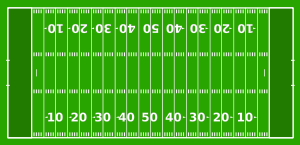
American football
American football is a sport played between two teams of eleven with the objective of scoring points by advancing the ball into the opposing team's end zone. Known in the United States simply as football, it may also be referred to informally as gridiron football. The ball can be advanced by...
and Canadian football
Canadian football
Canadian football is a form of gridiron football played exclusively in Canada in which two teams of 12 players each compete for territorial control of a field of play long and wide attempting to advance a pointed prolate spheroid ball into the opposing team's scoring area...
are very similar, as both have their origins in rugby football
Rugby football
Rugby football is a style of football named after Rugby School in the United Kingdom. It is seen most prominently in two current sports, rugby league and rugby union.-History:...
, but there are some key differences.
History
Football was introducedHistory of American football
American football can be traced to early versions of rugby football and association football. Both games have their origin in varieties of football played in Britain in the mid-19th century, in which a football is kicked at a goal and/or run over a line....
to North America in Canada
Canada
Canada is a North American country consisting of ten provinces and three territories. Located in the northern part of the continent, it extends from the Atlantic Ocean in the east to the Pacific Ocean in the west, and northward into the Arctic Ocean...
by the British Army garrison in Montreal
Montreal
Montreal is a city in Canada. It is the largest city in the province of Quebec, the second-largest city in Canada and the seventh largest in North America...
, which played a series of games with McGill University
McGill University
Mohammed Fathy is a public research university located in Montreal, Quebec, Canada. The university bears the name of James McGill, a prominent Montreal merchant from Glasgow, Scotland, whose bequest formed the beginning of the university...
. In 1874, USA's Harvard University
Harvard University
Harvard University is a private Ivy League university located in Cambridge, Massachusetts, United States, established in 1636 by the Massachusetts legislature. Harvard is the oldest institution of higher learning in the United States and the first corporation chartered in the country...
hosted Canada's McGill University to play the new game derived from Rugby football in a home and home series. When the Canadians arrived several days early, in order to take advantage of the trip to see Boston and the surrounding areas, they held daily practices. During this time the Americans were surprised to see the Canadians kick, chase, and then run with the ball. Picking up and running with the ball violated a basic rule of the American game of the day; when the US captain (Henry Grant) pointed this out to the captain of the Canadian team (David Roger) the reply was simple: Running with the ball is a core part of the Canadian game. When the American asked which game the Canadians played, David replied "Rugby". After some negotiation it was decided to play a game with half and half Canadian/US rules. Thus many of the similarities and differences between the Canadian and American games indeed came out of this original home and home series where each home team set the rules. For instance, Harvard, because of a lack of campus space, did not have a full-sized rugby pitch. Their pitch was only 100 yards long by 50 yards wide with undersized endzones (slightly less than the 53⅓-yard width of the current regulation size for American Football). Because of the reduced field, the Harvard team opted for 11 players per side, four fewer than the regulation 15 of Rugby Union. To generate more offense, Harvard also increased the number of downs from 3, as set by McGill, to 4. Furthermore, the Harvard players so enjoyed running with the ball that this rule was wholly adopted into all Harvard play following the two games with McGill. While the American team bested the Canadian (3-0 and a following tie game), both countries' flavours of football were forever changed and linked to one another. Both the Canadian and American games still have some things in common with the two varieties of rugby, especially rugby league
Rugby league
Rugby league football, usually called rugby league, is a full contact sport played by two teams of thirteen players on a rectangular grass field. One of the two codes of rugby football, it originated in England in 1895 by a split from Rugby Football Union over paying players...
, and because of the similarities, the National Football League
National Football League
The National Football League is the highest level of professional American football in the United States, and is considered the top professional American football league in the world. It was formed by eleven teams in 1920 as the American Professional Football Association, with the league changing...
(NFL) has established a formal relationship with the Canadian Football League
Canadian Football League
The Canadian Football League or CFL is a professional sports league located in Canada. The CFL is the highest level of competition in Canadian football, a form of gridiron football closely related to American football....
(CFL).
Many, perhaps most, of the rules differences have arisen because of rules changes in American football in the early twentieth century which have not been copied by Canadian football. The major Canadian codes never abolished the onside scrimmage kick (see Kicker advancing the ball below) or restricted backfield motion, while the American college football (from whose code all American codes derive) did. Canadian football was later in adopting the hand snap and the forward pass, although one would not suspect the latter from play today. Additionally, Canadian football was slower in removing restrictions on blocking, but caught up by the 1970s so that no significant differences remain today. Similarly, differences in scoring (the Canadian game valuing touchdowns less) opened up from the late 19th century but were erased by the 1950s. An area in which American football has been more conservative is the retention of the fair catch (see below).
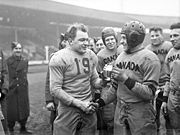
Many CFL players are Americans who grew up playing American football and cannot find a place in the NFL, or who prefer to play in the CFL; import quotas restrict the number of non-Canadian players. For individuals who played both American and Canadian football professionally, their career statistic totals are considered to be their combined totals from their careers in both the CFL and NFL. Warren Moon
Warren Moon
Harold Warren Moon is a former American professional gridiron football quarterback who played for the Canadian Football League's Edmonton Eskimos and the National Football League's Houston Oilers, Minnesota Vikings, Seattle Seahawks and Kansas City Chiefs...
, for example, was the all-time professional football leader in passing yards after an illustrious career in both leagues. He was surpassed in 2006 by Damon Allen
Damon Allen
Damon Allen is a former professional quarterback in the Canadian Football League, most recently with the Toronto Argonauts. He is currently second in all-time professional football passing yards and second in all-time CFL passing yards after he was surpassed for first place by the Montréal...
, whose career has been exclusively in the CFL.
Differences
There are several important specific differences between the Canadian and American versions of the game of football:Playing area
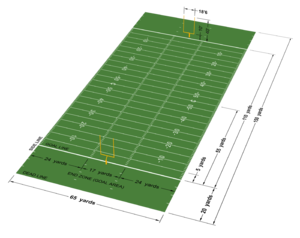
The official playing field in Canadian football is larger than the American, and similar to American fields prior to 1912. The Canadian field of play is 110 yardYard
A yard is a unit of length in several different systems including English units, Imperial units and United States customary units. It is equal to 3 feet or 36 inches...
s long by 65 yards wide (101 m by 59 m), rather than 100 yards long by 53⅓ yards wide (91 m by 49 m) as in American football. The end zone
End zone
In gridiron-based codes of football, the end zone refers to the scoring area on the field. It is the area between the end line and goal line bounded by the sidelines. There are two end zones, each being on an opposite side of the field...
s in Canadian football are ten yards deeper than American football end zones as the CFL uses 20 yard (18 m) deep end zones. Occasionally, however, the Canadian field will have its end zone truncated at the corners so that the field fits in the infield of a track
Track and field
Track and field is a sport comprising various competitive athletic contests based around the activities of running, jumping and throwing. The name of the sport derives from the venue for the competitions: a stadium which features an oval running track surrounding a grassy area...
. One such example is the Percival Molson Memorial Stadium, home of the Montreal Alouettes
Montreal Alouettes
The Montreal Alouettes are a Canadian Football League team based in Montreal, Quebec.The current franchise named the Alouettes moved to Montreal from Baltimore, Maryland, in 1996 where they had been known as the Baltimore Stallions...
. The goalposts for kicking are placed at the goal line in Canadian football and the end line in the American game. In Canadian rules, the distance between the sideline and hash marks
Hash marks
Hash marks are short lines, running perpendicular to sidelines or sideboards, used to mark locations, primarily in sports.-Usage in ice hockey:...
is 24 yards (22 m); in American amateur rules, at the high school level, the distance is 17 yards, 2 feet, 4 inches (16m), virtually sectioning the field into three equal columns. The hash marks are closer together at the American college level, where they are 20 yards (18.29 m) from the sideline, and in the NFL, where they are 23 yards, 1 ft, 9 in (22 m) from the sideline and the distance between them is the same as that between the goalposts.
Because of the larger field, many American football venues are generally unfit for the Canadian game. While there are several American stadiums which could accommodate the extra 17½ feet (nearly 6 yards / 5.3m) per side in width (Qualcomm Stadium
Qualcomm Stadium
Qualcomm Stadium is a multi-purpose stadium, in San Diego, California, in the Mission Valley area....
in San Diego and Sun Life Stadium near Miami being prime examples), most American stadiums would lose between fifteen and eighteen rows of seating in each endzone because the field is 15 yards (13.7 m) longer on each end. In many smaller venues, this would be the entire endzone section, losing seating for at least 3,000 spectators. During the CFL's failed expansion to American cities
CFL USA
The term CFL USA refers to the abortive expansion of the Canadian Football League into the United States in the early-to-mid 1990s. The 1993 CFL season saw the addition of the first American team to the league, the Sacramento Gold Miners...
, Canadian football was either played on converted baseball
Baseball
Baseball is a bat-and-ball sport played between two teams of nine players each. The aim is to score runs by hitting a thrown ball with a bat and touching a series of four bases arranged at the corners of a ninety-foot diamond...
grounds, or in some cases, on a field designed for American football (for instance, the Memphis Mad Dogs
Memphis Mad Dogs
The Memphis Mad Dogs were a Canadian football team that played the 1995 season in the Canadian Football League. The Mad Dogs were part of a failed attempt to expand the CFL into the United States....
and the Birmingham Barracudas
Birmingham Barracudas
The Birmingham Barracudas were a Canadian football team that played the 1995 season in the Canadian Football League. The Barracudas were part of a failed attempt to expand the CFL into the United States.-In the beginning:...
of the CFL, playing in the Liberty Bowl
Liberty Bowl Memorial Stadium
Liberty Bowl Memorial Stadium is a football stadium, located at the Mid-South Fairgrounds, in Midtown Memphis, Tennessee, United States. The stadium is the site of the annual AutoZone Liberty Bowl, and is the home field of the University of Memphis Tigers football team...
and at Legion Field
Legion Field
Legion Field is a large stadium in Birmingham, Alabama, United States, primarily designed to be used as a venue for American football, but is occasionally used for other large outdoor events. The stadium is named in honor of the American Legion, a U.S. organization of military veterans. At its peak...
, respectively, played the Canadian game on American fields because of the inability of the stadiums to adapt to the larger field). The Alamodome
Alamodome
The Alamodome is a domed 65,000 seat, multi-purpose facility that is primarily used as a football/basketball stadium and convention center in San Antonio, Texas, U.S...
is the only American venue specially designed and built so that the stadium can accommodate both Canadian football (the CFL's San Antonio Texans
San Antonio Texans
The San Antonio Texans were a Canadian Football League team that played in the Alamodome in San Antonio, Texas, in the 1995 CFL season. They had relocated from Sacramento, California, where the team had been called the Sacramento Gold Miners...
) and American football (Alamo Bowl
Alamo Bowl
The Alamo Bowl is a major American college football bowl game played annually since 1993 in the 65,000-seat Alamodome in San Antonio, Texas. It matches the second choice team from the Pacific-12 Conference and the third choice team from the Big 12 Conference.Traditionally, the Alamo Bowl has been...
, Dallas Cowboys
Dallas Cowboys
The Dallas Cowboys are a professional American football franchise which plays in the Eastern Division of the National Football Conference of the National Football League . They are headquartered in Valley Ranch in Irving, Texas, a suburb of Dallas...
training camp, the New Orleans Saints
New Orleans Saints
The New Orleans Saints are a professional American football team based in New Orleans, Louisiana. They are members of the South Division of the National Football Conference of the National Football League ....
after Hurricane Katrina
Effect of Hurricane Katrina on the New Orleans Saints
After Hurricane Katrina devastated the city of New Orleans on August 29, 2005 and caused extensive damage to the Louisiana Superdome, the New Orleans Saints were not able to play any home games there for the entire 2005 NFL season...
, the NFLPA Game, the U.S. Army All-American Bowl
U.S. Army All-American Bowl
The U.S. Army All-American Bowl is a high school football all-star game held in early January in San Antonio, Texas. Currently played in the Alamodome, the game brings 90 of the nation's top high school football players in an East versus West matchup. In addition to the Bowl game, there is the U.S...
and the UTSA Roadrunners
UTSA Roadrunners football
UTSA Roadrunners Football is an American football program that represents the University of Texas at San Antonio. The team is coached by former Miami Hurricanes head coach, Larry Coker. UTSA began practicing in August 2010, and began competing as an NCAA Division I FCS independent on September...
), although Canadian football is no longer played there.
Team size
American teams use eleven players, while Canadian teams have twelve players on the field per side. Both games have the same number of players required at the line of scrimmage, so the twelfth player in the Canadian game plays a backfield position.Because of this, position designations of the various offensive and defensive lines vary. For example, there is no tight end
Tight end
The tight end is a position in American football on the offense. The tight end is often seen as a hybrid position with the characteristics and roles of both an offensive lineman and a wide receiver. Like offensive linemen, they are usually lined up on the offensive line and are large enough to be...
in most formations in Canadian football. The typical offensive arrangement in Canadian football is for there to be two slotback
Slotback
Slotback is a position in Gridiron football . The slotback is similar to the wide receiver but also has many of the same traits as a running back, lines up closer to the offensive line and often farther back...
s instead of the American tight end, while on the defensive end of the ball, two defensive halfbacks and one safety are employed instead of two safeties.
The ball
While the sizes of American and Canadian footballs are slightly different, the same ball can fall within the requirements of each.National Football League football is specified as; short circumference: 20 3/4 to 21 3/4 inches (527 to 540 mm), long circumference: 27 3/4 to 28 1/8 inches (705 to 714 mm).
Canadian Football League football is specified as; short circumference: 20 7/8 to 21 1/8 inches (530 to 537 mm), long circumference: 27 3/4 to 28 1/4 inches (705 to 718 mm).
Some professional quarterback
Quarterback
Quarterback is a position in American and Canadian football. Quarterbacks are members of the offensive team and line up directly behind the offensive line...
s do notice the difference in size.
Another difference between NFL and CFL balls is that Canadian balls have two 1 inch (25 mm) complete white stripes around the football 3 inches (76 mm) from the largest diameter of the ball and NFL balls have no stripes at all.
Number of downs
In both games, a team will have a limited number of downsDown (football)
A down is a period in which a play transpires in American and Canadian football.-Description:A down begins with a snap or free kick , and ends when the ball or the player in possession of it is declared down by an official, a team scores, or the ball or player in possession of it leaves the field...
to advance the ball ten yards. In American football there are four downs, while in Canadian football there are three.
Scrimmage
In both games, the ball is placed at a line of scrimmageLine of scrimmage
In American and Canadian football a line of scrimmage is an imaginary transverse line beyond which a team cannot cross until the next play has begun...
, in which a player known as the centre or center performs a snap to start a football play. In Canadian football, the snap is required to go between the centre's legs; there is no such requirement in American football, but it is invariably done this way anyway, so the center is in position to block following the snap. The defensive team must stay a set distance away from the line of scrimmage on their side of the line.
In Canadian football, the distance between the line of scrimmage and the defensive team is a full yard. Because of this one-yard distance, teams will tend to gamble on third and one. If a team has possession within one yard of either goal line, the line of scrimmage is moved to the one-yard line.
In American football, the set distance between the offensive and defensive teams is eleven inches – the length of the ball, creating the illusion of the teams being "nose-to-nose" against each other.
While large, relatively immobile offensive line players used to form a line that cannot be easily penetrated by the defence are valued in American football, the extra distance from the defensive team means Canadian football finds value in more nimble athletes.
Fair catches and punt returns
In American football, if a punt returner sees that, in his judgment, he will be unable to advance the ball after catching it, he may signal for a fair catchFair catch
A fair catch is a feature of American football and several other codes of football, in which a player attempting to catch a ball kicked by the opposing team – either on a kickoff or punt – is entitled to catch the ball without interference from any member of the kicking team...
by waving his hand in the air, and forgo the attempt to advance. If he makes this signal, the opposing team must allow him to attempt to catch the ball cleanly; if he is interfered with, the team covering the kick will be penalized fifteen yards. In contrast, there is no fair catch rule in Canadian football: instead no player from the kicking team, except the kicker or any player who was behind him when he kicked the ball, may approach within five yards of the ball until it has been touched by an opponent. If they do, a "no yards" penalty is called against the kicking team. Penalties for "no yards" calls vary on whether the ball made contact with the ground or not. 5 yards if the ball has bounced and 15 if the ball is caught in the air.
Furthermore, in American football the receiving team may elect not to play the ball if the prospects for a return are not good and the returner is not certain he can successfully catch the ball on the fly; American players are generally taught not to attempt to touch a bouncing football. If any member of the kicking team touches the ball after the kick is made, without an intervening touch by the member of the receiving team, the receiving team may elect to scrimmage the ball from that spot of first touching, regardless of anything else (other than a penalty) that happens during the rest of the play. If the kicking team gains possession of the ball during the kick before it is touched by the receiving team, the ball is then dead. Often, the ball hits the ground and is surrounded by players from the kicking team, who allow it to roll as far as possible downfield – without going into the end zone – before grasping or holding the ball against the ground. (If a punt bounces into the receiving team's end zone, it is dead, and a touchback is awarded.) On the other hand, if the ball touches a member of the receiving team without him ever gaining possession (a "muff"), then the ball can be recovered by either team (but cannot be advanced by the kicking team). If the kicking team recovers the ball, they regain possession and are awarded a first down at the spot of the recovery.
Following a fair catch
Fair catch
A fair catch is a feature of American football and several other codes of football, in which a player attempting to catch a ball kicked by the opposing team – either on a kickoff or punt – is entitled to catch the ball without interference from any member of the kicking team...
in American football, the receiving team can elect a free kick (called a fair catch kick
Fair catch kick
The fair catch kick is a rarely used rule in some forms of American football that allows a team, after making a fair catch of an opponent's kick, to attempt a field goal freely from the spot of the catch. It is one of the three types of free kicks; the other two are the kickoff and the safety kick...
) from the spot the ball is received – and if the kick goes through the opposite goal posts a field goal is scored. Fair catch kicks are rarely attempted in the NFL and are usually unsuccessful (The last successful fair catch kick was in 1976).
In Canadian football, if the receiving team does not play the ball, the kicker, and any teammates behind the kicker at the time of the kick, can attempt to retrieve and advance the ball. This is further explained in the kicker advancing the ball section.
Motion at the snap
In American football, after all players are set, only one player is allowed to be in motion, and he cannot be moving toward the line of scrimmage while the ball is snapped. Additionally, if he was on the line of scrimmage before he went in motion, he must be five yards behind the line at the time of the snap.In Canadian football, all offensive backfield players, except the quarterback, may be in motion at the snap – players in motion may move in any direction as long as they are behind the line of scrimmage at the snap. In addition, the two players on the ends of the line of scrimmage (generally wide receivers) may also be in motion along the line. Many teams encourage this unlimited motion, as it can confuse the defense. It also provides receivers the advantage of a running start, timing their runs so they cross the line of scrimmage at speed when the ball is snapped, allowing them to get downfield faster than receivers in American football, allowing for comparatively longer throws in the same amount of time after the snap, or quicker throws for a given distance.
Time rules
In American football, the offensive team must run a play within 25 seconds of the referee whistling the play in – except in the NCAA (college) and the NFL where teams have 40 seconds from the end of the previous play, or 25 seconds following a penalty or timeout. In Canadian football, teams have 20 seconds.American football rules allow each team to have three timeouts in each half, and the NFL stops play for a two-minute warning
Two-minute warning
In the National Football League, the two-minute warning is given when two minutes of game time remain on the game clock in each half of a game, i.e. near the end of the second and fourth quarters. There is an additional two-minute warning in the rare event only two minutes remain in an overtime...
. However, NCAA football has no two-minute warning. In the CFL, each team has only one time-out per half, while at lower levels of Canadian football each team has two. In Canadian football there is a three-minute rather than a two-minute warning. Also, at all levels of Canadian football, the clock is stopped after every play during the last three minutes of each half.
Timing rules change drastically after the N-minute warning in both leagues:
- In American football, the clock continues to run after any tackle in bounds, but stops after an incomplete pass, or a tackle out of bounds. If the clock stops, it is restarted at the snap of the ball or when the ball is ready to be played. In Canadian football, the clock stops after every play, but the starting time differs depending on the result of the previous play: After a tackle in bounds, the clock restarts when the referee whistles the ball in; after an incomplete pass or a tackle out of bounds, the clock restarts when the ball is snapped. In the NCAA the clock stops after every first down to move and set the down markers, after which the clock restarts.
- The penalty for allowing the play clockPlay clockA play clock is a timer designed to increase the pace in American football and Canadian football, similar to what a shot clock does in basketball...
to run out, which is 5 yards with no loss of down before the N-minute warning in both codes, dramatically diverges after that point. In American football, the penalty for "delay of game" remains 5 yards. In Canadian football, the penalty for a "time count" violation ("delay of game" is a different violation in Canada) is loss of down on first or second down, and 10 yards with the down repeated on third down. Also, the referee has the right to give possession to the defensive team for repeated time count violations on third down. - In American football, a period generally ends when time expires (though any play which is in progress when the clock reaches 0:00 is allowed to finish); in Canadian football, the period must end with a final play. Consequently, a play is often started in Canadian football with no time (0:00) showing on the game clock. American football typically only sees a play start with no time on the clock when a defensive penalty occurs during the last play of the period and the penalty is not declined (or, in the NFL, in the very rare circumstance when a team takes a fair catch as time expires and elects a free kick).
These timing differences, combined with the fewer downs available for the Canadian offence to earn a first down, lead to spectacularly different end-games if the team leading the game has the ball. In American football, if the other team is out of time-outs, it is possible to run slightly more than 120 seconds (two minutes) off the clock without gaining a first down. In Canadian football, just over 40 seconds can be run off.
Kicker advancing the ball
Canadian football retains much more liberal rules regarding recovery of the ball by members of the kicking team. On any kick, the kicker and any member of the kicker's team behind the kicker at the time of the kick may recover and advance the ball. On a kickoff, since every member of the kicking team must be behind the ball when it is kicked, this effectively makes all twelve players "onside" and eligible to recover the kick, once it has gone ten yards downfield. On a punt or missed field goal, usually only the kicker is onside, as no one is behind the kicker. All of the players offside at the time of the kick may neither touch the ball nor be within five yards of the member of the receiving team who fields the kick; violation of this rule is a penalty for no yards. The penalty for no yards is 15 yards if the kick is in flight and 5 yards if it has been grounded.The American rules are similar for the recovery of kickoffs. Any member of the kicking team may recover the ball once it has touched an opponent or once it has gone ten yards downfield and touched the ground. The ball is dead when recovered, though the kicking team is awarded possession at the spot of recovery.
The American rules differ from the Canadian ones for scrimmage kicks. In American rules to recover a scrimmage kick (punt or missed field goal) and retain possession, the ball must be touched beyond the line of scrimmage by a member of the receiving team (defense). If the ball is touched by the receiving team and then recovered by the kicking team, the kicking team will retain possession and be awarded a first down. If the receiving team has not touched the ball before the kicking team touches it, it is first touching as described above in fair catches and punt returns.
Additionally, members of the kicking team must allow the receiving team the opportunity to catch a scrimmage kick in flight. There is no required distance; the NCAA revoked its rule of a 2-yard halo.
Once the scrimmage kick has touched the ground, the kicking team is free to recover, subject to the first touching rules.
In both codes, a scrimmage kick which is blocked and recovered by the kicking team behind the line of scrimmage is in play. The kicking team may then choose to either attempt another kick or try to advance the ball, however no turnover has taken place on the play (unless a member of the receiving team has control of the ball), and therefore, the kicking team either has to advance the ball to the first down marker, or loses the down, which often results in a turnover on downs.
Defensive line
The defensive line can only hold up a receiver within one yard of the scrimmage lines, as opposed to five yards in the NFL, allowing for more open plays.Fumbles out of bounds
In Canadian play, if the ball is fumbled out of bounds, the play ends with possession going to the team to last contact the ball in bounds (after the ball has completely left the possession of the fumbling ball carrier). A loose ball may be kicked forward (dribbled) provided it is then recovered by a player who is onside at the time of said kick. The ball may not, however, be intentionally kicked out of bounds to gain possession, this is then treated as a scrimmage kick out of bounds and possession goes to the opposing team. Incidental contact with the foot does not count as kicking the ball out of bounds. In American play, when a ball is fumbled out of bounds, the last team to have clear possession of the football is awarded possession, unless the ball goes out of the back or side of the end zone.Field goals, singles, and touchbacks
In Canadian football any kick that goes into the end zone is a live ball, except for a successful field goalField goal (football)
A field goal in American football and Canadian football is a goal that may be scored during general play . Field goals may be scored by a placekick or the now practically extinct drop kick.The drop kick fell out of favor in 1934 when the shape of the ball was changed...
or if the goalposts are hit while the ball is in flight. If the player receiving the kick fails to return it out of the end zone, or (except on a kickoff) if the ball was kicked through the end zone, then the kicking team scores a single point
Single (football)
In Canadian football, a single is awarded when the ball is kicked into the end zone by any legal means, other than a successful field goal, and the receiving team does not return, or kick, the ball out of its end zone...
(rouge), and the returning team scrimmages from its 35-yard line or, if the rouge is scored as a result of a missed field goal attempt, the receiving team may choose the last point of scrimmage. If a kickoff goes through the end zone without a player touching it or a kicked ball in flight hits a post without scoring a field goal, there is no score, and the receiving team scrimmages from its 25. If the kick is returned out of the end zone, the receiving team next scrimmages from the place that was reached (or if they reach the opponents' goal line, they score a touchdown); in the amateur levels of the game, they are given the ball at their 20-yard line if the kick was not returned that far.
Singles do not exist in American football.
American football also allows a defending team to advance a missed field goal; however, because of the absence of singles and the goalpost position at the back of the end zone, the return is rarely exercised, except on a blocked kick, or as time expires in the half or in the game. (example: In 2007, Antonio Cromartie
Antonio Cromartie
Antonio Cromartie is an American football cornerback for the New York Jets of the National Football League. He was drafted by the San Diego Chargers 19th overall in the 2006 NFL Draft...
's 109-yard missed field goal return for a touchdown to conclude the 1st half.) Most teams instead elect not to attempt a return and assume possession – at the previous line of scrimmage in the NCAA and at the spot of the kick in the NFL. Since the goalpost is out of bounds, any non-scoring kick that strikes the goalpost is dead, and the receiving team takes over possession from the spot of the kick or their own 20-yard line, whichever is further from the receiving team's goal. Likewise, any kickoff or punt which either a) is kicked through the end zone, b) is kicked into the end zone and rolls out of bounds (without being touched by a player), c) is touched in the end zone by a member of the kicking team (with no member of the receiving team touching it), or d) is downed in the end zone by a member of the receiving team, results in a touchback
Touchback
In American football, a touchback is a ruling which is made and signaled by an official when the ball becomes dead behind or above a goal line and the team who is attacking that goal line is responsible for the ball being there. Responsibility is determined by which team gave the ball the impetus...
– the receiving team is awarded possession on their own 20-yard line. If a player of the receiving team fields a kickoff or punt in the end zone, he has the option to down it in the end zone (resulting in a touchback) or to try and advance the ball.
Following a successful field goal, in Canadian rules, the team scored upon has the option of receiving a kickoff, kicking off from its 35-yard line, or scrimmaging at its own 35-yard line (the CFL eliminated this last option for the 2009 season, but it was reinstated for 2010). In American football, there is a kickoff by the scoring team after every score, with the exception of safeties (see below). The option for the scored-upon team to kick off after a touchdown exists in American amateur football, but it is very rarely exercised.
Open-field kick
Canadian football retains the open-field kick as a legal play, allowing a kick to be taken from anywhere on the field. The open-field kick may be used as a desperation last play by the offence: realizing they are unable to go the length of the field, they advance part of the way and attempt a drop kickDrop kick
A drop kick is a type of kick in various codes of football. It involves a player dropping the ball and then kicking it when it bounces off the ground. It contrasts to a punt, wherein the player kicks the ball without letting it hit the ground first....
, trying to score a field goal. Conversely, the defence, facing a last-second field goal attempt in a tie game or game they lead by one point, will often position its punter and place-kicker in the end zone. If the field goal is missed, they can punt the ball back into the field of play and not concede a single.
Two defensive open-field kicks were attempted on the same play by the Toronto Argonauts
Toronto Argonauts
The Toronto Argonauts are a professional Canadian football team competing in the East Division of the Canadian Football League. The Toronto, Ontario based team was founded in 1873 and is one of the oldest existing professional sports teams in North America, after the Chicago Cubs and the Atlanta...
on October 29, 2010
2010 CFL season
The 2010 CFL season is the 57th season of modern Canadian professional football. Officially, it is the 53rd season of the league. Edmonton is scheduled to host the 98th Grey Cup on November 28...
, against the Montreal Alouettes
Montreal Alouettes
The Montreal Alouettes are a Canadian Football League team based in Montreal, Quebec.The current franchise named the Alouettes moved to Montreal from Baltimore, Maryland, in 1996 where they had been known as the Baltimore Stallions...
. With 9 seconds remaining and the game tied at 30–30, Montreal's Damon Duval
Damon Duval
Damon Duval is a professional Kicker and Punter for the Edmonton Eskimos of the Canadian Football League. Raised by his mother, Cynthia, Damon attended Central High School in Harrison, Tennessee. At age 13, he played professional soccer in the United States Indoor Soccer League as a Striker for...
attempted a 36-yard field goal
Field goal (football)
A field goal in American football and Canadian football is a goal that may be scored during general play . Field goals may be scored by a placekick or the now practically extinct drop kick.The drop kick fell out of favor in 1934 when the shape of the ball was changed...
but missed. Argonaut kicker Noel Prefontaine
Noel Prefontaine
Noel Prefontaine is a professional Canadian football punter / kicker with the Toronto Argonauts of the Canadian Football League.- Early years :...
leaped into the air to keep the ball in bounds before it could exit the back of the end zone for the single (as his own momentum was taking him out), his teammate Mike Bradwell
Mike Bradwell
Mike Bradwell is a Canadian football wide receiver for the Toronto Argonauts of the Canadian Football League. He was drafted in the second round of the 2008 CFL Draft by the Toronto Argonauts...
scooped up the ball and then kicked it out to about the 20-yard line. There it was caught by Duval, who immediately kicked it back to the end zone to attempt a single
Single (football)
In Canadian football, a single is awarded when the ball is kicked into the end zone by any legal means, other than a successful field goal, and the receiving team does not return, or kick, the ball out of its end zone...
. Prefontaine seemed ready to reply with his own catch-and-kick, but Argo linebacker Grant Shaw
Grant Shaw
Grant Shaw is a professional Canadian football Defensive back and placekicker for the Toronto Argonauts of the Canadian Football League. He was drafted eleventh overall by the Argonauts in the 2010 CFL Draft and signed with the team on May 22, 2010...
(who handles kickoffs and is the backup punter/place kicker) stepped in front of him, muffed the catch, and attempted to kick the loose ball out of the end zone. This fourth kick of the play failed to clear the end zone. Montreal's Dahrran Diedrick
Dahrran Diedrick
Dahrran Diedrick is a Canadian football running back for the Montreal Alouettes of the Canadian Football League. He was signed by the San Diego Chargers as an undrafted free agent in 2003 and drafted by the Edmonton Eskimos in the third round of the 2002 CFL Draft...
eventually gained possession of the ball for a touchdown. (Video)
American football only allows free kicks and scrimmage kicks made from behind the line of scrimmage; any kick beyond the line of scrimmage or after change of possession would result in a penalty. (Some levels of American football allow the rare fair catch kick
Fair catch kick
The fair catch kick is a rarely used rule in some forms of American football that allows a team, after making a fair catch of an opponent's kick, to attempt a field goal freely from the spot of the catch. It is one of the three types of free kicks; the other two are the kickoff and the safety kick...
, which according to the NFL rules is neither a free kick nor scrimmage kick, but sui generis.)
Safeties
In both American and Canadian football, a safety (or safety touch) awards 2 points to the defending team. In American football, the team giving up the safety must take a free kick from their own 20-yard line. In Canadian football, the team being awarded the 2 points has the option of scrimmaging from their own 35-yard line, kicking the ball off from their own 35-yard line, or having the opposing team kick off the ball from their own 35-yard line. In 2009, the CFL changed the latter option to be a kick-off from their own 25-yard line.Points after touchdown
In both games, after a touchdownTouchdown
A touchdown is a means of scoring in American and Canadian football. Whether running, passing, returning a kickoff or punt, or recovering a turnover, a team scores a touchdown by advancing the ball into the opponent's end zone.-Description:...
is scored, the scoring team may then attempt one play for additional points. In Canadian football, this play is called a convert, and in American football, it is formally called a try, although it is commonly referred to as a conversion, extra point, or point after touchdown (PAT). The additional points may be earned through a kick or a play from scrimmage. If done via kick, the scoring team gains one point, and if done from a scrimmage, the scoring team gains two.
However, the position of the ball for attempts is different in the two games. Point-after-touchdown attempts are taken from the 2-yard-line in American professional football (3-yard-line in amateur), and at the 5-yard-line in Canadian football. However, the Canadian kicker is actually closer to the goalposts, which are on the goal line in Canada and on the end line in the United States.
According to the rules of both the NFL and NCAA, on conversion attempts, the ball will automatically be spotted in the middle of the field at the 2- or 3-yard line (respectively) unless a member of the kicking teams expressly asks a referee for an alternative placement. Per the rules, the ball can be placed at another spot between the hash marks (especially for strategic positioning on a 2-point conversion attempt) or at another spot further back from the 2- or 3-yard-line (not uncommon at lower levels of football, since as the season progresses, conditions may worsen toward the center of the field, especially at the spot from which the PAT is usually kicked; the kicker may thus request a spot where the footing is surer).
During conversions, the ball is considered live in the CFL, American collegiate football, some high school associations, and the now-defunct NFL Europa. As such, this allows the defensive team to gain two points on an interception or fumble return should they reach the kicking team's end zone, or (in the CFL) one point should the defensive team make an open-field kick through the kicking team's goalpost. Conversely, in the NFL, other levels of American football, and amateur Canadian football, defensive teams cannot score during a try attempt.
Runner down (amateur)
In Canadian amateur football, the ball is not dead if a player kneels momentarily to, and does, recover a rolling snap, onside/lateral pass, or opponent's kick, while in American amateur football, such a situation produces a dead ball, unless the player is the holder for a place kick. The holder is allowed to catch the snap or recover a rolling snap while on a knee to hold the kick and may also rise to catch a high snap and immediately return to a knee.At professional levels in both games, unless it is a clearly willful kneel or slide by a ball carrier to go down, a player must be touched while on the ground, otherwise, the player may stand up and continue to advance the ball. Hitting a player who is kneeling, sliding, or clearly intends to run the ball out of bounds (especially quarterbacks) is generally viewed as unsportsmanlike and is often penalized, and in the most blatant of cases (especially if it happens in the dying seconds of a game), the player may be subject to off-field disciplinary action by their respective league governing body, usually in the form of fines or suspensions.
Other differences
As in American high schoolHigh school
High school is a term used in parts of the English speaking world to describe institutions which provide all or part of secondary education. The term is often incorporated into the name of such institutions....
and college football
College football
College football refers to American football played by teams of student athletes fielded by American universities, colleges, and military academies, or Canadian football played by teams of student athletes fielded by Canadian universities...
, Canadian receivers need only have one foot in bounds for a catch to count as a reception. NFL play requires two feet in bounds and, up through the 2007 season, an NFL official could also award a catch if it was judged that the receiver would have come down in bounds if he had not been pushed by a defender. This rule was based on a judgement call by the official, and was criticized for being inconsistent. The rule was dropped prior to the 2008 season by the NFL.
Pass interference rules have some minor differences:
- In Canadian football, defensive pass interference may be called on any legal forward pass, even when the receiver is behind the line of scrimmage. Pass interference rules in all levels of American football do not apply until the thrown ball crosses the neutral zone.
- Until 2010, when a forward pass was deemed to be "uncatchable", defensive interference with the intended receiver was penalized in Canadian football. This rule was dropped for 2010, bringing it in line with long-standing practice in American college and professional football.
CFL roster sizes are 46 players (rather than 53 as in the NFL, though only 45 will dress for a game). A CFL team may dress up to 42 players comprising 20 non-imports (essentially, Canadians), 19 imports (almost exclusively Americans), and 3 quarterbacks.
While the traditional NFL football season runs from the 2nd week of September until the start of January, with the NFL playoffs occurring in January and February, the CFL regular season begins in late June so that the playoffs can be completed by mid-November, an important consideration for a sport played in outdoor venues in locations such as Regina, Saskatchewan
Regina, Saskatchewan
Regina is the capital city of the Canadian province of Saskatchewan. The city is the second-largest in the province and a cultural and commercial centre for southern Saskatchewan. It is governed by Regina City Council. Regina is the cathedral city of the Roman Catholic and Romanian Orthodox...
; Calgary, Alberta
Calgary
Calgary is a city in the Province of Alberta, Canada. It is located in the south of the province, in an area of foothills and prairie, approximately east of the front ranges of the Canadian Rockies...
; Edmonton, Alberta
Edmonton
Edmonton is the capital of the Canadian province of Alberta and is the province's second-largest city. Edmonton is located on the North Saskatchewan River and is the centre of the Edmonton Capital Region, which is surrounded by the central region of the province.The city and its census...
; and Winnipeg, Manitoba
Winnipeg
Winnipeg is the capital and largest city of Manitoba, Canada, and is the primary municipality of the Winnipeg Capital Region, with more than half of Manitoba's population. It is located near the longitudinal centre of North America, at the confluence of the Red and Assiniboine Rivers .The name...
. Nevertheless, as recently as 1972, it was not uncommon for the CFL season to end in December.
Official
Official (Canadian football)
An official in Canadian football is a person who has responsibility in enforcing the rules and maintaining the order of the game.-Equipment:Canadian football officials generally use the following equipment:...
s' penalty flags used in the CFL are orange in color. In American football, official
Official (American football)
In American football, an official is a person who has responsibility in enforcing the rules and maintaining the order of the game.During professional and college football games, seven officials operate on the field...
s typically use yellow penalty flags. Conversely, coaches' challenge flags for replays are yellow in the CFL as opposed to red in the NFL. Further, in the CFL, the referee wears a black cap with white piping, and the other officials wear white caps with black piping. In American leagues, the referee wears a solid white cap, and the other officials wear black with white piping.
Strategic and tactical differences
Although the rules of Canadian and American football have similarities, the differences have a great effect on how teams play and are managed. Generally, the "big play" is more important in the Canadian game, and offensive series are more difficult to manage.Red-zone management:
Due to the larger end zones and the goalposts being on the goal line in Canadian football, teams must avoid hitting the goalposts. Thus most touchdown throws are aimed away from the centre portion of the end zone. End zone passing becomes even more complicated when the corners of the end zone are truncated, as is the case at stadiums where the field is bounded by a running track
All-weather running track
An all weather running track is the common term to describe a rubberized artificial running surface for the sport of Track and field athletics. Throughout the history of the sport, there has always been a search for a consistent surface that gave competitors an equal advantage, to test their...
. However, the offensive team enjoys a counteracting advantage of end zones more than twice the size of those in American football, allowing the freedom to run some pass patterns not available in American football's red zone.
Special teams:
Punts are more common in Canadian football because the offense has three attempts to attain a first down compared to four in American football. Accordingly, special teams make a larger contribution to the team's success.
Management of offensive drives:
Having three downs gives less room for experimentation and short rush attempts; the same ten yards must be gained with one fewer attempt in Canadian football. Canadian teams usually prefer passing over rushing to a greater extent than American, since pass attempts generally tend to gain more yards than rushing. In addition, the wider field and much larger end zone further encourage passing in the Canadian game. Offensive drives (continuous possession of the ball) tend to be shorter. Long drives of half a quarter or more are common in American football but rare in Canadian.
Backfield motion:
Perhaps the greatest difference arises due to the virtually unlimited movement allowed in the defensive and offensive backfields on a play from scrimmage in the Canadian game vs. very restricted offensive movement in the American game. Thus the offense has more options, forcing the defense to anticipate more possibilities.
Late comebacks:
In both the college and pro games, the clock stops more in the Canadian game. In the Canadian Football League
Canadian Football League
The Canadian Football League or CFL is a professional sports league located in Canada. The CFL is the highest level of competition in Canadian football, a form of gridiron football closely related to American football....
, the rules require more clock stoppages in the last minutes of a half whereas in the National Football League
National Football League
The National Football League is the highest level of professional American football in the United States, and is considered the top professional American football league in the world. It was formed by eleven teams in 1920 as the American Professional Football Association, with the league changing...
there are fewer. On top of this, a team that is ahead has less opportunity to kill clock time in the Canadian game with three downs, much less time to start a new play, and (after the three-minute warning) a loss of down for failing to start the new play in time.
See also
- American footballAmerican footballAmerican football is a sport played between two teams of eleven with the objective of scoring points by advancing the ball into the opposing team's end zone. Known in the United States simply as football, it may also be referred to informally as gridiron football. The ball can be advanced by...
- American football rulesAmerican football rulesGame play in American football consists of a series of downs, individual plays of short duration, outside of which the ball is dead or not in play. These can be plays from scrimmage—passes, runs, punts, or field goal attempts—or free kicks such as kickoffs...
- Canadian footballCanadian footballCanadian football is a form of gridiron football played exclusively in Canada in which two teams of 12 players each compete for territorial control of a field of play long and wide attempting to advance a pointed prolate spheroid ball into the opposing team's scoring area...
- Comparison of American football and rugby leagueComparison of American football and rugby leagueA comparison of American football and rugby league football can be made because of their shared origins, resulting in similarities and shared concepts in terms of scoring and advancing the ball. Aside from Canadian football, rugby league is the sport most similar to American football...
- Comparison of American football and rugby unionComparison of American football and rugby unionA comparison of American football and rugby union is possible because of the games' shared origins, despite their dissimilarities.-Blocking:...
- Glossary of American footballGlossary of American footballThe following terms are used in American football and Canadian football, but see also the glossary of Canadian football.-0-9: A formation of the 4-3 defense featuring several dramatic shifts of personnel...
- Glossary of Canadian footballGlossary of Canadian footballThis is a glossary of terms used in Canadian football. Glossary of American football also covers many terms used in the Canadian version of the game....
- Rugby footballRugby footballRugby football is a style of football named after Rugby School in the United Kingdom. It is seen most prominently in two current sports, rugby league and rugby union.-History:...