

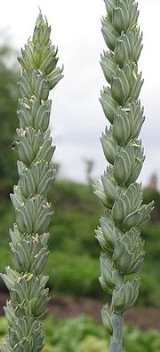
Common wheat

Encyclopedia
Common wheat, Triticum aestivum, (also known as bread wheat) is a cultivated wheat
species.
(an allopolyploid with six sets of chromosomes, two sets from each of three different species). Free-threshing wheat
is closely related to spelt
. As with spelt, genes contributed from goatgrass (Aegilops tauschii) give wheat bread greater cold hardiness than most wheats, and it is cultivated throughout the world's temperate regions.
Wheat first reached North America with Spanish missions in the 16th century, but North America's role as a major exporter of grain dates from the colonization of the prairies in the 1870s. As grain exports from Russia ceased in the First World War, grain production in Kansas doubled. Worldwide, bread wheat has proved well adapted to modern industrial baking, and has displaced many of the other wheat, barley
, and rye species that were once commonly used for bread making, particularly in Europe.
plant's sensitivity to gibberellic acid
, a plant hormone that lengthens cells. RHt genes were introduced to modern wheat varieties in the 1960s by Norman Borlaug
from Norin 10
cultivars of wheat grown in Japan. Short stems are important because the application of high levels of chemical fertilizers would otherwise cause the stems to grow too high, resulting in lodging (collapse of the stems). Stem heights are also even, which is important for modern harvesting techniques.
 Compact wheats (e.g., club wheat Triticum compactum, but in India T. sphaerococcum) are closely related to common wheat, but have a much more compact ear. Their shorter rachis segments lead to spikelets packed closer together. Compact wheats are often regarded as subspecies rather than species in their own right (thus T. aestivum subsp. compactum).
Wheat
Wheat is a cereal grain, originally from the Levant region of the Near East, but now cultivated worldwide. In 2007 world production of wheat was 607 million tons, making it the third most-produced cereal after maize and rice...
species.
Nomenclature and taxonomy of the variety and its cultivars
Evolution
Bread wheat is an allohexaploidPolyploidy
Polyploid is a term used to describe cells and organisms containing more than two paired sets of chromosomes. Most eukaryotic species are diploid, meaning they have two sets of chromosomes — one set inherited from each parent. However polyploidy is found in some organisms and is especially common...
(an allopolyploid with six sets of chromosomes, two sets from each of three different species). Free-threshing wheat
Wheat
Wheat is a cereal grain, originally from the Levant region of the Near East, but now cultivated worldwide. In 2007 world production of wheat was 607 million tons, making it the third most-produced cereal after maize and rice...
is closely related to spelt
Spelt
Spelt is a hexaploid species of wheat. Spelt was an important staple in parts of Europe from the Bronze Age to medieval times; it now survives as a relict crop in Central Europe and northern Spain and has found a new market as a health food. Spelt is sometimes considered a subspecies of the...
. As with spelt, genes contributed from goatgrass (Aegilops tauschii) give wheat bread greater cold hardiness than most wheats, and it is cultivated throughout the world's temperate regions.
History
Common wheat was first domesticated in Western Asia during the early Holocene, and spread from there to North Africa, Europe and East Asia in the prehistoric period.Wheat first reached North America with Spanish missions in the 16th century, but North America's role as a major exporter of grain dates from the colonization of the prairies in the 1870s. As grain exports from Russia ceased in the First World War, grain production in Kansas doubled. Worldwide, bread wheat has proved well adapted to modern industrial baking, and has displaced many of the other wheat, barley
Barley
Barley is a major cereal grain, a member of the grass family. It serves as a major animal fodder, as a base malt for beer and certain distilled beverages, and as a component of various health foods...
, and rye species that were once commonly used for bread making, particularly in Europe.
Plant breeding
Modern wheat varieties have short stems, the result of RHt dwarfing genes that reduce theplant's sensitivity to gibberellic acid
Gibberellic acid
Gibberellic acid Gibberellic acid Gibberellic acid (also called Gibberellin A3, GA, and (GA3) is a hormone found in plants. Its chemical formula is C19H22O6. When purified, it is a white-to-pale-yellow solid....
, a plant hormone that lengthens cells. RHt genes were introduced to modern wheat varieties in the 1960s by Norman Borlaug
Norman Borlaug
Norman Ernest Borlaug was an American agronomist, humanitarian, and Nobel laureate who has been called "the father of the Green Revolution". Borlaug was one of only six people to have won the Nobel Peace Prize, the Presidential Medal of Freedom and the Congressional Gold Medal...
from Norin 10
Norin 10 wheat
Wheat Norin 10 is a semi-dwarf cultivar of wheat, with very large ears, which was bred in the experimental station of Iwate Prefecture, Japan. In 1935, it was registered as a numbered cultivar by Ministry of Agriculture and Forestry...
cultivars of wheat grown in Japan. Short stems are important because the application of high levels of chemical fertilizers would otherwise cause the stems to grow too high, resulting in lodging (collapse of the stems). Stem heights are also even, which is important for modern harvesting techniques.
Other forms of common wheat
See also
- International Code of Nomenclature for Cultivated PlantsInternational Code of Nomenclature for Cultivated PlantsThe International Code of Nomenclature for Cultivated Plants regulates the names of cultigens...