

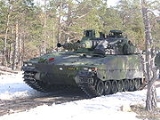
Combat Vehicle 90

Encyclopedia
The Combat Vehicle 90 or Stridsfordon 90 (Strf 90) is a Swedish
infantry fighting vehicle
designed by Hägglunds where the first generation was fitted with a Bofors turret. It is currently produced by BAE Systems Hägglunds.
, Hägglunds started the production of a new family of Combat Vehicles called Combat Vehicle 90. In 1984, the Swedish army
desired a unique vehicle with high mobility, air defence and anti-tank capability, high survivability and protection. In total five prototypes were developed; deliveries took place in 1988. These prototypes were tested during extensive trials for three years between 1988 to 1991. The first deliveries started in 1993, and now over 1000 CV90s have been delivered worldwide.
to boast an automatic Defensive Aid Suite (DAS) which classifies threats and in automatic mode can fire smoke and/or the main gun in suitable directions as well as instruct the driver. At the Eurosatory
2010 exhibition a version called Armadillo was presented. The Armadillo shown was in Armoured Personnel Carrier
(APC) version that shows how flexible the original platform is, and with a bolted roof several other roles (like ambulance, control vehicle or other turreted versions) are easy to create.
, a ceramic appliqué armor which provides all-round protection against 30 mm APFSDS. This armour kit is intended to provide increased protection against Improvised explosive device
, Explosively formed penetrator
and 30 mm caliber
armour piercing rounds. All CV90s are fitted with a Kevlar spall suppression liners which cover the interior spaces and provide protection for the troops inside against shrapnel and anti-personnel artillery munition.
The CV90 can be also fitted with cage armour, which provides protection against tandem-charge
and shaped charge
warheads. The CV90 is fitted with a nuclear, biological, and chemical (NBC) filtration system accompanied with a chemical detector and radiation detector systems. The CV90 also use heat-absorbing filters to provide temporary protection against thermal imaging (TIS), image intensifier
and infrared camera (IR). The CV 90 was designed to produce a very low and very compact structure to minimize radar and IR-signatures.
With every generation of CV90 there has been an increase in payload and corresponding protection levels. The inherent mine protection levels have risen substantially to presently defeat the heaviest (10 kg TNT) anti-tank mines.
ordered 57 CV9030 vehicles. Total cost was €250 million (in 2008 euros), or €4.42 million per vehicle. In June 2004 Finland
made another purchase, bringing the overall quantity ordered to 102. This time the cost was €2.92 million (in 2008 euros) per vehicle.
In December 2005, Denmark
ordered 45 CV9035 vehicles for a cost of €188 million or €4.18 million per vehicle. The Netherlands
ordered 184 combat plus 8 instruction CV9035 vehicles for a cost of €749 million.
version with thermoelectric plates, capable of posing as many different objects such as ordinary cars, stones, trees etc. to an enemy IR-viewfinder. It takes 1500 plates to cover a CV90, at a cost of $100 per plate.
The forward observation, command and recovery vehicles are armed only with a machine gun.
The CV 90 has also been fitted with the advanced mortar system
under the name Grkpbv 90120 (granatkastarpansarbandvagn, "tracked armoured mortar vehicle") or formerly SSG 120 (Splitterskyddad granatkastare, "lightly armoured mortar"). Now cancelled the vehicle was a project between Hägglunds and Patria
.
Sweden originally planned for a mix of CV9040 and CV9025, tests of the 25 mm turret being carried out on on an Ikv 91
chassis, but finally decided on the 40 mm version, due to the much higher potential of the larger calibre.
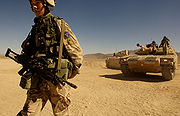 With production having begun in 1993, the CV90 had remained untested in live combat until November 2007, when Norwegian Army
CV90s from 2nd Battalion
saw heavy combat during Operation Harekate Yolo
in Afghanistan
. During the first week of November, Norwegian ISAF
forces from 2nd Battalion and Kystjegerkommandoen
based in Mazar-e-Sharif, responded to a Taliban attack on Afghan National Army
forces in the Ghowrmach
district. Having been heavily outnumbered by the Taliban forces, the Norwegians used mortars and, in particular, CV90s, to effectively beat down the attack. The operation left an unknown number of Taliban casualties, but Norwegian news sources say as many as 45 to 65 Taliban fighters may have been killed, and many more wounded.
The CV90 was later used extensively by ISAF-forces of the Norwegian Army's Telemark Battalion
in May 2008, when the battalion, during Operation Karez
in the Badghis Province, came under heavy machine gun and RPG fire from Taliban fighters. The attack left 13 Taliban fighters dead, and unknown number of wounded. No allied casualties were reported.
In January 2010, a Norwegian soldier driving a CV9030 was killed when it drove over an IED in Ghowrmach, Afghanistan.
Swedish CV90s have also seen service in Liberia. As of the spring of 2011, Sweden operates 9 CV9040s in Afghanistan. Swedish CV90s have seen combat with insurgents on at dozens occasions.
In February 2010 Denmark sent 10 CV9035DK's to Afghanistan in order to bolster their contingent in Helmand Province. The Danish contingent has suffered numerous casualties since they began operations in the province in the autumn of 2006. The vehicles are from the Danish Royal Lifeguard Regiment, based in the Northern part of Seeland. They are working alongside with MOWAG Piranha IIIC
, MOWAG Eagle IV
, M113 G3DK
and Leopard 2A5DK
, all contributed by Denmark, in the Helmand Province. By April 2010 two of the ten vehicles have been hit with IEDs, in both cases protecting the crew and passengers of personal injury. The vehicles lost two wheels and tracks, and were sent back to the manufacturer in Sweden for further investigation. On the 7th of August 2010, a CV9035DK hit an IED in Afghanistan. 2 were killed and 3 wounded. The explosion was so powerful the vehicle was turned over.
Sweden
Sweden , officially the Kingdom of Sweden , is a Nordic country on the Scandinavian Peninsula in Northern Europe. Sweden borders with Norway and Finland and is connected to Denmark by a bridge-tunnel across the Öresund....
infantry fighting vehicle
Infantry fighting vehicle
An infantry fighting vehicle , also known as a mechanized infantry combat vehicle , is a type of armoured fighting vehicle used to carry infantry into battle and provide fire support for them...
designed by Hägglunds where the first generation was fitted with a Bofors turret. It is currently produced by BAE Systems Hägglunds.
Background
During the Cold WarCold War
The Cold War was the continuing state from roughly 1946 to 1991 of political conflict, military tension, proxy wars, and economic competition between the Communist World—primarily the Soviet Union and its satellite states and allies—and the powers of the Western world, primarily the United States...
, Hägglunds started the production of a new family of Combat Vehicles called Combat Vehicle 90. In 1984, the Swedish army
Swedish Army
The Swedish Army is one of the oldest standing armies in the world and a branch of the Swedish Armed Forces; it is in charge of land operations. General Sverker Göranson is the Supreme Commander-in-Chief of the Army.- Organization :...
desired a unique vehicle with high mobility, air defence and anti-tank capability, high survivability and protection. In total five prototypes were developed; deliveries took place in 1988. These prototypes were tested during extensive trials for three years between 1988 to 1991. The first deliveries started in 1993, and now over 1000 CV90s have been delivered worldwide.
Design
Various customer requirements have led to several generations of CV90 where major differences are survivability and the electronic architecture. With higher protection follows higher curb weight, and the vehicle combat weight has risen from 23 to 35 tonnes. Power-to-weight ratio has remained approximately the same with increasingly stronger diesel engines. The track suspension system has seen upgrades in several stages. The Mk III version has a digital electronic architecture with several different CAN-buses and digital networks, and is the first IFVInfantry fighting vehicle
An infantry fighting vehicle , also known as a mechanized infantry combat vehicle , is a type of armoured fighting vehicle used to carry infantry into battle and provide fire support for them...
to boast an automatic Defensive Aid Suite (DAS) which classifies threats and in automatic mode can fire smoke and/or the main gun in suitable directions as well as instruct the driver. At the Eurosatory
Eurosatory
Eurosatory is an International Defence & Security industry trade show that is held every two years in Paris-Nord Villepinte Exhibition Centre, Paris, France. In 2006 it had over 1000 exhibitors and 46,000 visitors. It is organized by COGES in partnership with the French Ministry of Defense. The...
2010 exhibition a version called Armadillo was presented. The Armadillo shown was in Armoured Personnel Carrier
Armoured personnel carrier
An armoured personnel carrier is an armoured fighting vehicle designed to transport infantry to the battlefield.APCs are usually armed with only a machine gun although variants carry recoilless rifles, anti-tank guided missiles , or mortars...
(APC) version that shows how flexible the original platform is, and with a bolted roof several other roles (like ambulance, control vehicle or other turreted versions) are easy to create.
Protection
The basic armor of the CV9040 provides all-round protection against 14.5 mm armour-piercing rounds. Armour protection over the frontal arc is classified but all models from CV9040B and later are said to be protected against 30 mm APFSDS. Some variants, including the CV9030N, can be fitted with MEXASMEXAS
The Modular Expandable Armor System is a ceramic composite armour developed by the German company IBD Deisenroth Engineering. MEXAS was introduced in 1994 and has been applied on over 20,000 combat vehicles worldwide...
, a ceramic appliqué armor which provides all-round protection against 30 mm APFSDS. This armour kit is intended to provide increased protection against Improvised explosive device
Improvised explosive device
An improvised explosive device , also known as a roadside bomb, is a homemade bomb constructed and deployed in ways other than in conventional military action...
, Explosively formed penetrator
Explosively Formed Penetrator
An explosively formed penetrator , also known as an explosively formed projectile, a self-forging warhead, or a self-forging fragment, is a special type of shaped charge designed to penetrate armour effectively at standoff distances...
and 30 mm caliber
30 mm caliber
30 mm caliber ammunition is usually used in autocannon. Such ammunition includes NATO standard 30 × 173 mm and 30 × 113 mm and Soviet 30 × 165 mm ammunition widely used around the world....
armour piercing rounds. All CV90s are fitted with a Kevlar spall suppression liners which cover the interior spaces and provide protection for the troops inside against shrapnel and anti-personnel artillery munition.
The CV90 can be also fitted with cage armour, which provides protection against tandem-charge
Tandem-charge
A tandem-charge weapon is an explosive device or projectile that has two or more stages of detonation. It is effective against cage armor, which is designed to protect an armored vehicle against anti-tank munitions. The first stage of the weapon triggers the reactive armor of the target, limiting...
and shaped charge
Shaped charge
A shaped charge is an explosive charge shaped to focus the effect of the explosive's energy. Various types are used to cut and form metal, to initiate nuclear weapons, to penetrate armor, and in the oil and gas industry...
warheads. The CV90 is fitted with a nuclear, biological, and chemical (NBC) filtration system accompanied with a chemical detector and radiation detector systems. The CV90 also use heat-absorbing filters to provide temporary protection against thermal imaging (TIS), image intensifier
Image intensifier
An image intensifier tube is a vacuum tube device for increasing the intensity of available light in an optical system to allow use under low light conditions such as at night, to facilitate visual imaging of low-light processes such as fluorescence of materials to X-rays or gamma rays, or for...
and infrared camera (IR). The CV 90 was designed to produce a very low and very compact structure to minimize radar and IR-signatures.
With every generation of CV90 there has been an increase in payload and corresponding protection levels. The inherent mine protection levels have risen substantially to presently defeat the heaviest (10 kg TNT) anti-tank mines.
Mobility
The CV90 Mk0 is powered by a DSI14 developed by Scania, which provides 550 horse power (HP) and it can reach speeds of 70 kilometers per hour. The basic CV90 has a maximum road range of 320 kilometers but the latest generation can reach up to 600 kilometers. The CV90 offers quieter movement for improved stealth, greater speed over good terrain, and higher ground clearance for protection against mines and improvised explosive devices.Armament
The basic CV90 is fitted with a two-man turret, armed with Bofors 40 mm caliber gun and coaxial 7.62 mm machine gun. The CV90 also carries six 76-mm grenades in two clusters of three launchers positioned on each side of the turret. The grenade launchers are intended for smoke grenades.Sight
The CV90 is equipped with a UTAAS (Universal Tank and Anti-Aircraft Sight) from Saab. Daytime optical, Thermal Imaging System (TIS) and Generation III Image Intensification (II).Production
Production of the CV 90 began in 1993, and over 1,000 vehicles have been ordered. In November 2000, FinlandFinland
Finland , officially the Republic of Finland, is a Nordic country situated in the Fennoscandian region of Northern Europe. It is bordered by Sweden in the west, Norway in the north and Russia in the east, while Estonia lies to its south across the Gulf of Finland.Around 5.4 million people reside...
ordered 57 CV9030 vehicles. Total cost was €250 million (in 2008 euros), or €4.42 million per vehicle. In June 2004 Finland
Finland
Finland , officially the Republic of Finland, is a Nordic country situated in the Fennoscandian region of Northern Europe. It is bordered by Sweden in the west, Norway in the north and Russia in the east, while Estonia lies to its south across the Gulf of Finland.Around 5.4 million people reside...
made another purchase, bringing the overall quantity ordered to 102. This time the cost was €2.92 million (in 2008 euros) per vehicle.
In December 2005, Denmark
Denmark
Denmark is a Scandinavian country in Northern Europe. The countries of Denmark and Greenland, as well as the Faroe Islands, constitute the Kingdom of Denmark . It is the southernmost of the Nordic countries, southwest of Sweden and south of Norway, and bordered to the south by Germany. Denmark...
ordered 45 CV9035 vehicles for a cost of €188 million or €4.18 million per vehicle. The Netherlands
Netherlands
The Netherlands is a constituent country of the Kingdom of the Netherlands, located mainly in North-West Europe and with several islands in the Caribbean. Mainland Netherlands borders the North Sea to the north and west, Belgium to the south, and Germany to the east, and shares maritime borders...
ordered 184 combat plus 8 instruction CV9035 vehicles for a cost of €749 million.
Research
Hägglunds have demonstrated an infrared stealthStealth
Stealth may refer to:*Stealth technology, technology used to conceal ships, aircraft, and missiles*Stealth aircraft, aircraft which use stealth technology*Stealth ground vehicle, ground vehicles which use stealth technology...
version with thermoelectric plates, capable of posing as many different objects such as ordinary cars, stones, trees etc. to an enemy IR-viewfinder. It takes 1500 plates to cover a CV90, at a cost of $100 per plate.
Variants
- CV9040: The original model with a 40 mmBofors 40 mm gunThe Bofors 40 mm gun is an anti-aircraft autocannon designed by the Swedish defence firm of Bofors Defence...
BoforsBoforsThe name Bofors has been associated with the iron industry for more than 350 years.Located in Karlskoga, Sweden, the company originates from the hammer mill "Boofors" founded 1646. The modern corporate structure was created in 1873 with the foundation of Aktiebolaget Bofors-Gullspång...
autocannonAutocannonAn autocannon or automatic cannon is a rapid-fire projectile weapon firing a shell as opposed to the bullet fired by a machine gun. Autocannons often have a larger caliber than a machine gun . Usually, autocannons are smaller than a field gun or other artillery, and are mechanically loaded for a...
. Used by SwedenSwedenSweden , officially the Kingdom of Sweden , is a Nordic country on the Scandinavian Peninsula in Northern Europe. Sweden borders with Norway and Finland and is connected to Denmark by a bridge-tunnel across the Öresund.... - CV9040B: Updated CV90 with fully stabilized gun, although elevation suffers because of this. Used by SwedenSwedenSweden , officially the Kingdom of Sweden , is a Nordic country on the Scandinavian Peninsula in Northern Europe. Sweden borders with Norway and Finland and is connected to Denmark by a bridge-tunnel across the Öresund....
- CV9040C: Version for International Operations with additional all-round armour and tropical climate kit. Used by SwedenSwedenSweden , officially the Kingdom of Sweden , is a Nordic country on the Scandinavian Peninsula in Northern Europe. Sweden borders with Norway and Finland and is connected to Denmark by a bridge-tunnel across the Öresund....
- CV9030: Export version with a 30 mm Bushmaster IIBushmaster IIThe Mk44 Bushmaster II is a 30 mm chain gun manufactured by Alliant Techsystems. It is a derivative of the 25 mm M242 Bushmaster, and uses some 70% of the same parts as the M242 while increasing the firepower by as much as 50% with the 20% increase in caliber size. The barrel is chromium-plated...
autocannonAutocannonAn autocannon or automatic cannon is a rapid-fire projectile weapon firing a shell as opposed to the bullet fired by a machine gun. Autocannons often have a larger caliber than a machine gun . Usually, autocannons are smaller than a field gun or other artillery, and are mechanically loaded for a...
. Adopted by NorwayNorwayNorway , officially the Kingdom of Norway, is a Nordic unitary constitutional monarchy whose territory comprises the western portion of the Scandinavian Peninsula, Jan Mayen, and the Arctic archipelago of Svalbard and Bouvet Island. Norway has a total area of and a population of about 4.9 million...
, SwitzerlandSwitzerlandSwitzerland name of one of the Swiss cantons. ; ; ; or ), in its full name the Swiss Confederation , is a federal republic consisting of 26 cantons, with Bern as the seat of the federal authorities. The country is situated in Western Europe,Or Central Europe depending on the definition....
and FinlandFinlandFinland , officially the Republic of Finland, is a Nordic country situated in the Fennoscandian region of Northern Europe. It is bordered by Sweden in the west, Norway in the north and Russia in the east, while Estonia lies to its south across the Gulf of Finland.Around 5.4 million people reside...
. Within BAE Systems Hägglunds, the Norwegian CV9030N are generally known as the CV90 Mk I while the more advanced Finnish CV9030FIN and Swiss CV9030CH vehicles are known as the CV90 MK II. - CV9035: Armed with a Bushmaster IIIBushmaster IIIThe Bushmaster III is an automatic/semi-automatic cannon designed and built by Alliant Techsystems. It is based on the M242 Bushmaster originally developed by Alliant Techsystems...
35/50 cannon. Adopted by the NetherlandsNetherlandsThe Netherlands is a constituent country of the Kingdom of the Netherlands, located mainly in North-West Europe and with several islands in the Caribbean. Mainland Netherlands borders the North Sea to the north and west, Belgium to the south, and Germany to the east, and shares maritime borders...
as CV9035NL and DenmarkDenmarkDenmark is a Scandinavian country in Northern Europe. The countries of Denmark and Greenland, as well as the Faroe Islands, constitute the Kingdom of Denmark . It is the southernmost of the Nordic countries, southwest of Sweden and south of Norway, and bordered to the south by Germany. Denmark...
as CV9035DK. Within BAE Systems Hägglunds CV9035 is known as the CV90 MK III. - CV90105: Light tank equipped with 105 mm rifled tank gun/turret. Designed by Hägglunds (BAE Systems) and GIAT (Nexter).
- CV90120-T: Light tank equipped with tank turret and smoothbore 120 mm gun. (RUAG 120 mm Compact Tank Gun)
- CV9040 AAV (TriAD): Anti-Air Vehicle, fitted with radar and 40 mm autocannon. Can also elevate its cannon higher than CV9040
- CV90: Command Vehicle.
- CV90: Forward Observation Vehicle, more advanced IR sensor fitted.
- CV90: Armored Recovery Vehicle. (BgBv90 Swedish army designation)
- CV9056: Prototype version equipped with the Bofors RB56 anti-tank missile. No units ordered.
- Armadillo: Armoured Personnel CarrierArmoured personnel carrierAn armoured personnel carrier is an armoured fighting vehicle designed to transport infantry to the battlefield.APCs are usually armed with only a machine gun although variants carry recoilless rifles, anti-tank guided missiles , or mortars...
version built on a modular CV90 Mk III chassis - GRKPBV90120: Self Propelled Mortar. Twin mounted, breach loaded 120 mm mortars, AMOSAMOSAMOS or Advanced Mortar System is a 120 mm automatic twin barrelled, breech loaded mortar turret. AMOS has been fitted to a wide range of armoured vehicles such as the Sisu Pasi, Patria AMV, Combat Vehicle 90 or Combat Boat 90....
.
The forward observation, command and recovery vehicles are armed only with a machine gun.
The CV 90 has also been fitted with the advanced mortar system
AMOS
AMOS or Advanced Mortar System is a 120 mm automatic twin barrelled, breech loaded mortar turret. AMOS has been fitted to a wide range of armoured vehicles such as the Sisu Pasi, Patria AMV, Combat Vehicle 90 or Combat Boat 90....
under the name Grkpbv 90120 (granatkastarpansarbandvagn, "tracked armoured mortar vehicle") or formerly SSG 120 (Splitterskyddad granatkastare, "lightly armoured mortar"). Now cancelled the vehicle was a project between Hägglunds and Patria
Patria (company)
Patria is a Finnish company which produces a wide range of defence, aviation and aerospace technology. It carries on the firearms tradition of Valtion Kivääritehdas and the aerospace tradition of Valtion lentokonetehdas.-Patria Aviation:* NH90* Mini-UAVs...
.
Sweden originally planned for a mix of CV9040 and CV9025, tests of the 25 mm turret being carried out on on an Ikv 91
Infanterikanonvagn 91
The Ikv 91, or Infanterikanonvagn 91, was a high mobility tank destroyer that was developed to meet the operational requirements of the Swedish Army. It was designed and manufactured by Hägglund and Söner and employed common components with the Pbv 302 armoured personnel carrier series...
chassis, but finally decided on the 40 mm version, due to the much higher potential of the larger calibre.
Combat service
Norwegian Army
Norway achieved full independence in 1905, and in the first century of its short life has contributed to two major conflicts, the Cold War and the War on Terror. The Norwegian Army currently operates in the north of Norway and in Afghanistan as well as in Eastern Europe. The Army is the oldest of...
CV90s from 2nd Battalion
Norwegian Army 2nd Battalion
2nd Battalion is an infantry unit of the Norwegian Army, based at camp Skjold in Troms county in Northern Norway. It serves in the mechanized infantry role as part of Brigade Nord; the battalion is one of three that Norwegian battalions performing this role, along with being Telemark Battalion and...
saw heavy combat during Operation Harekate Yolo
Operation Harekate Yolo
Operation Harekate Yolo was a two part military operation involving NATO ISAF and Afghanistan government forces against the Taliban as part of the war in Afghanistan....
in Afghanistan
Afghanistan
Afghanistan , officially the Islamic Republic of Afghanistan, is a landlocked country located in the centre of Asia, forming South Asia, Central Asia and the Middle East. With a population of about 29 million, it has an area of , making it the 42nd most populous and 41st largest nation in the world...
. During the first week of November, Norwegian ISAF
International Security Assistance Force
The International Security Assistance Force is a NATO-led security mission in Afghanistan established by the United Nations Security Council on 20 December 2001 by Resolution 1386 as envisaged by the Bonn Agreement...
forces from 2nd Battalion and Kystjegerkommandoen
Kystjegerkommandoen
Kystjegerkommandoen is a Norwegian amphibious unit trained to operate in littoral combat theatres, filling the role of a marine corps and coastal artillery....
based in Mazar-e-Sharif, responded to a Taliban attack on Afghan National Army
Afghan National Army
The Afghan National Army is a service branch of the military of Afghanistan, which is currently trained by the coalition forces to ultimately take the role in land-based military operations in Afghanistan. , the Afghan National Army is divided into seven regional Corps. The strength of the Afghan...
forces in the Ghowrmach
Ghowrmach
-Armed conflict:One ISAF-soldier was killed here,January 25, 2010.-External links:*...
district. Having been heavily outnumbered by the Taliban forces, the Norwegians used mortars and, in particular, CV90s, to effectively beat down the attack. The operation left an unknown number of Taliban casualties, but Norwegian news sources say as many as 45 to 65 Taliban fighters may have been killed, and many more wounded.
The CV90 was later used extensively by ISAF-forces of the Norwegian Army's Telemark Battalion
Telemark Battalion
The Telemark Bataljon is a mechanised infantry unit of the Norwegian Army. It was established in 1993, and is a part of Brigade Nord and stationed at Rena, Hedmark...
in May 2008, when the battalion, during Operation Karez
Operation Karez
Operation Karez was a military operation between May 13–23, 2008 involving Norwegian and German ISAF and Afghan government forces against the Taliban as part of the war in Afghanistan...
in the Badghis Province, came under heavy machine gun and RPG fire from Taliban fighters. The attack left 13 Taliban fighters dead, and unknown number of wounded. No allied casualties were reported.
In January 2010, a Norwegian soldier driving a CV9030 was killed when it drove over an IED in Ghowrmach, Afghanistan.
Swedish CV90s have also seen service in Liberia. As of the spring of 2011, Sweden operates 9 CV9040s in Afghanistan. Swedish CV90s have seen combat with insurgents on at dozens occasions.
In February 2010 Denmark sent 10 CV9035DK's to Afghanistan in order to bolster their contingent in Helmand Province. The Danish contingent has suffered numerous casualties since they began operations in the province in the autumn of 2006. The vehicles are from the Danish Royal Lifeguard Regiment, based in the Northern part of Seeland. They are working alongside with MOWAG Piranha IIIC
Mowag Piranha
The MOWAG Piranha is a family of armoured fighting vehicles designed by the Swiss MOWAG , corporation....
, MOWAG Eagle IV
MOWAG Eagle
The MOWAG Eagle is a wheeled armored vehicle designed by the Swiss MOWAG corporation. It has gone through several generations of development. The current vehicle, introduced in November 2003, is the Eagle IV, which is based on the Duro IIIP chassis...
, M113 G3DK
M113 armored personnel carrier
The M113 is a fully tracked armored personnel carrier that has formed the backbone of the United States Army's mechanized infantry units from the time of its first fielding in Vietnam in April 1962. The M113 was the most widely used armored vehicle of the U.S...
and Leopard 2A5DK
Leopard 2
The Leopard 2 is a main battle tank developed by Krauss-Maffei in the early 1970s for the West German Army. The tank first entered service in 1979 and succeeded the earlier Leopard 1 as the main battle tank of the German Army. Various versions have served in the armed forces of Germany and twelve...
, all contributed by Denmark, in the Helmand Province. By April 2010 two of the ten vehicles have been hit with IEDs, in both cases protecting the crew and passengers of personal injury. The vehicles lost two wheels and tracks, and were sent back to the manufacturer in Sweden for further investigation. On the 7th of August 2010, a CV9035DK hit an IED in Afghanistan. 2 were killed and 3 wounded. The explosion was so powerful the vehicle was turned over.
Operators
- 45 CV9035DK.: 102 CV9030FIN (57 first batch, 45 second batch).: 193 CV9035NL (Initial order of 184 vehicles raised to 193. Deliveries will be completed by 2011.)
- 104 CV9030N. 17 of these have been upgraded with air-condition, additional mine protection and rear-view cameras, and are designated CV9030NF1.: 186 CV9030CH: 509 vehicles, including 42 CV9040C with additional armour.
See also
- ASCOD
- Schützenpanzer PumaPuma (IFV)The Puma is a German infantry fighting vehicle, the mass production has started on the 6th July 2009. It will replace the aging Marder IFVs, from 2010 through 2020. Governing company is PSM Projekt System Management, a joint venture of Krauss-Maffei Wegmann and Rheinmetall Landsysteme. The Puma is...
- Dardo IFVDardo IFVThe Dardo is a infantry fighting vehicle designed for the Italian Army as a replacement for the M113 APC. It is designed and built by the Iveco Fiat Oto Melara Syndicated Company based in Rome...
- K-21 IFV
- Bionix AFVBionix AFVThe Bionix is a family of tracked Singaporean armoured fighting vehicles developed by Singapore Technologies Kinetics . Intended to augment the Singapore Army's aging M113 armoured personnel carriers, it is the first indigenous armoured vehicle to be developed in Southeast Asia...
- AndersAnders (tank)The WPB Anders is a family of medium, tracked combat vehicles. The vehicle is designed by OBRUM part of the Bumar Group...
External links
- Army Technology Combat Vehicle 90
- BAE Systems Hägglunds
- SoldF.com - CV9040 (Swedish)
- Armada International 6/97-52 - information on the Norwegian IFV trials and changes found in the Norwegian CV9030
- Danish CV9035 MkIII