All Topics  
Comb honey


   Email Print
   Bookmark   Link


Comb honey


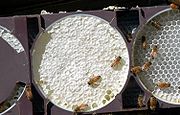
Comb honey is produced by honeybees in a hive. The bees fill the hexagon shaped wax cells of the honeycomb
Honeycomb

A honeycomb is a mass of hexagonal waxcells built by honey bees in their beehive to contain their larva and stores of honey and pollen.beekeeping may remove the entire honeycomb to harvest honey....
 with honey
Honey

Honey is a sweet fluid produced by honey bees , and derived from the nectar of flowers. According to the United States National Honey Board and various international food regulations, "honey stipulates a pure product that does not allow for the addition of any other substance?this includes, but is not limited to, water or other sweeteners...
 and cap it with beeswax
Beeswax

Beeswax is a natural wax produced in the Beehive of honey bees of the genus Apis. Worker bees have eight wax-producing mirror glands on the inner sides of the sternites on abdominal segments 4 to 7....
. Before the invention of the honey extractor
Honey extractor

A honey extractor is a mechanical device used in the honey harvest. A honey extractor extracts the honey from the honey comb without destroying the comb....
 almost all honey produced was in the form of comb honey. Today, most honey is produced for extraction but comb honey remains popular among consumers both for eating 'as is' and for combining with extracted honey to make Chunk Honey.


Discussion
Ask a question about 'Comb honey'
Start a new discussion about 'Comb honey'
Answer questions from other users
Full Discussion Forum


Encyclopedia


Comb honey is produced by honeybees in a hive. The bees fill the hexagon shaped wax cells of the honeycomb
Honeycomb

A honeycomb is a mass of hexagonal waxcells built by honey bees in their beehive to contain their larva and stores of honey and pollen.beekeeping may remove the entire honeycomb to harvest honey....
 with honey
Honey

Honey is a sweet fluid produced by honey bees , and derived from the nectar of flowers. According to the United States National Honey Board and various international food regulations, "honey stipulates a pure product that does not allow for the addition of any other substance?this includes, but is not limited to, water or other sweeteners...
 and cap it with beeswax
Beeswax

Beeswax is a natural wax produced in the Beehive of honey bees of the genus Apis. Worker bees have eight wax-producing mirror glands on the inner sides of the sternites on abdominal segments 4 to 7....
. Before the invention of the honey extractor
Honey extractor

A honey extractor is a mechanical device used in the honey harvest. A honey extractor extracts the honey from the honey comb without destroying the comb....
 almost all honey produced was in the form of comb honey. Today, most honey is produced for extraction but comb honey remains popular among consumers both for eating 'as is' and for combining with extracted honey to make Chunk Honey. Hobbyists and sideliners can best develop their beekeeping skills by producing comb honey, which they can easily sell for several times its value as extracted honey. Comb honey production is more suitable for areas with a prolonged honeyflow from dutch clover, alsike, and yellow clover. Areas that are wooded are not very suitable for comb honey production as bees tend to collect much propolis
Propolis

Propolis is a resinous mixture that honey bees collect from tree buds, sap flows, or other botanical sources. It is used as a sealant for unwanted open spaces in the beehive ....
 which makes the harvesting of comb honey much more difficult. This problem has been largely circumvented with the adoption of specialized frames, notably Ross Rounds, which prevent accumulation of propolis on saleable units. Virtually all commercial beekeepers and a large percentage of other beekeepers produce comb honey using Ross Round equipment as it provides the best combination of reasonable cost and labor savings compared to other methods.

Hive management

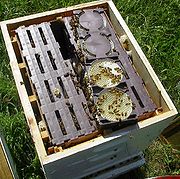
Populous honey bee colonies are usually reduced to single hive bodies at the beginning of the honeyflow when one or more comb honey supers are added. Comb honey can either be produced in wooden sections, shallow frames, or Ross Rounds. Presently in North America, the Ross Rounds method is likely the most common comb honey production system. The successful production of comb honey requires that the hive remains somewhat crowded without overcrowding which leads to swarming
Swarming (honeybee)

Swarming is the natural means of reproduction of honey bee colonies , including the domesticated Western honey bee. In the process two or more colonies are created in place of the original single colony....
. Young prolific queens help rapid colony population expansion with less likelihood of swarming. Caucasian Apis mellifera bees are often preferred for their tendency to keep a constricted brood nest and for their production of white wax cappings, making more attractive honey combs.