

Coma Berenices

Encyclopedia
Coma Berenices is a traditional asterism
that has since been defined as one of the 88 modern constellation
s. It is located near Leo
, to which it formerly belonged, and accommodates the North Galactic Pole. Its name means "Berenice's Hair" (in Greek
, via Latin
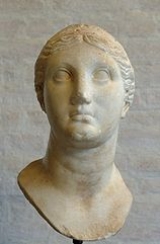
), and refers to the legend of Queen Berenice II of Egypt, who sacrificed her long hair.
became an important cultural center.
 In 243 BC
, Ptolemy, in the Third Syrian War, undertook a dangerous expedition against the Seleucids who had murdered his sister. His newlywed bride, Berenice, swore to the goddess Aphrodite
to sacrifice her long, blonde hair, of which she was extremely proud, if her husband returned safely. He did, and she had her hair cut and placed it in the goddess' temple. By the next morning the hair had disappeared. To appease the furious king the court astronomer, Conon
, announced that the offering had so pleased the goddess, that she had placed it in the sky. He indicated a cluster of stars that have since been called Berenice's Hair.
This incident inspired the court poet, Callimachus of Cyrene
to write a poem entitled Βερενίκης πλόκαμος (Greek "Berenice's braid"). About 2/3 of the Greek original is now lost, but before that happened, the poem has been translated to Latin by a Roman poet Catullus
, and his version exists to this day.
Coma Berenices consists of a number of stars close together, and has been recognized as a distinct asterism
since the Hellenistic period
. Eratosthenes
referred to it as both "Ariadne
's Hair" and "Berenice's Hair". Ptolemy
referred to it as "the lock" of hair; however, he did not list it as one of his 48 constellations, considering it as part of Leo, considering it to be the tuft
at the end of the lion's tail.
Tycho Brahe
, who is usually given credit for Coma's promotion to constellation status, listed it in his star catalogue of 1602, but it originally occurred on a celestial globe by the cartographer Caspar Vopel from 1536, so Tycho Brahe obviously distinguished and measured up the constellation around a previous cartographers' tradition, originating from Ptolemy
's explanatory texts in Almagest
.
It appeared in Johann Bayer
's Uranometria
of 1603, and during the 17th century, a few other maps that were made of the sky followed suit.
s. The constellation is rich in galaxies
, containing the northern part of the Virgo cluster
. There are also several globular cluster
s to be seen. These objects can be seen with minimal obscuration from dust because the constellation is not in the direction of the galactic plane. However, because of this fact, there are few open cluster
s (except for the Coma Berenices Cluster, which dominates the northern part of the constellation), diffuse nebula
e, or planetary nebula
e.
is the brightest star
in the constellation, at magnitude
4.26. It is intrinsically only slightly brighter than the Sun
, which gives an idea of how faint the Sun would appear seen from 29.96 light years away.
The second brightest star in Coma Berenices is α Comae Berenices
(4.32m), also called Diadem
. The name represents the gem in Berenice's crown. It is a binary star
, with two components of almost equal magnitude. Because the orbital plane
is so close to the Earth's line of sight, it was long suspected of being an eclipsing binary, but it now appears that the orbital tilt is 0.1° relative to the line of sight, so the stars do not eclipse each other as seen from Earth.
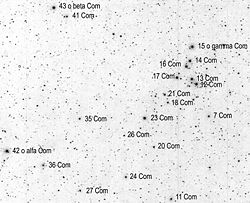 The only other fourth magnitude star in Coma Berenices is γ Comae Berenices
(4.36m).
Over 200 variable stars are known in Coma Berenices, although many of them are obscure. FK Comae Berenices
, which varies between 8.14m and 8.33m over a period of 2.4 days, is the prototype for the FK Com class of variable stars. It is believed that the variability of FK Com stars is caused by large, cool spots on the rotating surfaces of the stars. FS Comae Berenices is a semiregular variable that varies between 5.3m and 6.1m over a period of 58 days. R Comae Berenices is a Mira variable
star that varies between 7.1m and 14.6m over a period of 363 days.
Richard Hinckley Allen lists among others the following star names for stars in Coma:
(NGC 5024) is a globular cluster that was discovered by Bode
in 1775 and independently by Charles Messier
in February 1777. Its brightness is 7.7m, making it visible in binoculars. It is around 65,000 light years away and its total luminosity is around 200,000 times that of the Sun. Only 1° away is NGC 5053, a globular cluster that is sparser and has a less dense nucleus of stars. Its total luminosity is around 16,000 suns, which is one of the lowest luminosities of any globular cluster. It was discovered by Sir William Herschel in 1784. It is around magnitude 9.9 m. NGC 4147 is a somewhat dimmer (magnitude 10.2m) globular cluster with a much smaller apparent size.
M100
(NGC 4321) is a 9.4m spiral galaxy
seen face-on. At 7 arcminutes across, it has the largest apparent size of any galaxy in the Virgo cluster. It is located about 56 million light-years away. Its diameter is over 120,000 light years, making it among the largest spiral galaxies in the Virgo cluster. Photographs reveal a brilliant core, two prominent spiral arms and an array of secondary ones, as well as several dust lanes.
M85
(NGC 4382) is a lenticular galaxy
that is the northernmost outlier of the Virgo cluster. It is one of the brighter members of the cluster. M98
(NGC 4192) is a bright, elongated spiral that is seen nearly edge-on. It has a small nucleus and faint but vast spiral arms. M99
(NGC 4254), about 1.5° southeast of M98, is a bright, round spiral seen face-on. R.H. Allen called it the "Pinwheel nebula", although this name is more often applied to the Triangulum Galaxy
.
M88
(NGC 4501) is a multi-arm spiral galaxy, seen about 30° from edge-on.
M91
(NGC 4548) is a barred spiral galaxy
.
in 1957 identified 29,951 galaxies in the area that are brighter than 19.0m. While some of these may be distant background objects, the total number of galaxies in the cluster is quite large.
Due to the great distance to the cluster, most of the galaxies are only visible in large telescopes. The brightest members are NGC 4889
and NGC 4874
, both of which are of thirteenth magnitude, with most of the other members being of fifteenth magnitude or dimmer. NGC 4889 is a giant elliptical galaxy. The Coma cluster contains comparatively few spiral galaxies
. NGC 4921
is the brightest among them.
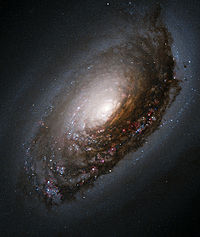 M64 (NGC 4826) is known as the Black Eye Galaxy
because of its prominent dark dust lane in front of the galaxy's bright nucleus. It is relatively nearby, at around 17 million light years away from Earth. Recent studies have revealed that the interstellar gas in the outer regions of the galaxy rotates in the opposite direction from that in the inner regions, leading astronomers to believe that at least one satellite galaxy had collided with it less than a billion years ago.
NGC 4565
is a spiral galaxy that is seen edge-on, and is called the "Needle Galaxy" for that reason. With an apparent length of 16 arcminutes, it has the largest apparent size of any galaxy seen edgewise from Earth. It appears quite thin and has a dark dust lane.
PG1247+26° is the brightest quasar visible in Coma Berenices. As well, W Com was originally identified as a variable star and so given a variable star designation, but later discovered to be a BL Lacertae
object. It is normally around magnitude 16.5 m, but has been known to reach 12th magnitude.
and declination
(epoch J2000.0).
, the stars of Coma Berenices are located in two areas: the Supreme Palace enclosure
(太微垣, Tài Wēi Yuán) and the Azure Dragon of the East (東方青龍, Dōng Fāng Qīng Lóng).
Asterism (astronomy)
In astronomy, an asterism is a pattern of stars recognized on Earth's night sky. It may form part of an official constellation, or be composed of stars from more than one. Like constellations, asterisms are in most cases composed of stars which, while they are visible in the same general direction,...
that has since been defined as one of the 88 modern constellation
Constellation
In modern astronomy, a constellation is an internationally defined area of the celestial sphere. These areas are grouped around asterisms, patterns formed by prominent stars within apparent proximity to one another on Earth's night sky....
s. It is located near Leo
Leo (constellation)
Leo is one of the constellations of the zodiac. Its name is Latin for lion. Its symbol is . Leo lies between dim Cancer to the west and Virgo to the east.-Stars:...
, to which it formerly belonged, and accommodates the North Galactic Pole. Its name means "Berenice's Hair" (in Greek
Greek language
Greek is an independent branch of the Indo-European family of languages. Native to the southern Balkans, it has the longest documented history of any Indo-European language, spanning 34 centuries of written records. Its writing system has been the Greek alphabet for the majority of its history;...
, via Latin
Latin
Latin is an Italic language originally spoken in Latium and Ancient Rome. It, along with most European languages, is a descendant of the ancient Proto-Indo-European language. Although it is considered a dead language, a number of scholars and members of the Christian clergy speak it fluently, and...
), and refers to the legend of Queen Berenice II of Egypt, who sacrificed her long hair.
History and mythology
Coma Berenices is one of the few constellations to owe its name to a historical figure, in this case Queen Berenice II of Egypt, wife of Ptolemy III Euergetes (fl. 246 BC–221 BC), the king under whom AlexandriaAlexandria
Alexandria is the second-largest city of Egypt, with a population of 4.1 million, extending about along the coast of the Mediterranean Sea in the north central part of the country; it is also the largest city lying directly on the Mediterranean coast. It is Egypt's largest seaport, serving...
became an important cultural center.
243 BC
Year 243 BC was a year of the pre-Julian Roman calendar. At the time it was known as the Year of the Consulship of Fundulus and Galus...
, Ptolemy, in the Third Syrian War, undertook a dangerous expedition against the Seleucids who had murdered his sister. His newlywed bride, Berenice, swore to the goddess Aphrodite
Aphrodite
Aphrodite is the Greek goddess of love, beauty, pleasure, and procreation.Her Roman equivalent is the goddess .Historically, her cult in Greece was imported from, or influenced by, the cult of Astarte in Phoenicia....
to sacrifice her long, blonde hair, of which she was extremely proud, if her husband returned safely. He did, and she had her hair cut and placed it in the goddess' temple. By the next morning the hair had disappeared. To appease the furious king the court astronomer, Conon
Conon of Samos
Conon of Samos was a Greek astronomer and mathematician. He is primarily remembered for naming the constellation Coma Berenices.-Life and work:...
, announced that the offering had so pleased the goddess, that she had placed it in the sky. He indicated a cluster of stars that have since been called Berenice's Hair.
This incident inspired the court poet, Callimachus of Cyrene
Callimachus
Callimachus was a native of the Greek colony of Cyrene, Libya. He was a noted poet, critic and scholar at the Library of Alexandria and enjoyed the patronage of the Egyptian–Greek Pharaohs Ptolemy II Philadelphus and Ptolemy III Euergetes...
to write a poem entitled Βερενίκης πλόκαμος (Greek "Berenice's braid"). About 2/3 of the Greek original is now lost, but before that happened, the poem has been translated to Latin by a Roman poet Catullus
Catullus
Gaius Valerius Catullus was a Latin poet of the Republican period. His surviving works are still read widely, and continue to influence poetry and other forms of art.-Biography:...
, and his version exists to this day.
Coma Berenices consists of a number of stars close together, and has been recognized as a distinct asterism
Asterism (astronomy)
In astronomy, an asterism is a pattern of stars recognized on Earth's night sky. It may form part of an official constellation, or be composed of stars from more than one. Like constellations, asterisms are in most cases composed of stars which, while they are visible in the same general direction,...
since the Hellenistic period
Hellenistic period
The Hellenistic period or Hellenistic era describes the time which followed the conquests of Alexander the Great. It was so named by the historian J. G. Droysen. During this time, Greek cultural influence and power was at its zenith in Europe and Asia...
. Eratosthenes
Eratosthenes
Eratosthenes of Cyrene was a Greek mathematician, poet, athlete, geographer, astronomer, and music theorist.He was the first person to use the word "geography" and invented the discipline of geography as we understand it...
referred to it as both "Ariadne
Ariadne
Ariadne , in Greek mythology, was the daughter of King Minos of Crete, and his queen Pasiphaë, daughter of Helios, the Sun-titan. She aided Theseus in overcoming the Minotaur and was the bride of the god Dionysus.-Minos and Theseus:...
's Hair" and "Berenice's Hair". Ptolemy
Ptolemy
Claudius Ptolemy , was a Roman citizen of Egypt who wrote in Greek. He was a mathematician, astronomer, geographer, astrologer, and poet of a single epigram in the Greek Anthology. He lived in Egypt under Roman rule, and is believed to have been born in the town of Ptolemais Hermiou in the...
referred to it as "the lock" of hair; however, he did not list it as one of his 48 constellations, considering it as part of Leo, considering it to be the tuft
Tuft
In the aviation field, the term tuft refers to a strip of yarn or string of varying length attached to an aircraft surface in a grid pattern and imaged during flight. The motion of these tufts during flight can be observed and recorded in order to locate flow features such as boundary layer...
at the end of the lion's tail.
Tycho Brahe
Tycho Brahe
Tycho Brahe , born Tyge Ottesen Brahe, was a Danish nobleman known for his accurate and comprehensive astronomical and planetary observations...
, who is usually given credit for Coma's promotion to constellation status, listed it in his star catalogue of 1602, but it originally occurred on a celestial globe by the cartographer Caspar Vopel from 1536, so Tycho Brahe obviously distinguished and measured up the constellation around a previous cartographers' tradition, originating from Ptolemy
Ptolemy
Claudius Ptolemy , was a Roman citizen of Egypt who wrote in Greek. He was a mathematician, astronomer, geographer, astrologer, and poet of a single epigram in the Greek Anthology. He lived in Egypt under Roman rule, and is believed to have been born in the town of Ptolemais Hermiou in the...
's explanatory texts in Almagest
Almagest
The Almagest is a 2nd-century mathematical and astronomical treatise on the apparent motions of the stars and planetary paths. Written in Greek by Claudius Ptolemy, a Roman era scholar of Egypt,...
.
It appeared in Johann Bayer
Johann Bayer
Johann Bayer was a German lawyer and uranographer . He was born in Rain, Bavaria, in 1572. He began his study of philosophy in Ingolstadt in 1592, and moved later to Augsburg to begin work as a lawyer. He grew interested in astronomy during his time in Augsburg...
's Uranometria
Uranometria
Uranometria is the short title of a star atlas produced by Johann Bayer.It was published in Augsburg, Germany, in 1603 by Christophorus Mangus under the full title Uranometria : omnium asterismorum continens schemata, nova methodo delineata, aereis laminis expressa. This translates to...
of 1603, and during the 17th century, a few other maps that were made of the sky followed suit.
Notable features
Although Coma Berenices is not a large constellation, it contains eight Messier objectMessier object
The Messier objects are a set of astronomical objects first listed by French astronomer Charles Messier in 1771. The original motivation of the catalogue was that Messier was a comet hunter, and was frustrated by objects which resembled but were not comets...
s. The constellation is rich in galaxies
Galaxy
A galaxy is a massive, gravitationally bound system that consists of stars and stellar remnants, an interstellar medium of gas and dust, and an important but poorly understood component tentatively dubbed dark matter. The word galaxy is derived from the Greek galaxias , literally "milky", a...
, containing the northern part of the Virgo cluster
Virgo Cluster
The Virgo Cluster is a cluster of galaxies whose center is 53.8 ± 0.3 Mly away in the constellation Virgo. Comprising approximately 1300 member galaxies, the cluster forms the heart of the larger Local Supercluster, of which the Local Group is an outlying member...
. There are also several globular cluster
Globular cluster
A globular cluster is a spherical collection of stars that orbits a galactic core as a satellite. Globular clusters are very tightly bound by gravity, which gives them their spherical shapes and relatively high stellar densities toward their centers. The name of this category of star cluster is...
s to be seen. These objects can be seen with minimal obscuration from dust because the constellation is not in the direction of the galactic plane. However, because of this fact, there are few open cluster
Open cluster
An open cluster is a group of up to a few thousand stars that were formed from the same giant molecular cloud and have roughly the same age. More than 1,100 open clusters have been discovered within the Milky Way Galaxy, and many more are thought to exist...
s (except for the Coma Berenices Cluster, which dominates the northern part of the constellation), diffuse nebula
Nebula
A nebula is an interstellar cloud of dust, hydrogen gas, helium gas and other ionized gases...
e, or planetary nebula
Planetary nebula
A planetary nebula is an emission nebula consisting of an expanding glowing shell of ionized gas ejected during the asymptotic giant branch phase of certain types of stars late in their life...
e.
Stars
Coma Berenices is not particularly bright, having no stars brighter than fourth magnitude. β Comae BerenicesBeta Comae Berenices
Beta Comae Berenices is a main sequence dwarf star in the constellation of Coma Berenices. It is located at a distance of about 30 light years. The Greek letter beta usually indicates that the star has the second highest visual magnitude in the constellation...
is the brightest star
Star
A star is a massive, luminous sphere of plasma held together by gravity. At the end of its lifetime, a star can also contain a proportion of degenerate matter. The nearest star to Earth is the Sun, which is the source of most of the energy on Earth...
in the constellation, at magnitude
Apparent magnitude
The apparent magnitude of a celestial body is a measure of its brightness as seen by an observer on Earth, adjusted to the value it would have in the absence of the atmosphere...
4.26. It is intrinsically only slightly brighter than the Sun
Sun
The Sun is the star at the center of the Solar System. It is almost perfectly spherical and consists of hot plasma interwoven with magnetic fields...
, which gives an idea of how faint the Sun would appear seen from 29.96 light years away.
The second brightest star in Coma Berenices is α Comae Berenices
Alpha Comae Berenices
Alpha Comae Berenices is a star in the constellation Coma Berenices . Although it has the Bayer designation "alpha", at magnitude 4.32 it is actually fainter than Beta Comae Berenices. It has the traditional name Diadem. It is said to represent the crown worn by Queen Berenice...
(4.32m), also called Diadem
Diadem
Diadem may refer to:*Diadem, a type of crown-Military:*HMS Diadem was a 64-gun third rate ship of the line in the Royal Navy launched in 1782 at Chatham and participated in the Battle of Cape St Vincent in 1787...
. The name represents the gem in Berenice's crown. It is a binary star
Binary star
A binary star is a star system consisting of two stars orbiting around their common center of mass. The brighter star is called the primary and the other is its companion star, comes, or secondary...
, with two components of almost equal magnitude. Because the orbital plane
Orbital plane (astronomy)
All of the planets, comets, and asteroids in the solar system are in orbit around the Sun. All of those orbits line up with each other making a semi-flat disk called the orbital plane. The orbital plane of an object orbiting another is the geometrical plane in which the orbit is embedded...
is so close to the Earth's line of sight, it was long suspected of being an eclipsing binary, but it now appears that the orbital tilt is 0.1° relative to the line of sight, so the stars do not eclipse each other as seen from Earth.
Gamma Comae Berenices
Gamma Comae Berenices is a K-type giant star in the constellation of Coma Berenices. It has an apparent visual magnitude of approximately 4.350. It appears as part of the cluster Melotte 111, although it is probably not actually in this cluster....
(4.36m).
Over 200 variable stars are known in Coma Berenices, although many of them are obscure. FK Comae Berenices
FK Comae Berenices
FK Comae Berenices is a variable star that varies in apparent magnitude between 8.14m and 8.33m over a period of 2.4 days. It is the prototype for the FK Com class of variable stars. The variability of FK Com stars may be caused by large, cool spots on the rotating surfaces of the stars....
, which varies between 8.14m and 8.33m over a period of 2.4 days, is the prototype for the FK Com class of variable stars. It is believed that the variability of FK Com stars is caused by large, cool spots on the rotating surfaces of the stars. FS Comae Berenices is a semiregular variable that varies between 5.3m and 6.1m over a period of 58 days. R Comae Berenices is a Mira variable
Mira variable
Mira variables , named after the star Mira, are a class of pulsating variable stars characterized by very red colors, pulsation periods longer than 100 days, and light amplitudes greater than one magnitude in infrared and 2.5 magnitude in visual...
star that varies between 7.1m and 14.6m over a period of 363 days.
Richard Hinckley Allen lists among others the following star names for stars in Coma:
| Bayer Bayer Bayer AG is a chemical and pharmaceutical company founded in Barmen , Germany in 1863. It is headquartered in Leverkusen, North Rhine-Westphalia, Germany and well known for its original brand of aspirin.-History:... |
Name | Origin | Meaning |
|---|---|---|---|
| α Com | Diadem | Latin Latin Latin is an Italic language originally spoken in Latium and Ancient Rome. It, along with most European languages, is a descendant of the ancient Proto-Indo-European language. Although it is considered a dead language, a number of scholars and members of the Christian clergy speak it fluently, and... |
diadem |
| β Com | Al Ḍafīrah | Arabic | the curl |
| ρ Com | Shang Tseang | Chinese Chinese language The Chinese language is a language or language family consisting of varieties which are mutually intelligible to varying degrees. Originally the indigenous languages spoken by the Han Chinese in China, it forms one of the branches of Sino-Tibetan family of languages... |
higher army general |
| 21 Com | Kissīn | Greek??? Greek language Greek is an independent branch of the Indo-European family of languages. Native to the southern Balkans, it has the longest documented history of any Indo-European language, spanning 34 centuries of written records. Its writing system has been the Greek alphabet for the majority of its history;... |
species of ivy Ivy Ivy, plural ivies is a genus of 12–15 species of evergreen climbing or ground-creeping woody plants in the family Araliaceae, native to western, central and southern Europe, Macaronesia, northwestern Africa and across central-southern Asia east to Japan and Taiwan.-Description:On level ground they... |
Coma Berenices Open Cluster
The Coma Berenices Cluster does not have a Messier or an NGC designation, but it is in the Melotte catalogue of open clusters, where it is designated Melotte 111. It is a large, diffuse open cluster of stars that range between 5th and 10th magnitudes, including several of the naked eye stars in the constellation. The cluster is spread over a huge region, more than 5 degrees across, near γ Coma Berenices. The cluster has such a large apparent size because it is relatively nearby, only around 270 light years away.Globular clusters
M53Messier 53
Messier 53 is a globular cluster in the Coma Berenices constellation. It was discovered by Johann Elert Bode in 1775. M53 is one of the more outlying globular clusters, being about 60,000 light-years away from the Galactic Center, and almost the same distance from the Solar system.-External links:*...
(NGC 5024) is a globular cluster that was discovered by Bode
Johann Elert Bode
Johann Elert Bode was a German astronomer known for his reformulation and popularization of the Titius-Bode law. Bode determined the orbit of Uranus and suggested the planet's name.-Biography:...
in 1775 and independently by Charles Messier
Charles Messier
Charles Messier was a French astronomer most notable for publishing an astronomical catalogue consisting of deep sky objects such as nebulae and star clusters that came to be known as the 110 "Messier objects"...
in February 1777. Its brightness is 7.7m, making it visible in binoculars. It is around 65,000 light years away and its total luminosity is around 200,000 times that of the Sun. Only 1° away is NGC 5053, a globular cluster that is sparser and has a less dense nucleus of stars. Its total luminosity is around 16,000 suns, which is one of the lowest luminosities of any globular cluster. It was discovered by Sir William Herschel in 1784. It is around magnitude 9.9 m. NGC 4147 is a somewhat dimmer (magnitude 10.2m) globular cluster with a much smaller apparent size.
Virgo cluster of galaxies
Coma Berenices contains the northern portion of the Virgo cluster (also known as the Coma-Virgo cluster), which is around 60 million light years away.M100
Messier 100
Messier 100 is an example of a grand design spiral galaxy located within the southern part of constellation Coma Berenices. It is one of the brightest galaxies in the Virgo cluster, approximately 55 million light-years distant from Earth and has a diameter of 160,000 light years...
(NGC 4321) is a 9.4m spiral galaxy
Spiral galaxy
A spiral galaxy is a certain kind of galaxy originally described by Edwin Hubble in his 1936 work The Realm of the Nebulae and, as such, forms part of the Hubble sequence. Spiral galaxies consist of a flat, rotating disk containing stars, gas and dust, and a central concentration of stars known as...
seen face-on. At 7 arcminutes across, it has the largest apparent size of any galaxy in the Virgo cluster. It is located about 56 million light-years away. Its diameter is over 120,000 light years, making it among the largest spiral galaxies in the Virgo cluster. Photographs reveal a brilliant core, two prominent spiral arms and an array of secondary ones, as well as several dust lanes.
M85
Messier 85
Messier 85 is a lenticular galaxy in the Coma Berenices constellation. It is 60 million light years away, making it the 94th most distant Messier object, and it estimated to be 125,000 light years across....
(NGC 4382) is a lenticular galaxy
Lenticular galaxy
A lenticular galaxy is a type of galaxy which is intermediate between an elliptical galaxy and a spiral galaxy in galaxy morphological classification schemes. Lenticular galaxies are disk galaxies which have used up or lost most of their interstellar matter and therefore have very little ongoing...
that is the northernmost outlier of the Virgo cluster. It is one of the brighter members of the cluster. M98
Messier 98
Messier 98 is an intermediate spiral galaxy about 60 million light-years away in the constellation Coma Berenices. It was discovered by Pierre Méchain on March 15, 1781 along with M99 and M100 and was cataloged as a Messier object on April 13, 1781...
(NGC 4192) is a bright, elongated spiral that is seen nearly edge-on. It has a small nucleus and faint but vast spiral arms. M99
Messier 99
Messier 99 is an unbarred spiral galaxy approximately 50 million light-years away in the constellation Coma Berenices....
(NGC 4254), about 1.5° southeast of M98, is a bright, round spiral seen face-on. R.H. Allen called it the "Pinwheel nebula", although this name is more often applied to the Triangulum Galaxy
Triangulum Galaxy
The Triangulum Galaxy is a spiral galaxy approximately 3 million light years from Earth in the constellation Triangulum. It is catalogued as Messier 33 or NGC 598, and is sometimes informally referred to as the Pinwheel Galaxy, a nickname it shares with Messier 101...
.
M88
Messier 88
Messier 88 is a spiral galaxy about 47 million light-years away in the constellation Coma Berenices. It was discovered by Charles Messier in 1781.-Properties:...
(NGC 4501) is a multi-arm spiral galaxy, seen about 30° from edge-on.
M91
Messier 91
Messier 91 is a barred spiral galaxy located in the Coma Berenices constellation and is part of the Virgo Cluster of galaxies. M91 is about 63 million light-years away from the earth. It was the last of a group of eight nebulae discovered by Charles Messier in 1781...
(NGC 4548) is a barred spiral galaxy
Barred spiral galaxy
A barred spiral galaxy is a spiral galaxy with a central bar-shaped structure composed of stars. Bars are found in approximately two-thirds of all spiral galaxies...
.
Coma cluster of galaxies
The Coma cluster of galaxies is to the north of the Virgo cluster. It lies much further off, however, around 230 to 300 million light years away. The cluster is quite large, containing 1,000 large galaxies and possibly up to 30,000 smaller ones. A survey by Fritz ZwickyFritz Zwicky
Fritz Zwicky was a Swiss astronomer. He worked most of his life at the California Institute of Technology in the United States of America, where he made many important contributions in theoretical and observational astronomy.- Biography :Fritz Zwicky was born in Varna, Bulgaria to a Swiss father....
in 1957 identified 29,951 galaxies in the area that are brighter than 19.0m. While some of these may be distant background objects, the total number of galaxies in the cluster is quite large.
Due to the great distance to the cluster, most of the galaxies are only visible in large telescopes. The brightest members are NGC 4889
NGC 4889
NGC 4889, also known as Caldwell 35, is a supergiant class-4 elliptical galaxy, the brightest within the Coma cluster and a Caldwell object in the constellation Coma Berenices. It shines at magnitude +11.4. Its celestial coordinates are RA 13h00.1m, DEC +27°59'...
and NGC 4874
NGC 4874
NGC 4874 is giant elliptical galaxy, about ten times larger than the Milky Way, at the centre of the Coma Galaxy Cluster. With its strong gravitational pull, it is able to hold onto more than 30.000 globular clusters of stars and even has a few dwarf galaxies in its grasp....
, both of which are of thirteenth magnitude, with most of the other members being of fifteenth magnitude or dimmer. NGC 4889 is a giant elliptical galaxy. The Coma cluster contains comparatively few spiral galaxies
Spiral galaxy
A spiral galaxy is a certain kind of galaxy originally described by Edwin Hubble in his 1936 work The Realm of the Nebulae and, as such, forms part of the Hubble sequence. Spiral galaxies consist of a flat, rotating disk containing stars, gas and dust, and a central concentration of stars known as...
. NGC 4921
NGC 4921
NGC 4921 is a barred spiral galaxy in the Coma Cluster, located in the constellation Coma Berenices. It is about 320 million light-years from Earth. The galaxy has a nucleus with a bar structure that is surrounded by a distinct ring of dust that contains recently formed, hot blue stars...
is the brightest among them.
Other galaxies
Black Eye Galaxy
The Black Eye Galaxy was discovered by Edward Pigott in March 1779, and independently by Johann Elert Bode in April of the same year, as well as by Charles Messier in 1780...
because of its prominent dark dust lane in front of the galaxy's bright nucleus. It is relatively nearby, at around 17 million light years away from Earth. Recent studies have revealed that the interstellar gas in the outer regions of the galaxy rotates in the opposite direction from that in the inner regions, leading astronomers to believe that at least one satellite galaxy had collided with it less than a billion years ago.
NGC 4565
NGC 4565
NGC 4565 is an edge-on spiral galaxy about 30 to 50 million light-years away in the constellation Coma Berenices....
is a spiral galaxy that is seen edge-on, and is called the "Needle Galaxy" for that reason. With an apparent length of 16 arcminutes, it has the largest apparent size of any galaxy seen edgewise from Earth. It appears quite thin and has a dark dust lane.
Quasars
QuasarQuasar
A quasi-stellar radio source is a very energetic and distant active galactic nucleus. Quasars are extremely luminous and were first identified as being high redshift sources of electromagnetic energy, including radio waves and visible light, that were point-like, similar to stars, rather than...
PG1247+26° is the brightest quasar visible in Coma Berenices. As well, W Com was originally identified as a variable star and so given a variable star designation, but later discovered to be a BL Lacertae
BL Lacertae
BL Lacertae or BL Lac is a highly variable, extragalactic AGN . It was first discovered by Cuno Hoffmeister in 1929, but was originally thought to be an irregular variable star in the Milky Way galaxy and so was given a variable star designation...
object. It is normally around magnitude 16.5 m, but has been known to reach 12th magnitude.
Other
Coma Berenices contains the North Galactic Pole, at right ascensionRight ascension
Right ascension is the astronomical term for one of the two coordinates of a point on the celestial sphere when using the equatorial coordinate system. The other coordinate is the declination.-Explanation:...
and declination
Declination
In astronomy, declination is one of the two coordinates of the equatorial coordinate system, the other being either right ascension or hour angle. Declination in astronomy is comparable to geographic latitude, but projected onto the celestial sphere. Declination is measured in degrees north and...
(epoch J2000.0).
Equivalents
In Chinese astronomyChinese astronomy
Astronomy in China has a very long history, with historians considering that "they [the Chinese] were the most persistent and accurate observers of celestial phenomena anywhere in the world before the Arabs."...
, the stars of Coma Berenices are located in two areas: the Supreme Palace enclosure
Supreme Palace enclosure
Tai Wei Yuan, the Supreme Palace Enclosure , is one of the San Yuan or Three enclosures. Stars and constellations of this group are visible during autumn in the Northern Hemisphere .-Asterisms:The asterisms are :...
(太微垣, Tài Wēi Yuán) and the Azure Dragon of the East (東方青龍, Dōng Fāng Qīng Lóng).