

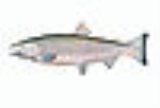
Coho salmon

Encyclopedia
The Coho salmon, Oncorhynchus kisutch, (from the Russian
кижуч kizhuch) is a species
of anadromous fish
in the salmon
family
. Coho salmon are also known as silver salmon or "silvers". It is the state animal of Chiba
, Japan
.
phase, Coho have silver sides and dark blue backs. During their spawning phase, the jaw
s and teeth of the coho become hooked. They develop bright red sides, bluish green heads and backs, dark bellies and dark spots on their backs after they go in to fresh water. Sexually maturing coho develop a light pink or rose shading along the belly and the males may show a slight arching of the back. Mature adults have a pronounced red skin color with darker backs and average 28 inches (71.1 cm) and 7 to 11 lb (3.2 to 5 kg) occasionally reaching 36 pounds (16.3 kg). Mature females may be darker than males, with both showing a pronounced hook on the nose.
, and rely on their yolk sac for nourishment during growth. The alevin life stage is very sensitive to aquatic and sedimental contaminants. When the yolk sac is completely resorbed, the alevin leaves the redd. Young coho spend one to two years in their freshwater natal streams,often spending the first winter in off-channel slough
s, before transforming to the smolt
life-stage. Smolts are generally 100–150 mm (3.9–5.9 in) and their parr marks are faded and the adult's characteristic silver scales start to dominate. Smolts migrate to the ocean from late March through July. Some fish
leave fresh water in the spring, spend summer in brackish estuarine
ponds and then return to fresh water in the fall. Coho salmon live in salt water for one to three years before returning to spawn
. Some precocious males known as "jacks" return as two-year-old spawners. Spawning males develop a strongly hooked snout
and large teeth.
, Japan
and eastern Russian, around the Bering Sea
to mainland Alaska
, and south all the way to Monterey Bay, California. Coho salmon have also been introduced in all the Great Lakes
, as well as many landlocked reservoirs throughout the United States
.
This species is a game fish
and provides fine sport in fresh and salt water from July to December, especially with light fishing tackle
. It is one of the most popular sport fish in the Pacific Northwest
of the United States. Its popularity is due in part to the reckless abandon which it frequently displays chasing bait
and lure
while in salt water
, and the large number of coastal streams it ascends during its spawning runs. Its habit of schooling in relatively shallow water, and often near beaches, makes it accessible to anglers on the banks as well as in boats.
Ocean caught coho is regarded as excellent table fare. It has a moderate to high amount of fat, which is considered essential when judging taste. Only Spring Chinook
and Sockeye salmon
have higher levels of fats in their meat.
Historically, the coho, along with other species, has been a staple in the diet of several Indigenous Peoples
, who would also use it to trade with other tribes farther inland. The coho salmon is also a symbol of several tribes, representing life and sustenance.
During November 1997, a Portland television station and The Oregonian teamed with the Oregon chapter of the American Meteorological Society (AMS) to name the strong Columbia River Gorge winds through a contest. Some 7,000 entries were submitted to the "Name our East Wind Contest" with a total of 2,424 different names. The name 'Coho' was judged to be the best name, since it is easy to pronounce (and spell), it's an indigenous name to the Pacific Northwest, Coho salmon are wild fast swimmers analogous to the wind, and it relates to the widely known westerly Chinook winds that are also a name of a salmon.
Salmonid species on the west coast of the United States have experienced dramatic declines in abundance during the past several decades as a result of human-induced and natural factors.
(NMFS) has identified seven populations, called Evolutionary Significant Units (ESUs), of coho salmon in Washington, Oregon
and California. Four of these ESUs are listed under the U.S. Endangered Species Act
(ESA). These are the Lower Columbia River
(threatened), Oregon Coast (threatened), Southern Oregon and Northern California
Coasts (threatened), and Central California Coast (endangered). The long-term trend for the listed populations is still downward, though there was one recent good year with an increasing trend in 2001.
The Puget Sound
/Strait of Georgia
ESU in Washington state is a NMFS "Species of Concern". Species of Concern are those species for which insufficient information prevents resolving the U.S. National Oceanic and Atmospheric Administration
's concerns regarding status and threats and whether to list the species under the ESA.
On May 6, 1997, NMFS, on behalf of the Secretary of Commerce
, listed as threatened the Southern Oregon/Northern California Coast coho salmon ESU. The coho salmon population in the Southern Oregon/Northern California region has declined from an estimated 150,000–400,000 naturally spawning fish in the 1940s to fewer than 10,000 naturally producing adults today. These reductions are due to natural and man-made changes, including short-term atmospheric trends, such as El Niño, which causes extremes in annual rainfall on the northern California coast; predation by the California Sea Lion
and Pacific Harbor Seal
; and commercial timber harvesting.
More than 680,000 coho returned to Oregon in 2009, double that of 2007. The Oregon Department of Fish & Wildlife required volunteers to herd fish into hatchery pens. There were reports of creeks with so many fish that "you could literally walk across on the backs of Coho," said Grant McOmie, outdoors correspondent for a Portland television station. Lower temperatures in 2008 North Pacific waters brought in fatter plankton
which, along with greater outflows of Columbia River
water, feeding the resurgent populations. The 2009 run was so large that food banks were able to freeze 40 tonnes (39.4 LT) for later use.
.
Russian language
Russian is a Slavic language used primarily in Russia, Belarus, Uzbekistan, Kazakhstan, Tajikistan and Kyrgyzstan. It is an unofficial but widely spoken language in Ukraine, Moldova, Latvia, Turkmenistan and Estonia and, to a lesser extent, the other countries that were once constituent republics...
кижуч kizhuch) is a species
Species
In biology, a species is one of the basic units of biological classification and a taxonomic rank. A species is often defined as a group of organisms capable of interbreeding and producing fertile offspring. While in many cases this definition is adequate, more precise or differing measures are...
of anadromous fish
Fish
Fish are a paraphyletic group of organisms that consist of all gill-bearing aquatic vertebrate animals that lack limbs with digits. Included in this definition are the living hagfish, lampreys, and cartilaginous and bony fish, as well as various extinct related groups...
in the salmon
Salmon
Salmon is the common name for several species of fish in the family Salmonidae. Several other fish in the same family are called trout; the difference is often said to be that salmon migrate and trout are resident, but this distinction does not strictly hold true...
family
Family (biology)
In biological classification, family is* a taxonomic rank. Other well-known ranks are life, domain, kingdom, phylum, class, order, genus, and species, with family fitting between order and genus. As for the other well-known ranks, there is the option of an immediately lower rank, indicated by the...
. Coho salmon are also known as silver salmon or "silvers". It is the state animal of Chiba
Chiba Prefecture
is a prefecture of Japan located in the Kantō region and the Greater Tokyo Area. Its capital is Chiba City.- History :Chiba Prefecture was established on June 15, 1873 with the merger of Kisarazu Prefecture and Inba Prefecture...
, Japan
Japan
Japan is an island nation in East Asia. Located in the Pacific Ocean, it lies to the east of the Sea of Japan, China, North Korea, South Korea and Russia, stretching from the Sea of Okhotsk in the north to the East China Sea and Taiwan in the south...
.
Description
During their oceanOcean
An ocean is a major body of saline water, and a principal component of the hydrosphere. Approximately 71% of the Earth's surface is covered by ocean, a continuous body of water that is customarily divided into several principal oceans and smaller seas.More than half of this area is over 3,000...
phase, Coho have silver sides and dark blue backs. During their spawning phase, the jaw
Jaw
The jaw is any opposable articulated structure at the entrance of the mouth, typically used for grasping and manipulating food. The term jaws is also broadly applied to the whole of the structures constituting the vault of the mouth and serving to open and close it and is part of the body plan of...
s and teeth of the coho become hooked. They develop bright red sides, bluish green heads and backs, dark bellies and dark spots on their backs after they go in to fresh water. Sexually maturing coho develop a light pink or rose shading along the belly and the males may show a slight arching of the back. Mature adults have a pronounced red skin color with darker backs and average 28 inches (71.1 cm) and 7 to 11 lb (3.2 to 5 kg) occasionally reaching 36 pounds (16.3 kg). Mature females may be darker than males, with both showing a pronounced hook on the nose.
Reproduction
The eggs hatch in the late winter or early spring after 6 to 7 weeks in the redd. Once hatched, they remain mostly immobile in the redd as the alevin life-stage, which lasts for 6–7 weeks. Alevin no longer have the protective egg shell, or chorionChorion
The chorion is one of the membranes that exist during pregnancy between the developing fetus and mother. It is formed by extraembryonic mesoderm and the two layers of trophoblast and surrounds the embryo and other membranes...
, and rely on their yolk sac for nourishment during growth. The alevin life stage is very sensitive to aquatic and sedimental contaminants. When the yolk sac is completely resorbed, the alevin leaves the redd. Young coho spend one to two years in their freshwater natal streams,often spending the first winter in off-channel slough
Slough
Slough is a borough and unitary authority within the ceremonial county of Royal Berkshire, England. The town straddles the A4 Bath Road and the Great Western Main Line, west of central London...
s, before transforming to the smolt
Spawn (biology)
Spawn refers to the eggs and sperm released or deposited, usually into water, by aquatic animals. As a verb, spawn refers to the process of releasing the eggs and sperm, also called spawning...
life-stage. Smolts are generally 100–150 mm (3.9–5.9 in) and their parr marks are faded and the adult's characteristic silver scales start to dominate. Smolts migrate to the ocean from late March through July. Some fish
Fish
Fish are a paraphyletic group of organisms that consist of all gill-bearing aquatic vertebrate animals that lack limbs with digits. Included in this definition are the living hagfish, lampreys, and cartilaginous and bony fish, as well as various extinct related groups...
leave fresh water in the spring, spend summer in brackish estuarine
Estuary
An estuary is a partly enclosed coastal body of water with one or more rivers or streams flowing into it, and with a free connection to the open sea....
ponds and then return to fresh water in the fall. Coho salmon live in salt water for one to three years before returning to spawn
Spawn (biology)
Spawn refers to the eggs and sperm released or deposited, usually into water, by aquatic animals. As a verb, spawn refers to the process of releasing the eggs and sperm, also called spawning...
. Some precocious males known as "jacks" return as two-year-old spawners. Spawning males develop a strongly hooked snout
Snout
The snout, or muzzle, is the protruding portion of an animal's face, consisting of its nose, mouth, and jaw.-Terminology:The term "muzzle", used as a noun, can be ambiguous...
and large teeth.
Range
The traditional range of the coho salmon runs from both sides of the North Pacific ocean, from HokkaidōHokkaido
, formerly known as Ezo, Yezo, Yeso, or Yesso, is Japan's second largest island; it is also the largest and northernmost of Japan's 47 prefectural-level subdivisions. The Tsugaru Strait separates Hokkaido from Honshu, although the two islands are connected by the underwater railway Seikan Tunnel...
, Japan
Japan
Japan is an island nation in East Asia. Located in the Pacific Ocean, it lies to the east of the Sea of Japan, China, North Korea, South Korea and Russia, stretching from the Sea of Okhotsk in the north to the East China Sea and Taiwan in the south...
and eastern Russian, around the Bering Sea
Bering Sea
The Bering Sea is a marginal sea of the Pacific Ocean. It comprises a deep water basin, which then rises through a narrow slope into the shallower water above the continental shelves....
to mainland Alaska
Alaska
Alaska is the largest state in the United States by area. It is situated in the northwest extremity of the North American continent, with Canada to the east, the Arctic Ocean to the north, and the Pacific Ocean to the west and south, with Russia further west across the Bering Strait...
, and south all the way to Monterey Bay, California. Coho salmon have also been introduced in all the Great Lakes
Great Lakes
The Great Lakes are a collection of freshwater lakes located in northeastern North America, on the Canada – United States border. Consisting of Lakes Superior, Michigan, Huron, Erie, and Ontario, they form the largest group of freshwater lakes on Earth by total surface, coming in second by volume...
, as well as many landlocked reservoirs throughout the United States
United States
The United States of America is a federal constitutional republic comprising fifty states and a federal district...
.
Human uses
Coho salmon are the backbone of the Alaska troll fishery, however, the majority are caught by the net fishery (Gillnet and Seine). Coho salmon average 3.5% by fish of the annual Alaska salmon harvest; 5.9% by weight of the annual Alaska salmon harvest. (Alaska Seafood Marketing Institute, 2003, p. 2)This species is a game fish
Game fish
Game fish are fish pursued for sport by recreational anglers. They can be freshwater or marine fish. Game fish can be eaten after being caught, though increasingly anglers practise catch and release to improve fish populations. Some game fish are also targeted commercially, particularly...
and provides fine sport in fresh and salt water from July to December, especially with light fishing tackle
Fishing tackle
Fishing tackle, is a general term that refers to the equipment used by fishermen when fishing. Almost any equipment or gear used for fishing can be called fishing tackle. Some examples are hooks, lines, sinkers, floats, rods, reels, baits, lures, spears, nets, gaffs, traps, waders and tackle...
. It is one of the most popular sport fish in the Pacific Northwest
Pacific Northwest
The Pacific Northwest is a region in northwestern North America, bounded by the Pacific Ocean to the west and, loosely, by the Rocky Mountains on the east. Definitions of the region vary and there is no commonly agreed upon boundary, even among Pacific Northwesterners. A common concept of the...
of the United States. Its popularity is due in part to the reckless abandon which it frequently displays chasing bait
Fishing bait
Fishing bait is any substance used to attract and catch fish, e.g. on the end of a fishing hook, or inside a fish trap. Traditionally, nightcrawlers, insects, and smaller bait fish have been used for this purpose...
and lure
Fishing lure
A fishing lure is an object attached to the end of a fishing line which is designed to resemble and move like the prey of a fish. The purpose of the lure is to use movement, vibration, and colour to catch the fish's attention so it bites the hook...
while in salt water
Seawater
Seawater is water from a sea or ocean. On average, seawater in the world's oceans has a salinity of about 3.5% . This means that every kilogram of seawater has approximately of dissolved salts . The average density of seawater at the ocean surface is 1.025 g/ml...
, and the large number of coastal streams it ascends during its spawning runs. Its habit of schooling in relatively shallow water, and often near beaches, makes it accessible to anglers on the banks as well as in boats.
Ocean caught coho is regarded as excellent table fare. It has a moderate to high amount of fat, which is considered essential when judging taste. Only Spring Chinook
Chinook salmon
The Chinook salmon, Oncorhynchus tshawytscha, is the largest species in the pacific salmon family. Other commonly used names for the species include King salmon, Quinnat salmon, Spring salmon and Tyee salmon...
and Sockeye salmon
Sockeye salmon
Sockeye salmon , also called red salmon or blueback salmon in the USA, is an anadromous species of salmon found in the Northern Pacific Ocean and rivers discharging into it...
have higher levels of fats in their meat.
Historically, the coho, along with other species, has been a staple in the diet of several Indigenous Peoples
Indigenous peoples of the Americas
The indigenous peoples of the Americas are the pre-Columbian inhabitants of North and South America, their descendants and other ethnic groups who are identified with those peoples. Indigenous peoples are known in Canada as Aboriginal peoples, and in the United States as Native Americans...
, who would also use it to trade with other tribes farther inland. The coho salmon is also a symbol of several tribes, representing life and sustenance.
During November 1997, a Portland television station and The Oregonian teamed with the Oregon chapter of the American Meteorological Society (AMS) to name the strong Columbia River Gorge winds through a contest. Some 7,000 entries were submitted to the "Name our East Wind Contest" with a total of 2,424 different names. The name 'Coho' was judged to be the best name, since it is easy to pronounce (and spell), it's an indigenous name to the Pacific Northwest, Coho salmon are wild fast swimmers analogous to the wind, and it relates to the widely known westerly Chinook winds that are also a name of a salmon.
Ecology
In their freshwater stages, coho feed on plankton and insects, and switch to a diet of small fishes as adults in the ocean. Spawning habitat is small streams with stable gravel substrates.Salmonid species on the west coast of the United States have experienced dramatic declines in abundance during the past several decades as a result of human-induced and natural factors.
Conservation
The U.S. National Marine Fisheries ServiceNational Marine Fisheries Service
The National Marine Fisheries Service is a United States federal agency. A division of the National Oceanic and Atmospheric Administration and the Department of Commerce, NMFS is responsible for the stewardship and management of the nation's living marine resources and their habitat within the...
(NMFS) has identified seven populations, called Evolutionary Significant Units (ESUs), of coho salmon in Washington, Oregon
Oregon
Oregon is a state in the Pacific Northwest region of the United States. It is located on the Pacific coast, with Washington to the north, California to the south, Nevada on the southeast and Idaho to the east. The Columbia and Snake rivers delineate much of Oregon's northern and eastern...
and California. Four of these ESUs are listed under the U.S. Endangered Species Act
Endangered Species Act
The Endangered Species Act of 1973 is one of the dozens of United States environmental laws passed in the 1970s. Signed into law by President Richard Nixon on December 28, 1973, it was designed to protect critically imperiled species from extinction as a "consequence of economic growth and...
(ESA). These are the Lower Columbia River
Columbia River
The Columbia River is the largest river in the Pacific Northwest region of North America. The river rises in the Rocky Mountains of British Columbia, Canada, flows northwest and then south into the U.S. state of Washington, then turns west to form most of the border between Washington and the state...
(threatened), Oregon Coast (threatened), Southern Oregon and Northern California
California
California is a state located on the West Coast of the United States. It is by far the most populous U.S. state, and the third-largest by land area...
Coasts (threatened), and Central California Coast (endangered). The long-term trend for the listed populations is still downward, though there was one recent good year with an increasing trend in 2001.
The Puget Sound
Puget Sound
Puget Sound is a sound in the U.S. state of Washington. It is a complex estuarine system of interconnected marine waterways and basins, with one major and one minor connection to the Strait of Juan de Fuca and the Pacific Ocean — Admiralty Inlet being the major connection and...
/Strait of Georgia
Strait of Georgia
The Strait of Georgia or the Georgia Strait is a strait between Vancouver Island and the mainland coast of British Columbia, Canada. It is approximately long and varies in width from...
ESU in Washington state is a NMFS "Species of Concern". Species of Concern are those species for which insufficient information prevents resolving the U.S. National Oceanic and Atmospheric Administration
National Oceanic and Atmospheric Administration
The National Oceanic and Atmospheric Administration , pronounced , like "noah", is a scientific agency within the United States Department of Commerce focused on the conditions of the oceans and the atmosphere...
's concerns regarding status and threats and whether to list the species under the ESA.
On May 6, 1997, NMFS, on behalf of the Secretary of Commerce
United States Secretary of Commerce
The United States Secretary of Commerce is the head of the United States Department of Commerce concerned with business and industry; the Department states its mission to be "to foster, promote, and develop the foreign and domestic commerce"...
, listed as threatened the Southern Oregon/Northern California Coast coho salmon ESU. The coho salmon population in the Southern Oregon/Northern California region has declined from an estimated 150,000–400,000 naturally spawning fish in the 1940s to fewer than 10,000 naturally producing adults today. These reductions are due to natural and man-made changes, including short-term atmospheric trends, such as El Niño, which causes extremes in annual rainfall on the northern California coast; predation by the California Sea Lion
California Sea Lion
The California sea lion is a coastal sea lion of western North America. Their numbers are abundant , and the population continues to expand about 5% annually. They are quite intelligent and can adapt to man-made environments...
and Pacific Harbor Seal
Harbor Seal
The harbor seal , also known as the common seal, is a true seal found along temperate and Arctic marine coastlines of the Northern Hemisphere...
; and commercial timber harvesting.
More than 680,000 coho returned to Oregon in 2009, double that of 2007. The Oregon Department of Fish & Wildlife required volunteers to herd fish into hatchery pens. There were reports of creeks with so many fish that "you could literally walk across on the backs of Coho," said Grant McOmie, outdoors correspondent for a Portland television station. Lower temperatures in 2008 North Pacific waters brought in fatter plankton
Plankton
Plankton are any drifting organisms that inhabit the pelagic zone of oceans, seas, or bodies of fresh water. That is, plankton are defined by their ecological niche rather than phylogenetic or taxonomic classification...
which, along with greater outflows of Columbia River
Columbia River
The Columbia River is the largest river in the Pacific Northwest region of North America. The river rises in the Rocky Mountains of British Columbia, Canada, flows northwest and then south into the U.S. state of Washington, then turns west to form most of the border between Washington and the state...
water, feeding the resurgent populations. The 2009 run was so large that food banks were able to freeze 40 tonnes (39.4 LT) for later use.
.
Technical reports
- Use of three microhabitats by juvenile coho salmon in Jordan Creek during the winter, 2004-2005 / by Ryan J. Briscoe. Hosted by the Alaska State Publications Program.