

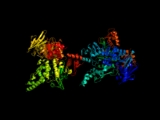
Cohesin

Encyclopedia
Cohesin is a protein complex
that regulates the separation of sister chromatids
during cell division, either mitosis
or meiosis
.
is present, the two ATPase domains are able to bind, forming a ring structure. ATP hydrolysis can therefore trigger opening and closing of the ring.
Scc1 and Scc3 bind the ATPase domains of Smc1 and Smc3 stabilizing the ring structure. Scc1 is a member of the kleisin protein family and it controls sister-chromatid separation. The amino and carboxy terminus of Scc1 bind Smc1 and Smc3. Once Scc1 binds on the SMC proteins, Scc3 can also associate by binding with the C-terminal region of Scc1. When Scc1 binds on both Smc1 and Smc3, the cohesin complex forms a closed ring structure. When it binds to only one of the SMC proteins, the complex forms an open ring.
However more recently cohesin rings were found to dimerise, with two rings held together by the Scc3 subunit in a handcuff shape, one strand of DNA in each cohesin ring.
1. It is used to keep the sister chromatids connected with each other during metaphase
ensuring that during mitosis
(and meiosis
), each sister chromatid segregates to opposite poles. Without cohesin, the cell would be unable to control sister chromatid segregation since there would be no way of ensuring whether the spindle fiber attached on each sister chromatid is from a different pole.
2. It facilitates spindle
attachment onto chromosomes.
3. It facilitates DNA repair by recombination
.
, following APC/C-cdc20 mediated degradation, and it renders separase (a protease, inhibited by the association with securin) to cleave kleisin. Kleisin is associated with the cohesin complex, linking both SMC 3 and SMC 1 together, ultimately accomplishing the proteolysis of cohesin.
Dissociation of sister chromatids cohesion defines anaphase onset, which establishes two sets of identical chromosomes at each pole of the cell (telophase
). Then the two daughter cells separate, and a new round of the cell cycle
freshly starts in each one, at the stage of G0. When cells are ready to divide, because cell size is big enough or because they receive the appropriate stimulus, they activate the mechanism to enter into the G1 stage of cell cycle, and they duplicate most organelles during S (synthesis) phase, including their centrosome. Therefore, when the cell division process will end, each daughter cell will receive a complete set of organelles. At the same time, during S phase all cells must duplicate their DNA
very precisely, a process termed DNA replication
. Once DNA replication has finished, in eukaryotes the DNA molecule is compacted and condensed, to form the mitotic chromosome
s, each one constituted by two sister chromatid
s, which stay hold together by the establishment of cohesion between them; each chromatid is a complete DNA molecule, attached via microtubule
s to one of the two centrosomes of the dividing cell, located at opposed poles of the cell. To avoid premature sister chromatid separation, the APC/C is maintained in an inactive state bound to different molecules, which are part of a complex mechanism termed the spindle assembly checkpoint.
Current evidence suggests that the second scenario is the most likely. Proteins that are essential for sister chromatid cohesion, such as Smc3 and Scc1, do not regulate the formation of covalent bonds between cohesin and DNA, indicating that DNA interaction is not sufficient for cohesion. In addition, disturbing the ring structure of cohesin through cleavage of Smc3 or Scc1 triggers premature sister chromatid segregation in vivo. This shows that the ring structure is important for cohesin’s function.
Even though the ring hypothesis appears to be valid, there are still questions about the number of rings required to hold sister chromatids together. One possibility is that one ring surrounds the two chromatids. Another possibility involves the creation of a dimer where each ring surrounds one sister chromatid. The two rings are connected to each other through formation of a bridge that holds the two sister chromatids together.
The cohesion complex is established during the initial stages of S-phase. The complexes associate with chromosomes before DNA replication occurs. Once cells start replicating their DNA, cohesin rings close and link the sister chromatids together. Cohesin complexes must be present during S-phase in order for cohesion to take place. It is unclear, however, how cohesin is loaded on the chromosomes during G1
. There are two proposed hypotheses so far:
These conditions include:
Protein complex
A multiprotein complex is a group of two or more associated polypeptide chains. If the different polypeptide chains contain different protein domain, the resulting multiprotein complex can have multiple catalytic functions...
that regulates the separation of sister chromatids
Sister chromatids
Sister chromatids are two identical copies of a chromatid connected by a centromere. Compare sister chromatids to homologous chromosomes, which are the two different copies of the same chromosome that diploid organisms inherit, one from each parent...
during cell division, either mitosis
Mitosis
Mitosis is the process by which a eukaryotic cell separates the chromosomes in its cell nucleus into two identical sets, in two separate nuclei. It is generally followed immediately by cytokinesis, which divides the nuclei, cytoplasm, organelles and cell membrane into two cells containing roughly...
or meiosis
Meiosis
Meiosis is a special type of cell division necessary for sexual reproduction. The cells produced by meiosis are gametes or spores. The animals' gametes are called sperm and egg cells....
.
Structure
Cohesin is made up of four subunits, Scc1, Scc3, Smc1 and Smc3. Smc1 and Smc3 are members of the Structural Maintenance of Chromosomes (SMC) family. SMC proteins have two main structural characteristics: an ATPase activity domain (formed when the amino and carboxy terminals interact) and a hinge region that allows dimerization of SMCs. The ATPase domain and the hinge are connected to each other via long anti-parallel coiled coils. The overall structure of a dimer has, therefore, an ATPase domain at each end and a hinge at the center. When ATPAdenosine triphosphate
Adenosine-5'-triphosphate is a multifunctional nucleoside triphosphate used in cells as a coenzyme. It is often called the "molecular unit of currency" of intracellular energy transfer. ATP transports chemical energy within cells for metabolism...
is present, the two ATPase domains are able to bind, forming a ring structure. ATP hydrolysis can therefore trigger opening and closing of the ring.
Scc1 and Scc3 bind the ATPase domains of Smc1 and Smc3 stabilizing the ring structure. Scc1 is a member of the kleisin protein family and it controls sister-chromatid separation. The amino and carboxy terminus of Scc1 bind Smc1 and Smc3. Once Scc1 binds on the SMC proteins, Scc3 can also associate by binding with the C-terminal region of Scc1. When Scc1 binds on both Smc1 and Smc3, the cohesin complex forms a closed ring structure. When it binds to only one of the SMC proteins, the complex forms an open ring.
However more recently cohesin rings were found to dimerise, with two rings held together by the Scc3 subunit in a handcuff shape, one strand of DNA in each cohesin ring.
Function
The cohesin ring has three functions:1. It is used to keep the sister chromatids connected with each other during metaphase
Metaphase
Metaphase, from the ancient Greek μετά and φάσις , is a stage of mitosis in the eukaryotic cell cycle in which condensed & highly coiled chromosomes, carrying genetic information, align in the middle of the cell before being separated into each of the two daughter cells...
ensuring that during mitosis
Mitosis
Mitosis is the process by which a eukaryotic cell separates the chromosomes in its cell nucleus into two identical sets, in two separate nuclei. It is generally followed immediately by cytokinesis, which divides the nuclei, cytoplasm, organelles and cell membrane into two cells containing roughly...
(and meiosis
Meiosis
Meiosis is a special type of cell division necessary for sexual reproduction. The cells produced by meiosis are gametes or spores. The animals' gametes are called sperm and egg cells....
), each sister chromatid segregates to opposite poles. Without cohesin, the cell would be unable to control sister chromatid segregation since there would be no way of ensuring whether the spindle fiber attached on each sister chromatid is from a different pole.
2. It facilitates spindle
Spindle
The term spindle may refer to:In textiles and manufacturing:*Spindle , a device to spin fibres into thread*Spindle , is the main rotating part of a machine tool, woodworking machine, etc...
attachment onto chromosomes.
3. It facilitates DNA repair by recombination
Recombination
Recombination may refer to:* Recombination , the process by which genetic material is broken and joined to other genetic material* Recombination , in semiconductors, the elimination of mobile charge carriers...
.
Dissociation of sister chromatid cohesion
The anaphase promoting complex associated to Cdc20 (APC/C-cdc20) cleaves the securin (anaphase inhibitor), which holds the sister chromatids together. Securin is cleaved at anaphaseAnaphase
Anaphase, from the ancient Greek ἀνά and φάσις , is the stage of mitosis or meiosis when chromosomes move to opposite poles of the cell....
, following APC/C-cdc20 mediated degradation, and it renders separase (a protease, inhibited by the association with securin) to cleave kleisin. Kleisin is associated with the cohesin complex, linking both SMC 3 and SMC 1 together, ultimately accomplishing the proteolysis of cohesin.
Dissociation of sister chromatids cohesion defines anaphase onset, which establishes two sets of identical chromosomes at each pole of the cell (telophase
Telophase
Telophase from the ancient Greek "τελος" and "φασις" , is a stage in both meiosis and mitosis in a eukaryotic cell. During telophase, the effects of prophase and prometaphase events are reversed. Two daughter nuclei form in the cell. The nuclear envelopes of the daughter cells are formed from the...
). Then the two daughter cells separate, and a new round of the cell cycle
Cell cycle
The cell cycle, or cell-division cycle, is the series of events that takes place in a cell leading to its division and duplication . In cells without a nucleus , the cell cycle occurs via a process termed binary fission...
freshly starts in each one, at the stage of G0. When cells are ready to divide, because cell size is big enough or because they receive the appropriate stimulus, they activate the mechanism to enter into the G1 stage of cell cycle, and they duplicate most organelles during S (synthesis) phase, including their centrosome. Therefore, when the cell division process will end, each daughter cell will receive a complete set of organelles. At the same time, during S phase all cells must duplicate their DNA
DNA
Deoxyribonucleic acid is a nucleic acid that contains the genetic instructions used in the development and functioning of all known living organisms . The DNA segments that carry this genetic information are called genes, but other DNA sequences have structural purposes, or are involved in...
very precisely, a process termed DNA replication
DNA replication
DNA replication is a biological process that occurs in all living organisms and copies their DNA; it is the basis for biological inheritance. The process starts with one double-stranded DNA molecule and produces two identical copies of the molecule...
. Once DNA replication has finished, in eukaryotes the DNA molecule is compacted and condensed, to form the mitotic chromosome
Chromosome
A chromosome is an organized structure of DNA and protein found in cells. It is a single piece of coiled DNA containing many genes, regulatory elements and other nucleotide sequences. Chromosomes also contain DNA-bound proteins, which serve to package the DNA and control its functions.Chromosomes...
s, each one constituted by two sister chromatid
Chromatid
A chromatid is one of the two identical copies of DNA making up a duplicated chromosome, which are joined at their centromeres, for the process of cell division . They are called sister chromatids so long as they are joined by the centromeres...
s, which stay hold together by the establishment of cohesion between them; each chromatid is a complete DNA molecule, attached via microtubule
Microtubule
Microtubules are a component of the cytoskeleton. These rope-like polymers of tubulin can grow as long as 25 micrometers and are highly dynamic. The outer diameter of microtubule is about 25 nm. Microtubules are important for maintaining cell structure, providing platforms for intracellular...
s to one of the two centrosomes of the dividing cell, located at opposed poles of the cell. To avoid premature sister chromatid separation, the APC/C is maintained in an inactive state bound to different molecules, which are part of a complex mechanism termed the spindle assembly checkpoint.
Mechanism of action
It is not clear how the cohesion ring links sister chromatids together. There are two possible scenarios:- Cohesin subunits bind to each sister chromatid and form a bridge between the two.
- Since cohesin has a ring structure, it is able to encircle both sister chromatids.
Current evidence suggests that the second scenario is the most likely. Proteins that are essential for sister chromatid cohesion, such as Smc3 and Scc1, do not regulate the formation of covalent bonds between cohesin and DNA, indicating that DNA interaction is not sufficient for cohesion. In addition, disturbing the ring structure of cohesin through cleavage of Smc3 or Scc1 triggers premature sister chromatid segregation in vivo. This shows that the ring structure is important for cohesin’s function.
Even though the ring hypothesis appears to be valid, there are still questions about the number of rings required to hold sister chromatids together. One possibility is that one ring surrounds the two chromatids. Another possibility involves the creation of a dimer where each ring surrounds one sister chromatid. The two rings are connected to each other through formation of a bridge that holds the two sister chromatids together.
The cohesion complex is established during the initial stages of S-phase. The complexes associate with chromosomes before DNA replication occurs. Once cells start replicating their DNA, cohesin rings close and link the sister chromatids together. Cohesin complexes must be present during S-phase in order for cohesion to take place. It is unclear, however, how cohesin is loaded on the chromosomes during G1
G1
G1, G01, G.I or G-1 can be:-Sports:* G1 Climax, an annual professional wrestling singles tournament held by New Japan Pro Wrestling-Science:* G1 phase in the cellular cycle* G1 regulatory sequence for the insulin gene...
. There are two proposed hypotheses so far:
- The ATPase domain of the SMC proteins interacts with DNA and this interaction initially mediates the loading of cohesin complexes on chromosomes.
- Several proteins aid in the loading process. For example, Scc2 and Scc4 are both required for cohesin to load in budding yeast.
Localization of cohesin rings
Cohesin binding along the chromosomal DNA is considered to be dynamic and its location changes based on gene transcription, specific DNA sequence and presence of chromosome-associated proteins. There are three possible scenarios:- Cohesin location is influenced by the orientation of neighboring genes and it is most frequently located in areas of convergent transcription. Gene orientation depends on the direction of transcription and can be of three types: head-to-head, head-to-tail and tail-to-tail. The tail-to-tail configuration results in the convergence of transcription machinery. One hypothesis states that the RNA polymeraseRNA polymeraseRNA polymerase is an enzyme that produces RNA. In cells, RNAP is needed for constructing RNA chains from DNA genes as templates, a process called transcription. RNA polymerase enzymes are essential to life and are found in all organisms and many viruses...
“pushes” cohesin along the DNA, causing them to move towards the direction of the RNA polymerases. Changing the transcription pattern of genes changes the location of cohesin indicating that localization of cohesin may depend on transcription. - A few cohesin rings are found in chromosome arms that have AT-rich DNA sequences indicating that DNA sequence may be an independent factor of cohesin binding.
- Cohesin rings, especially in budding yeast, are also located in the region surrounding the centromere. Two hypotheses may explain this: the presence of repetitive heterochromatic DNA in centromeres and the presence of chromosome-associated proteins. For example, Schizosaccharomyces pombeSchizosaccharomyces pombeSchizosaccharomyces pombe, also called "fission yeast", is a species of yeast. It is used as a model organism in molecular and cell biology. It is a unicellular eukaryote, whose cells are rod-shaped. Cells typically measure 3 to 4 micrometres in diameter and 7 to 14 micrometres in length...
have multiple copies of specific heterochromatic DNA whose involvement in cohesion binding has been proven. Budding yeast lacks repetitive sequences and, therefore, requires a different mechanism for cohesion binding. Evidence suggests that binding of cohesin to the budding yeast centromereCentromereA centromere is a region of DNA typically found near the middle of a chromosome where two identical sister chromatids come closest in contact. It is involved in cell division as the point of mitotic spindle attachment...
region depends on chromosome-associated proteins of the kinetochoreKinetochoreThe kinetochore is the protein structure on chromatids where the spindle fibers attach during cell division to pull sister chromatids apart....
that mediate cohesion association to pericentric regions (the kinetochore is an enhancer of pericentric cohesin binding).
Evolution
Cohesin structure and function has been conserved in evolution. The SMC proteins are found in prokaryotes and have been conserved through evolution. The coiled coils of SMC1 and SMC3 are conserved with an amino acid divergence of less than 0.5%.| Name | Saccharomyces Cerevisiae | Schizosaccharomyces pombe | Drosophila | Vertebrates |
|---|---|---|---|---|
| Smc1 | Smc1 | Psm1 | DmSmc1 | Smc1 SMC1A Structural maintenance of chromosomes protein 1A is a protein that in humans is encoded by the SMC1A gene.-Interactions:SMC1A has been shown to interact with SMC3 and Ataxia telangiectasia mutated.-External links:*... |
| Smc3 | Smc3 | Psm3 | DmSmc3 | Smc3 SMC3 (gene) Structural maintenance of chromosomes 3, also known as SMC3, is a human gene.-Interactions:SMC3 has been shown to interact with REC8, MXD1, KIFAP3, MXI1 and SMC1A.-External links:*... |
| Scc1 | Mcd1/Pds3 | Rad21 | DmRad21 | Rad21 RAD21 Double-strand-break repair protein rad21 homolog is a protein that in humans is encoded by the RAD21 gene.-External links:... |
| Scc3 | Scc3 | Psc3 | DmSA | SA1 and SA2 |
Clinical significance
The term "cohesinopathy" has been used to describe conditions affecting the cohesin complex.These conditions include:
- Cornelia de Lange SyndromeCornelia de Lange SyndromeCornelia de Lange Syndrome often termed as Bushy Syndrome is a genetic disorder that can lead to severe developmental anomalies. It affects the physical and intellectual development of a child. Exact incidence is unknown, but it is estimated at 1 in 10,000 to 30,000.! Appx...
- Roberts syndromeRoberts syndromeRoberts syndrome, or sometimes called pseudothalidomide syndrome, is an extremely rare genetic disorder that is characterized by mild to severe prenatal retardation or disruption of cell division, leading to malformation of the bones in the skull, face, arms, and legs.Roberts syndrome is also known...
- Warsaw breakage syndrome